
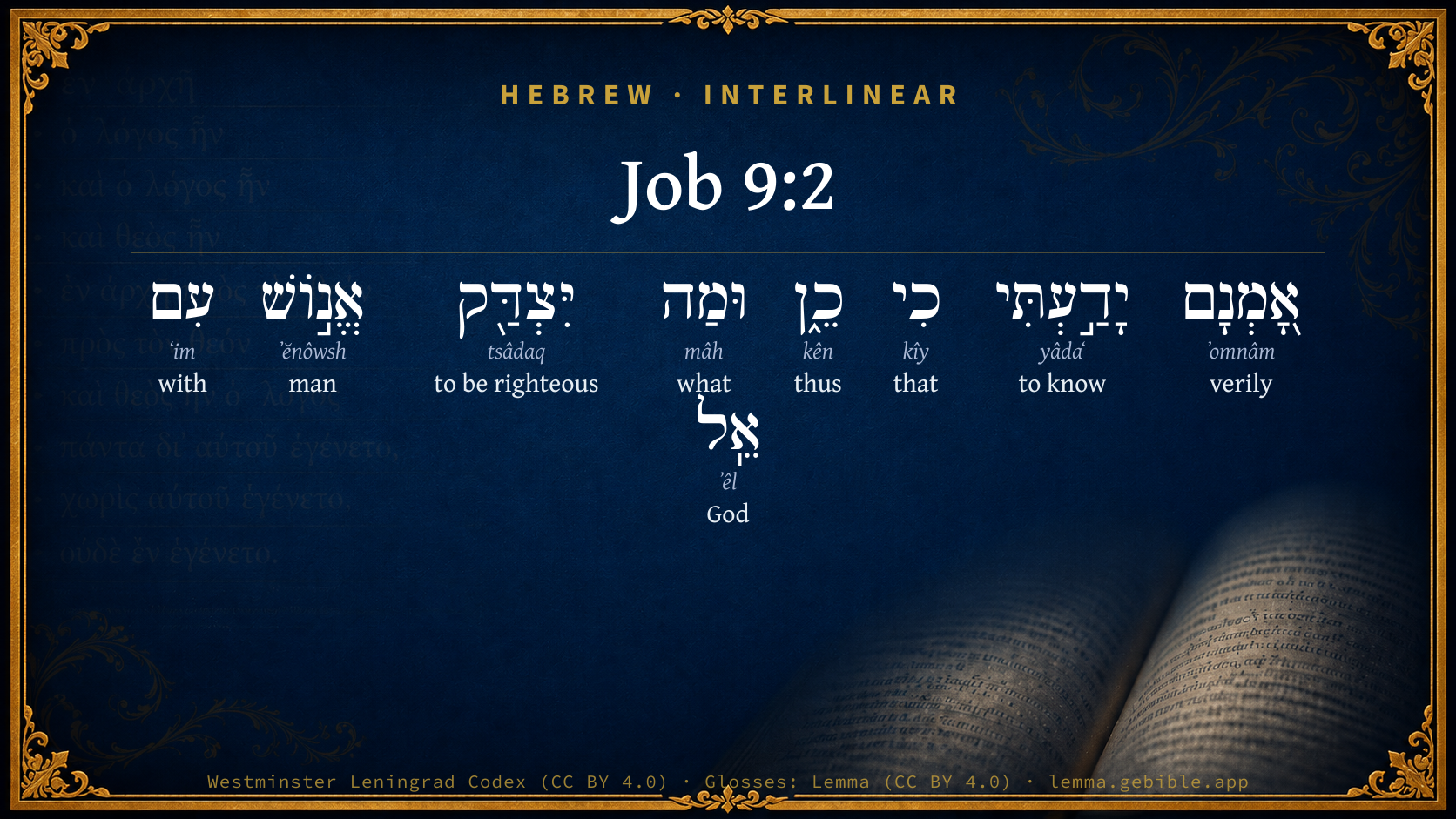
Job 9:2

Hebrew (Westminster Leningrad Codex) Job 9:2 appears in the Hebrew Old Testament. The text above is from the Westminster Leningrad Codex. Each word links to its Strong’s number, a concise gloss, and parsing drawn from the Open Scriptures Hebrew Bible morphology. Click any word for its full Brown-Driver-Briggs (BDB) entry.
Download image
Cite this verse

Job 9:2 (World English Bible). Public Domain. Lemma interlinear Bible study tool, https://lemma.gebible.app/v/job/9/2.

Show BibTeX & RIS
BibTeX
RIS
English Translation
"Truly I know that it is so, But how can man be just with God?
World English Bible · Public Domain
Download a study sheet

One document with this verse’s original text, its word-by-word gloss line, the meaning frame, cross-references with their text, attributed commentary, and full source and license credits — printable, and it pastes into notes with its structure intact.

This verse Autodidact and up

Study sheet (.html) Plain text (.txt)

A passage Seminary Student

Up to 50 verses in one chapter. A passage sheet keeps up to 6 commentary sources and 12 cross-references per verse, in the order this page ranks them, and says so on the sheet whenever that leaves anything out. Ask for a single verse and you get the Autodidact verse sheet above.

Everything on this page stays free to read, with no account — the sheet is a download of what is already on screen, not access to it.

Want to remove ads? Support Godless Engineer
Compare translations 3

The same verse in 3 English versions, stacked beneath the original-language interlinear above. Click any original word for its lexicon entry.

Each is an independent rendering of the whole verse — the interlinear is not word-aligned to these translations.

Highlighted words mark where these versions differ — a whole-verse word diff, not a word-by-word alignment.

  • World English Bible Public Domain
    "Truly I know that it is so, But how can man be just with God?
  • King James Version Public Domain
    I know it is so of a truth: but how should man be just with God?
  • unfoldingWord Literal Text CC BY-SA 4.0
    “I know truly that so. But how will a man be righteous with God?

unfoldingWord Literal Text — © unfoldingWord, licensed CC BY-SA 4.0. Word-aligned USFM3 via Door43 (git.door43.org/unfoldingWord/en_ult).

Versions to compare (up to 4)

3 of 4 selected

Show all 18 translations

Every available English version of this verse, each an independent rendering of the whole verse.

  • World English Bible Public Domain
    "Truly I know that it is so, But how can man be just with God?
  • Berean Standard Bible Public Domain
    “Yes, I know that it is so, but how can a mortal be righteous before God?
  • Majority Standard Bible Public Domain
    “Yes, I know that it is so, but how can a mortal be righteous before God?
  • King James Version Public Domain
    I know it is so of a truth: but how should man be just with God?
  • American Standard Version (1901) Public Domain
    Of a truth I know that it is so: But how can man be just with God?
  • Revised Version (1885) Public Domain
    Of a truth I know that it is so: but how can man be just with God?
  • Geneva Bible (1599) Public Domain
    I knowe verily that it is so: for howe should man compared vnto God, be iustified?
  • Douay-Rheims (1899) Public Domain
    Indeed I know it is so, and that man cannot be justified compared with
  • Young's Literal Translation Public Domain
    Truly I have known that `it is' so, And what -- is man righteous with God?
  • Literal Standard Version CC BY-SA 4.0
    “Truly I have known that [it is] so, || But how is man righteous with God?
  • Unlocked Literal Bible CC BY-SA 4.0
    “I truly know that this is so. But how can a person be in the right with God?
  • unfoldingWord Literal Text CC BY-SA 4.0
    “I know truly that so. But how will a man be righteous with God?
  • Darby Bible Public Domain
    Of a truth I know it is so; but how can man be just with ùGod?
  • World Messianic Bible Public Domain
    “Truly I know that it is so, but how can man be just with God?
  • Webster's Bible Public Domain
    I know it to be so of a truth: but how should man be just with God?
  • Free Bible Version CC BY-SA 4.0
    “Yes, I know all that! But how can anyone be right before God?
  • Bible in Basic English Public Domain
    Truly, I see that it is so: and how is it possible for a man to get his right before God?
  • JPS Tanakh (1917) Public Domain
    Of a truth I know that it is so; and how can man be just with God?

Literal Standard Version (2020), Covenant Press — licensed CC BY-SA 4.0. Text via the HelloAO Bible API (eBible.org). Unlocked Literal Bible (unfoldingWord) — licensed CC BY-SA 4.0. Text via the HelloAO Bible API (eBible.org). unfoldingWord Literal Text — © unfoldingWord, licensed CC BY-SA 4.0. Word-aligned USFM3 via Door43 (git.door43.org/unfoldingWord/en_ult). Free Bible Version, Dr. Jonathan Gallagher — licensed CC BY-SA 4.0. Text via the HelloAO Bible API (eBible.org).

Word by word

More ways to search: Search by grammar → Find every occurrence → Compare this word →

Practice this passage: Drill this verse → Learn its vocabulary →

About this verse

These counts appear in no published source. They are computed here, from the morphology-tagged text and Lemma’s own curated glosses. What Lemma adds →

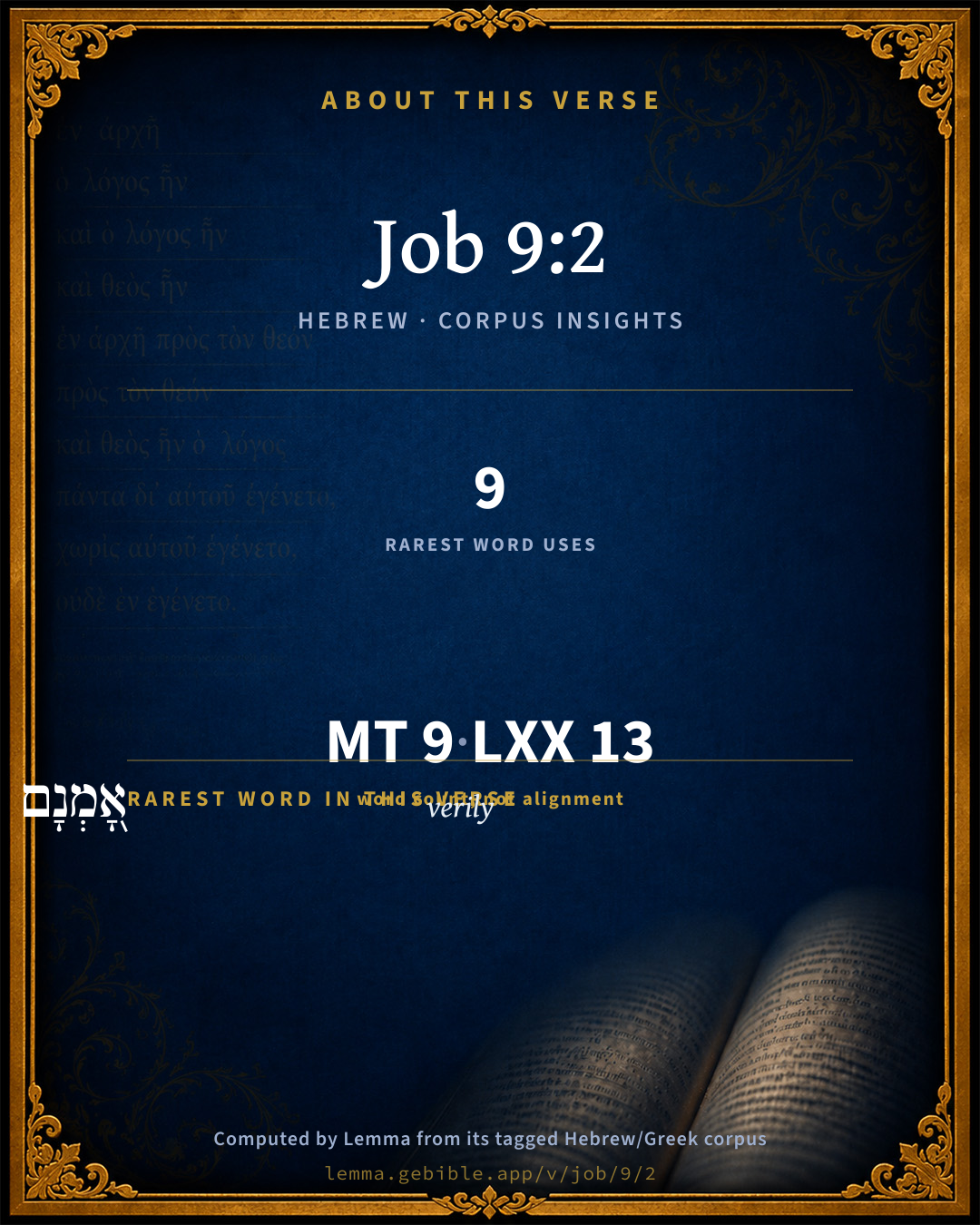
9
words
9
distinct lemmas
Wisdom
section

Notable vocabulary

The rarest word here is אָ֭מְנָם verily H551 — appearing just 9 times in the whole Hebrew Bible.

Shared distinctive vocabulary

אָ֭מְנָם verily H551 occurs in 9 verses of the Hebrew Bible. Also found in:

Grammatical profile

  • 2 verbs
  • 2 nouns
  • 1 preposition
  • 1 conjunction
  • 2 adverbs
  • 1 particle

Verb forms

  • יָדַ֣עְתִּי Qal · Perfect
  • יִּצְדַּ֖ק Qal · Imperfect

Hebrew & Septuagint length

In English translation the verse runs 15 words from the Hebrew and 20 from the Septuagint (LXX English) — closely comparable.

A rough comparison of the two English renderings, which tokenize alike — not a word-level alignment.

Word counts can differ between the Hebrew and the Greek without any difference in meaning — e.g. the Hebrew direct-object marker אֵת has no separate Greek word, and Greek often adds the article ὁ.

In the original languages it is 9 Hebrew tokens and 13 Greek tokens — but the two are counted differently (Hebrew bundles its prefixes and suffixes into one token; the Greek is in lemma form), so that isn’t a like-for-like length.

Cross-references

10

Topical passages linked to Job 9:2 in the Treasury of Scripture Knowledge — connected by theme and wording, ordered by reader-vote popularity; previews shown in the World English Bible.

  • Job 4:17 'Shall mortal man be more just than God? Shall a man be more pure than his Maker?
  • Job 25:4 How then can man be just with God? Or how can he who is born of a woman be clean?
  • Psalms 143:2 Don't enter into judgment with your servant, For in your sight no man living is righteous.
  • Romans 3:20 Because by the works of the law, no flesh will be justified in his sight. For through the law comes the knowledge of sin.
  • 1 Kings 8:46 If they sin against you (for there is no man who doesn't sin), and you are angry with them, and deliver them to the enemy, so that they carry them away captive to the land of the enemy, far off or near;
  • Job 14:3–4 Do you open your eyes on such a one, And bring me into judgment with you?
  • Job 32:2 Then the wrath of Elihu the son of Barachel, the Buzite, of the family of Ram, was kindled against Job. His wrath was kindled because he justified himself rather than God.
  • Job 33:9 'I am clean, without disobedience. I am innocent, neither is there iniquity in me:
  • Job 34:5 For Job has said, 'I am righteous, God has taken away my right:
  • Psalms 130:3 If you, Yah, kept a record of sins, Lord, who could stand?

Cross-references courtesy of OpenBible.info (CC BY 4.0).

Hebrew and Greek witnesses Masoretic Hebrew ↔ Greek Septuagint

The same verse in the two great witnesses to the Old Testament, shown verse-for-verse.

These are two independent witnesses, not word-aligned to each other, and the Septuagint is shown in lemma (dictionary) form.

Hebrew Job 9:2 Masoretic · Westminster Leningrad Codex

אָ֭מְנָם יָדַ֣עְתִּי כִי כֵ֑ן וּמַה יִּצְדַּ֖ק אֱנ֣וֹשׁ עִם אֵֽל

"Truly I know that it is so, But how can man be just with God?

World English Bible · Public Domain

Greek LXX Job 9:2 Septuagint · lemma form

ἐπί ἀλήθεια οἶδα ὅτι οὕτως εἰμί πῶς γάρ εἰμί δίκαιος βροτός παρά κύριος

I know of a truth that it is so: for how shall a mortal man be just before the Lord?

LXX2012 (modern English Septuagint) · Public Domain

Hebrew: Westminster Leningrad Codex (CC BY 4.0). Greek: Septuagint (public domain); English from LXX2012 (modern English Septuagint) (Public Domain). How the Septuagint differs from the Hebrew →

Commentary

Notes on Job 9:2 from classic Christian and Jewish commentators (each source and its license shown beneath its notes). The classic Christian expositions comment on the surrounding passage and are grouped to its opening verse, so a note may address several verses; the Jewish commentaries on the Tanakh (Rashi and others) are per-verse, so they appear only where the commentator wrote on this verse.

Lemma curates 59 commentaries, every one of them public domain or Creative Commons licensed, each selected and text-cleaned for this edition rather than reprinted as found. About our sources →

Trapp's Complete Commentary

John Trapp

Job 9:2 I know [it is] so of a truth: but how should man be just with God?

Ver. 2. I know it is so of a truth] Bildad’s argument was, God, who hath punished thee, is just, therefore thou art unjust. Job grants the antecedent here, but denies and refutes the consequent, Job 9:22-23, &c. To Eliphaz also Job grants, not only that man could not be more just than God, as he had said, Job 4:3, but also that none could ever be found so just that he might any way be compared to God. Job is one of those candidates of immortality, who can do nothing against the truth, but for the truth, 2Co 13:8, every parcel whereof he accounted precious, and could not but be a friend to it, though brought by them who seemed his enemies; this spoke him ingenuous and humble, a well tempered champion for the truth. Athanasius is said to be such another, and so Mr Bucer. Helvidius is taxed by Jerome for the contrary, and Bishop Montague, by Dr Rivet.

But how should man be just with God?] Mr Broughton translateth, And how can man be just before the Omnipotent? Sorry, sickly, wretched man, how can he be just (sc. by an inherent righteousness; by an imputed he may) before the most Holy and Almighty God; or compared to him? Job afterwards, setting himself by God, and considering the infinite distance and disproportion, crieth out, "I abhor myself, and repent in dust and ashes," Job 42:5-6. I say likewise, "Woe is me, for I am undone," Isa 6:5. He that hath looked a while intentively upon the body of the sun is so dazzled with the beams thereof, that he can see nothing.

John Trapp, A Commentary or Exposition upon All the Books of the Old and New Testament (1647–1656) — public domain. Text from a community e-Sword module.

Joseph Benson's Commentary

Job 9:2. I know it is so of a truth — Namely, as you say, that God must be just and righteous; that purity and uprightness are qualities belonging to him; that he cannot possibly be biased or prejudiced in judging and determining the state and condition of mankind. I am likewise satisfied, that the time we have to live here is too short to compass any considerable points of knowledge; and that, whenever he pleases, he can exercise his power so as to change our exalted mirth to most bitter weeping, our highest joy to the most abject sorrow: can bring the most insolent offender to shame, and dispossess the wicked of his strongest and most magnificent situation. But how — Hebrew, And how, should man — Enosh, weak, frail man, imperfect as he is, be just with God? — Be justified, or clear himself in God’s account. I know that no man is absolutely holy and righteous, if God be severe to mark what is amiss in him.

Joseph Benson's Commentary on the Old and New Testaments (1811–1818) — public domain. Text from a community e-Sword module.

Whedon's Commentary on the Bible

Daniel D. Whedon

First division — THE FACT THAT GOD IS IMMUTABLY JUST (Job_8:3) AND ABSOLUTELY PURE, (Job_4:17,) DOES NOT SOLVE THE MYSTERY OF THE IMPLACABLE ANTAGONISM TO THE RIGHTEOUS ON THE PART OF AN OMNIPOTENT GOD, Job_9:2-12.

Strophe a — Job ironically grants the propositions of his antagonists, but only as NON SEQUITURS. In almost the same breath they have insisted that “God rewards the just,” and that “none are just before God,” thus apparently contradicting themselves. Taking advantage of their discomfiture he redoubles his blows, plying them with the most momentous questions man can ask, Job_9:2-4.

2. Man (אנושׁ, a mortal) be just with God, (אל, the Strong) — The key to the subsequent glowing description of the terror-working God (5-11) is found in this antithesis of mortal man to an omnipotent God. Prayers and oblations, temples and altars, sacrifices and self-tortures, lustral waters and bleeding victims, bear witness to a universal consciousness of sin and guilt — to man’s abiding sense that he is not acceptable to his God; moreover, that the wrath of that God has gone forth against him, and must by some means be appeased. Whence that sense? By what means did it so deeply ingrain itself in man’s nature? It antedates all other merely human knowledge, and points, as with a wand, to certain deep, underlying, and congenital facts of a fallen nature everywhere recognized in Scripture. The only religion which proffers a satisfactory answer to the questions of Job is that which alone gives peace with God. Rom_5:1.

Daniel D. Whedon (gen. ed.), Commentary on the Old and New Testaments (1874–1909) — public domain. Text from a community e-Sword module.

Geneva Bible (1599)

Geneva Bible translators

Job here answereth to that point of Eliphaz and Bildad’s oration, touching the justice of God, and his innocency, confessing God to be infinite in justice, and man to be nothing in respect.

Geneva Bible (1599) marginal notes — public domain. Text via Bolls.life.

Adam Clarke's Commentary

Verse 2. I know it is so of a truth] I acknowledge the general truth of the maxims you have advanced. God will not ultimately punish a righteous person, nor shall the wicked finally triumph; and though righteous before man, and truly sincere in my piety, yet I know, when compared with the immaculate holiness of God, all my righteousness is nothing.

Adam Clarke's Commentary on the Bible (1810–1826) — public domain. Text from a community e-Sword/MySword module.

John Gill's Exposition

If he will contend with him,.... If God will contend with man, so Sephorno; enter into a controversy with him, litigate and dispute the point in law, whether he is just or not, man cannot answer to the allegations he will produce; or if man should contend with God, a potsherd strive with its maker, to what purpose would it be? he could never avail himself by such a procedure; the match is unequal, there is no striving or contending with God in a judicial, way:

he cannot answer him one of a thousand; which some understand, that God will not answer men; he will not vouchsafe to give an answer to such that plead with him, or talk with him of his judgments in providence, or pretend to vindicate themselves, their ways, and their works, before him; but this sense seems contrary to Jer 12:1; but the meaning is, that man cannot answer God; either not one man out of a thousand, that is, none at all; unless, by one of a thousand, is meant the interpreter, one among a thousand, even the Messiah, the chiefest among ten thousand; the one man of a thousand Solomon found upon search; see Job 33:23; he indeed has made himself responsible for his people, as their surety, and was able to answer for them; and he has answered for them, and made satisfaction for their sins; it was exacted, or required, that is, a full payment of their debts, or a plenary satisfaction for their sins, "and he answered", according to Isa 53:7; but rather the sense is, that a man cannot answer, either one time of a thousand (u), or one argument to one article exhibited, or to one objection or charge of a thousand brought against him by the law or justice of God; that is, for one sin of a thousand he has committed; so Mr. Broughton renders it, "to one thing of a thousand" (w); this suggests that the sins of men are numerous; their debts are many, they are more than ten thousand talents, which they are not able to answer to, or pay off, no, not one of them; their iniquities are more than the hairs of their head, they cannot be understood or reckoned: and now a man cannot answer for one of a thousand, or the millions of sins he is guilty of; he cannot deny them, he cannot excuse them, he cannot make satisfaction for anyone of them; they are committed against an infinite Being, and require an infinite satisfaction, which man cannot give; they are violations of a law, and injuries to divine justice, that no man is able to atone for; whatever obedience he is capable of, or does perform, God has a prior right unto it, and therefore can never answer for former transgressions; this being the case, sinful man cannot be just with God upon the foot of his works, which is the thing this observation is made to illustrate: man's obedience is so short, and God's commandment or law so very broad, that these two can never be brought to meet, agree together, or answer to one another; and therefore it may be strongly concluded that a man is justified, if ever he is justified at all, in the sight of God, by faith in Christ and his righteousness, without the deeds of the law, Rom 3:28.

(u) "una vice ex millibus", Schmidt. (w) "Ad rem unam ex mille", Beza; "ad unum argumentum ex mille argumentis", Vatablus; so Castalio, Bar Tzemach.

John Gill's Exposition of the Whole Bible (1746–1763) — public domain (CC PDM 1.0). Text via the HelloAO Bible API.

Albert Barnes' Notes on the Bible

I know it is so of a truth - Job here refers, undoubtedly, to something that had been said before; but whether it is to the general strain of remark, or to some particular expression, may be doubted. Rosenmuller supposes that he refers to what was said by Eliphaz in Job 4:17; but it seems more probable that it is to the general position which had been laid down and defended, that God was just and holy, and that his proceedings were marked with equity. Job admits this, and proceeds to show that it was a truth quite as familiar to him as it was to them. The object of his dwelling on it seems to be to show them that it was no new thing to him, and that he had some views on that important subject which were well worthy of attention.

But how should man be just with God? - Margin, “before.” The meaning is, that he could not be regarded as perfectly holy in the sight of God; or that so holy and pure a being as God must see that man was a sinner, and regard him as such; see the sentiment explained in the notes at Job 4:17. The question here asked is, in itself, the most important ever propounded by man - “How shall sinful man be regarded and treated as righteous by his Maker?” This has been the great inquiry which has always been before the human mind. Man is conscious that he is a sinner. He feels that he must be regarded as such by God. Yet his happiness here and hereafter, his peace and all his hope, depend on his being treated as if he were righteous, or regarded as just before God. This inquiry has led to all forms of religion among people; to all the penances and sacrifices of different systems; to all the efforts which have been made to devise some system that shall make it proper for God to treat people as righteous.

The question has never been satisfactorily answered except in the Christian revelation, where a plan is disclosed by which God “may be just, and yet the justifier of him that believeth.” Through the infinite merits of the Redeemer, man, though conscious that he is personally a sinner, may be treated as if he had never sinned; though feeling that he is guilty, he may consistently be forever treated as if he were just. The question asked by Job implies that such is the evidence and the extent of human guilt, that man can never justify himself. This is clear and indisputable. Man cannot justify himself by the deeds of the law. Justification, as a work of law, is this: A man is charged, for example, with the crime of murder. He sets up in defense that he did not kill, or that if he tools life it was in self-defense, and that he had a right to do it. Unless the fact of killing be proved, and it be shown that he had no right to do in the case as he has done, he cannot be condemned, and the law acquits him. It has no charge against him, and he is just or justified in the sight of the law. But in this sense man can never be just before God. He can neither show that the things charged on him by his Maker were not done, or that being done, he had a right to do them; and being unable to do this, he must be held to be guilty. He can never be justified therefore by the law, and it is only by that system which God has revealed in the gospel, where a conscious sinner may be treated as if he were righteous through the merits of another, that a man can ever be regarded as just before God; see Rom 1:17, note; Rom 3:24-25, note.

Albert Barnes' Notes on the Bible (1834–1885) — public domain. Text from a community e-Sword/MySword module.

Haydock's Catholic Bible Commentary

God. Job answers both his friends, and with admirable humility acknowledges that in God’s sight he is full of defects; but not of such a nature as to fall (Calmet) under the cognizance of man. I am not conscious to myself of anything; but....God is the judge, 1 Corinthians iv. 4. (Haydock)

George Leo Haydock (1774–1849), Haydock's Catholic Family Bible and Commentary, 1859 edition — public domain. Excludes Psalms (Douay-Rheims chapter numbering differs from Protestant) and Deuterocanonical books (Catholic canon only).

Matthew Poole's English Annotations

I know it is so, to wit, as you say, that God is just in all his ways, that he doth ordinarily bless the righteous, and punish the wicked.

But how should man be just? Heb. and how, &c.? i.e. and I know that no man is absolutely just, or can defend his righteousness, if God be severe to mark what is amiss in him.

With God; either,

1. Being compared with God; or,

2. Before God, as the same phrase is taken, 1Sa 2:26; Psa 130:3, if he be brought before God’s tribunal to debate the matter with him.

Matthew Poole's English Annotations on the Holy Bible (1683–1685) — public domain. Text from a community e-Sword/MySword module.

John Wesley's Explanatory Notes

I know - That God is just in all his ways, that he doth ordinarily bless the righteous, and punish the wicked. Before God - And I know that no man is absolutely just, if God be severe to mark what is amiss in him.

John Wesley, Explanatory Notes Upon the Whole Bible (1754–1765) — public domain. Text via the GEBible commentary corpus.

Lesson kit

Teaching starters — assembled from the data on this page, not authored interpretation. Every prompt links to the verse data it draws on. Edit before teaching.

Job, in the Wisdom, opens this verse with 9 words (9 distinct Hebrew lemmas). Its most distinctive word is ʼomnâm (“verily”). A historical commentator’s framing appears above. Read the whole chapter for the surrounding context.

Discussion questions

  1. What does “verily” (ʼomnâm) contribute to the verse as a whole?
  2. Ruth 3:12 shares the word «verily» with this verse. How do the two illuminate each other?
  3. These translations render this verse differently. What is at stake in choosing one wording over another?
  4. The verb «יָדַ֣עְתִּי» is Qal Perfect. How does its form color the action?
  5. Reading how Trapp's Complete Commentary and Joseph Benson's Commentary read this verse, where do the two commentators agree and where do they part?

Things to notice

Reading settings

Reading text

Shown beneath each verse's original-language words.

Old Testament
Old Testament edition

Read the OT as the Masoretic Hebrew (MT) or the Greek Septuagint (LXX).

English shown for the Greek Septuagint (in the Hebrew ↔ Greek comparison).

Comparing translations? Open the Compare panel on any verse page to stack up to four side by side.