
2 Thessalonians 3:7

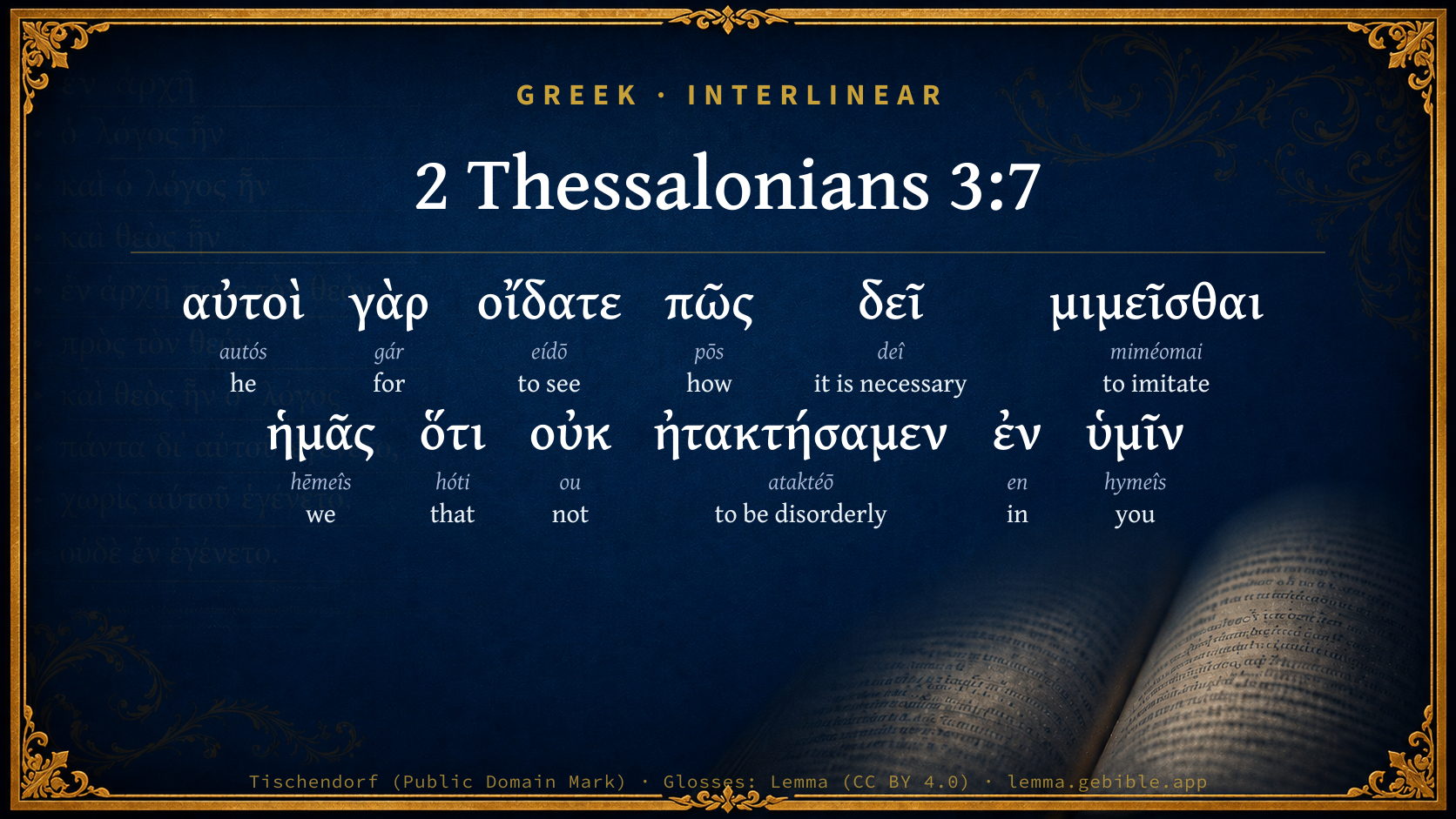
Greek (Tischendorf 8th ed.) 2 Thessalonians 3:7 appears in the Greek New Testament. The text above is from the Tischendorf 8th edition. Each word links to its Strong’s number and a concise gloss. Click any word for its full Thayer’s Greek Lexicon entry.
Download image
Cite this verse

2 Thessalonians 3:7 (World English Bible). Public Domain. Lemma interlinear Bible study tool, https://lemma.gebible.app/v/2-thessalonians/3/7.

Show BibTeX & RIS
BibTeX
RIS
English Translation
For you know how you ought to imitate us. For we didn't behave ourselves rebelliously among you,
World English Bible · Public Domain
Highlights
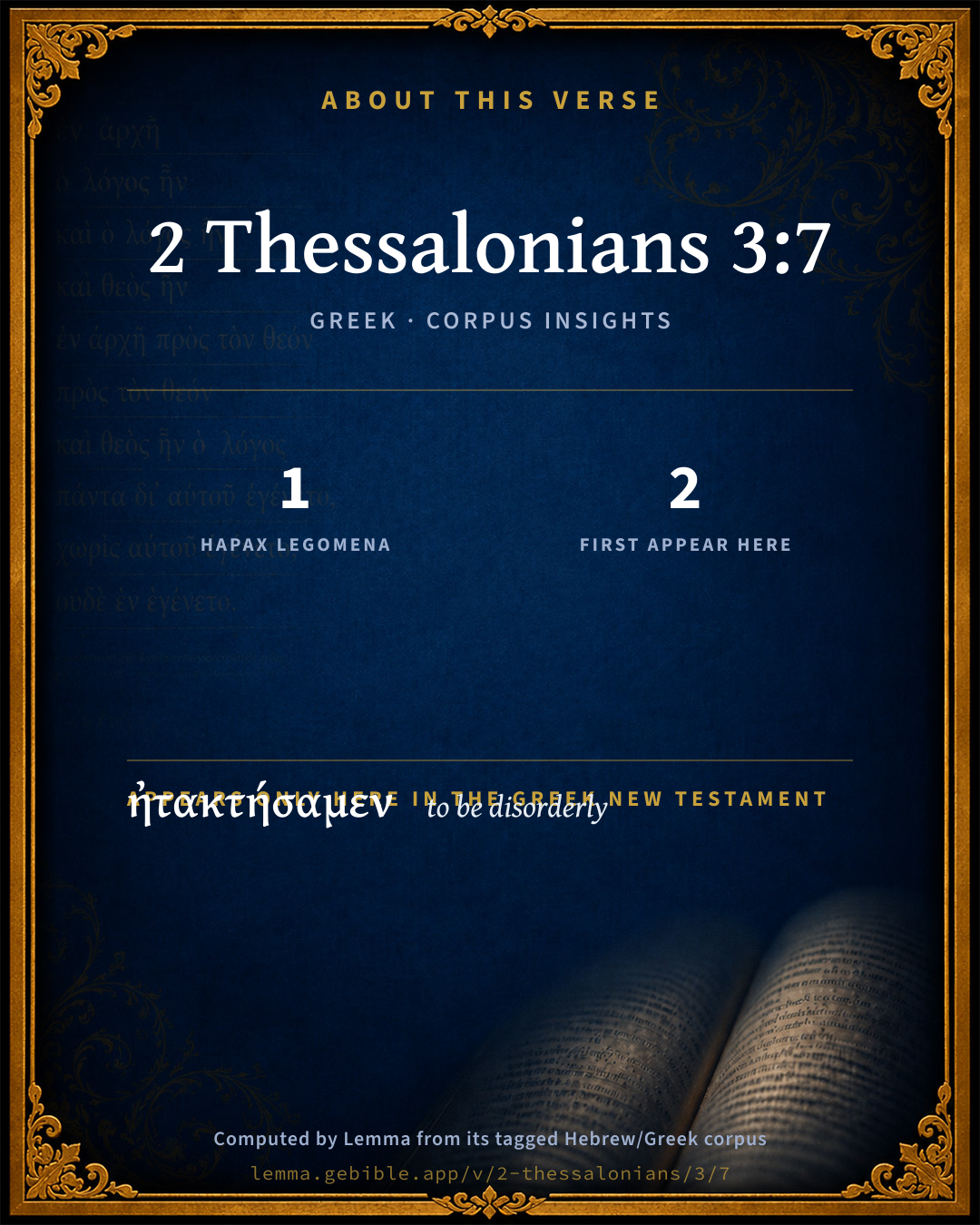
  • 1 hapax legomenon — only here in the Greek New Testament
  • 2 first appearances in the Greek New Testament
Full analysis ↓
Download a study sheet

One document with this verse’s original text, its word-by-word gloss line, the meaning frame, cross-references with their text, attributed commentary, and full source and license credits — printable, and it pastes into notes with its structure intact.

This verse Autodidact and up

Study sheet (.html) Plain text (.txt)

A passage Seminary Student

Up to 50 verses in one chapter. A passage sheet keeps up to 6 commentary sources and 12 cross-references per verse, in the order this page ranks them, and says so on the sheet whenever that leaves anything out. Ask for a single verse and you get the Autodidact verse sheet above.

Everything on this page stays free to read, with no account — the sheet is a download of what is already on screen, not access to it.

Want to remove ads? Support Godless Engineer
Compare translations 3

The same verse in 3 English versions, stacked beneath the original-language interlinear above. Click any original word for its lexicon entry.

Each is an independent rendering of the whole verse — the interlinear is not word-aligned to these translations.

Highlighted words mark where these versions differ — a whole-verse word diff, not a word-by-word alignment.

  • World English Bible Public Domain
    For you know how you ought to imitate us. For we didn't behave ourselves rebelliously among you,
  • King James Version Public Domain
    For yourselves know how ye ought to follow us: for we behaved not ourselves disorderly among you;
  • unfoldingWord Literal Text CC BY-SA 4.0
    For you yourselves know in what manner it is necessary to imitate us, because we did not behave disorderly among you,

unfoldingWord Literal Text — © unfoldingWord, licensed CC BY-SA 4.0. Word-aligned USFM3 via Door43 (git.door43.org/unfoldingWord/en_ult).

Versions to compare (up to 4)

3 of 4 selected

Show all 19 translations

Every available English version of this verse, each an independent rendering of the whole verse.

  • World English Bible Public Domain
    For you know how you ought to imitate us. For we didn't behave ourselves rebelliously among you,
  • Berean Standard Bible Public Domain
    For you yourselves know how you ought to imitate us, because we were not undisciplined among you,
  • Majority Standard Bible Public Domain
    For you yourselves know how you ought to imitate us, because we were not undisciplined among you,
  • King James Version Public Domain
    For yourselves know how ye ought to follow us: for we behaved not ourselves disorderly among you;
  • American Standard Version (1901) Public Domain
    For yourselves know how ye ought to imitate us: for we behaved not ourselves disorderly among you;
  • Revised Version (1885) Public Domain
    For yourselves know how ye ought to imitate us: for we behaved not ourselves disorderly among you;
  • Geneva Bible (1599) Public Domain
    For ye your selues know, how ye ought to follow vs: for we behaued not our selues inordinately among you,
  • Douay-Rheims (1899) Public Domain
    For yourselves know how you ought to imitate us: for we were not disorderly among you;
  • Young's Literal Translation Public Domain
    for yourselves have known how it behoveth `you' to imitate us, because we did not act disorderly among you;
  • Literal Standard Version CC BY-SA 4.0
    for you have known how it is necessary to imitate us, because we did not act disorderly among you;
  • Unlocked Literal Bible CC BY-SA 4.0
    For you yourselves know it is proper for you to imitate us. We did not live among you as those who had no discipline.
  • unfoldingWord Literal Text CC BY-SA 4.0
    For you yourselves know in what manner it is necessary to imitate us, because we did not behave disorderly among you,
  • Darby Bible Public Domain
    For ye know yourselves how ye ought to imitate us, because we have not walked disorderly among you;
  • World Messianic Bible Public Domain
    For you know how you ought to imitate us. For we didn’t behave ourselves rebelliously among you,
  • Webster's Bible Public Domain
    For yourselves know how ye ought to follow us: for we behaved not ourselves disorderly among you;
  • Free Bible Version CC BY-SA 4.0
    You certainly know that you should follow our example, because while we were with you we weren't lazy,
  • Bible in Basic English Public Domain
    For you yourselves are used to taking us as your example, because our life among you was ruled by order,
  • Text-Critical English NT CC BY 4.0
    For you yourselves know how you ought to imitate us, because we were not idle when we were with you,
  • Tyndale New Testament (1534) Public Domain
    Ye youre selves knowe how ye ought to folowe vs. For we behaved not oure selves inordinatly amonge you.

Literal Standard Version (2020), Covenant Press — licensed CC BY-SA 4.0. Text via the HelloAO Bible API (eBible.org). Unlocked Literal Bible (unfoldingWord) — licensed CC BY-SA 4.0. Text via the HelloAO Bible API (eBible.org). unfoldingWord Literal Text — © unfoldingWord, licensed CC BY-SA 4.0. Word-aligned USFM3 via Door43 (git.door43.org/unfoldingWord/en_ult). Free Bible Version, Dr. Jonathan Gallagher — licensed CC BY-SA 4.0. Text via the HelloAO Bible API (eBible.org).

Word by word

More ways to search: Search by grammar → Find every occurrence → Compare this word →

Practice this passage: Drill this verse → Learn its vocabulary →

ἠτακτήσαμεν
ataktéō
G812
“to be disorderly”
Verb, Aorist, Active, Indicative, 1st person, Plural
Part of Speech
Verb
Tense
Aorist
Voice
Active
Mood
Indicative
Person
1st person
Number
Plural
Full Thayer's Definition

Origin: from G813

TDNT: 08:47,1

1. to be disorderly a. of soldiers marching out of order or quitting ranks b. to be neglectful of duty, to be lawless c. to lead a disorderly life
  1. αὐτοὶ autós G846 “he” Personal pronoun, Nominative, Plural, Masculine
  2. γὰρ gár G1063 “for” Conjunction
  3. οἴδατε eídō G1492 “to see” Verb, Perfect, Active, Indicative, 2nd person, Plural
  4. πῶς pōs G4459 “how” Adverb
  5. δεῖ deî G1163 “it is necessary” Verb, Present, Active, Indicative, 3rd person, Singular
  6. μιμεῖσθαι miméomai G3401 “to imitate” Verb, Present, Middle or Passive deponent, Infinitive
  7. ἡμᾶς hēmeîs G2249 “we” Personal pronoun, 1st person, Accusative, Plural
  8. ὅτι hóti G3754 “that” Conjunction
  9. οὐκ ou G3756 “not” Particle, Negative
  10. ἐν en G1722 “in” Preposition
  11. ὑμῖν hymeîs G5210 “you” Personal pronoun, 2nd person, Dative, Plural

About this verse

These counts appear in no published source. They are computed here, from the morphology-tagged text and Lemma’s own curated glosses. What Lemma adds →

12
words
12
distinct lemmas
Pauline Epistles
section

Notable vocabulary

1 hapax legomenon — a word that appears only here in the entire Greek New Testament:

  • ἠτακτήσαμεν to be disorderly G812

First appearance in Scripture

These words make their first canonical appearance in the Greek New Testament here:

  • μιμεῖσθαι to imitate G3401
  • ἠτακτήσαμεν to be disorderly G812

Shared distinctive vocabulary

μιμεῖσθαι to imitate G3401 occurs in 4 verses of the Greek New Testament. Also found in:
Cross-references

11

Topical passages linked to 2 Thessalonians 3:7 in the Treasury of Scripture Knowledge — connected by theme and wording, ordered by reader-vote popularity; previews shown in the World English Bible.

  • 2 Thessalonians 3:6 Now we command you, brothers, in the name of our Lord Jesus Christ, that you withdraw yourselves from every brother who walks in rebellion, and not after the tradition which they received from us.
  • 2 Thessalonians 3:9 not because we don't have the right, but to make ourselves an example to you, that you should imitate us.
  • 1 Corinthians 4:16 I beg you therefore, be imitators of me.
  • 1 Corinthians 11:1 Be imitators of me, even as I also am of Christ.
  • Philippians 3:17 Brothers, be imitators together of me, and note those who walk this way, even as you have us for an example.
  • 1 Thessalonians 1:6–7 You became imitators of us, and of the Lord, having received the word in much affliction, with joy of the Holy Spirit,
  • Titus 2:7 in all things showing yourself an example of good works; in your teaching showing integrity, seriousness, incorruptibility,
  • Philippians 4:9 The things which you learned, received, heard, and saw in me: do these things, and the God of peace will be with you.
  • 1 Timothy 4:12 Let no man despise your youth; but be an example to those who believe, in word, in your way of life, in love, in spirit, in faith, and in purity.
  • 1 Thessalonians 2:10 You are witnesses with God, how holy, righteously, and blamelessly we behaved ourselves toward you who believe.
  • 1 Peter 5:3 neither as lording it over the charge allotted to you, but making yourselves examples to the flock.

Cross-references courtesy of OpenBible.info (CC BY 4.0).

Commentary

Notes on 2 Thessalonians 3:7 from classic Christian and Jewish commentators (each source and its license shown beneath its notes). The classic Christian expositions comment on the surrounding passage and are grouped to its opening verse, so a note may address several verses; the Jewish commentaries on the Tanakh (Rashi and others) are per-verse, so they appear only where the commentator wrote on this verse.

Lemma curates 59 commentaries, every one of them public domain or Creative Commons licensed, each selected and text-cleaned for this edition rather than reprinted as found. About our sources →

The Biblical Illustrator

Joseph S. Exell

2Th_3:7-9

For yourselves know how ye ought to follow us

Apostolic example and precept concerning industry

1.

Paul found it expedient on many accounts to commend industry.

(1) The early Christians felt a most lively sense of the evidence and importance of Christianity, were greatly affected by its promises, and looked with indifference on a world from which they had little to expect but persecution. The zeal engendered by all this, however, had its dangers. A contempt for the world may be carried too far, and Paul was afraid it might be here, and lead to a widespread negligence of work and consequent ruin to many families.

(2) The apostles had assurances of support from Christ, and there was a danger lest Christians should apply them generally.

(3) The opinion of the nearness of the Second Advent led some to regard work as superfluous.

(4) The eminent liberality of the first believers was a temptation to dishonest and lazy men. Thus there was a danger lest the Church, instead of being a society of honest, busy men, should become a nest of drones.

2. St. Paul, therefore, recommended industry by precept and example. He had a strong claim to maintenance as an apostle of Christ, and especially to the Gentiles, and a very small sum would have been sufficient for a man who only required food and raiment. Yet he chose to waive this right, and laboured night and day rather than eat any mans bread for nought. Such a person, therefore, might well lay the stress he does here on labour; elsewhere he condemns what we should regard as carelessness or indolence, denial of the faith and infidelity. Consider this example as a precept of industry in--

I. Our worldly callings. This is necessary, because--

1. We came naked and destitute, both physically and mentally, into the world. But both body and soul are designed by God, the one to improve in understanding and the other to increase in strength. Thus, by the voice of nature, God teaches us to be improvable and industrious beings.

2. The Scriptures echo the voice of reason, and command and commend industry throughout.

3. God has made us dependent on others, and teaches us, by the voice of reason, that we ought in return to promote the welfare of others.

4. The Gospel commands us to do good--i.e., what an idle person has not the power or inclination to perform. He who is negligent of his own interests will hardly be serviceable to others.

5. Whosoever is slothful in business will be a slothful Christian, for the same temper disposes to both.

6. Idleness is the parent of vice. He who has some good end to pursue is too busy for temptation; but the idle, having nothing else to do, is tempted to yield. A vacant mind is a proper habitation for the devil. An idle person loathes his own company, and thus gets into worse, and, unless favoured by an extraordinary concurrence of circumstances, falls into want and thence into wickedness.

7. Of all bad dispositions, laziness is the most vexatious. The love of ease and pleasure produces idleness; yet such is the nature of things, idleness produces neither ease nor pleasure, but the reverse.

8. By industry we obtain credit and reputation.

9. By industry we shut out many fretting desires, sorrowful reflections, and turbulent passions.

10. By industry we become beneficial to others, and thereby secure many blessings for ourselves.

II. Our religious affairs.

1. The shortness and uncertainty of life warn us not to neglect it, since upon our present behaviour depends our future state.

2. The reward before us excites us to it.

3. Gratitude to Him who has done so much for us moves us to do something for Him.

4. The punishment allotted to the idle and wicked servant calls us to it.

5. Our present interest invites us to it, bringing as it does peace of mind and the blessing of God upon our worldly affairs. (J. Jortin, D. D.)

The Biblical Illustrator, edited by Joseph S. Exell (c. 1880s–1900s) — public domain. Text from a community e-Sword module.

Tyndale Open Study Notes

Tyndale Open Resources

3:7 Teaching by example was highly regarded in the ancient world. Paul himself provided an example by working for his own food (3:8; 1 Thes 2:9).

Tyndale Open Study Notes — © Tyndale Open Resources, licensed CC BY-SA 4.0. Text via the HelloAO Bible API.

Bengel's Gnomon

Johann Albrecht Bengel

2Th 3:7. Πῶς) [‘how’] in what manner of living?

Bengel's Gnomon of the New Testament — English translation (T&T Clark, Edinburgh, 1860) — public domain. Text from a community e-Sword module.

Meyer's Critical & Exegetical Commentary

Heinrich August Wilhelm Meyer

2Th_3:7. Confirmation of κατὰ τὴν παράδοσιν, ἣν παρελάβοσαν. The instruction imparted was sufficiently known to the readers: what Paul commanded, he practically exhibited by his own conduct.

αὐτοί] ye yourselves, without it being necessary for me to speak much about it.

πῶς δεῖ μιμεῖσθαι ἡμᾶς] a concise expression, meaning: What is your incumbent walk, and how, in consequence of it, ye will be my imitators.

ὅτι] for. Unnaturally, Hofmann: ὅτι is to be translated by that, and is added as a parallel expression to πῶς δεῖ μιμεῖσθαι ἡμᾶς, in which also 2Th_3:9 is absorbed.

ἀτακτεῖν] equal to ἀτάκτως περιπατεῖν, 2Th_3:6. Only here in the N. T.

Meyer — Critical and Exegetical Commentary on the New Testament — English translation by Peter Christie, edited by Frederick Crombie (T&T Clark, 1880) — public domain. Text from a community e-Sword module.

Geneva Bible (1599)

Geneva Bible translators

Lest he might seem to deal harshly with them, he setteth forth himself as an example, who besides his travail in preaching labored with his hands, which he saith he was not simply bound to do.

Geneva Bible (1599) marginal notes — public domain. Text via Bolls.life.

Jamieson, Fausset & Brown

Robert Jamieson, A. R. Fausset & David Brown

how ye ought to follow us--how ye ought to live so as to "imitate (so the Greek for 'follow') us" (compare Notes, see on Co1 11:1; Th1 1:6).

Jamieson, Fausset & Brown — Commentary Critical and Explanatory on the Whole Bible (1871) — public domain (CC PDM 1.0). Text via the HelloAO Bible API.

Adam Clarke's Commentary

Verse 7. We behaved not ourselves disorderly] ουκ ητακτησαμεν. We did not go out of our rank-we kept our place, and discharged all its duties.

Adam Clarke's Commentary on the Bible (1810–1826) — public domain. Text from a community e-Sword/MySword module.

Ellicott's Commentary for English Readers

(7) For justifies the assertion that they had received a better teaching. (Comp. 1Th_2:1; 1Th_4:9; 1Th_5:2.)

To follow us.—The word, of course, means “to imitate”; and the rather compressed expression seems to stand for something fuller, such as, “Yourselves know how you ought to live, for you have but to imitate us: you recollect not only a tradition, but an example.” This is better than (with St. Chrysostom) to make the whole “tradition” consist of example without precept, however such an interpretation might simplify the logic.

For (or because).—Historical justification of the statement that their example was a trustworthy mode in this particular, at any rate: see the same use of “for” in 1Th_2:9, “for labouring,” &c.; 1Th_4:3. It is perhaps simpler, however, to translate the word “that,” instead of “for “: “You know perfectly how to live—how to imitate our example—that we never,” &c. Then follows a description of the Apostles’ conduct at Thessalonica similar to that in the First Epistle, thus giving us a clearer understanding why they dwelt so long and so passionately upon the topic there—namely, in order by force of tacit, contrast to shame the disorderly brethren into imitation.

A Bible Commentary for English Readers, edited by Charles John Ellicott (1878–1897) — public domain. Text from a community e-Sword module.

The Cambridge Bible for Schools and Colleges

gen. ed. J. J. S. Perowne

7. For yourselves know how ye ought to follow us] Lit., imitate us: see note on 1Th_1:6; and again, ch. 2Th_2:14, and 2Th_3:9 below. you know of yourselves—“without our needing to tell it all again.” Such references are frequent in these Epistles; see note on 1Th_2:1.

“How you ought to imitate us” points beyond the mere duty to the spirit and manner of the imitation desired—“with what diligence and devotion.”

for we behaved not ourselves disorderly among you] This “for” differs from that at the beginning of the verse; it is a specifying for—giving not a reason for what has just been said, but a definition of its meaning: in that we did not play a disorderly part among you. The readers’ attention is called to this feature of the missionaries’ conduct, and imitation is recommended. There is a meiosis (or litotes) in the expression, resembling that of 2Th_3:2, and of 1Th_2:15 (see notes). “Far indeed was our walk from giving an example of disorder!” How far, the next line shows.

To-be-disorderly (a single verb in the Greek) is a word applied to soldiers out of rank. Officers in the army are as much subject to its discipline as the rank and file; and the Apostle Paul felt it to be due to the Churches over which he presided, that he should set an example of a strictly ordered and self-denying life.

The Cambridge Bible for Schools and Colleges (gen. ed. J. J. S. Perowne; Cambridge University Press, 1878–1918) — public domain. Text from a community e-Sword module.

John Gill's Exposition

For yourselves know how ye ought to follow us,.... The apostle goes on to dissuade from that which denominates persons disorderly walkers, and exposes them to the censure of the church, and that partly by the example of the apostles, and partly by their command. He appeals to them, to their knowledge and judgment, it being a thing well known to them, that they ought to walk as they had the apostles for ensamples; for who should they follow but their spiritual fathers, shepherds, and guides? and especially so far as they were followers of Christ, as they were, in the case referred unto, working with their own hands:

for we behaved not ourselves disorderly among you; they could appeal to them as witnesses, and God also, how holily, justly, and unblamably they walked among them; see Th1 2:10 and particularly, that they did not live an idle and inactive life among them.

John Gill's Exposition of the Whole Bible (1746–1763) — public domain (CC PDM 1.0). Text via the HelloAO Bible API.

Trapp's Complete Commentary

John Trapp

7 For yourselves know how ye ought to follow us: for we behaved not ourselves disorderly among you;

Ver. 7. For yourselves know] You idle addleheads, {a} 2Th 3:11. For these he here directs his speech, that by doing nothing, had learned at length to do naughtily. Nihil agendo male agere discimus.

We behaved not ourselves disorderly] Gr. ητακτησαμεν, We brake not our ranks, as unruly soldiers.

{a} Applied contemptuously to one whose intellect seems muddled. ŒD

John Trapp, A Commentary or Exposition upon All the Books of the Old and New Testament (1647–1656) — public domain. Text from a community e-Sword module.

Albert Barnes' Notes on the Bible

For yourselves know how ye ought to follow us - You know what you should do in order to imitate us.

For we behaved not ourselves disorderly among you - See the notes on 1Th 2:10.

Albert Barnes' Notes on the Bible (1834–1885) — public domain. Text from a community e-Sword/MySword module.

Matthew Poole's English Annotations

Whereby the apostle intimates the aggravation of their crime who did walk disorderly, and so justifies the withdrawing from them. For they would be reproved not only by his doctrine, but example: what he required of others he practised himself, and that in some cases for this end alone, that he might be an example; examples teaching more than precepts, especially in ministers. And they did not only know how the apostle and his fellow ministers walked among them, but their end therein, whereby they knew they ought to follow them, and how to follow them; being guided as well as excited by their example. And this is expressed more generally. First, negatively:

We behaved not ourselves disorderly among you, which he speaks not in a way of self-commendation, but for their imitation; and he useth here the same word to express his own practice which he did in theirs, being properly a military word, as was said before. He went before them as it captain before the army, and taught them order by his own example; for in the negative the positive is included.

Matthew Poole's English Annotations on the Holy Bible (1683–1685) — public domain. Text from a community e-Sword/MySword module.

Whedon's Commentary on the Bible

Daniel D. Whedon

7. Yourselves know—Another appeal to their own consciences in proof of his truth.

Ourselves—Again appealing to his own example. Note, 1Th_2:9.

Daniel D. Whedon (gen. ed.), Commentary on the Old and New Testaments (1874–1909) — public domain. Text from a community e-Sword module.

The Pulpit Commentary

For yourselves know; without it being necessary for me to say anything about the matter; ye yourselves are witnesses. How ye ought to follow (or, imitate) us; better, perhaps, to be restricted to Paul than used as inclusive of Silas and Timothy. For we behaved not ourselves disorderly among you; referring to the apostle"s residence in Thessalonica.

Vers. 7-10.

The example of the apostle himself as a support to his command.

I THE APOSTLE"S EXAMPLE. "For we were not disorderly among you, nor did we eat bread for nought from any one, but in toil and weariness, working night and day." Though there were rich people in the Church, he accepted no gift from them, but laboured at his craft assiduously to earn a living for himself.

1. His refusal of support from his converts did not invalidate his right to it. "Not because we have not authority an authority which he fully expounds in 1Co 9. for "the labourer is worthy of his hire," and has he not "a right to forbear working"?

2. It was based upon a supreme regard to Thessalonian interests.

(1) "That we might not be a burden to any one of you,

(2) and "that we might give ourselves for a pattern unto you to imitate us." The apostle had evidently in view the extravagances of conduct that were beginning at an early period to spring from misunderstandings respecting the time of the Lord"s coming. He was not ashamed of his handicraft. No Christian man ought ever to be ashamed of honest labour.

II THE APOSTLE"S INJUNCTION TO THE DISORDERLY. "For even when we were with you, this we commanded you, that if any one will not work, neither let him eat.

1. This does not apply to those who cannot work, but to those who will not. The command does not touch cases of charity.

2. It is a command based on the original law of Eden. "In the sweat of thy face shalt thou eat bread". (Gen_3:19) Work is a Divine order, not repealed by Christianity but lifted up to higher blessing and dignity. The idle man ought, therefore, to be allowed to suffer the effects of his idleness.

3. It is a command which, when obeyed, will introduce tranquillity into life, and at the same time conduce to an honest self-respect. "That working with quietness they eat their own bread.

(1) They would thus be eating their own bread, not the bread earned by others" toil, nor that reserved by the same toil for the use of the really destitute and poor.

(2) They would thus carry more quietness into their own lives as well as those of their neighbours, for there would be no time for intermeddling with other people"s concerns. We should live "quiet and peaceable lives in all godliness and honesty T.C. (1Ti_2:2)

The Pulpit Commentary (1880–1919), ed. H.D.M. Spence-Jones & Joseph S. Exell — public domain. Text from a community e-Sword module.

Burkitt's Expository Notes on the New Testament

William Burkitt

In these verses the apostle plainly intimates, whom he meant by the disorderly brother mentioned in the foregoing verse; it is the idle person, called disorderly for this reason; because Almighty God having fitted man for, and ordained him to, labour, he that will not do so, deserts the order in which God has placed him, and thus renders himself disorderly.

To condemn which practice, St. Paul propounds his own example to their consideration and imitation; declaring, that he did not eat any man’s bread before he earned it, but wrought with his own hands in the day-time, and sometimes part of the night, at his trade of tent-making, that he might not be chargeable to any of them: not but that he had power to demand maintenance for his ministry; but he chose rather to depart from his right, and to labour in his calling, to excite others to do the like.

Note here, 1. That had not St. Paul laboured in his calling of tent- making, he had not been a disorderly person; but lest any should think so, he takes away and cuts off all occasion of suspicion, by working with his hands; his ministerial office would have freed him from the charge and imputation of idleness, and made maintenance from the church his due; but idleness, the apostle observed, was a growing sin, which needeth an example as well as doctrine to subdue it; and accordingly the apostle sets one, I behaved myself not disorderly or idle amongst you, but wrought with labour and travail night and day.

Note, 2. It is commendable to follow good examples, but much more to set a good example: as ministers ought to be patterns, so people ought to be followers; and their will be much the greater, and their punishment much the sorer, who do not follow their ministers’ doctrine, when they have seen it exemplified in their conversation.

Note, 3. There have all along been some persons in the world who have looked upon the work of the ministry as a very easy calling, yea, as an idle calling, that a little time, a little pains and labour, is enough for it: whereas, the labour of the ministry in the exercise of the mind, may justly be esteemed the greatest of labours; yet we see people all along have not judged it so, but the ministers of Christ find it so.

From the poverty of St. Paul’s condition, that he had nothing before- hand, but was forced to earn his bread before he eat it;

Learn, that it pleases God sometimes to measure out a very hard lot to his own children, and to give but little of earth to those who glorify him most upon earth; and those upon whom he intends to bestow extraordinary measures of glory in heaven, are cut short, very short of these outward comforts.

Here behold St. Paul, a chosen vessel, one of the holiest men, and the most serviceable man that lived in the world in his time, yet without a penny in his purse, but what he wrought for with his hands, nay, working night and day for bread! Lord! how endearing are thy children’s obligations to thy goodness, for their easy and plentiful circumstances in the world! what a favour it is to have fulness upon earth whilst we live, and the assurance of thy everlasting fruitation when we die!

William Burkitt's Expository Notes on the New Testament (1700–1703) — public domain. Text from a community e-Sword module.

Godbey's Commentary on the New Testament

William B. Godbey

ARGUMENT 9

SELF-SUPPORTING EVANGELISM

7-12. Here we see that while the apostles earned their bread by manual labor, they certify (2Th 3:9) that they have a right to their temporal support while preaching the gospel. This is certainly the feasible basis for the evangelization of the world. Delinquency in reference to our temporal support does not excuse us from the commission, “Go ye into all the world, and preach the gospel to every creature.” We are to go and preach just as if we had a bushel of gold lying in the Bank of England to draw on ad libitum, trusting God, with or without human agency, to feed us like he feeds the birds. Thus we are to push the conquest to the ends of the earth, evangelizing all nations under the commission,

“Lo, I am with you always, even unto the end of the age.” (Mat 28:20.)

With his presence we can certainly trust him for our bread. All this so strikingly contrasts with the financial policy of modern ecclesiasticism, hiring the preacher like a rail-splitter.

William B. Godbey, Commentary on the New Testament (1896–1900) — public domain. Text from a community e-Sword module.

McGarvey & Pendleton's Commentaries

J. W. McGarvey

For yourselves know how ye ought to imitate us: for we behaved not ourselves disorderly among you ;

J. W. McGarvey (with Philip Y. Pendleton), Commentaries on the New Testament (The Fourfold Gospel, 1914; Acts; and the epistles) — public domain. Text from a community e-Sword/MySword module.

The People's New Testament

B. W. Johnson

7. Ye know how ye ought to follow us. For Paul's example in the matter of work at Thessalonica, see 1 Thess. 2:9. He labors for his own support.

B. W. Johnson's The People's New Testament with Notes (1889–1891) — public domain. Electronic text from the Christian Classics Ethereal Library (CCEL) ThML edition.

Cambridge Greek Testament for Schools and Colleges

7. αὐτοὶ γὰρ οἴδατε. For you know of yourselves—“without our needing to tell it again”: see notes on καθὼς οἴδατε, 1Th 1:5 f., 2Th 2:1, &c.

πῶς δεῖ μιμεῖσθαι ἡμᾶς, in what manner you ought to imitate us—“an abridged expression for πῶς δεῖ ὑμᾶς περιπατεῖν ὥστε μιμεῖσθαι ἡμᾶς” (Lightfoot). Πῶς (quali ratione, Bengel) qualifies μιμεῖσθαι rather than δεῖ (cf. 1Th 4:1; Eph 5:15; 1Ti 3:15): not urging the grounds of this duty, but showing the direction in which it lies, the true line of imitation. For μιμεῖσθαι, see notes on 1Th 1:6, and 2Th 3:9 below.

ὅτι οὐκ ἠτακτήσαμεν ἐν ὑμῖν, for we did not act a disorderly part among you. Ἠτακτήσαμεν is misrendered in the Vulg. “inquieti fuimus”; Erasmus better, “praeter ordinem viximus”; Beza, “inordinate nos gessimus”; Calvin, “inordinate egimus.” Another meiosis (cf. οὐ πάντων ἡ πίστις, 2Th 3:2; and θεῷ μὴ ἀρεσκόντων, 1Th 2:15): how far the Apostles were from conduct like this! Ἀτακτέω (= ἀτάκτως περιπατέω, 2Th 3:6; cf. ἀτάκτους, 1Th 5:14)—hap. leg. in N.T.—a military term, applied e.g. to soldiers out of rank: cf. Col 2:5, τὴν τάξιν ὑμῶν καὶ τὸ στερέωμα κ.τ.λ., “your order and the solid front of your faith in Christ.” Officers are as much subject to discipline as the rank and file; it was due to their Churches that the Apostles should set an example of a strictly ordered life; with this example before them, which bore exactly upon the point in question, the readers “know” what the nature of their “imitation” should be. Ὅτι governs along with οὐκ ἠτακτήσαμεν the following οὐδέ clause, which should have been included in the same verse, for it brings out the kind of disorder reproved:—

7. ANTICHRIST IN MODERN TIMES

It would occupy several pages barely to state the various theories advanced upon this mysterious subject in more recent times.

Not the least plausible is that which saw τὸ μυστήριον τῆς ἀνομίας in the later developments of the French Revolution at the close of the 18th century, with its apotheosis of an abandoned woman in the character of Goddess of Reason, and which identified ὁ ἄνομος with Napoleon Buonaparte. The empire of Napoleon was essentially a restoration of the military Cæsarism of ancient Rome. He came within a little of making himself master, like Julius Cæsar, of the civilized world. This unscrupulous despot, with his superb genius and insatiable egotism—the offspring and the idol, till he became the scourge, of a lawless democracy—is, surely, in the true succession of Antiochus Epiphanes and Nero Cæsar. Napoleon has set before our times a new and commanding type of the Lawless One, which has had, and may have hereafter, its imitators.

Nor is the godlessness of St Paul’s υἱὸς τῆς ἀπωλείας wanting in a bold and typical modern expression. Following upon the negative and destructive atheism of the 18th century, the scientific, constructive atheism of the 19th century has built up an imposing system of thought and life. The theory of Positivism, as it was propounded by its great apostle, Auguste Comte, culminates in the doctrine that “Man is man’s god.” God and immortality, the entire world of the supernatural, this philosophy abolishes in the name of science and modern thought. It sweeps them out of the way to make room for le grand être humain, or collective humanity, which is to command our worship through the memory of its heroes and men of genius, and in the person of woman adored within the family. This scheme of religion Comte worked out with the utmost seriousness, and furnished with an elaborate hierarchy and ritual based on the Roman Catholic model. Although Comte’s religion of humanity is disowned by many positivists and has only come into practice upon a limited scale, it is a phenomenon of great significance. It testifies to the persistence of the religious instinct in our nature, and indicates the direction which that instinct is compelled to take when deprived of its rightful object (see the Apostle’s words in Rom 1:23). Comte would have carried us back, virtually, to the Pagan adoration of deified heroes and deceased emperors, or to the Chinese worship of family ancestors. Positivism provides in its Great Being an abstraction which, if it should once take hold of the popular mind, must inevitably tend to realize itself in concrete individual shape. It sets up a throne of worship within “the temple of God,” which the man of destiny will be found “in his season” to occupy.

Since the time of Hugo Grotius (1583–1645 A.D.), the famous Dutch Protestant scholar, theologian, and statesman, numerous attempts have been made to demonstrate the fulfilment of N.T. prophecy within the Apostolic or post-Apostolic days, upon the assumption that the παρουσία of Jesus was realized in the judgement falling upon the Jewish nation and by the destruction of Jerusalem in the year 70 A.D. This line of interpretation was adopted by Romanist theologians, as by Bossuet in the 17th century and Döllinger in the 19th, partly by way of return to the Patristic view and partly in defence against Protestant exegesis. These prœterist theories, restricting the application of St Paul’s prediction to the first age of the Church, in various ways strain and minimize his language by attempting to bring it within the measure of contemporary events. Or else they assume, as rationalistic interpreters complacently do, that such prophecies, proceeding from a subjective stand-point and being the product of the passing situation, were incapable of real fulfilment and have been refuted by the course of history. Almost every Roman Emperor from Caligula down to Trajan—some even of later times—has been made to serve for the Man of Sin, or the Restrainer, by one or other of the commentators; Nero has figured in both capacities; so has Vespasian[10]. Others hold—and this theory is partly combined with the last, as e.g. by Grotius—that Simon Magus, the traditional father of heresy, was ὁ ἄνομος; while others, again, see τὸ μυστήριον τῆς ἀνομίας in the Jewish nation of St Paul’s time[11]. Outside the secular field, the power of the Holy Spirit, the decree of God, the Jewish law, the believing remnant of Judaism, and even Paul himself, have been put into the place of τὸ κατέχον by earlier or later authorities. But none of these suggestions has obtained much acceptance. A small group of critics—Bahnsen, Hilgenfeld, Pfleiderer—who date 2 Thessalonians in the reign of Trajan and after the year 100 (see Introd. p. xlv.), explain τὸ μυστήριον τῆς ἀνομίας as the heretical Gnosticism of that period, and τὸ κατέχον as the Episcopate, or the like. Apart from the assumed date, Bahnsen’s interpretation is a return to the view of Theodore and Augustine.

[10] On the relation of contemporary Emperors to 2Th 2:3 ff., see Askwith’s Introduction to the Epp. to the Thessalonians. pp. 130 ff.

[11] So Lightfoot: “It seems on the whole probable that the Antichrist if represented especially by Judaism” (Smith’s DB., art. 2 Thessalonians).

The tendency of recent critical interpretation is to ascribe to this passage, and to the prophetic eschatology of the N.T. generally, a purely ideal or “poetic” and parænetic value[12]. The rise of Antichrist, along with the παρουσία of the Lord Jesus and the judgementscene of the Last Day, are taken to be no literal occurrences of the future, but “super-historical” events of the kingdom of God—in other words, to be imaginative representations, under their symbolic Biblical dress, of spiritual conflicts and crises which will find their issue in modes determined by conditions remote from those existing in the first ages and far beyond the horizon of the New Testament. The N.T. fulfilment, it is pointed out, set aside in what appeared to be essential particulars the concrete terms of O.T. prophecy, so that the interpreters of the latter were thrown quite off the track in their forecast of the Messianic days; and the like fate, it is said, will overtake the expositors of N.T. eschatology, who moreover are at complete discord amongst themselves. No doubt, the Apostles expected, and that shortly, a visible return of the glorified Jesus and the gathering of mankind in judgement before Him. But this mode of conceiving the consummation belonged to the mental furniture of their times; it was supplied them by the prophetic imagery of the Old Testament and by Jewish Apocalyptic; only the spiritual ideas expressed under this conventional dress were truly their own, and are essential to the Christian faith and of unchanging worth.

[12] C. L. Nitzsch (in his Essays De revelatione, 1808) was the first to give this theory systematic expression. The following sentences, quoted by Bornemann, indicate his position: the παρουσία “est factum ideale, non certo loco ac tempore, sed ubicumque et quandocumque opus fuerit ad confirmanda pietatis studia, cum fiducia exspectandum.” The prediction of the parousia is “mere moralis qua masteriam, et poetica qua formam … Apostolus, cum illa scriberet, parum curavit aut sensiit discrimen quod poeticæ rerum divinarum descriptionicum histora intercedit. Ex instinctu morali ac divino docebat omnia, accominidate ad usum practicum; non ut scholæ præceptis atque ita ut theologicis usibus inserviret.” As to the Man of Sin: “Homo iste malus cujus futura revelatio describitur, nusquam quisquam fuit nec in posterum futurus esse videtur.” As much as to say, the Apostle Paul aimed at edification in his prophecies, with very little regard to fact and truth!

The above mode of treating N.T. prophecy falls in with the spirit of our times, and escapes the difficulties pressing on those who maintain a belief in definite prediction. But, in consistency, it must be applied to the words of our Lord as well as to those of His Apostles, and to the thoughts which lay behind His words. The Day of the Lord and the Second Coming were matter of positive expectation on His part. However mistaken Jewish eschatology had been in respect to the circumstances of His first coming, that proved a matter-of-fact event and not a mere regulative or edifying idea; it realized in historical form the deeper sense and true burden of O.T. prophecy. Ancient Israel was right in the main fact. The Church should be wiser by the experience of Judaism; it has been cautioned by the failure of so many presumptuous deductions from the words of Christ and His Apostles respecting the last days. To evacuate their predictions of all definite meaning because that meaning has been overdefined, to suppose that what they foresaw was a mere exaggerated reflexion of the circumstances of their own age and is without objective warrant or reality, is an act of despair in the interpreter. The ideal and the abstract, if they be living forces, are bound to take a real, determinate shape. History requires another coming of Jesus in His glory to crown human development, and to complement His first coming in lowliness and for rejection. On the other hand, the powers of evil at work in humanity tend, by a secret law, to gather themselves up at one crisis after another into some dominant and representative personality. The ideal Antichrist conceived by Scripture, when actualized, will mould himself upon the lines of the many Antichrists whose career the Church has already witnessed.

Like other great prophecies of Scripture, this word of St Paul has a progressive fulfilment. It is carried into effect from time to time, under the action of Divine laws operating throughout human affairs, in partial and transitional forms, which prefigure and may contribute to its final realization. For such predictions are inspired by Him who “worketh all things after the counsel of His own will”; they rest upon the principles of God’s moral government, and the abiding facts of human nature. We find in Antiochus IV. and in Gaius Cæsar examples, present to the minds of inspired writers, of autocratic human power animated by a demonic pride and a desperate spirit of irreligion. We accept, with Chrysostom, an earnest of the embodiment of St Paul’s idea in the person of Nero, who furnished St John with an apt model for his more extended and vivid delineations. We recognize, with the later Greek Fathers and Melanchthon, plain Antichristian tokens and features in the polity of Muhammad. We recognize, with Gregory I. and the Protestant Reformers, a prelude of Antichrist’s coming and conspicuous traits of his character in the spiritual despotism of the See of Rome; and we sorrowfully mark throughout the Church’s history the tares growing amid the wheat, the perpetuation and recrudescence in manifold forms of “the apostasy” which prepares the way of Antichrist and abets his rule. We agree with those who discern in the Napoleonic idea an ominous revival of the lawless absolutism and worship of human power that prevailed in the age of the Cæsars; while positivist and materialistic philosophy, with sensualistic ethics, are making for the same goal[13].

[13] The following extract from Comte’s Catéchisme Positiviste is a striking proof of the readiness with which scientific atheism may join hands political absolutism: “Au nom du passé et de l’svenir, les seviteurs théoriques et les serviteurs pratiques de L’HUMANTITÉ viennent prendre digement la direction générale des affaires terrestres, pour construire enfin la vraie providence, morale, intellectualle, et matérielle; en excluant irrévocablemment de la suprématie politique tous les divers esclaves de Dieu, Catholiques, protestantes, ou déistes, comme étaut à la fois arriérés et perturbateurs.”—The true Pontifical style! It is not a very long step from these words to the situation which the Apostles describe in 2Th 2:4 and Rev 13:16 ff. It is significant that Comte issued his Catechism of the new religion just after the coup d’état of Louis Napoleon, whom he congratulates on “the happy crisis”! In the same preface he glorified the Empreoe Nicholas I. of Russia, as “the sole truly eminent chief of which our century can claim the honour, up to the present time.” Comte’s ignorance of politics is some excuse for these blunders; but the conjuction remains no less portentous. Faith in God and faithe in freedom are bound up together. See Arthur’s Physical and Moral Law. pp. 231–237; and his Religion without God, on positivism generally.

The history of the world is one. The first century lives over again in the twentieth. All the factors of evil co-operate, as do those of good. There are but two kingdoms behind the numberless powers contending throughout the ages of human existence, that of Satan and that of Christ; though to our eyes their forces lie scattered and confused, and we distinguish ill between them. But the course of time quickens its pace, as if nearing some great issue. Science has given an immense impetus to human progress in almost all directions, and moral influences propagate themselves with greater speed than heretofore. There is going on a rapid interfusion of thought, a unifying of the world’s life and a gathering together of the forces on either side to “the valley of decision,” that seem to portend some worldwide crisis, in which the glorious promises or dark forebodings of revelation, or both at once, will be anew fulfilled. Still Christ’s words stand, as St Augustine said, to put down “the fingers of the calculators[14].” It is not for us to know times or seasons. What backward currents may arise in our secular progress, what new seals are to be opened in the book of human fate, and through what cycles the evolution of God’s purpose for mankind has yet to run, we cannot guess.

[14] “Omnes calculantium digitos resolvit”; on Mat 24:36.

Cambridge Greek Testament for Schools and Colleges (Cambridge University Press, 1896; 21 vols, various authors incl. Carr, Maclear, Plummer, Farrar, Lumby, Moule, M. R. James, Simcox) — public domain. Text from a community e-Sword module.

Alford’s Greek Testament

Henry Alford

7.] πῶς δεῖ μιμ. ἡμ. is a concise way of expressing ‘how ye ought to walk in imitation of us.’

ἀτακτέω also occurs in Lysias κατὰ Ἀλκιβ. a. p. 141. 18, in this sense, of ‘leading a disorderly life.’

Henry Alford, The Greek Testament (1849–1861) — public domain. Text from a community e-Sword module.

International Critical Commentary

7-11. In these verses, Paul gives the reasons why he commands the readers to hold aloof from the idle brethren among them, the separate points being introduced respectively by γά (v. 7), καὶ γά (v. 10), and γά (v. 11). (1) First with γά (v. 7), he reminds them of himself as an example of industry, how he worked to support himself when he was with them, so as to free them from any financial burden on his account, strengthening the reminder by referring to the fact that though he, as an apostle, was entitled to a stipend, yet he waived that right in order that his self-sacrificing labour might serve as an example to them of industry (vv. 7-9). (2) Next with καὶ γά (v. 10), he justifies the present command (v. 6) by stating that the instruction to the idlers referred to in v. 6 (ἡ παράδοσι) is but a repetition of what he had repeatedly commanded when he was with them, namely, “if any one refuses to work, neither let him eat” (v. 10). (3) Finally with γά (v. 11), he wishes it to be understood distinctly that he issues the command because he is informed that some among them are idle and meddlesome.

In reminding the converts both of himself as a visible example of industry (vv. 7-9) and of his repeated oral teaching in reference to idleness (v. 10), it would appear that Paul intends not only to arouse the majority to a sense of their own responsibility in the matter, but also to furnish them with arguments that would have weight even with those who might persist in refusing to obey this command as conveyed by letter (v. 14, I 5:27). At all events, this latter consideration helps to explain why Paul refers them not to what he had written in I, but to what he had said and done when he was yet with them. To be sure v. 8 is an exact reminiscence of I 2:9, and v. 12 recalls what was written in I 4:11-12; but both the example of Paul (vv. 7-9) and the precept in v. 10 (cf. καθὼς παρηγγείλαμε, I 4:11) hark back to the time of the first visit.

7. αὐτοὶ γὰρ οἴδατε κτλ With an appeal to the knowledge of the readers quite in the manner of I (2:1, 3:3, 5:2; cf. 1:5, 2:2, 5, etc.), Paul advances the first reason (γά) for commanding the readers to hold aloof from every brother who walks idly and not in accordance with the specific instruction received. The reason is that they themselves know, without his telling them, the manner in which they ought to imitate him, namely, by working and supporting themselves. Though addressed to all, the appeal is intended for the idlers. On the analogy of I 4:1, we expect πῶς δεῖ ὑμᾶς περιπατεῖν ὥστε μιμεῖσθαι ἡμᾶ (Lft.); but the abridged expression puts an “emphasis on μιμεῖσθα and gives the whole appeal more point and force” (Ell.).

ὅτι οὐκ ἠτακτήσαμε … οὐδί κτλ. The ὅτ is not “that” (I 3:3) resuming πῶ, but “for,” explaining why they know how to imitate Paul. The explanation is stated (1) negatively, and in two co-ordinated clauses (οὐ … οὐδε), namely, (a) “because we were no loafers when we lived among your” (Rutherford), and (b) because “we did not receive our maintenance from any one for nothing”; and (2) positively (v. 8), “but we worked toiling and moiling night and day rather than become a burden to any of you” (Rutherford). That ἀτακτεῖ (only here in the Gk. Bib.) is not general “to be disorderly” but specific “to be idle,” “to be a loafers” (Rutherford) has already been pointed out (see on τοὺς ἀτάκτου in I 5:14). ἐσθίειν ἄρτο is apparently a Hebraism for ἐσθίει (v. 10). In view of παρά τινο (not τινι is in Tobit 8:20 א), it means not “take a meal,” and not simply “get food,” but more broadly “receive the means of support,” “get a living.” Paul received maintenance, lodging probably with Jason; but unlike the idle brothers who were begging support from the church, he did not receive it “gratis,” that is, without paying for it (cf. 2Co 11:7 ff.; also Exo 21:11 δωρεὰν ἄνευ ἀργυρίο).

On πῶσδει, cf. I 4:1, and Col 4:6 εἰδέναι πῶς δεῖ ὑμᾶ; μιμεῖσθα, here and v. 9 in Paul, is rare in Gk. Bib. (Heb 13:7, 3Jn 1:11, 3Jn 1:4 Mac. 9:23, etc.); on μιμητή, a word found chiefly in Paul, see I 1:6.—The phrase ἐσθίειν ἄρτο, only here and v. 12 in Paul (cf. Mar 3:20, Mar 7:5, etc., and Lxx passim), represents the Hebrew אכל להם (see BDB sub voc. and Briggs, ICC on Psa 14:4), which, like the simple אכל, denotes “take a meal,” “get food,” and, by a further extension of meaning “to spend one’s life” (or, “to earn a livelihood”; see Skinner, ICC on Gen 3:19); so Amo 7:12 where Lxx has καταβιοῦ But the total phrase ἐσθίειν ἄρτον παρά τινο seems to be unique in Gk. Bib., Lev 10:12 (A) Luk 10:27, Php 4:18 not being exact parallels. A few minuscules, bothered with ἐφάγομεν παρα, read ἐλάβομεν παρα—For the adverbial accusative δωρεά, which is common in Lxx, cf. in N. T. Rom 3:24, Gal 2:21. For οὐ … οὐδε … ἀλλα, see I 2:3.—The fact that Paul states not only that he was not idle but also that he did not beg is doubtless due to the consideration that the idlers were begging support from the church (cf. the emphatic ἑαυτῶ in v. 12); the reference in I 5:12 to μηδενὸς χρεία now becomes definite.

International Critical Commentary — older volumes (1896–1929), various authors — public domain. Text from a community e-Sword module.

Vincent's Word Studies in the New Testament

Marvin R. Vincent

Follow [μιμεισθαι] . Better, imitate. Comp. 1Co 4:16; 1Co 11:1; Phi 3:17; 1Th 1:6.

Marvin R. Vincent, Word Studies in the New Testament (1887–1900) — public domain. Text from a community e-Sword/MySword module.

Lesson kit

Teaching starters — assembled from the data on this page, not authored interpretation. Every prompt links to the verse data it draws on. Edit before teaching.

2 Thessalonians, in the Pauline Epistles, opens this verse with 12 words (12 distinct Greek lemmas). Its most distinctive word is ataktéō (“to be disorderly”). A historical commentator’s framing appears above. Read the whole chapter for the surrounding context.

Discussion questions

  1. How does “to be disorderly” (ataktéō) shape what this verse is saying?
  2. This verse holds 1 word here found nowhere else in the Greek New Testament. What might the rare word draw attention to?
  3. 2 words here appear for the first time in Scripture. What is being introduced at this debut?
  4. 2 Thessalonians 3:9 shares the word «to imitate» with this verse. How do the two illuminate each other?
  5. These translations render this verse differently. What is at stake in choosing one wording over another?
  6. Reading how The Biblical Illustrator and Tyndale Open Study Notes read this verse, where do the two commentators agree and where do they part?

Things to notice

  • 1 word in this verse appears nowhere else in the Greek New Testament.
  • 2 words make their first canonical appearance in Scripture here.
  • These translations choose different wording for 16 words in this verse.
  • 12 distinct Greek lemmas span 12 words in this verse.

Reading settings

Reading text

Shown beneath each verse's original-language words.

Old Testament
Old Testament edition

Read the OT as the Masoretic Hebrew (MT) or the Greek Septuagint (LXX).

English shown for the Greek Septuagint (in the Hebrew ↔ Greek comparison).

Comparing translations? Open the Compare panel on any verse page to stack up to four side by side.