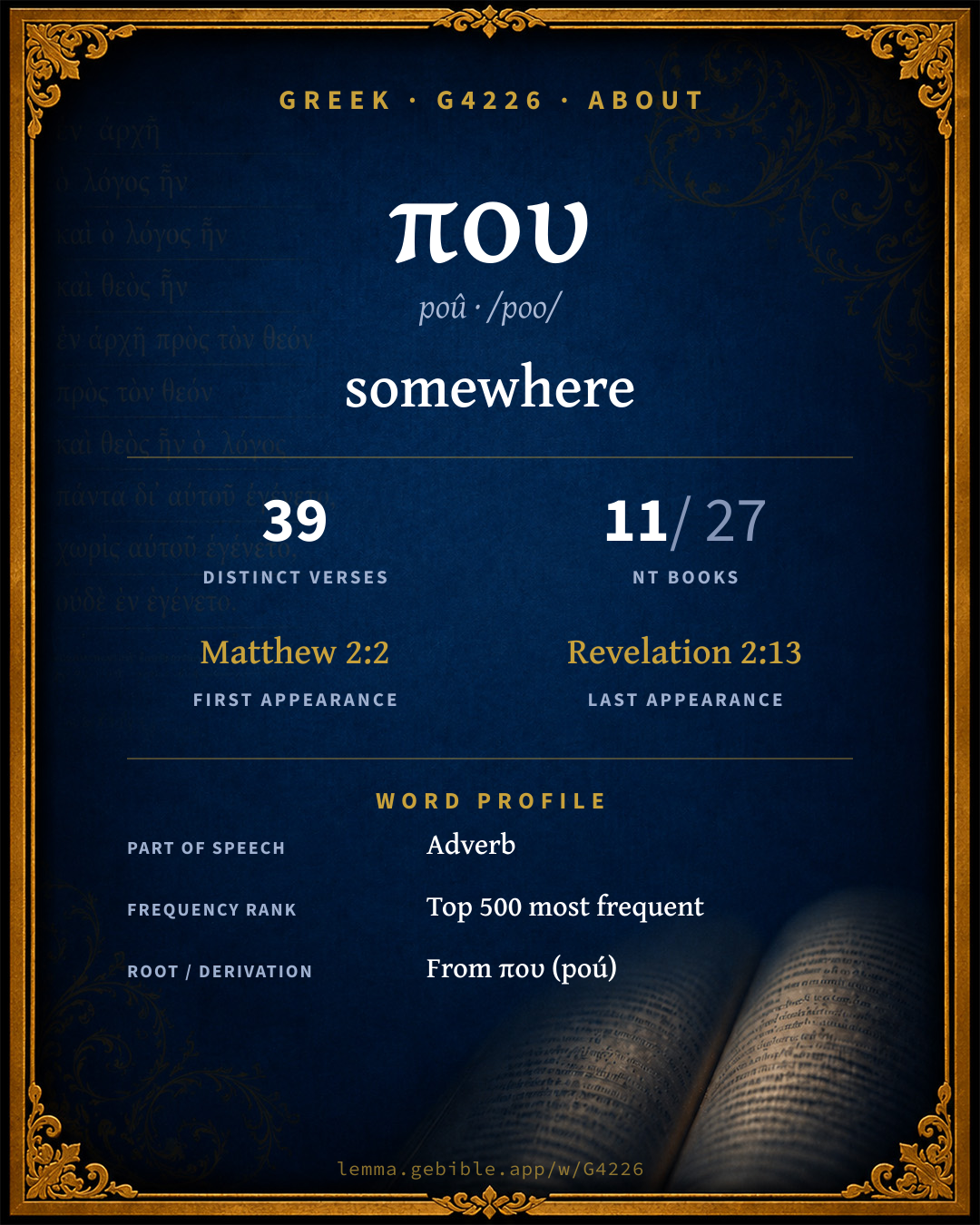
ποῦ
somewhere
‘somewhere’ is one of 3 main senses fuller range ↓
Full lexicon entry — Thayer's Greek Lexicon
From Thayer's Greek Lexicon
Where this word appears
Grammar key — what these labels mean
Part of speech
- Particle
- A short, often untranslatable function word adding nuance or connection.
Degree
- Interrogative
- Marks an interrogative form.
Every verse where G4226 appears — 39 distinct verses across 11 books. Click any verse to open its interlinear word-by-word view. Verse text shown in the World English Bible for context — . Each verse’s Greek form is shown with its reference; the English is not keyword-highlighted, since the data carries no word-level English alignment. Use “Compare translations” on any verse to read it across multiple English versions. This concordance covers the Greek New Testament; Septuagint (Greek Old Testament) occurrences of this word are not indexed here.
Matthew 4 verses
- Matthew 2:2 ποῦ ptcl interrog "Where is he who is born King of the Jews? For we saw his star in the east, and have come to worship him."
- Matthew 2:4 ποῦ ptcl interrog Gathering together all the chief priests and scribes of the people, he asked them where the Christ would be born.
- Matthew 8:20 ποῦ ptcl interrog Jesus said to him, "The foxes have holes, and the birds of the sky have nests, but the Son of Man has nowhere to lay his head."
- Matthew 26:17 ποῦ ptcl interrog Now on the first day of unleavened bread, the disciples came to Jesus, saying to him, "Where do you want us to prepare for you to eat the Passover?"
Mark 2 verses
- Mark 14:12 ποῦ ptcl interrog On the first day of unleavened bread, when they sacrificed the Passover, his disciples asked him, "Where do you want us to go and make ready that you may eat the Passover?"
- Mark 14:14 ποῦ ptcl interrog and wherever he enters in, tell the master of the house, 'The Teacher says, "Where is the guest room, where I may eat the Passover with my disciples?"'
Luke 7 verses
- Luke 8:25 ποῦ ptcl interrog He said to them, "Where is your faith?" Being afraid they marveled, saying one to another, "Who is this, then, that he commands even the winds and the water, and they obey him?"
- Luke 9:58 ποῦ ptcl interrog Jesus said to him, "The foxes have holes, and the birds of the sky have nests, but the Son of Man has no place to lay his head."
- Luke 12:17 ποῦ ptcl interrog He reasoned within himself, saying, 'What will I do, because I don't have room to store my crops?'
- Luke 17:17 ποῦ ptcl interrog Jesus answered, "Weren't the ten cleansed? But where are the nine?
- Luke 17:37 ποῦ ptcl interrog They answering, asked him, "Where, Lord?" He said to them, "Where the body is, there will the vultures also be gathered together."
- Luke 22:9 ποῦ ptcl interrog They said to him, "Where do you want us to prepare?"
- Luke 22:11 ποῦ ptcl interrog Tell the master of the house, 'The Teacher says to you, "Where is the guest room, where I may eat the Passover with my disciples?"'
John 16 verses
- John 3:8 ποῦ ptcl interrog The wind blows where it wants to, and you hear its sound, but don't know where it comes from and where it is going. So is everyone who is born of the Spirit."
- John 7:11 ποῦ ptcl interrog The Jews therefore sought him at the feast, and said, "Where is he?"
- John 7:35 ποῦ ptcl interrog The Jews therefore said among themselves, "Where will this man go that we won't find him? Will he go to the Dispersion among the Greeks, and teach the Greeks?
- John 8:10 ποῦ ptcl interrog Jesus, standing up, saw her and said, "Woman, where are your accusers? Did no one condemn you?"
- John 8:14 ποῦ ποῦ ptcl interrog ptcl interrog Jesus answered them, "Even if I testify about myself, my testimony is true, for I know where I came from, and where I am going; but you don't know where I came from, or where I am going.
- John 8:19 ποῦ ptcl interrog They said therefore to him, "Where is your Father?" Jesus answered, "You know neither me, nor my Father. If you knew me, you would know my Father also."
- John 9:12 ποῦ ptcl interrog Then they asked him, "Where is he?" He said, "I don't know."
- John 11:34 ποῦ ptcl interrog and said, "Where have you laid him?" They told him, "Lord, come and see."
- John 11:57 ποῦ ptcl interrog Now the chief priests and the Pharisees had commanded that if anyone knew where he was, he should report it, that they might seize him.
- John 12:35 ποῦ ptcl interrog Jesus therefore said to them, "Yet a little while the light is with you. Walk while you have the light, that darkness doesn't overtake you. He who walks in the darkness doesn't know where he is going.
- John 13:36 ποῦ ptcl interrog Simon Peter said to him, "Lord, where are you going?" Jesus answered, "Where I am going, you can't follow now, but you will follow afterwards."
- John 14:5 ποῦ ptcl interrog Thomas says to him, "Lord, we don't know where you are going. How can we know the way?"
- John 16:5 ποῦ ptcl interrog But now I am going to him who sent me, and none of you asks me, 'Where are you going?'
- John 20:2 ποῦ ptcl interrog Therefore she ran and came to Simon Peter, and to the other disciple whom Jesus loved, and said to them, "They have taken away the Lord out of the tomb, and we don't know where they have laid him!"
- John 20:13 ποῦ ptcl interrog They told her, "Woman, why are you weeping?" She said to them, "Because they have taken away my Lord, and I don't know where they have laid him."
- John 20:15 ποῦ ptcl interrog Jesus said to her, "Woman, why are you weeping? Who are you looking for?" She, supposing him to be the gardener, said to him, "Sir, if you have carried him away, tell me where you have laid him, and I will take him away."
Romans 1 verse
1 Corinthians 4 verses
- 1 Corinthians 1:20 ποῦ ποῦ ποῦ ptcl interrog ptcl interrog ptcl interrog Where is the wise? Where is the scribe? Where is the lawyer of this world? Hasn't God made foolish the wisdom of this world?
- 1 Corinthians 12:17 ποῦ ποῦ ptcl interrog ptcl interrog If the whole body were an eye, where would the hearing be? If the whole were hearing, where would the smelling be?
- 1 Corinthians 12:19 ποῦ ptcl interrog If they were all one member, where would the body be?
- 1 Corinthians 15:55 ποῦ ποῦ ptcl interrog ptcl interrog "Death, where is your sting? Hades, where is your victory?"
Galatians 1 verse
Hebrews 1 verse
1 Peter 1 verse
2 Peter 1 verse
Revelation 1 verse
About this entry
At a glance — auto-summarized from this page’s data, not written by a person. Every figure links to its source below. This summary describes the numbers; it doesn’t interpret them.
“somewhere” is the headline sense of the Greek verb που (poû). One archaism survives in the King James Version — “whither” — where modern Bibles read “where”; see the renderings breakdown. The Greek New Testament uses it across 39 verses — moderately common. More than a third of its appearances fall in John. Lexicons map it across 3 senses. The sections below give every sense, occurrence, and version rendering.
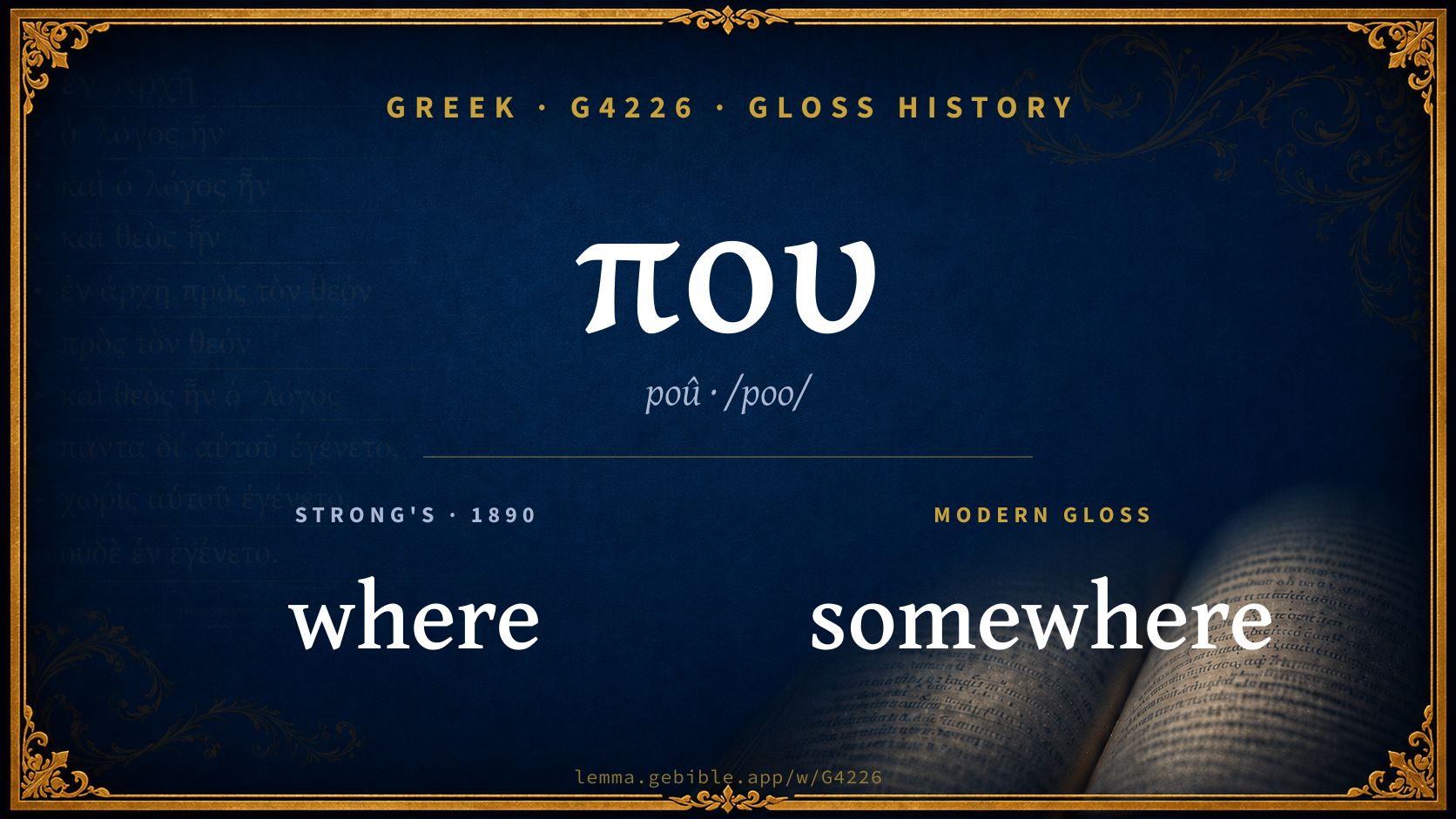
Gloss history
Strong's 1890 vs modern scholarship
About this word
Strong's G4226 catalogs a Greek word from the Greek New Testament.
These counts are not copied from any lexicon or concordance. They are computed here, from the morphology-tagged Greek New Testament. What Lemma adds →
- 39
- distinct verses
- The word appears in 39 distinct verses.
- 11 / 27
- NT books
- The word appears in 11 of 27 New Testament books.
- #343
- by frequency
- Top 500 most frequent Greek words (rank 343 of 5,347 Greek words by occurrence).
View all 39 occurrences in the concordance →
By section of the New Testament
By traditional corpus
Conventional, traditional groupings — biblical authorship is debated, so this is a traditional corpus grouping, not an authorship claim. Some books belong to more than one corpus (Luke is in both the Gospels and the Lukan corpus, and so on), so these shares overlap and need not total 100%. Each figure is a share of the word’s 39 distinct verses.
- Gospels 29 verses · 74%
- Johannine 17 verses · 44%
- Lukan (Luke–Acts) 7 verses · 18%
- Pauline corpus 6 verses · 15%
- General (Catholic) Epistles 2 verses · 5%
- Hebrews 1 verse · 3%
- Revelation 1 verse · 3%
How translations render this word
Counts come from each version’s own published word-to-Strong’s tagging or interlinear alignment — an approximate guide to how each version renders this word, not a word-level alignment the data otherwise carries. Because each total is that version’s own tagged count, the per-version totals vary from one another and need not match the appearance or distinct-verse counts above. These counts may also differ from a printed concordance because Lemma counts each distinctly tagged rendering and does not collapse phrase taggings into a single head-word total. This is a fixed set of word-tagged versions (KJV, ASV, BSB, ULT) and does not change with the reading translation you choose elsewhere. Each version’s license is shown beside its name below (and on Sources).
- King James Version: Where 36×, Whither 10×
- American Standard Version: Where 35×, Whither 9×
- Berean Standard Bible: Where 38×, What 2×
- unfoldingWord Literal Text: Where 46×, Is 7×, Be 3×
King James Version Public Domain
Renders G4226 across 47 tagged occurrences — most commonly:
Plus 1 rendering that appears only once — usually multi-word phrases or single function words the recovered tagging swept in, not distinct renderings.
American Standard Version Public Domain
Renders G4226 across 45 tagged occurrences — most commonly:
Plus 1 rendering that appears only once — usually multi-word phrases or single function words the recovered tagging swept in, not distinct renderings.
Berean Standard Bible Public Domain
Renders G4226 across 42 tagged occurrences — most commonly:
Plus 2 renderings that appear only once — usually multi-word phrases or single function words the recovered tagging swept in, not distinct renderings. Not rendered by a distinct English word in 4 further occurrences.
unfoldingWord Literal Text CC BY-SA 4.0
Renders G4226 across 62 tagged occurrences — most commonly:
Plus 3 renderings that appear only once — usually multi-word phrases or single function words the recovered tagging swept in, not distinct renderings.
Senses in Thayer's
The 3 senses Thayer's distinguishes for this word, in lexicon order (not ranked by frequency or importance). The full entry — with sub-senses — is in the Lexicon Entry tab.
- somewhere
- nearly
- with numerals: somewhere about, about
Word origin
Derived from που (poú) (G4225) — where.
Genitive case of πός pos an interrogitive pronoun ( what ) otherwise obsolete (perhaps the same as G4225 used with the rising slide of inquiry); as adverb of place; at (by implication to ) what locality : - where whither.
— Strong’s Exhaustive Concordance (1890), public domain.
Forms in the corpus
The 2 distinct written forms G4226 takes in the Greek New Testament, most frequent first — each parse links to that case’s occurrences in the concordance.
| Form | Parsing | Example | Uses |
|---|---|---|---|
| ποῦ poû | Particle, Interrogative | Matthew 2:2 | 43 |
| Ποῦ Poû | Particle, Interrogative | Romans 3:27 | 1 |
Same root — word family
Other Thayer's entries built from the same root as G4226, grouped by Strong’s listed origin. These share a root / origin per the lexicon — not necessarily a shared meaning. Each links to that word’s own entry.
Derives from
Shares the same root
Derived from this word
- ποιος poîos G4169 of what sort
- ποτε póte G4219 when
- ποτερον póteron G4220 which of two
- πως pōs G4459 how
Compare all same-root words → Showing 4 of 9 — not the complete family. They share a root, not necessarily a meaning.