
John 3:12

Greek (Tischendorf 8th ed.) John 3:12 appears in the Greek New Testament. The text above is from the Tischendorf 8th edition. Each word links to its Strong’s number and a concise gloss. Click any word for its full Thayer’s Greek Lexicon entry.
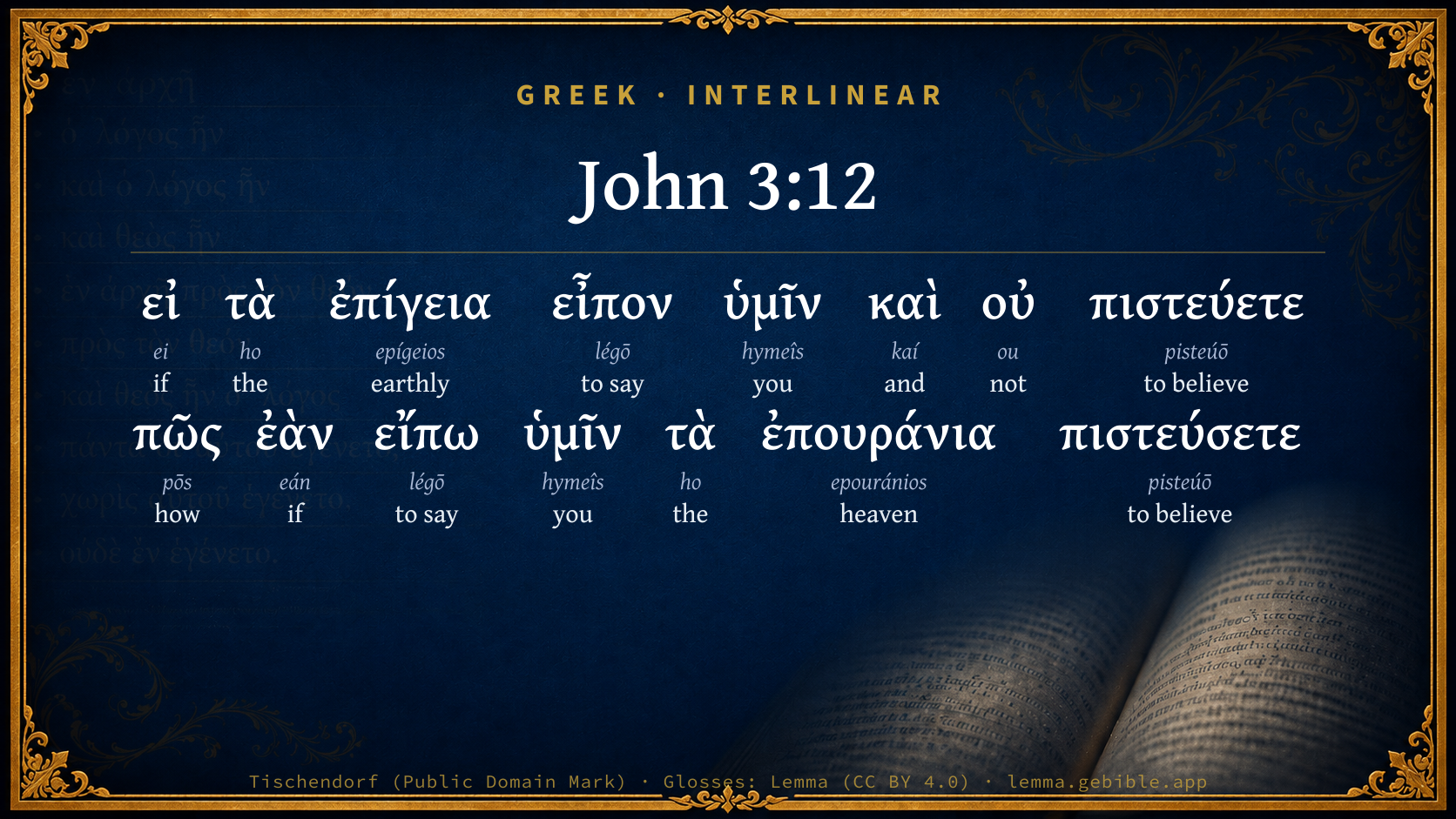
Download image
Cite this verse

John 3:12 (World English Bible). Public Domain. Lemma interlinear Bible study tool, https://lemma.gebible.app/v/john/3/12.

Show BibTeX & RIS
BibTeX
RIS
English Translation
If I told you earthly things and you don't believe, how will you believe if I tell you heavenly things?
World English Bible · Public Domain
Highlights
  • 2 first appearances in the Greek New Testament
Full analysis ↓
Download a study sheet

One document with this verse’s original text, its word-by-word gloss line, the meaning frame, cross-references with their text, attributed commentary, and full source and license credits — printable, and it pastes into notes with its structure intact.

This verse Autodidact and up

Study sheet (.html) Plain text (.txt)

A passage Seminary Student

Up to 50 verses in one chapter. A passage sheet keeps up to 6 commentary sources and 12 cross-references per verse, in the order this page ranks them, and says so on the sheet whenever that leaves anything out. Ask for a single verse and you get the Autodidact verse sheet above.

Everything on this page stays free to read, with no account — the sheet is a download of what is already on screen, not access to it.

Want to remove ads? Support Godless Engineer
Compare translations 3

The same verse in 3 English versions, stacked beneath the original-language interlinear above. Click any original word for its lexicon entry.

Each is an independent rendering of the whole verse — the interlinear is not word-aligned to these translations.

Highlighted words mark where these versions differ — a whole-verse word diff, not a word-by-word alignment.

  • World English Bible Public Domain
    If I told you earthly things and you don't believe, how will you believe if I tell you heavenly things?
  • King James Version Public Domain
    If I have told you earthly things, and ye believe not, how shall ye believe, if I tell you of heavenly things?
  • unfoldingWord Literal Text CC BY-SA 4.0
    If I told you earthly things and you do not believe, how will you believe if I tell you heavenly things?

unfoldingWord Literal Text — © unfoldingWord, licensed CC BY-SA 4.0. Word-aligned USFM3 via Door43 (git.door43.org/unfoldingWord/en_ult).

Versions to compare (up to 4)

3 of 4 selected

Show all 19 translations

Every available English version of this verse, each an independent rendering of the whole verse.

  • World English Bible Public Domain
    If I told you earthly things and you don't believe, how will you believe if I tell you heavenly things?
  • Berean Standard Bible Public Domain
    If I have told you about earthly things and you do not believe, how will you believe if I tell you about heavenly things?
  • Majority Standard Bible Public Domain
    If I have told you about earthly things and you do not believe, how will you believe if I tell you about heavenly things?
  • King James Version Public Domain
    If I have told you earthly things, and ye believe not, how shall ye believe, if I tell you of heavenly things?
  • American Standard Version (1901) Public Domain
    If I told you earthly things and ye believe not, how shall ye believe if I tell you heavenly things?
  • Revised Version (1885) Public Domain
    If I told you earthly things, and ye believe not, how shall ye believe, if I tell you heavenly things?
  • Geneva Bible (1599) Public Domain
    If when I tel you earthly things, ye beleeue not, howe should yee beleeue, if I shall tel you of heauenly things?
  • Douay-Rheims (1899) Public Domain
    If I have spoken to you earthly things, and you believe not; how will you believe, if I shall speak to you heavenly things?
  • Young's Literal Translation Public Domain
    if the earthly things I said to you, and ye do not believe, how, if I shall say to you the heavenly things, will ye believe?
  • Literal Standard Version CC BY-SA 4.0
    if I spoke to you of the earthly things, and you do not believe, how, if I will speak to you of the heavenly things, will you believe?
  • Unlocked Literal Bible CC BY-SA 4.0
    If I told you about earthly things and you do not believe, how will you believe if I tell you about heavenly things?
  • unfoldingWord Literal Text CC BY-SA 4.0
    If I told you earthly things and you do not believe, how will you believe if I tell you heavenly things?
  • Darby Bible Public Domain
    If I have said the earthly things to you, and ye believe not, how, if I say the heavenly things to you, will ye believe?
  • World Messianic Bible Public Domain
    If I told you earthly things and you don’t believe, how will you believe if I tell you heavenly things?
  • Webster's Bible Public Domain
    If I have told you earthly things, and ye believe not, how will ye believe if I tell you heavenly things?
  • Free Bible Version CC BY-SA 4.0
    If you don't trust what I say when I tell you about earthly things, how would you ever trust what I say if I were to tell you about heavenly things?
  • Bible in Basic English Public Domain
    If you have no belief when my words are about the things of earth, how will you have belief if my words are about the things of heaven?
  • Text-Critical English NT CC BY 4.0
    If I have spoken to you about earthly things and you do not believe, how will you believe if I speak to you about heavenly things?
  • Tyndale New Testament (1534) Public Domain
    Yf when I tell you erthely thinges ye beleve not: how shuld ye beleve yf I shall tell you of hevenly thinges?

Literal Standard Version (2020), Covenant Press — licensed CC BY-SA 4.0. Text via the HelloAO Bible API (eBible.org). Unlocked Literal Bible (unfoldingWord) — licensed CC BY-SA 4.0. Text via the HelloAO Bible API (eBible.org). unfoldingWord Literal Text — © unfoldingWord, licensed CC BY-SA 4.0. Word-aligned USFM3 via Door43 (git.door43.org/unfoldingWord/en_ult). Free Bible Version, Dr. Jonathan Gallagher — licensed CC BY-SA 4.0. Text via the HelloAO Bible API (eBible.org).

Word by word

More ways to search: Search by grammar → Find every occurrence → Compare this word →

Practice this passage: Drill this verse → Learn its vocabulary →

ἐπίγεια
epígeios
G1919
“earthly”
Adjective, Accusative, Plural, Neuter
Part of Speech
Adjective
Case
Accusative
Number
Plural
Gender
Neuter
Full Thayer's Definition

Origin: from G1909 and G1093

TDNT: 12:20,1

1. existing upon the earth, earthly, terrestrial
  1. εἰ ei G1487 “if” Conditional
  2. τὰ ho G3588 “the” Article, Accusative, Plural, Neuter
  3. εἶπον légō G3004 “to say” Verb, Aorist, Active, Indicative, 1st person, Singular
  4. ὑμῖν hymeîs G5210 “you” Personal pronoun, 2nd person, Dative, Plural
  5. καὶ kaí G2532 “and” Conjunction
  6. οὐ ou G3756 “not” Particle, Negative
  7. πιστεύετε pisteúō G4100 “to believe” Verb, Present, Active, Indicative, 2nd person, Plural
  8. πῶς pōs G4459 “how” Adverb, Interrogative
  9. ἐὰν eán G1437 “if” Conditional
  10. εἴπω légō G3004 “to say” Verb, Aorist, Active, Subjunctive, 1st person, Singular
  11. ὑμῖν hymeîs G5210 “you” Personal pronoun, 2nd person, Dative, Plural
  12. τὰ ho G3588 “the” Article, Accusative, Plural, Neuter
  13. ἐπουράνια epouránios G2032 “heaven” Adjective, Accusative, Plural, Neuter
  14. πιστεύσετε pisteúō G4100 “to believe” Verb, Future, Active, Indicative, 2nd person, Plural

About this verse

These counts appear in no published source. They are computed here, from the morphology-tagged text and Lemma’s own curated glosses. What Lemma adds →

15
words
11
distinct lemmas
Gospels
section

Notable vocabulary

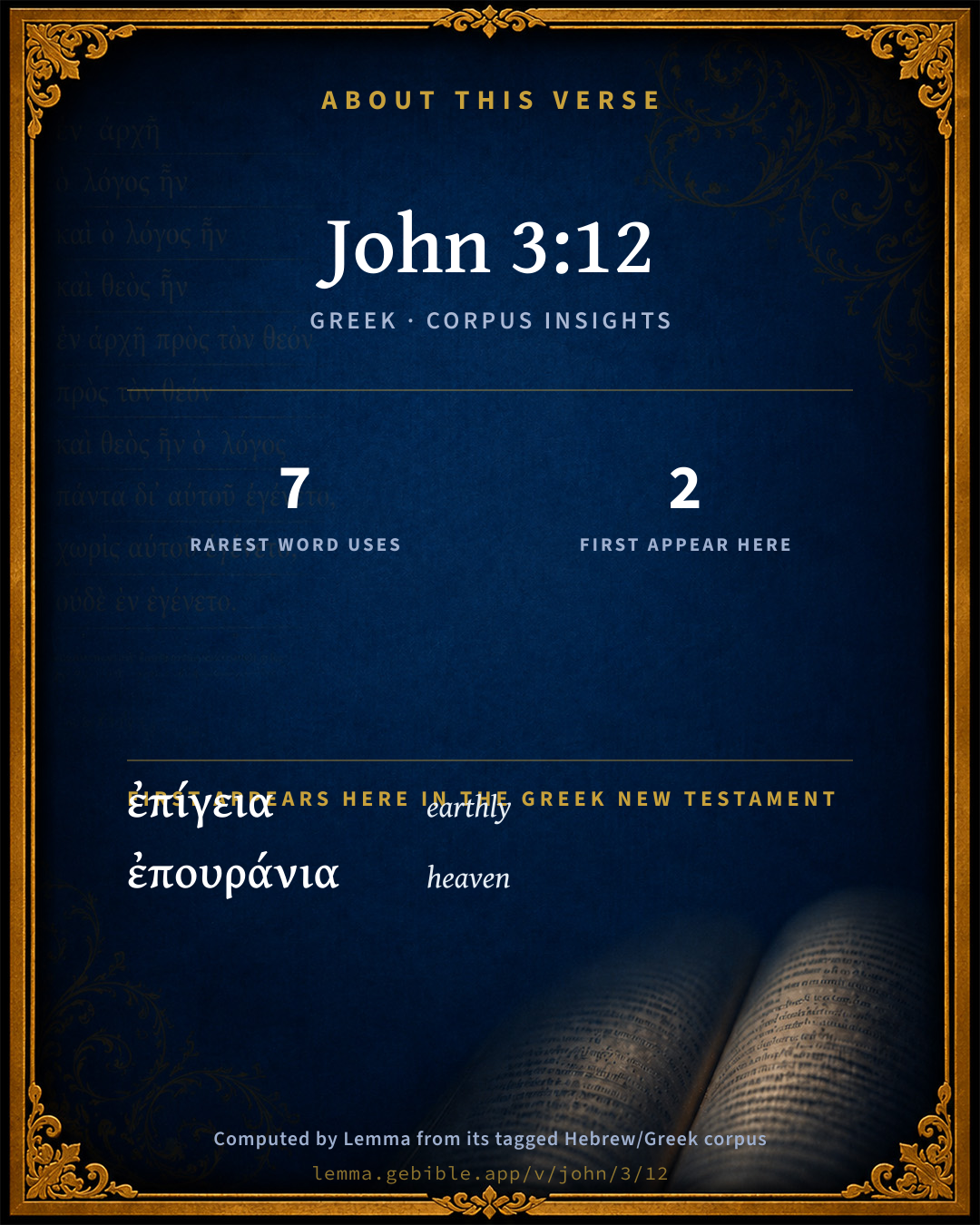
The rarest word here is ἐπίγεια earthly G1919 — appearing just 7 times in the whole Greek New Testament.

First appearance in Scripture

These words make their first canonical appearance in the Greek New Testament here:

  • ἐπίγεια earthly G1919
  • ἐπουράνια heaven G2032

Shared distinctive vocabulary

ἐπίγεια earthly G1919 occurs in 6 verses of the Greek New Testament. Also found in:
Repetition

Words recur within this verse:

  • εἶπον to say G3004 ×2
  • πιστεύετε to believe G4100 ×2
  • τὰ the G3588 ×2
  • ὑμῖν you G5210 ×2

Cross-references

12

Topical passages linked to John 3:12 in the Treasury of Scripture Knowledge — connected by theme and wording, ordered by reader-vote popularity; previews shown in the World English Bible.

  • 1 Corinthians 3:1–2 Brothers, I couldn't speak to you as to spiritual, but as to fleshly, as to babies in Christ.
  • 1 Corinthians 2:7–9 But we speak God's wisdom in a mystery, the wisdom that has been hidden, which God foreordained before the worlds for our glory,
  • Hebrews 5:11 About him we have many words to say, and hard to interpret, seeing you have become dull of hearing.
  • John 3:31–36 He who comes from above is above all. He who is from the Earth belongs to the Earth, and speaks of the Earth. He who comes from heaven is above all.
  • 1 Peter 2:1–3 Putting away therefore all wickedness, all deceit, hypocrisies, envies, and all evil speaking,
  • John 1:1–14 In the beginning was the Word, and the Word was with God, and the Word was God.
  • John 3:5 Jesus answered, "Most assuredly I tell you, unless one is born of water and spirit, he can't enter into the Kingdom of God!
  • John 3:8 The wind blows where it wants to, and you hear its sound, but don't know where it comes from and where it is going. So is everyone who is born of the Spirit."
  • John 3:13–17 No one has ascended into heaven, but he who descended out of heaven, the Son of Man, who is in heaven.
  • John 3:3 Jesus answered him, "Most assuredly, I tell you, unless one is born anew, he can't see the Kingdom of God."
  • 1 Timothy 3:16 Without controversy, the mystery of godliness is great: God was revealed in the flesh, Justified in the spirit, Seen by angels, Preached among the nations, Believed on in the world, And received up in glory.
  • 1 John 4:10 In this is love, not that we loved God, but that he loved us, and sent his Son as the atoning sacrifice for our sins.

Cross-references courtesy of OpenBible.info (CC BY 4.0).

Commentary

Notes on John 3:12 from classic Christian and Jewish commentators (each source and its license shown beneath its notes). The classic Christian expositions comment on the surrounding passage and are grouped to its opening verse, so a note may address several verses; the Jewish commentaries on the Tanakh (Rashi and others) are per-verse, so they appear only where the commentator wrote on this verse.

Lemma curates 59 commentaries, every one of them public domain or Creative Commons licensed, each selected and text-cleaned for this edition rather than reprinted as found. About our sources →

The Biblical Illustrator

Joseph S. Exell

Joh_3:12

If I have told you of earthly things, and ye believe not, how shall ye believe, if I tell you of heavenly things?

--The question in its bare form is easily grappled with, but in its application to the subjects before us we encounter a great obstacle. Earthly things are the deep things of the new birth; heavenly things are the lifting up of the Son of man, the gift of the Only-Begotten, that the world through Him might be saved. Regeneration and santification are by comparison earthly things; redemption, atonement, justification are by contrast and preeminence heavenly. He who believes not the former, how can he believe the latter We notice

I. AN INVERSION OF OUR COMMON ESTIMATE OF THE MYSTERIES OF CHRISTS KINGDOM.

1. It is usual to speak of the work of Christ as far easier of apprehension than the work of the Spirit. The idea of atonement is treated as self-evident, and theory after theory has been constructed to explain it. But Christ says difficult as it is to understand a Divine influence, it is more difficult to apprehend a Divine sacrifice; that He only who is from heaven can reveal the latter, while a master of Israel is culpably ignorant if he knows not of the former.

2. The same persons exaggerate the mystery of the doctrine of grace, whereas Christ treats it as a plain earthly thing. The writer of the Epistle to the Hebrews treats it in the same way, bidding us leave the elements, baptism, etc., to go on to perfection--the strong meat, the profounder study of the fulfilment of type and shadow in the atonement and mediation of Jesus Christ.

II. CAN WE EXPLAIN THIS INVERSION?

1. With regard to the new birth.

(1) It is not that it is discoverable by man in its nature, or recognizable in its process, or practicable in its realization, and so an earthly thing. It is as much above reason, as secret, as independent of mans interference as the deepest mystery of redemption. But

(2) The idea of a spiritual influence has obvious illustrations from earthly experience. Life itself is a putting forth and taking in of the authority of mind over mind. Therefore there can be no antecedent improbability of a Divine influence affecting the soul.

(3) When we think of our indebtedness to God as Creator, Preserver, Benefactor, there can be nothing difficult in the thought that the Author of our spirit can quicken and bless it.

(4) Although the work is secret in its processes, it is cognizable in its effects. When you see a proud man humble, the worldly man religious, you have proof which carries the matter into the region of sight.

(5) The doctrine was earthly to Nicodemus because it was in his Old Testament.

2. How different with the topics that follow! At first sight less mysterious, for was not Christ really man, and was not His sacrifice a human death? Yet when we turn to that which the human enshrined, the mystery of Christs Person, we see the appositeness of the term heavenly.

(1) Divine incarnation and Divine suffering are absolutely incomprehensible revelations. The more men argue over them the more danger there is of darkening counsel by words without knowledge.

(2) If the Divine passion is a mystery, how much more the connection between that suffering and mans release!

(3) The individual appropriation of Christs sacrifice is incomprehensible.

(4) The work of grace shows itself by infallible signs, but the absolution is the secret act of God alone.

III. Let us press upon ourselves the thought of THE HEAVENLINESS OF THE ONE ALL-SUFFICIENT SACRIFICE. We have in our Lords question the key to much of modern unbelief. Christ tells us of our need of Divine grace to change us into new men, and we believe not that. Men confess that they must be moral, but contend that they can secure that for themselves, and that it is weakness to look cut of themselves for help. Nature refuses grace. Who, then, can wonder if the same unbelief shall spread into the region of the heavenly, and the scoffer at grace scoff at atonement? (Dean Vaughan.)

The moral and the revealed truths

We may distinguish between these. Christs teaching in its practical applications is its earthly side; His revelation of God, His nature and will its heavenly side.

I. THE MORAL TEACHING OF CHRIST MUST BE ACCEPTED BY EVERY UPRIGHT CONSCIENCE.

1. Where else do you find the idea of the sovereign and eternal value of right more clearly and firmly expressed?

2. The same applies to holiness. He opposes the systems which make it consist in outward performances, and places stress on the intention.

3. None more than Christ have preached the necessity of sacrificing ones self for the sake of truth.

4. Whoever taught as Christ the relations of men with one another and the bonds of justice and mercy which should units them? Christ alone has made love the supreme law of mankind.

5. Not only has He taught all this; He has acted all He has taught.

6. This is why He has a right to the authority He claims over our consciences, and why when He tells us of earthly things He has a right to be believed.

II. CHRIST CLAIMS THE SAME FAITH AS THE REVEALER OF RELIGIOUS TRUTH. He is not merely a teacher of morals; He speaks of the things which are far beyond our human vision: of God, His government, providence, saving purposes, judgment. In the presence of these affirmations our situation changes. So long as His moral teaching was in question we could judge of it by our consciences, but here are declarations we cannot control.

1. Are we justified in putting faith in Christ.? If we set aside this faith, no other means of access to religious truth remains. Science can teach us nothing. Are we then to remain in the dark? Men have tried to do so, but always unsuccessfully.

2. Is Christ to be believed?

(1) The very accent of His affirmations leads us to reflection. No man ever spoke with such authority. We believe the assertions of Christ when He tells us of heavenly things, because lie has always spoken truth when He has told us of earthly things.

(2) If we believe the religious truths revealed by Christ it is because they are the necessary complement of the moral truths our conscience compels us to believe; so that accepting the latter, we are led by an invincible logic to believe the former. There is no moral truth in the gospel that does not expand into a religious truth. (E. Bersier, D. D.)

Earthly and heavenly things

Heavenly things, being represented unto us in an earthly form (Joh_3:8), come clothed to us with our own notions. We can see the sun better when reflected in the water of a vase than in the firmament; and we can interpret heavens language best when it speaks to us in the language of earth. (T. Manton.)

The Biblical Illustrator, edited by Joseph S. Exell (c. 1880s–1900s) — public domain. Text from a community e-Sword module.

Joseph Benson's Commentary

Joh 3:12-13. If I have told you earthly things — As the truths which I have taught you concerning the spiritual nature of God’s kingdom, and the qualifications of his subjects, may properly be termed, because they are capable of being represented to you in a familiar way, and of being illustrated by such obvious and well-known similitudes as to be rendered thereby perfectly plain and easy to be understood. Or, by earthly things, he might mean things to be experienced and enjoyed on earth, such as the new birth and the present privileges of the children of God. And ye believe not — Even these; how shall ye believe if I tell you of heavenly things — If I should go on to teach you other doctrines, much more mysterious and sublime, and not capable of being thus illustrated and explained? Our Lord has been thought by some to refer here to those sublime and heavenly doctrines which were afterward revealed, such as the eternity of the Son, the fulness of the Godhead dwelling in him bodily, the unity of the Father, Son, and Spirit, and those other mysteries of godliness that are above the reach of human reason, and cannot be illustrated by earthly things. It is more probable, however, as Dr. Doddridge observes, that he more immediately refers “to the doctrines which he mentions in the remaining part of his discourse to Nicodemus — of his descent from heaven to instruct us in the things of God, and be united to the human nature here below, while, by his divine nature, he still continued to be present above, — of the design for which he came into the world, to be lifted up upon the cross, that he might save us from our sins, — of everlasting life, and happiness to be obtained by faith in his death, — and of the condemnation of all those that should reject him; which may be counted as the deep things of God, which he reveals unto us by his Spirit, and which the natural man, who disregards that Spirit, receiveth not, for they are foolishness unto him, 1Co 2:10; 1Co 2:14.” And no man, &c. — As if he had said, For here you must rely on my single testimony, whereas in the other points, termed earthly things, you have a cloud of witnesses. Or the connection and sense may be, Yet the truth of my doctrine concerning these heavenly things you will have no just reason to suspect, considering whence it comes, and who it is that reveals it. For no man hath ascended up to heaven — To search into the secret counsels of God, and to obtain an intimate and perfect knowledge of his mind and will; but he that came down from heaven — Qualified and commissioned in the most extraordinary manner to reveal them, as far as is proper, to mankind; even the Son of man which is in heaven — Is present there by his divine nature, which fills both heaven and earth, even while he is here on earth as to his human nature. This is a plain instance of what is usually termed the communication of properties between Christ’s divine and human nature, whereby what is proper to the divine nature is spoken concerning the human; and what is proper to the human, is spoken of the divine. “Beza, and some others, suppose that the present tense, (ων, who is,) is here put for the past, (ην, who was,) of which construction we have some examples, particularly Joh 9:25. Accordingly they translate the clause, The Son of man, who was in heaven: but the common translation may be retained, [and interpreted,] thus: Moses, your lawgiver, did not ascend into heaven; he only went up to mount Sinai, and that but for a few days, that he might receive the law from God. Whereas, the Son of man, (this was one of the Messiah’s titles,) who is come down from heaven, (ο εκ του ουρανου καταβας,) who is commissioned by God in an extraordinary manner, to reveal his will to men, and in respect of whose commission, all the other messengers of God may be said to have been of the earth: (see Joh 3:31; Heb 12:25:) he hath ascended up to heaven — Hath received the clearest and most extensive views of spiritual things; hath penetrated into the recesses of the divine counsels; (see Pro 30:3-4;) nay, is, at present, in heaven, is with God, is conscious of all his gracious purposes toward men, consequently must be a messenger of much higher dignity than Moses, or Elijah, or any of the prophets, for whom you entertain so great a regard.” — Macknight.

Joseph Benson's Commentary on the Old and New Testaments (1811–1818) — public domain. Text from a community e-Sword module.

Bengel's Gnomon

Johann Albrecht Bengel

Joh 3:12. Τὰ ἐπίγεια, earthly things) To the heavenly sense of Jesus Christ there are earthly things, ἐπίγεια, which, having to be accomplished on the regions of earth by us who creep on the ground, appear in the highest degree heavenly. The whole style of Scripture is full of συγκατάβασις [condescension]. Regeneration is from heaven, not however in heaven: it is indeed [a process] on the margin of heaven.—πῶς, how) The cause why Scripture is silent about many things.—τὰ ἐπούρανια) heavenly things, the inner principles of the kingdom of God, Joh 3:3; Wis 9:16, μόλις εἰκάζομεν τὰ ἐπὶ γῆς—τὰ δὲ ἐν οὐρανοῖς τίς ἐξιχνίασε; He does not, at Joh 3:13, so much speak out, as hint at.—πιστεύσετε, will ye believe) The less anything seems credible to reason, often the more heavenly it is.

Bengel's Gnomon of the New Testament — English translation (T&T Clark, Edinburgh, 1860) — public domain. Text from a community e-Sword module.

Meyer's Critical & Exegetical Commentary

Heinrich August Wilhelm Meyer

Joh_3:12. How grievous the prospect which your unbelief regarding the instructions I have already given opens up as to the future!

τὰ ἐπίγεια] what is on earth, things which take place on earth (not in heaven). We must strictly adhere to this meaning of the word in this as in all other passages (1Co_15:40; 2Co_5:1; Php_2:10; Php_3:19; Jam_3:15. Comp. Wis_9:16, and Grimm, Handbuch, p. 189). To the category of these earthly things belonged also the birth from above (against Baeumlein), because, though brought about by a power from heaven, it is accomplished on earth; and because, proceeding in repentance and faith, it is a change taking place on earth within the earthly realm of our moral life; and because it is historically certain that Christ everywhere began His work with this very preaching of μετάνοια. The Lord has in His mind not only the doctrine of regeneration just declared to Nicodemus, but, as the plural shows, all which thus far He had taught the Jews (εἶπον ὑμῖν); and this had been hitherto only ἐπίγεια, and not ἐπουράνια, of which He still designs to speak.[157] It is therefore wrong to refer the expression to the comparison of the wind (Beza) or of corporeal birth (Grotius), as prefiguring higher doctrine; for the relation to the faith spoken of did not lie in these symbols, but in the truths they symbolized. The meaning of the words is quite altered, moreover, if we change the word ἐπίγεια into human and moral (B. Crusius), or take it as meaning only what is stated in the immediate context (Lücke), or, with De Wette, make the point of difference to be nothing more than the antithesis between mans susceptibility of regeneration as a work within him and his susceptibility of merely believing.

The counterpart of the ἐπίγεια are the ἐπουράνια, of which Jesus intends to speak to them in future, things which are in heaven (so in all places, Mat_18:35; 1Co_15:40; 1Co_15:48-49; Eph_1:3; Php_2:10, etc.). To this category belong especially the Messianic mysteries, i.e. the divine decrees for mans redemption and final blessedness. These are ἐπουράνια, because they have their foundation (Wis_9:16-17) in the divine will, though their realization commences in the present αἰών, through the entire work, and in particular through the death of Jesus and the faith of mankind; but while still unaccomplished, belongs to the divine counsel, and shall be first consummated and fully revealed in the kingdom of the Messiah by the exalted Christ, when the ζωὴ αἰώνιος will reveal itself at the goal of perfection (Col_3:4), and it will appear what we shall be. To the ἐπουρανίοις, therefore, does not first belong what is to be said of His exaltation, Mat_26:64 (Steinfass); but that very statement, and indeed as the first and main thing, which Jesus immediately after delivers in Joh_3:14 ff., where the heavenly element, i.e. what is in the counsels of God (Joh_3:15-16), is clearly contained. According to the connection, it is to be inferred that what is heavenly is difficult to be understood; but this difficulty has nothing to do with the word itself, as Lücke holds.

[157] εἶπον is dixi, not dixerunt, as Ewald thinks, who regards the ancients in the O. T. as the subject, and upon too feeble evidence reads ἐπιστεύσατε instead of πιστεύετε. This new subject must have been expressed, and an ἐγώ should have stood over against it in the apodosis. Comp. Mat_5:21-22. The earthly might be appropriate to the law (following Col_2:17; Heb_9:5; Heb_10:1), but not to the prophets.

Meyer — Critical and Exegetical Commentary on the New Testament — English translation by Peter Christie, edited by Frederick Crombie (T&T Clark, 1880) — public domain. Text from a community e-Sword module.

Expositor's Greek Testament

ed. W. Robertson Nicoll

Joh 3:12 . εἰ τὰ ἐπίγεια … πιστεύσετε ; The reference of τὰ ἐπίγεια is fixed by the εἶπον ὑμῖν . They are such things as Jesus had been speaking of: things verified in human, earthly experience, the necessity of a spiritual birth and the results of it. Regeneration was a change made in this earthly life. The kingdom of regenerate men was to be established on earth, as apprehensible in certain of its aspects as the kingdom Nicodemus was proposing to found. The ἐπουράνια are matters not open to human observation, matters wholly in the unseen, the nature and purposes of God. Cf. the remarkable parallel in Wis 9:16 .

The Expositor's Greek Testament, edited by W. Robertson Nicoll (1897–1910) — public domain. Text from a community e-Sword module.

Jamieson, Fausset & Brown

Robert Jamieson, A. R. Fausset & David Brown

earthly things--such as regeneration, the gate of entrance to the kingdom of God on earth, and which Nicodemus should have understood better, as a truth even of that more earthly economy to which he belonged.

heavenly things--the things of the new and more heavenly evangelical economy, only to be fully understood after the effusion of the Spirit from heaven through the exalted Saviour.

Jamieson, Fausset & Brown — Commentary Critical and Explanatory on the Whole Bible (1871) — public domain (CC PDM 1.0). Text via the HelloAO Bible API.

Adam Clarke's Commentary

Verse 12. If I have told you earthly things] If, after I have illustrated this new birth by a most expressive metaphor taken from earthly things, and after all you believe not; how can you believe, should I tell you of heavenly things, in such language as angels use, where earthly images and illustrations can have no place? Or, if you, a teacher in Israel, do not understand the nature of such an earthly thing, or custom of the kingdom established over the Jewish nation, as being born of baptism, practised every day in the initiation of proselytes, how will you understand such heavenly things as the initiation of my disciples by the baptism of the Holy Ghost and fire from heaven, if I should proceed farther on the subject?

Adam Clarke's Commentary on the Bible (1810–1826) — public domain. Text from a community e-Sword/MySword module.

John Calvin's Commentaries

12. If I have told you earthly things. Christ concludes that it ought to be laid to the charge of Nicodemus and others, if they do not make progress in the doctrine of the Gospel; for he shows that the blame does not lie with him, that all are not properly instructed, since he comes down even to the earth, that he may raise us to heaven. It is too common a fault that men desire to be taught in an ingenious and witty style. Hence, the greater part of men are so delighted with lofty and abstruse speculations. Hence, too, many hold the Gospel in less estimation, because they do not find in it high-sounding words to fill their ears, and on this account do not deign to bestow their attention on a doctrine so low and mean. But it shows an extraordinary degree of wickedness, that we yield less reverence to God speaking to us, because he condescends to our ignorance; and, therefore, when God prattles to us in Scripture in a rough and popular style, let us know that this is done on account of the love which he bears to us. Whoever exclaims that he is offended by such meanness of language, or pleads it as an excuse for not subjecting himself to the word of God, speaks falsely; for he who cannot endure to embrace God, when he approaches to him, will still less fly to meet him above the clouds.

Earthly things. Some explain this to mean the elements of spiritual doctrine; for self-denial may be said to be the commencement of piety. But I rather agree with those who refer it to the form of instruction; for, though the whole of Christ’s discourse was heavenly, yet he spoke in a manner so familiar, that the style itself had some appearance of being earthly. Besides, these words must not be viewed as referring exclusively to a single sermon; for Christ’s ordinary method of teaching — that is, a popular simplicity of style — is here contrasted with the pompous and high-sounding phrases to which ambitious men are too strongly addicted.

John Calvin's Commentaries (1540-1563) — public domain. Text from the Calvin Translation Society English edition (1840s-50s) via the Christian Classics Ethereal Library (ccel.org). Calvin's coverage is partial (roughly two-thirds of the Bible); uncommented books and verses are honest gaps, never fabricated. The 19th-century editor's footnotes and remarks are omitted so the notes are faithfully Calvin's own voice.

Ellicott's Commentary for English Readers

(12) Earthly things—i.e., things upon earth, having the sphere of their action upon earth. These are not necessarily restricted to the subjects of this interview. The context includes previous witness borne by Him, and there must have been much which is unrecorded. (Comp. Joh_2:23.) But the new birth is not excluded from “earthly things,” because it is the entrance to a life which, while it is spiritual, is still a life upon earth.

Heavenly things, in the same way, are things which have the sphere of their action in heaven, the full development of the spiritual life, of which the birth only is on earth; the divine counsels of redemption; the Messianic mysteries, of which this ruler of Israel does not understand even the initiation. Comp. the question in the Wisdom of Solomon, “What man is he that can know the counsel of God? or who can think what the will of the Lord is? . . . And hardly do we guess aright at things that are upon earth, and with labour do we find the things that are before us: but the things that are in heaven who hath searched out?” (Joh_9:13; Joh_9:16).

The earthly things are the elements of spiritual knowledge, having their test in the moral sense and in their fitness to supply the spiritual wants of man. When these elements are learnt, the mind is then, and then only, fitted to receive heavenly things. The teaching can only proceed step by step from the known to the unknown; but if the will refuses or the intellect neglects to know the knowable, the man cuts himself off from the power to receive truth. The message from the spirit-world has come, and others read it; but he has not learnt the alphabet. (Comp. Note on Joh_16:12.)

A Bible Commentary for English Readers, edited by Charles John Ellicott (1878–1897) — public domain. Text from a community e-Sword module.

The Cambridge Bible for Schools and Colleges

gen. ed. J. J. S. Perowne

12. earthly things] Things which take place on earth, even though originating in heaven, e.g. the ‘new birth,’ which though ‘from above,’ must take place in this world. See notes on 1Co_15:40 and Jas_3:15.

heavenly things] The mysteries which are not of this world, the Divine counsels respecting man’s salvation.

The Cambridge Bible for Schools and Colleges (gen. ed. J. J. S. Perowne; Cambridge University Press, 1878–1918) — public domain. Text from a community e-Sword module.

John Gill's Exposition

And no man hath ascended into heaven,.... Though Enoch and Elias had, yet not by their own power, nor in the sense our Lord designs; whose meaning is, that no man had, or could go up to heaven, to bring from thence the knowledge of divine and heavenly things; in which sense the phrase is used in Deu 30:12, and which may be illustrated by Joh 1:18; wherefore inasmuch as Nicodemus had acknowledged Christ to he a teacher come from God, our Lord, would have him know, that he was the only teacher of heavenly things, as being the only person that had been in heaven, and in the bosom of the Father; and therefore, if he, and the rest of the Jews, did not receive instructions from him, they must for ever remain ignorant; for there never had been, nor was, nor could be, any mere man that could go up to heaven, and learn the mysteries of God, and of the kingdom of heaven, and return and instruct men in them:

but he that came down from heaven; meaning himself, who is the Lord from heaven, and came from thence to do the will of God by preaching the Gospel, working miracles, obeying the law, and suffering death in the room of his people, and thereby obtaining eternal redemption for them. Not that he brought down from heaven with him, either the whole of his human nature, or a part of it; either an human soul, or an human body; nor did he descend locally, by change of place, he being God omnipresent, infinite and immense, but by assumption of the human nature into union with his divine person:

even the son of man which is in heaven; at the same time he was then on earth: not that he was in heaven in his human nature, and as he was the son of man; but in his divine nature, as he was the Son of God; see Joh 1:18; though this is predicated of his person, as denominated from the human nature, which was proper to him only in his divine nature; for such is omnipresence, or to be in heaven and earth at the same time: just as on the other hand God is said to purchase the church with his blood, and the Lord of glory is said to be crucified, Act 20:28, where those things are spoken of Christ, as denominated from his divine nature, which were proper only to his human nature; and is what divines call a communication of idioms or properties; and which will serve as a key to open all such passages of Scripture: and now as a proof of our Lord's having been in heaven, and of his being a teacher come from God, and such an one as never was, or can be, he opens and explains a type respecting himself, in the following verse.

John Gill's Exposition of the Whole Bible (1746–1763) — public domain (CC PDM 1.0). Text via the HelloAO Bible API.

Trapp's Complete Commentary

John Trapp

12 If I have told you earthly things, and ye believe not, how shall ye believe, if I tell you of heavenly things?

Ver. 12. If I have told you earthly things] That is, spiritual things under earthly gross similitudes, of wind, water, &c. In the mystery of Christ, the best of us are acute obtusi. But for the natural man, that cannot tell the nature of the wind, or enter into the depth of the flower or the grass, &c., how should he possibly have the wit to enter into the deep things of God, especially if darkly delivered?

John Trapp, A Commentary or Exposition upon All the Books of the Old and New Testament (1647–1656) — public domain. Text from a community e-Sword module.

Albert Barnes' Notes on the Bible

If I have told you earthly things - Things which occur on earth. Not sensual or worldly things, for Jesus had said nothing of these; but he had told him of operations of the Spirit which had occurred “on earth,” whose effects were visible, and which “might” be, therefore, believed. These were the plainest and most obvious of the doctrines of religion.

How shall ye believe - How will you believe. Is there any probability that you will understand them?

Heavenly things - Things pertaining to the government of God and his doings in the heavens; things which are removed from human view, and which cannot be subjected to human sight; the more profound and inscrutable things pertaining to the redemption of men. Hence, learn:

The height and depth of the doctrines of religion. There is much that we cannot yet understand, The feebleness of our understandings and the corruptions of our hearts are the real causes why doctrines of religion are so little understood by us. There is before us a vast eternity, and there are profound wonders of God’s government, to be the study of the righteous, and to be seen and admired by them forever and ever.

Albert Barnes' Notes on the Bible (1834–1885) — public domain. Text from a community e-Sword/MySword module.

Matthew Poole's English Annotations

If I have spoken to you plain things, and in a plain style, humbling my phrase to your apprehensions, and illustrating sublime, spiritual mysteries, which in their own nature are more remote from your apprehensions, by plain and obvious similitudes and parables, and speaking thus, you understand and believe not; what would you do if I should discourse to you sublime and spiritual things, without these advantages for your understandings?

Matthew Poole's English Annotations on the Holy Bible (1683–1685) — public domain. Text from a community e-Sword/MySword module.

Whedon's Commentary on the Bible

Daniel D. Whedon

12. Earthly things—Such as the regeneration which takes place on earth.

Heavenly things—Such as God’s requirement, in the counsels of heaven, of the atonement and death of his only begotten Son.

Daniel D. Whedon (gen. ed.), Commentary on the Old and New Testaments (1874–1909) — public domain. Text from a community e-Sword module.

The Pulpit Commentary

If I told you earthly things and ye believe not, how will ye believe if I tell you of heavenly things? Our Lord here drops the plural form of address, and returns to the singular. He is about to refer to matters in which the testimony of disciples was not available. It has sometimes been said that the "earthly" and "heavenly" things refer to the wind parable and its interpretation. But, on the supposition that there is a parable or metaphor in ver. 8, which we have seen reason to doubt, there would be no perplexity about the reception of the earthly illustration; none could in that day have made a moment"s question touching the invisibility and incomprehensibility of the motion of the wind. The birth from water has been supposed by others to be the (epigeion) "earthly" thing of which he had spoken, as contrasted with the heavenly thing, the birth anew from the Spirit. But this also is improbable, for of all the things of which Jesus spoke, that was the least likely to have been rejected by the Pharisaic party. The "earthly things" are the subject matter of the discourse as a whole, in apprehending which Nicodemus manifested such obtuseness. The change, renovation of human nature, the new beginning "from the Spirit" of each human life, was indeed operated on the ground of an earthly experience, and came fairly within the compass of common appreciation. Though produced by the Spirit, these things were enacted on earth. When Nicodemus asks the question how?" he launches the inquiry into another region. There is wide difference between the question "what?" and the question "how?" The one in physical science refers to the whole range of phenomena, and the answer states the facts as they present themselves to the senses; the other question inquires into what Bacon called the latens processus into verae causae, into the movements and method of the creative hand. So the answer to the question what?" may be an "earthly thing," the answer to the question how?" a "heavenly thing." If Christ answer the "how" of his listener, he raises his mind to the "heavenly" and transcendental realities which Nicodemus and we too will have to receive on an authority which entirely outsoars that of daily experience or temporal phenomena. Truly he does proceed to do so, but the difficulty of acceptance is indefinitely augmented. The answer of Christ to the matters of personal experience, verifiable by conscience and affirmed by Scripture, was difficult to the master of Israel. The answer of Jesus to the question "how?" may prove far more formidable. It involves the revelation of "the Son of man," and the redemption by the cross, and the ascension of the Son of man into heaven, and the love of God to the world, and the gift of eternal life to faith.

The Pulpit Commentary (1880–1919), ed. H.D.M. Spence-Jones & Joseph S. Exell — public domain. Text from a community e-Sword module.

John Wesley's Explanatory Notes

Earthly things - Things done on earth; such as the new birth, and the present privileges of the children of God. Heavenly things - Such as the eternity of the Son, and the unity of the Father, Son, and Spirit.

John Wesley, Explanatory Notes Upon the Whole Bible (1754–1765) — public domain. Text via the GEBible commentary corpus.

The People's New Testament

B. W. Johnson

12. If I have told you earthly things, and ye believe not. He had spoken of the things that belonged to the kingdom of God on earth, of the new birth. If Nicodemus could not understand and believe this, how would he receive testimony concerning the heavenly kingdom, God, and eternal glory?

B. W. Johnson's The People's New Testament with Notes (1889–1891) — public domain. Electronic text from the Christian Classics Ethereal Library (CCEL) ThML edition.

unfoldingWord translationNotes

Door43 World Missions Community

Connecting Statement:

Jesus continues responding to Nicodemus.

how will you believe if I tell you about heavenly things?

This question emphasizes the disbelief of Nicodemus. AT: "you certainly will not believe if I tell you about heavenly things!" (See: Rhetorical Question)

how will you believe if I tell you

In both places "you" is singular. (See: Forms of You)

heavenly things

spiritual things

heaven

This means the place where God lives.

translationWords

earth

believe

heaven

Son of Man

unfoldingWord translationNotes — © Distant Shores Media and the Door43 World Missions Community, licensed CC BY-SA 4.0. Source: git.door43.org/Door43/en_tn.

Cambridge Greek Testament for Schools and Colleges

12. τὰ ἐπίγεια. Terrena, things which take place on earth, even though originating in heaven, e.g. the ‘new birth,’ which though ‘of God,’ must take place in this world. See on 1Co 15:40, and Jas 3:15. Prophets and other teachers can make known ἐγίγεια. τὰ ἐπουράνια. The mysteries which are not of this world, the nature of the Son, God’s counsels respecting man’s salvation.

Cambridge Greek Testament for Schools and Colleges (Cambridge University Press, 1896; 21 vols, various authors incl. Carr, Maclear, Plummer, Farrar, Lumby, Moule, M. R. James, Simcox) — public domain. Text from a community e-Sword module.

Alford’s Greek Testament

Henry Alford

12.] The words μαρτυρίαν λαμβάνειν prepared the way for the new idea which is brought forward in this verse—πιστεύειν. Faith is, in the most pregnant sense, ‘the receiving of testimony;’ because it is the making subjectively real the contents of that testimony. So the πιστεύειν εἰς αὐτόν [see ver. 15] is, the full reception of the Lord’s testimony; because the burden of that testimony is, grace and truth and salvation by Himself. This faith is neither reasoning, nor knowledge, but a reception of divine Truth declared by One who came from God; and so it is far above reasoning and knowledge:—πιστεύομεν above οἴδαμεν.

But what are the ἐπίγεια? The matters relating to the new birth which have hitherto been spoken of;—called so because that side of them has been exhibited which is upon earth, and happens among men;—ἃ τοῖς ἐπὶ γῆς ἔτι διατρίβουσιν ἀνθρώποις δυνατὰ ὑπάρξαι τε καὶ νοηθῆναι, Origen. That the parable about the wind is not intended, is evident from κ. οὐ πιστεύετε, which in that case would be ‘do not understand.’ And the ἐπουράνια are the things of which the discourse goes on to treat from this point: viz. the heavenly side of the new birth and salvation of man, in the eternal counsels of God regarding His only-begotten Son.

Stier supposes a reference in this verse to Wisd. 9:16, καὶ μόλις εἰκάζομεν τὰ ἐπὶ τῆς γῆς, καὶ τὰ ἐν χερσὶν εὑρίσκομεν μετὰ πόνου, τὰ δὲ ἐν οὐρανοῖς τίς ἐξιχνίασεν;

Henry Alford, The Greek Testament (1849–1861) — public domain. Text from a community e-Sword module.

International Critical Commentary

12. The contrast between τὰ ἐπίγεια and τὰ ἐπουράνια appears again, 1Co 15:40, 2Co 5:1, Php 2:10, Php 3:19, Jas 3:15; the word ἐπἱγειος appearing in these passages only in the Greek Bible. The thought of this verse is like Wisd. 9:16, 17, “Hardly do we divine the things that are on earth, and the things that are close at hand we find with labour; but the things that are in the heavens who ever yet traced out … except thou gavest wisdom and sentest thy Holy Spirit from on high?”

The ἐπίγεια or “earthly things” as to which Jesus has already spoken include the doctrine of the kingdom of God, which was to be set up on earth, and accordingly of the New Birth which Nicodemus found it difficult to accept. Such matters are wonderful in the telling, although ἐπίγεια all the time, in contradistinction to the deep secrets of the Divine nature and purpose (ἐπουράνια), of which no one could tell except “He that cometh from heaven” (v. 32).

πιστεύσετε. So אABL. πιστεύσητε is read by ΓΔΘW fam. 13, etc.

International Critical Commentary — older volumes (1896–1929), various authors — public domain. Text from a community e-Sword module.

Vincent's Word Studies in the New Testament

Marvin R. Vincent

Have told [ειπον] . Rendering the aorist more strictly, I told.

Earthly things [τα επιγεια] . Compounded of ejpi, upon, and gh, earth. In Col 3:2, the adjective appears in its analyzed form, ta ejpi thv ghv, things on the earth. It is in this literal sense it is to be taken here; not things of earthly nature, but things whose proper place is on earth. Not worldly affairs, nor things sinful, but, on the contrary, "those facts and phenomena of the higher life as a class, which have their seat and manifestation on earth; which belong in their realization to our present existence; which are seen in their consequences, like the issues of birth; which are sensible in their effects, like the action of the wind; which are a beginning and a prophecy, and not a fulfillment" (Westcott). The earthly things would therefore include the phenomena of the new birth.

Heavenly things [τα επουρανια] . Compounded with ejpi, upon or in, and oujranov, heaven. Not holy things as compared with sinful, nor spiritual things as compared with temporal; but things which are in heaven, mysteries of redemption, having their seat in the divine will, realized in the world through the work and death of Jesus Christ and the faith of mankind (v. 14 - 16). Thus it is said (ver. 13) that the Son of man who is in heaven came down out of heaven, and in vv. 31, 32 that He that cometh out of heaven beareth witness (on earth) of what He has seen and heard; and that, being sent from God, He speaketh the words of God (ver. 34).

It has been urged against the genuineness of the fourth Gospel that the lofty and mystical language which is there ascribed to Jesus is inconsistent with the synoptical reports of His words. That if the one represents truthfully His style of speaking, the other must misrepresent it. Godet's words on this point are worth quoting : "It would be truly curious that the first who should have pointed out that contrast should be the Evangelist himself against whose narrative it has been brought forward as a ground of objection. The author of the fourth Gospel puts these words (iii. 12) into the mouth of Jesus. He there declares that He came down from heaven to bring this divine message to the world. The author of the fourth Gospel was then clearly aware of two ways of teaching adopted by Jesus; the one the usual, in which he explained earthly things, evidently always in their relation to God and His kingdom; the other, which contrasted in many respects with the first, and which Jesus employed only exceptionally, in which He spoke directly, and as a witness, of God and the things of God, always naturally in connection with the fate of mankind. The instructions of the first kind had a more simple, more practical, more varied character. They referred to the different situations of life; it was the exposition of the true moral relations of men to each other, and of men to God.... But in that way Jesus could not attain to the final aim which He sought, the full revelation of the divine mystery, of the plan of salvation. Since His baptism Jesus had heaven constantly open before Him; the decree of salvation was disclosed to Him; He had, in particular, heard these words : 'Thou art my well beloved Son; ' He reposed on the Father 's bosom, and He could descend and redescend without ceasing into the depths of the Father 's fathomless love, of which He felt the vivifying power; and when He came, at certain exceptional moments, to speak of that divine relationship, and to give scope to that fullness of life with which it supplied Him, His language took a peculiar, solemn, mystical, one might even say a heavenly tone; for they were heavenly things which He then revealed. Now such is precisely the character of His language in the fourth Gospel." Compare Luk 10:18, sqq., where Jesus ' words take on a character similar to that of His utterances in John.

Marvin R. Vincent, Word Studies in the New Testament (1887–1900) — public domain. Text from a community e-Sword/MySword module.

Godet's Commentaries

Frédéric Louis Godet

Ver. 12. “If I have told you earthly things and ye believe not, how shall ye believe if I tell you of heavenly things?”

When a teacher says to his pupil: “If you do not understand me on this point, how will you understand me on that?” we must suppose that the disciple expects to be instructed respecting this latter point. We must, therefore, conclude from this word of Jesus, that the heavenly things are to Jesus’ view those which preoccupy Nicodemus, and with reference to which he had come to interrogate Him: the person of the Messiah, the nature of His kingdom, the way in which He will lay the foundation of, and complete this great work, both in Israel and in the Gentile world. And, indeed, these are precisely the questions which Jesus answers in the second part of the conversation, which is to follow.

The contrast between the past, “if I have told you” and the present “if I tell you” proves that Jesus had not yet set forth publicly what He calls the heavenly things. This conversation was the first communication of Jesus concerning the nature of the Messianic kingdom and the mode of salvation, outside of the innermost circle of His own friends. The public teaching of Jesus had, therefore, up to that time related to what He calls the earthly things.This expression cannot denote things which appertain to earthly interests: for Jesus did not occupy Himself with these things before this, any more than He did afterwards. If by the heavenly things we must of course understand the designs of God, inaccessible to the human mind, for the establishment of His kingdom, we must include in the domain of earthly things all that which appertains to the moral nature of man; outside of the region of redemption and regeneration; thus, everything which Jesus comes to declare respecting the carnal state of the natural man and the necessity of a radical transformation. Jesus is thinking, no doubt, of the contents of His first preachings, analogous to those of John the Baptist, and which Mark sums up (Joh 1:15) in these words: “Repent ye, and believe the Gospel: for the kingdom of heaven is at hand;” those preachings of which we possess the most remarkable example in the Sermon on the Mount. What a difference as compared with the revelations which Jesus makes to Nicodemus! The conversation with him is the first step in a region infinitely elevated above that elementary preaching. We understand now why it has been preserved to us by John; it had been of marked importance in the development of his own faith.

According to Lucke and Reuss the earthly things are the things easy to be understood, and the heavenly “the most elevated ideas of the Gospel, less accessible to an intelligence which was not yet enlightened by it.” This sense is true from the standpoint of consequences, but not from that of explanation strictly so-called. There is no example to prove that heavenly can signify difficult, and earthly, easy. Ewald makes of εἶπον a third person plural: “If they (the prophets) have spoken to you of earthly things and you have not believed (the reading: ἐπιστεύσατε).”

But a subject of this sort could not be understood, and an ἐγώ could not be omitted in the following clause (Meyer, Baumlein). In this remarkable saying, Jesus contrasts the facts which pertain to the domain of the human consciousness, and which man can verify by observation of himself, with the divine decrees which cannot be known except by means of a revelation. This is the reasoning: “If, when I have declared to you the things whose reality you can, by consulting your own consciousness, discover, you have not believed, how will you believe when I shall reveal to you the secrets of heaven, which must be received solely on the foundation of a word?” There, the testimony of the inner sense facilitates faith; here, on the contrary, everything rests upon confidence in the testimony of the revealer. This testimony being rejected, the ladder, on which man may raise himself to the knowledge of heavenly things, is broken, and the access to the divine secrets remain, closed.

This saying of Jesus should teach apologetics to place the supporting point of faith in the declarations of the Gospel which are most immediately connected with the facts of consciousness and the moral needs of the soul. Its truth being once recognized in this domain where it can be verified by every one, it is already half-demonstrated in relation to those declarations which are connected with the purely divine domain. It will be completely so, as soon as it shall be established that these two parts, divine and human, of the Gospel, are adapted to one another as the two parts of one whole; that the moral needs of man which are proved by the one find their full satisfaction in the divine plans revealed in the other. The moral truth of the Gospel is the first guarantee of its religious truth.

Frédéric Louis Godet — Commentaries on Luke, John, Romans, and 1 Corinthians — English translation (T&T Clark, Edinburgh, 1870s–1890s) — public domain. Text from a community e-Sword module.

Lesson kit

Teaching starters — assembled from the data on this page, not authored interpretation. Every prompt links to the verse data it draws on. Edit before teaching.

John, in the Gospels, opens this verse with 15 words (11 distinct Greek lemmas). Its most distinctive word is epígeios (“earthly”). A historical commentator’s framing appears above. Read the whole chapter for the surrounding context.

Discussion questions

  1. The word epígeios carries the sense “earthly.” How does it shape the verse?
  2. 2 words make their first appearance in Scripture here. What does this debut establish?
  3. How does 1 Corinthians 15:40, which shares the word «earthly», read alongside this verse?
  4. What does the repetition of “to say” (2× in this one verse) do in this verse?
  5. These translations render this verse differently; the difference is in the English rendering, not the original. What questions does that raise?
  6. Compare how The Biblical Illustrator and Joseph Benson's Commentary read this verse. Where do they agree or differ?

Things to notice

  • 2 words make their first canonical appearance in Scripture here.
  • These translations choose different wording for 5 words in this verse.
  • “to say” occurs 2× in this single verse.
  • 11 distinct Greek lemmas span 15 words in this verse.

Reading settings

Reading text

Shown beneath each verse's original-language words.

Old Testament
Old Testament edition

Read the OT as the Masoretic Hebrew (MT) or the Greek Septuagint (LXX).

English shown for the Greek Septuagint (in the Hebrew ↔ Greek comparison).

Comparing translations? Open the Compare panel on any verse page to stack up to four side by side.