
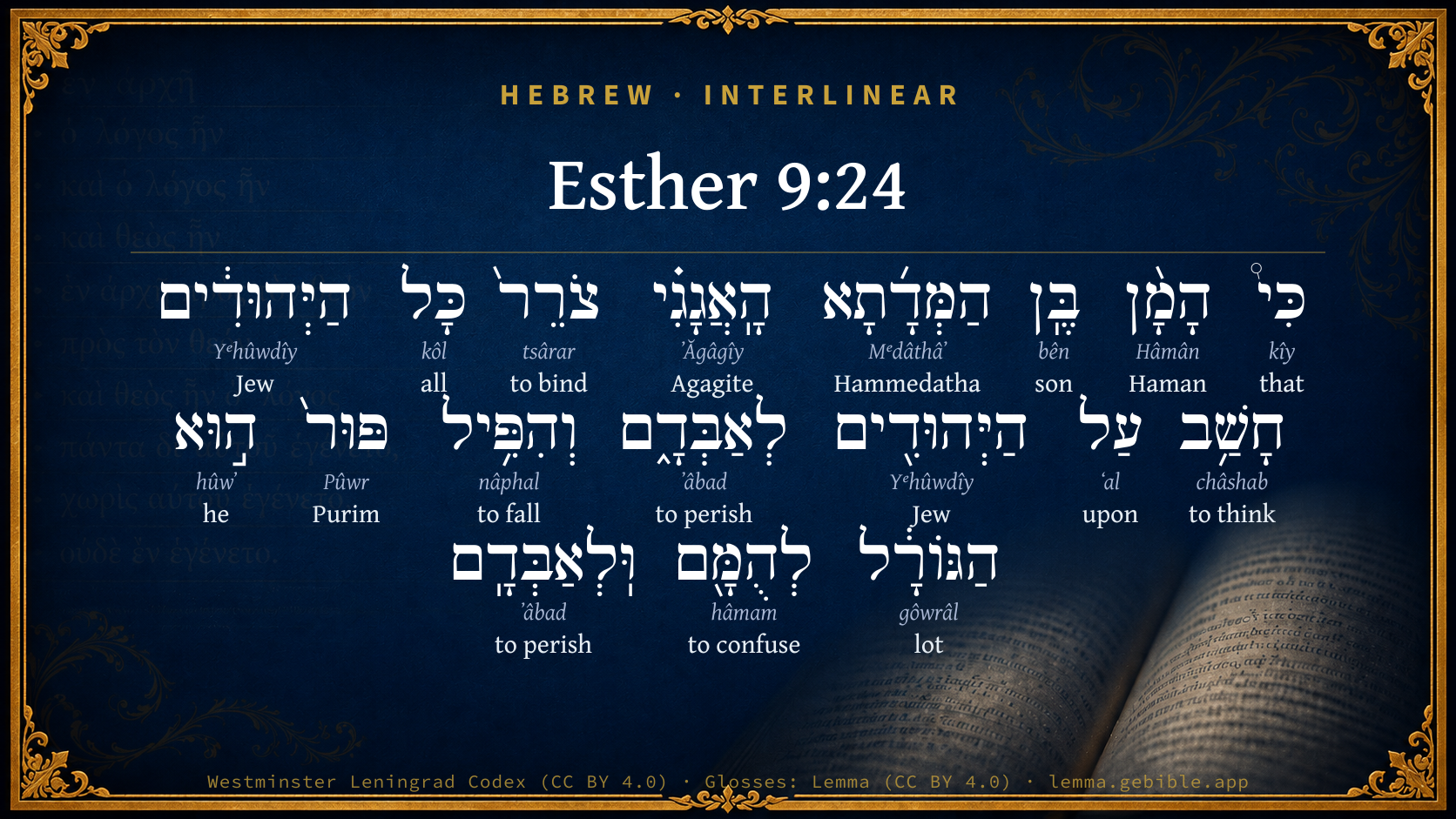
Esther 9:24

Hebrew (Westminster Leningrad Codex) Esther 9:24 appears in the Hebrew Old Testament. The text above is from the Westminster Leningrad Codex. Each word links to its Strong’s number, a concise gloss, and parsing drawn from the Open Scriptures Hebrew Bible morphology. Click any word for its full Brown-Driver-Briggs (BDB) entry.
Download image
Cite this verse

Esther 9:24 (World English Bible). Public Domain. Lemma interlinear Bible study tool, https://lemma.gebible.app/v/esther/9/24.

Show BibTeX & RIS
BibTeX
RIS
English Translation
because Haman the son of Hammedatha, the Agagite, the enemy of all the Jews, had plotted against the Jews to destroy them, and had cast Pur, that is the lot, to consume them, and to destroy them;
World English Bible · Public Domain
Download a study sheet

One document with this verse’s original text, its word-by-word gloss line, the meaning frame, cross-references with their text, attributed commentary, and full source and license credits — printable, and it pastes into notes with its structure intact.

This verse Autodidact and up

Study sheet (.html) Plain text (.txt)

A passage Seminary Student

Up to 50 verses in one chapter. A passage sheet keeps up to 6 commentary sources and 12 cross-references per verse, in the order this page ranks them, and says so on the sheet whenever that leaves anything out. Ask for a single verse and you get the Autodidact verse sheet above.

Everything on this page stays free to read, with no account — the sheet is a download of what is already on screen, not access to it.

Want to remove ads? Support Godless Engineer
Compare translations 3

The same verse in 3 English versions, stacked beneath the original-language interlinear above. Click any original word for its lexicon entry.

Each is an independent rendering of the whole verse — the interlinear is not word-aligned to these translations.

Highlighted words mark where these versions differ — a whole-verse word diff, not a word-by-word alignment.

  • World English Bible Public Domain
    because Haman the son of Hammedatha, the Agagite, the enemy of all the Jews, had plotted against the Jews to destroy them, and had cast Pur, that is the lot, to consume them, and to destroy them;
  • King James Version Public Domain
    Because Haman the son of Hammedatha, the Agagite, the enemy of all the Jews, had devised against the Jews to destroy them, and had cast Pur, that is, the lot, to consume them, and to destroy them;
  • unfoldingWord Literal Text CC BY-SA 4.0
    For Haman, the son of Hammedatha, the Agagite, the adversary of all the Jews, had plotted concerning the Jews to annihilate them. And he had cast a Pur (which is “the lot”) to vex them and to destroy them.

unfoldingWord Literal Text — © unfoldingWord, licensed CC BY-SA 4.0. Word-aligned USFM3 via Door43 (git.door43.org/unfoldingWord/en_ult).

Versions to compare (up to 4)

3 of 4 selected

Show all 18 translations

Every available English version of this verse, each an independent rendering of the whole verse.

  • World English Bible Public Domain
    because Haman the son of Hammedatha, the Agagite, the enemy of all the Jews, had plotted against the Jews to destroy them, and had cast Pur, that is the lot, to consume them, and to destroy them;
  • Berean Standard Bible Public Domain
    For Haman son of Hammedatha, the Agagite, the enemy of all the Jews, had plotted against the Jews to destroy them and had cast the Pur (that is, the lot) to crush and destroy them.
  • Majority Standard Bible Public Domain
    For Haman son of Hammedatha, the Agagite, the enemy of all the Jews, had plotted against the Jews to destroy them and had cast the Pur (that is, the lot) to crush and destroy them.
  • King James Version Public Domain
    Because Haman the son of Hammedatha, the Agagite, the enemy of all the Jews, had devised against the Jews to destroy them, and had cast Pur, that is, the lot, to consume them, and to destroy them;
  • American Standard Version (1901) Public Domain
    because Haman the son of Hammedatha, the Agagite, the enemy of all the Jews, had plotted against the Jews to destroy them, and had cast Pur, that is the lot, to consume them, and to destroy them;
  • Revised Version (1885) Public Domain
    because Haman the son of Hammedatha, the Agagite, the enemy of all the Jews, had devised against the Jews to destroy them, and had cast Pur, that is, the lot, to consume them, and to destroy them;
  • Geneva Bible (1599) Public Domain
    Because Haman the sonne of Hammedatha the Agagite al the Iewes aduersarie, had imagined against the Iewes, to destroy them, and had cast Pur (that is a lot) to consume and destroy them.
  • Douay-Rheims (1899) Public Domain
    For Aman, the son of Amadathi of the race of Agag, the enemy and adversary of the Jews, had devised evil against them, to kill them and destroy them: and had cast Phur, that is, the lot.
  • Young's Literal Translation Public Domain
    because Haman son of Hammedatha the Agagite, adversary of all the Jews, had devised concerning the Jews to destroy them, and had caused to fall Pur -- that `is' the lot -- to crush them and to destroy them;
  • Literal Standard Version CC BY-SA 4.0
    because Haman son of Hammedatha the Agagite, adversary of all the Jews, had devised concerning the Jews to destroy them, and had caused to fall Pur—that [is] the lot—to crush them and to destroy them;
  • Unlocked Literal Bible CC BY-SA 4.0
    At that time Haman son of Hammedatha the Agagite, the enemy of all the Jews, had plotted against the Jews to destroy them, and he threw Pur (that is, he threw lots), to crush and destroy them.
  • unfoldingWord Literal Text CC BY-SA 4.0
    For Haman, the son of Hammedatha, the Agagite, the adversary of all the Jews, had plotted concerning the Jews to annihilate them. And he had cast a Pur (which is “the lot”) to vex them and to destroy them.
  • Darby Bible Public Domain
    For Haman the son of Hammedatha the Agagite, the oppressor of all the Jews, had devised against the Jews to destroy them, and had cast Pur, that is, the lot, to consume them and to destroy them;
  • World Messianic Bible Public Domain
    because Haman the son of Hammedatha, the Agagite, the enemy of all the Jews, had plotted against the Jews to destroy them, and had cast “Pur”, that is the lot, to consume them and to destroy them;
  • Webster's Bible Public Domain
    Because Haman the son of Hammedatha, the Agagite, the enemy of all the Jews, had devised against the Jews to destroy them, and had cast Pur, that is, the lot, to consume them, and to destroy them;
  • Free Bible Version CC BY-SA 4.0
    For Haman, son of Hammedatha, the Agagite, the enemy of all the Jews, had plotted to destroy the Jews, and had cast “pur” (meaning a “lot”) to crush and destroy them.
  • Bible in Basic English Public Domain
    Because Haman, the son of Hammedatha the Agagite, the hater of all the Jews, had made designs for their destruction, attempting to get a decision by Pur (that is, chance) with a view to putting an end to them and cutting them off;
  • JPS Tanakh (1917) Public Domain
    because Haman the son of Hammedatha, the Agagite, the enemy of all the Jews, had devised against the Jews to destroy them, and had cast pur, that is, the lot, to discomfit them, and to destroy them;

Literal Standard Version (2020), Covenant Press — licensed CC BY-SA 4.0. Text via the HelloAO Bible API (eBible.org). Unlocked Literal Bible (unfoldingWord) — licensed CC BY-SA 4.0. Text via the HelloAO Bible API (eBible.org). unfoldingWord Literal Text — © unfoldingWord, licensed CC BY-SA 4.0. Word-aligned USFM3 via Door43 (git.door43.org/unfoldingWord/en_ult). Free Bible Version, Dr. Jonathan Gallagher — licensed CC BY-SA 4.0. Text via the HelloAO Bible API (eBible.org).

Word by word

More ways to search: Search by grammar → Find every occurrence → Compare this word →

Practice this passage: Drill this verse → Learn its vocabulary →

הַמְּדָ֜תָא
Mᵉdâthâʼ
H4099
“Hammedatha”
Noun, Proper
Part of Speech
Noun
Type
Proper
Full BDB Definition

Origin: of Persian origin

TWOT: None

Hammedatha = "double" - father of Haman
  1. כִּי֩ kîy H3588 “that” Conjunction
  2. הָמָ֨ן Hâmân H2001 “Haman” Noun, Proper
  3. בֶּֽן bên H1121 “son of” Noun, Common, Masculine, Singular, Construct
  4. הָֽאֲגָגִ֗י ʼĂgâgîy H91 “the · Agagite” Particle, Definite Article + Noun, Gentilic, Masculine, Singular, Absolute
  5. צֹרֵר֙ tsârar H6887 “binding” Verb, Qal, Participle Active, Masculine, Singular, Construct
  6. כָּל kôl H3605 “all of” Noun, Common, Masculine, Singular, Construct
  7. הַיְּהוּדִ֔ים Yᵉhûwdîy H3064 “the · Jews” Particle, Definite Article + Noun, Gentilic, Masculine, Plural, Absolute
  8. חָשַׁ֥ב châshab H2803 “to think” Verb, Qal, Perfect, 3rd Person, Masculine, Singular
  9. עַל ʻal H5921 “upon” Preposition
  10. הַיְּהוּדִ֖ים Yᵉhûwdîy H3064 “the · Jews” Particle, Definite Article + Noun, Gentilic, Masculine, Plural, Absolute
  11. לְאַבְּדָ֑ם ʼâbad H6 “to perish · them” Preposition + Verb, Piel, Infinitive Construct + Suffix, Personal, 3rd Person, Masculine, Plural
  12. וְהִפִּ֥יל nâphal H5307 “and · to fall” Conjunction + Verb, Hiphil, Perfect, 3rd Person, Masculine, Singular
  13. פּוּר֙ Pûwr H6332 “Purim” Noun, Common, Masculine, Singular, Absolute
  14. ה֣וּא hûwʼ H1931 “he” Pronoun, Personal, 3rd Person, Masculine, Singular
  15. הַגּוֹרָ֔ל gôwrâl H1486 “the · lot” Particle, Definite Article + Noun, Common, Masculine, Singular, Absolute
  16. לְהֻמָּ֖ם hâmam H2000 “to confuse · them” Preposition + Verb, Qal, Infinitive Construct + Suffix, Personal, 3rd Person, Masculine, Plural
  17. וּֽלְאַבְּדָֽם ʼâbad H6 “and · to perish · them” Conjunction + Preposition + Verb, Piel, Infinitive Construct + Suffix, Personal, 3rd Person, Masculine, Plural

About this verse

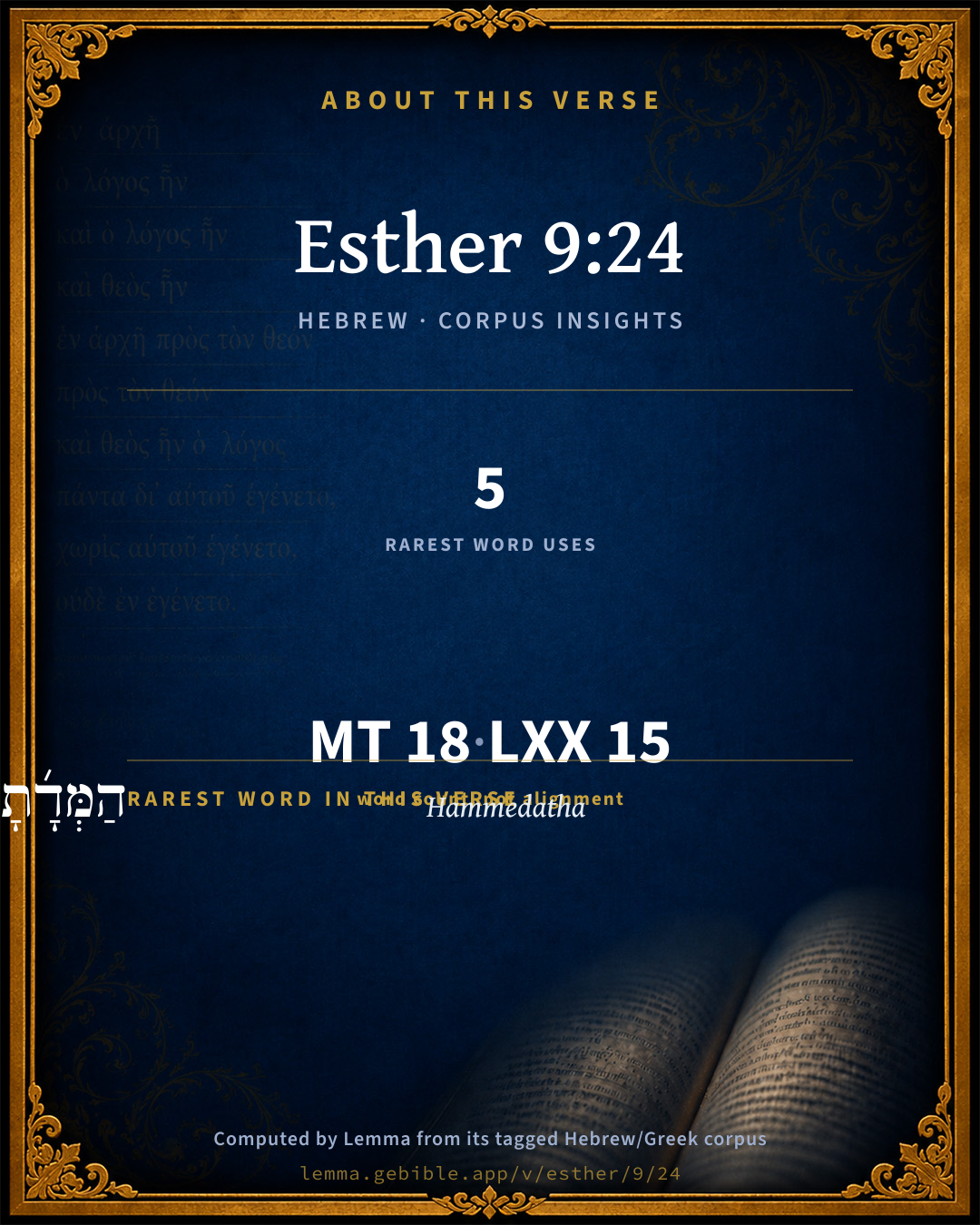
These counts appear in no published source. They are computed here, from the morphology-tagged text and Lemma’s own curated glosses. What Lemma adds →

18
words
16
distinct lemmas
Historical
section

Notable vocabulary

The rarest word here is הַמְּדָ֜תָא Hammedatha H4099 — appearing just 5 times in the whole Hebrew Bible.

Shared distinctive vocabulary

הַמְּדָ֜תָא Hammedatha H4099 occurs in 5 verses of the Hebrew Bible. Also found in:

Grammatical profile

  • 6 verbs
  • 9 nouns
  • 1 pronoun
  • 1 preposition
  • 1 conjunction

Verb forms

  • צֹרֵר֙ Qal · Participle Active
  • חָשַׁ֥ב Qal · Perfect
  • לְאַבְּדָ֑ם Piel · Infinitive Construct
  • וְהִפִּ֥יל Hiphil · Perfect
  • לְהֻמָּ֖ם Qal · Infinitive Construct
  • וּֽלְאַבְּדָֽם Piel · Infinitive Construct

Repetition

Words recur within this verse — often emphatic in Hebrew:

  • הַיְּהוּדִ֔ים Jew H3064 ×2
  • לְאַבְּדָ֑ם to perish H6 ×2

Hebrew & Septuagint length

In English translation the verse runs 37 words from the Hebrew and 24 from the Septuagint (LXX English) — the Septuagint runs noticeably shorter here. See the side-by-side →

A rough comparison of the two English renderings, which tokenize alike — not a word-level alignment.

Word counts can differ between the Hebrew and the Greek without any difference in meaning — e.g. the Hebrew direct-object marker אֵת has no separate Greek word, and Greek often adds the article ὁ.

In the original languages it is 18 Hebrew tokens and 15 Greek tokens — but the two are counted differently (Hebrew bundles its prefixes and suffixes into one token; the Greek is in lemma form), so that isn’t a like-for-like length.

Cross-references

2

Topical passages linked to Esther 9:24 in the Treasury of Scripture Knowledge — connected by theme and wording, ordered by reader-vote popularity; previews shown in the World English Bible.

  • Esther 3:5–13 When Haman saw that Mordecai didn't bow down, nor did him reverence, then was Haman full of wrath.
  • Esther 9:10 the ten sons of Haman the son of Hammedatha, the Jew's enemy, killed they; but they didn't lay their hand on the spoil.

Cross-references courtesy of OpenBible.info (CC BY 4.0).

Hebrew and Greek witnesses Masoretic Hebrew ↔ Greek Septuagint

The same verse in the two great witnesses to the Old Testament, shown verse-for-verse.

Here the Septuagint runs noticeably shorter than the Hebrew — LXX2012 (modern English Septuagint) 24 words vs World English Bible 37. A rough length comparison of the two English translations, not a word-level alignment — read both below.

These are two independent witnesses, not word-aligned to each other, and the Septuagint is shown in lemma (dictionary) form.

Hebrew Esther 9:24 Masoretic · Westminster Leningrad Codex

כִּי֩ הָמָ֨ן בֶּֽן הַמְּדָ֜תָא הָֽאֲגָגִ֗י צֹרֵר֙ כָּל הַיְּהוּדִ֔ים חָשַׁ֥ב עַל הַיְּהוּדִ֖ים לְאַבְּדָ֑ם וְהִפִּ֥יל פּוּר֙ ה֣וּא הַגּוֹרָ֔ל לְהֻמָּ֖ם וּֽלְאַבְּדָֽם

because Haman the son of Hammedatha, the Agagite, the enemy of all the Jews, had plotted against the Jews to destroy them, and had cast Pur, that is the lot, to consume them, and to destroy them;

World English Bible · Public Domain

Greek LXX Esther 9:24 Septuagint · lemma form

πῶς αμαν αμαδαθος ὁ μακεδών πολεμέω αὐτός καθώς τίθημι ψήφισμα καί κλῆρος ἀπο ἀναἵζω αὐτός

showing how Aman the son of Amadathes the Macedonian fought against them, how he made a decree and cast lots to destroy them utterly;

LXX2012 (modern English Septuagint) · Public Domain

Hebrew: Westminster Leningrad Codex (CC BY 4.0). Greek: Septuagint (public domain); English from LXX2012 (modern English Septuagint) (Public Domain). How the Septuagint differs from the Hebrew →

Commentary

Notes on Esther 9:24 from classic Christian and Jewish commentators (each source and its license shown beneath its notes). The classic Christian expositions comment on the surrounding passage and are grouped to its opening verse, so a note may address several verses; the Jewish commentaries on the Tanakh (Rashi and others) are per-verse, so they appear only where the commentator wrote on this verse.

Lemma curates 59 commentaries, every one of them public domain or Creative Commons licensed, each selected and text-cleaned for this edition rather than reprinted as found. About our sources →

Trapp's Complete Commentary

John Trapp

Est 9:24 Because Haman the son of Hammedatha, the Agagite, the enemy of all the Jews, had devised against the Jews to destroy them, and had cast Pur, that [is], the lot, to consume them, and to destroy them;

Ver. 24. Because Haman the son of Hammedatha the Agagite, &c.] In detestation of whose wicked plot, the Jews at this day, when, at this feast of Purim, they read the Book of Esther in their synagogues, as oft as they hear mention of Haman they do with their fists and hammers beat upon the benches and boards, as if they did knock upon Haman’s head (Anton. Meraanta. lib. de Jud. Cerem.). Lavater saith the Papists in some countries do the like on Good Friday, when, in reading the Gospel, mention is made of Judas the traitor. But as for Fawkes, Digby, Piercy, Catesby, and the rest of that hellish crew of Popish Hamans, treacherous Judases, these they have crowned with fresh eulogies, and little less than sainted. Garnet (that boute-feu) has his picture set among the rest of Rome’s saints, in the Jesuits’ Church at Rome, with this inscription, Voluisse sat est. To have been willing is enough. Prodigious impudency (Cornel. a Lapide in Apoc. vii. 8).

And had cast Pur] But found, to his cost, that "there is no enchantment against Jacob, neither any divination against Israel," but that, "according to this time it should be said of Jacob and Israel" (said by way of wonder at God’s doing on their behalf), "What hath God wrought!" Num 23:23.

To consume them] Heb. to crush them, ut contereret eos, as a thing crushed to pieces, as the lesser beasts are crushed by the lion, or as things are broken with a wooden hammer.

John Trapp, A Commentary or Exposition upon All the Books of the Old and New Testament (1647–1656) — public domain. Text from a community e-Sword module.

Joseph Benson's Commentary

Est 9:24. Because Haman had devised against the Jews to destroy them, and had cast Pur, that is, the lot — Haman had, by lot, determined this to be the time of the Jews’ destruction; but the Lord, at whose disposal the lot is, had determined it to be the time of their triumph. The name of this festival, therefore, would remind them of the sovereign dominion of the God of Israel, who served his own purposes by the foolish superstitions of the heathen, and outwitted the monthly prognosticators in their craft, Isa 47:14, frustrating the tokens of the liars, and making the diviners mad, Isa 44:26.

Joseph Benson's Commentary on the Old and New Testaments (1811–1818) — public domain. Text from a community e-Sword module.

Geneva Bible (1599)

Geneva Bible translators

Read Esther 3.

Geneva Bible (1599) marginal notes — public domain. Text via Bolls.life.

Ellicott's Commentary for English Readers

(24) Pur.—See above on Est_3:7.

A Bible Commentary for English Readers, edited by Charles John Ellicott (1878–1897) — public domain. Text from a community e-Sword module.

The Cambridge Bible for Schools and Colleges

gen. ed. J. J. S. Perowne

24. Pur, that is, the lot] See on Est_3:7.

The Cambridge Bible for Schools and Colleges (gen. ed. J. J. S. Perowne; Cambridge University Press, 1878–1918) — public domain. Text from a community e-Sword module.

John Gill's Exposition

Wherefore they called these days Purim, after the name of Pur,.... The lot; because of the lots cast by Haman; see Est 3:7,

therefore for all the words of this letter; in obedience to what Mordecai wrote in his letter to the Jews, and because of the things contained in it:

and of that which they had seen concerning this matter; with their own eyes, in the several provinces where their enemies rose up to assault them, but were destroyed by them:

and what had come unto them: by report; as the fall of Haman, and advancement of Mordecai, and the favours shown to Esther and her people; all this belongs to the following verse, containing the reasons of the Jews' appointment and engagement to observe the days of Purim.

John Gill's Exposition of the Whole Bible (1746–1763) — public domain (CC PDM 1.0). Text via the HelloAO Bible API.

Keil & Delitzsch

C. F. Keil & F. Delitzsch

For Haman, the enemy of all the Jews, had devised against the Jews to destroy them (comp. Est 3:1, Est 3:6.), and had cast Pur, that is the lot (see on Est 3:7), to consume them and to destroy them. המם, mostly used of the discomfiture with which God destroys the enemies, Exo 14:24; Deu 2:15, and elsewhere.

Keil & Delitzsch — Biblical Commentary on the Old Testament (1861–1891) — public domain (CC PDM 1.0). Text via the HelloAO Bible API. (Old Testament only.)

Rashi

Rabbi Shlomo Yitzchaki (Rashi)

For Haman the son of Hammedatha, the Agagite devised to terrify them and destroy them.

Rashi on the Tanakh — English translations: “The Judaica Press complete Tanach with Rashi, translated by A. J. Rosenberg” (CC BY 4.0); “Pentateuch with Rashi's commentary by M. Rosenbaum and A.M. Silbermann, 1929-1934” (public domain); “The Metsudah Tanach series, Lakewood, N.J” (CC BY 4.0); and “The Book of Joshua, Metsudah Publications, 1997” (CC BY 4.0). Text via Sefaria.

Lesson kit

Teaching starters — assembled from the data on this page, not authored interpretation. Every prompt links to the verse data it draws on. Edit before teaching.

Esther, in the Historical, opens this verse with 18 words (16 distinct Hebrew lemmas). Its most distinctive word is Mᵉdâthâʼ (“Hammedatha”). The Greek Septuagint runs shorter here. A historical commentator’s framing appears above. Read the whole chapter for the surrounding context.

Discussion questions

  1. How does “Hammedatha” (Mᵉdâthâʼ) shape what this verse is saying?
  2. Esther 3:1 shares the word «Hammedatha» with this verse. How do the two illuminate each other?
  3. “Jew” occurs 2× in this one verse. What is the effect of the repetition?
  4. Compared with the Hebrew, the Septuagint runs shorter here. What questions does that raise?
  5. These translations render this verse differently. What is at stake in choosing one wording over another?
  6. The verb «צֹרֵר֙» is Qal Participle Active. How does its form color the action?
  7. Reading how Trapp's Complete Commentary and Joseph Benson's Commentary read this verse, where do the two commentators agree and where do they part?

Things to notice

Reading settings

Reading text

Shown beneath each verse's original-language words.

Old Testament
Old Testament edition

Read the OT as the Masoretic Hebrew (MT) or the Greek Septuagint (LXX).

English shown for the Greek Septuagint (in the Hebrew ↔ Greek comparison).

Comparing translations? Open the Compare panel on any verse page to stack up to four side by side.