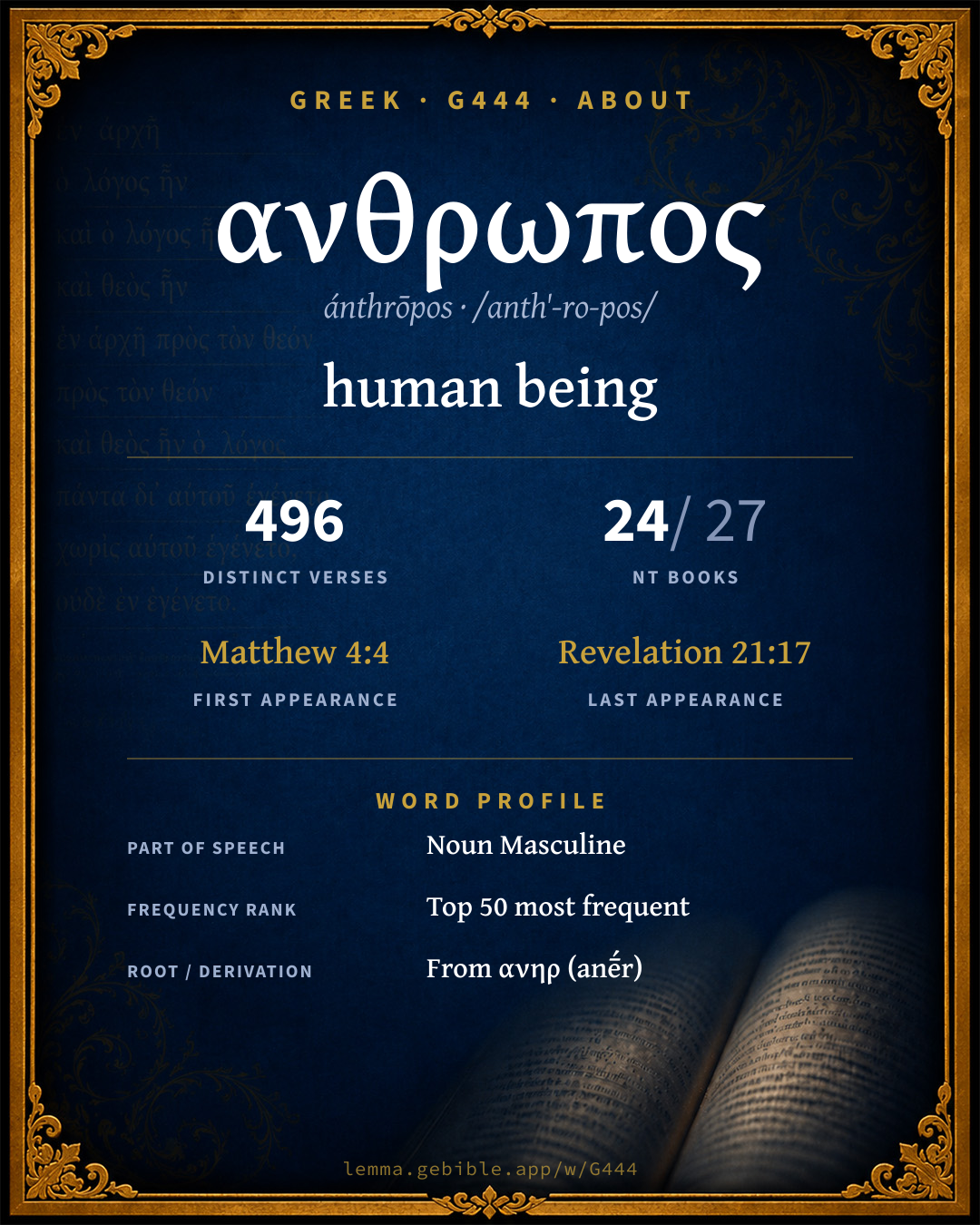
ἄνθρωπος
human being
‘human being’ is one of 4 main senses fuller range ↓
Full lexicon entry — Thayer's Greek Lexicon
From Thayer's Greek Lexicon
Where this word appears
See every Genitive-case word in the Greek New Testament →
Grammar key — what these labels mean
Part of speech
- Noun
- A naming word — a person, place, thing, or idea.
Case
- Genitive
- The case of source, possession, or “of” — answers “whose / from what.”
- Nominative
- The case of the subject (and the predicate nominative).
- Accusative
- The case of the direct object and of extent.
- Dative
- The case of the indirect object, means, or location — “to / for / with / in.”
- Vocative
- The case of direct address (“O Lord”).
Gender
- Masculine
- Grammatically masculine.
Number
- Singular
- One.
- Plural
- More than one.
Every verse where G444 appears in the Book of Luke — 86 distinct verses. Click any verse to open its interlinear word-by-word view. Verse text shown in the World English Bible for context — . Each verse’s Greek form is shown with its reference; the English is not keyword-highlighted, since the data carries no word-level English alignment. Use “Compare translations” on any verse to read it across multiple English versions. This concordance covers the Greek New Testament; Septuagint (Greek Old Testament) occurrences of this word are not indexed here.
Luke
- Luke 1:25 ἀνθρώποις n dat pl masc "Thus has the Lord done to me in the days in which he looked at me, to take away my reproach among men."
- Luke 2:14 ἀνθρώποις n dat pl masc "Glory to God in the highest, On earth peace, good will toward men."
- Luke 2:25 ἄνθρωπος ἄνθρωπος n nom sg masc n nom sg masc Behold, there was a man in Jerusalem whose name was Simeon. This man was righteous and devout, looking for the consolation of Israel, and the Holy Spirit was on him.
- Luke 2:52 ἀνθρώποις n dat pl masc And Jesus increased in wisdom and stature, and in favor with God and men.
- Luke 4:4 ἄνθρωπος n nom sg masc Jesus answered him, saying, "It is written, 'Man shall not live by bread alone, but by every word of God.'"
- Luke 4:33 ἄνθρωπος n nom sg masc In the synagogue there was a man who had a spirit of an unclean demon, and he cried out with a loud voice,
- Luke 5:10 ἀνθρώπους n acc pl masc and so also were James and John, sons of Zebedee, who were partners with Simon. Jesus said to Simon, "Don't be afraid. From now on you will be catching people alive."
- Luke 5:18 ἄνθρωπον n acc sg masc Behold, men brought a paralyzed man on a cot, and they sought to bring him in to lay before Jesus.
- Luke 5:20 ἄνθρωπε n voc sg masc Seeing their faith, he said to him, "Man, your sins are forgiven you."
- Luke 5:24 ἀνθρώπου n gen sg masc But that you may know that the Son of Man has authority on earth to forgive sins" (he said to the paralyzed man), "I tell you, arise, and take up your cot, and go to your house."
- Luke 6:5 ἀνθρώπου n gen sg masc He said to them, "The Son of Man is lord of the Sabbath."
- Luke 6:6 ἄνθρωπος n nom sg masc It also happened on another Sabbath that he entered into the synagogue and taught. There was a man there, and his right hand was withered.
- Luke 6:22 ἄνθρωποι ἀνθρώπου n nom pl masc n gen sg masc Blessed are you when men shall hate you, and when they shall exclude and mock you, and throw out your name as evil, for the Son of Man's sake.
- Luke 6:26 ἄνθρωποι n nom pl masc Woe, when men speak well of you! For their fathers did the same thing to the false prophets.
- Luke 6:31 ἄνθρωποι n nom pl masc "As you would like people to do to you, do exactly so to them.
- Luke 6:45 ἄνθρωπος n nom sg masc The good man out of the good treasure of his heart brings out that which is good, and the evil man out of the evil treasure of his heart brings out that which is evil, for out of the abundance of the heart, his mouth speaks.
- Luke 6:48 ἀνθρώπῳ n dat sg masc He is like a man building a house, who dug and went deep, and laid a foundation on the rock. When a flood arose, the stream broke against that house, and could not shake it, because it was founded on the rock.
- Luke 6:49 ἀνθρώπῳ n dat sg masc But he who hears, and doesn't do, is like a man who built a house on the earth without a foundation, against which the stream broke, and immediately it fell, and the ruin of that house was great."
- Luke 7:8 ἄνθρωπός n nom sg masc For I also am a man placed under authority, having under myself soldiers. I tell this one, 'Go!' and he goes; and to another, 'Come!' and he comes; and to my servant, 'Do this,' and he does it."
- Luke 7:25 ἄνθρωπον n acc sg masc But what did you go out to see? A man clothed in soft clothing? Behold, those who are gorgeously dressed, and live delicately, are in kings' courts.
- Luke 7:31 ἀνθρώπους n acc pl masc But the Lord said, "To what then will I liken the people of this generation? What are they like?
- Luke 7:34 ἀνθρώπου ἄνθρωπος n gen sg masc n nom sg masc The Son of Man has come eating and drinking, and you say, 'Behold, a gluttonous man, and a drunkard; a friend of tax collectors and sinners!'
- Luke 8:29 ἀνθρώπου n gen sg masc For Jesus was commanding the unclean spirit to come out of the man. For the unclean spirit had often seized the man. He was kept under guard, and bound with chains and fetters. Breaking the bands apart, he was driven by the demon into the desert.
- Luke 8:33 ἀνθρώπου n gen sg masc The demons came out from the man, and entered into the pigs, and the herd rushed down the steep bank into the lake, and were drowned.
- Luke 8:35 ἄνθρωπον n acc sg masc People went out to see what had happened. They came to Jesus, and found the man from whom the demons had gone out, sitting at Jesus' feet, clothed and in his right mind; and they were afraid.
- Luke 9:22 ἀνθρώπου n gen sg masc saying, "The Son of Man must suffer many things, and be rejected by the elders, chief priests, and scribes, and be killed, and the third day be raised up."
- Luke 9:25 ἄνθρωπος n nom sg masc For what does it profit a man if he gains the whole world, and loses or forfeits his own self?
- Luke 9:26 ἀνθρώπου n gen sg masc For whoever will be ashamed of me and of my words, of him will the Son of Man be ashamed, when he comes in his glory, and the glory of the Father, and of the holy angels.
- Luke 9:44 ἀνθρώπου ἀνθρώπων n gen sg masc n gen pl masc "Let these words sink into your ears, for the Son of Man will be delivered up into the hands of men."
- Luke 9:58 ἀνθρώπου n gen sg masc Jesus said to him, "The foxes have holes, and the birds of the sky have nests, but the Son of Man has no place to lay his head."
- Luke 10:30 ἄνθρωπός n nom sg masc Jesus answered, "A certain man was going down from Jerusalem to Jericho, and he fell among robbers, who both stripped him and beat him, and departed, leaving him half dead.
- Luke 11:24 ἀνθρώπου n gen sg masc The unclean spirit, when he has gone out of the man, passes through dry places, seeking rest, and finding none, he says, 'I will turn back to my house from which I came out.'
- Luke 11:26 ἀνθρώπου n gen sg masc Then he goes, and takes seven other spirits more evil than himself, and they enter in and dwell there. The last state of that man becomes worse than the first."
- Luke 11:30 ἀνθρώπου n gen sg masc For even as Jonah became a sign to the Ninevites, so will also the Son of Man be to this generation.
- Luke 11:44 ἄνθρωποι n nom pl masc Woe to you, scribes and Pharisees, hypocrites! For you are like hidden graves, and the men who walk over them don't know it."
- Luke 11:46 ἀνθρώπους n acc pl masc He said, "Woe to you lawyers also! For you load men with burdens that are difficult to carry, and you yourselves won't even lift one finger to help carry those burdens.
- Luke 12:8 ἀνθρώπων ἀνθρώπου n gen pl masc n gen sg masc "I tell you, everyone who confesses me before men, him will the Son of Man also confess before the angels of God;
- Luke 12:9 ἀνθρώπων n gen pl masc but he who denies me in the presence of men will be denied in the presence of the angels of God.
- Luke 12:10 ἀνθρώπου n gen sg masc Everyone who speaks a word against the Son of Man will be forgiven, but those who blaspheme against the Holy Spirit will not be forgiven.
- Luke 12:14 ἄνθρωπε n voc sg masc But he said to him, "Man, who made me a judge or an arbitrator over you?"
- Luke 12:16 ἀνθρώπου n gen sg masc He spoke a parable to them, saying, "The ground of a certain rich man brought forth abundantly.
- Luke 12:36 ἀνθρώποις n dat pl masc Be like men watching for their lord, when he returns from the marriage feast; that, when he comes and knocks, they may immediately open to him.
- Luke 12:40 ἀνθρώπου n gen sg masc Therefore be ready also, for the Son of Man is coming in an hour that you don't expect him."
- Luke 13:4 ἀνθρώπους n acc pl masc Or those eighteen, on whom the tower in Siloam fell, and killed them; do you think that they were worse offenders than all the men who dwell in Jerusalem?
- Luke 13:19 ἄνθρωπος n nom sg masc It is like a grain of mustard seed, which a man took, and put in his own garden. It grew, and became a large tree, and the birds of the sky lodged in its branches."
- Luke 14:2 ἄνθρωπός n nom sg masc Behold, a certain man who had dropsy was in front of him.
- Luke 14:16 ἄνθρωπός n nom sg masc But he said to him, "A certain man made a great supper, and he invited many people.
- Luke 14:30 ἄνθρωπος n nom sg masc saying, 'This man began to build, and wasn't able to finish.'
- Luke 15:4 ἄνθρωπος n nom sg masc "Which of you men, if you had one hundred sheep, and lost one of them, wouldn't leave the ninety-nine in the wilderness, and go after the one that was lost, until he found it?
- Luke 15:11 ἄνθρωπός n nom sg masc He said, "A certain man had two sons.
- Luke 16:1 ἄνθρωπός n nom sg masc He also said to his disciples, "There was a certain rich man who had a manager. An accusation was made to him that this man was wasting his possessions.
- Luke 16:15 ἀνθρώπων ἀνθρώποις n gen pl masc n dat pl masc He said to them, "You are those who justify yourselves in the sight of men, but God knows your hearts. For that which is exalted among men is an abomination in the sight of God.
- Luke 16:19 Ἄνθρωπος n nom sg masc "Now there was a certain rich man, and he was clothed in purple and fine linen, living in luxury every day.
- Luke 17:22 ἀνθρώπου n gen sg masc He said to the disciples, "The days will come, when you will desire to see one of the days of the Son of Man, and you will not see it.
- Luke 17:24 ἀνθρώπου n gen sg masc for as the lightning, when it flashes out of the one part under the sky, shines to the other part under the sky; so will the Son of Man be in his day.
- Luke 17:26 ἀνθρώπου n gen sg masc As it happened in the days of Noah, even so will it be also in the days of the Son of Man.
- Luke 17:30 ἀνθρώπου n gen sg masc It will be the same way in the day that the Son of Man is revealed.
- Luke 18:2 ἄνθρωπον n acc sg masc saying, "There was a judge in a certain city who didn't fear God, and didn't respect man.
- Luke 18:4 ἄνθρωπον n acc sg masc He wouldn't for a while, but afterward he said to himself, 'Though I neither fear God, nor respect man,
- Luke 18:8 ἀνθρώπου n gen sg masc I tell you that he will avenge them quickly. Nevertheless, when the Son of Man comes, will he find faith on the earth?"
- Luke 18:10 Ἄνθρωποι n nom pl masc "Two men went up into the temple to pray; one was a Pharisee, and the other was a tax collector.
- Luke 18:11 ἀνθρώπων n gen pl masc The Pharisee stood and prayed to himself like this: 'God, I thank you, that I am not like the rest of men, extortioners, unrighteous, adulterers, or even like this tax collector.
- Luke 18:27 ἀνθρώποις n dat pl masc But he said, "The things which are impossible with men are possible with God."
- Luke 18:31 ἀνθρώπου n gen sg masc He took the twelve aside, and said to them, "Behold, we are going up to Jerusalem, and all the things that are written through the prophets concerning the Son of Man will be completed.
- Luke 19:10 ἀνθρώπου n gen sg masc For the Son of Man came to seek and to save that which was lost."
- Luke 19:12 ἄνθρωπός n nom sg masc He said therefore, "A certain nobleman went into a far country to receive for himself a kingdom, and to return.
- Luke 19:21 ἄνθρωπος n nom sg masc for I feared you, because you are an exacting man. You take up that which you didn't lay down, and reap that which you didn't sow.'
- Luke 19:22 ἄνθρωπος n nom sg masc "He said to him, 'Out of your own mouth will I judge you, you wicked servant! You knew that I am an exacting man, taking up that which I didn't lay down, and reaping that which I didn't sow.
- Luke 19:30 ἀνθρώπων n gen pl masc saying, "Go your way into the village on the other side, in which, as you enter, you will find a colt tied, whereon no man ever yet sat. Untie it, and bring it.
- Luke 20:4 ἀνθρώπων n gen pl masc the baptism of John, was it from heaven, or from men?"
- Luke 20:6 ἀνθρώπων n gen pl masc But if we say, 'From men,' all the people will stone us, for they are persuaded that John was a prophet."
- Luke 20:9 ἄνθρωπός n nom sg masc He began to tell the people this parable. "A man planted a vineyard, and rented it out to some farmers, and went into another country for a long time.
- Luke 21:26 ἀνθρώπων n gen pl masc men fainting for fear, and for expectation of the things which are coming on the world: for the powers of the heavens will be shaken.
- Luke 21:27 ἀνθρώπου n gen sg masc Then they will see the Son of Man coming in a cloud with power and great glory.
- Luke 21:36 ἀνθρώπου n gen sg masc Therefore be watchful all the time, asking that you may be counted worthy to escape all these things that will happen, and to stand before the Son of Man."
- Luke 22:10 ἄνθρωπος n nom sg masc He said to them, "Behold, when you have entered into the city, a man carrying a pitcher of water will meet you. Follow him into the house which he enters.
- Luke 22:22 ἀνθρώπου ἀνθρώπῳ n gen sg masc n dat sg masc The Son of Man indeed goes, as it has been determined, but woe to that man through whom he is betrayed!"
- Luke 22:48 ἀνθρώπου n gen sg masc But Jesus said to him, "Judas, do you betray the Son of Man with a kiss?"
- Luke 22:58 ἄνθρωπε n voc sg masc After a little while someone else saw him, and said, "You also are one of them!" But Peter answered, "Man, I am not!"
- Luke 22:60 ἄνθρωπε n voc sg masc But Peter said, "Man, I don't know what you are talking about!" Immediately, while he was still speaking, a rooster crowed.
- Luke 22:69 ἀνθρώπου n gen sg masc From now on, the Son of Man will be seated at the right hand of the power of God."
- Luke 23:4 ἀνθρώπῳ n dat sg masc Pilate said to the chief priests and the multitudes, "I find no basis for a charge against this man."
- Luke 23:6 ἄνθρωπος n nom sg masc But when Pilate heard Galilee mentioned, he asked if the man was a Galilean.
- Luke 23:14 ἄνθρωπον ἀνθρώπῳ n acc sg masc n dat sg masc and said to them, "You brought this man to me as one that perverts the people, and see, I have examined him before you, and found no basis for a charge against this man concerning those things of which you accuse him.
- Luke 23:47 ἄνθρωπος n nom sg masc When the centurion saw what was done, he glorified God, saying, "Certainly this was a righteous man."
- Luke 24:7 ἀνθρώπου ἀνθρώπων n gen sg masc n gen pl masc saying that the Son of Man must be delivered up into the hands of sinful men, and be crucified, and the third day rise again?"
About this entry
At a glance — auto-summarized from this page’s data, not written by a person. Every figure links to its source below. This summary describes the numbers; it doesn’t interpret them.
ανθρωπος — transliterated ánthrōpos — is a Greek noun carrying the sense “human being.” Thayer's distinguishes 4 senses for it. The Greek New Testament uses it across 496 verses — common. Debuting at Matthew 4:4, it then recurs through the corpus. It shares a root with ανηρ, ανδραποδιστης and ανδριζομαι. Each statement above links to its evidence; the full detail follows below.
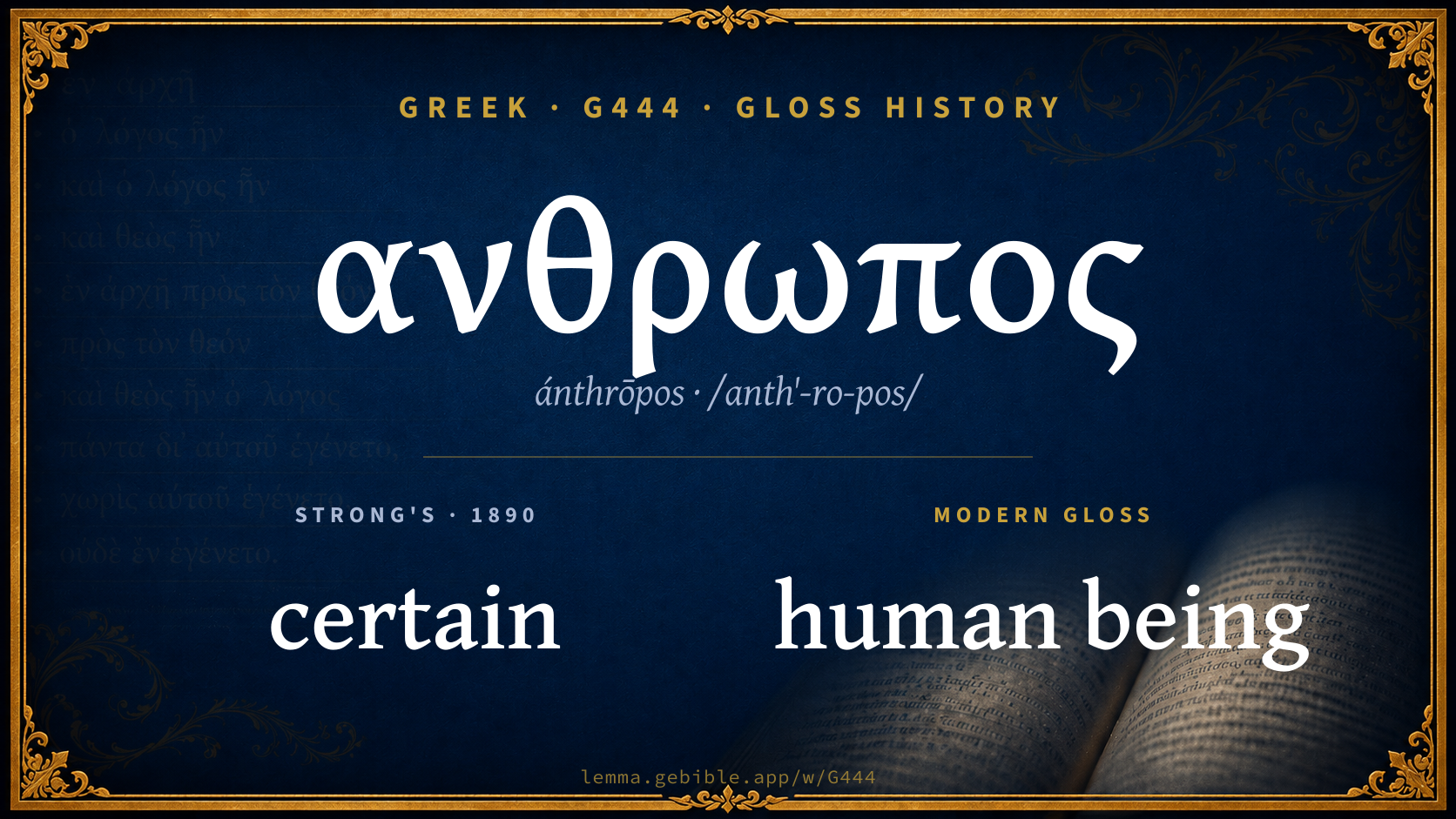
Gloss history
Strong's 1890 vs modern scholarship
About this word
Strong's G444 catalogs a Greek word from the Greek New Testament.
These counts are not copied from any lexicon or concordance. They are computed here, from the morphology-tagged Greek New Testament. What Lemma adds →
- 496
- distinct verses
- The word appears in 496 distinct verses.
- 24 / 27
- NT books
- The word appears in 24 of 27 New Testament books.
- #35
- by frequency
- Top 50 most frequent Greek words (rank 35 of 5,347 Greek words by occurrence).
View all 496 occurrences in the concordance →
By section of the New Testament
By traditional corpus
Conventional, traditional groupings — biblical authorship is debated, so this is a traditional corpus grouping, not an authorship claim. Some books belong to more than one corpus (Luke is in both the Gospels and the Lukan corpus, and so on), so these shares overlap and need not total 100%. Each figure is a share of the word’s 496 distinct verses.
- Gospels 291 verses · 59%
- Lukan (Luke–Acts) 131 verses · 26%
- Pauline corpus 111 verses · 22%
- Johannine 79 verses · 16%
- Revelation 24 verses · 5%
- General (Catholic) Epistles 17 verses · 3%
- Hebrews 8 verses · 2%
How translations render this word
Counts come from each version’s own published word-to-Strong’s tagging or interlinear alignment — an approximate guide to how each version renders this word, not a word-level alignment the data otherwise carries. Because each total is that version’s own tagged count, the per-version totals vary from one another and need not match the appearance or distinct-verse counts above. These counts may also differ from a printed concordance because Lemma counts each distinctly tagged rendering and does not collapse phrase taggings into a single head-word total. This is a fixed set of word-tagged versions (KJV, ASV, BSB, ULT) and does not change with the reading translation you choose elsewhere. Each version’s license is shown beside its name below (and on Sources).
- King James Version: Man 335×, Men 185×, Man's 10×
- American Standard Version: Man 337×, Men 182×, Certain 3×
- Berean Standard Bible: Man 284×, Men 124×, People 12×
- unfoldingWord Literal Text: Man 341×, Men 200×, A 21×
King James Version Public Domain
Renders G444 across 556 tagged occurrences — most commonly:
Plus 11 renderings that appear only once — usually multi-word phrases or single function words the recovered tagging swept in, not distinct renderings. Not rendered by a distinct English word in 3 further occurrences.
American Standard Version Public Domain
Renders G444 across 561 tagged occurrences — most commonly:
Plus 22 renderings that appear only once — usually multi-word phrases or single function words the recovered tagging swept in, not distinct renderings.
Berean Standard Bible Public Domain
Renders G444 across 479 tagged occurrences — most commonly:
Plus other, less common renderings. Plus 20 renderings that appear only once — usually multi-word phrases or single function words the recovered tagging swept in, not distinct renderings. Not rendered by a distinct English word in 66 further occurrences.
unfoldingWord Literal Text CC BY-SA 4.0
Renders G444 across 592 tagged occurrences — most commonly:
Plus 5 renderings that appear only once — usually multi-word phrases or single function words the recovered tagging swept in, not distinct renderings.
Senses in Thayer's
The 4 senses Thayer's distinguishes for this word, in lexicon order (not ranked by frequency or importance). The full entry — with sub-senses — is in the Lexicon Entry tab.
- a human being, whether male or female
- indefinitely, someone, a man, one
- in the plural, people
- joined with other words, merchantman
Word origin
Derived from ανηρ (anḗr) (G435) — man.
Forms in the corpus
The 14 distinct written forms G444 takes in the Greek New Testament, most frequent first — each parse links to that case’s occurrences in the concordance.
Same root — word family
Other Thayer's entries built from the same root as G444, grouped by Strong’s listed origin. These share a root / origin per the lexicon — not necessarily a shared meaning. Each links to that word’s own entry.
Derives from
Shares the same root
- ανδραποδιστης andrapodistḗs G405 man-stealer
- ανδριζομαι andrízomai G407 to show oneself brave
- ανδροφονος androphónos G409 murderer
Derived from this word
- ανηρ anḗr G435 man
- ανθρωπαρεσκος anthrōpáreskos G441 man-pleasing
- ανθρωπινος anthrṓpinos G442 human
- ανθρωποκτονος anthrōpoktónos G443 murderer
Proper names from this root
People and places named from this root — a name, not an additional meaning of the word.
Compare all same-root words → Showing 4 of 10 — not the complete family. 2 of the same-root words are proper names (people or places). They share a root, not necessarily a meaning.
Septuagint usage
The same Greek word ανθρωπος appears 1,098 times in the Greek Old Testament (Septuagint), across 983 verses in 36 books.
- 1,098
- LXX occurrences
- Tagged occurrences of this Greek word in the Septuagint.
- 983
- verses
- Distinct Septuagint verses containing this word.
- 36 / 39
- OT books
- The word appears in 36 of the 39 Old Testament books.
Sample Septuagint occurrences
- Genesis 1:26 ἄνθρωπος
- Exodus 2:11 ἄνθρωπος
- Leviticus 1:2 ἄνθρωπος
- Numbers 2:2 ἄνθρωπος
- Deuteronomy 1:17 ἄνθρωπος
- Joshua 1:5 ἄνθρωπος
- Judges 9:13 ἄνθρωπος
- 1 Samuel 1:1 ἄνθρωπος
- 2 Samuel 7:14 ἄνθρωπος
- 1 Kings 2:32 ἄνθρωπος
- 2 Kings 1:9 ἄνθρωπος
- 1 Chronicles 17:17 ἄνθρωπος
Septuagint occurrences (same lexeme)
Every verse where the same Strong’s number (G444) appears in the Greek Septuagint — showing the first 50 of 983. Verse text shown in the World English Bible for context; the Greek form is the matched word — the English is not keyword-highlighted.
- Genesis 1:26 ἄνθρωπος God said, "Let us make man in our image, after our likeness: and let them have dominion over the fish of the sea, and over the birds of the sky, and over the cattle, and over all the earth, and over every creeping thing that creeps on the earth."
- Genesis 1:27 ἄνθρωπος God created man in his own image. In God's image he created him; male and female he created them.
- Genesis 2:5 ἄνθρωπος No plant of the field was yet in the earth, and no herb of the field had yet sprung up; for Yahweh God had not caused it to rain on the earth. There was not a man to till the ground,
- Genesis 2:7 ἄνθρωπος Yahweh God formed man from the dust of the ground, and breathed into his nostrils the breath of life; and man became a living soul.
- Genesis 2:8 ἄνθρωπος Yahweh God planted a garden eastward, in Eden, and there he put the man whom he had formed.
- Genesis 2:15 ἄνθρωπος Yahweh God took the man, and put him into the garden of Eden to dress it and to keep it.
- Genesis 2:18 ἄνθρωπος Yahweh God said, "It is not good that the man should be alone; I will make him a helper suitable for him."
- Genesis 2:24 ἄνθρωπος Therefore a man will leave his father and his mother, and will join with his wife, and they will be one flesh.
- Genesis 4:1 ἄνθρωπος The man knew Eve his wife. She conceived, and gave birth to Cain, and said, "I have gotten a man with Yahweh's help."
- Genesis 5:1 ἄνθρωπος This is the book of the generations of Adam. In the day that God created man, he made him in God's likeness.
- Genesis 6:1 ἄνθρωπος It happened, when men began to multiply on the surface of the ground, and daughters were born to them,
- Genesis 6:2 ἄνθρωπος that God's sons saw that men's daughters were beautiful, and they took for themselves wives of all that they chose.
- Genesis 6:3 ἄνθρωπος Yahweh said, "My Spirit will not strive with man forever, because he also is flesh; yet will his days be one hundred twenty years."
- Genesis 6:4 ἄνθρωπος The Nephilim were in the earth in those days, and also after that, when God's sons came to men's daughters. They bore children to them: the same were the mighty men who were of old, men of renown.
- Genesis 6:5 ἄνθρωπος Yahweh saw that the wickedness of man was great in the earth, and that every imagination of the thoughts of his heart was only evil continually.
- Genesis 6:6 ἄνθρωπος Yahweh was sorry that he had made man on the earth, and it grieved him in his heart.
- Genesis 6:7 ἄνθρωπος Yahweh said, "I will destroy man whom I have created from the surface of the ground; man, along with animals, creeping things, and birds of the sky; for I am sorry that I have made them."
- Genesis 6:9 ἄνθρωπος This is the history of the generations of Noah. Noah was a righteous man, blameless among the people of his time. Noah walked with God.
- Genesis 6:13 ἄνθρωπος God said to Noah, "The end of all flesh has come before me, for the earth is filled with violence through them. Behold, I will destroy them with the earth.
- Genesis 7:21 ἄνθρωπος All flesh died that moved on the earth, including birds, cattle, animals, every creeping thing that creeps on the earth, and every man.
- Genesis 7:23 ἄνθρωπος Every living thing was destroyed that was on the surface of the ground, including man, cattle, creeping things, and birds of the sky. They were destroyed from the earth. Only Noah was left, and those who were with him in the ark.
- Genesis 8:21 ἄνθρωπος Yahweh smelled the sweet savor. Yahweh said in his heart, "I will not again curse the ground any more for man's sake, because the imagination of man's heart is evil from his youth; neither will I ever again strike everything living, as I have done.
- Genesis 9:5 ἄνθρωπος I will surely require your blood of your lives. At the hand of every animal I will require it. At the hand of man, even at the hand of every man's brother, I will require the life of man.
- Genesis 9:6 ἄνθρωπος Whoever sheds man's blood, by man will his blood be shed, for in the image of God made he man.
- Genesis 9:20 ἄνθρωπος Noah began to be a farmer, and planted a vineyard.
- Genesis 11:3 ἄνθρωπος They said one to another, "Come, let's make brick, and burn them thoroughly." They had brick for stone, and they used tar for mortar.
- Genesis 11:5 ἄνθρωπος Yahweh came down to see the city and the tower, which the children of men built.
- Genesis 13:8 ἄνθρωπος Abram said to Lot, "Please, let there be no strife between me and you, and between my herdsmen and your herdsmen; for we are relatives.
- Genesis 13:13 ἄνθρωπος Now the men of Sodom were exceedingly wicked and sinners against Yahweh.
- Genesis 16:12 ἄνθρωπος He will be like a wild donkey among men. His hand will be against every man, and every man's hand against him. He will live opposite all of his brothers."
- Genesis 20:7 ἄνθρωπος Now therefore, restore the man's wife. For he is a prophet, and he will pray for you, and you will live. If you don't restore her, know for sure that you will die, you, and all who are yours."
- Genesis 20:8 ἄνθρωπος Abimelech rose early in the morning, and called all his servants, and told all these things in their ear. The men were very scared.
- Genesis 24:21 ἄνθρωπος The man looked steadfastly at her, holding his peace, to know whether Yahweh had made his journey prosperous or not.
- Genesis 24:22 ἄνθρωπος It happened, as the camels had done drinking, that the man took a golden ring of half a shekel weight, and two bracelets for her hands of ten shekels weight of gold,
- Genesis 24:26 ἄνθρωπος The man bowed his head, and worshiped Yahweh.
- Genesis 24:29 ἄνθρωπος Rebekah had a brother, and his name was Laban. Laban ran out to the man, to the spring.
- Genesis 24:30 ἄνθρωπος It happened, when he saw the ring, and the bracelets on his sister's hands, and when he heard the words of Rebekah his sister, saying, "This is what the man said to me," that he came to the man. Behold, he was standing by the camels at the spring.
- Genesis 24:32 ἄνθρωπος The man came into the house, and he unloaded the camels. He gave straw and provender for the camels, and water to wash his feet and the feet of the men who were with him.
- Genesis 24:43 ἄνθρωπος Behold, I am standing by the spring of water. Let it happen, that the maiden who comes forth to draw, to whom I will say, Give me, I pray you, a little water from your pitcher to drink.
- Genesis 24:58 ἄνθρωπος They called Rebekah, and said to her, "Will you go with this man?" She said, "I will go."
- Genesis 24:61 ἄνθρωπος Rebekah arose with her ladies. They rode on the camels, and followed the man. The servant took Rebekah, and went his way.
- Genesis 24:65 ἄνθρωπος She said to the servant, "Who is the man who is walking in the field to meet us?" The servant said, "It is my master." She took her veil, and covered herself.
- Genesis 25:27 ἄνθρωπος The boys grew. Esau was a skillful hunter, a man of the field. Jacob was a quiet man, living in tents.
- Genesis 26:11 ἄνθρωπος Abimelech charged all the people, saying, "He who touches this man or his wife will surely be put to death."
- Genesis 26:13 ἄνθρωπος The man grew great, and grew more and more until he became very great.
- Genesis 26:31 ἄνθρωπος They rose up some time in the morning, and swore one to another. Isaac sent them away, and they departed from him in peace.
- Genesis 30:43 ἄνθρωπος The man increased exceedingly, and had large flocks, maid-servants and men-servants, and camels and donkeys.
- Genesis 32:25 ἄνθρωπος When he saw that he didn't prevail against him, he touched the hollow of his thigh, and the hollow of Jacob's thigh was strained, as he wrestled.
- Genesis 32:29 ἄνθρωπος Jacob asked him, "Please tell me your name." He said, "Why is it that you ask what my name is?" He blessed him there.
- Genesis 34:14 ἄνθρωπος and said to them, "We can't do this thing, to give our sister to one who is uncircumcised; for that is a reproach to us.
These are occurrences of the same Greek lexeme (G444) in the Septuagint — not a translation of any one Hebrew word. The store carries no word-level Hebrew↔Greek alignment, so no Hebrew original is asserted here. Counts come from the recovered LXX Strong's tagging — high-frequency vocabulary is well covered, while rare or late forms may be untagged — so they reflect tagged occurrences and may slightly undercount.