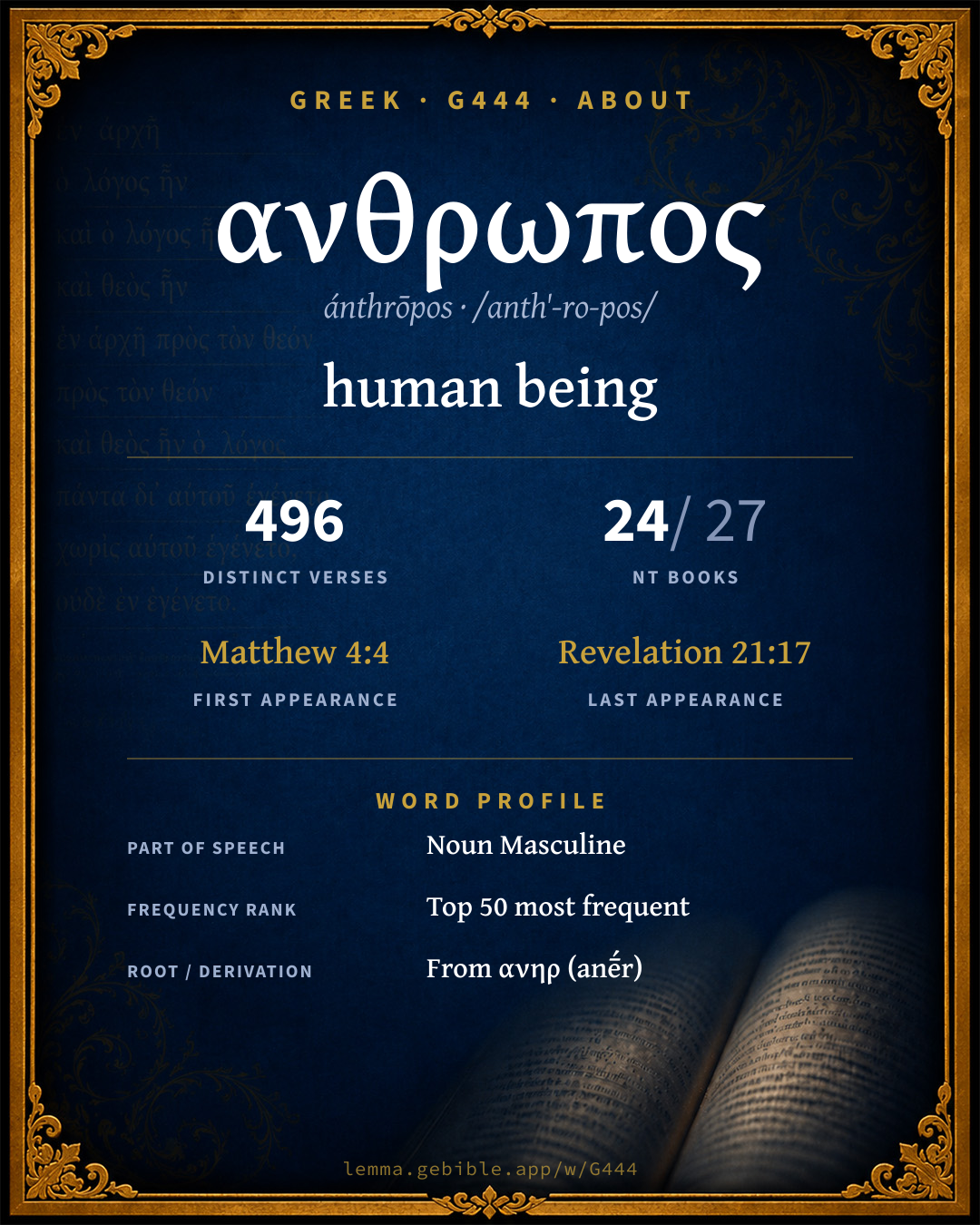
ἄνθρωπος
human being
‘human being’ is one of 4 main senses fuller range ↓
Full lexicon entry — Thayer's Greek Lexicon
From Thayer's Greek Lexicon
Where this word appears
See every Nominative-case word in the Greek New Testament →
Grammar key — what these labels mean
Part of speech
- Noun
- A naming word — a person, place, thing, or idea.
Case
- Genitive
- The case of source, possession, or “of” — answers “whose / from what.”
- Nominative
- The case of the subject (and the predicate nominative).
- Accusative
- The case of the direct object and of extent.
- Dative
- The case of the indirect object, means, or location — “to / for / with / in.”
- Vocative
- The case of direct address (“O Lord”).
Gender
- Masculine
- Grammatically masculine.
Number
- Singular
- One.
- Plural
- More than one.
Every verse where G444 appears in the Book of Acts — 45 distinct verses. Click any verse to open its interlinear word-by-word view. Verse text shown in the World English Bible for context — . Each verse’s Greek form is shown with its reference; the English is not keyword-highlighted, since the data carries no word-level English alignment. Use “Compare translations” on any verse to read it across multiple English versions. This concordance covers the Greek New Testament; Septuagint (Greek Old Testament) occurrences of this word are not indexed here.
Acts
- Acts 4:9 ἀνθρώπου n gen sg masc if we are examined today concerning a good deed done to a crippled man, by what means this man has been healed,
- Acts 4:12 ἀνθρώποις n dat pl masc There is salvation in none other, for neither is there any other name under heaven, that is given among men, by which we must be saved!"
- Acts 4:13 ἄνθρωποι n nom pl masc Now when they saw the boldness of Peter and John, and had perceived that they were unlearned and ignorant men, they marveled. They recognized that they had been with Jesus.
- Acts 4:14 ἄνθρωπον n acc sg masc Seeing the man who was healed standing with them, they could say nothing against it.
- Acts 4:16 ἀνθρώποις n dat pl masc saying, "What shall we do to these men? Because indeed a notable miracle has been done through them, as can be plainly seen by all who dwell in Jerusalem, and we can't deny it.
- Acts 4:17 ἀνθρώπων n gen pl masc But so that this spreads no further among the people, let's threaten them, that from now on they don't speak to anyone in this name."
- Acts 4:22 ἄνθρωπος n nom sg masc For the man on whom this miracle of healing was performed was more than forty years old.
- Acts 5:4 ἀνθρώποις n dat pl masc While you kept it, didn't it remain your own? After it was sold, wasn't it in your power? How is it that you have conceived this thing in your heart? You haven't lied to men, but to God."
- Acts 5:28 ἀνθρώπου n gen sg masc saying, "Didn't we strictly charge you not to teach in this name? Behold, you have filled Jerusalem with your teaching, and intend to bring this man's blood on us."
- Acts 5:29 ἀνθρώποις n dat pl masc But Peter and the apostles answered, "We must obey God rather than men.
- Acts 5:34 ἀνθρώπους n acc pl masc But one stood up in the council, a Pharisee named Gamaliel, a teacher of the law, honored by all the people, and commanded to put the apostles out for a little while.
- Acts 5:35 ἀνθρώποις n dat pl masc He said to them, "You men of Israel, be careful concerning these men, what you are about to do.
- Acts 5:38 ἀνθρώπων ἀνθρώπων n gen pl masc n gen pl masc Now I tell you, withdraw from these men, and leave them alone. For if this counsel or this work is of men, it will be overthrown.
- Acts 6:13 ἄνθρωπος n nom sg masc and set up false witnesses who said, "This man never stops speaking blasphemous words against this holy place and the law.
- Acts 7:56 ἀνθρώπου n gen sg masc and said, "Behold, I see the heavens opened, and the Son of Man standing at the right hand of God!"
- Acts 9:33 ἄνθρωπόν n acc sg masc There he found a certain man named Aeneas, who had been bedridden for eight years, because he was paralyzed.
- Acts 10:26 ἄνθρωπός n nom sg masc But Peter raised him up, saying, "Stand up! I myself am also a man."
- Acts 10:28 ἄνθρωπον n acc sg masc He said to them, "You yourselves know how it is an unlawful thing for a man who is a Jew to join himself or come to one of another nation, but God has shown me that I shouldn't call any man unholy or unclean.
- Acts 12:22 ἀνθρώπου n gen sg masc The people shouted, "The voice of a god, and not of a man!"
- Acts 14:11 ἀνθρώποις n dat pl masc When the multitude saw what Paul had done, they lifted up their voice, saying in the language of Lycaonia, "The gods have come down to us in the likeness of men!"
- Acts 14:15 ἄνθρωποι n nom pl masc "Men, why are you doing these things? We also are men of like passions with you, and bring you good news, that you should turn from these vain things to the living God, who made the sky and the earth and the sea, and all that is in them;
- Acts 15:17 ἀνθρώπων n gen pl masc That the rest of men may seek after the Lord; All the Gentiles who are called by my name, Says the Lord, who does all these things.
- Acts 15:26 ἀνθρώποις n dat pl masc men who have risked their lives for the name of our Lord Jesus Christ.
- Acts 16:17 ἄνθρωποι n nom pl masc Following Paul and us, she cried out, "These men are servants of the Most High God, who proclaim to us the way of salvation!"
- Acts 16:20 ἄνθρωποι n nom pl masc When they had brought them to the magistrates, they said, "These men, being Jews, are agitating our city,
- Acts 16:35 ἀνθρώπους n acc pl masc But when it was day, the magistrates sent the sergeants, saying, "Let those men go."
- Acts 16:37 ἀνθρώπους n acc pl masc But Paul said to them, "They have beaten us publicly, without a trial, men who are Romans, and have cast us into prison! Do they now release us secretly? No, most assuredly, but let them come themselves and bring us out!"
- Acts 17:26 ἀνθρώπων n gen pl masc He made from one blood every nation of men to dwell on all the surface of the earth, having determined appointed seasons, and the boundaries of their dwellings,
- Acts 17:29 ἀνθρώπου n gen sg masc Being then the offspring of God, we ought not to think that the Divine Nature is like gold, or silver, or stone, engraved by art and design of man.
- Acts 17:30 ἀνθρώποις n dat pl masc The times of ignorance therefore God overlooked. But now he commands that all people everywhere should repent,
- Acts 18:13 ἀνθρώπους n acc pl masc saying, "This man persuades men to worship God contrary to the law."
- Acts 19:16 ἄνθρωπος n nom sg masc The man in whom the evil spirit was leaped on them, and overpowered them, and prevailed against them, so that they fled out of that house naked and wounded.
- Acts 19:35 ἀνθρώπων n gen pl masc When the town clerk had quieted the multitude, he said, "You men of Ephesus, what man is there who doesn't know that the city of the Ephesians is temple-keeper of the great goddess Artemis, and of the image which fell down from Zeus?
- Acts 21:28 ἄνθρωπος n nom sg masc crying out, "Men of Israel, help! This is the man who teaches all men everywhere against the people, and the law, and this place. Moreover, he also brought Greeks into the temple, and has defiled this holy place!"
- Acts 21:39 ἄνθρωπος n nom sg masc But Paul said, "I am a Jew, from Tarsus in Cilicia, a citizen of no insignificant city. I beg you, allow me to speak to the people."
- Acts 22:15 ἀνθρώπους n acc pl masc For you will be a witness for him to all men of what you have seen and heard.
- Acts 22:25 ἄνθρωπον n acc sg masc When they had tied him up with thongs, Paul asked the centurion who stood by, "Is it lawful for you to scourge a man who is a Roman, and not found guilty?"
- Acts 22:26 ἄνθρωπος n nom sg masc When the centurion heard it, he went to the commanding officer and told him, "Watch what you are about to do, for this man is a Roman!"
- Acts 23:9 ἀνθρώπῳ n dat sg masc A great clamor arose, and some of the scribes of the Pharisees part stood up, and contended, saying, "We find no evil in this man. But if a spirit or angel has spoken to him, let's not fight against God!"
- Acts 24:16 ἀνθρώπους n acc pl masc Herein I also practice always having a conscience void of offense toward God and men.
- Acts 25:16 ἄνθρωπον n acc sg masc To whom I answered that it is not the custom of the Romans to give up any man to destruction, before the accused has met the accusers face to face, and has had opportunity to make his defense concerning the matter laid against him.
- Acts 25:22 ἀνθρώπου n gen sg masc Agrippa said to Festus, "I also would like to hear the man myself." "Tomorrow," he said, "you shall hear him."
- Acts 26:31 ἄνθρωπος n nom sg masc When they had withdrawn, they spoke one to another, saying, "This man does nothing worthy of death or of bonds."
- Acts 26:32 ἄνθρωπος n nom sg masc Agrippa said to Festus, "This man might have been set free if he had not appealed to Caesar."
- Acts 28:4 ἄνθρωπος n nom sg masc When the natives saw the creature hanging from his hand, they said one to another, "No doubt this man is a murderer, whom, though he has escaped from the sea, yet Justice has not allowed to live."
About this entry
At a glance — auto-summarized from this page’s data, not written by a person. Every figure links to its source below. This summary describes the numbers; it doesn’t interpret them.
ανθρωπος — transliterated ánthrōpos — is a Greek noun carrying the sense “human being.” Thayer's distinguishes 4 senses for it. The Greek New Testament uses it across 496 verses — common. Debuting at Matthew 4:4, it then recurs through the corpus. It shares a root with ανηρ, ανδραποδιστης and ανδριζομαι. Each statement above links to its evidence; the full detail follows below.
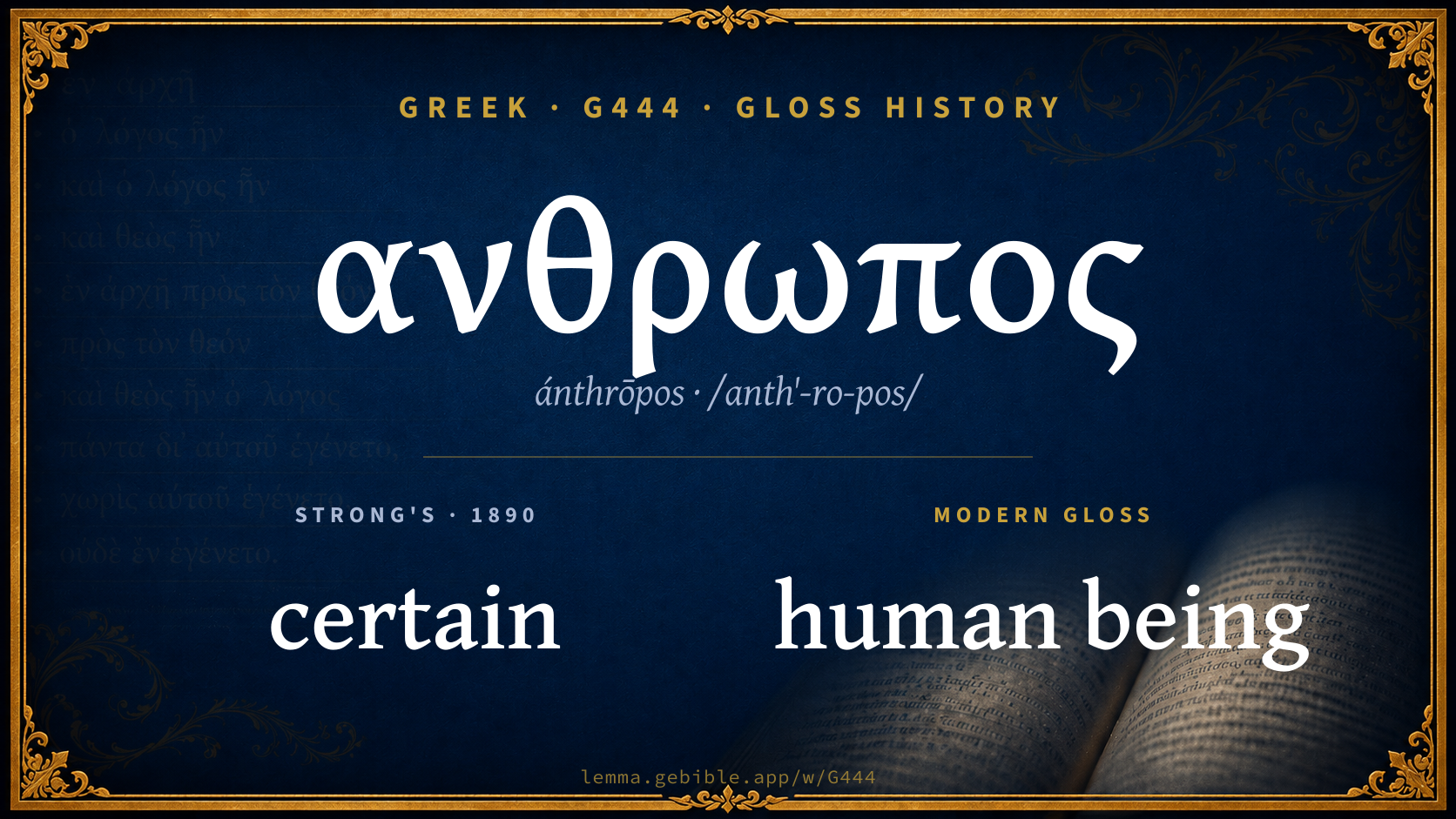
Gloss history
Strong's 1890 vs modern scholarship
About this word
Strong's G444 catalogs a Greek word from the Greek New Testament.
These counts are not copied from any lexicon or concordance. They are computed here, from the morphology-tagged Greek New Testament. What Lemma adds →
- 496
- distinct verses
- The word appears in 496 distinct verses.
- 24 / 27
- NT books
- The word appears in 24 of 27 New Testament books.
- #35
- by frequency
- Top 50 most frequent Greek words (rank 35 of 5,347 Greek words by occurrence).
View all 496 occurrences in the concordance →
By section of the New Testament
By traditional corpus
Conventional, traditional groupings — biblical authorship is debated, so this is a traditional corpus grouping, not an authorship claim. Some books belong to more than one corpus (Luke is in both the Gospels and the Lukan corpus, and so on), so these shares overlap and need not total 100%. Each figure is a share of the word’s 496 distinct verses.
- Gospels 291 verses · 59%
- Lukan (Luke–Acts) 131 verses · 26%
- Pauline corpus 111 verses · 22%
- Johannine 79 verses · 16%
- Revelation 24 verses · 5%
- General (Catholic) Epistles 17 verses · 3%
- Hebrews 8 verses · 2%
How translations render this word
Counts come from each version’s own published word-to-Strong’s tagging or interlinear alignment — an approximate guide to how each version renders this word, not a word-level alignment the data otherwise carries. Because each total is that version’s own tagged count, the per-version totals vary from one another and need not match the appearance or distinct-verse counts above. These counts may also differ from a printed concordance because Lemma counts each distinctly tagged rendering and does not collapse phrase taggings into a single head-word total. This is a fixed set of word-tagged versions (KJV, ASV, BSB, ULT) and does not change with the reading translation you choose elsewhere. Each version’s license is shown beside its name below (and on Sources).
- King James Version: Man 335×, Men 185×, Man's 10×
- American Standard Version: Man 337×, Men 182×, Certain 3×
- Berean Standard Bible: Man 284×, Men 124×, People 12×
- unfoldingWord Literal Text: Man 341×, Men 200×, A 21×
King James Version Public Domain
Renders G444 across 556 tagged occurrences — most commonly:
Plus 11 renderings that appear only once — usually multi-word phrases or single function words the recovered tagging swept in, not distinct renderings. Not rendered by a distinct English word in 3 further occurrences.
American Standard Version Public Domain
Renders G444 across 561 tagged occurrences — most commonly:
Plus 22 renderings that appear only once — usually multi-word phrases or single function words the recovered tagging swept in, not distinct renderings.
Berean Standard Bible Public Domain
Renders G444 across 479 tagged occurrences — most commonly:
Plus other, less common renderings. Plus 20 renderings that appear only once — usually multi-word phrases or single function words the recovered tagging swept in, not distinct renderings. Not rendered by a distinct English word in 66 further occurrences.
unfoldingWord Literal Text CC BY-SA 4.0
Renders G444 across 592 tagged occurrences — most commonly:
Plus 5 renderings that appear only once — usually multi-word phrases or single function words the recovered tagging swept in, not distinct renderings.
Senses in Thayer's
The 4 senses Thayer's distinguishes for this word, in lexicon order (not ranked by frequency or importance). The full entry — with sub-senses — is in the Lexicon Entry tab.
- a human being, whether male or female
- indefinitely, someone, a man, one
- in the plural, people
- joined with other words, merchantman
Word origin
Derived from ανηρ (anḗr) (G435) — man.
Forms in the corpus
The 14 distinct written forms G444 takes in the Greek New Testament, most frequent first — each parse links to that case’s occurrences in the concordance.
Same root — word family
Other Thayer's entries built from the same root as G444, grouped by Strong’s listed origin. These share a root / origin per the lexicon — not necessarily a shared meaning. Each links to that word’s own entry.
Derives from
Shares the same root
- ανδραποδιστης andrapodistḗs G405 man-stealer
- ανδριζομαι andrízomai G407 to show oneself brave
- ανδροφονος androphónos G409 murderer
Derived from this word
- ανηρ anḗr G435 man
- ανθρωπαρεσκος anthrōpáreskos G441 man-pleasing
- ανθρωπινος anthrṓpinos G442 human
- ανθρωποκτονος anthrōpoktónos G443 murderer
Proper names from this root
People and places named from this root — a name, not an additional meaning of the word.
Compare all same-root words → Showing 4 of 10 — not the complete family. 2 of the same-root words are proper names (people or places). They share a root, not necessarily a meaning.
Septuagint usage
The same Greek word ανθρωπος appears 1,098 times in the Greek Old Testament (Septuagint), across 983 verses in 36 books.
- 1,098
- LXX occurrences
- Tagged occurrences of this Greek word in the Septuagint.
- 983
- verses
- Distinct Septuagint verses containing this word.
- 36 / 39
- OT books
- The word appears in 36 of the 39 Old Testament books.
Sample Septuagint occurrences
- Genesis 1:26 ἄνθρωπος
- Exodus 2:11 ἄνθρωπος
- Leviticus 1:2 ἄνθρωπος
- Numbers 2:2 ἄνθρωπος
- Deuteronomy 1:17 ἄνθρωπος
- Joshua 1:5 ἄνθρωπος
- Judges 9:13 ἄνθρωπος
- 1 Samuel 1:1 ἄνθρωπος
- 2 Samuel 7:14 ἄνθρωπος
- 1 Kings 2:32 ἄνθρωπος
- 2 Kings 1:9 ἄνθρωπος
- 1 Chronicles 17:17 ἄνθρωπος
Septuagint occurrences (same lexeme)
Every verse where the same Strong’s number (G444) appears in the Greek Septuagint — showing the first 50 of 983. Verse text shown in the World English Bible for context; the Greek form is the matched word — the English is not keyword-highlighted.
- Genesis 1:26 ἄνθρωπος God said, "Let us make man in our image, after our likeness: and let them have dominion over the fish of the sea, and over the birds of the sky, and over the cattle, and over all the earth, and over every creeping thing that creeps on the earth."
- Genesis 1:27 ἄνθρωπος God created man in his own image. In God's image he created him; male and female he created them.
- Genesis 2:5 ἄνθρωπος No plant of the field was yet in the earth, and no herb of the field had yet sprung up; for Yahweh God had not caused it to rain on the earth. There was not a man to till the ground,
- Genesis 2:7 ἄνθρωπος Yahweh God formed man from the dust of the ground, and breathed into his nostrils the breath of life; and man became a living soul.
- Genesis 2:8 ἄνθρωπος Yahweh God planted a garden eastward, in Eden, and there he put the man whom he had formed.
- Genesis 2:15 ἄνθρωπος Yahweh God took the man, and put him into the garden of Eden to dress it and to keep it.
- Genesis 2:18 ἄνθρωπος Yahweh God said, "It is not good that the man should be alone; I will make him a helper suitable for him."
- Genesis 2:24 ἄνθρωπος Therefore a man will leave his father and his mother, and will join with his wife, and they will be one flesh.
- Genesis 4:1 ἄνθρωπος The man knew Eve his wife. She conceived, and gave birth to Cain, and said, "I have gotten a man with Yahweh's help."
- Genesis 5:1 ἄνθρωπος This is the book of the generations of Adam. In the day that God created man, he made him in God's likeness.
- Genesis 6:1 ἄνθρωπος It happened, when men began to multiply on the surface of the ground, and daughters were born to them,
- Genesis 6:2 ἄνθρωπος that God's sons saw that men's daughters were beautiful, and they took for themselves wives of all that they chose.
- Genesis 6:3 ἄνθρωπος Yahweh said, "My Spirit will not strive with man forever, because he also is flesh; yet will his days be one hundred twenty years."
- Genesis 6:4 ἄνθρωπος The Nephilim were in the earth in those days, and also after that, when God's sons came to men's daughters. They bore children to them: the same were the mighty men who were of old, men of renown.
- Genesis 6:5 ἄνθρωπος Yahweh saw that the wickedness of man was great in the earth, and that every imagination of the thoughts of his heart was only evil continually.
- Genesis 6:6 ἄνθρωπος Yahweh was sorry that he had made man on the earth, and it grieved him in his heart.
- Genesis 6:7 ἄνθρωπος Yahweh said, "I will destroy man whom I have created from the surface of the ground; man, along with animals, creeping things, and birds of the sky; for I am sorry that I have made them."
- Genesis 6:9 ἄνθρωπος This is the history of the generations of Noah. Noah was a righteous man, blameless among the people of his time. Noah walked with God.
- Genesis 6:13 ἄνθρωπος God said to Noah, "The end of all flesh has come before me, for the earth is filled with violence through them. Behold, I will destroy them with the earth.
- Genesis 7:21 ἄνθρωπος All flesh died that moved on the earth, including birds, cattle, animals, every creeping thing that creeps on the earth, and every man.
- Genesis 7:23 ἄνθρωπος Every living thing was destroyed that was on the surface of the ground, including man, cattle, creeping things, and birds of the sky. They were destroyed from the earth. Only Noah was left, and those who were with him in the ark.
- Genesis 8:21 ἄνθρωπος Yahweh smelled the sweet savor. Yahweh said in his heart, "I will not again curse the ground any more for man's sake, because the imagination of man's heart is evil from his youth; neither will I ever again strike everything living, as I have done.
- Genesis 9:5 ἄνθρωπος I will surely require your blood of your lives. At the hand of every animal I will require it. At the hand of man, even at the hand of every man's brother, I will require the life of man.
- Genesis 9:6 ἄνθρωπος Whoever sheds man's blood, by man will his blood be shed, for in the image of God made he man.
- Genesis 9:20 ἄνθρωπος Noah began to be a farmer, and planted a vineyard.
- Genesis 11:3 ἄνθρωπος They said one to another, "Come, let's make brick, and burn them thoroughly." They had brick for stone, and they used tar for mortar.
- Genesis 11:5 ἄνθρωπος Yahweh came down to see the city and the tower, which the children of men built.
- Genesis 13:8 ἄνθρωπος Abram said to Lot, "Please, let there be no strife between me and you, and between my herdsmen and your herdsmen; for we are relatives.
- Genesis 13:13 ἄνθρωπος Now the men of Sodom were exceedingly wicked and sinners against Yahweh.
- Genesis 16:12 ἄνθρωπος He will be like a wild donkey among men. His hand will be against every man, and every man's hand against him. He will live opposite all of his brothers."
- Genesis 20:7 ἄνθρωπος Now therefore, restore the man's wife. For he is a prophet, and he will pray for you, and you will live. If you don't restore her, know for sure that you will die, you, and all who are yours."
- Genesis 20:8 ἄνθρωπος Abimelech rose early in the morning, and called all his servants, and told all these things in their ear. The men were very scared.
- Genesis 24:21 ἄνθρωπος The man looked steadfastly at her, holding his peace, to know whether Yahweh had made his journey prosperous or not.
- Genesis 24:22 ἄνθρωπος It happened, as the camels had done drinking, that the man took a golden ring of half a shekel weight, and two bracelets for her hands of ten shekels weight of gold,
- Genesis 24:26 ἄνθρωπος The man bowed his head, and worshiped Yahweh.
- Genesis 24:29 ἄνθρωπος Rebekah had a brother, and his name was Laban. Laban ran out to the man, to the spring.
- Genesis 24:30 ἄνθρωπος It happened, when he saw the ring, and the bracelets on his sister's hands, and when he heard the words of Rebekah his sister, saying, "This is what the man said to me," that he came to the man. Behold, he was standing by the camels at the spring.
- Genesis 24:32 ἄνθρωπος The man came into the house, and he unloaded the camels. He gave straw and provender for the camels, and water to wash his feet and the feet of the men who were with him.
- Genesis 24:43 ἄνθρωπος Behold, I am standing by the spring of water. Let it happen, that the maiden who comes forth to draw, to whom I will say, Give me, I pray you, a little water from your pitcher to drink.
- Genesis 24:58 ἄνθρωπος They called Rebekah, and said to her, "Will you go with this man?" She said, "I will go."
- Genesis 24:61 ἄνθρωπος Rebekah arose with her ladies. They rode on the camels, and followed the man. The servant took Rebekah, and went his way.
- Genesis 24:65 ἄνθρωπος She said to the servant, "Who is the man who is walking in the field to meet us?" The servant said, "It is my master." She took her veil, and covered herself.
- Genesis 25:27 ἄνθρωπος The boys grew. Esau was a skillful hunter, a man of the field. Jacob was a quiet man, living in tents.
- Genesis 26:11 ἄνθρωπος Abimelech charged all the people, saying, "He who touches this man or his wife will surely be put to death."
- Genesis 26:13 ἄνθρωπος The man grew great, and grew more and more until he became very great.
- Genesis 26:31 ἄνθρωπος They rose up some time in the morning, and swore one to another. Isaac sent them away, and they departed from him in peace.
- Genesis 30:43 ἄνθρωπος The man increased exceedingly, and had large flocks, maid-servants and men-servants, and camels and donkeys.
- Genesis 32:25 ἄνθρωπος When he saw that he didn't prevail against him, he touched the hollow of his thigh, and the hollow of Jacob's thigh was strained, as he wrestled.
- Genesis 32:29 ἄνθρωπος Jacob asked him, "Please tell me your name." He said, "Why is it that you ask what my name is?" He blessed him there.
- Genesis 34:14 ἄνθρωπος and said to them, "We can't do this thing, to give our sister to one who is uncircumcised; for that is a reproach to us.
These are occurrences of the same Greek lexeme (G444) in the Septuagint — not a translation of any one Hebrew word. The store carries no word-level Hebrew↔Greek alignment, so no Hebrew original is asserted here. Counts come from the recovered LXX Strong's tagging — high-frequency vocabulary is well covered, while rare or late forms may be untagged — so they reflect tagged occurrences and may slightly undercount.