

Luke 7:25
Greek (Tischendorf 8th ed.) Luke 7:25 appears in the Greek New Testament. The text above is from the Tischendorf 8th edition. Each word links to its Strong’s number and a concise gloss. Click any word for its full Thayer’s Greek Lexicon entry.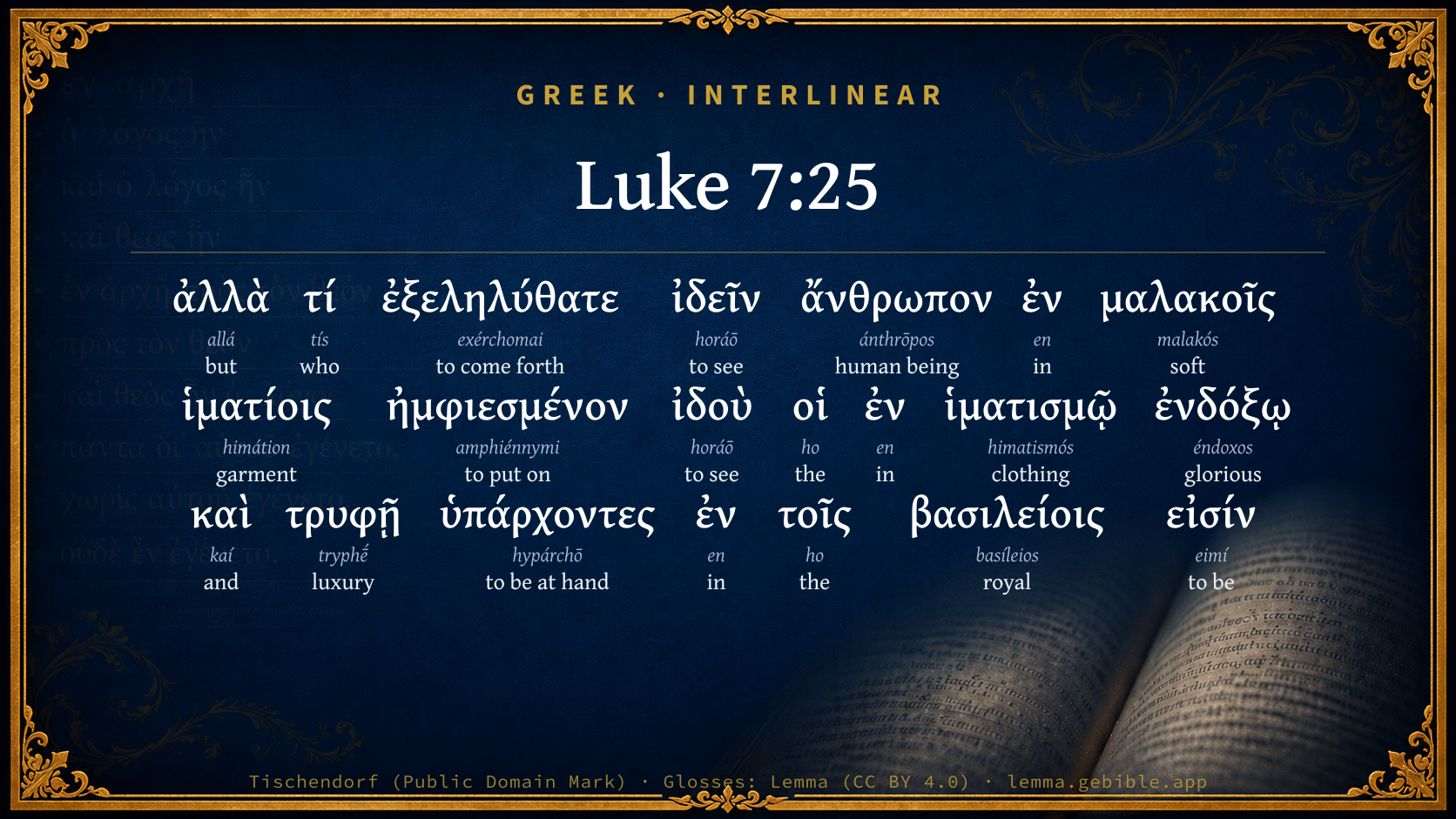
But what did you go out to see? A man clothed in soft clothing? Behold, those who are gorgeously dressed, and live delicately, are in kings' courts.
Download a study sheet
One document with this verse’s original text, its word-by-word gloss line, the meaning frame, cross-references with their text, attributed commentary, and full source and license credits — printable, and it pastes into notes with its structure intact.
This verse Autodidact and up
A passage Seminary Student
Up to 50 verses in one chapter. A passage sheet keeps up to 6 commentary sources and 12 cross-references per verse, in the order this page ranks them, and says so on the sheet whenever that leaves anything out. Ask for a single verse and you get the Autodidact verse sheet above.
Everything on this page stays free to read, with no account — the sheet is a download of what is already on screen, not access to it.
Compare translations 3
The same verse in 3 English versions, stacked beneath the original-language interlinear above. Click any original word for its lexicon entry.
Each is an independent rendering of the whole verse — the interlinear is not word-aligned to these translations.
Highlighted words mark where these versions differ — a whole-verse word diff, not a word-by-word alignment.
-
World English Bible Public Domain
But what did you go out to see? A man clothed in soft clothing? Behold, those who are gorgeously dressed, and live delicately, are in kings' courts.
-
King James Version Public Domain
But what went ye out for to see? A man clothed in soft raiment? Behold, they which are gorgeously apparelled, and live delicately, are in kings' courts.
-
unfoldingWord Literal Text CC BY-SA 4.0
But what did you go out to see? A man dressed in soft clothes? Behold, the ones in expensive clothing and living in luxury are in kings’ palaces.
unfoldingWord Literal Text — © unfoldingWord, licensed CC BY-SA 4.0. Word-aligned USFM3 via Door43 (git.door43.org/unfoldingWord/en_ult).
Show all 19 translations
Every available English version of this verse, each an independent rendering of the whole verse.
-
World English Bible Public Domain
But what did you go out to see? A man clothed in soft clothing? Behold, those who are gorgeously dressed, and live delicately, are in kings' courts.
-
Berean Standard Bible Public Domain
Otherwise, what did you go out to see? A man dressed in fine clothes? Look, those who wear elegant clothing and live in luxury are found in palaces.
-
Majority Standard Bible Public Domain
Otherwise, what did you go out to see? A man dressed in fine clothes? Look, those who wear elegant clothing and live in luxury are found in palaces.
-
King James Version Public Domain
But what went ye out for to see? A man clothed in soft raiment? Behold, they which are gorgeously apparelled, and live delicately, are in kings' courts.
-
American Standard Version (1901) Public Domain
But what went ye out to see? a man clothed in soft raiment? Behold, they that are gorgeously apparelled, and live delicately, are in kings' courts.
-
Revised Version (1885) Public Domain
But what went ye out to see? a man clothed in soft raiment? Behold, they which are gorgeously apparelled, and live delicately, are in kings’ courts.
-
Geneva Bible (1599) Public Domain
But what went ye out to see? A man clothed in soft rayment? beholde, they which are gorgeously apparelled, and liue delicately, are in Kings courtes.
-
Douay-Rheims (1899) Public Domain
But what went you out to see? a man clothed in soft garments? Behold they that are in costly apparel and live delicately, are in the houses of kings.
-
Young's Literal Translation Public Domain
but what have ye gone forth to see? a man in soft garments clothed? lo, they in splendid apparellings, and living in luxury, are in the houses of kings!
-
Literal Standard Version CC BY-SA 4.0
But what have you gone forth to see? A man clothed in soft garments? Behold, they in splendid clothing, and living in luxury, are in the houses of kings!
-
Unlocked Literal Bible CC BY-SA 4.0
But what did you go out to see? A man dressed in soft clothes? Look, those who wear expensive clothing and who live in luxury are in kings' palaces.
-
unfoldingWord Literal Text CC BY-SA 4.0
But what did you go out to see? A man dressed in soft clothes? Behold, the ones in expensive clothing and living in luxury are in kings’ palaces.
-
Darby Bible Public Domain
But what went ye out to see? a man clothed in delicate garments? Behold, those who are in splendid clothing and live luxuriously are in the courts of kings.
-
World Messianic Bible Public Domain
But what did you go out to see? A man clothed in soft clothing? Behold, those who are gorgeously dressed and live delicately are in kings’ courts.
-
Webster's Bible Public Domain
But what went ye out to see? A man clothed in soft raiment? behold, they who are gorgeously appareled, and live delicately, are in kings' courts.
-
Free Bible Version CC BY-SA 4.0
Did you come looking for a man dressed in fine clothes? No, those who have stylish clothes and live in luxury are found in palaces.
-
Bible in Basic English Public Domain
But what did you go out to see? a man in soft clothing? See now, those who have beautiful clothing and delicate food are in kings' houses.
-
Text-Critical English NT CC BY 4.0
What then did you go out to see? A man clothed in soft garments? Behold, those who are dressed in splendid clothing and who live in luxury are in royal palaces.
-
Tyndale New Testament (1534) Public Domain
But what went ye out for tose? A man clothed in soofte rayment? Beholde they which are gorgeously apparelled and lyve delicatly are in kynges courtes.
Literal Standard Version (2020), Covenant Press — licensed CC BY-SA 4.0. Text via the HelloAO Bible API (eBible.org). Unlocked Literal Bible (unfoldingWord) — licensed CC BY-SA 4.0. Text via the HelloAO Bible API (eBible.org). unfoldingWord Literal Text — © unfoldingWord, licensed CC BY-SA 4.0. Word-aligned USFM3 via Door43 (git.door43.org/unfoldingWord/en_ult). Free Bible Version, Dr. Jonathan Gallagher — licensed CC BY-SA 4.0. Text via the HelloAO Bible API (eBible.org).
Word by word
More ways to search: Search by grammar → Find every occurrence → Compare this word →
Practice this passage: Drill this verse → Learn its vocabulary →
- Appears 2× in the Greek New Testament
- First appears here
- Part of Speech
- Noun
- Case
- Dative
- Number
- Singular
- Gender
- Feminine
Full Thayer's Definition
- ἀλλὰ allá G235 “but” Conjunction
- τί tís G5101 “who” Interrogative pronoun, Accusative, Singular, Neuter
- ἐξεληλύθατε exérchomai G1831 “to come forth” Verb, Perfect, Active, Indicative, 2nd person, Plural
- ἰδεῖν horáō G3708 “to see” Verb, Aorist, Active, Infinitive
- ἄνθρωπον ánthrōpos G444 “human being” Noun, Accusative, Singular, Masculine
- ἐν en G1722 “in” Preposition
- μαλακοῖς malakós G3120 “soft” Adjective, Dative, Plural, Neuter
- ἱματίοις himátion G2440 “garment” Noun, Dative, Plural, Neuter
- ἠμφιεσμένον amphiénnymi G294 “to put on” Verb, Perfect, Passive, Participle, Accusative, Singular, Masculine
- ἰδοὺ horáō G3708 “to see” Verb, Aorist, Middle, Imperative, 2nd person, Singular
- οἱ ho G3588 “the” Article, Nominative, Plural, Masculine
- ἐν en G1722 “in” Preposition
- ἱματισμῷ himatismós G2441 “clothing” Noun, Dative, Singular, Masculine
- ἐνδόξῳ éndoxos G1741 “glorious” Adjective, Dative, Singular, Masculine
- καὶ kaí G2532 “and” Conjunction
- τρυφῇ tryphḗ G5172 “luxury” Noun, Dative, Singular, Feminine
- ὑπάρχοντες hypárchō G5225 “to be at hand” Verb, Present, Active, Participle, Nominative, Plural, Masculine
- ἐν en G1722 “in” Preposition
- τοῖς ho G3588 “the” Article, Dative, Plural, Masculine
- βασιλείοις basíleios G934 “royal” Adjective, Dative, Plural, Masculine
- εἰσίν eimí G1510 “to be” Verb, Present, Active, Indicative, 3rd person, Plural
About this verse
These counts appear in no published source. They are computed here, from the morphology-tagged text and Lemma’s own curated glosses. What Lemma adds →
- 21
- words
- 17
- distinct lemmas
- Gospels
- section
Notable vocabulary
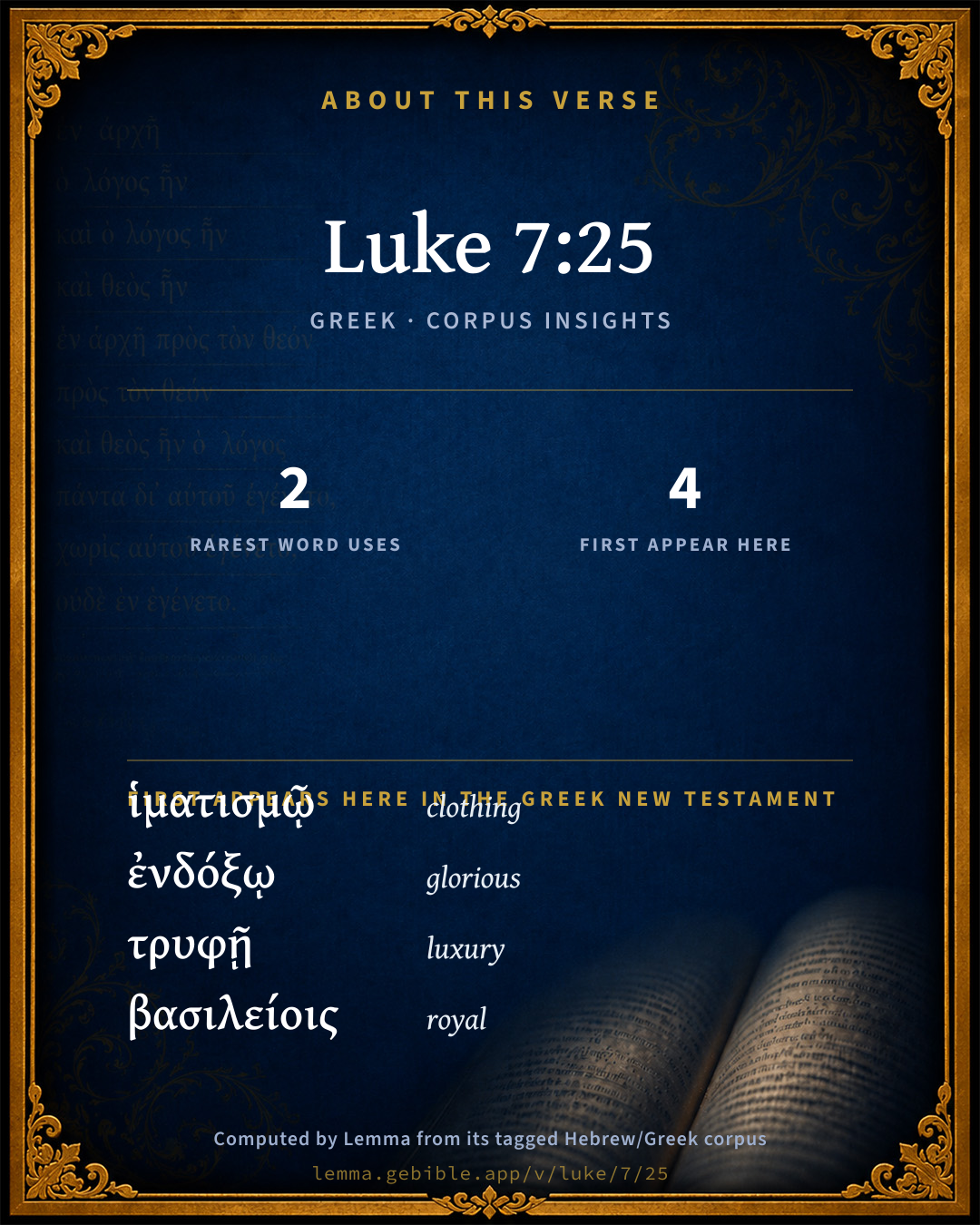
The rarest word here is τρυφῇ luxury G5172 — appearing just 2 times in the whole Greek New Testament.
First appearance in Scripture
These words make their first canonical appearance in the Greek New Testament here:
Shared distinctive vocabulary
τρυφῇ luxury G5172 occurs in 2 verses of the Greek New Testament. Also found in:
Cross-references
12Topical passages linked to Luke 7:25 in the Treasury of Scripture Knowledge — connected by theme and wording, ordered by reader-vote popularity; previews shown in the World English Bible.
- 2 Samuel 19:35 I am this day eighty years old: can I discern between good and bad? can your servant taste what I eat or what I drink? can I hear any more the voice of singing men and singing women? why then should your servant be yet a burden to my lord the king?
- 1 Kings 10:5 and the food of his table, and the sitting of his servants, and the attendance of his ministers, and their clothing, and his cup bearers, and his ascent by which he went up to the house of Yahweh; there was no more spirit in her.
- 2 Kings 1:8 They answered him, He was a hairy man, and girt with a belt of leather about his loins. He said, It is Elijah the Tishbite.
- Esther 1:3 in the third year of his reign, he made a feast to all his princes and his servants; the power of Persia and Media, the nobles and princes of the provinces, being before him;
- Esther 1:11 to bring Vashti the queen before the king with the crown royal, to show the peoples and the princes her beauty; for she was beautiful to look on.
- Esther 4:2 and he came even before the king's gate: for none might enter within the king's gate clothed with sackcloth.
- Esther 8:15 Mordecai went forth from the presence of the king in royal clothing of blue and white, and with a great crown of gold, and with a robe of fine linen and purple: and the city of Shushan shouted and was glad.
- Isaiah 59:17 He put on righteousness as a breastplate, and a helmet of salvation on his head; and he put on garments of vengeance for clothing, and was clad with zeal as a mantle.
- Matthew 6:29 yet I tell you that even Solomon in all his glory was not dressed like one of these.
- Esther 5:1 Now it happened on the third day, that Esther put on her royal clothing, and stood in the inner court of the king's house, over against the king's house: and the king sat on his royal throne in the royal house, over against the entrance of the house.
- Matthew 3:4 Now John himself wore clothing made of camel's hair, with a leather belt around his waist. His food was locusts and wild honey.
- 1 Peter 3:3–4 Let your beauty be not just the outward adorning of braiding the hair, and of wearing jewels of gold, or of putting on fine clothing;
Cross-references courtesy of OpenBible.info (CC BY 4.0).
Lesson kit
Teaching starters — assembled from the data on this page, not authored interpretation. Every prompt links to the verse data it draws on. Edit before teaching.
Luke, in the Gospels, opens this verse with 21 words (17 distinct Greek lemmas). Its most distinctive word is tryphḗ (“luxury”). A historical commentator’s framing appears above. Read the whole chapter for the surrounding context.
Discussion questions
- The word tryphḗ carries the sense “luxury.” How does it shape the verse?
- 4 words make their first appearance in Scripture here. What does this debut establish?
- How does 2 Peter 2:13, which shares the word «luxury», read alongside this verse?
- What does the repetition of “to see” (2× in this one verse) do in this verse?
- These translations render this verse differently; the difference is in the English rendering, not the original. What questions does that raise?
- Compare how Expositor's Greek Testament and Ellicott's Commentary for English Readers read this verse. Where do they agree or differ?
Things to notice
- 4 words make their first canonical appearance in Scripture here.
- These translations choose different wording for 21 words in this verse.
- “to see” occurs 2× in this single verse.
- 17 distinct Greek lemmas span 21 words in this verse.
Commentary
Notes on Luke 7:25 from classic Christian and Jewish commentators (each source and its license shown beneath its notes). The classic Christian expositions comment on the surrounding passage and are grouped to its opening verse, so a note may address several verses; the Jewish commentaries on the Tanakh (Rashi and others) are per-verse, so they appear only where the commentator wrote on this verse.
Lemma curates 59 commentaries, every one of them public domain or Creative Commons licensed, each selected and text-cleaned for this edition rather than reprinted as found. About our sources →
Expositor's Greek Testament
ed. W. Robertson Nicoll
The Expositor's Greek Testament, edited by W. Robertson Nicoll (1897–1910) — public domain. Text from a community e-Sword module.
Ellicott's Commentary for English Readers
A Bible Commentary for English Readers, edited by Charles John Ellicott (1878–1897) — public domain. Text from a community e-Sword module.
The Cambridge Bible for Schools and Colleges
gen. ed. J. J. S. Perowne
The Cambridge Bible for Schools and Colleges (gen. ed. J. J. S. Perowne; Cambridge University Press, 1878–1918) — public domain. Text from a community e-Sword module.
John Gill's Exposition
John Gill's Exposition of the Whole Bible (1746–1763) — public domain (CC PDM 1.0). Text via the HelloAO Bible API.
The Pulpit Commentary
The Pulpit Commentary (1880–1919), ed. H.D.M. Spence-Jones & Joseph S. Exell — public domain. Text from a community e-Sword module.
Cambridge Greek Testament for Schools and Colleges
Cambridge Greek Testament for Schools and Colleges (Cambridge University Press, 1896; 21 vols, various authors incl. Carr, Maclear, Plummer, Farrar, Lumby, Moule, M. R. James, Simcox) — public domain. Text from a community e-Sword module.
International Critical Commentary
International Critical Commentary — older volumes (1896–1929), various authors — public domain. Text from a community e-Sword module.
Vincent's Word Studies in the New Testament
Marvin R. Vincent
Marvin R. Vincent, Word Studies in the New Testament (1887–1900) — public domain. Text from a community e-Sword/MySword module.