Luke 9:25

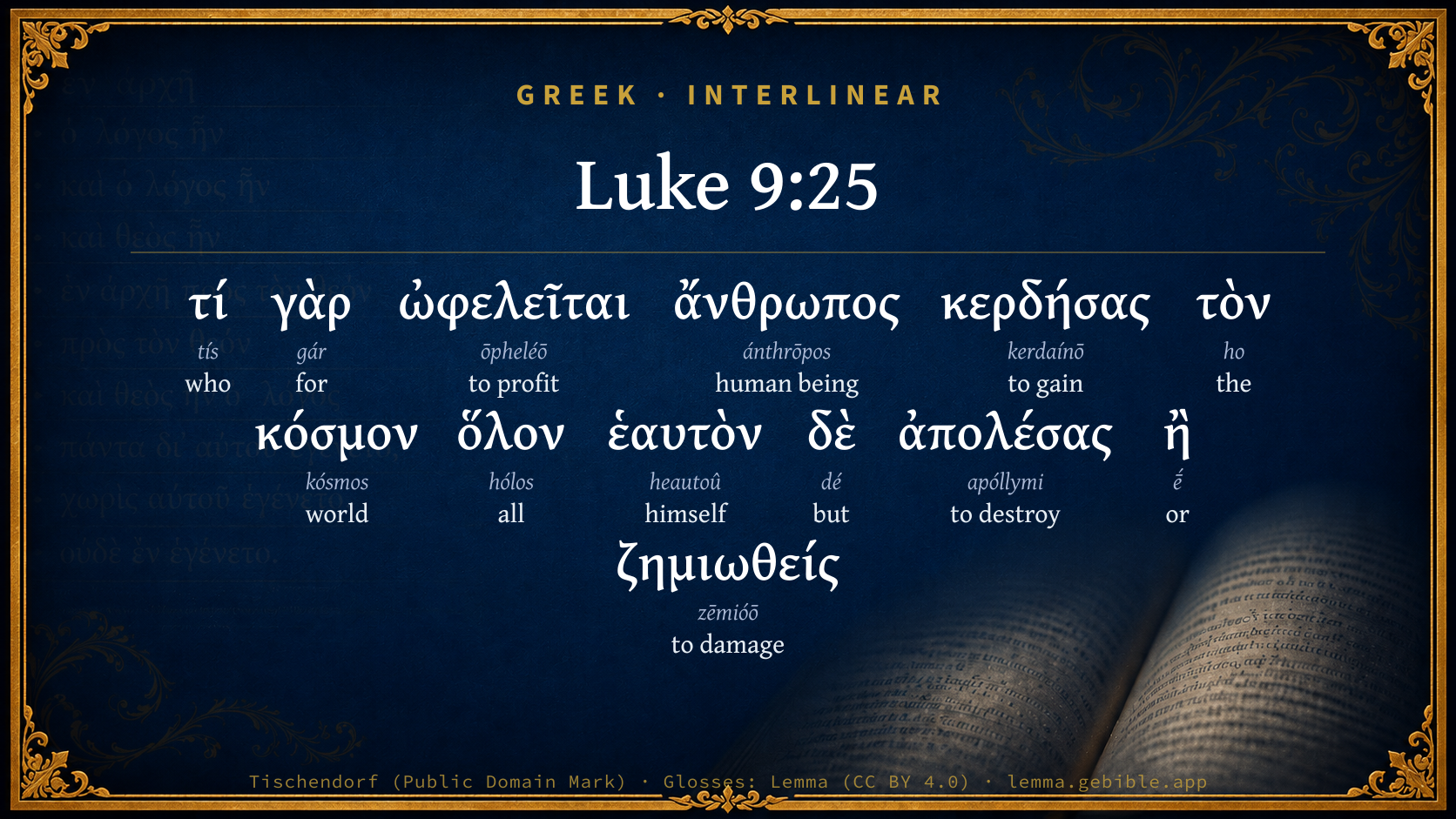
Greek (Tischendorf 8th ed.) Luke 9:25 appears in the Greek New Testament. The text above is from the Tischendorf 8th edition. Each word links to its Strong’s number and a concise gloss. Click any word for its full Thayer’s Greek Lexicon entry.
Download image
Cite this verse

Luke 9:25 (World English Bible). Public Domain. Lemma interlinear Bible study tool, https://lemma.gebible.app/v/luke/9/25.

Show BibTeX & RIS
BibTeX
RIS
English Translation
For what does it profit a man if he gains the whole world, and loses or forfeits his own self?
World English Bible · Public Domain
Download a study sheet

One document with this verse’s original text, its word-by-word gloss line, the meaning frame, cross-references with their text, attributed commentary, and full source and license credits — printable, and it pastes into notes with its structure intact.

This verse Autodidact and up

Study sheet (.html) Plain text (.txt)

A passage Seminary Student

Up to 50 verses in one chapter. A passage sheet keeps up to 6 commentary sources and 12 cross-references per verse, in the order this page ranks them, and says so on the sheet whenever that leaves anything out. Ask for a single verse and you get the Autodidact verse sheet above.

Everything on this page stays free to read, with no account — the sheet is a download of what is already on screen, not access to it.

Want to remove ads? Support Godless Engineer
Compare translations 3

The same verse in 3 English versions, stacked beneath the original-language interlinear above. Click any original word for its lexicon entry.

Each is an independent rendering of the whole verse — the interlinear is not word-aligned to these translations.

Highlighted words mark where these versions differ — a whole-verse word diff, not a word-by-word alignment.

  • World English Bible Public Domain
    For what does it profit a man if he gains the whole world, and loses or forfeits his own self?
  • King James Version Public Domain
    For what is a man advantaged, if he gain the whole world, and lose himself, or be cast away?
  • unfoldingWord Literal Text CC BY-SA 4.0
    For what does a man benefit, having gained the whole world, but losing or forfeiting himself?

unfoldingWord Literal Text — © unfoldingWord, licensed CC BY-SA 4.0. Word-aligned USFM3 via Door43 (git.door43.org/unfoldingWord/en_ult).

Versions to compare (up to 4)

3 of 4 selected

Show all 19 translations

Every available English version of this verse, each an independent rendering of the whole verse.

  • World English Bible Public Domain
    For what does it profit a man if he gains the whole world, and loses or forfeits his own self?
  • Berean Standard Bible Public Domain
    What does it profit a man to gain the whole world, yet lose or forfeit his very self?
  • Majority Standard Bible Public Domain
    What does it profit a man to gain the whole world, yet lose or forfeit his very self?
  • King James Version Public Domain
    For what is a man advantaged, if he gain the whole world, and lose himself, or be cast away?
  • American Standard Version (1901) Public Domain
    For what is a man profited, if he gain the whole world, and lose or forfeit his own self?
  • Revised Version (1885) Public Domain
    For what is a man profited, if he gain the whole world, and lose or forfeit his own self?
  • Geneva Bible (1599) Public Domain
    For what auantageth it a man, if he win the whole worlde, and destroy himselfe, or lose himselfe?
  • Douay-Rheims (1899) Public Domain
    For what is a man advantaged, if he gain the whole world, and lose himself, and cast away himself?
  • Young's Literal Translation Public Domain
    for what is a man profited, having gained the whole world, and having lost or having forfeited himself?
  • Literal Standard Version CC BY-SA 4.0
    for what is a man profited, having gained the whole world, and having lost or having forfeited himself?
  • Unlocked Literal Bible CC BY-SA 4.0
    What good is it for a person to gain the whole world, and yet lose or forfeit himself?
  • unfoldingWord Literal Text CC BY-SA 4.0
    For what does a man benefit, having gained the whole world, but losing or forfeiting himself?
  • Darby Bible Public Domain
    For what shall a man profit if he shall have gained the whole world, and have destroyed, or come under the penalty of the loss of himself?
  • World Messianic Bible Public Domain
    For what does it profit a man if he gains the whole world, and loses or forfeits his own self?
  • Webster's Bible Public Domain
    For what is a man profited, if he shall gain the whole world, and lose himself, or be cast away?
  • Free Bible Version CC BY-SA 4.0
    What do you benefit by gaining the whole world if you end up lost or destroyed?
  • Bible in Basic English Public Domain
    For what profit will a man have if he gets all the world, but undergoes loss or destruction himself?
  • Text-Critical English NT CC BY 4.0
    For what does it benefit a person if he gains the whole world but loses or forfeits himself?
  • Tyndale New Testament (1534) Public Domain
    For what avauntageth it a man to wynne the whole worlde yf he loose him sylfe or runne in domage of him sylfe?

Literal Standard Version (2020), Covenant Press — licensed CC BY-SA 4.0. Text via the HelloAO Bible API (eBible.org). Unlocked Literal Bible (unfoldingWord) — licensed CC BY-SA 4.0. Text via the HelloAO Bible API (eBible.org). unfoldingWord Literal Text — © unfoldingWord, licensed CC BY-SA 4.0. Word-aligned USFM3 via Door43 (git.door43.org/unfoldingWord/en_ult). Free Bible Version, Dr. Jonathan Gallagher — licensed CC BY-SA 4.0. Text via the HelloAO Bible API (eBible.org).

Word by word

More ways to search: Search by grammar → Find every occurrence → Compare this word →

Practice this passage: Drill this verse → Learn its vocabulary →

ζημιωθείς
zēmióō
G2210
“to damage”
Verb, Aorist, Passive, Participle, Nominative, Singular, Masculine
Part of Speech
Verb
Tense
Aorist
Voice
Passive
Mood
Participle
Case
Nominative
Number
Singular
Gender
Masculine
Full Thayer's Definition

Origin: from G2209

TDNT: 16:48,3

1. to affect with damage, do damage to 2. to sustain damage, to receive injury, suffer loss
  1. τί tís G5101 “who” Interrogative pronoun, Accusative, Singular, Neuter
  2. γὰρ gár G1063 “for” Conjunction
  3. ὠφελεῖται ōpheléō G5623 “to profit” Verb, Present, Passive, Indicative, 3rd person, Singular
  4. ἄνθρωπος ánthrōpos G444 “human being” Noun, Nominative, Singular, Masculine
  5. κερδήσας kerdaínō G2770 “to gain” Verb, Aorist, Active, Participle, Nominative, Singular, Masculine
  6. τὸν ho G3588 “the” Article, Accusative, Singular, Masculine
  7. κόσμον kósmos G2889 “world” Noun, Accusative, Singular, Masculine
  8. ὅλον hólos G3650 “all” Adjective, Accusative, Singular, Masculine
  9. ἑαυτὸν heautoû G1438 “himself” Reflexive pronoun, 3rd person, Accusative, Singular, Masculine
  10. δὲ dé G1161 “but” Conjunction
  11. ἀπολέσας apóllymi G622 “to destroy” Verb, Aorist, Active, Participle, Nominative, Singular, Masculine
  12. ἢ ḗ G2228 “or” Particle

About this verse

These counts appear in no published source. They are computed here, from the morphology-tagged text and Lemma’s own curated glosses. What Lemma adds →

13
words
13
distinct lemmas
Gospels
section

Notable vocabulary

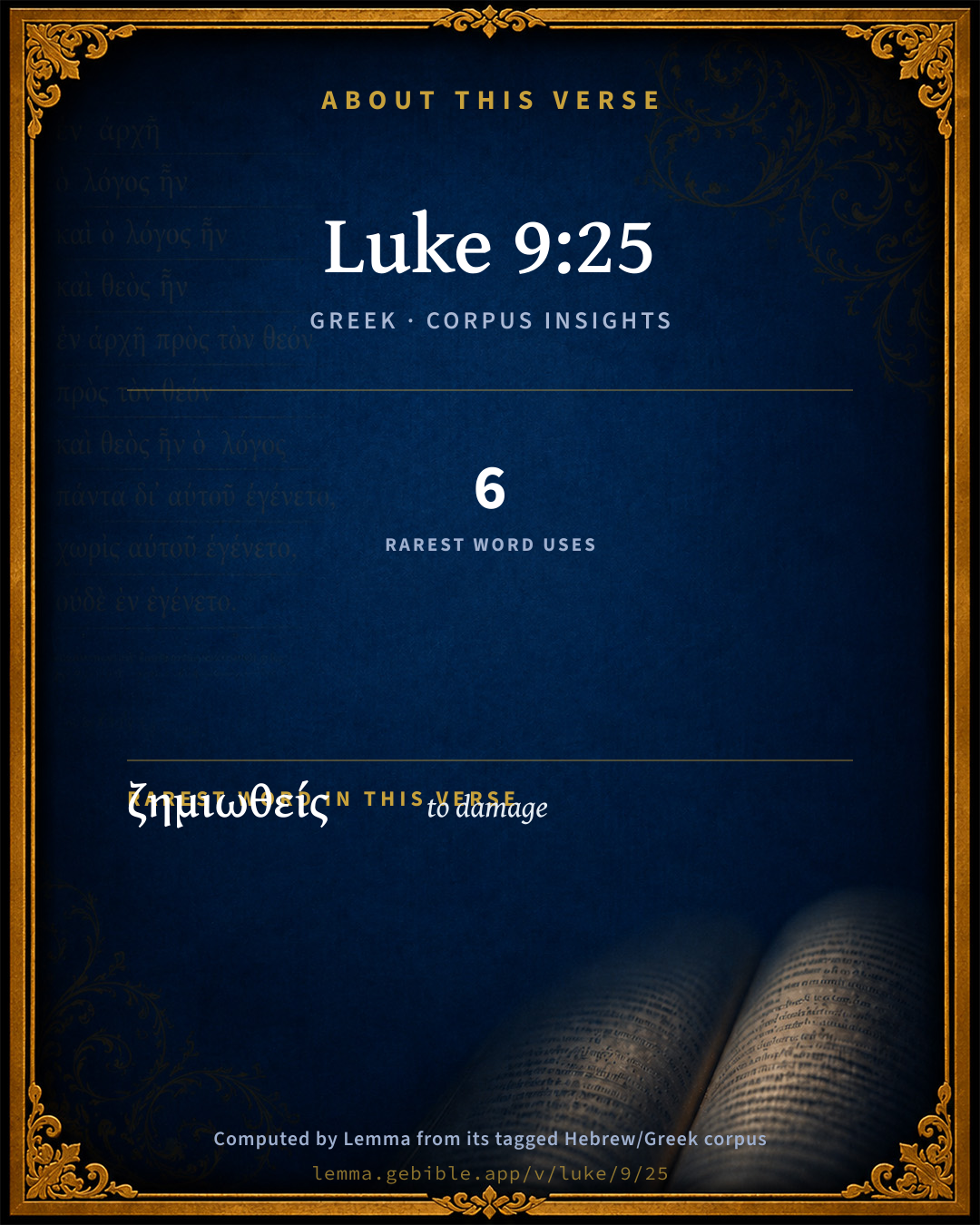
The rarest word here is ζημιωθείς to damage G2210 — appearing just 6 times in the whole Greek New Testament.

Shared distinctive vocabulary

ζημιωθείς to damage G2210 occurs in 6 verses of the Greek New Testament. Also found in:

Cross-references

11

Topical passages linked to Luke 9:25 in the Treasury of Scripture Knowledge — connected by theme and wording, ordered by reader-vote popularity; previews shown in the World English Bible.

  • Matthew 16:26 For what will it profit a man, if he gains the whole world, and forfeits his life? Or what will a man give in exchange for his life?
  • Mark 8:36 For what does it profit a man, to gain the whole world, and forfeit his life?
  • Psalms 49:6–8 Those who trust in their wealth, And boast in the multitude of their riches--
  • Luke 12:19–21 I will tell my soul, "Soul, you have many goods laid up for many years. Take your ease, eat, drink, be merry."'
  • Luke 4:5–7 The devil, leading him up on a high mountain, showed him all the kingdoms of the world in a moment of time.
  • 2 Peter 2:15–17 forsaking the right way, they went astray, having followed the way of Balaam the son of Beor, who loved the wages of wrong-doing;
  • Acts 1:25 to take part in this ministry and apostleship from which Judas fell away, that he might go to his own place."
  • 1 Corinthians 9:27 but I beat my body and bring it into submission, lest by any means, after I have preached to others, I myself should be rejected.
  • Matthew 13:50 and will cast them into the furnace of fire. There will be the weeping and the gnashing of teeth."
  • Mark 9:43–48 If your hand causes you to stumble, cut it off. It is better for you to enter into life maimed, rather than having your two hands to go into Gehenna, into the unquenchable fire,
  • Revelation 18:7–8 However much she glorified herself, and grew wanton, so much give her of torment and mourning. For she says in her heart, 'I sit a queen, and am no widow, and will in no way see mourning.'

Cross-references courtesy of OpenBible.info (CC BY 4.0).

Commentary

Notes on Luke 9:25 from classic Christian and Jewish commentators (each source and its license shown beneath its notes). The classic Christian expositions comment on the surrounding passage and are grouped to its opening verse, so a note may address several verses; the Jewish commentaries on the Tanakh (Rashi and others) are per-verse, so they appear only where the commentator wrote on this verse.

Lemma curates 59 commentaries, every one of them public domain or Creative Commons licensed, each selected and text-cleaned for this edition rather than reprinted as found. About our sources →

The Biblical Illustrator

Joseph S. Exell

Luk_9:25

What is a man advantaged

A wreck

Did you ever see a wreck?

I remember being one winters night in a little town on the coast of Wales. We were sitting by the fire, cheerful, and we heard, while there, a sudden noise: we looked out into the night; there was a deep fog over the sea; we could scarcely see the cliffs; the wind was very high; there was a drizzling rain; and suddenly we heard the scream of voices; then the boom of the guns over the water; then stillness; then the clatter of feet along the street; the life boat and the life buoy. Human life in danger. We thought we discried the dark mass heaving over the black billows, lit up by the ray of the guns and the blue lights; but the sound of the surf and the roar of the breakers carried all away; they carried her away. That night she struck on the rocks. I walked down in the morning to look at her lying on the beach. I could not help saying, How human this is; how life-like! There she lay--the pride and hope of her owners--stripped; masts, sails, shrouds, broken, ragged, torn, gone; and yet much had depended on her. She had been launched with many hopes and expectations. All gone--a melancholy wreck! The winds howled through as they lifted her ragged shrouds. She could not, as once she might have done, repel them and make them her ministers. The sun shone on her, through her cabin windows and port-hole, but awakened no answering glory oil her deck. She was a lost ship--melancholy type of a lost soul. (E. Paxton Hood.)

The loss of the soul

I. MAN HAS A SOUL.. The soul touches the highest part of the universe. Nature ministers to nature; but nature cannot feed the soul. The fruits, and grapes, and animals cannot contribute to the being of the soul. God, who is its Parent, can alone minister to it. This is that difference between the spirit of the beast which goeth downward, and the spirit of man which goeth upward. We are dust and Deity, says a great poet: most true. This is our original Turn into reality the great fact that you have a soul. Did you ever hear how Fichte awoke the consciousness of his hearers? He pointed to the wall, the white wall. Gentlemen, said he, I want you to think the wall. Have you thought the wall? Now, think the man that thought the wall. Ah! to do that is to realize to ourselves our soul.

II. IT IS OF INFINITE VALUE.

1. Think of its power.

(1) It can sin. It is capable of moral wrong. The soul has had power to disturb the universe.

(2) It can suffer. Oh, how it can suffer, remorse, conscience, despair! Nay, we estimate the greatness of the soul by its power to suffer.

(3) It can think. How it can think! Can be even wild with thought, and rend the poor body as the strong wind rends oaks and rocks!

2. Its duration. For ever: no cessation.

III. A SOUL MAY BE LOST. Nay, every soul in the world is, in fact, lost. Do you know it? do you feel it? Lost! For there are but two ways in the universe--Gods and mans. To be lost, is to wander into the far country, and to attempt to feed an angel nature with the husks that the swine eat. Picture to yourselves the man on the dark moor at night among the mountains--amidst the mists--lost. I may mention four causes of the loss of the soul.

1. Ignorance.

2. Error.

3. Passion.

4. A perverted will: underlying the whole.

These are the marks of human nature in its present state. And to be lost, is to love our natural state, and to persist in it. You may remember an incident in the united lives of two men, with whose labours and lives, it may be, you have on the whole little sympathy. When Francis Xavier, the youthful, the eloquent, the noble, was engaged in the pursuits of his varied and wonderful mind, in Paris, in the university, and its more romantic neighbourhood, as he yielded himself to the fascinations mingling around him, there stepped forth and spoke to him a plainly dressed and powerful preacher of lofty bearing and stern deportment, mighty in the assumption of a voluntary poverty--Ignatius Loyola. Francis, said he, What shall it profit a man, if he gain the whole world, and lose his own soul? He would not let the youth go. He attended the hall where Xavier delivered his eloquent prelections; he stood and listened before the orators chair; but when the applause had subsided, and the crowd had retired, then he was by the side of the eloquent scholar. He touched him on the shoulder; Francis, said he, What shall it profit a man, if he gain the whole world, and lose his own soul? Noble as he was, Xavier was not rich; his affairs became embarrassed; he needed help. The stern apostle of voluntary poverty did not forsake; he came to him with assistance; he produced mysterious aid; but, as he put the bag into the hands of his friend, he was ready with his old question, Francis, What shall it profit a man, if he gain the whole world, and lose his own soul? They wandered together by the banks of the Seine; they trod together through its groves of trees, and wound their way into its lovely recesses; but even as the enthusiastic and imaginative Xavier paused, enraptured before the spectacle of some astonishing beauty, some enchanting or spell-compelling spot, the voice thrilled through him: Francis, What shall it profit a man, if he gain the whole world, and lose his own soul? And the reader knows that earnestness subdued the eloquent scholar, and he became the comrade and the disciple of Ignatius Loyola. You have heard of the Mammoth Cave in America--a world under the ground--how many miles no one can tell, rivers, lakes, chambers, immense territories all in darkness, where the light of the sun never penetrated. But nineteen miles within the cave, 450 feet beneath the soil, there was yet a descent called the Bottomless Pit. Down into that no man would go; they had sounded 150 feet, and yet had not reached the depth; no man would go; the guide refused 500 dollars offered him to go. At length a poor man came, a young man, and he determined he would descend. Ropes were procured, and he descended 150 feet. He walked among those galleries of darkness, alone, through those depths and corridors of gloom; he began to ascend, but as he ascended he stayed to throw himself into an interminable cave on the side of the pit; there as he roamed through its fissures, his light went out--no light--and alone in that gloom--lost! And the light was kindled again; but he found, as he began to ascend, the rope was on fire. Ah! what shall he do now? What think you, ascending--looking up to that faint ray, and the fire burning--burning. But it was extinguished, he was saved. But is it not the very picture of a poor soul? In the deep night, the light extinguished. And sometimes those very powers by which he might ascend,--his passions, his intellect, his will, only kindling to ruin him--affections which might unite to God, turning to fire to separate him for ever.

IV. And why? FOR THE SOUL MAY BE SAVED. Surely no person will say, What shall I do to be saved? But if so, I have only to say, Believe in the Lord Jesus Christ, and thou shalt be saved. And if you say, I cannot believe, in a word, I have only to say--say thou to God, I will not let Thee go except Thou bless me. Pray, and you shall not fail to obtain the knowledge of Christ and Him crucified. (E. Paxton Hood.)

Save your soul

If temporal affairs impose upon a man a large measure of labour and solicitude, how much more should he exercise the utmost diligence in behalf of his eternal welfare?

I. NOTHING IS MORE NECESSARY THAN TO SAVE OUR SOULS.

1. The chief solicitude of God is for our salvation.

2. The question is of everlasting weal or woe.

3. Therefore Jesus warns us with the most tender anxiety--

(1) To work our salvation before all things.

(2) To work our salvation in all things.

(3) To take care of our salvation at all times, and give it our own personal attention.

II. NOTHING IS MORE RARE THAN THIS SOLICITUDE.

1. Everywhere we may observe an all-absorbing care for temporal affairs and earthly possessions.

(1) The heart of man is attached to them; restless his desire to acquire them; great his sorrow at their loss.

(2) All activity of man is centred upon them. Men are grovelling in the dust.

2. Negligence in regard to heavenly things.

(1) No earnest examination of the condition of the soul.

(2) Carelessness in regard to the means of salvation.

3. Men appear to be without conscience in regard to the salvation of others.

(1) Careless parents, educating their children for everything except the one thing necessary.

(2) Cruel seducers, showing heartless indifference to their own and others salvation.

4. Let us look back at our past life.

(1) How many opportunities has God granted us to save our souls! Time, the Word of God, misfortunes, &c.

(2) How little is it that we have given to God! What use have we made of our time? For whom have we laboured? Have we laid up treasures for the world to come?

(3) What folly! All our trouble for nothing! We run after the mists and clouds, and neglect that which is everlasting. We frustrate the merciful designs and endeavours of God. (Tourbe.)

Money given as the punishment of avarice

We read of a Spanish general who was so fond of money that the enemies into whose hands he had fallen, tortured and killed him by pouring melted gold down his throat in mockery of his covetousness. So Satan now often makes money unlawfully acquired, the very means of tormenting the miserable beings who have sold their consciences to obtain it. (Family Treasury.)

Bad bargains

A Sunday-school teacher, when speaking about the passage, Buy the truth, and sell it not, said that the man who buys the truth, at whatever cost, makes a good bargain. He then asked his boys if any of them remembered an instance in the Scriptures of a bad bargain. These answers were given--

1. Esau made a bad bargain when he sold his birthright for a mess of pottage.

2. Judas made a bad bargain when he sold Jesus for thirty pieces of silver.

3. He makes a bad bargain, who, to gain the whole world, loses his own soul.

The world cannot give peace

There was one living who, scarcely in a figure, might be said to have the whole world. The Roman Emperor Tiberius was at that moment infinitely the most powerful of living men, the absolute, undisputed, deified ruler of all that was fairest and richest in the kingdoms of the earth. There was no control to his power, no limit to his wealth, no restraint upon his pleasures. And, to yield himself still more unreservedly to the boundless self-gratification of a voluptuous luxury, not long after this time he chose for himself a home on one of the loveliest spots on the earths surface, under the shadow of the slumbering volcano, upon an enchanting islet in one of the most softly delicious climates of the world. What came of it all? He was, as Pliny calls him, Tristissimus ut constat hominum, confessedly the most gloomy of mankind. And there, from this home of his hidden infamies, from this island where, on a scale so splendid, he had tried the experiment of what happiness can be achieved by pressing the worlds most absolute authority and the worlds guiltiest indulgencies into the service of an exclusively selfish life, he wrote to his servile and corrupted senate, What to write to you, conscript fathers, or how to write, or what not to write, may all the gods and goddesses destroy me, worse than I feel that they are daily destroying me, if I know. Rarely has there been vouchsafed to the world a more overwhelming proof that its richest gifts are but fairy gold that turns to dust and dross. (Archdeacon Earrar.)

A crime against the life of the soul

When, a half-century ago, the famous Kaspar Hauser appeared in the streets of Nuremberg, having been released from a dungeon in which he had been confined from infancy, having never seen the face or heard the voice of man, nor gone without the walls of his prison, nor seen the full light of day, a distinguished lawyer in Germany wrote a legal history of the case, which he entitled, A Crime against the Life of the Soul. It was well named But it is no worse than the treatment some men bestow upon their own souls As the poor German youth was at length thrust out into the world for which he was unfitted, with untrained senses in a world of sense, without speech in a world of language, with a dormant mind in a world of thought, so many go out of this world with no preparation in that part of their nature that will most be called into use. (Theodore T. Munger.)

Secure the soul

What wise man would fetch gold out of a fiery crucible, hazard himself to endless woes, for a few waterish pleasures, and give his soul to the devil, as some Popes did for the short enjoyment of the Papal dignity. What was this but to win Venice, and then to be hanged at the gates thereof, as the proverb is. In great fires men look first to their jewels, then to their lumber; so should these see first to their souls to secure them, and then take care of the outward man. The soldier cares not how his buckler speeds, so his body be kept thereby from deadly thrusts. (J. Trapp.)

The Biblical Illustrator, edited by Joseph S. Exell (c. 1880s–1900s) — public domain. Text from a community e-Sword module.

Bengel's Gnomon

Johann Albrecht Bengel

Luk 9:25. Ἀπολέσας, having destroyed himself) when he might have been saved [Luk 9:24].—ζημιωθεὶς, having incurred loss [having become a castaway]) when he might have gained [Luk 9:25] himself.

Bengel's Gnomon of the New Testament — English translation (T&T Clark, Edinburgh, 1860) — public domain. Text from a community e-Sword module.

Expositor's Greek Testament

ed. W. Robertson Nicoll

Luk 9:25 . ἑαυτὸν ἀπολέσας ἢ ζημιωθείς = losing, or receiving damage in, his own self (Field, Ot. Nor. ). The idea expressed by the second participle seems to be that even though it does not come to absolute loss, yet if gaining the world involve damage to the self, the moral personality taint, lowering of the tone, vulgarising of the soul we lose much more than we gain.

The Expositor's Greek Testament, edited by W. Robertson Nicoll (1897–1910) — public domain. Text from a community e-Sword module.

Godet's Commentaries

Frédéric Louis Godet

Vers. 25-27 are the confirmation (for) of this Maschal, and first of all, Luk 9:25-26, of the first proposition. Jesus supposes, Luk 9:25, the act of saving one’s own life, accomplished with the most complete success...., amounting to a gain of the whole world. But in this very moment the master of this magnificent domain finds himself condemned to perish! What gain! To draw in a lottery a gallery of pictures..., and at the same time to become blind! The expression ἢ ζημιωθείς, or suffering loss, is difficult. In Matthew and Mark this word, completed by Ψυχήν, corresponds to ἀπολέσας in Luke; but in Luke it must express a different idea. We may understand with it either the world or ἑαυτόν, himself, “suffering the loss of this world already gained,” or (which is more natural) “losing himself altogether (ἀπολέσας), or even merely suffering some small loss in his own person.” It is not necessary that the chastisement should amount to total perdition; the smallest injury to the human personality will be found to be a greater evil than all the advantages accruing from the possession of the whole world.

The losing oneself [the loss of the personality] mentioned in Luk 9:25 consists, according to Luk 9:26 (for), in being denied by Jesus in the day of His glory. The expression, to be ashamed of Jesus, might be applied to the Jews, because fear of their rulers hindered them from declaring themselves for Him; but in this context it is more natural to apply it to disciples whose fidelity gives way before ridicule or violence. The Cantabrigiensis omits the word λόγους, which leads to the sense: “ashamed of me and mine.” This reading would recommend itself if better supported, and if the word λόγους (my words) was not confirmed by the parallel expression of Mark (Mar 8:35): “for my sake and the gospel’s.” The glory of the royal advent of Jesus will be, first, that of His own personal appearing; next, the glory of God; lastly, the glory of the angels,—all these several glories will be mingled together in the incomparable splendour of that great day (2Th 1:7-10). “Thus,” says Gess, “to be worthy of this man is the new and paramount principle. This is no mere spiritualization of the Mosaic law; it is a revolution in the religious and moral intuitions of mankind.”

Ver. 27 is the justification of the promise in Luk 9:24 b (find his life by losing it), as Luk 9:25-26 explained the threatening of 24a. It forms in the three Syn. the conclusion of this discourse, and the transition to the narrative of the transfiguration; but could any of the evangelists have applied to such an exceptional and transitory incident this expression: the coming of the kingdom of Christ (Matthew), or of God (Mark and Luke)?

Meyer thinks that this saying can only apply to the Parousia, to which the preceding verse referred, and which was believed to be very near. But could Jesus have laboured under this misconception (see the refutation of this opinion at chap. 21)? Or has the meaning of His words been altered by tradition? The latter view only would be tenable. Many, urging the difference between Matthew’s expression (until they have seen the Son of man coming in His kingdom) and that of Mark (“...the kingdom of God come with power”) or of Luke (“...the kingdom of God”), think that the notion of the Parousia has been designedly erased from the text of Matthew by the other two, because they wrote after the fall of Jerusalem. Comp. also the relation between Matthew 24, where the confusion of the two events appears evident, and Luke 21, where it is avoided. But, 1. It is to be observed that this confusion is found in Mark (xiii.) exactly the same as in Matthew (xxiv.). Now, if Mark had corrected Matthew for the reason alleged in the passage before us, how much more would he have corrected him in chap. 13, where it is not a single isolated passage that is in question, but where the subject of the Parousia is the chief matter of discourse! And if the form of expression in Mark is not the result of an intentional correction, but of a simple difference in the mode of transmission, why might it not be the same also with the very similar form that occurs in ?Luke 2. There is a very marked distinction both in Mark and Luke, a sort of gradation and antithesis between this saying and the preceding—in Luke by means of the particle δέ, and further: “And I also say that this recompense promised to the faithful confessors shall be enjoyed by some of you before you die;” and in Mark, in a still more striking manner, by the interruption of the discourse and the commencement of a new phrase: “And He said to them” (Luk 9:1). So that the idea of the Parousia must be set aside as far as the texts of Mark and Luke are concerned. It may even be doubted whether it is contained in Matthew’s expression; comp. Mat 26:64: “Henceforth [from now] ye shall see the Son of man coming in the clouds of heaven.” The expression henceforth does not permit of our thinking of the Parousia. But this saying is very similar to the one before us. Others apply this promise to the fall of Jerusalem, or to the establishment of the kingdom of God among the heathen, or to the descent of the Holy Spirit. But inasmuch as these events were outward facts, and all who were contemporary with them were witnesses of them, we cannot by this reference explain τινές, some, which announces an exceptional privilege. After all, is the Lord’s meaning so difficult to apprehend? Seeing the kingdom of God, in His teaching, is a spiritual fact, in accordance with the inward nature of the kingdom itself; comp. Luk 17:21: “The kingdom of God is within you” (see the explanation of this passage). For this reason, in order to enjoy this sight, a new sense and a new birth are needed; Joh 3:3: “Except a man be born again, he cannot see the kingdom of God.” This thought satisfactorily explains the present promise as expressed in Luke and Mark. To explain Matthew’s expression, we must remember that the work of the Holy Spirit pre-eminently consists in giving us a lively conviction of the exaltation and heavenly glory of Jesus (Joh 16:14). The τινές, some, are therefore all those then present who should receive the Holy Spirit at Pentecost, and behold with their inward eye those wonderful works of God, which Jesus calls His kingdom, or the kingdom of God. In this way is explained the gradation from Luk 9:26 to Luk 9:27 in Mark and Luke: “Whoever shall give his own life shall find it again, not only at the end of time, but even in this life (at Pentecost).” If this explanation be inadmissible, it must be conceded that this promise is based on a confusion of the fall of Jerusalem with the Parousia; and this would be a proof that our Gospel as well as Matthew’s was written before that catastrophe.—᾿Αληθῶς must not be connected with λέγω: Verily I say to you. It should be placed before the verb, as the ἀμήν is in the two other Syn.; and Luke more generally makes use of ἐπ᾿ ἀληθείας (three times in the Gospel, twice in the Acts). It must, then, belong to εἰσίν: “There are certainly among you.”

The Alex. reading αὐτοῦ, here, must be preferred to the received reading, ὧδε, which is taken from the other Syn.

Frédéric Louis Godet — Commentaries on Luke, John, Romans, and 1 Corinthians — English translation (T&T Clark, Edinburgh, 1870s–1890s) — public domain. Text from a community e-Sword module.

Adam Clarke's Commentary

Verse 25. Lose himself] That is, his life or soul. See the parallel places, Mt 16:25; Mr 8:35, and especially the note on the former.

Or be cast away?] Or receive spiritual damage η ζημιωθεις. I have added the word spiritual here, which I conceive to be necessarily implied. Because, if a man received only temporal damage in some respect or other, yet gaining the whole world must amply compensate him. But if he should receive spiritual damage - hurt to his soul in the smallest degree, the possession of the universe could not indemnify him. Earthly goods may repair earthly losses, but they cannot repair any breach that may be made in the peace or holiness of the soul. See Clarke on Mt 16:26.

Adam Clarke's Commentary on the Bible (1810–1826) — public domain. Text from a community e-Sword/MySword module.

Ellicott's Commentary for English Readers

(25) And lose himself, or be cast away.—Better, destroy himself, or suffer loss. The first word expresses a more direct act, as of self-destruction, and the second (see Note on Mat_16:16) implies the thought of the forfeiture of something precious rather than of being absolutely rejected. It presents, so to speak, a slightly softened aspect of the previous words.

A Bible Commentary for English Readers, edited by Charles John Ellicott (1878–1897) — public domain. Text from a community e-Sword module.

The Cambridge Bible for Schools and Colleges

gen. ed. J. J. S. Perowne

25. if he gain the whole world] It was by the constant repetition of this verse that Ignatius Loyola won the life-long devotion of St Francis Xavier.

lose himself or be cast away] Rather, destroy himself, and suffer loss.

The Cambridge Bible for Schools and Colleges (gen. ed. J. J. S. Perowne; Cambridge University Press, 1878–1918) — public domain. Text from a community e-Sword module.

John Gill's Exposition

But I tell you of a truth,.... And let it be received as such; you may assure yourselves of it, that not only at the last day, the son of man will come in this glorious manner, and show his resentment to all such as have been ashamed of him; but, also

there be some standing here, which shall not, taste of death till they see the kingdom of God; the Gospel dispensation visibly taking place, both among Jews and Gentiles, upon the resurrection of Christ, and the pouring fourth of his Spirit; and when it should come in power both in the conversion of God's elect in great numbers, and in the destruction of the Jewish nation, for their rejection, of the Messiah: See Gill on Mat 16:28

John Gill's Exposition of the Whole Bible (1746–1763) — public domain (CC PDM 1.0). Text via the HelloAO Bible API.

Trapp's Complete Commentary

John Trapp

25 For what is a man advantaged, if he gain the whole world, and lose himself, or be cast away?

Ver. 25. See Mat 16:26; Mar 8:36.

John Trapp, A Commentary or Exposition upon All the Books of the Old and New Testament (1647–1656) — public domain. Text from a community e-Sword module.

Matthew Poole's English Annotations

See Poole on "Mat 16:26", See Poole on "Mar 8:36".

Matthew Poole's English Annotations on the Holy Bible (1683–1685) — public domain. Text from a community e-Sword/MySword module.

The Pulpit Commentary

For what is a man advantaged, if he gain the whole world, and lose himself, or be cast away? Godet"s comment here is pithy and quaint: "Jesus supposes, in this twenty-fifth verse, the act of saving ones own life accomplished with the most complete success... amounting to a gain of the whole world. But in this very moment, the master of this magnificent domain finds himself condemned to perish! What gain to draw in a lottery a gallery of pictures... and at the same time to become blind!" "O flesh," writes Luther (quoted by Dr. Morrison), "how mighty art thou, that thou canst still throw darkness over those things, even to the minds of the holy!

The priceless.

Our Lord has taught us as no other teacher ever has

I THE TRANSCENDENT WORTH OF OUR HUMAN NATURE. When he came that was held in very small esteem. Men showed what they thought of human nature by the use they made of it, and of human life by the readiness with which they threw it away. There was no thought of the inviolable sacredness of a human spirit. Jesus Christ has taught us to think of it as precious beyond all price. Man"s body is only the vesture of his mind; man, like God, is spirit, but he is spirit clothed in flesh. He is a spirit

(1) accountable to God for all he thinks and feels, as well as for all he says and does;

(2) capable of forming a beautiful and noble character resembling that of the Divine Father himself;

(3) capable of living a life which, in its sphere, is a reproduction of the life God is living in heaven;

(4) coming into close contact and fellowship with God;

(5) intended to share God"s own immortality.

II THE TEMPTATION TO LOSE SIGHT OF THIS GREAT TRUTH. There are two things that often have such a deteriorating effect upon us that it is practically erased from the tablet of our soul.

1. The love of pleasure; whether this be indulgence in unholy pleasure, or the practical surrender of ourselves to mere enjoyment, to the neglect of all that is best and highest.

2. The eager pursuit of gain. Not that there is any radical inconsistency between profitable trading and holy living; not that a Christian man may not exemplify his piety by the way in which he conducts his business; but that there are often found to be terribly strong temptations to untruthfulness, or dishonesty, or hardness, or unjust withholdment, or a culpable and injurious absorption in business. And under the destructive influence of one of these two forces the soul withers or dies.

III THE CALAMITOUS MISTAKE THAT IS SOMETIMES MADE. It is not only a grievous sin, but a disastrous error to gain worldly wealth, and, in the act of gaining it, to lose the soul. That is the worst of all possible bargains. The man who makes many thousands of pounds, and who loses conscientiousness, truthfulness, spirituality, all care for what God thinks of him and feels about him, sensitiveness of spirit in fact, himself, is a man over whom Heaven weeps; he has made a supreme mistake. Gold, silver, precious stones, are of limited worth. There are many of the most important services we want which they have no power to render; and the hour is daily drawing near when they will have no value to us whatever. But the soul is of immeasurable worth; no sum of money that can be expressed in figures will indicate its value; that is something which absolutely transcends expression; and time, instead of diminishing, enhances its importance it becomes of more and more account "as our days go by," as our life draws toward its close. Jesus Christ not only put this thought into words, the words of the texthe put it into action. He let us see that, in his estimation, the human soul was worth suffering and dying for worth suffering for as he suffered in Gethsemane, worth dying for as he died at Calvary. Then do we wisely enter into his thought concerning it when we seek salvation at his cross, when, by knowing him as our Divine Redeemer, we enter into eternal life. C.

The Pulpit Commentary (1880–1919), ed. H.D.M. Spence-Jones & Joseph S. Exell — public domain. Text from a community e-Sword module.

Burkitt's Expository Notes on the New Testament

William Burkitt

Here our Saviour goes on to show the folly of those that for saving their temporal lives will expose their eternal life, or the life of their souls, to hazard and danger; yea, sometimes by refusing to lay down our temporal life for Christ, we lose thay also; which renders it the greatest folly in the world to refuse to part with any enjoyment, even life itself, at the call and command of Christ.

William Burkitt's Expository Notes on the New Testament (1700–1703) — public domain. Text from a community e-Sword module.

Cambridge Greek Testament for Schools and Colleges

25. κερδήσας τὸν κόσμον ὅλον κ.τ.λ. It was by the constant repetition of this verse that Ignatius Loyola won the life-long devotion of St Francis Xavier.

ἑαυτὸν δὲ ἀπολέσας ἢ ζημιωθείς. ‘Destroy himself, and suffer loss.’

Cambridge Greek Testament for Schools and Colleges (Cambridge University Press, 1896; 21 vols, various authors incl. Carr, Maclear, Plummer, Farrar, Lumby, Moule, M. R. James, Simcox) — public domain. Text from a community e-Sword module.

Alford’s Greek Testament

Henry Alford

25.] ἑαυτόν = τὴν ψυχὴν αὐτοῦ Matt., Mark:—his life, in the highest sense.

Henry Alford, The Greek Testament (1849–1861) — public domain. Text from a community e-Sword module.

International Critical Commentary

25. τί γὰρ ὠφελεῖται ἄνθρωπος. The same verb is used by all three; but AV. obliterates this by rendering “profit” in Mt. and Mk., and “advantage” in Lk. Again, ζημιωθῆναι is common to all three: yet AV. has “lose” in Mt. and Mk., and “cast away” in Lk. The opposition between κέρδος and ζημία is common in Grk. See Lft. on Php 3:7. In N.T. the act. ζημιόω does not occur, but only the pass. with either acc. of the thing confiscated (Php 3:8), or dat. with ἐν (2Co 7:9), or absol. (1Co 3:15). The ἑαυτόν is equivalent to τὴν ψυχήν in ver. 24 and in Mt. and Mk. To be excluded from eternal life is death. Lk. omits “What should a man give in exchange for his life?” We must keep “life” for ψυχή throughout the passage: the context shows when it means life as men desire it on earth, and when life as the blessed enjoy it in the Kingdom. The Gospel has raised the meaning of ψυχή, as of ζωή, to a higher power. Comp. Rev 12:11. Frumentum; si servas perdis, si seminas renovas (Bede)

For the combination of aor. part. with fut. indic. comp. 3Jn 1:6, and Burton., § 141.

International Critical Commentary — older volumes (1896–1929), various authors — public domain. Text from a community e-Sword module.

Vincent's Word Studies in the New Testament

Marvin R. Vincent

Gain [κερδησας] . A merchant 's word. Jesus is putting the case as a common - sense question of profit and loss.

Lose [απολεσας] . "When he might have been saved" (Bengel). This word, in classical Greek, is used :

1. Of death in battle or elsewhere.

2. Of laying waste, as a city or heritage.

3. Of losing of life, property, or other objects. As an active verb, to kill or demolish.

4. Of being demoralized, morally abandoned or ruined, as children under bad influences. In New Testament of killing (Mt 2:13; Mt 12:14). Of destroying and perishing, not only of human life, but of material and intellectual things (1Co 1:19; Joh 6:27; Mr 2:22; 1Pe 1:7; Jas 1:11; Heb 1:11). Of losing (Mt 10:6, 42; Luk 14:4, 6, 8). Of moral abandonment (Luk 14:24, 32). Of the doom of the inpenitent (Mt 10:28; Luk 13:3; Joh 3:15; Joh 10:28; 2Pe 3:9; Rom 2:12).

Cast away [ζημιωθεις] . Another business term. The word means to fine, amerce, mulct; to punish by exacting forfeit. Hence Rev., correctly, forfeit his own self. See on win your souls, Luk 21:19. Also on Mt 16:26.

Marvin R. Vincent, Word Studies in the New Testament (1887–1900) — public domain. Text from a community e-Sword/MySword module.

Lesson kit

Teaching starters — assembled from the data on this page, not authored interpretation. Every prompt links to the verse data it draws on. Edit before teaching.

Luke, in the Gospels, opens this verse with 13 words (13 distinct Greek lemmas). Its most distinctive word is zēmióō (“to damage”). A historical commentator’s framing appears above. Read the whole chapter for the surrounding context.

Discussion questions

  1. The word zēmióō carries the sense “to damage.” How does it shape the verse?
  2. How does Matthew 16:26, which shares the word «to damage», read alongside this verse?
  3. The translations on this page render this verse differently — a whole-verse word diff, not a word-by-word alignment. What might account for the different wordings?
  4. Compare how The Biblical Illustrator and Bengel's Gnomon read this verse. Where do they agree or differ?

Things to notice

Reading settings

Reading text

Shown beneath each verse's original-language words.

Old Testament
Old Testament edition

Read the OT as the Masoretic Hebrew (MT) or the Greek Septuagint (LXX).

English shown for the Greek Septuagint (in the Hebrew ↔ Greek comparison).

Comparing translations? Open the Compare panel on any verse page to stack up to four side by side.