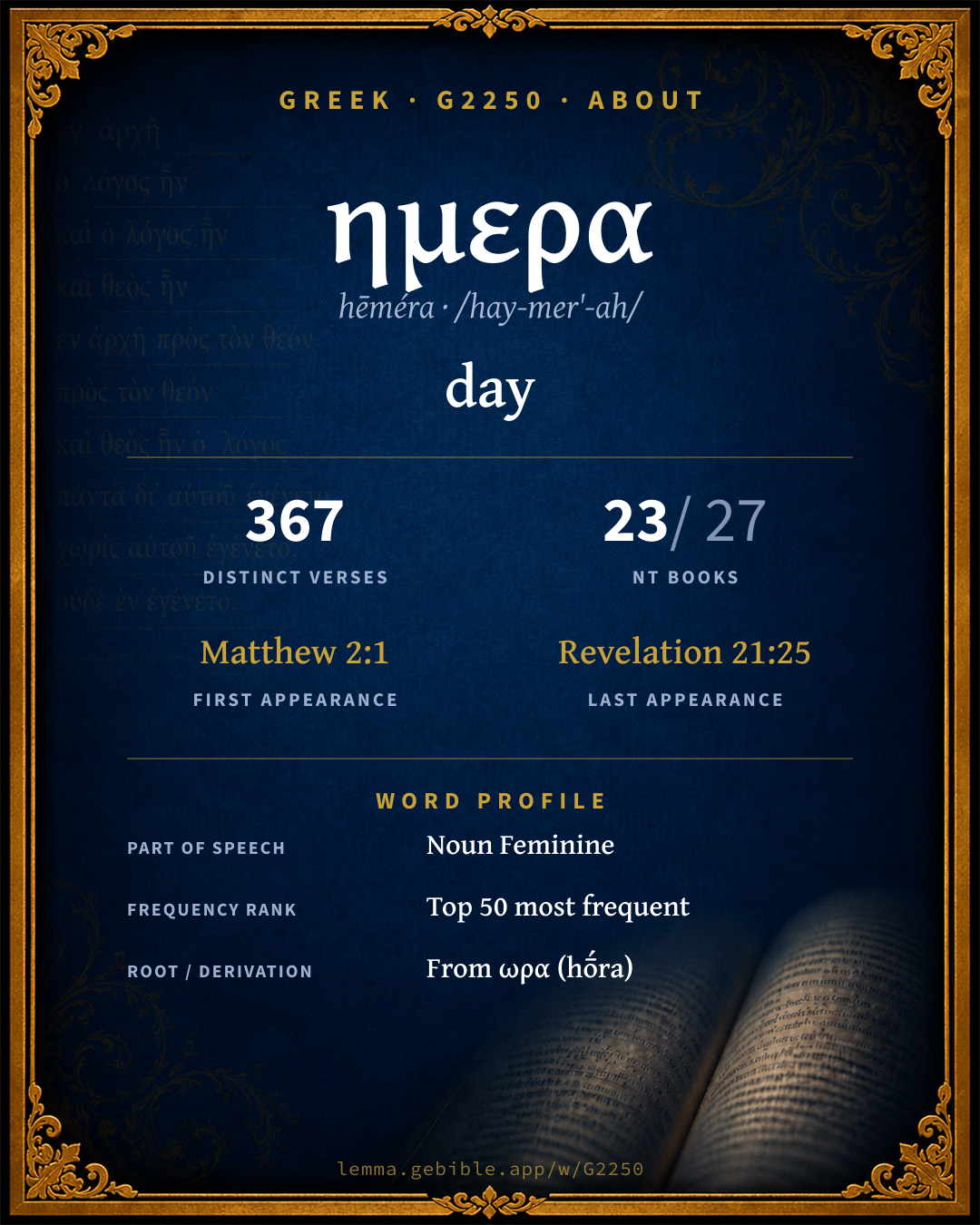
ἡμέρα
day
‘day’ is one of 4 main senses fuller range ↓
Full lexicon entry — Thayer's Greek Lexicon
From Thayer's Greek Lexicon
Where this word appears
See every Accusative-case word in the Greek New Testament →
Grammar key — what these labels mean
Part of speech
- Noun
- A naming word — a person, place, thing, or idea.
Case
- Dative
- The case of the indirect object, means, or location — “to / for / with / in.”
- Accusative
- The case of the direct object and of extent.
- Genitive
- The case of source, possession, or “of” — answers “whose / from what.”
- Nominative
- The case of the subject (and the predicate nominative).
Gender
- Feminine
- Grammatically feminine.
Number
- Singular
- One.
- Plural
- More than one.
Every verse where G2250 appears in the Book of Acts — 90 distinct verses. Click any verse to open its interlinear word-by-word view. Verse text shown in the World English Bible for context — . Each verse’s Greek form is shown with its reference; the English is not keyword-highlighted, since the data carries no word-level English alignment. Use “Compare translations” on any verse to read it across multiple English versions. This concordance covers the Greek New Testament; Septuagint (Greek Old Testament) occurrences of this word are not indexed here.
Acts
- Acts 1:2 ἡμέρας n gen sg fem until the day in which he was received up, after he had given commandment through the Holy Spirit to the apostles whom he had chosen.
- Acts 1:3 ἡμερῶν n gen pl fem To these he also showed himself alive after he suffered, by many proofs, appearing to them over a period of forty days, and speaking about God's Kingdom.
- Acts 1:5 ἡμέρας n acc pl fem For John indeed baptized in water, but you will be baptized in the Holy Spirit not many days from now."
- Acts 1:15 ἡμέραις n dat pl fem In these days, Peter stood up in the midst of the disciples (and the number of names was about one hundred twenty), and said,
- Acts 1:22 ἡμέρας n gen sg fem beginning from the baptism of John, to the day that he was received up from us, of these one must become a witness with us of his resurrection."
- Acts 2:1 ἡμέραν n acc sg fem Now when the day of Pentecost had come, they were all with one accord in one place.
- Acts 2:15 ἡμέρας n gen sg fem For these aren't drunken, as you suppose, seeing it is only the third hour of the day.
- Acts 2:17 ἡμέραις n dat pl fem 'It will be in the last days, says God, That I will pour out my Spirit on all flesh. Your sons and your daughters will prophesy. Your young men will see visions. Your old men will dream dreams.
- Acts 2:18 ἡμέραις n dat pl fem Yes, and on my servants and on my handmaidens in those days, I will pour out my Spirit, and they will prophesy.
- Acts 2:20 ἡμέραν n acc sg fem The sun will be turned into darkness, And the moon into blood, Before the great and glorious day of the Lord comes.
- Acts 2:29 ἡμέρας n gen sg fem "Brothers, I may tell you freely of the patriarch David, that he both died and was buried, and his tomb is with us to this day.
- Acts 2:41 ἡμέρᾳ n dat sg fem Then those who gladly received his word were baptized. There were added that day about three thousand souls.
- Acts 2:46 ἡμέραν n acc sg fem Day by day, continuing steadfastly with one accord in the temple, and breaking bread at home, they took their food with gladness and singleness of heart,
- Acts 2:47 ἡμέραν n acc sg fem praising God, and having favor with all the people. The Lord added to the assembly day by day those who were being saved.
- Acts 3:2 ἡμέραν n acc sg fem A certain man who was lame from his mother's womb was being carried, whom they laid daily at the door of the temple which is called Beautiful, to ask gifts for the needy of those who entered into the temple.
- Acts 3:24 ἡμέρας n acc pl fem Yes, and all the prophets from Samuel and those who followed after, as many as have spoken, they also told of these days.
- Acts 5:36 ἡμερῶν n gen pl fem For before these days Theudas rose up, making himself out to be somebody; to whom a number of men, about four hundred, joined themselves: who was slain; and all, as many as obeyed him, were dispersed, and came to nothing.
- Acts 5:37 ἡμέραις n dat pl fem After this man, Judas of Galilee rose up in the days of the enrollment, and drew away some people after him. He also perished, and all, as many as obeyed him, were scattered abroad.
- Acts 5:42 ἡμέραν n acc sg fem Every day, in the temple and at home, they never stopped teaching and preaching Jesus, the Christ.
- Acts 6:1 ἡμέραις n dat pl fem Now in those days, when the number of the disciples was multiplying, a complaint arose from the Grecian Jews against the Hebrews because their widows were neglected in the daily service.
- Acts 7:8 ἡμέρᾳ n dat sg fem He gave him the covenant of circumcision. So Abraham became the father of Isaac, and circumcised him the eighth day. Isaac became the father of Jacob, and Jacob became the father of the twelve patriarchs.
- Acts 7:26 ἡμέρᾳ n dat sg fem "The day following, he appeared to them as they fought, and urged them to be at peace again, saying, 'Sirs, you are brothers. Why do you wrong one another?'
- Acts 7:41 ἡμέραις n dat pl fem They made a calf in those days, and brought a sacrifice to the idol, and rejoiced in the works of their hands.
- Acts 7:45 ἡμερῶν n gen pl fem which also our fathers, in their turn, brought in with Joshua when they entered into the possession of the nations, whom God drove out before the face of our fathers, to the days of David,
- Acts 8:1 ἡμέρᾳ n dat sg fem Saul was consenting to his death. A great persecution arose against the assembly which was in Jerusalem in that day. They were all scattered abroad throughout the regions of Judea and Samaria, except for the apostles.
- Acts 9:9 ἡμέρας n acc pl fem He was without sight for three days, and neither ate nor drank.
- Acts 9:19 ἡμέρας n acc pl fem He took food and was strengthened. Saul stayed several days with the disciples who were at Damascus.
- Acts 9:23 ἡμέραι n nom pl fem When many days were fulfilled, the Jews conspired together to kill him,
- Acts 9:24 ἡμέρας n gen sg fem but their plot became known to Saul. They watched the gates both day and night that they might kill him,
- Acts 9:37 ἡμέραις n dat pl fem It happened in those days that she fell sick, and died. When they had washed her, they laid her in an upper chamber.
- Acts 9:43 ἡμέρας n acc pl fem It happened, that he stayed many days in Joppa with one Simon, a tanner.
- Acts 10:3 ἡμέρας n gen sg fem At about the ninth hour of the day, he clearly saw in a vision an angel of God coming to him, and saying to him, "Cornelius!"
- Acts 10:30 ἡμέρας n gen sg fem Cornelius said, "Four days ago, I was fasting until this hour, and at the ninth hour, I prayed in my house, and behold, a man stood before me in bright clothing,
- Acts 10:40 ἡμέρᾳ n dat sg fem God raised him up the third day, and gave him to be revealed,
- Acts 10:48 ἡμέρας n acc pl fem He commanded them to be baptized in the name of Jesus Christ. Then they asked him to stay some days.
- Acts 11:27 ἡμέραις n dat pl fem Now in these days, prophets came down from Jerusalem to Antioch.
- Acts 12:3 ἡμέραι n nom pl fem When he saw that it pleased the Jews, he proceeded to seize Peter also. This was during the days of unleavened bread.
- Acts 12:18 ἡμέρας n gen sg fem Now as soon as it was day, there was no small stir among the soldiers about what had become of Peter.
- Acts 12:21 ἡμέρᾳ n dat sg fem On an appointed day, Herod dressed himself in royal clothing, sat on the throne, and gave a speech to them.
- Acts 13:14 ἡμέρᾳ n dat sg fem But they, passing on from Perga, came to Antioch of Pisidia. They went into the synagogue on the Sabbath day, and sat down.
- Acts 13:31 ἡμέρας n acc pl fem and he was seen for many days by those who came up with him from Galilee to Jerusalem, who are his witnesses to the people.
- Acts 13:41 ἡμέραις n dat pl fem 'Behold, you scoffers, and wonder, and perish; For I work a work in your days, A work which you will in no way believe, if one declares it to you.'"
- Acts 15:7 ἡμερῶν n gen pl fem When there had been much discussion, Peter rose up and said to them, "Brothers, you know that a good while ago God made choice among you, that by my mouth the Gentiles should hear the word of the Gospel, and believe.
- Acts 15:36 ἡμέρας n acc pl fem After some days Paul said to Barnabas, "Let's return now and visit our brothers in every city in which we proclaimed the word of the Lord, to see how they are doing."
- Acts 16:5 ἡμέραν n acc sg fem So the assemblies were strengthened in the faith, and increased in number daily.
- Acts 16:12 ἡμέρας n acc pl fem and from there to Philippi, which is a city of Macedonia, the foremost of the district, a Roman colony. We were staying some days in this city.
- Acts 16:13 ἡμέρᾳ n dat sg fem On the Sabbath day we went forth outside of the city by a riverside, where we supposed there was a place of prayer, and we sat down, and spoke to the women who had come together.
- Acts 16:18 ἡμέρας n acc pl fem She was doing this for many days. But Paul, becoming greatly annoyed, turned and said to the spirit, "I charge you in the name of Jesus Christ to come out of her!" It came out that very hour.
- Acts 16:35 Ἡμέρας n gen sg fem But when it was day, the magistrates sent the sergeants, saying, "Let those men go."
- Acts 17:11 ἡμέραν n acc sg fem Now these were more noble than those in Thessalonica, in that they received the word with all readiness of the mind, examining the Scriptures daily to see whether these things were so.
- Acts 17:17 ἡμέραν n acc sg fem So he reasoned in the synagogue with the Jews and the devout persons, and in the marketplace every day with those who met him.
- Acts 17:31 ἡμέραν n acc sg fem because he has appointed a day in which he will judge the world in righteousness by the man whom he has ordained; of which he has given assurance to all men, in that he has raised him from the dead."
- Acts 18:18 ἡμέρας n acc pl fem Paul, having stayed after this many more days, took his leave of the brothers, and sailed from there for Syria, together with Priscilla and Aquila. He shaved his head in Cenchreae, for he had a vow.
- Acts 19:9 ἡμέραν n acc sg fem But when some were hardened and disobedient, speaking evil of the Way before the multitude, he departed from them, and separated the disciples, reasoning daily in the school of Tyrannus.
- Acts 20:6 ἡμέρας ἡμερῶν ἡμέρας n acc pl fem n gen pl fem n acc pl fem We sailed away from Philippi after the days of Unleavened Bread, and came to them at Troas in five days, where we stayed seven days.
- Acts 20:16 ἡμέραν n acc sg fem For Paul had determined to sail past Ephesus, that he might not have to spend time in Asia; for he was hastening, if it were possible for him, to be in Jerusalem on the day of Pentecost.
- Acts 20:18 ἡμέρας n gen sg fem When they had come to him, he said to them, "You yourselves know, from the first day that I set foot in Asia, how I was with you all the time,
- Acts 20:26 ἡμέρᾳ n dat sg fem Therefore I testify to you this day that I am clean from the blood of all men,
- Acts 20:31 ἡμέραν n acc sg fem Therefore watch, remembering that for a period of three years I didn't cease to admonish everyone night and day with tears.
- Acts 21:4 ἡμέρας n acc pl fem Having found disciples, we stayed there seven days. These said to Paul through the Spirit, that he should not go up to Jerusalem.
- Acts 21:5 ἡμέρας n acc pl fem When it happened that we had accomplished the days, we departed and went on our journey. They all, with wives and children, brought us on our way until we were out of the city. Kneeling down on the beach, we prayed.
- Acts 21:7 ἡμέραν n acc sg fem When we had finished the voyage from Tyre, we arrived at Ptolemais. We greeted the brothers, and stayed with them one day.
- Acts 21:10 ἡμέρας n acc pl fem As we stayed there some days, a certain prophet named Agabus came down from Judea.
- Acts 21:15 ἡμέρας n acc pl fem After these days we took up our baggage and went up to Jerusalem.
- Acts 21:26 ἡμέρᾳ ἡμερῶν n dat sg fem n gen pl fem Then Paul took the men, and the next day, purified himself and went with them into the temple, declaring the fulfillment of the days of purification, until the offering was offered for every one of them.
- Acts 21:27 ἡμέραι n nom pl fem When the seven days were almost completed, the Jews from Asia, when they saw him in the temple, stirred up all the multitude and laid hands on him,
- Acts 21:38 ἡμερῶν n gen pl fem Aren't you then the Egyptian, who before these days stirred up to sedition and led out into the wilderness the four thousand men of the Assassins?"
- Acts 23:1 ἡμέρας n gen sg fem Paul, looking steadfastly at the council, said, "Brothers, I have lived before God in all good conscience until this day."
- Acts 23:12 ἡμέρας n gen sg fem When it was day, some of the Jews banded together, and bound themselves under a curse, saying that they would neither eat nor drink until they had killed Paul.
- Acts 24:1 ἡμέρας n acc pl fem After five days, the high priest, Ananias, came down with certain elders and an orator, one Tertullus. They informed the governor against Paul.
- Acts 24:11 ἡμέραι n nom pl fem seeing that you can recognize that it is not more than twelve days since I went up to worship at Jerusalem.
- Acts 24:24 ἡμέρας n acc pl fem But after some days, Felix came with Drusilla, his wife, who was a Jewess, and sent for Paul, and heard him concerning the faith in Christ Jesus.
- Acts 25:1 ἡμέρας n acc pl fem Festus therefore, having come into the province, after three days went up to Jerusalem from Caesarea.
- Acts 25:6 ἡμέρας n acc pl fem When he had stayed among them more than ten days, he went down to Caesarea, and on the next day he sat on the judgment seat, and commanded Paul to be brought.
- Acts 25:13 Ἡμερῶν n gen pl fem Now when some days had passed, Agrippa the King and Bernice arrived at Caesarea, and greeted Festus.
- Acts 25:14 ἡμέρας n acc pl fem As he stayed there many days, Festus laid Paul's case before the king, saying, "There is a certain man left a prisoner by Felix;
- Acts 26:7 ἡμέραν n acc sg fem which our twelve tribes, earnestly serving night and day, hope to attain. Concerning this hope I am accused by the Jews, King Agrippa!
- Acts 26:13 ἡμέρας n gen sg fem at noon, O King, I saw on the way a light from the sky, brighter than the sun, shining around me and those who traveled with me.
- Acts 26:22 ἡμέρας n gen sg fem Having therefore obtained the help that is from God, I stand to this day testifying both to small and great, saying nothing but what the prophets and Moses said would happen,
- Acts 27:7 ἡμέραις n dat pl fem When we had sailed slowly many days, and had come with difficulty opposite Cnidus, the wind not allowing us further, we sailed under the lee of Crete, opposite Salmone.
- Acts 27:20 ἡμέρας n acc pl fem When neither sun nor stars shone on us for many days, and no small tempest pressed on us, all hope that we would be saved was now taken away.
- Acts 27:29 ἡμέραν n acc sg fem Fearing that we would run aground on rocky ground, they let go four anchors from the stern, and wished for daylight.
- Acts 27:33 ἡμέρα ἡμέραν n nom sg fem n acc sg fem While the day was coming on, Paul begged them all to take some food, saying, "This day is the fourteenth day that you wait and continue fasting, having taken nothing.
- Acts 27:39 ἡμέρα n nom sg fem When it was day, they didn't recognize the land, but they noticed a certain bay with a beach, and they decided to try to drive the ship onto it.
- Acts 28:7 ἡμέρας n acc pl fem Now in the neighborhood of that place were lands belonging to the chief man of the island, named Publius, who received us, and courteously entertained us for three days.
- Acts 28:12 ἡμέρας n acc pl fem Touching at Syracuse, we stayed there three days.
- Acts 28:13 ἡμέραν n acc sg fem From there we circled around and arrived at Rhegium. After one day, a south wind sprang up, and on the second day we came to Puteoli,
- Acts 28:14 ἡμέρας n acc pl fem where we found brothers, and were entreated to stay with them for seven days. So we came to Rome.
- Acts 28:17 ἡμέρας n acc pl fem It happened that after three days Paul called together those who were the leaders of the Jews. When they had come together, he said to them, "I, brothers, though I had done nothing against the people, or the customs of our fathers, still was delivered prisoner from Jerusalem into the hands of the Romans,
- Acts 28:23 ἡμέραν n acc sg fem When they had appointed him a day, many people came to him at his lodging. He explained to them, testifying about the Kingdom of God, and persuading them concerning Jesus, both from the law of Moses and from the prophets, from morning until evening.
About this entry
At a glance — auto-summarized from this page’s data, not written by a person. Every figure links to its source below. This summary describes the numbers; it doesn’t interpret them.
At its core, ημερα (hēméra) means “day.” Ranging over 4 senses, it is not a single-sense word. It turns up in 367 verses across 23 books, a common footprint. The word gravitates to Acts (25%), then Luke and Matthew. It first appears in Matthew 2:1. Dig into 367-verse concordance and the renderings breakdown below.
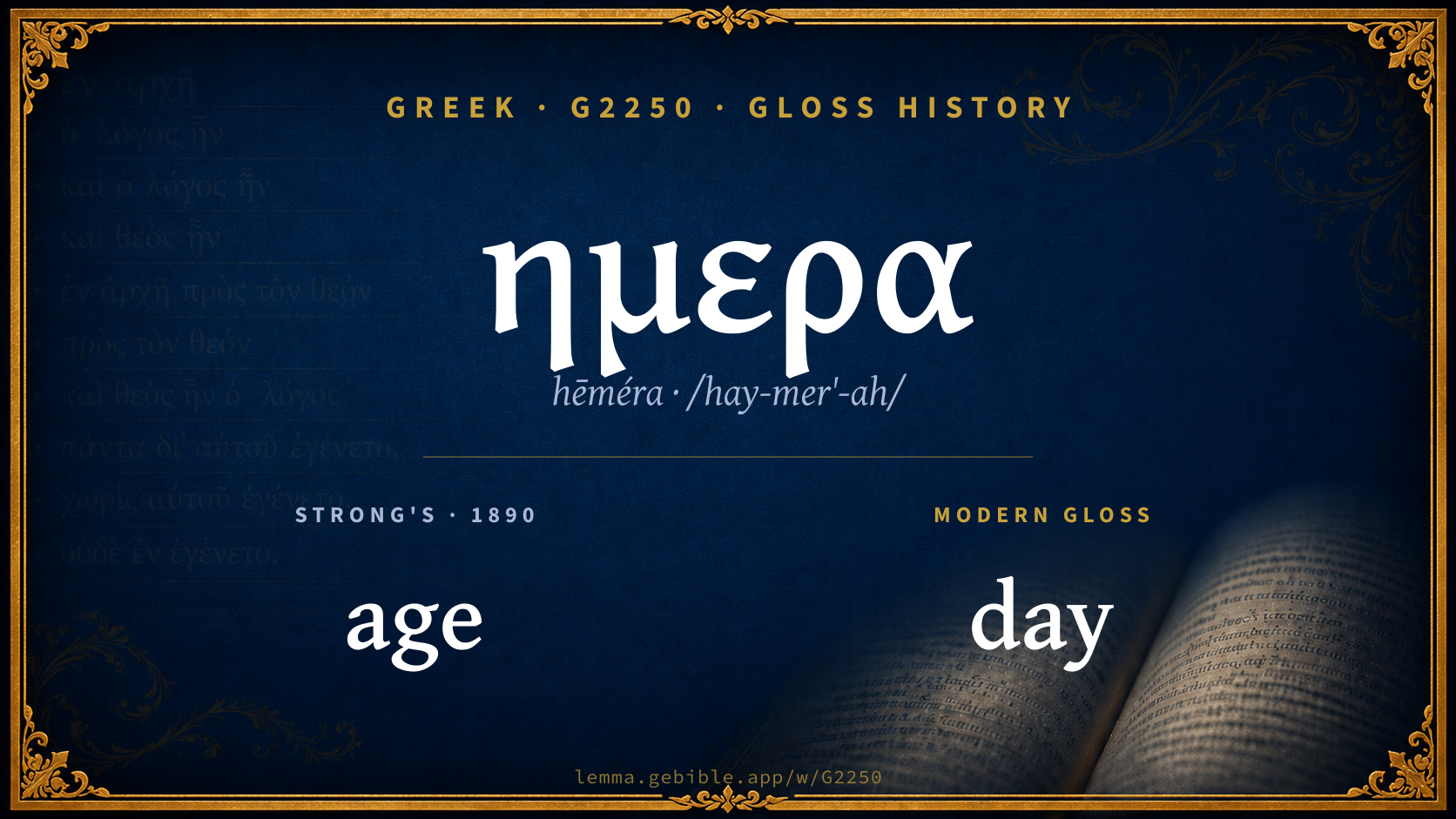
Gloss history
Strong's 1890 vs modern scholarship
About this word
Strong's G2250 catalogs a Greek word from the Greek New Testament.
These counts are not copied from any lexicon or concordance. They are computed here, from the morphology-tagged Greek New Testament. What Lemma adds →
- 367
- distinct verses
- The word appears in 367 distinct verses.
- 23 / 27
- NT books
- The word appears in 23 of 27 New Testament books.
- #47
- by frequency
- Top 50 most frequent Greek words (rank 47 of 5,347 Greek words by occurrence).
View all 367 occurrences in the concordance →
By section of the New Testament
By traditional corpus
Conventional, traditional groupings — biblical authorship is debated, so this is a traditional corpus grouping, not an authorship claim. Some books belong to more than one corpus (Luke is in both the Gospels and the Lukan corpus, and so on), so these shares overlap and need not total 100%. Each figure is a share of the word’s 367 distinct verses.
- Gospels 174 verses · 47%
- Lukan (Luke–Acts) 168 verses · 46%
- Johannine 52 verses · 14%
- Pauline corpus 47 verses · 13%
- Revelation 21 verses · 6%
- Hebrews 18 verses · 5%
- General (Catholic) Epistles 17 verses · 5%
How translations render this word
Counts come from each version’s own published word-to-Strong’s tagging or interlinear alignment — an approximate guide to how each version renders this word, not a word-level alignment the data otherwise carries. Because each total is that version’s own tagged count, the per-version totals vary from one another and need not match the appearance or distinct-verse counts above. These counts may also differ from a printed concordance because Lemma counts each distinctly tagged rendering and does not collapse phrase taggings into a single head-word total. This is a fixed set of word-tagged versions (KJV, ASV, BSB, ULT) and does not change with the reading translation you choose elsewhere. Each version’s license is shown beside its name below (and on Sources).
- King James Version: Day 192×, Days 153×, Daily 9×
- American Standard Version: Day 188×, Days 156×, The 14×
- Berean Standard Bible: Day 186×, Days 131×, Time 19×
- unfoldingWord Literal Text: Day 214×, Days 164×, The 20×
King James Version Public Domain
Renders G2250 across 376 tagged occurrences — most commonly:
Plus 9 renderings that appear only once — usually multi-word phrases or single function words the recovered tagging swept in, not distinct renderings. Not rendered by a distinct English word in 13 further occurrences.
American Standard Version Public Domain
Renders G2250 across 398 tagged occurrences — most commonly:
Plus 23 renderings that appear only once — usually multi-word phrases or single function words the recovered tagging swept in, not distinct renderings.
Berean Standard Bible Public Domain
Renders G2250 across 368 tagged occurrences — most commonly:
Plus 8 renderings that appear only once — usually multi-word phrases or single function words the recovered tagging swept in, not distinct renderings. Not rendered by a distinct English word in 19 further occurrences.
unfoldingWord Literal Text CC BY-SA 4.0
Renders G2250 across 441 tagged occurrences — most commonly:
Plus 11 renderings that appear only once — usually multi-word phrases or single function words the recovered tagging swept in, not distinct renderings.
Senses in Thayer's
The 4 senses Thayer's distinguishes for this word, in lexicon order (not ranked by frequency or importance). The full entry — with sub-senses — is in the Lexicon Entry tab.
- the day, used of the natural day, or the interval between sunrise and sunset, as distinguished from and contrasted with…
- of the civil day, or the space of twenty four hours (thus including the night)
- of the last day of this present age…
- used of time in general, i.e. the days of his life.
Word origin
Derived from ωρα (hṓra) (G5610) — hour.
Feminine (with G5610 implied) of a derivative of ἧμαι hē mai (to sit ; akin to the base of G1476 ) meaning tame that is gentle ; day that is (literally) the time space between dawn and dark or the whole 24 hours (but several days were usually reckoned by the Jews as inclusive of the parts of both extremes); figuratively a period (always defined more or less clearly by the context): - age + alway (mid-) day (by day [-ly]) + for ever judgment (day) time while years.
— Strong’s Exhaustive Concordance (1890), public domain.
Forms in the corpus
The 9 distinct written forms G2250 takes in the Greek New Testament, most frequent first — each parse links to that case’s occurrences in the concordance.
| Form | Parsing | Example | Uses |
|---|---|---|---|
| ἡμέρας hēméras | Noun, Accusative, Plural, Feminine | Matthew 4:2 | 126 |
| ἡμέρᾳ hēméra | Noun, Dative, Singular, Feminine | Matthew 6:34 | 84 |
| ἡμέραν hēméran | Noun, Accusative, Singular, Feminine | Matthew 20:2 | 58 |
| ἡμέραις hēmérais | Noun, Dative, Plural, Feminine | Matthew 2:1 | 48 |
| ἡμέραι hēmérai | Noun, Nominative, Plural, Feminine | Matthew 9:15 | 26 |
| ἡμέρα hēméra | Noun, Nominative, Singular, Feminine | Luke 6:13 | 23 |
| ἡμερῶν hēmerō̂n | Noun, Genitive, Plural, Feminine | Matthew 11:12 | 21 |
| Ἡμέρας Hēméras | Noun, Genitive, Singular, Feminine | Acts 16:35 | 1 |
| Ἡμερῶν Hēmerō̂n | Noun, Genitive, Plural, Feminine | Acts 25:13 | 1 |
Same root — word family
Other Thayer's entries built from the same root as G2250, grouped by Strong’s listed origin. These share a root / origin per the lexicon — not necessarily a shared meaning. Each links to that word’s own entry.
Derives from
Shares the same root
Compare all same-root words → They share a root, not necessarily a meaning.
Septuagint usage
The same Greek word ημερα appears 2,052 times in the Greek Old Testament (Septuagint), across 1,732 verses in 38 books.
- 2,052
- LXX occurrences
- Tagged occurrences of this Greek word in the Septuagint.
- 1,732
- verses
- Distinct Septuagint verses containing this word.
- 38 / 39
- OT books
- The word appears in 38 of the 39 Old Testament books.
Sample Septuagint occurrences
- Genesis 1:5 ἡμέρα
- Exodus 2:11 ἡμέρα
- Leviticus 5:24 ἡμέρα
- Numbers 3:1 ἡμέρα
- Deuteronomy 1:2 ἡμέρα
- Joshua 1:5 ἡμέρα
- Judges 1:21 ἡμέρα
- Ruth 4:5 ἡμέρα
- 1 Samuel 1:3 ἡμέρα
- 2 Samuel 1:1 ἡμέρα
- 1 Kings 1:1 ἡμέρα
- 2 Kings 1:18 ἡμέρα
Septuagint occurrences (same lexeme)
Every verse where the same Strong’s number (G2250) appears in the Greek Septuagint — showing the first 50 of 1,732. Verse text shown in the World English Bible for context; the Greek form is the matched word — the English is not keyword-highlighted.
- Genesis 1:5 ἡμέρα God called the light Day, and the darkness he called Night. There was evening and there was morning, one day.
- Genesis 1:8 ἡμέρα God called the expanse sky. There was evening and there was morning, a second day.
- Genesis 1:13 ἡμέρα There was evening and there was morning, a third day.
- Genesis 1:14 ἡμέρα God said, "Let there be lights in the expanse of sky to divide the day from the night; and let them be for signs, and for seasons, and for days and years;
- Genesis 1:16 ἡμέρα God made the two great lights: the greater light to rule the day, and the lesser light to rule the night. He also made the stars.
- Genesis 1:18 ἡμέρα and to rule over the day and over the night, and to divide the light from the darkness. God saw that it was good.
- Genesis 1:19 ἡμέρα There was evening and there was morning, a fourth day.
- Genesis 1:23 ἡμέρα There was evening and there was morning, a fifth day.
- Genesis 1:31 ἡμέρα God saw everything that he had made, and, behold, it was very good. There was evening and there was morning, the sixth day.
- Genesis 2:2 ἡμέρα On the seventh day God finished his work which he had made; and he rested on the seventh day from all his work which he had made.
- Genesis 2:3 ἡμέρα God blessed the seventh day, and made it holy, because he rested in it from all his work which he had created and made.
- Genesis 2:4 ἡμέρα This is the history of the generations of the heavens and of the earth when they were created, in the day that Yahweh God made earth and the heavens.
- Genesis 2:17 ἡμέρα but of the tree of the knowledge of good and evil, you shall not eat of it: for in the day that you eat of it you will surely die."
- Genesis 3:5 ἡμέρα for God knows that in the day you eat it, your eyes will be opened, and you will be like God, knowing good and evil."
- Genesis 3:14 ἡμέρα Yahweh God said to the serpent, "Because you have done this, cursed are you above all cattle, and above every animal of the field. On your belly shall you go, and you shall eat dust all the days of your life.
- Genesis 3:17 ἡμέρα To Adam he said, "Because you have listened to your wife's voice, and have eaten of the tree, of which I commanded you, saying, 'You shall not eat of it,' cursed is the ground for your sake. In toil you will eat of it all the days of your life.
- Genesis 4:3 ἡμέρα As time passed, it happened that Cain brought an offering to Yahweh from the fruit of the ground.
- Genesis 5:1 ἡμέρα This is the book of the generations of Adam. In the day that God created man, he made him in God's likeness.
- Genesis 5:2 ἡμέρα He created them male and female, and blessed them, and called their name Adam, in the day when they were created.
- Genesis 5:4 ἡμέρα The days of Adam after he became the father of Seth were eight hundred years, and he became the father of sons and daughters.
- Genesis 5:5 ἡμέρα All the days that Adam lived were nine hundred thirty years, then he died.
- Genesis 5:8 ἡμέρα All the days of Seth were nine hundred twelve years, then he died.
- Genesis 5:11 ἡμέρα All the days of Enosh were nine hundred five years, then he died.
- Genesis 5:14 ἡμέρα and all the days of Kenan were nine hundred ten years, then he died.
- Genesis 5:17 ἡμέρα All the days of Mahalalel were eight hundred ninety-five years, then he died.
- Genesis 5:20 ἡμέρα All the days of Jared were nine hundred sixty-two years, then he died.
- Genesis 5:23 ἡμέρα all the days of Enoch were three hundred sixty-five years.
- Genesis 5:27 ἡμέρα All the days of Methuselah were nine hundred sixty-nine years, then he died.
- Genesis 5:31 ἡμέρα All the days of Lamech were seven hundred seventy-seven years, then he died.
- Genesis 6:3 ἡμέρα Yahweh said, "My Spirit will not strive with man forever, because he also is flesh; yet will his days be one hundred twenty years."
- Genesis 6:4 ἡμέρα The Nephilim were in the earth in those days, and also after that, when God's sons came to men's daughters. They bore children to them: the same were the mighty men who were of old, men of renown.
- Genesis 6:5 ἡμέρα Yahweh saw that the wickedness of man was great in the earth, and that every imagination of the thoughts of his heart was only evil continually.
- Genesis 7:4 ἡμέρα In seven days, I will cause it to rain on the earth for forty days and forty nights. Every living thing that I have made, I will destroy from the surface of the ground."
- Genesis 7:10 ἡμέρα It happened after the seven days, that the waters of the flood came on the earth.
- Genesis 7:11 ἡμέρα In the six hundredth year of Noah's life, in the second month, on the seventeenth day of the month, on the same day all the fountains of the great deep were burst open, and the sky's windows were opened.
- Genesis 7:12 ἡμέρα The rain was on the earth forty days and forty nights.
- Genesis 7:13 ἡμέρα In the same day Noah, and Shem, Ham, and Japheth, the sons of Noah, and Noah's wife, and the three wives of his sons with them, entered into the ark;
- Genesis 7:17 ἡμέρα The flood was forty days on the earth. The waters increased, and lifted up the ark, and it was lifted up above the earth.
- Genesis 7:24 ἡμέρα The waters prevailed on the earth one hundred fifty days.
- Genesis 8:3 ἡμέρα The waters receded from off the earth continually. After the end of one hundred fifty days the waters decreased.
- Genesis 8:6 ἡμέρα It happened at the end of forty days, that Noah opened the window of the ark which he had made,
- Genesis 8:10 ἡμέρα He stayed yet another seven days; and again he sent forth the dove out of the ark.
- Genesis 8:12 ἡμέρα He stayed yet another seven days, and sent forth the dove; and she didn't return to him any more.
- Genesis 8:22 ἡμέρα While the earth remains, seed time and harvest, and cold and heat, and summer and winter, and day and night shall not cease."
- Genesis 9:29 ἡμέρα All the days of Noah were nine hundred fifty years, then he died.
- Genesis 10:25 ἡμέρα To Eber were born two sons. The name of the one was Peleg, for in his days was the earth divided. His brother's name was Joktan.
- Genesis 11:32 ἡμέρα The days of Terah were two hundred five years. Terah died in Haran.
- Genesis 15:18 ἡμέρα In that day Yahweh made a covenant with Abram, saying, "To your seed have I given this land, from the river of Egypt to the great river, the river Euphrates:
- Genesis 17:12 ἡμέρα He who is eight days old will be circumcised among you, every male throughout your generations, he who is born in the house, or bought with money of any foreigner who is not of your seed.
- Genesis 17:14 ἡμέρα The uncircumcised male who is not circumcised in the flesh of his foreskin, that soul shall be cut off from his people. He has broken my covenant."
These are occurrences of the same Greek lexeme (G2250) in the Septuagint — not a translation of any one Hebrew word. The store carries no word-level Hebrew↔Greek alignment, so no Hebrew original is asserted here. Counts come from the recovered LXX Strong's tagging — high-frequency vocabulary is well covered, while rare or late forms may be untagged — so they reflect tagged occurrences and may slightly undercount.