
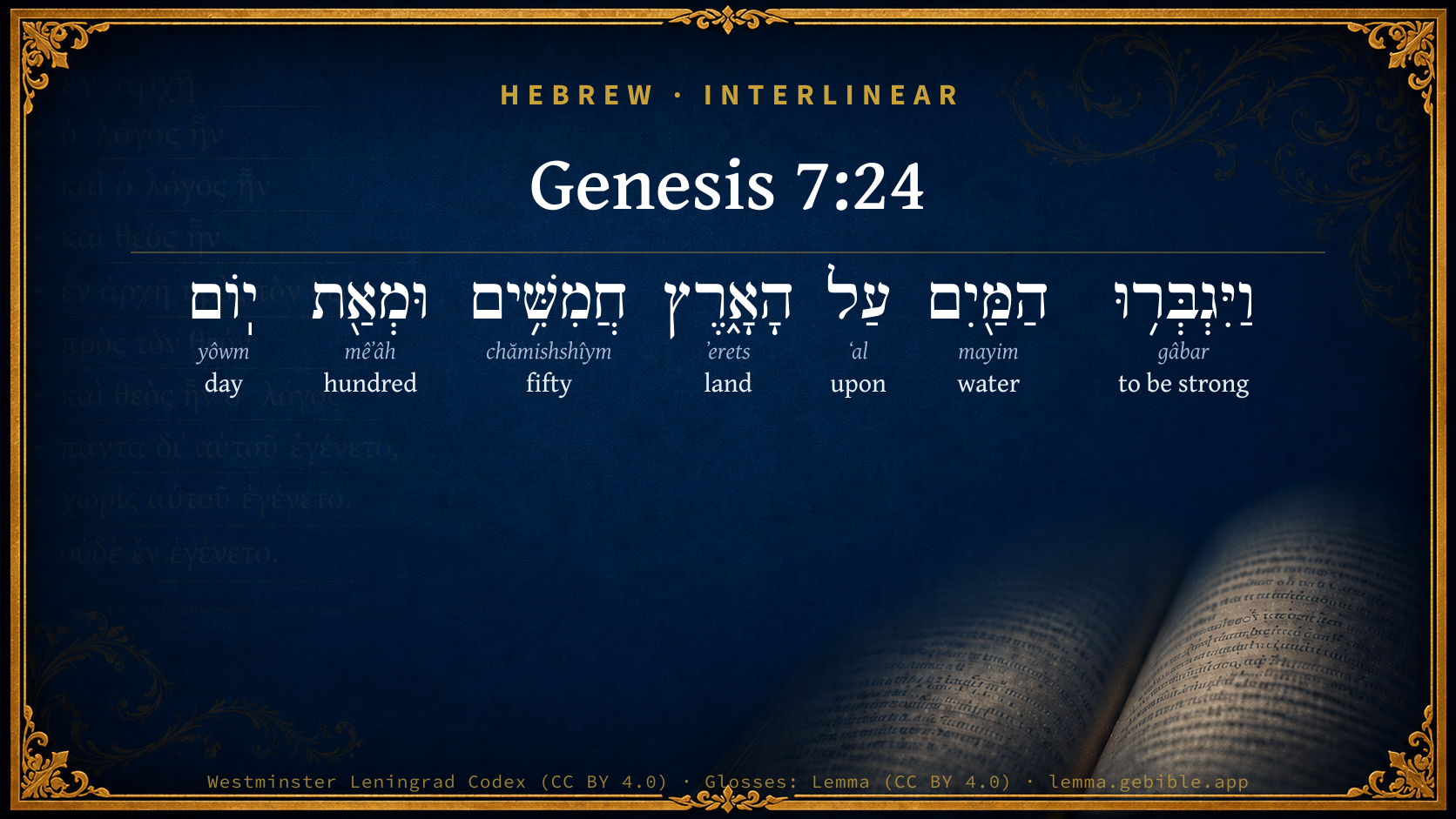
Genesis 7:24

Hebrew (Westminster Leningrad Codex) Genesis 7:24 appears in the Hebrew Old Testament. The text above is from the Westminster Leningrad Codex. Each word links to its Strong’s number, a concise gloss, and parsing drawn from the Open Scriptures Hebrew Bible morphology. Click any word for its full Brown-Driver-Briggs (BDB) entry.
Download image
Cite this verse

Genesis 7:24 (World English Bible). Public Domain. Lemma interlinear Bible study tool, https://lemma.gebible.app/v/genesis/7/24.

Show BibTeX & RIS
BibTeX
RIS
English Translation
The waters prevailed on the earth one hundred fifty days.
World English Bible · Public Domain
Download a study sheet

One document with this verse’s original text, its word-by-word gloss line, the meaning frame, cross-references with their text, attributed commentary, and full source and license credits — printable, and it pastes into notes with its structure intact.

This verse Autodidact and up

Study sheet (.html) Plain text (.txt)

A passage Seminary Student

Up to 50 verses in one chapter. A passage sheet keeps up to 6 commentary sources and 12 cross-references per verse, in the order this page ranks them, and says so on the sheet whenever that leaves anything out. Ask for a single verse and you get the Autodidact verse sheet above.

Everything on this page stays free to read, with no account — the sheet is a download of what is already on screen, not access to it.

Want to remove ads? Support Godless Engineer
Compare translations 3

The same verse in 3 English versions, stacked beneath the original-language interlinear above. Click any original word for its lexicon entry.

Each is an independent rendering of the whole verse — the interlinear is not word-aligned to these translations.

Highlighted words mark where these versions differ — a whole-verse word diff, not a word-by-word alignment.

  • World English Bible Public Domain
    The waters prevailed on the earth one hundred fifty days.
  • King James Version Public Domain
    And the waters prevailed upon the earth an hundred and fifty days.
  • unfoldingWord Literal Text CC BY-SA 4.0
    And the waters prevailed over the earth 150 days.

unfoldingWord Literal Text — © unfoldingWord, licensed CC BY-SA 4.0. Word-aligned USFM3 via Door43 (git.door43.org/unfoldingWord/en_ult).

Versions to compare (up to 4)

3 of 4 selected

Show all 18 translations

Every available English version of this verse, each an independent rendering of the whole verse.

  • World English Bible Public Domain
    The waters prevailed on the earth one hundred fifty days.
  • Berean Standard Bible Public Domain
    And the waters prevailed upon the earth for 150 days.
  • Majority Standard Bible Public Domain
    And the waters prevailed upon the earth for 150 days.
  • King James Version Public Domain
    And the waters prevailed upon the earth an hundred and fifty days.
  • American Standard Version (1901) Public Domain
    And the waters prevailed upon the earth a hundred and fifty days.
  • Revised Version (1885) Public Domain
    And the waters prevailed upon the earth an hundred and fifty days.
  • Geneva Bible (1599) Public Domain
    And the waters preuailed vpon the earth an hundreth and fiftie dayes.
  • Douay-Rheims (1899) Public Domain
    And the waters prevailed upon the earth a hundred and fifty days.
  • Young's Literal Translation Public Domain
    and the waters are mighty on the earth a hundred and fifty days.
  • Literal Standard Version CC BY-SA 4.0
    and the waters are mighty on the earth [for] one hundred and fifty days.
  • Unlocked Literal Bible CC BY-SA 4.0
    The waters stayed upon the earth for a hundred and fifty days.
  • unfoldingWord Literal Text CC BY-SA 4.0
    And the waters prevailed over the earth 150 days.
  • Darby Bible Public Domain
    And the waters prevailed on the earth a hundred and fifty days.
  • World Messianic Bible Public Domain
    The waters flooded the earth one hundred fifty days.
  • Webster's Bible Public Domain
    And the waters prevailed upon the earth a hundred and fifty days.
  • Free Bible Version CC BY-SA 4.0
    The earth remained flooded for 150 days.
  • Bible in Basic English Public Domain
    And the waters were over the earth a hundred and fifty days.
  • JPS Tanakh (1917) Public Domain
    And the waters prevailed upon the earth a hundred and fifty days.

Literal Standard Version (2020), Covenant Press — licensed CC BY-SA 4.0. Text via the HelloAO Bible API (eBible.org). Unlocked Literal Bible (unfoldingWord) — licensed CC BY-SA 4.0. Text via the HelloAO Bible API (eBible.org). unfoldingWord Literal Text — © unfoldingWord, licensed CC BY-SA 4.0. Word-aligned USFM3 via Door43 (git.door43.org/unfoldingWord/en_ult). Free Bible Version, Dr. Jonathan Gallagher — licensed CC BY-SA 4.0. Text via the HelloAO Bible API (eBible.org).

Word by word

More ways to search: Search by grammar → Find every occurrence → Compare this word →

Practice this passage: Drill this verse → Learn its vocabulary →

וַיִּגְבְּר֥וּ
gâbar
H1396
“and · to be strong”
Conjunction + Verb, Qal, Sequential Imperfect, 3rd Person, Masculine, Plural
Part of Speech
Conjunction + Verb
Stem
Qal
Form
Sequential Imperfect
Person
3rd Person
Gender
Masculine
Number
Plural
Full BDB Definition

Origin: a primitive root

TWOT: 310

to prevail, have strength, be strong, be powerful, be mighty, be great - (Qal) - to be strong, mighty - to prevail - (Piel) to make strong, strengthen - (Hiphil) - to confirm, give strength - to confirm (a covenant) - (Hithpael) - to show oneself mighty - to act proudly (toward God)
  1. הַמַּ֖יִם mayim H4325 “the · water(s)” Particle, Definite Article + Noun, Common, Masculine, Plural, Absolute
  2. עַל ʻal H5921 “upon” Preposition
  3. הָאָ֑רֶץ ʼerets H776 “the · land” Particle, Definite Article + Noun, Common, Both, Singular, Absolute
  4. חֲמִשִּׁ֥ים chămishshîym H2572 “fifty” Adjective, Cardinal number, Both, Plural, Absolute
  5. וּמְאַ֖ת mêʼâh H3967 “and · hundred” Conjunction + Adjective, Cardinal number, Both, Singular, Construct
  6. יֽוֹם yôwm H3117 “day” Noun, Common, Masculine, Singular, Absolute

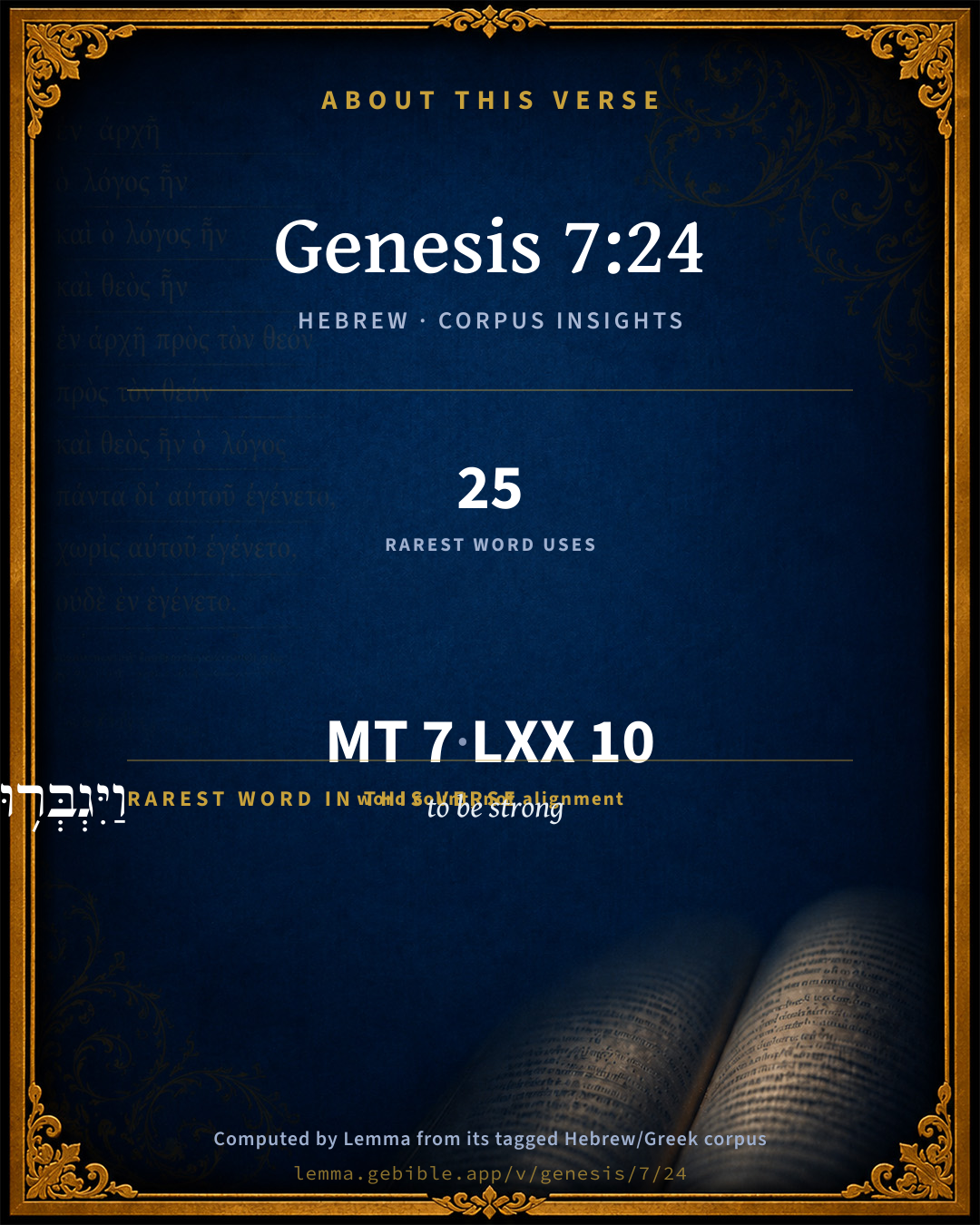
About this verse

These counts appear in no published source. They are computed here, from the morphology-tagged text and Lemma’s own curated glosses. What Lemma adds →

7
words
7
distinct lemmas
Pentateuch
section

Notable vocabulary

The rarest word here is וַיִּגְבְּר֥וּ to be strong H1396 — appearing just 25 times in the whole Hebrew Bible.

Shared distinctive vocabulary

וַיִּגְבְּר֥וּ to be strong H1396 occurs in 24 verses of the Hebrew Bible. Also found in:

Grammatical profile

  • 1 verb
  • 3 nouns
  • 2 adjectives
  • 1 preposition

Verb forms

  • וַיִּגְבְּר֥וּ Qal · Sequential Imperfect

Hebrew & Septuagint length

In English translation the verse runs 10 words from the Hebrew and 13 from the Septuagint (LXX English) — closely comparable.

A rough comparison of the two English renderings, which tokenize alike — not a word-level alignment.

Word counts can differ between the Hebrew and the Greek without any difference in meaning — e.g. the Hebrew direct-object marker אֵת has no separate Greek word, and Greek often adds the article ὁ.

In the original languages it is 7 Hebrew tokens and 10 Greek tokens — but the two are counted differently (Hebrew bundles its prefixes and suffixes into one token; the Greek is in lemma form), so that isn’t a like-for-like length.

Cross-references

1

Topical passages linked to Genesis 7:24 in the Treasury of Scripture Knowledge — connected by theme and wording, ordered by reader-vote popularity; previews shown in the World English Bible.

  • Genesis 8:3–4 The waters receded from off the earth continually. After the end of one hundred fifty days the waters decreased.

Cross-references courtesy of OpenBible.info (CC BY 4.0).

Hebrew and Greek witnesses Masoretic Hebrew ↔ Greek Septuagint

The same verse in the two great witnesses to the Old Testament, shown verse-for-verse.

These are two independent witnesses, not word-aligned to each other, and the Septuagint is shown in lemma (dictionary) form.

Hebrew Genesis 7:24 Masoretic · Westminster Leningrad Codex

וַיִּגְבְּר֥וּ הַמַּ֖יִם עַל הָאָ֑רֶץ חֲמִשִּׁ֥ים וּמְאַ֖ת יֽוֹם

The waters prevailed on the earth one hundred fifty days.

World English Bible · Public Domain

Greek LXX Genesis 7:24 Septuagint · lemma form

καί ὑψόω ὁ ὕδωρ ἐπί ὁ γῆ ἡμέρα ἑκατόν πεντήκοντα

And the water was raised over the earth one hundred and fifty days.

LXX2012 (modern English Septuagint) · Public Domain

Hebrew: Westminster Leningrad Codex (CC BY 4.0). Greek: Septuagint (public domain); English from LXX2012 (modern English Septuagint) (Public Domain). How the Septuagint differs from the Hebrew →

Targum (Aramaic paraphrase)

2

The Targum is the ancient Jewish Aramaic paraphrase of the Hebrew Scriptures — an interpretive translation, not the Hebrew text itself. Onkelos (literal) and Pseudo-Jonathan (expansive) render the Torah, and Jonathan the Prophets. Coverage is partial: where no permissively-licensed English translation exists for a verse, only the Aramaic is shown. This is verse-level text, not a word-by-word alignment to the Hebrew.

  1. Targum Onkelos Torah (Genesis–Deuteronomy)
    וּתְקִיפוּ מַיָּא עַל אַרְעָא מְאָה וְחַמְשִׁין יוֹמִין

    And the waters prevailed upon the earth an hundred and fifty days.

    Targum Onkelos — Aramaic: “Onkelos Genesis” (public domain); “Onkelos Exodus” (public domain); “Onkelos Leviticus” (public domain); “Onkelos Numbers” (public domain); “Onkelos Deuteronomy” (public domain). English: “Sefaria Community Translation” (CC0 1.0 (public-domain dedication)); “J.W. Etheridge. The Targums of Onkelos and Jonathan Ben Uzziel on the Pentateuch. London: Longmans, Green, 1862” (public domain). Text via Sefaria.

  2. Targum Pseudo-Jonathan Torah (Genesis–Deuteronomy)
    וּתְקִיפוּ מַיָא עַל אַרְעָא מְאָה וְחַמְשִׁין יוֹמִין

    And the waters prevailed upon the earth a hundred and fifty days.

    Targum Pseudo-Jonathan — Aramaic: “Targum Jonathan on Genesis” (public domain); “Targum Jonathan on Exodus” (public domain); “Targum Jonathan on Leviticus” (public domain); “Targum Jonathan on Numbers” (public domain); “Targum Jonathan on Deuteronomy” (public domain). English: “The Targum of Jonathan ben Uzziel, trans. J. W. Etheridge, London, 1862” (public domain). Text via Sefaria.

Commentary

Notes on Genesis 7:24 from classic Christian and Jewish commentators (each source and its license shown beneath its notes). The classic Christian expositions comment on the surrounding passage and are grouped to its opening verse, so a note may address several verses; the Jewish commentaries on the Tanakh (Rashi and others) are per-verse, so they appear only where the commentator wrote on this verse.

Lemma curates 59 commentaries, every one of them public domain or Creative Commons licensed, each selected and text-cleaned for this edition rather than reprinted as found. About our sources →

Trapp's Complete Commentary

John Trapp

Gen 7:24 And the waters prevailed upon the earth an hundred and fifty days.

Ver. 24. A hundred and fifty days.] Reckoning from the first day of the falling of the rain {Gen 7:11} unto the end of the sixth month: well might the poet say -

Oψε θεων αλεουσι μυλαι, αλεουσι δε λεπτον.

John Trapp, A Commentary or Exposition upon All the Books of the Old and New Testament (1647–1656) — public domain. Text from a community e-Sword module.

Jamieson, Fausset & Brown

Robert Jamieson, A. R. Fausset & David Brown

an hundred and fifty days--a period of five months. Though long before that every living creature must have been drowned, such a lengthened continuance of the flood was designed to manifest God's stern displeasure at sin and sinners. Think of Noah during such a crisis. We learn (Eze 14:14) that he was a man who lived and breathed habitually in an atmosphere of devotion; and having in the exercise of this high-toned faith made God his refuge, he did not fear "though the waters roared and were troubled; though the mountains shook with the swelling thereof" [Psa 46:3].

Next: Genesis Chapter 8

Jamieson, Fausset & Brown — Commentary Critical and Explanatory on the Whole Bible (1871) — public domain (CC PDM 1.0). Text via the HelloAO Bible API.

Adam Clarke's Commentary

Verse 24. And the waters prevailed upon the earth a hundred and fifty days.] The breaking up of the fountains of the great deep, and the raining forty days and nights, had raised the waters fifteen cubits above the highest mountains; after which forty days it appears to have continued at this height for one hundred and fifty days more. "So," says Dr. Lightfoot, "these two sums are to be reckoned distinct, and not the forty days included in the one hundred and fifty; so that when the one hundred and fifty days were ended, there were six months and ten days of the flood past."

For an improvement of this awful judgment, see the conclusion of the following chapter (Ge 8:22 note).

Adam Clarke's Commentary on the Bible (1810–1826) — public domain. Text from a community e-Sword/MySword module.

Ellicott's Commentary for English Readers

(24) prevailed.—Heb., were strong, as in Gen_7:18. The rains lasted forty days; for one hundred and ten more days they still bore up the ark, and then it grounded. But though still mighty, they had by this time “abated” (see Gen_8:3), inasmuch as, instead of covering the hills to the depth of nearly four fathoms, the ark now had touched dry land. Again, then, the narrative seems to give the personal experiences of some one in the ark.

A Bible Commentary for English Readers, edited by Charles John Ellicott (1878–1897) — public domain. Text from a community e-Sword module.

Haydock's Catholic Bible Commentary

Days: counting from the end of the forty days, when the deluge was at its height. (Calmet) --- In all the histories of past ages, there is nothing so terrible as this event. What became of all those myriads of human beings who perished on this occasion? We know not. Some have charitably supposed, that, although the far greater part perished everlastingly, a few who had been incredulous while Noe preached, opened their eyes at last, when it was too late to save their bodies, and by sincere repentance rescued their souls from the flames, and were consigned to do penance, for a time, in the other world. These heard the preaching of Jesus Christ, or believed in his redemption, while they were yet living, and so deserved to partake of his mercies, and joyfully beheld his sacred person when he came to visit them in their prison of purgatory. 1 Peter iii. 19, He came and preached to those spirits that were in prison: which had been sometime incredulous, when they waited for the patience of God in the days of Noe, when the ark was a building: wherein a few, that is eight souls, were saved from drowning by water. Whereunto baptism, being of the like form, now saves you also, &c. See F. S. Bellarmine, &c. In these last words of St. Peter, we may also notice, that the ark was a figure of baptism, which is so necessary, that without its reception, or desire of it at least, no man can be saved. It is also a figure of the cross, and of the one true Church, as the Fathers remark, with St. Augustine, City of God xv. i; Menochius &c.; St. Gregory, hom. 12 in Ezech. &c. --- This is so striking that it deserves to be seriously considered. It was only one, though God could have ordered many smaller vessels to be made ready, perhaps with less inconvenience to Noe, that we might reflect, out of the Church the obstinate will surely perish. St. Jerome, ep. ad Dam.: In this ark all that were truly holy, and some imperfect, like Cham, were contained, clean beasts and unclean dwelt together, that we need not wonder if some Catholics be a disgrace to their name. The ark had different partitions, to remind us of the various orders of Clergy and Laity in the Church, with one chief governor, the Pope, like Noe in the ark. It was strong, visible, &c., and pitched all over with the durable cement, bitumen, and riding triumphant amid the storms, the envy of all who were out of it, till at last it settled upon a rock. So the Church is built on a rock, against which the gates of hell shall not prevail: she is not less obvious to the sincere seeker, than a city built on the top of the highest mountain, &c. We might here take a retrospective view of the chief occurrences and personages of the former world; we should observe the same order of the things from the beginning, --- the conflict of virtue and vice, the preservation of the true faith and worship of God among a few chosen souls, who preferred to be persecuted by worldlings, rather than to offend God. They contended earnestly for the fiath once delivered to the Saints, to Adam and Eve, once innocent, and afterwards penitent. We behold original sin, and the promised remedy for mankind; while the rebel angels are abandoned, without redress. There was kept up a communion of saints: sacrifice to the one God was performed generally by the heads of families, who were priests in the law of nature. Even Cain, though a bad man, through hypocrisy, chose to offer sacrifice before he had quite broken off from the society of the faithful, and resolved to become the father of all excommunicated persons, and of all seceders. (chap. iv. 16.) He was admonished by God that he had free will, and might merit a reward by a different conduct. His sentence, as well as that pronounced upon Adam, and upon all mankind, before the flood, reminds us of the particular and general judgment; as the translation of Henoch sets before us the happy state of the blessed, and the immortality, of which it was an earnest. See Douay Bible, where the chief mysteries of faith are pointed out as the creed of the Antediluvians. Even the Blessed Trinity was insinuated, or shewn to them, at a distance, in various texts: the unity and indissolubility of marriage were clearly expressed; the true Church continued in Noe, while the chain of schismatics and heretics was broken, and Cain’s progeny destroyed. In this period of time, we may discover what the ancients so often describe respecting the four ages: --- the golden age is most perfectly found in Paradise; but only for a few days, or perhaps only a few hours, during which our first parents preserved their innocence. The silver age may have lasted rather longer, till the murder of Abel, or 128 years, when Cain began to disturb the peace of the world. From that time, till the giants make their appearance, we may reckon the age of brass. But that of iron had continued for may years before the flood. The like deterioration of morals we may discover after the deluge, and again after the renovation of the world, by the preaching of the gospel. For some time after these two great events, things bore a pleasing aspect; Noe was busy in offering sacrifice to God, Christians wee all one heart and one soul, enjoying all things in common, and God gave a blessing to the earth, and confirmed his covenant with men. Then Cham, Nemrod, and Babel appear, heresies in the new law break forth, and disturb the lovely harmony of mankind: but still a sufficient number preserve their integrity, till about the days of Abraham and Arius, in their respective periods, and may be said to have lived in the silver age, when compared with the brazen insolence of the great majority of those who came after. The iron age of these two periods, may be dated from the persecution of Epiphanes against the Jews, when so may apostatized from the faith, and from that much more terrible persecution which will be raised against Christians by Antichrist, the man of sin, (of which the former was a type) when the charity of many shall grow cold, and Christ will hardly find faith upon the earth. To that age may just be applied, those strong expressions of disapprobation which God made use of before the flood, chap. vi. 3, 6, 12. He will punish the crimes of that age with a deluge of fire, and say, The end of all flesh is come before me, &c., ver. 13. Time shall be no longer, Apocalypse x. 6. (Haydock)

George Leo Haydock (1774–1849), Haydock's Catholic Family Bible and Commentary, 1859 edition — public domain. Excludes Psalms (Douay-Rheims chapter numbering differs from Protestant) and Deuterocanonical books (Catholic canon only).

Matthew Poole's English Annotations

The waters prevailed, i.e. either grew higher and higher, or rather continued to prevail, and did not decrease.

An hundred and fifty days in all, whereof one part was the forty days mentioned Gen 7:17, as appears from Gen 8:4.

Matthew Poole's English Annotations on the Holy Bible (1683–1685) — public domain. Text from a community e-Sword/MySword module.

Whedon's Commentary on the Bible

Daniel D. Whedon

24. A hundred and fifty days — Five months elapsed from the time Noah entered the ark until it rested on the mountains of Ararat. He entered in on the seventeenth day of the second month, (Gen_7:11,) and the ark rested on the seventeenth day of the seventh month. Gen_8:4.

Daniel D. Whedon (gen. ed.), Commentary on the Old and New Testaments (1874–1909) — public domain. Text from a community e-Sword module.

The Pulpit Commentary

And the waters prevailed upon the earth a hundred and fifty days. Additional to the forty days of rain (Murphy), making 190 since the commencement of the Flood; or more probably inclusive of the forty days (Knobel, Lange, Bush, Wordsworth, "Speaker"s Comment." Inglis), which, reckoning thirty days to the month, would bring the landing of the ark to the seventeenth day of the seventh month, as stated in Gen_8:4.

The Pulpit Commentary (1880–1919), ed. H.D.M. Spence-Jones & Joseph S. Exell — public domain. Text from a community e-Sword module.

Radak

Rabbi David Kimhi (Radak)

ויגברו, the Torah now describes for how many days this overwhelming force of the water continued to increase, i.e. for 150 days. Moses knew all this due to his holy spirit, [which included not only prophetic visions of the future, but knowledge of the past that no living man had seen. Ed.] We cannot assume that Noach, personally, was aware that the waters kept rising for 150 days and that he passed on this information throughout the ages. What instruments did Noach have to arrive at such a conclusion? All he knew for sure was that the rain had stopped after 40 days. No doubt he had implicit trust that G’d had told him the truth when He had announced that here would be continuous rain for 40 days. Still, he had ways of confirming this by his own observations. If there is a question, the question is what way did Noach have to determine that precisely 40 days had elapsed since the beginning of the deluge? Surely, inside the ark with its windows closed, he could not be sure when it was daylight outside and when it was night? This is assuming that even if he had been outside he could have told the difference between day and night, with the sun blocked out through the clouds all that time. Furthermore, how could he determine that after 40 days the waters had begun to recede? How could he know for sure that seven days had elapsed between the dispatch of the raven and the pigeon on two occasions? We must conclude that Noach was an exceedingly smart man who had prepared [during the preceding 120 years, presumably, Ed.] instruments, such as an hour glass, to measure the progress of time, so that he could measure hours and therefore day and night by means of these instruments, even if he could not see either the sun or the sky. There is no question that lamps were burning inside the ark by means of which one could find one’s way around, serving food, preparing meals and gaining access to where supplies had been stored. The 150 days that our verse speaks about were after the 40 days of continuous rain, which had concluded on the 27th day of Kislev. By adding 150 days from that date on we arrive at the 1st of Sivan, counting the months on the basis of the solar year of 365 days, allocating approximately 30 days to each month. [I know that the author’s arithmetic is problematic. Ed.]

Radak on the Tanakh — English translations: “Sefaria Community Translation” (CC0 1.0 (public-domain dedication)); “Eliyahu Munk, HaChut Hameshulash” (CC BY 4.0); “Rabbi Mike Feuer, Jerusalem Anthology” (CC BY 4.0); and “R. David Kimhi on the first book of Psalms, Translated by R.G. Finch, London, 1919” (public domain). Text via Sefaria.

Lesson kit

Teaching starters — assembled from the data on this page, not authored interpretation. Every prompt links to the verse data it draws on. Edit before teaching.

Genesis, in the Pentateuch, opens this verse with 7 words (7 distinct Hebrew lemmas). Its most distinctive word is gâbar (“to be strong”). A historical commentator’s framing appears above. Read the whole chapter for the surrounding context.

Discussion questions

  1. What does “to be strong” (gâbar) contribute to the verse as a whole?
  2. How does Genesis 7:18, which shares the word «to be strong», read alongside this verse?
  3. These translations render this verse differently. What is at stake in choosing one wording over another?
  4. «וַיִּגְבְּר֥וּ» is a Qal Sequential Imperfect verb. How does that grammatical form shape the action described?
  5. Compare how Trapp's Complete Commentary and Jamieson, Fausset & Brown read this verse. Where do they agree or differ?

Things to notice

Reading settings

Reading text

Shown beneath each verse's original-language words.

Old Testament
Old Testament edition

Read the OT as the Masoretic Hebrew (MT) or the Greek Septuagint (LXX).

English shown for the Greek Septuagint (in the Hebrew ↔ Greek comparison).

Comparing translations? Open the Compare panel on any verse page to stack up to four side by side.