
Acts 28:12

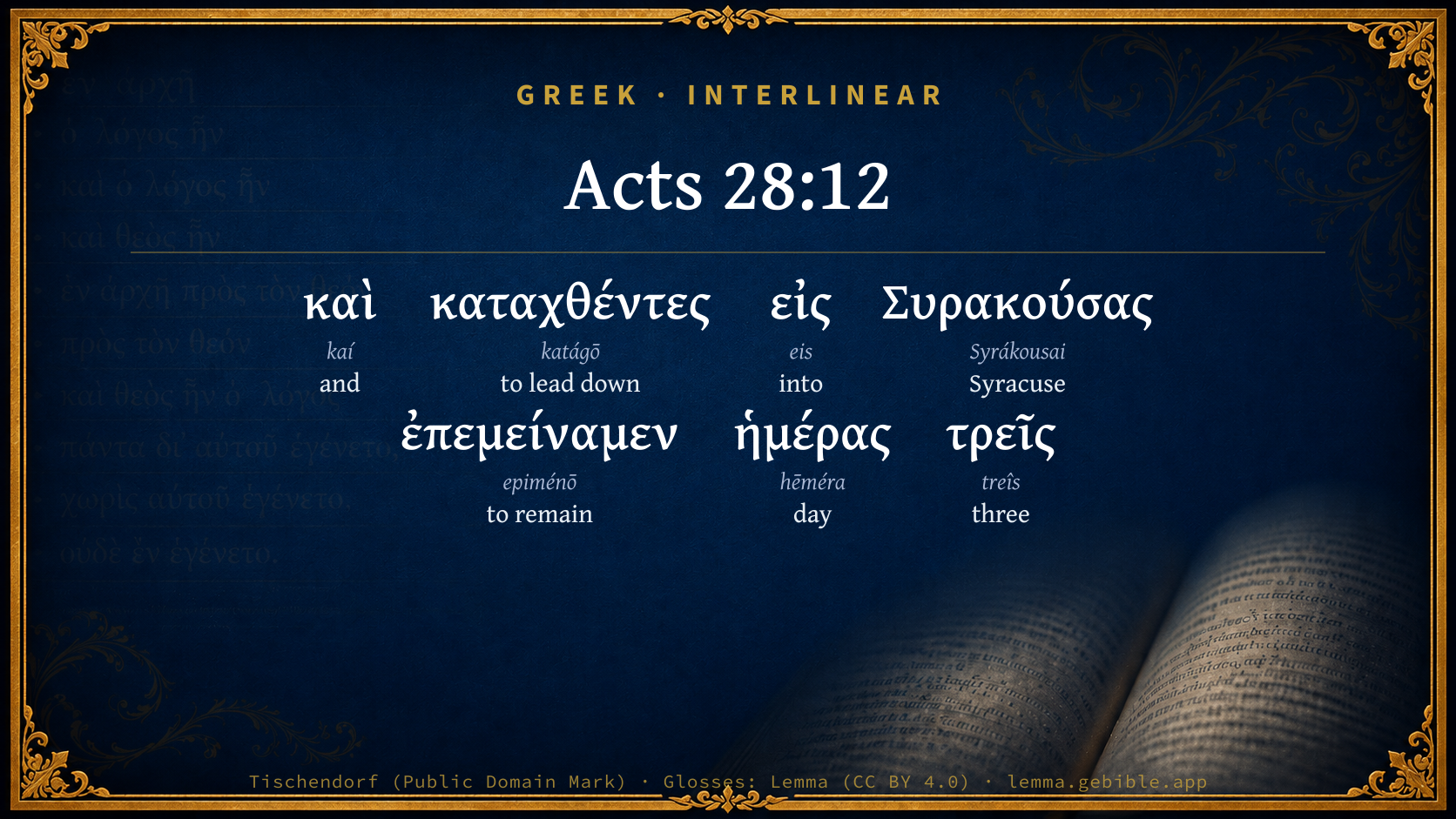
Greek (Tischendorf 8th ed.) Acts 28:12 appears in the Greek New Testament. The text above is from the Tischendorf 8th edition. Each word links to its Strong’s number and a concise gloss. Click any word for its full Thayer’s Greek Lexicon entry.
Download image
Cite this verse

Acts 28:12 (World English Bible). Public Domain. Lemma interlinear Bible study tool, https://lemma.gebible.app/v/acts/28/12.

Show BibTeX & RIS
BibTeX
RIS
English Translation
Touching at Syracuse, we stayed there three days.
World English Bible · Public Domain
Highlights
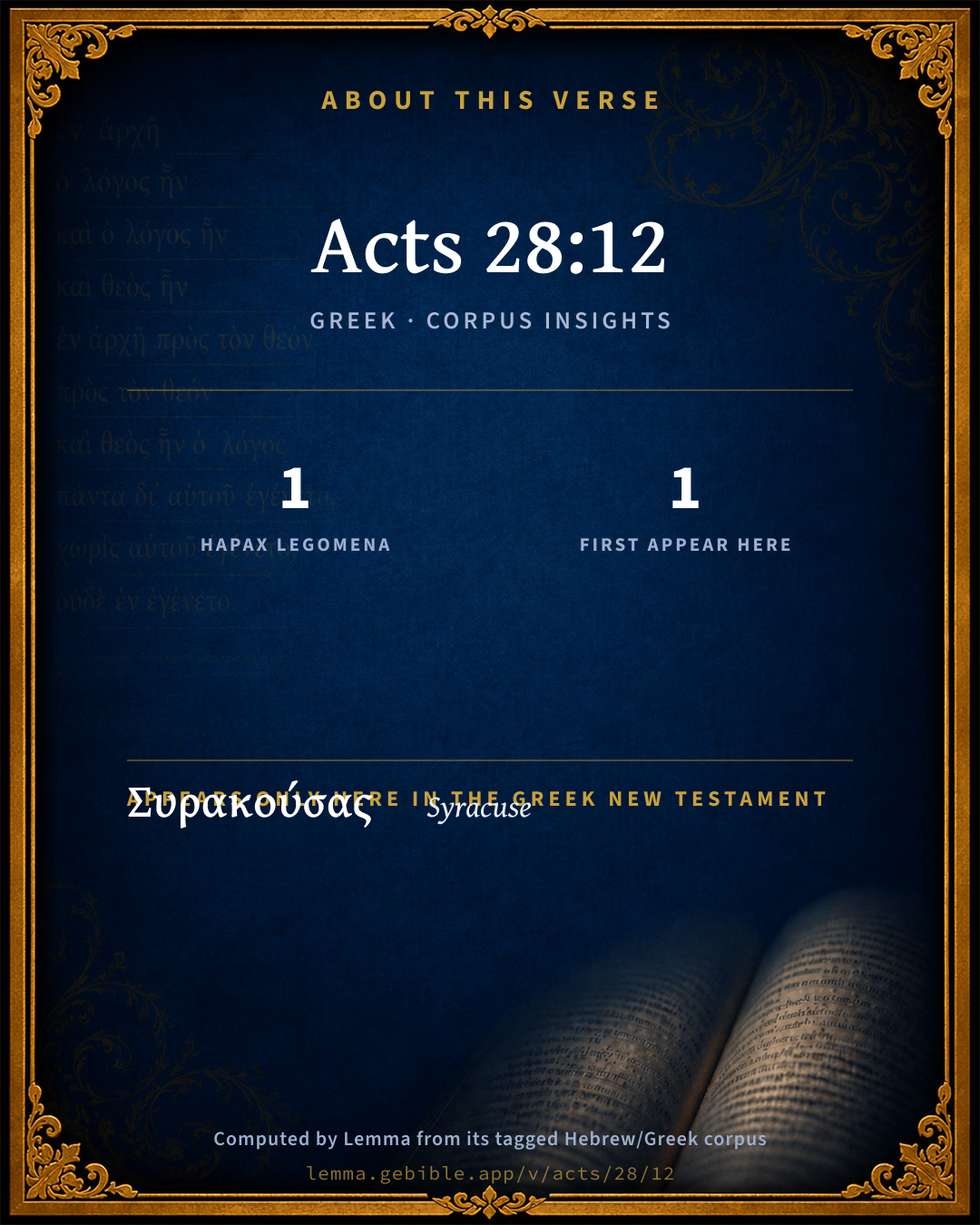
  • 1 hapax legomenon — only here in the Greek New Testament
  • 1 first appearance in the Greek New Testament
Full analysis ↓
Download a study sheet

One document with this verse’s original text, its word-by-word gloss line, the meaning frame, cross-references with their text, attributed commentary, and full source and license credits — printable, and it pastes into notes with its structure intact.

This verse Autodidact and up

Study sheet (.html) Plain text (.txt)

A passage Seminary Student

Up to 50 verses in one chapter. A passage sheet keeps up to 6 commentary sources and 12 cross-references per verse, in the order this page ranks them, and says so on the sheet whenever that leaves anything out. Ask for a single verse and you get the Autodidact verse sheet above.

Everything on this page stays free to read, with no account — the sheet is a download of what is already on screen, not access to it.

Want to remove ads? Support Godless Engineer
Compare translations 3

The same verse in 3 English versions, stacked beneath the original-language interlinear above. Click any original word for its lexicon entry.

Each is an independent rendering of the whole verse — the interlinear is not word-aligned to these translations.

Highlighted words mark where these versions differ — a whole-verse word diff, not a word-by-word alignment.

  • World English Bible Public Domain
    Touching at Syracuse, we stayed there three days.
  • King James Version Public Domain
    And landing at Syracuse, we tarried there three days.
  • unfoldingWord Literal Text CC BY-SA 4.0
    And having come down to Syracuse, we stayed for three days.

unfoldingWord Literal Text — © unfoldingWord, licensed CC BY-SA 4.0. Word-aligned USFM3 via Door43 (git.door43.org/unfoldingWord/en_ult).

Versions to compare (up to 4)

3 of 4 selected

Show all 19 translations

Every available English version of this verse, each an independent rendering of the whole verse.

  • World English Bible Public Domain
    Touching at Syracuse, we stayed there three days.
  • Berean Standard Bible Public Domain
    Putting in at Syracuse, we stayed there three days.
  • Majority Standard Bible Public Domain
    Putting in at Syracuse, we stayed there three days.
  • King James Version Public Domain
    And landing at Syracuse, we tarried there three days.
  • American Standard Version (1901) Public Domain
    And touching at Syracuse, we tarried there three days.
  • Revised Version (1885) Public Domain
    And touching at Syracuse, we tarried there three days.
  • Geneva Bible (1599) Public Domain
    And when we arriued at Syracuse, we taried there three dayes.
  • Douay-Rheims (1899) Public Domain
    And when we were come to Syracusa, we tarried there three days.
  • Young's Literal Translation Public Domain
    and having landed at Syracuse, we remained three days,
  • Literal Standard Version CC BY-SA 4.0
    and having landed at Syracuse, we remained three days,
  • Unlocked Literal Bible CC BY-SA 4.0
    After we landed at the city of Syracuse, we stayed there three days.
  • unfoldingWord Literal Text CC BY-SA 4.0
    And having come down to Syracuse, we stayed for three days.
  • Darby Bible Public Domain
    And having come to Syracuse we remained three days.
  • World Messianic Bible Public Domain
    Touching at Syracuse, we stayed there three days.
  • Webster's Bible Public Domain
    And landing at Syracuse, we tarried there three days.
  • Free Bible Version CC BY-SA 4.0
    We stopped at Syracuse, and spent three days there.
  • Bible in Basic English Public Domain
    And going into the harbour at Syracuse, we were waiting there for three days.
  • Text-Critical English NT CC BY 4.0
    Putting in at Syracuse, we stayed there for three days.
  • Tyndale New Testament (1534) Public Domain
    And when we came to Cyracusa we taryed there.iii. dayes.

Literal Standard Version (2020), Covenant Press — licensed CC BY-SA 4.0. Text via the HelloAO Bible API (eBible.org). Unlocked Literal Bible (unfoldingWord) — licensed CC BY-SA 4.0. Text via the HelloAO Bible API (eBible.org). unfoldingWord Literal Text — © unfoldingWord, licensed CC BY-SA 4.0. Word-aligned USFM3 via Door43 (git.door43.org/unfoldingWord/en_ult). Free Bible Version, Dr. Jonathan Gallagher — licensed CC BY-SA 4.0. Text via the HelloAO Bible API (eBible.org).

Word by word

More ways to search: Search by grammar → Find every occurrence → Compare this word →

Practice this passage: Drill this verse → Learn its vocabulary →

About this verse

These counts appear in no published source. They are computed here, from the morphology-tagged text and Lemma’s own curated glosses. What Lemma adds →

7
words
7
distinct lemmas
Acts
section

Notable vocabulary

1 hapax legomenon — a word that appears only here in the entire Greek New Testament:

  • Συρακούσας Syracuse G4946

First appearance in Scripture

This word makes its first canonical appearance in the Greek New Testament here:

  • Συρακούσας Syracuse G4946

Shared distinctive vocabulary

καταχθέντες to lead down G2609 occurs in 9 verses of the Greek New Testament. Also found in:
Commentary

Notes on Acts 28:12 from classic Christian and Jewish commentators (each source and its license shown beneath its notes). The classic Christian expositions comment on the surrounding passage and are grouped to its opening verse, so a note may address several verses; the Jewish commentaries on the Tanakh (Rashi and others) are per-verse, so they appear only where the commentator wrote on this verse.

Lemma curates 59 commentaries, every one of them public domain or Creative Commons licensed, each selected and text-cleaned for this edition rather than reprinted as found. About our sources →

Joseph Benson's Commentary

Act 28:12. And — Soon after, leaving Malta, they made the island of Sicily; and landing at Syracuse, tarried there three days — The ship, probably, having some goods to put ashore, or some to take in there; for the ship seems to have been making a trading voyage. This city was the metropolis of Sicily, situated on the east side of the island, and had a beautiful prospect for every entrance, both by sea and land. The port, which had the sea on both sides of it, was almost wholly surrounded with elegant buildings; all the suburbs on both sides being banked up, and supported with walls of marble. While in its splendour, this city was considered as the largest and richest belonging to the Greeks; being twenty-two miles in circuit, and equalling Carthage in its wealth. It was called Quadruplex, because it was divided into four parts; the first of which contained the famous temple of Jupiter; the second, the temple of Fortune; the third, a large amphitheatre, and a surprising statue of Apollo; and the fourth, which was the island of Ortygia, the two temples of Diana and Minerva, and the celebrated fountain of Arethusa. About two hundred and ten years before the birth of Christ, this city was taken by Marcellus, the Roman general, and, in storming the place, the famous Archimedes was slain by a common soldier, while he was intent upon his geometrical studies. He was calmly drawing his lines, and proceeding in the demonstration of a problem, when a soldier entered the room and clapped a sword to his throat. “Hold,” said Archimedes, “one moment, and my demonstration will be finished.” But the soldier, equally regardless of his prayer and demonstration, killed him instantly; Marcellus extremely regretting his death, and afterward showing singular favour to his relations for his sake. The reader that will be at the pains of consulting the Encyclopædia Britannica, on the word SYRACUSE, will find a particular account of the manner in which this illustrious geometrician, Archimedes, defended the city for a long time, by his powerful engines, against all the valour and power of the Romans, beating their galleys to pieces by huge stones projected from his machines, and by his levers, chains, and hooks from the walls, weighing the ships out of the water, tossing them to and fro, whirling them round, and dashing them in pieces against each other, or against the points of rocks which projected under the walls, or sinking them to the bottom, destroying several also by burning-glasses. In short, the account of the power of his engines is, perhaps, the most extraordinary that occurs in history; and if it were not well authenticated, would exceed all belief. How these stupendous effects were produced, few, if any, have been able to comprehend. Syracuse was afterward rebuilt by Augustus, and had, at the time Paul visited it, recovered itself so as to answer its former splendour. It had at length three castles, three walls, and a marble gate, and was able to send out twelve thousand heroes, and four hundred ships; but it received such a blow from the Saracens, A.D. 884, when they razed it, that it has not been able to recover itself since: See Calmet and the Universal History, vol. 7. p. 516; vol. 17. p. 29.

Joseph Benson's Commentary on the Old and New Testaments (1811–1818) — public domain. Text from a community e-Sword module.

Tyndale Open Study Notes

Tyndale Open Resources

28:12 Syracuse was the capital of the eastern half of Sicily.

Tyndale Open Study Notes — © Tyndale Open Resources, licensed CC BY-SA 4.0. Text via the HelloAO Bible API.

Meyer's Critical & Exegetical Commentary

Heinrich August Wilhelm Meyer

Act_28:12-14. The voyage proceeded in quite a regular course from Malta to Syracuse, and from that to Rhegium,[178] now Reggio, in the Sicilian Straits, and then through the Etruscan Sea to Puteoli, now Puzzuolo, near Naples.

ἐπιγενομένου Νότου] when thereupon south wind (which favoured the voyage) had arisen.

The force of ἐπί is, in all places where ἐπιγίνεσθαι occurs of wind, as in Thuc. iv. 30. 1, et al., not to be overlooked.

δευτεραῖοι] as persons, who were on the second day, i.e. on the second day. Herod. iv. 106. Comp. on Joh_11:39; Php_3:5.

ἀδελφούς] Thus Christianity was already at that time in Puteoli (whether coming thither from Rome, or perhaps from Alexandria?).

Act_28:14. παρεκλήθημεν ἐπʼ αὐτοῖς ἐπιμεῖναι] we were invited to remain with them.

ἐπʼ αὐτοῖς] beside them. Comp. Xen. Anab. vii. 2. 1 : ἐπέμενον ἐπὶ τῇ στρατίᾳ, Cyrop. v. 3. 52; Plat. Lach. p. 144 A. Rinck (Lucubr. crit. p. 93), as also Ewald, prefers the reading ἐπιμείναντες, and takes (comp. Bengel) παρεκλ. ἐπʼ αὐτοῖς together: we were refreshed in them; but the participle is much too weakly attested, and without doubt has only come into the text through this view of παρεκλ.

καὶ οὕτως εἰς τ. Ῥώμ. ἤλθ.] and thus (after we had first tarried seven days at Puteoli) we came to Rome. ἔρχεσθαι is neither here (in opposition to Beza, Grotius, de Dieu, Heinrichs, Kuinoel, and many others) nor elsewhere in the N.T. ire (not even in Joh_6:17, where the imperfect is to be observed); but Luke narrates the arrival at Rome, and then in Act_28:15 inserts by way of episode something special, which stood in close connection with this arrival; hence he again joins on Act_28:16 by ὅτε δὲ ἤλθομεν εἰς Ῥ. to Act_28:14. Observe at the same time that in Act_28:14 εἰς τ. Ῥώμ., as the final aim of the voyage, but in Act_28:16 ἤλθομεν, has the emphasis.

Moreover, the concession of a seven days stay, so near to the end of the journey, testifies how much Paul possessed the love and confidence of the centurion. The Book of Acts, however, gives us no information at all how Christianity was planted in the Italian cities and in Rome.

[178] ὅθεν περιελθόντες: from which after we had come round, from Syracuse round the eastern coast of Sicily. Not: after we had sailed round about (Lange, comp. Smith). Luke does not express himself with chartographic accuracy.

Meyer — Critical and Exegetical Commentary on the New Testament — English translation by Peter Christie, edited by Frederick Crombie (T&T Clark, 1880) — public domain. Text from a community e-Sword module.

Expositor's Greek Testament

ed. W. Robertson Nicoll

Act 28:12 . καταχ .: “touching at,” R.V., Ramsay, cf. Act 27:3 . We are not told that St. Paul landed, but the local tradition makes him the founder of the Sicilian Church, C. and H., p. 663, small edit. Συρ .: ( Siragosa ) about 100 miles distant from Malta, the capital of Sicily, and a Roman colony; in a mercantile city St. Paul would find countrymen and Jewish proselytes; it was moreover a city of great historical interest, and a usual stopping-place for Alexandrian ships on their voyage to Italy; see C. and H., p. 662, u. s. , and notices in Strabo, vi., p. 270 (but see also Grimm-Thayer, sub v. , Συρ .); Cicero, Verr. , iv., 53; Pliny, N.H. , iii., 8, and B.D., sub v. For accentuation cf. also Grimm-Thayer. τρεῖς ἡμέρας : probably to wait for a favouring breeze from the south. ἐπεμείναμεν : with accusative of time, cf. Act 10:48 , Act 21:4 ; Act 21:10 , Act 28:14 below, 1Co 16:7 .

The Expositor's Greek Testament, edited by W. Robertson Nicoll (1897–1910) — public domain. Text from a community e-Sword module.

Jamieson, Fausset & Brown

Robert Jamieson, A. R. Fausset & David Brown

landing at Syracuse--the ancient and celebrated capital of Sicily, on its eastern coast, about eighty miles, or a day's sail, north from Malta.

we tarried there three days--probably from the state of the wind. Doubtless Paul would wish to go ashore, to find out and break ground among the Jews and proselytes whom such a mercantile center would attract to it; and if this was allowed at the outset of the voyage (Act 27:3), much more readily would it be now when he had gained the reverence and confidence of all classes with whom he came in contact. At any rate we cannot wonder that he should be regarded by the Sicilians as the founder of the Church of that island.

Jamieson, Fausset & Brown — Commentary Critical and Explanatory on the Whole Bible (1871) — public domain (CC PDM 1.0). Text via the HelloAO Bible API.

Adam Clarke's Commentary

Verse 12. Landing at Syracuse] In order to go to Rome from Malta, their readiest course was to keep pretty close to the eastern coast of Sicily, in order to pass through the straits of Rhegium and get into the Tyrrhenian Sea.

Syracuse is one of the most famous cities of antiquity: it is the capital of the island of Sicily, and was built about 730 years before the Christian era. It lies 72 miles S. by E. of Messina, and about 112 of Palermo. Long. 15°. 30'. W., lat. 37°. 17'. N. In its ancient state, it was about 22 English miles in circumference; and was highly celebrated for the martial spirit of its inhabitants. This was the birthplace of the illustrious Archimedes; who, when the city was besieged by the Romans, under Marcellus, about 212 years before Christ, defended the place with his powerful engines against all the valour and power of the assailants. He beat their galleys to pieces by huge stones projected from his machines; and by hooks, chains, and levers, from the walls, weighed the ships out of the water, and, whirling them round, dashed them in pieces against each other, or sunk them to the bottom: several also, he is said to have destroyed by his burning glasses. When the city was taken by treachery, Archimedes was found intensely engaged in the demonstration of a problem. A Roman soldier coming up, and presenting his dagger to his throat, he cried, "Stop, soldier, or thou wilt spoil my diagram!" The brute was unmoved, and murdered him on the spot.

This city was almost totally destroyed by an earthquake in 1693: its present population amounts to but about 18,000. Christianity, in some form or other, has existed here ever since St. Paul spent the three days in it, mentioned in the text.

Adam Clarke's Commentary on the Bible (1810–1826) — public domain. Text from a community e-Sword/MySword module.

John Calvin's Commentaries

12. When we were come to Syracuse. Luke prosecuteth the residue of the course of their sailing, that they arrived first in Sicilia. And after that they set a compass by reason of the tempest and raging of the sea, and sailed over into Italy. And as that haven whereof Luke speaketh in this place is the most famous haven of all Sicilia, so is it farther from the coast of Italy than is that of Messina, over against which is Rhegium, whereof he maketh mention. And it is in the country of the Brutians, as is Puteoli, a city of Campania. But forasmuch as the brethren kept Paul at Puteoli seven days, by this we gather how favorably and gently the centurion handled Paul. Neither do I doubt but that the holy man would have made him a faithful promise that he would always return in due time. But he was persuaded of his uprightness, so that he was not afraid that he would deceive him. And now we gather out of this place, that the seed of the gospel was then sown abroad, seeing there was some body of the Church even at Puteoli.

John Calvin's Commentaries (1540-1563) — public domain. Text from the Calvin Translation Society English edition (1840s-50s) via the Christian Classics Ethereal Library (ccel.org). Calvin's coverage is partial (roughly two-thirds of the Bible); uncommented books and verses are honest gaps, never fabricated. The 19th-century editor's footnotes and remarks are omitted so the notes are faithfully Calvin's own voice.

Ellicott's Commentary for English Readers

(12) And landing at Syracuse . . .—The city, famous for the memorable siege during the Peloponnesian war, and at all times taking its place among the most flourishing towns of Sicily, was about eighty or a hundred miles from Malta, and might be reached accordingly in from twenty-four to thirty-six hours. Ships bound from Alexandria to Italy commonly put in there. The stay of three days was probably caused by their waiting for a favourable wind. The fact stated in the next verse implies that it was more or less against them.

A Bible Commentary for English Readers, edited by Charles John Ellicott (1878–1897) — public domain. Text from a community e-Sword module.

The Cambridge Bible for Schools and Colleges

gen. ed. J. J. S. Perowne

12. And landing [R. V. touching] at Syracuse] The vessel takes the regular road, sailing north from Valetta to Sicily. Syracuse was one of the chief towns of Sicily lying on the south-eastern extremity, and was famous in classical history as the scene of many of the disasters of the Athenian fleet and army in their expedition to Sicily during the Peloponnesian war.

The Cambridge Bible for Schools and Colleges (gen. ed. J. J. S. Perowne; Cambridge University Press, 1878–1918) — public domain. Text from a community e-Sword module.

John Gill's Exposition

And landing at Syracuse,.... A famous city in the isle of Sicily, now called Saragossa: it is placed by Ptolomy (c) on the east side of the island, in the Adriatic sea; it was 180 furlongs, or two and twenty miles and a half in circuit, and formerly had a marble haven and triple wall, and as many towers; the founder of it was Archias, a Corinthian; Pliny says (d), that it is never so cloudy weather, but the sun is seen in it, at one time or another of the day: Cicero (e) calls it the greatest and most beautiful of all the cities of Greece; it is such a city, he says, that it may be said to consist of four large cities; "one" part of it is called "the island", which has two ports to it; "another" was called Acradina, in which were a large market, beautiful porticos, &c. the "third", Tiche, in which was the ancient temple of Fortune; and the "fourth", which because it was last built, was called Neapolis: it is a very ancient city, being built more than seven hundred years before the birth of Christ; it was a colony of the Corinthians; here reigned two tyrants, whose names were Dionysius; it was attacked by the Carthaginians, but without success, being delivered from the siege by Pyrrhus king of Epirus (f); it was again assaulted by the Athenians, who were repulsed, and entirely conquered, about the year before Christ 413: after that it was taken by Marcellus, the Roman consul, about the year of the city of Rome 542 (g), after a three years' siege; during which time it was defended, and preserved by the means of the famous mathematician Archimedes; who by his invention of warlike machines, baffled all the attempts of the Romans; but was killed by a soldier, as he was intent upon his studies, not knowing that the city was taken; and it continued in the hands of the Romans, until it was taken and plundered by the Saracens, in the year of Christ 675; and was retaken by Roger king of Apulia, about the year 1090, and is now under the government of Don Carlos, king of the two Sicilies;

we tarried there three days; on what account it is not said, whether on account of merchandise, or for the sake of the conversation of Christians here: it is certain there were churches in Sicily very early; we read of them in the "second" and "third" centuries; in the time of Constantine, at the beginning of the "fourth" century, there was a church at Syracuse, of which Chrestus was bishop, to whom the emperor wrote a letter himself, which is still extant in Eusebius (h): in the "fifth" century, Hilarius, a teacher at Syracuse, wrote from thence to Augustine, concerning the Pelagian heresy, to whom he gave an answer: in the "sixth" century, Maximinianus, bishop of this church, had the inspection of all the churches in Sicily committed to him, by Gregory; who was wonderfully preserved in a shipwreck, as he was returning from Rome; in this same age lived John, bishop of Syracuse, and Trajanus a presbyter, and Felix a deacon of the same church: in the seventh century there was one George bishop of this place, to whom Pope Vitalian wrote a letter; and in the same century a bishop of this church was in the sixth council at Constantinople (i).

(c) Geogr. l. 3. c. 4. (d) Nat. Hist. l. 2. c. 62. (e) Orat. 9. in Verrem, l. 4. p. 566. (f) Pausanius, l. 1. p. 22. (g) Petav. Rationar. Temp. par. 1. l. 3. c. 9. p. 108. & l. 4. c. 2. p. 137. (h) Eccl. Hist. l. 10. c. 5. (i) Magdeburg. Eccl. Hist. cent. 2. c. 2. p. 4. cent. 3. c. 2. p. 3. cent. 4. c. 2. p. 5. cent. 5. c. 2. p. 6. c. 10. p. 664. cent. 6. c. 2. p. 6. c. 10. p. 346. c. 13. p. 436. cent. 7. c. 2. p. 4. c. 10. p. 358.

John Gill's Exposition of the Whole Bible (1746–1763) — public domain (CC PDM 1.0). Text via the HelloAO Bible API.

Trapp's Complete Commentary

John Trapp

12 And landing at Syracuse, we tarried there three days.

Ver. 12. Syracuse] The metropolis of Sicily, where lived and died that famous mathematician Archimedes; who by his art so long held out the city against Marcellus the Roman general, that beleaguered it. (Plut.)

John Trapp, A Commentary or Exposition upon All the Books of the Old and New Testament (1647–1656) — public domain. Text from a community e-Sword module.

Albert Barnes' Notes on the Bible

And landing at Syracuse - Syracuse was the capital of the island of Sicily, on the eastern coast. It was in the direct course from Malta to Rome. It contains about 18,000 inhabitants.

Albert Barnes' Notes on the Bible (1834–1885) — public domain. Text from a community e-Sword/MySword module.

Matthew Poole's English Annotations

Syracuse; the chief city of Sicily, famous for Archimedes.

We tarried there three days; probably to sell some of their wares, the ship making a trading voyage.

Matthew Poole's English Annotations on the Holy Bible (1683–1685) — public domain. Text from a community e-Sword/MySword module.

Whedon's Commentary on the Bible

Daniel D. Whedon

12. Syracuse—A trip of a hundred miles. This celebrated city was situated on a broad promontory on the eastern coast of Sicily.

Three days— Probably for the purpose of trade, for the present ship still bore its corn freight from Egypt.

Daniel D. Whedon (gen. ed.), Commentary on the Old and New Testaments (1874–1909) — public domain. Text from a community e-Sword module.

The Pulpit Commentary

Touching for landing, A.V.. Touching (katacqentev); Act_21:3 Act_27:3, note. The way in which Syracuse is hero mentioned is another redundant proof that Melita is Malta. "Syracause is about eighty miles, a days" sail, from Malta" (Afford). Tarried there three days. Perhaps wind- bound, or possibly having to land part of their cargo there.

The Pulpit Commentary (1880–1919), ed. H.D.M. Spence-Jones & Joseph S. Exell — public domain. Text from a community e-Sword module.

McGarvey & Pendleton's Commentaries

J. W. McGarvey

See notes on verse 11

J. W. McGarvey (with Philip Y. Pendleton), Commentaries on the New Testament (The Fourfold Gospel, 1914; Acts; and the epistles) — public domain. Text from a community e-Sword/MySword module.

Cambridge Greek Testament for Schools and Colleges

12. καὶ καταχθέντες εἰς Συρακούσας, and touching at Syracuse. The vessel takes the regular route, sailing north from Valetta to Sicily. Syracuse was one of the chief towns of Sicily lying on the south-eastern extremity, and was famous in classical history as the scene of many of the disasters of the Athenian fleet and army in their expedition to Sicily during the Peloponnesian war.

Cambridge Greek Testament for Schools and Colleges (Cambridge University Press, 1896; 21 vols, various authors incl. Carr, Maclear, Plummer, Farrar, Lumby, Moule, M. R. James, Simcox) — public domain. Text from a community e-Sword module.

Alford’s Greek Testament

Henry Alford

12.] Syracuse is about eighty miles, a day’s sail, from Malta.

Henry Alford, The Greek Testament (1849–1861) — public domain. Text from a community e-Sword module.

Lesson kit

Teaching starters — assembled from the data on this page, not authored interpretation. Every prompt links to the verse data it draws on. Edit before teaching.

Acts, in the Acts, opens this verse with 7 words (7 distinct Greek lemmas). Its most distinctive word is Syrákousai (“Syracuse”). A historical commentator’s framing appears above. Read the whole chapter for the surrounding context.

Discussion questions

  1. How does “Syracuse” (Syrákousai) shape what this verse is saying?
  2. This verse holds 1 word here found nowhere else in the Greek New Testament. What might the rare word draw attention to?
  3. The word “Syracuse” first appears here in Scripture. What is being introduced at this debut?
  4. Luke 5:11 shares the word «to lead down» with this verse. How do the two illuminate each other?
  5. These translations render this verse differently; the difference is in the English rendering, not the original. What questions does that raise?
  6. Reading how Joseph Benson's Commentary and Tyndale Open Study Notes read this verse, where do the two commentators agree and where do they part?

Things to notice

  • 1 word in this verse appears nowhere else in the Greek New Testament.
  • 1 word makes its first canonical appearance in Scripture here.
  • These translations choose different wording for 8 words in this verse.
  • 7 distinct Greek lemmas span 7 words in this verse.

Reading settings

Reading text

Shown beneath each verse's original-language words.

Old Testament
Old Testament edition

Read the OT as the Masoretic Hebrew (MT) or the Greek Septuagint (LXX).

English shown for the Greek Septuagint (in the Hebrew ↔ Greek comparison).

Comparing translations? Open the Compare panel on any verse page to stack up to four side by side.