
Matthew 4:2

Greek (Tischendorf 8th ed.) Matthew 4:2 appears in the Greek New Testament. The text above is from the Tischendorf 8th edition. Each word links to its Strong’s number and a concise gloss. Click any word for its full Thayer’s Greek Lexicon entry.
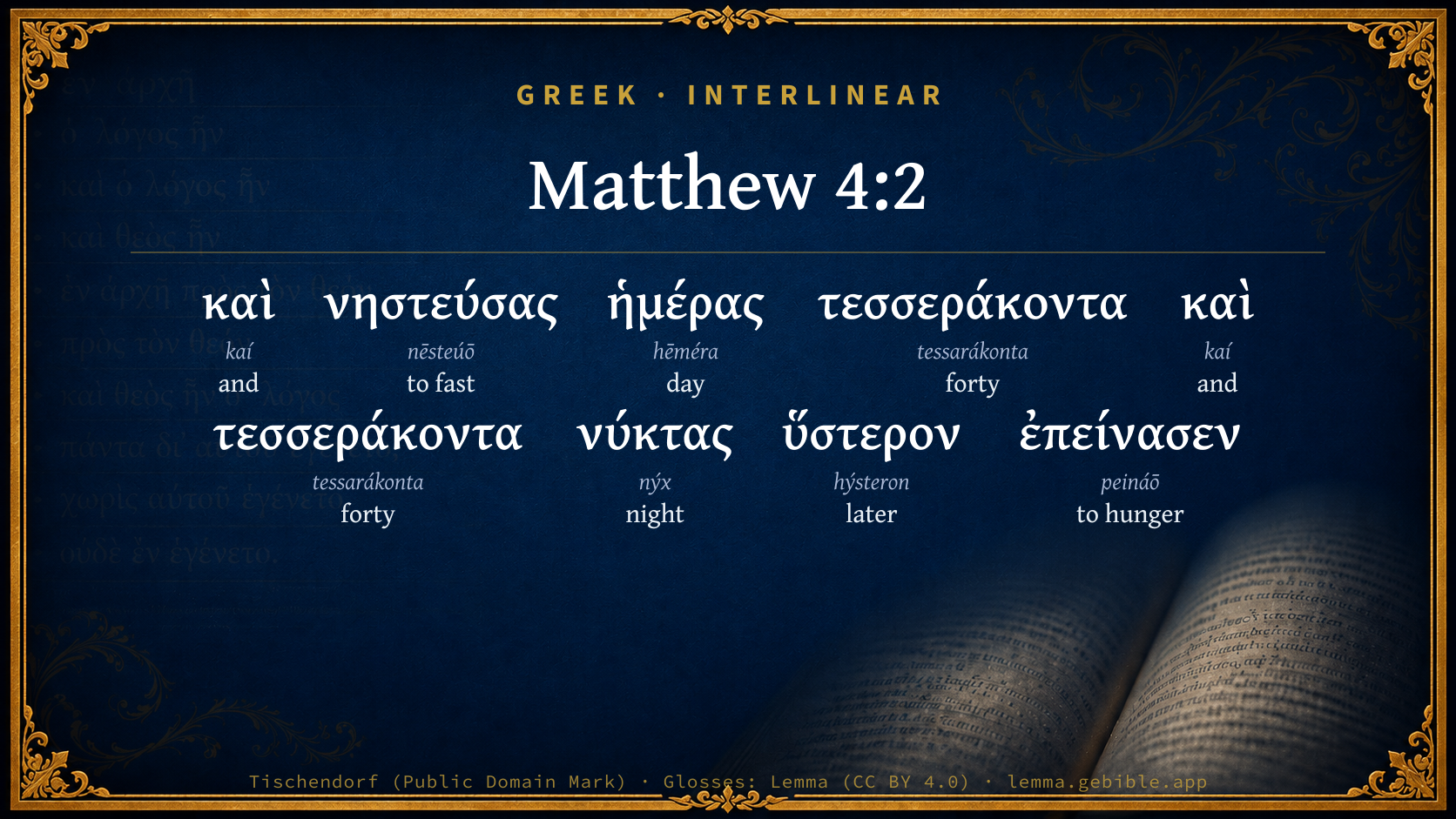
Download image
Cite this verse

Matthew 4:2 (World English Bible). Public Domain. Lemma interlinear Bible study tool, https://lemma.gebible.app/v/matthew/4/2.

Show BibTeX & RIS
BibTeX
RIS
English Translation
When he had fasted forty days and forty nights, he was hungry afterward.
World English Bible · Public Domain
Highlights
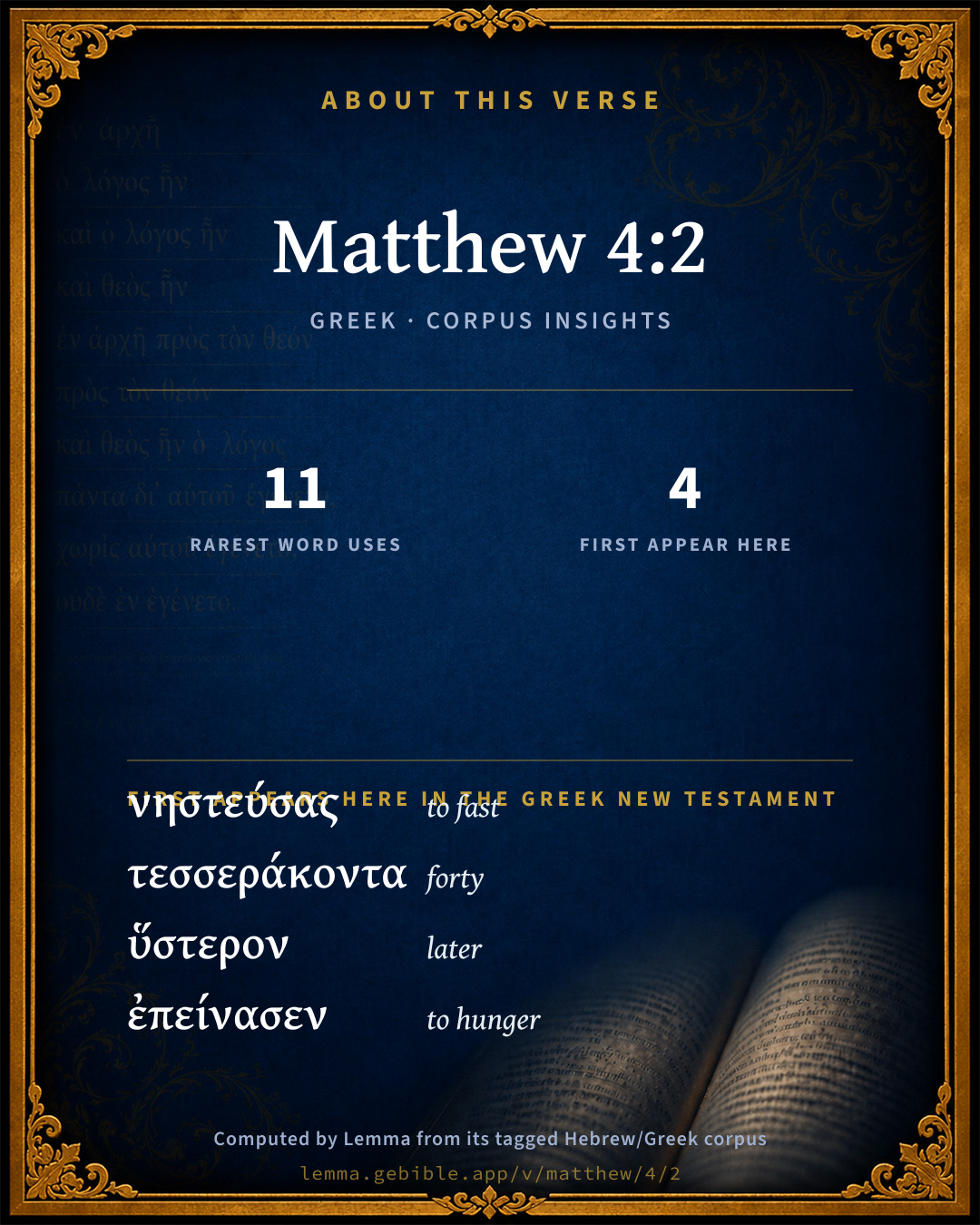
  • 4 first appearances in the Greek New Testament
Full analysis ↓
Download a study sheet

One document with this verse’s original text, its word-by-word gloss line, the meaning frame, cross-references with their text, attributed commentary, and full source and license credits — printable, and it pastes into notes with its structure intact.

This verse Autodidact and up

Study sheet (.html) Plain text (.txt)

A passage Seminary Student

Up to 50 verses in one chapter. A passage sheet keeps up to 6 commentary sources and 12 cross-references per verse, in the order this page ranks them, and says so on the sheet whenever that leaves anything out. Ask for a single verse and you get the Autodidact verse sheet above.

Everything on this page stays free to read, with no account — the sheet is a download of what is already on screen, not access to it.

Want to remove ads? Support Godless Engineer
Compare translations 3

The same verse in 3 English versions, stacked beneath the original-language interlinear above. Click any original word for its lexicon entry.

Each is an independent rendering of the whole verse — the interlinear is not word-aligned to these translations.

Highlighted words mark where these versions differ — a whole-verse word diff, not a word-by-word alignment.

  • World English Bible Public Domain
    When he had fasted forty days and forty nights, he was hungry afterward.
  • King James Version Public Domain
    And when he had fasted forty days and forty nights, he was afterward an hungred.
  • unfoldingWord Literal Text CC BY-SA 4.0
    And having fasted 40 days and 40 nights, afterward he was hungry.

unfoldingWord Literal Text — © unfoldingWord, licensed CC BY-SA 4.0. Word-aligned USFM3 via Door43 (git.door43.org/unfoldingWord/en_ult).

Versions to compare (up to 4)

3 of 4 selected

Show all 19 translations

Every available English version of this verse, each an independent rendering of the whole verse.

  • World English Bible Public Domain
    When he had fasted forty days and forty nights, he was hungry afterward.
  • Berean Standard Bible Public Domain
    After fasting forty days and forty nights, He was hungry.
  • Majority Standard Bible Public Domain
    After fasting forty days and forty nights, He was hungry.
  • King James Version Public Domain
    And when he had fasted forty days and forty nights, he was afterward an hungred.
  • American Standard Version (1901) Public Domain
    And when he had fasted forty days and forty nights, he afterward hungered.
  • Revised Version (1885) Public Domain
    And when he had fasted forty days and forty nights, he afterward hungered.
  • Geneva Bible (1599) Public Domain
    And when he had fasted fourtie dayes, and fourtie nights, he was afterward hungrie.
  • Douay-Rheims (1899) Public Domain
    And when he had fasted forty days and forty nights, afterwards he was hungry.
  • Young's Literal Translation Public Domain
    and having fasted forty days and forty nights, afterwards he did hunger.
  • Literal Standard Version CC BY-SA 4.0
    and having fasted forty days and forty nights, afterward He hungered.
  • Unlocked Literal Bible CC BY-SA 4.0
    When he had fasted forty days and forty nights, he was hungry.
  • unfoldingWord Literal Text CC BY-SA 4.0
    And having fasted 40 days and 40 nights, afterward he was hungry.
  • Darby Bible Public Domain
    and having fasted forty days and forty nights, afterwards he hungered.
  • World Messianic Bible Public Domain
    When he had fasted forty days and forty nights, he was hungry afterward.
  • Webster's Bible Public Domain
    And when he had fasted forty days and forty nights, he was afterward hungry.
  • Free Bible Version CC BY-SA 4.0
    After fasting forty days and nights, he was hungry.
  • Bible in Basic English Public Domain
    And after going without food for forty days and forty nights, he was in need of it.
  • Text-Critical English NT CC BY 4.0
    After fasting for forty days and forty nights, he was hungry.
  • Tyndale New Testament (1534) Public Domain
    And when he had fasted fourtye dayes and fourtye nightes he was afterward an hungred.

Literal Standard Version (2020), Covenant Press — licensed CC BY-SA 4.0. Text via the HelloAO Bible API (eBible.org). Unlocked Literal Bible (unfoldingWord) — licensed CC BY-SA 4.0. Text via the HelloAO Bible API (eBible.org). unfoldingWord Literal Text — © unfoldingWord, licensed CC BY-SA 4.0. Word-aligned USFM3 via Door43 (git.door43.org/unfoldingWord/en_ult). Free Bible Version, Dr. Jonathan Gallagher — licensed CC BY-SA 4.0. Text via the HelloAO Bible API (eBible.org).

Word by word

More ways to search: Search by grammar → Find every occurrence → Compare this word →

Practice this passage: Drill this verse → Learn its vocabulary →

About this verse

These counts appear in no published source. They are computed here, from the morphology-tagged text and Lemma’s own curated glosses. What Lemma adds →

9
words
7
distinct lemmas
Gospels
section

Notable vocabulary

The rarest word here is ὕστερον later G5305 — appearing just 11 times in the whole Greek New Testament.

First appearance in Scripture

These words make their first canonical appearance in the Greek New Testament here:

  • νηστεύσας to fast G3522
  • τεσσεράκοντα forty G5062
  • ὕστερον later G5305
  • ἐπείνασεν to hunger G3983

Shared distinctive vocabulary

ὕστερον later G5305 occurs in 11 verses of the Greek New Testament. Also found in:
Repetition

Words recur within this verse:

  • τεσσεράκοντα forty G5062 ×2
  • καὶ and G2532 ×2

Cross-references

12

Topical passages linked to Matthew 4:2 in the Treasury of Scripture Knowledge — connected by theme and wording, ordered by reader-vote popularity; previews shown in the World English Bible.

  • Deuteronomy 9:18 I fell down before Yahweh, as at the first, forty days and forty nights; I did neither eat bread nor drink water; because of all your sin which you sinned, in doing that which was evil in the sight of Yahweh, to provoke him to anger.
  • Exodus 34:28 He was there with Yahweh forty days and forty nights; he neither ate bread, nor drank water. He wrote on the tablets the words of the covenant, the ten commandments.
  • 1 Kings 19:8 He arose, and ate and drink, and went in the strength of that food forty days and forty nights to Horeb the Mount of God.
  • Luke 4:2 for forty days, being tempted by the devil. He ate nothing in those days. Afterward, when they were completed, he was hungry.
  • Deuteronomy 9:9 When I was gone up onto the mountain to receive the tables of stone, even the tables of the covenant which Yahweh made with you, then I stayed on the mountain forty days and forty nights; I did neither eat bread nor drink water.
  • Exodus 24:18 Moses entered into the midst of the cloud, and went up on the mountain; and Moses was on the mountain forty days and forty nights.
  • Deuteronomy 9:25 So I fell down before Yahweh the forty days and forty nights that I fell down, because Yahweh had said he would destroy you.
  • Deuteronomy 18:18 I will raise them up a prophet from among their brothers, like you; and I will put my words in his mouth, and he shall speak to them all that I shall command him.
  • Mark 11:12 The next day, when they had come out from Bethany, he was hungry.
  • John 4:6 Jacob's well was there. Jesus therefore, being tired from his journey, sat down by the well. It was about the sixth hour.
  • Hebrews 2:14–17 Since then the children have shared in flesh and blood, he also himself in like manner partook of the same, that through death he might bring to nothing him who had the power of death, that is, the devil,
  • Matthew 21:18 Now in the morning, as he returned to the city, he was hungry.

Cross-references courtesy of OpenBible.info (CC BY 4.0).

Commentary

Notes on Matthew 4:2 from classic Christian and Jewish commentators (each source and its license shown beneath its notes). The classic Christian expositions comment on the surrounding passage and are grouped to its opening verse, so a note may address several verses; the Jewish commentaries on the Tanakh (Rashi and others) are per-verse, so they appear only where the commentator wrote on this verse.

Lemma curates 59 commentaries, every one of them public domain or Creative Commons licensed, each selected and text-cleaned for this edition rather than reprinted as found. About our sources →

Jamieson, Fausset & Brown

Robert Jamieson, A. R. Fausset & David Brown

And when he had fasted forty days and forty nights--Luke says "When they were quite ended" (Luk 4:2).

he was afterward an hungered--evidently implying that the sensation of hunger was unfelt during all the forty days; coming on only at their close. So it was apparently with Moses (Exo 34:28) and Elijah (Kg1 19:8) for the same period. A supernatural power of endurance was of course imparted to the body, but this probably operated through a natural law--the absorption of the Redeemer's Spirit in the dread conflict with the tempter. (See on Act 9:9). Had we only this Gospel, we should suppose the temptation did not begin till after this. But it is clear, from Mark's statement, that "He was in the wilderness forty days tempted of Satan" (Mar 1:13), and Luke's, "being forty days tempted of the devil" (Luk 4:2), that there was a forty days' temptation before the three specific temptations afterwards recorded. And this is what we have called the First Stage. What the precise nature and object of the forty days' temptation were is not recorded. But two things seem plain enough. First, the tempter had utterly failed of his object, else it had not been renewed; and the terms in which he opens his second attack imply as much. But further, the tempter's whole object during the forty days evidently was to get Him to distrust the heavenly testimony borne to Him at His baptism as THE SON OF GOD--to persuade Him to regard it as but a splendid illusion--and, generally, to dislodge from His breast the consciousness of His Sonship. With what plausibility the events of His previous history from the beginning would be urged upon Him in support of this temptation it is easy to imagine. And it makes much in support of this view of the forty days' temptation that the particulars of it are not recorded; for how the details of such a purely internal struggle could be recorded it is hard to see. If this be correct, how naturally does the SECOND STAGE of the temptation open! In Mark's brief notice of the temptation there is one expressive particular not given either by Matthew or by Luke--that "He was with the wild beasts" (Mar 1:12), no doubt to add terror to solitude, and aggravate the horrors of the whole scene.

Jamieson, Fausset & Brown — Commentary Critical and Explanatory on the Whole Bible (1871) — public domain (CC PDM 1.0). Text via the HelloAO Bible API.

John Gill's Exposition

And when he had fasted forty days..... As Moses did, when he was about to deliver the law to the Israelites, Exo 34:28 and as Elijah did, when he bore his testimony for the Lord of hosts, Kg1 19:8 so did Christ, when he was about to publish the Gospel of his grace, and bear witness to the truth. "Forty nights" as well as days, are mentioned; partly to show that these were whole entire days, consisting of twenty four hours; and partly to distinguish this fast of Christ from the common fastings of the Jews, who used to eat in the night, though they fasted in the day: for according to their canons (z), they might eat and drink as soon as it was dark, and that till cock crowing; and others say, till break of day. Maimonides (a) says, they might eat and drink at night, in all fasts, except the ninth of Ab. What is very surprising in this fasting of our Lord, which was made and recorded, not for our imitation, is, that during the whole time he should not be attended with hunger; for it is added,

he was afterwards an hungered; that is, as Luke says, "when" the "forty" days "were ended", Luk 4:2 which seized upon him, and is related, both to express the reality of his human nature, which though miraculously supported for so long a time without food, and insensible of hunger, yet at length had appetite for food; and also that very advantageous opportunity Satan had to attack him in the manner he did, with his first temptation.

(z) T. Bab. Taanith, fol. 12. 1, 2. Misn. Taanith, c. 1. sect. 5. (a) Hilch. Taanith, c. 5. sect. 5.

John Gill's Exposition of the Whole Bible (1746–1763) — public domain (CC PDM 1.0). Text via the HelloAO Bible API.

Albert Barnes' Notes on the Bible

Had fasted - Abstained from food.

Forty days and forty nights - It has been questioned by some whether Christ abstained wholly from food, or only from the food to which he was accustomed. Luke says Luk 4:2 that he ate nothing. This settles the question. Mark says Mar 1:13 that angels came and ministered unto him. At first view this would seem to imply that he did eat during that time. But Mark does not mention the time when the angels performed this office of kindness, and we are at liberty to suppose that he means to say that it was done at the close of the 40 days; and the rather as Matthew, after giving an account of the temptation, says the same thing Mat 4:2. There are other instances of persons fasting 40 days recorded in the Scriptures. Thus, Moses fasted 40 days, Exo 34:28. Elijah also fasted the same length of time, 1Ki 19:8. In these cases they were no doubt miraculously supported.

Albert Barnes' Notes on the Bible (1834–1885) — public domain. Text from a community e-Sword/MySword module.

The Biblical Illustrator

Joseph S. Exell

Mat_4:2

Fasted.

Temptation

I. Satan has the worst designs under the most friendly appearances.

II. When Satan tempts, he can appear to be invisible, as suits him best, He tempted Christ invisibly, and then appeared (Luk_4:2, and text, vers. 2, 3).

III. Satan tempts us to doubt some things most plain and certain.

IV. When temptations are well suited, they are sometimes very plausible. To Jesus-to prove His Sonship; for food, being hungry.

V. Things lawful themselves become sinful by circumstances.

VI. It is an encouragement to the tempted to see now God has appeared for others. To Jesus, to Elijah, etc. (Deu_8:3-4).

VII. He that would prevail against temptation must stand on scripture ground. (Skeletons of Sermons.)

Sundry motives for religious fasting

1. Shall Christ fast for us and net we for ourselves?

2. Shall the Pharisees fast twice a week in hypocrisy, and we not once in our lives in sincerity?

3. Can we cheerfully take us for our bodily health to fasting, and will we do nothing for our souls health?

4. Can worldly men, for a good market, fast from morning to evening, and can Christians be so careless as to dedicate no time to the exercising of fasting and prayer, to increase the gain of godliness?

5. Is not this a seasonable exhortation? hath not God sounded the trumpet to fasting? (Mat_9:16.) When the bridegroom is taken away it is time to fast. (T. Taylor, D. D.)

This was the true, the model fast. Fulness of bread, abundance of luxury, makes Gods work impossible; but look to it that the fasting be not the substitute for, but the handmaid of, the devotion-not the end, but the means. (C. J. Vaughan, D. D.)

The fast

I. The limits of Christs fast. His fast lasted the same length of time as that of Moses and Elias; thus we may see in Christ the end and explanation of the Old Testament. How often in Scripture this number forty occurs. But not simply the length but to the limit of Christs fast we direct attention. We are not told that our Lord practised austerities, except in the desert. The universality and perfectness of Christs life did not admit of its being contracted into a single idea or type of holiness. He too would thus have lent support to the idea that holiness is in external practices; whereas it was His great purpose to point to states of mind and heart as the pith of perfection. Christianity must not in all cases be modelled upon a forbidding asceticism; we must remember the limits of the fast, and that He who sanctioned austerity was present at the marriage festival.

II. The purposes of Christs fast.

1. Its purpose in reference to the past. The first sin was the violation of the law of abstinence; His fast was an expression of sorrow for that transgression, and for the sins of intemperance which have resulted. Fasting may be a natural effect of sorrow, but this of rare occurrence in a soul burdened with grievous sin.

2. Christs fast had also relation to the present. He fasted as aa example to teach us one of the means for vanquishing the tempter.

3. Christs fast sanctified fasting also in relation to the future, as a means for increasing illumination. Coming before His public ministry He sanctioned it as calculated to produce an accession of light in the soul. It will be seen that light springs from mortification if we observe how darkness is the result of self-indulgence.

III. The conditions of Christs fast.

1. It must be a real self-denial. The first degree of mortification is the ceasing to gratify fallen inclinations; then the surrender of superfluities; then the withdrawal from the concerns of life; finally it touches even the necessaries of life.

2. It was in secret, in the depths of the desert. It should not be vainglorious.

3. With the enlargement of the motives of fasting, there was also an importation of brightness into the practice. Our Lord was led by the Spirit, and where the Spirit is, there is joy, peace, etc. There is danger of losing sweetness of temper unless the fast be sustained by the Spirit. (W. H. Hutchings, M. A.)

Storming the inward city of sin

The root of sin is within. You may take a city by siege as well as by direct attack; fasting is the weakening of the enemy by the former process-by the withdrawal of supplies. (W. H. Hutchings, M. A.)

An hungred.-

Temptation through the bodily appetites

In warm weather vast numbers of wasps and other insects are caught by bottles of syrup, into which they are easily enticed by the sweet and tempting fluid, but are unable to escape, and so are drowned. Temptation often assails us through our lawful appetites. Christ, whose temptations were types of ours, was invited by Satan to make bread to satisfy His hunger … As a cunning fowler sets his limed ears of corn to catch sparrows in a hard frost or great snow, when they are ready to starve. (Diez.)

The Biblical Illustrator, edited by Joseph S. Exell (c. 1880s–1900s) — public domain. Text from a community e-Sword module.

Joseph Benson's Commentary

Mat 4:2. And when he had fasted forty days and forty nights — As Moses, the giver, and Elias, the restorer of the law, had done before: he was afterward a hungered — That is, he was as sharply assaulted with hunger, as any man is at any time for want of food. Thus he was fitted for the ensuing trial of his trust in God. And, as an ancient writer observes, We are then especially to expect temptations, when we are alone, and when we are in straits and exigencies, from which we see no ordinary way of deliverance, which was the case with Christ. For he was hungry, and in a wild wilderness, where was no food, and was at last fed miraculously by angels ministering unto him.

Joseph Benson's Commentary on the Old and New Testaments (1811–1818) — public domain. Text from a community e-Sword module.

Tyndale Open Study Notes

Tyndale Open Resources

4:2 forty days and forty nights (see Exod 24:18; 34:28; 1 Kgs 19:8): Israel was tested in the wilderness for forty years (Exod 16:35; Deut 1:3).

Tyndale Open Study Notes — © Tyndale Open Resources, licensed CC BY-SA 4.0. Text via the HelloAO Bible API.

Bengel's Gnomon

Johann Albrecht Bengel

Mat 4:2. Νηστεύσας, when He had fasted) no doubt by virtue of His baptism. Fasting implies also abstinence from drink.—ἡμέρας, days) In these days, during this retirement, matters of the greatest importance passed between God and the Mediator.—τεσσαράκοντα, forty) A celebrated measure of time, also, in the lives of Moses and Elijah. But the condition of Moses, when without food, was one of glory; that of Christ (which is more to be wondered at), one of humiliation. An angel brought food to Elijah before his fast commenced; many angels ministered to Christ after His fast ended. Jesus passed forty days before He appeared in public: forty days, as if for the sake of preparation before His ascension.—ὕστερον, afterwards) up to this point it had not been so much a temptation as a preparation for it: cf. the beginning of the following verse.—ἐπείνασε, He hungered) Hunger is a very bitter temptation; thirst He experienced in His passion. This temptation may be compared with that which is described in Genesis 3 : the Tempter employed the same arts; but that cause, which the first-formed pair of the human race had lost, Christ restored.

Bengel's Gnomon of the New Testament — English translation (T&T Clark, Edinburgh, 1860) — public domain. Text from a community e-Sword module.

Meyer's Critical & Exegetical Commentary

Heinrich August Wilhelm Meyer

Mat_4:2. Νηστεύσας] to be taken absolutely. Luk_4:2. Comp. Deu_9:9; Exo_34:28; 1Ki_19:8. It is explained, without reason, by Kuiuoel, Kuhn, and many others in the sense of deprivation of the usual means of nourishment. This relative meaning, which, if presented by the context, would be admissible (Kuhn, L. J. I. p. 364 ff.), is here, however, where even the nights are mentioned as well as the days, contradicted by the context, the supernatural character of the history, the intentionally definite statement of Luke (Mat_4:2), and the types of Moses and Elijah. It is just as irrelevant to change the forty days as a sacred number into an indefinite measure of time (Köster); or, as a round number, into several days (Neander, Krabbe). That, moreover, the forty days fast became the occasion of the temptation, cannot appear as out of keeping (Strauss, de Wette) with the object, but, according to Mat_4:1, was contained in the design of the Spirit.

ὕστερον] of itself superfluous, indicates, however, the circumstance that the hunger did not attack Him until He had fasted. Bengel: Hactenus non tarn fuerat tentatio, quam ad eam praeparatio. Comp. the similar usage of εἶτα and ἔπειτα after participles by classical writers, Stallbaum, ad Plat. Phaed. p. 70 E.

Meyer — Critical and Exegetical Commentary on the New Testament — English translation by Peter Christie, edited by Frederick Crombie (T&T Clark, 1880) — public domain. Text from a community e-Sword module.

Expositor's Greek Testament

ed. W. Robertson Nicoll

Mat 4:2 . καὶ νηστεύσας . The fasting was spontaneous, not ascetic, due to mental preoccupation. In such a place there was no food to be had, but Jesus did not desire it. The aorist implies that a period of fasting preceded the sense of hunger. The period of forty days and nights may be a round number. ἐπείνασεν , He at last felt hunger. This verb like διψάω contracts in α rather than η in later Greek. Both take an accusative in Mat 5:6 .

The Expositor's Greek Testament, edited by W. Robertson Nicoll (1897–1910) — public domain. Text from a community e-Sword module.

Geneva Bible (1599)

Geneva Bible translators

Full forty days.

Geneva Bible (1599) marginal notes — public domain. Text via Bolls.life.

Adam Clarke's Commentary

Verse 2. And when he had fasted forty days] It is remarkable that Moses, the great lawgiver of the Jews, previously to his receiving the law from God, fasted forty days in the mount; that Elijah, the chief of the prophets, fasted also forty days; and that Christ, the giver of the New Covenant, should act in the same way. Was not all this intended to show, that God's kingdom on earth was to be spiritual and Divine? - that it should not consist in meat and drink, but in righteousness, peace, and joy in the Holy Ghost? Ro 14:17. Relative to the forty days' fast of Moses, there is a beautiful saying in the Talmudists. "Is it possible that any man can fast forty days and forty nights? To which Rabbi Meir answered, When thou takest up thy abode in any particular city, thou must live according to its customs. Moses ascended to heaven, where they neither eat nor drink therefore he became assimilated to them. We are accustomed to eat and drink; and, when angels descend to us, they eat and drink also." Moses, Elijah, and our blessed Lord could fast forty days and forty nights, because they were in communion with God, and living a heavenly life.

Adam Clarke's Commentary on the Bible (1810–1826) — public domain. Text from a community e-Sword/MySword module.

Ellicott's Commentary for English Readers

(2) Forty days and forty nights.—Here we have an obvious parallelism with the fasts of Moses (Exo_34:28) and Elijah (1Ki_19:8), and we may well think of it as deliberately planned. Prolonged fasts of nearly the same extent have been recorded in later times. The effect of such a fast on any human organism, and therefore on our Lord’s real humanity, would be to interrupt the ordinary continuity of life, and quicken all perceptions of the spiritual world into a new intensity. It may be noted that St. Luke describes the Temptation as continuing through the whole period, so that what is recorded was but the crowning conflict, gathering into one the struggles by which it had been preluded. The one feature peculiar to St. Mark (who omits the specific history of the temptations), that our Lord “was with the wild beasts” (Mar_1:13). suggests that their presence, their yells of hunger, their ravening fierceness, their wild glaring eyes, had left, as it were, an ineffable and ineffaceable impression of horror, in addition to the terrors and loneliness of the wilderness as such.

He was afterward an hungred.—The words imply a partial return to the common life of sensation. The cravings of the body at last made themselves felt, and in them, together with the memory of the divine witness that had been borne forty days before, the Tempter found the starting-point of his first attack. Of that attack there may well have been preludes during the previous time of trial. Now it came more distinctly.

A Bible Commentary for English Readers, edited by Charles John Ellicott (1878–1897) — public domain. Text from a community e-Sword module.

The Cambridge Bible for Schools and Colleges

gen. ed. J. J. S. Perowne

2. he was afterward a hungred] The words imply that the temptation was not throughout the forty days, but at the end of the forty days.

The Cambridge Bible for Schools and Colleges (gen. ed. J. J. S. Perowne; Cambridge University Press, 1878–1918) — public domain. Text from a community e-Sword module.

Trapp's Complete Commentary

John Trapp

2 And when he had fasted forty days and forty nights, he was afterward an hungred.

Ver. 2. And when he had fasted forty days, &c.] All Christ’s actions are for our instruction, not all for our imitation. We may not imitate the works miraculous of Christ, and proper to him as mediator. The ignorance of this caused some to counterfeit themselves Christ’s: as one Moor in King Edward VI’s time, and one Hacker in Queen Elizabeth’s time, David George, and various others; according to Mat 24:24. Neither need we seek to imitate him in his infirmities, which (though they were not sinful, but only natural, and therefore unblamable) yet import a weakness (as that he was hungry, weary, sleepy, &c.), and so, though they be in us, yet we need not strive the attainment of them. But we must imitate the Lord Christ in all his imitable graces and actions: showing forth the praises or virtues of him that hath called us out of darkness into his marvellous light. (τας αρετας εξαγγειλητε, 1Pe 2:9) The word signifies to preach them abroad; for we should practise those virtues so clearly, that our lives may be as so many sermons upon the life of Christ. It is a dishonour to a dear friend to hang his picture in a dark hole and not in a conspicuous place, that it may appear we rejoice in it as an ornament to us; think the same of Christ’s image and graces, show them forth we must, and express them to the world; walking in Christ, Col 2:6, yea, as Christ, 1Jn 2:6, who therefore left us a copy that we might write after it, a sampler that we might work by it, a pattern that we should follow his steps, 1Pe 2:21; (υπογραμμον. Exemplar quod oculo conspicitur), And although we cannot follow him passibus aequis, yet we must show our goodwills, stretching and straining our utmost, as St Paul did; {επεκτεινομενος, Php 3:14} striving what we can to resemble him, not as a picture doth a man in outward lineaments only; but as a son doth his father (for he is the Father of eternity, Isa 9:6) in nature and disposition; and as servants, labouring to do as our Lord, Joh 13:15, who therefore washed his disciples’ feet, to give us an example of humility; as he did likewise of meekness, Mat 11:29; patience, 1Pe 2:21; obedience, Heb 12:2; diligence and fidelity in his function, Heb 3:1-2; fewness of words, yet boldness of speech, going about and doing all possible good; beneficence to the poor saints, 2Co 8:9; constancy in profession, 1Ti 6:13; forgiveness of others and love to the brethren, Eph 5:2; "Be ye therefore followers herein of Christ, as dear children, not fashioning yourselves according to the former lusts in your ignorance; but as he which hath called you is holy, so be ye holy in all manner of conversation," 1Pe 1:14-15.

He was afterward an hungred] Our Saviour was tempted all that forty days’ time, saith St Luke; but these three worst assaults were reserved to the last. So deals the devil with the Church (which is Christ mystical, 1Co 12:12). He never ceaseth tempting, though never so often repulsed; and is therefore called Beelzebub, as some will have it, the lord of flies, because the fly is noted for an impudent creature, that will soon return to the bait, though beaten away but erewhile. (κυναμυια ponitur apud Homerum pro valde impudente; quia muscae pervicaces sunt, &c.) Hence those many bickerings and buffetings we meet with all our life long: and hence those sharpest encounters and terrible conflicts many times at the hour of death. The Israelites met with many trials and troubles in the wilderness, Amalek and the Amorites, sore thirst, and fiery serpents, &c., but were never so put to it as when they came to take possession of the promised land; for then all the kings of Canaan combined to keep them out. So the devil, furious enough at all times, most of all bestirs him at last cast, because he knows his time is but short, Rev 12:12, for death sets a saint out of his gunshot (α βελους). Satan may compass the earth, but not enter the borders of heaven. He tempted Adam in the earthly Paradise; he cannot tempt in the heavenly: hence his malice, while he may. Morientium nempe bestiaram violentiores sunt morsus (ut ille olim de semidiruta Carthagine): beasts that have their death’s wound, bite cruelly, convulse exceedingly.

John Trapp, A Commentary or Exposition upon All the Books of the Old and New Testament (1647–1656) — public domain. Text from a community e-Sword module.

Haydock's Catholic Bible Commentary

Jesus wished to manifest a certain corporeal weakness, arising from his continued fast, that the devil might venture to tempt him; and after a fast of 40 days and 40 nights he was hungry. (Haydock) --- Christ was well acquainted with the thoughts of the wicked fiend, and his great desire of tempting or trying him. The devil had learnt that he was come into the world from the songs of the angels at his birth, and from the mouth of the shepherds and of St. John the Baptist. To fast 40 days without being hungry, was certainly far above the strength of man, but to be hungry at any time is inconsistent with God; for which reason our blessed Saviour, that he might not manifestly declare his divinity, was afterwards hungry. (St. Hilary) --- On this example, as well as that of Moses and Elias, who also fasted 40 days, the fast of Lent was instituted by the apostles, and is of necessity to be observed according to the general consent of the ancient Fathers. St. Jerome (ep. liv. ad Marcel.) says, we fast 40 days, or make one Lent in a year, according to the tradition of the apostles. St. Augustine (serm. lxix.) says, by the due observance of Lent, the wicked are separated from the good, infidels from Christians, heretics from Catholics. Our Saviour fasted 40 days, not because he stood in need of it, as we do, to subject the unruly members of the body, which lust against the spirit, but to set an example for our imitation. (Haydock) --- Another reason might be, to prevent the captious remarks of the Jews, who might object that he had not yet done what the founder of their law, Moses, and after him Elias, had done. (Palacius in Mat.)

George Leo Haydock (1774–1849), Haydock's Catholic Family Bible and Commentary, 1859 edition — public domain. Excludes Psalms (Douay-Rheims chapter numbering differs from Protestant) and Deuterocanonical books (Catholic canon only).

Matthew Poole's English Annotations

He was in the wilderness, a place of solitude, and so fitter for Satan’s purpose, and he was

an hungred, which was another advantage Satan had. But he was not an hungred till he had fasted forty days and forty nights. Here was the Divine power miraculously seen, in upholding the human nature of Christ without any thing to eat: this was a miracle. The like did Moses before the law, Elijah under the law. Christ doth the same in the beginning of the gospel; nor did he fast as the Jews were wont, of whom we sometimes read that they kept fasts several days; they only fasted in the day time, but ate their food at night; or sometimes only forbare pleasant bread, as Daniel did, Dan 10:2,3, for three full weeks. But Christ fasted from all food, and that not only forty days, but forty nights also; from whence may easily be gathered, how idly, if not impiously, the papists found their fasting forty days in Lent. Here all Christ’s acts (most certainly his miraculous works) are not recorded for our imitation; some of them are only for our adoration; all his miraculous acts are so. There can be nothing more sottish than for us to think that because Christ (supported by the Divine nature) fasted forty days, therefore we are obliged to do it; and because we cannot fast forty days and forty nights, without eating something, therefore we may eat fish, though no flesh (when all know that to some palates there is no more delicate food than fish); or we are obliged to fast in the day time, though not at night. And because Christ once in his lifetime fasted forty days and forty nights, therefore we must do so every year; or that the church hath any power to enjoin any such thing. If papists think Christ’s fast of forty days and forty nights obliges them to imitation, let them keep them as he did, (with such a fasting I mean), and try whether they be able to do it, or whether four days or nights, instead of forty, will not convince them of their folly. Christ fasted forty days and forty nights, and thereby showed he was God man, the Divine nature supported the human; afterward he was hungry, to show that he was truly man, touched with the feeling of our infirmities, in all points tempted as we are, yet without sin, Heb 4:15.

Matthew Poole's English Annotations on the Holy Bible (1683–1685) — public domain. Text from a community e-Sword/MySword module.

Whedon's Commentary on the Bible

Daniel D. Whedon

2. Had fasted forty days — Just so Moses fasted forty days at Sinai, (Deu_9:9,) and so Elijah fasted forty days. Moses was founder of a dispensation; Elijah was restorer; and Christ was both founder and restorer. And as Christ was led by the Spirit, so it was the divine will and order that he should pass this ordeal as an induction to his office. As Adam and Eve in the garden were, by the divine order, made to fast from a particular food, so Christ in the wilderness was required, by the same divine order, to fast for a particular season. He was… ahungered — He hungered.

Daniel D. Whedon (gen. ed.), Commentary on the Old and New Testaments (1874–1909) — public domain. Text from a community e-Sword module.

The Pulpit Commentary

And when he had fasted... he was afterwards a hungred. He was so absorbed in prayer that it was only after his six weeks meditation that he felt the need of food. But though his humanity had been elevated and his spiritual sense quickened by this at the time almost unconscious fast, it left him physically prostrate and completely exposed to attack. "In certain morbid conditions, which involve a more or less entire abstinence from food, a period of six weeks generally brings about a crisis, after which the demand for nourishment is renewed with extreme urgency. The exhausted body becomes a prey to a deathly sinking. Such, doubtless, was the condition of Jesus; he felt himself dying. It was the moment the tempter had waited for to make his decisive assault" (Godet). Luke (cf. Mark?) probably (though not in the Revised Version) represents the temptation as continuous during the whole period. Of this Matthew says nothing, but only describes the final scenes, when the might of the tempter was felt to the uttermost, and his defeat was most crucial. Forty. Trench"s remark is well worth study: "On a close examination we note it to be everywhere there i.e. in Holy Scripture the number or signature of penalty, of affliction, of the confession, or the punishment, of sin (Studies, p. 14). Nights. The mention of nights as well as days brings out more vividly the continuance and the completeness of the abstinence. (cf Gen_7:4, 12 Exo_24:18 De 9, especially De 18 1Ki_19:8)

Vers. 2-4. The temptation of hunger.

This was a serious encounter. One rebuff was not sufficient to drive off the tempter. The devil is most persevering; only persevering resistance can hope to overcome him. The successive temptations were varied in form. The tempter is wily and subtle. If he does not succeed in one way he will try another. Each temptation has its own features; yet there is a common character running through them all. In every case Jesus was urged to use his miraculous powers and Messianic privileges for his own advantage. The great conflict raged round one central position the life-work of Jesus as the Christ. Should this be degraded to selfish ends? or should it be carried on in self-sacrifice for its highest purposes? Let us consider the first temptation.

I THE TEMPTATION THROUGH HUNGER.

1. The tempter waited for Ms opportunity. For forty days Jesus fasted in the wilderness. All this while the tempter delayed, like a wild beast crouching in the bush and waiting for a favourable moment to pounce on his prey. Would that Christians had Satan"s patience in watching for souls!

2. The tempter chose a weak moment. When Christ was exhausted by lack of food. Physical weakness may indicate the moment of approaching temptation; much more probably it will come in times of spiritual weakness.

3. The tempter worked on a strong natural appetite. Hunger. This is a fundamental appetite in all living animals. When it is keenly excited it will turn the gentlest beings into wild beasts. Beware of a hungry man!

4. The tempter suggested an easy satisfaction. The famished man is haunted by tantalizing visions of food. Nothing is more natural than that the stones of the wilderness should suggest the idea of the bread they resembled in form and colour!

II HOW IT IS MET.

1. By an appeal to Scripture. In dark moments we cannot trust our own thoughts, for temptation is sophistical. Then, like Christ, we may find the advantage of a familiar knowledge of the Bible. If he needed this extraneous aid he the Sinless! much more do we whose thoughts are dark and foolish.

2. By imparting a new current of thought. Here was the use of the recollection of Scripture. So long as his mind rested on his physical condition he could not but fed the terrible force of the temptation. By a great effort of will he turned the current of his thinking into another channel. Knowing the Bible from early days, he found a helpful scriptural idea flashing through his mind.

3. By consideration of the dignity of man. The suggestion of the tempter is degrading. Christ rises above it by considering the true greatness of man. This is not a method which he only can follow, because it is not the dignity of the Son of God, but the dignity of man, that he thinks of. Every man may avail himself of the same bracing thought. There is a higher life than that of the body. Man is more than a feeding animal. In his true self he is not wholly dependent on bread.

4. By a reflection on mans chief food. Man needs more than bread, and man can feed his soul on the better food even while his body is fasting. Probably the very purpose of Christ"s fast was that he might give himself wholly to feeding his higher life on the Word, the truth of God. W.F.A.

Vers. 2-4. The first ordeal-temptation recorded of Jesus.

This reply of Jesus to the first temptation specially recorded as addressed to him by Satan is a quotation from Deuteronomy 8. part of the language spoken by the lips of Moses, but dictated by the Spirit of God for the admonishment of his people. The words occur in that impressive review which Moses took of the career of the people whom he had led like a flock through the wilderness, when now the time was approaching for those wanderings to cease, and for the entrance into a land flowing with milk and honey. In the review Moses makes particular reference to the apprehensions the people had suffered under of starvation amid their hunger in the wilderness; and he distinctly says God had permitted them to suffer hunger for the purpose of "humbling them, and proving them, and of knowing what was in their heart." A lesson, however, was to be learnt, not merely from their hunger, but also from the way in which it was to be removed. When they should have first felt right well what hunger was, they were to be fed with a food which they knew not, nor their fathers before them. That unknown food was to teach them that human life does not depend exclusively on the known and seen, the touched and tasted and handled, but on the Word, the sovereign Word, of God; or, as it is more fully expressed elsewhere, "on every word that proceedeth out of the mouth of God." This new food was in a double sense unknown, and the object of wonder to them; for they knew neither how nor whence it came, nor what it was when it had come. Perhaps it may seem rather remarkable that Jesus should put away and promptly reject the temptation by a mere quotation, and one found in such a comparatively humble connection. But we must remember, on the other hand, that it was little enough of a quotation, really speaking; it was little else than his own original language Moses rather the person who quotes. Meantime Jesus honours the Bible, reminding us how it is a storehouse of truths and principles, the application and practice of which it is ours to find. The temptation of Jesus is one of the deep things of his life, of Scripture, and even of our world. There is something in it which at present we fail, and are sure to fail, to compass. Be it so. There is also much in it that we can compass; much fraught with spiritual instruction and practical service for us. Else it would not have been here, and in the very foreground of three out of the four Gospel narratives. There is often a little confusion in some people"s minds as to the phrase, "a man is tempted;" for it does confessedly sometimes mean that a man feels working guiltily within him the temptation presented to him. But otherwise it strictly means, simply that the matter of temptation has been presented to him, been tried upon him, to its utmost power to influence or fascinate has sought to bewitch him; yet, perhaps, though it charmed never so wisely, charmed all in vain. It is in this latter sense only that Jesus was tempted." Whatever could smile after the manner of a tempting would smile on him; whatever could frown would frown; whatever could have the remotest chance of making his heart"s perfect rectitude tremble but one moment like the needle to the pole, hovering one moment uncertain, tried its most subtle, but utterly in vain. Open as the heart of Jesus was beyond any other to all love, goodness, kindness, pain, it also resented more immediately and more thoroughly the faintest touch and impress of evil than any other nature. This immediate resentment of the challenge of evil was what kept the soul of Jesus so free from a finger-mark"s impress or soil; while some, detracting thereby from the meritoriousness of Christ"s victory over temptations, have assumed that, because he resisted so immediately, it was the symptom of a stoical absence of feeling! Jesus Christ had just submitted to the baptism of water, and received that of the Holy Ghost. He was now to receive the baptism of temptation, while in no far distance awaited him that of blood and untold agony.

(A) Notice in the attack of this, the first of the three recorded temptations, that

I IT PURPORTED TO BASE ITS FORCE AND PLANT ITS ATTACK, IN FAITH OF THE WEAKNESS THAT LURKS IN BODILY APPETITE. Jesus was prepared, presumably, not to resist and conquer, but rather to yield, by reason of being "a-hungered," and, if the expression be allowable, fiercely so. Compare the essence of this temptation with that presented to our first parents, which rested not on hunger, but on the attraction of indulgence and inviting, luscious food; again, with that of Esau; and with that of the Israelites.

II SATAN APPEARS IN ORDER BY HUNGER TO TEMPT TO EVIL DISTINCTLY. When God tempted the Israelites by hunger, he did not tempt by evil, for hunger is not in itself any evil in the sense of being sinful; nor did he tempt to evil, for he would have been infinitely more pleased that the end of that tempting should have brought honour and confirmed strength to the people. But in the present instance, while it is not Satan who makes Jesus "a-hungered," it is he who comes, in the day of Jesus" fierce hunger, to attempt what worst thing he can get out of that hunger.

III THE POINT OF THE TEMPTATION LAY IN SUGGESTING AND SOLICITING THE SATISFYING OF A PERFECTLY INNOCENT APPETITE, BUT IN A MANNER AND BY A METHOD UNWORTHY OF JESUS. At the first blush of the thing, the evil feature in the temptation may not seem so patent. But the unerring eye unveils it at once.

1. Christ can do things which he nevertheless wont do. It is a reminder for us all that we have no right always to do the thing for which we may have the resources of abundant might. It is like a man saying, as men often have said, with as infinite wrongness to their own soul as supreme complaisance, that "he has a right to do what he likes with his own money a speech most infidel! We have no right to do what we "like," but only what"s right!

2. Not only can Jesus do things he won"t do, but also he won"t do for himself what he will do for others. He can make stones bread; he can make stones cry out; he can make the stones of the temple walls utter forth his praise; he can out of stones raise up children to Abraham. But he will not command stones to become bread for himself; this, doubtless, the reason, that he will let faith, and patience, and bodily endurance, and the highest style of trust, have each its perfect work. Not to do so is to him, clearly and distinctly, sin.

3. When Satan now tempts Jesus through the appetite of the body, natural and innocent as the appetite was, there was something yet more natural to him, viz. to wait to wait with trust; to wait, with perfect trust and perfect filial love, the great Father"s time. He well knew him who fed Elijah by the raven; who fed also ravens and sparrows at all times; and for his feeding would he wait, Had Jesus on this occasion fallen back on his power for the behoof of himself, he might as well have done so again, and then again and again. No longer would he have been suffering Man for and amongst us suffering men! No longer patient Man amongst us impatient; pattern Man amongst us who so needed such a Pattern! No longer would he have been One learning sympathy by fellow-experience and the sharing of our lot and our weakness! No; all the contrary; not a day but would have distanced him further from us, and increased most decisively our sense of isolation from his majestic self. We should have felt overpoweringly how absolute our inability to be "like him." Painfully a-hungered, then, as Jesus was, the temptation was powerless, rebounding as the arrow from the rock; his strong fortitude builded partly at least on this foundation, "Man liveth not by bread alone, but by every word which proceedeth out of the mouth of God.

(B) Notice in the answer of Christ to this, the first of the three temptations

II THE SOURCE OR SECRET OF THIS DECISIVE PROMPTNESS. It was one simple and very imitable thing. It was the living, speaking Word of God that was in Christ. He knew that Word by memory, and in all the faith and love of his heart. And he knew it, not as a dead letter, but as a working, useful, trusty force.

III THE METHOD OF THE ANSWER.

1. By the barest statement, and that in quotation, of the fallacy that the question of bread was a supreme question in man"s life, he scouts that fallacy at once off the ground. It becomes ludicrously dwarfed to its just proportions, and it takes not a moment to do it. "Man lives not by bread alone.

2. By one suggestion of the right direction in which to look, he lays bare the very basis of the truth in that matter. Not only so, a whole vista of truth and thought seems to stand revealed. The creative, paternal Word seems to be heard proclaiming itself in its manifold, myriad tones of thoughtful, providing, loving care. And the omens of its future utterances seem to be caught. Whatever we may think of our lives, and however little; however we may estimate, misestimate, use, misuse, or fail to use them; we live subject to "every word of God." The breathing of God is on our life. How will that Word some day reverberate in all our inner ear, and in all its newborn power to hear, which now finds in but our outer ear echoes often so hollow! Let us now open our most listening ear to it. Its burden is hope, promise, mercy, and eternal life. B.

The Pulpit Commentary (1880–1919), ed. H.D.M. Spence-Jones & Joseph S. Exell — public domain. Text from a community e-Sword module.

John Wesley's Explanatory Notes

Having fasted - Whereby doubtless he received more abundant spiritual strength from God. Forty days and forty nights - As did Moses, the giver of the law, and Elijah, the great restorer of it. He was afterward hungry - And so prepared for the first temptation.

John Wesley, Explanatory Notes Upon the Whole Bible (1754–1765) — public domain. Text via the GEBible commentary corpus.

Kretzmann's Popular Commentary

Paul E. Kretzmann

A severe test, even from the standpoint of Christ’s physical nature:

v. 2. And when He had fasted forty days and forty nights, He was afterward an hungered.

The expression indicates that it was a spontaneous, voluntary desisting from food, the severity of the trials, the mental preoccupation caused by the temptation, stifling the ordinary desire for nourishment, somewhat after the manner of Moses, Exo 34:28, and Elijah, 1Ki 19:8. But this entire abstinence from food, which possibly included also drink, was not in the nature of an ascetic exercise "That is also the reason why the evangelist at the beginning with great care sets down and says: He was driven into the wilderness by the Spirit that He fast and be tempted there, in order that no one may follow the example from his own choice and make a selfish, self-willed, and assumed fasting out of it, but wait for the Spirit; He will send him enough of fasting and temptation."

Paul E. Kretzmann, Popular Commentary of the Bible (1921–1924) — public domain. Text from a community e-Sword module.

Burkitt's Expository Notes on the New Testament

William Burkitt

Observe here, How the divine power upheld the human nature of Christ without food. What Moses did at the giving of the law, Christ doth at the beginning of the gospel namely, fast forty days and forty nights.

Christ hereby intended our admiration, not our imitation: or, if our imitation, of the action only, not of the time. Christ teaches us, by fasting and prayer to prepare ourselves for a conflict with our spiritual enemies; as he prepared himself by fasting to grapple with the tempter, so shall we.

William Burkitt's Expository Notes on the New Testament (1700–1703) — public domain. Text from a community e-Sword module.

The People's New Testament

B. W. Johnson

2. When he had fasted forty days and forty nights. Moses and Elijah each fasted for the same length of time. It was a period of spiritual exaltation, of meditation and prayer, of preparation for his work, and it is hardly probable that he felt the need of food. He was afterward an hungered. At the close of this period nature began to assert her demands, and hunger was keenly felt.

B. W. Johnson's The People's New Testament with Notes (1889–1891) — public domain. Electronic text from the Christian Classics Ethereal Library (CCEL) ThML edition.

Cambridge Greek Testament for Schools and Colleges

2. ὕστερον ἐπείνασεν. The words imply that the particular temptations named were offered at the end of the forty days during which he had fasted. But the parallel accounts represent the temptation as enduring throughout the whole period: ἦν ἐν τῇ ἐρήμῳ … πειραζόμενος (Mark); ἤγετο ἐν τῇ ἐρήμῳ πειραζόμενος (Luke).

So far as fasting rests on the facts of human nature it may be regarded as (1) a result of sorrow, (α) either the natural sorrow for the loss of those we love, or (β) sorrow for sin—contrition. (2) The effect of deep absorption. (3) A means to secure self-mastery and a test of it. Such signs and natural uses of it are deepened and sanctified by the example of Christ.

2. The service consisted in reading the Law and the Prophets by those who were called upon by the ‘Angel of the Church,’ and in prayers offered up by the minister for the people; the people responding ‘Amen’ as with us.

Cambridge Greek Testament for Schools and Colleges (Cambridge University Press, 1896; 21 vols, various authors incl. Carr, Maclear, Plummer, Farrar, Lumby, Moule, M. R. James, Simcox) — public domain. Text from a community e-Sword module.

Alford’s Greek Testament

Henry Alford

2. νηστεύσας] Not in the wider ecclesiastical sense of the word, but its strict meaning, of abstaining from all food whatever; οὐκ ἔφαγεν οὐδὲν ἐν ταῖς ἡμέραις ἐκείναις, Luke, ver. 2. Similarly Moses, Exo 34:28, ἦν ἐναντίον κυρίου τεσσαράκοντα ἡμ. κ. τεσ. νύκ.· ἄρτον οὐκ ἔφαγε, καὶ ὕδωρ οὐκ ἔπιε, and Elias ἐπορεύθη ἐν ἰσχύϊ τῆς βρώσεως ἐκείνης τεσ. ἡ. καὶ τεσ. ν., 3 Kings 19:8.

ὕστερον ἐπείν.] Then probably not during the time itself. The period of the fast, as in the case of Moses, was spent in a spiritual ecstasy, during which the wants of the natural body were suspended.

Henry Alford, The Greek Testament (1849–1861) — public domain. Text from a community e-Sword module.

International Critical Commentary

2. And having fasted forty days and forty nights, He was afterwards hungry.] Mk. has only the “forty days,” omitting the fasting and the hunger (which Lk. also has). But he has the obscure, “And he was with the wild beasts,” which Mt. omits. The verse reminds us of the fasting of Moses, Exo 34:28. For the form ἐπείνασα, see Blass, pp. 40, 47. Lk. has: “And He ate nothing in those days; and when they were accomplished He was hungry.” Vv. 3-10 are not in Mk. Lk. has a parallel narrative, but the temptations are in a different order, and the descriptive verses differ in phraseology. There is also less verbal agreement here in the dialogue than there is in 3:7-12 = Luk 3:7-17. As in that case the two Evangelists may have drawn from independent written or oral sources.

(X)

International Critical Commentary — older volumes (1896–1929), various authors — public domain. Text from a community e-Sword module.

Lesson kit

Teaching starters — assembled from the data on this page, not authored interpretation. Every prompt links to the verse data it draws on. Edit before teaching.

Matthew, in the Gospels, opens this verse with 9 words (7 distinct Greek lemmas). Its most distinctive word is hýsteron (“later”). A historical commentator’s framing appears above. Read the whole chapter for the surrounding context.

Discussion questions

  1. How does “later” (hýsteron) shape what this verse is saying?
  2. 4 words here appear for the first time in Scripture. What is being introduced at this debut?
  3. Matthew 21:29 shares the word «later» with this verse. How do the two illuminate each other?
  4. “forty” occurs 2× in this one verse. What is the effect of the repetition?
  5. These translations render this verse differently; the difference is in the English rendering, not the original. What questions does that raise?
  6. Reading how Jamieson, Fausset & Brown and John Gill's Exposition read this verse, where do the two commentators agree and where do they part?

Things to notice

  • 4 words make their first canonical appearance in Scripture here.
  • These translations choose different wording for 7 words in this verse.
  • “forty” occurs 2× in this single verse.
  • 7 distinct Greek lemmas span 9 words in this verse.

Reading settings

Reading text

Shown beneath each verse's original-language words.

Old Testament
Old Testament edition

Read the OT as the Masoretic Hebrew (MT) or the Greek Septuagint (LXX).

English shown for the Greek Septuagint (in the Hebrew ↔ Greek comparison).

Comparing translations? Open the Compare panel on any verse page to stack up to four side by side.