Acts 28:13

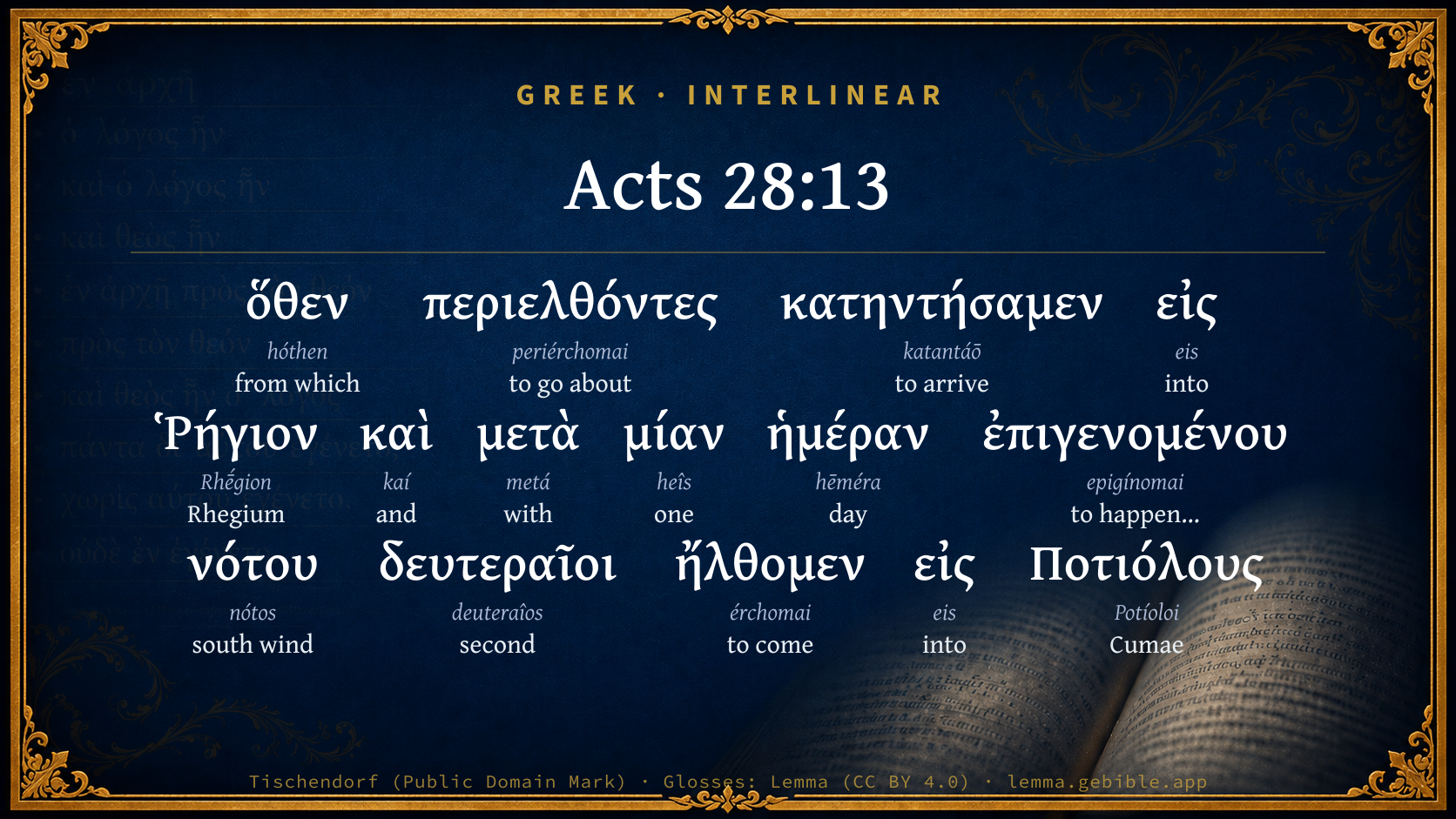
Greek (Tischendorf 8th ed.) Acts 28:13 appears in the Greek New Testament. The text above is from the Tischendorf 8th edition. Each word links to its Strong’s number and a concise gloss. Click any word for its full Thayer’s Greek Lexicon entry.
Download image
Cite this verse

Acts 28:13 (World English Bible). Public Domain. Lemma interlinear Bible study tool, https://lemma.gebible.app/v/acts/28/13.

Show BibTeX & RIS
BibTeX
RIS
English Translation
From there we circled around and arrived at Rhegium. After one day, a south wind sprang up, and on the second day we came to Puteoli,
World English Bible · Public Domain
Highlights
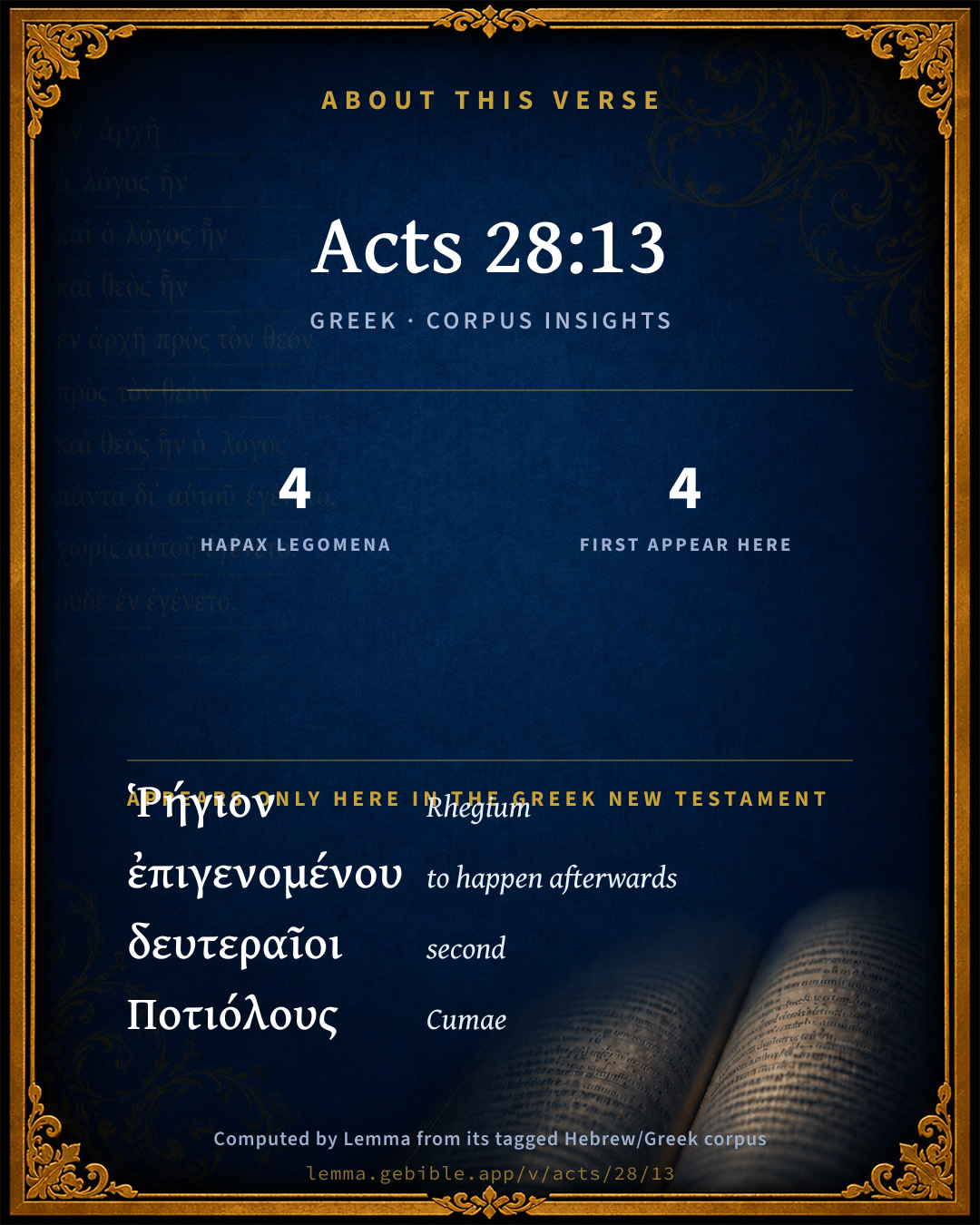
  • 4 hapax legomena — only here in the Greek New Testament
  • 4 first appearances in the Greek New Testament
Full analysis ↓
Download a study sheet

One document with this verse’s original text, its word-by-word gloss line, the meaning frame, cross-references with their text, attributed commentary, and full source and license credits — printable, and it pastes into notes with its structure intact.

This verse Autodidact and up

Study sheet (.html) Plain text (.txt)

A passage Seminary Student

Up to 50 verses in one chapter. A passage sheet keeps up to 6 commentary sources and 12 cross-references per verse, in the order this page ranks them, and says so on the sheet whenever that leaves anything out. Ask for a single verse and you get the Autodidact verse sheet above.

Everything on this page stays free to read, with no account — the sheet is a download of what is already on screen, not access to it.

Want to remove ads? Support Godless Engineer
Compare translations 3

The same verse in 3 English versions, stacked beneath the original-language interlinear above. Click any original word for its lexicon entry.

Each is an independent rendering of the whole verse — the interlinear is not word-aligned to these translations.

Highlighted words mark where these versions differ — a whole-verse word diff, not a word-by-word alignment.

  • World English Bible Public Domain
    From there we circled around and arrived at Rhegium. After one day, a south wind sprang up, and on the second day we came to Puteoli,
  • King James Version Public Domain
    And from thence we fetched a compass, and came to Rhegium: and after one day the south wind blew, and we came the next day to Puteoli:
  • unfoldingWord Literal Text CC BY-SA 4.0
    Having sailed from there, we came down to Rhegium, and after one day, a south wind having occurred, we came to Puteoli the next day,

unfoldingWord Literal Text — © unfoldingWord, licensed CC BY-SA 4.0. Word-aligned USFM3 via Door43 (git.door43.org/unfoldingWord/en_ult).

Versions to compare (up to 4)

3 of 4 selected

Show all 19 translations

Every available English version of this verse, each an independent rendering of the whole verse.

  • World English Bible Public Domain
    From there we circled around and arrived at Rhegium. After one day, a south wind sprang up, and on the second day we came to Puteoli,
  • Berean Standard Bible Public Domain
    From there we weighed anchor and came to Rhegium. After one day, a south wind came up, and on the second day we arrived at Puteoli.
  • Majority Standard Bible Public Domain
    From there we sailed around and came to Rhegium. After one day, a south wind came up, and on the second day we arrived at Puteoli.
  • King James Version Public Domain
    And from thence we fetched a compass, and came to Rhegium: and after one day the south wind blew, and we came the next day to Puteoli:
  • American Standard Version (1901) Public Domain
    And from thence we made a circuit, and arrived at Rhegium: and after one day a south wind sprang up, and on the second day we came to Puteoli;
  • Revised Version (1885) Public Domain
    And from thence we made a circuit, and arrived at Rhegium: and after one day a south wind sprang up, and on the second day we came to Puteoli:
  • Geneva Bible (1599) Public Domain
    And from thence we set a compasse, and came to Rhegium: and after one day, the South wind blewe, and we came the seconde day to Putioli:
  • Douay-Rheims (1899) Public Domain
    From thence, compassing by the shore, we came to Rhegium: and after one day, the south wind blowing, we came the second day to Puteoli;
  • Young's Literal Translation Public Domain
    thence having gone round, we came to Rhegium, and after one day, a south wind having sprung up, the second `day' we came to Puteoli;
  • Literal Standard Version CC BY-SA 4.0
    there having gone around, we came to Rhegium, and after one day, a south wind having sprung up, the second [day] we came to Puteoli,
  • Unlocked Literal Bible CC BY-SA 4.0
    From there we sailed and arrived at the city of Rhegium. After one day a south wind sprang up, and in two days we came to the city of Puteoli.
  • unfoldingWord Literal Text CC BY-SA 4.0
    Having sailed from there, we came down to Rhegium, and after one day, a south wind having occurred, we came to Puteoli the next day,
  • Darby Bible Public Domain
    Whence, going in a circuitous course, we arrived at Rhegium; and after one day, the wind having changed to south, on the second day we came to Puteoli,
  • World Messianic Bible Public Domain
    From there we circled around and arrived at Rhegium. After one day, a south wind sprang up, and on the second day we came to Puteoli,
  • Webster's Bible Public Domain
    And from thence we made a circuit, and came to Rhegium: and after one day the south wind blew, and we came the next day to Puteoli:
  • Free Bible Version CC BY-SA 4.0
    From there we sailed on to Rhegium. The following day a south wind blew, and on the second day we arrived at the port of Puteoli,
  • Bible in Basic English Public Domain
    And from there, going about in a curve, we came to Rhegium: and after one day a south wind came up and on the day after we came to Puteoli:
  • Text-Critical English NT CC BY 4.0
    From there we took a circuitous course and arrived at Rhegium. After one day a south wind sprang up, and on the second day we came to Puteoli.
  • Tyndale New Testament (1534) Public Domain
    And from thence we set a compasse and came to Regium. And after one daye the south wynde blewe and we came the next daye to Putiolus:

Literal Standard Version (2020), Covenant Press — licensed CC BY-SA 4.0. Text via the HelloAO Bible API (eBible.org). Unlocked Literal Bible (unfoldingWord) — licensed CC BY-SA 4.0. Text via the HelloAO Bible API (eBible.org). unfoldingWord Literal Text — © unfoldingWord, licensed CC BY-SA 4.0. Word-aligned USFM3 via Door43 (git.door43.org/unfoldingWord/en_ult). Free Bible Version, Dr. Jonathan Gallagher — licensed CC BY-SA 4.0. Text via the HelloAO Bible API (eBible.org).

Word by word

More ways to search: Search by grammar → Find every occurrence → Compare this word →

Practice this passage: Drill this verse → Learn its vocabulary →

Ῥήγιον
Rhḗgion
G4484
“Rhegium”
Noun, Accusative, Singular, Neuter
Part of Speech
Noun
Case
Accusative
Number
Singular
Gender
Neuter
Full Thayer's Definition

Origin: of Latin origin

TDNT: None

Rhegium = "breach" 1. an Italian town situated on the Bruttian coast, just at the southern entrance of the Straits of Messina
  1. ὅθεν hóthen G3606 “from which” Adverb
  2. περιελθόντες periérchomai G4022 “to go about” Verb, Aorist, Active, Participle, Nominative, Plural, Masculine
  3. κατηντήσαμεν katantáō G2658 “to arrive” Verb, Aorist, Active, Indicative, 1st person, Plural
  4. εἰς eis G1519 “into” Preposition
  5. καὶ kaí G2532 “and” Conjunction
  6. μετὰ metá G3326 “with” Preposition
  7. μίαν heîs G1520 “one” Adjective, Accusative, Singular, Feminine
  8. ἡμέραν hēméra G2250 “day” Noun, Accusative, Singular, Feminine
  9. ἐπιγενομένου epigínomai G1920 “to happen afterwards” Verb, Aorist, Middle deponent, Participle, Genitive, Singular, Masculine
  10. νότου nótos G3558 “south wind” Noun, Genitive, Singular, Masculine
  11. δευτεραῖοι deuteraîos G1206 “second” Adjective, Nominative, Plural, Masculine
  12. ἤλθομεν érchomai G2064 “to come” Verb, Aorist, Active, Indicative, 1st person, Plural
  13. εἰς eis G1519 “into” Preposition
  14. Ποτιόλους Potíoloi G4223 “Cumae” Noun, Accusative, Plural, Masculine

About this verse

These counts appear in no published source. They are computed here, from the morphology-tagged text and Lemma’s own curated glosses. What Lemma adds →

15
words
14
distinct lemmas
Acts
section

Notable vocabulary

4 hapax legomena — words that appear only here in the entire Greek New Testament:

  • Ῥήγιον Rhegium G4484
  • ἐπιγενομένου to happen afterwards G1920
  • δευτεραῖοι second G1206
  • Ποτιόλους Cumae G4223

First appearance in Scripture

These words make their first canonical appearance in the Greek New Testament here:

  • Ῥήγιον Rhegium G4484
  • ἐπιγενομένου to happen afterwards G1920
  • δευτεραῖοι second G1206
  • Ποτιόλους Cumae G4223

Shared distinctive vocabulary

περιελθόντες to go about G4022 occurs in 4 verses of the Greek New Testament. Also found in:

Repetition

A word recurs within this verse:

Cross-references

1

Topical passages linked to Acts 28:13 in the Treasury of Scripture Knowledge — connected by theme and wording, ordered by reader-vote popularity; previews shown in the World English Bible.

  • Acts 27:13 When the south wind blew softly, supposing that they had obtained their purpose, they weighed anchor and sailed along Crete, close to shore.

Cross-references courtesy of OpenBible.info (CC BY 4.0).

Where the printed editions differ

1 variant

Places in this verse where the major printed Greek editions disagree on the wording in a way that affects the translation — a comparison of editions, not a manuscript-by-manuscript collation. The editions are the modern critical texts (Nestlé-Aland 28/27, SBL, Westcott-Hort, Tregelles, Tyndale House) and the traditional texts behind the KJV (the Textus Receptus and the Byzantine/Majority text). It is not a claim about which reading is original.

  1. Different wording
    περιελόντες

    “having taken off”

    In NA28NA27SBLWH Not in TynTregTRByz

    περιελθόντες (perielthontes) 'having gone around' occurs in traditional manuscripts (Tyn+Treg+TR+Byz) instead of περιελόντες (perielontes) 'having taken off' in older manuscripts (NA28+NA27+SBL+WH)

Textual data: Translators Amalgamated Greek New Testament (STEPBible TAGNT) · CC BY 4.0.

Commentary

Notes on Acts 28:13 from classic Christian and Jewish commentators (each source and its license shown beneath its notes). The classic Christian expositions comment on the surrounding passage and are grouped to its opening verse, so a note may address several verses; the Jewish commentaries on the Tanakh (Rashi and others) are per-verse, so they appear only where the commentator wrote on this verse.

Lemma curates 59 commentaries, every one of them public domain or Creative Commons licensed, each selected and text-cleaned for this edition rather than reprinted as found. About our sources →

Joseph Benson's Commentary

Act 28:13-15. From thence we fetched a compass — Coasted round the eastern shore of Sicily; and came to Rhegium — A town on the Italian shore, opposite to Messina in Sicily; and after one day — Having a favourable gale, we pursued our voyage; and came to Puteoli — A great seaport town of Campania, not far from Naples. Here finding Christian brethren — To whom Paul was known, at least by his fame; we were desired to stay with them seven days — That they might have an opportunity of hearing Paul and conversing with him. And Julius was so good as to grant their request. After which he set out with the prisoners and soldiers for Rome, by land. And now the brethren in that city, to whom Paul was well known by his letter lately written to the Romans, hearing that he was on the road, came out to meet him — Not being ashamed of his bonds; and some of them came as far as the town of Appii Forum — Which was fifty-one miles from the city, and others to the Three Taverns, a town at the distance of thirty miles. This unlooked-for testimony of respect from the brethren at Rome, making a strong impression upon the apostle’s mind, he thanked God for it, and took courage — Finding Christ was at Rome also, and being greatly refreshed by the company and conversation of such affectionate friends. After which they all went forward to the city, where, it is supposed, they arrived in the February of A.D. 63. It is remarkable that there is no certain account by whom Christianity was planted at Rome. Probably some inhabitants of that city were at Jerusalem on the day of pentecost, (Act 2:10,) and being then converted themselves, carried the gospel thither at their return.

Joseph Benson's Commentary on the Old and New Testaments (1811–1818) — public domain. Text from a community e-Sword module.

Tyndale Open Study Notes

Tyndale Open Resources

28:13-14 They sailed across the Straits of Messina to Rhegium on the southern tip of Italy. This port was a stopping place for ships traveling from the west coast of Italy to the eastern Mediterranean. • Puteoli (modern Pozzuoli) was a major port of entry for large grain ships bringing supplies from the east to Rome. Paul spent a week here with some local believers before moving on to Rome.

Tyndale Open Study Notes — © Tyndale Open Resources, licensed CC BY-SA 4.0. Text via the HelloAO Bible API.

Bengel's Gnomon

Johann Albrecht Bengel

Act 28:13. Περιελθόντες, coasting around) along the curve.—νότου, the south wind) An appropriate and pleasant termination to their voyage.

Bengel's Gnomon of the New Testament — English translation (T&T Clark, Edinburgh, 1860) — public domain. Text from a community e-Sword module.

Expositor's Greek Testament

ed. W. Robertson Nicoll

Act 28:13 . περιελθόντες : so A. and R.V., but latter in margin περιελόντες , see critical note. Ramsay also following T.R. points out that the latter reading could hardly signify more than “cast off” (“cast loose,” margin, R.V.), unnecessary here although important information in Act 27:40 , where τὰς ἀγκ . is added, and the meaning is evidently different. Ramsay renders “by tacking” (the verb referring to the frequent alteration of the ship’s course); they worked up to Rhegium by good seamanship as they could not go straight across, J. Smith, C. and H., p. 663, small edit. Mr. Lewin, St. Paul , 2, p. 736, takes a different view, and thinks that they were obliged to stand out to sea to fill their sails, and so to come to Rhegium by a circuitous sweep. R.V. renders simply “made a circuit,” so Grimm-Thayer. W.H [428] , ii., p. 226, explain their rendering “weighed anchor” by the use of the verb in Act 27:40 (but see Blass above), the elliptic employment of transitive verbs being common in Greek nautical language as in English, and by the opinion that the run from Syracuse to Rhegium could not be described as circuitous, unless the ship was thrown out by contrary winds (but see above); Mr. Rendall supports W.H [429] , Mr. Page the opposite, following T.R., so Smith, p. 156, fourth edit., and see critical note above, and Wendt (1899), p. 418. A.V. “fetched a compass,” so Tyndale, which formerly meant that they made a circuit, but the phrase is now obsolete, cf. 2Sa 5:23 , 2Ki 3:9 , same Greek verb in LXX. Ῥήγιον : Reggio , Titus put in here on his way from Judæa to Puteoli bound for Rome, Suet., Tit. , 5; and we learn from Jos., Ant. , xix., 2, 5, that Caligula began to construct a harbour for the corn-ships of Egypt, although he never finished it. The place was situated at the southern entrance to the Straits of Messina, here little more than a few miles in breadth between it and the city Messina (on its name from ῥήγνυμι , because Sicily was at this point rent away from Italy, see Grimm-Thayer, sub v. , and Wetstein). St. Paul was said to have visited Messina, and to have given the Christians a bishop, Acta Petri, Acta Pauli , Lipsius, p. ix. (Zöckler). The coins show us that here too the Dioscuri were the patron deities. κατην . only in Luke and Paul, see Act 16:1 , cf. 2Ma 4:44 . ἐπιγ .: “a south wind sprang up,” R.V., here only in N.T., cf. Thuc., iii., 74, iv., 30; Xen., Hell. , iii., 2, 17, oborto Austro , Blass, or it may mean coming after or in succession to, ἐπί , the previous adverse wind. δευτεραῖοι , cf. πεμπταῖοι , Act 20:6 , Blass in [430] , Joh 11:39 , Phi 3:5 , so in classical Greek. The distance is about 180 miles, and J. Smith, p. 217, 4th edit., points out that if we suppose the ship to sail at seven knots an hour the voyage would take about twenty-six hours, and St. Luke’s account is shown to be very accurate; see also Ramsay and Hackett for examples of the ancient rate of sailing quite in accordance with the facts before us. Ποτιόλους ( Pozzuoli ), in earlier days Dicaearchia; its new name was Latin, probably from the mineral springs in the neighbourhood a puteis , or perhaps a putendo (C. and H.). It was not only a great landing-place for travellers from the East, but the great harbour for Alexandrian corn-ships, as also for the trade from Syria and Spain (Renan, Saint Paul , p. 558). Seneca, Epist. , 77, gives us a vivid description of the interest taken in the arrival of the corn-ships, since the people of Rome depended so much upon this cargo for food. The importance gained by the place is shown by the fact that it gave its name to the bay, once the Bay of Cumæ, now the Bay of Naples, but in St. Paul’s day Sinus Puteolanus . Here St. Ignatius desired to land that he might follow the footsteps of St. Paul to Rome ( Martyr. , v.), see further Jos., Ant. , xvii., 12, 1, xviii., 7, 2; Strabo, xvii., 1, 7, and Wetstein’s references. For modern writers cf. also Lewin, St. Paul , ii. 218, and Farrar, ii., 386; their description shows how the Apostle’s eyes now rested upon “one of the loveliest of earthly scenes”.

[428] Westcott and Hort’s The New Testament in Greek: Critical Text and Notes.

[429] Westcott and Hort’s The New Testament in Greek: Critical Text and Notes.

[430] R(omana), in Blass, a first rough copy of St. Luke.

The Expositor's Greek Testament, edited by W. Robertson Nicoll (1897–1910) — public domain. Text from a community e-Sword module.

Jamieson, Fausset & Brown

Robert Jamieson, A. R. Fausset & David Brown

from thence we fetched a compass--that is, proceeded circuitously, or tacked, working to windward probably, and availing themselves of the sinuosities of the coast, the wind not being favorable [SMITH]. What follows confirms this.

and came to Rhegium--now Reggio, a seaport on the southwest point of the Italian coast, opposite the northeast point of Sicily, and at the entrance of the narrow straits of Messina.

after one day the south wind blew--a south wind having sprung up; being now favored with a fair wind, for want of which they had been obliged first to stay three days at Syracuse, and then to tack and put in for a day at Rhegium.

the next day to Puteoli--now Pozzuoli, situated on the northern part of the magnificent bay of Naples about one hundred eighty miles north of Rhegium, a distance which they might make, running before their "south wind," in about twenty-six hours. The Alexandrian corn ships enjoyed a privilege peculiar to themselves, of not being obliged to strike their topsail on landing. By this they were easily recognized as they hove in sight by the crowds that we find gathered on the shore on such occasions [HOWSON].

Jamieson, Fausset & Brown — Commentary Critical and Explanatory on the Whole Bible (1871) — public domain (CC PDM 1.0). Text via the HelloAO Bible API.

Adam Clarke's Commentary

Verse 13. We fetched a compass] οθεν περιελθοντες, Whence we coasted about. This will appear evident, when the coast of Sicily is viewed on any correct map, of a tolerably large scale.

Rhegium] A city and promontory in Calabria, in Italy, opposite to Sicily. It is now called Reggio. It had its name, ρηγιον, Rhegium, from the Greek ρηγνυμι, to break off; because it appears to have been broken off from Sicily.

The south wind blew] This was the fairest wind they could have from Syracuse, to reach the straits of Rhegium.

The next day to Puteoli] This place, now commonly called Pozzuoli, is an ancient town of Naples in the Terra di Lavoro; and is supposed to have been founded by the Samians, about 470 years before Christ. Within this city are several warm baths, very highly celebrated; and from these, and its springs in general, it seems to have had its ancient name Puteoli, from PUTEI, wells or pits; though some derive it from putor, a stench, or bad smell, because of the sulphureous exhalations from its warm waters. Varro gives both these etymologies, lib. iv. de Ling. Lat. cap. 5. It is famous for its temple of Jupiter Serapis, which is built, not according to the Grecian or Roman manner, but according to the Asiatic. Near this place are the remains of Cicero's villa, which are of great extent. The town contains, at present, about 10,000 inhabitants. Long. 14°. 40'. E., lat. 41°. 50'. N.

Adam Clarke's Commentary on the Bible (1810–1826) — public domain. Text from a community e-Sword/MySword module.

Ellicott's Commentary for English Readers

(13) From thence we fetched a compass.—The phrase, now somewhat obsolete, was formerly in common use for a circuitous route by land or sea from one point to another. (Comp. 2Sa_5:23; 2Ki_3:9, and—

“For ‘tis his custom, like a creeping fool,

To fetch a compass of a mile about, “

in Heywood’s Fair Maid of the Exchange, ii. 3.) It is found in most of the English versions, but Wiclif gives “we sailed about,” and the Rhemish, “compassing by the shore.” The latter, however, hardly expresses the fact, which was that the wind being probably from the west, they were compelled to tack so as to stand out from the shore to catch the breeze, instead of coasting.

Came to Rhegium.—This town, now Reggio, was in Italy, on the southern opening of the Straits of Messina. Ships from Alexandria to Italy commonly touched there, and Suetonius relates that the Emperor Titus, taking the same course as St. Paul, put in there on his way from Judæa to Puteoli, and thence to Rome. Caligula began the construction of a harbour at Rhegium for the corn-ships of Egypt; but this work, which the Jewish historian notes as the one “great and kingly undertaking” of his reign, was left unfinished (Ant. xix. 2, § 5).

The south wind blew.—More accurately, when a breeze from, the south had sprung, the form of the Greek verb implying a change of wind. The south wind was, of course, directly in their favour, and they sailed without danger between the famous rocks of Scylla and the whirlpool of Charybdis.

We came the next day to Puteoli.—As the distance was about one hundred and eighty miles, the ship was clearly making good way before the wind. Puteoli (more anciently Dikæarchia, now Pozzuoli) lies in a sheltered recess, forming the northern part of the Bay of Naples. It was at this time the chief port of Rome, and was, in particular, the great emporium for the corn ships of Alexandria, upon which the people of Rome largely depended for their food, and the arrival of which was accordingly eagerly welcomed. A pier on twenty-five arches was thrown out into the sea for the protection of the harbour. It may be noted further that but a few months prior to St. Paul’s arrival it had been raised to the dignity of a colonia (Tac. Ann. xiv. 27). It is hardly necessary to describe the well-known beauties of the bay, but the reader may be reminded that as the ship entered it the eye of St. Paul must have rested on the point of Misenum, to the north, behind which was stationed the imperial fleet; on Vesuvius, to the south; on the town of Neapolis (= New-town), now Naples, which had taken the place of the old Parthenope; on the islands of Capreæ, Ischia, and Procida.

A Bible Commentary for English Readers, edited by Charles John Ellicott (1878–1897) — public domain. Text from a community e-Sword module.

The Cambridge Bible for Schools and Colleges

gen. ed. J. J. S. Perowne

13. we fet a compass] [R.V. “made a circuit”] The old English phrase of the A. V. is not uncommon, cp. 2Sa_5:23; 2Ki_3:9. They made this winding course because the favourable wind, for which they had probably been waiting during the three days’ stay at Syracuse, did not come. “Fet” is the old preterite of “fetch” and is found often in the version of 1611, but has been changed by modern printers.

came to [R. V. arrived at] Rhegium] The modern Reggio situated at the southern point of Italy, on the straits of Messina. At this place Caligula designed to construct a harbour for these corn ships coming from Egypt to Italy, but his intention was never carried out.

the south wind blew] Better (with R. V.) “a south wind sprang up.” Thus by a change of wind they were able to go speedily forward, instead of tacking as they had been obliged to do from Syracuse to Rhegium.

to Puteoli] This is the modern Pozzuoli, near Naples. In St Paul’s day it was a principal port of Rome, and to it came most of the corn supply from Egypt.

The Cambridge Bible for Schools and Colleges (gen. ed. J. J. S. Perowne; Cambridge University Press, 1878–1918) — public domain. Text from a community e-Sword module.

John Gill's Exposition

And from thence we fetched a compass,.... About the isle of Sicily, from Syracuse to Pachinus, the promontory of the island:

and came to Rhegium; a city in Calabria, called by Ptolomy (k) Regium Julium; it was built, as Solinus (l) says, by the Chalcidensians, and was formerly a city of the Brutians (m); it is now called Reggio: it is said (n) to have its name from its being broken off from the main continent, for it lies in the straits of Sicily; and formerly Sicily was joined to Italy, but was separated from it by the violence of the sea at this place:

and after one day the south wind blew; they stayed one day at Rhegium, and when they departed from thence, they had a south wind, which was favourable to them: whether the apostle preached here, or no, is not certain, since his stay was so short; some Popish writers tell some idle stories about the apostle's preaching; how that the fishes came to the shore to hear him; that the grasshoppers were commanded by him to be silent, and have never been seen in that place since; that a stone pillar was set on fire by the flame of a candle, by which miracle the inhabitants present were converted and baptized; and one Stephen, that was in company, was made by him their first bishop: but in ecclesiastical history we meet with no account of any church in this place, until the fifth century; when the bishop of it, with others, subscribed a letter of Leo the First, sent into the east; and about the year 440, there was a synod of thirteen bishops convened in this place, on account of a certain ordination; and in the "seventh" century, a bishop of the church at Rhegium was present in the sixth council at Constantinople; in the "eighth", Constantine, bishop of Rhegium, was in the Nicene synod (o):

and we came the next day to Puteoli; the Syriac version adds, "a city of Italy"; it was formerly called Dicearchia (p), from the strict justice used in the government of it: it had its name of Puteoli, either "a putore", from the rankness and ill smell of the waters of it, through the "sulphur" and "alum" in them; or "a puteis", from the wells about it, the waters of which, by Pausanias, are said (q) to be so hot, as in time to melt the leaden pipes through which they flow, who calls it a town of the Tyrrhenians; by Pliny (r) it is placed in Campania, and so Jerom (s) says, Puteoli a city, a colony of Campania, the same that is called Dicearchia. Josephus (t) also speaks of it as in the same country; for he says, that Herod and Herodias both came to Dicearchia, (or Puteoli), and found Caius (the emperor) at Baiai, which is a little town in Campania, about five furlongs from Dicearchia; and he also in another (u) place says, the Italians call Dicearchia, "Potioli"; which is the same word the apostle here uses, and which is the Latin "Puteoli" corrupted; it is said to be first built by the Samians: frequent mention is made by writers (w), of "pulvis Puteolanus", the dust of Puteoli; which being touched by the sea water, hardens into a stone; and was therefore used to bank the sea, break the waves, and repel the force of them: that it was a place by the sea side, may be learned from the sea being called after its name, "mare Puteolanum" (x), the sea of Puteoli; so Apollonius Tyaneus is said (y) to sail from this place to Rome, whither he came in three days; to this port the ships of Alexandria particularly used to come, and hither persons were wont to go to take shipping for Alexandria (z); it is now called by the Italians Pozzuolo, and lies about eight miles from Naples; and according to the following story of the Jews', must be an hundred and twenty miles from Rome; who tell us (a), that

"Rabban Gamaliel, and R. Eleazar ben Azariah, and R. Joshua, and R. Akiba, went to Rome, and they heard the noise of the multitude at Rome, from Puteoli, an hundred and twenty miles:''

the story is a fable designed to signify the vast number of people at Rome, and the noise, hurry, and tumult there; but perhaps the distance between the two places may not be far from truth: and as fabulous is the account which R. Benjamin (b) gives of this place Puteoli, when he says it was called Surentum, a great city which Tzintzan Hadarezer built, when he fled for fear of David.

(k) Geograph. l. 3. c. 1. (l) Polyhistor. c. 8. (m) Mela, l. 2. c. 11. (n) Philo quod mundus, &c. p. 963. & de mundo, p. 1171. Vid. Justin. l. 4. c. 1. & Sallust. fragment. p. 147. (o) Ib. cent. 5. c. 2. p. 7. c. 9. p. 508. cent. 7. c. 2. p. 5. cent. 8. c. 2. p. 5. (p) Plin. l. 3. c. 5. (q) Pausan. Messenica vel. 1. 4. p. 285. & Arcadica vel. l. 8. p. 465. (r) Nat. Hist. l. 31. c. 2. (s) De locis Hebraicis, fol. 76. G. (t) Antiqu. l. 18. c. 8. sect. 2. (u) In Vita sua, sect. 3. p. 905. (w) Plin. l. 35. c. 13. Alex. ab Alex. l. 5. c. 9. Isidor. de origin l. 16. c. 1. p. 135. (x) A. Gell. noct. Attic. l. 7. c. 9. (y) Philostrat. Vit. Apollon. l. 7. c. 8. (z) Philo in Flaccum, p. 968. & de leg. ad Caium, p. 1018. Senec. cp. 77. (a) Echa Rabbati, fol. 59. 4. & T. Bab. Maccot, fol. 24. 1. (b) Itinerar. p. 14.

John Gill's Exposition of the Whole Bible (1746–1763) — public domain (CC PDM 1.0). Text via the HelloAO Bible API.

Trapp's Complete Commentary

John Trapp

13 And from thence we fetched a compass, and came to Rhegium: and after one day the south wind blew, and we came the next day to Puteoli:

Ver. 13. Came to Rhegium] Which hath its name of breaking, from ρηγνυμι, rumpo; because, say some, there the sea broke off Sicily from Italy, which was before but one continent. The like they report concerning France and England.

John Trapp, A Commentary or Exposition upon All the Books of the Old and New Testament (1647–1656) — public domain. Text from a community e-Sword module.

Albert Barnes' Notes on the Bible

We fetched a compass - We coasted about; or we sailed along the eastern side of Sicily.

And came to Rhegium - This was a city of Italy, in the kingdom of Naples, on the coast near the southwest extremity of Italy. It was nearly opposite to Messina, in Sicily. It is now called “Reggio.”

The south wind - A wind favorable for their voyage.

To Puteoli - The wells. This place was celebrated for its warm baths, and from these and its springs it is supposed to have derived its name of The Wells. It is now called “Pozzuoli,” and is in the campania of Naples, on the north side of the bay, and about 8 miles northwest from Naples. The town contains at present (circa 1880’s) about 10,000 inhabitants.

Albert Barnes' Notes on the Bible (1834–1885) — public domain. Text from a community e-Sword/MySword module.

Matthew Poole's English Annotations

Rhegium; a city in the kingdom of Naples, over against Messina in Sicily; so called because that Sicily was believed to be thereabouts rent and plucked from the main land, unto which they held it to have been formerly joined, until by a tempest it became an island.

Puteoli is a sea town not far from Naples.

Matthew Poole's English Annotations on the Holy Bible (1683–1685) — public domain. Text from a community e-Sword/MySword module.

Whedon's Commentary on the Bible

Daniel D. Whedon

13. A compass—A curve in the ship’s course. According to Mr. Lewin the wind was from the west; but Mount Etna obstructing the breeze left them becalmed, and obliged them to make an outward circuit in order to fill their sails.

Rhegium—Here, as the north wind blowing down through the strait made navigation impossible, they were detained for one day, after which the favourable south wind blew, and the next day, after a sail of one hundred and eighty-two miles, they arrived at Puteoli.

A corn ship now arrives at Puteoli, the earliest of the spring! It was always a great arrival, and of all that sailed into this the great Roman harbour, the Alexandrian ship alone was not required reverently to lower her topsail, but might sail into port in towering triumph.

It was the bay still renowned as the Bay of Naples into which Paul now sailed. Celebrated for its beauty, this wonderful bay had another celebrity derived from its performing the office (for which the small port of Ostia at the month of the Tiber was wholly insufficient) of harbour to the imperial city. Through this harbour of Puteoli passed the great current of intercourse by sea between Rome and the whole world.

Daniel D. Whedon (gen. ed.), Commentary on the Old and New Testaments (1874–1909) — public domain. Text from a community e-Sword module.

The Pulpit Commentary

Made a circuit for fetched a compass, A.V.; arrived at for came to, A.V.; a south for the south, A.V.; sprang up for blew, A.V.; on the second day we came for we came the next day, A.V.. We made a circuit; perielqontev. St. Luke only uses this word in one other passage, Act_19:13, "The strolling or, "vagabond" Jews;" and it has the same sense of "wandering" in the only other passages where it occurs in the New Testament (1Ti_5:13; Heb_11:37) If it is the right reading here, the meaning must be "tacking," the wind not allowing them to sail in a direct course. "I am inclined to suppose that the wind was north-west, and that they worked to windward, availing themselves of the sinuosities of the coast. But with this wind they could not proceed through the Straits of Messina .... They were, therefore, obliged to put into Rhegium But after one day the wind became fair (from the south), and on the following day they arrived at Puteoli, having accomplished about one hundred and eighty nautical miles in less than two days" (Smith, p. 156). But Meyer explains it, "after we had come round," viz. from Syracuse, round the eastern coast of Sicily. Lewin thinks they had to stand out to sea to catch the wind, and so arrived at Rhegium by a circuitous course. The other reading is perielontev, as in Act_27:40; but this seems to give no proper sense here. A south wind sprang up. The force of the preposition in ejpigenome) shows that there was a change of wind. The south wind would, of course, be a very favorable one for sailing from Reggio to Puzzuoli. Hobart remarks of ejpiginesqai (which is also found Act_27:27, according to some good manuscripts) that it "was a favorite medical word constantly employed to denote the coming on of an attack of illness." It occurs nowhere else in the New Testament, but is common in Diodorus Siculus, Xenophon, Herodotus, Thucydides, etc., for the coming on of a storm, wind (adverse or favorable), or any other change. On the second day; deuteraioi. This particular numeral occurs nowhere else in the New Testament, but the analogous tetartaiov is used keto, Joh_11:39. And Herodotus has tritaiov ajfi) "he went away on the third day." Tritaiov is also common in medical writers with puretov, a tertian ague, a fever that recurs on the third day; tetartaiov, a quartan fever; pemptaiov, one recurring on the fifth day; eJbdomaiov, on the seventh day; ejnnataiov, on the ninth day. The forms dekataiov penthkostaiov, etc., "doing anything on the tenth, the fiftieth day," also occur. Puteoli; now Puzzuoli. The Italian port to which ships from Alexandria usually came. Smith quotes a passage from Seneca (Epist., 77) describing the arrival of the Alexandrian wheat-ships at Puteoli. The whole population of Puteoli went out to see them sail into harbor with their topsails (supparum), which they alone were allowed to carry, in order to hasten their arrival (p. 157), so important to Italy was the corn trade with Alexandria.

The Pulpit Commentary (1880–1919), ed. H.D.M. Spence-Jones & Joseph S. Exell — public domain. Text from a community e-Sword module.

Godbey's Commentary on the New Testament

William B. Godbey

13. Puteoli is now the city of Naples, the metropolis of Italy.

William B. Godbey, Commentary on the New Testament (1896–1900) — public domain. Text from a community e-Sword module.

McGarvey & Pendleton's Commentaries

J. W. McGarvey

See notes on verse 11

J. W. McGarvey (with Philip Y. Pendleton), Commentaries on the New Testament (The Fourfold Gospel, 1914; Acts; and the epistles) — public domain. Text from a community e-Sword/MySword module.

unfoldingWord translationNotes

Door43 World Missions Community

General Information:

The Market of Appius and The Three Taverns was a popular market and inn on the main highway called the Appian Way, about 50 kilometers south of the city of Rome. (See: How to Translate Names)

city of Rhegium

This is the port city located at the southwestern tip of Italy. (See: How to Translate Names)

a south wind sprang up

"the wind began to blow from the south"

city of Puteoli

Puteoli is located in modern-day Naples on the west coast of Italy. (See: How to Translate Names)

There we found

"There we met"

brothers

These were followers of Jesus, including both men and women. AT: "fellow believers" (See: When Masculine Words Include Women)

were invited

This can be stated in active form. AT: "they invited us" (See: Active or Passive)

In this way we came to Rome

Once Paul reached Puteoli, the rest of the journey to Rome was on land. AT: "And after we stayed seven days with them, we went to Rome"

after they heard about us

"after they heard we were coming"

he thanked God and took courage

Taking courage is spoken of as if it were an object that a person could take. AT: "this encouraged him, and he thanked God" (See: Metaphor)

translationWords

brother

Rome

Paul

God

courage

unfoldingWord translationNotes — © Distant Shores Media and the Door43 World Missions Community, licensed CC BY-SA 4.0. Source: git.door43.org/Door43/en_tn.

Cambridge Greek Testament for Schools and Colleges

13. περιελθόντες, having made a circuit. They made this winding course because the favourable wind, for which they had probably been waiting during the three days’ stay at Syracuse, did not come.

κατηντήσαμεν εἰς Ῥήγιον, we arrived at Rhegium. The modern Reggio, situated at the southern point of Italy, on the straits of Messina. At this place Caligula designed to construct a harbour for these corn ships coming from Egypt to Italy, but his intention was never carried out.

ἐπιγενομένου νότου, when a south wind sprang up. Thus by a change of wind they were able to go speedily forward, instead of tacking as they had been obliged to do from Syracuse to Rhegium.

εἰς Ποτιόλους, to Puteoli. This is the modern Pozzuoli, near Naples. In St Paul’s day it was a principal port of Rome, and to it came most of the corn supply from Egypt.

A Greek name of Puteoli was Δικαιαρχία. Philo in Flaccum 521. Josephus, Vita 3.

Cambridge Greek Testament for Schools and Colleges (Cambridge University Press, 1896; 21 vols, various authors incl. Carr, Maclear, Plummer, Farrar, Lumby, Moule, M. R. James, Simcox) — public domain. Text from a community e-Sword module.

Alford’s Greek Testament

Henry Alford

13.] περιελθόντες apparently denotes the roundabout course of a vessel tacking with an adverse wind. That the wind was not favourable, follows from ἐπιγενομένου below. Mr. Lewin’s account is, “as the wind was westerly, and they were under shelter of the high mountainous range of Etna on their left, they were obliged to stand out to sea in order to fill their sails, and so came to Rhegium by a circuitous sweep.” And he cites a case of a passage from Syracuse to Rhegium, in which a similar circuit was taken for a similar reason, p. 736. The day at Rhegium, as perhaps the three at Syracuse before, was spent probably in waiting for the wind.

ἐπιγ. νότ.] the South wind having sprung up,—succeeded the one which blew before.

δευτεραῖοι] viz. after leaving Rhegium: a distance of about 180 nautical miles.

Ποτιόλους] Puteoli (anciently Dicæarchia, Strab. v. 4, now Puzzuoli) was the most sheltered part of the bay of Naples. It was the principal port of Southern Italy, and, in particular, formed the great emporium for the Alexandrian wheat ships. Strabo, xvii. 1. Seneca (Ep. 77) gives a graphic account (cited by Smith, p. 117) of the arrival of the Alexandrine fleet at Puteoli: “Subito nobis hodie Alexandrinæ naves apparuerunt, quæ præmitti solent et nuntiare secuturæ classis adventum; tabellarias vocant. Gratus illarum adspectus Campaniæ est. Omnis in pilis Puteolorum turba constitit, et ex ipso genere velorum, Alexandrinas quamvis in magna turba navium intelligit, solis enim licet supparum (the topsail) intendere quod in alto omnes habent naves. Nulla enim res æquo adjuvat cursum, quam summa pars veli; illinc maxime navis urgetur. Itaque quoties ventus increbuit majorque est quam expedit, antenna submittitur, minus habet virium flatus ex humili: cum intrare capreas et promontorium ex quo ‘Alta procellos speculatur vertice Pallas,’ cæteræ velo jubentur esse contentæ, supparum Alexandrinarum insigne est.”

Henry Alford, The Greek Testament (1849–1861) — public domain. Text from a community e-Sword module.

Lesson kit

Teaching starters — assembled from the data on this page, not authored interpretation. Every prompt links to the verse data it draws on. Edit before teaching.

Acts, in the Acts, opens this verse with 15 words (14 distinct Greek lemmas). Its most distinctive word is Rhḗgion (“Rhegium”). A historical commentator’s framing appears above. Read the whole chapter for the surrounding context.

Discussion questions

  1. The word Rhḗgion carries the sense “Rhegium.” How does it shape the verse?
  2. 4 words here appear nowhere else in the Greek New Testament. Why might the author reach for such rare wording?
  3. 4 words make their first appearance in Scripture here. What does this debut establish?
  4. How does Acts 19:13, which shares the word «to go about», read alongside this verse?
  5. What does the repetition of “into” (2× in this one verse) do in this verse?
  6. These translations render this verse differently. What is at stake in choosing one wording over another?
  7. Compare how Joseph Benson's Commentary and Tyndale Open Study Notes read this verse. Where do they agree or differ?

Things to notice

  • 4 words in this verse appear nowhere else in the Greek New Testament.
  • 4 words make their first canonical appearance in Scripture here.
  • These translations choose different wording for 16 words in this verse.
  • “into” occurs 2× in this single verse.
  • 14 distinct Greek lemmas span 15 words in this verse.

Reading settings

Reading text

Shown beneath each verse's original-language words.

Old Testament
Old Testament edition

Read the OT as the Masoretic Hebrew (MT) or the Greek Septuagint (LXX).

English shown for the Greek Septuagint (in the Hebrew ↔ Greek comparison).

Comparing translations? Open the Compare panel on any verse page to stack up to four side by side.