Acts 12:21

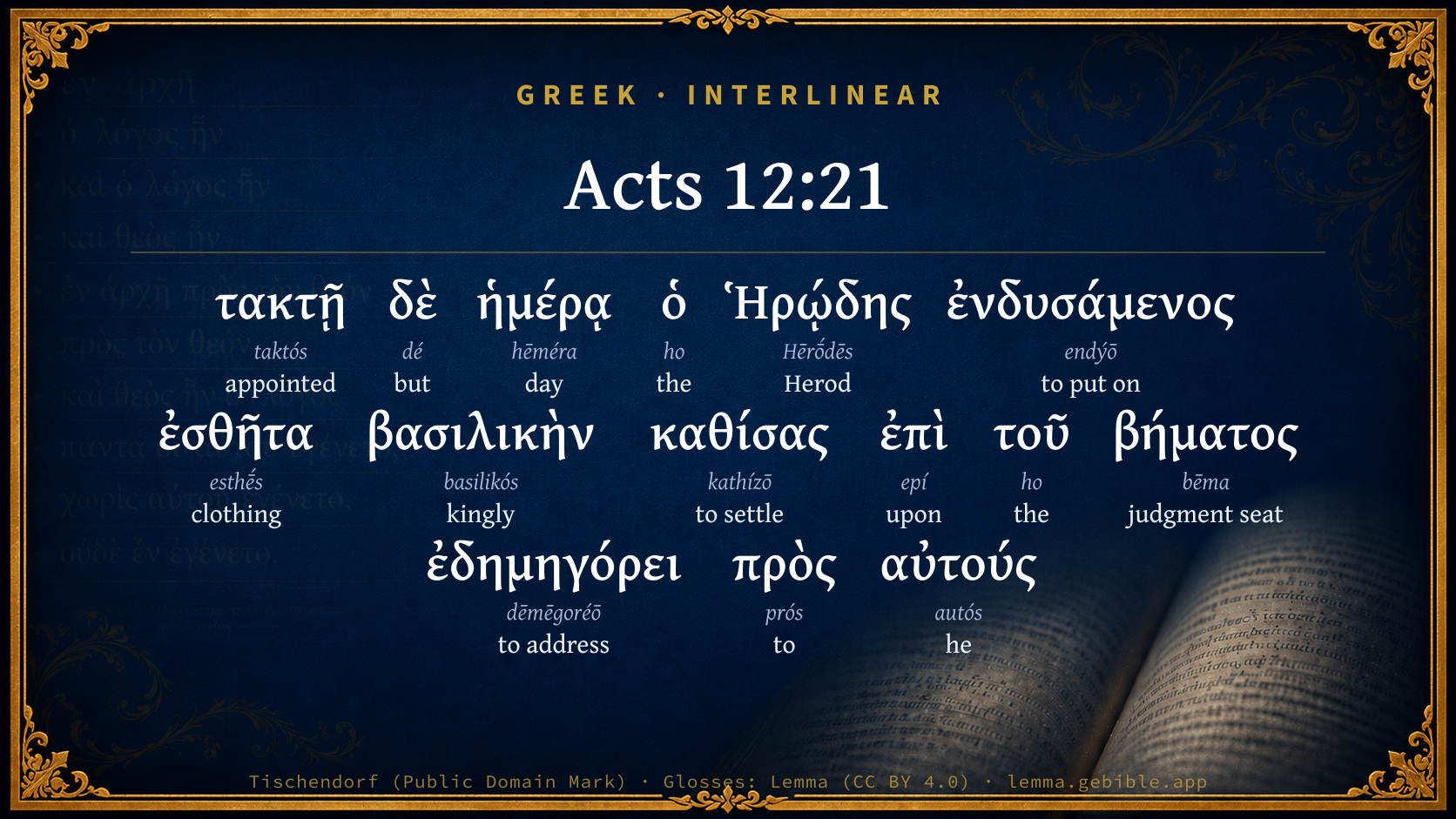
Greek (Tischendorf 8th ed.) Acts 12:21 appears in the Greek New Testament. The text above is from the Tischendorf 8th edition. Each word links to its Strong’s number and a concise gloss. Click any word for its full Thayer’s Greek Lexicon entry.
Download image
Cite this verse

Acts 12:21 (World English Bible). Public Domain. Lemma interlinear Bible study tool, https://lemma.gebible.app/v/acts/12/21.

Show BibTeX & RIS
BibTeX
RIS
English Translation
On an appointed day, Herod dressed himself in royal clothing, sat on the throne, and gave a speech to them.
World English Bible · Public Domain
Highlights
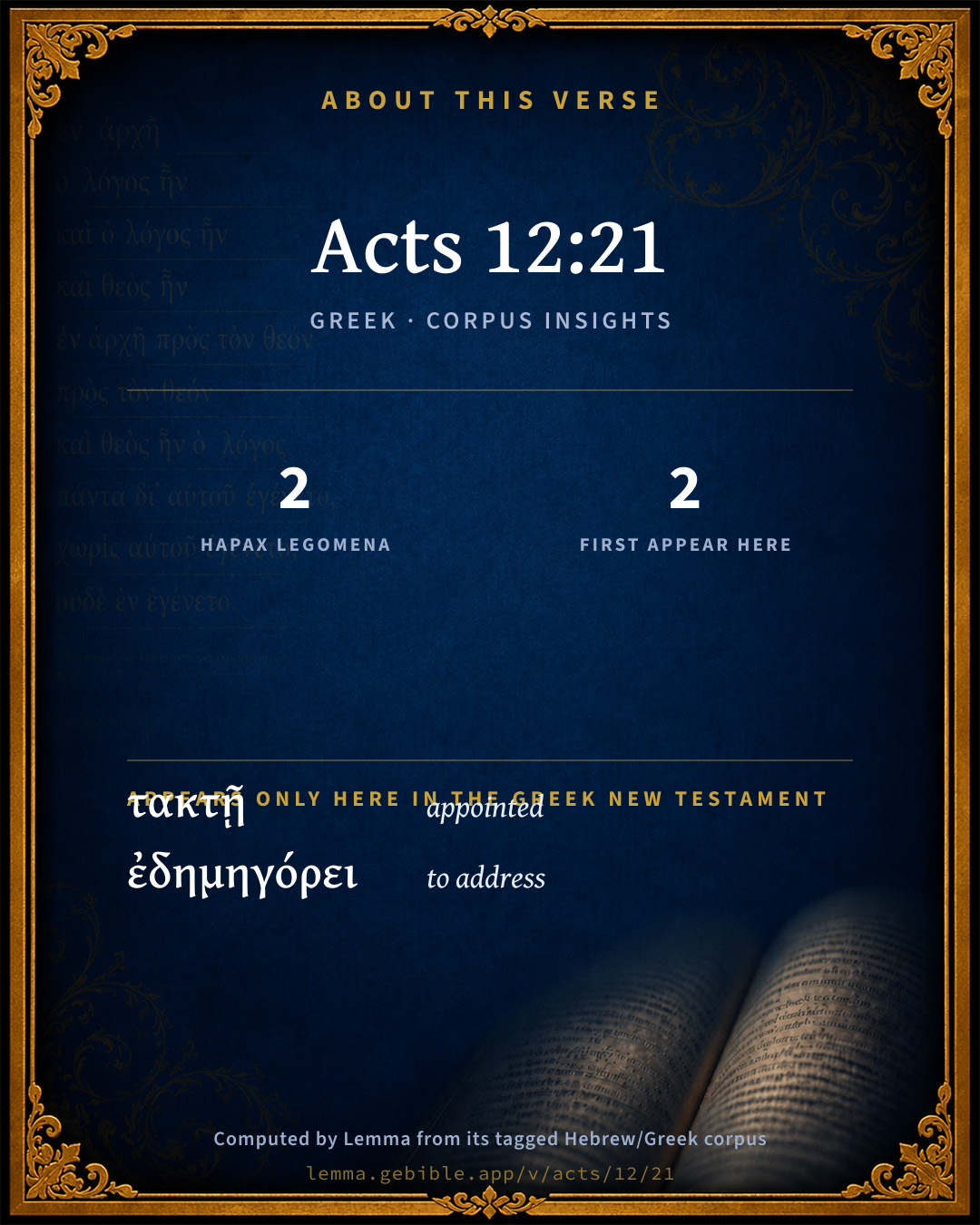
  • 2 hapax legomena — only here in the Greek New Testament
  • 2 first appearances in the Greek New Testament
Full analysis ↓
Download a study sheet

One document with this verse’s original text, its word-by-word gloss line, the meaning frame, cross-references with their text, attributed commentary, and full source and license credits — printable, and it pastes into notes with its structure intact.

This verse Autodidact and up

Study sheet (.html) Plain text (.txt)

A passage Seminary Student

Up to 50 verses in one chapter. A passage sheet keeps up to 6 commentary sources and 12 cross-references per verse, in the order this page ranks them, and says so on the sheet whenever that leaves anything out. Ask for a single verse and you get the Autodidact verse sheet above.

Everything on this page stays free to read, with no account — the sheet is a download of what is already on screen, not access to it.

Want to remove ads? Support Godless Engineer
Compare translations 3

The same verse in 3 English versions, stacked beneath the original-language interlinear above. Click any original word for its lexicon entry.

Each is an independent rendering of the whole verse — the interlinear is not word-aligned to these translations.

Highlighted words mark where these versions differ — a whole-verse word diff, not a word-by-word alignment.

  • World English Bible Public Domain
    On an appointed day, Herod dressed himself in royal clothing, sat on the throne, and gave a speech to them.
  • King James Version Public Domain
    And upon a set day Herod, arrayed in royal apparel, sat upon his throne, and made an oration unto them.
  • unfoldingWord Literal Text CC BY-SA 4.0
    And on the appointed day, Herod, having put on royal clothing and having sat on the throne, made a speech to them.

unfoldingWord Literal Text — © unfoldingWord, licensed CC BY-SA 4.0. Word-aligned USFM3 via Door43 (git.door43.org/unfoldingWord/en_ult).

Versions to compare (up to 4)

3 of 4 selected

Show all 19 translations

Every available English version of this verse, each an independent rendering of the whole verse.

  • World English Bible Public Domain
    On an appointed day, Herod dressed himself in royal clothing, sat on the throne, and gave a speech to them.
  • Berean Standard Bible Public Domain
    On the appointed day, Herod donned his royal robes, sat on his throne, and addressed the people.
  • Majority Standard Bible Public Domain
    On the appointed day, Herod donned his royal robes, sat on his throne, and addressed the people.
  • King James Version Public Domain
    And upon a set day Herod, arrayed in royal apparel, sat upon his throne, and made an oration unto them.
  • American Standard Version (1901) Public Domain
    And upon a set day Herod arrayed himself in royal apparel, and sat on the throne, and made an oration unto them.
  • Revised Version (1885) Public Domain
    And upon a set day Herod arrayed himself in royal apparel, and sat on the throne, and made an oration unto them.
  • Geneva Bible (1599) Public Domain
    And vpon a day appointed, Herod arayed himselfe in royall apparell, and sate on the iudgement seate, and made an oration vnto them.
  • Douay-Rheims (1899) Public Domain
    And upon a day appointed, Herod being arrayed in kingly apparel, sat in the judgment seat, and made an oration to them.
  • Young's Literal Translation Public Domain
    and on a set day, Herod having arrayed himself in kingly apparel, and having sat down upon the tribunal, was making an oration unto them,
  • Literal Standard Version CC BY-SA 4.0
    and on a set day, Herod having clothed himself in kingly clothing, and having sat down on the judgment seat, was making an oration to them,
  • Unlocked Literal Bible CC BY-SA 4.0
    On a set day Herod dressed himself in royal clothing and sat on a throne; he made a speech to them.
  • unfoldingWord Literal Text CC BY-SA 4.0
    And on the appointed day, Herod, having put on royal clothing and having sat on the throne, made a speech to them.
  • Darby Bible Public Domain
    And on a set day, clothed in royal apparel and sitting on the elevated seat [of honour], Herod made a public oration to them.
  • World Messianic Bible Public Domain
    On an appointed day, Herod dressed himself in royal clothing, sat on the throne, and gave a speech to them.
  • Webster's Bible Public Domain
    And upon a set day, Herod arrayed in royal apparel, sat upon his throne, and made an oration to them.
  • Free Bible Version CC BY-SA 4.0
    When the day came for their appointment with the king, Herod put on his royal robes, sat on his throne, and gave a speech to them.
  • Bible in Basic English Public Domain
    And on the day which had been fixed, Herod, dressed in his robes and seated in his place, made a public statement to them.
  • Text-Critical English NT CC BY 4.0
    On an appointed day Herod dressed himself in royal clothing, sat down on the platform, and made a speech to them.
  • Tyndale New Testament (1534) Public Domain
    And upon a daye appoynted Herode arayed him in royall apparell and set him in his seate and made an oraycon vnto them.

Literal Standard Version (2020), Covenant Press — licensed CC BY-SA 4.0. Text via the HelloAO Bible API (eBible.org). Unlocked Literal Bible (unfoldingWord) — licensed CC BY-SA 4.0. Text via the HelloAO Bible API (eBible.org). unfoldingWord Literal Text — © unfoldingWord, licensed CC BY-SA 4.0. Word-aligned USFM3 via Door43 (git.door43.org/unfoldingWord/en_ult). Free Bible Version, Dr. Jonathan Gallagher — licensed CC BY-SA 4.0. Text via the HelloAO Bible API (eBible.org).

Word by word

More ways to search: Search by grammar → Find every occurrence → Compare this word →

Practice this passage: Drill this verse → Learn its vocabulary →

τακτῇ
taktós
G5002
“appointed”
Adjective, Dative, Singular, Feminine
Part of Speech
Adjective
Case
Dative
Number
Singular
Gender
Feminine
Full Thayer's Definition

Origin: from G5021

TDNT: None

1. ordered, arranged, fixed, stated
  1. δὲ dé G1161 “but” Conjunction
  2. ἡμέρᾳ hēméra G2250 “day” Noun, Dative, Singular, Feminine
  3. ὁ ho G3588 “the” Article, Nominative, Singular, Masculine
  4. Ἡρῴδης Hērṓdēs G2264 “Herod” Noun, Nominative, Singular, Masculine
  5. ἐνδυσάμενος endýō G1746 “to put on” Verb, Aorist, Middle, Participle, Nominative, Singular, Masculine
  6. ἐσθῆτα esthḗs G2066 “clothing” Noun, Accusative, Singular, Feminine
  7. βασιλικὴν basilikós G937 “kingly” Adjective, Accusative, Singular, Feminine
  8. καθίσας kathízō G2523 “to settle” Verb, Aorist, Active, Participle, Nominative, Singular, Masculine
  9. ἐπὶ epí G1909 “upon” Preposition
  10. τοῦ ho G3588 “the” Article, Genitive, Singular, Neuter
  11. βήματος bēma G968 “judgment seat” Noun, Genitive, Singular, Neuter
  12. ἐδημηγόρει dēmēgoréō G1215 “to address” Verb, Imperfect, Active, Indicative, 3rd person, Singular
  13. πρὸς prós G4314 “to” Preposition
  14. αὐτούς autós G846 “he” Personal pronoun, Accusative, Plural, Masculine

About this verse

These counts appear in no published source. They are computed here, from the morphology-tagged text and Lemma’s own curated glosses. What Lemma adds →

15
words
14
distinct lemmas
Acts
section

Notable vocabulary

2 hapax legomena — words that appear only here in the entire Greek New Testament:

  • τακτῇ appointed G5002
  • ἐδημηγόρει to address G1215

First appearance in Scripture

These words make their first canonical appearance in the Greek New Testament here:

  • τακτῇ appointed G5002
  • ἐδημηγόρει to address G1215

Shared distinctive vocabulary

βασιλικὴν kingly G937 occurs in 5 verses of the Greek New Testament. Also found in:

Repetition

A word recurs within this verse:

Commentary

Notes on Acts 12:21 from classic Christian and Jewish commentators (each source and its license shown beneath its notes). The classic Christian expositions comment on the surrounding passage and are grouped to its opening verse, so a note may address several verses; the Jewish commentaries on the Tanakh (Rashi and others) are per-verse, so they appear only where the commentator wrote on this verse.

Lemma curates 59 commentaries, every one of them public domain or Creative Commons licensed, each selected and text-cleaned for this edition rather than reprinted as found. About our sources →

Joseph Benson's Commentary

Act 12:21-23. And upon a set day — When shows and games were exhibited by him in honour of Claudius Cesar; Herod, arrayed in royal apparel — In a garment so wrought with silver, that the rays of the rising sun, striking upon, and reflected from it, dazzled the eyes of the beholders; sat upon his throne — In a public theatre; and made an oration unto them — Not to the Tyrian and Sidonian deputies merely, but unto all the people assembled on this grand occasion. And the people gave a shout, It is the voice of a god, and not of a man — Such profane flattery the heathen frequently paid to princes. But the commonness of a wicked custom rather increases than lessens the guilt of it. And the unhappy king, instead of expressing a just indignation at such base and impious adulation, hearkened to it with a secret pleasure. And immediately — For frequently God does not delay to vindicate his injured honour; an angel of the Lord smote him — Of this, other historians say nothing; so wide a difference there is between divine and human history! An angel of the Lord brought out Peter, an angel smote Herod. Men did not see the instruments in either case: these were only known to the people of God. Because he gave not God the glory — Did not reject these blasphemous applauses, but willingly received them, and thus filled up the measure of his iniquities. So then vengeance tarried not. And he was eaten of worms — Or vermin, which bred in his bowels, and rendered him a most loathsome and horrible spectacle to all about him; and he gave up the ghost — Expired in agony and infamy, (as his grandfather, Herod the Great, had done, see on Mat 2:19,) and sunk as much below the common state of human nature, as his flatterers endeavoured to raise him above it! The Jewish historian, Josephus, confirms St. Luke’s account of the end of this miserable man. He tells us, that “as he did not rebuke the impious flattery addressed to him, he was immediately seized with exquisite and racking tortures in his bowels, so that he was compelled, before he left the place, to own his folly in admitting such acclamations, and upbraided those about him with the wretched condition in which they then saw their god; and being carried out of the assembly to his palace, he expired in violent agonies, the fifth day after he was taken, in the fifty-fourth year of his age, and the seventh of his reign.” Antiq., Act 19:7.

Joseph Benson's Commentary on the Old and New Testaments (1811–1818) — public domain. Text from a community e-Sword module.

Bengel's Gnomon

Johann Albrecht Bengel

Act 12:21. Τακτῇ δὲ ἡμέρᾳ, but on an appointed day) The solemn celebration of games for the safety of Cæsar, as Josephus says, l. 19. Ant. Jud. ch. 8, who describes at large this impiety of Herod and its punishment: “Clad in a garment which was all woven of silver by marvellous workmanship, and which, struck by the rays of the rising sun and emitting a kind of divine splendour, was inspiring the spectators with veneration accompanied with awe: and presently after pernicious (baneful) flatterers raising acclamations, each from a different quarter, were hailing him as a god, begging him that he would be favourably propitious; for that heretofore having revered him as a man, they now perceive and acknowledge that there is in him something more excellent than mortal nature: this impious adulation he did not correct or repel.—There ensued torturing pains in the belly, which were violent from the very first. Having therefore turned his eyes towards his friends, ‘Behold,’ said he, ‘I the god, as you called me, am commanded to leave life, the fatal necessity of death confuting your lie; and I, whom ye hailed as immortal, am hurried away by a mortal stroke.’—Then worn out by the torture, which did not at all abate for five days in continuation, he ended life.”—πρὸς αὐτοὺς, unto them) It is probable that among his hearers were ambassadors of the Tyrians and Sidonians.

Bengel's Gnomon of the New Testament — English translation (T&T Clark, Edinburgh, 1860) — public domain. Text from a community e-Sword module.

Meyer's Critical & Exegetical Commentary

Heinrich August Wilhelm Meyer

Act_12:21. Τακτῇ δὲ ἡμέρᾳ] According to Joseph. Antt. xix. 8. 2, comp. xviii. 6. 7, δευτέρᾳ δὲ τῶν θεωριῶν ἡμέρᾳ. According to Josephus, namely, he was celebrating just at that time games in honour of Claudius, at which, declared by flatterers to be a god, he became suddenly very ill, etc.

ἐνδυσάμ. ἐσθῆτα βασιλ.] στολὴν ἐνδυσάμενος ἐξ ἀργυρίου πεποιημένην πᾶσαν, Joseph. l.c.

The βῆμα, the platform from which Agrippa spoke, would have to be conceived, in harmony with Josephus, as the throne-like box in the theatre (which, according to the custom of the Romans, was used for popular assemblies and public speeches, comp. Act_19:29), which was destined for the king, if Lukewhich, however, cannot be ascertainedhas apprehended the whole occurrence as in connection with the festival recorded by Josephus. This festival itself is not defined more exactly by Josephus than as held ὑπὲρ τῆς σωτηρίας of the emperor. Hence different hypotheses concerning it, such as that of Anger: that it celebrated the return of Claudius from Britain; and that of Wieseler: that it was the Quinquennalia, which, however, was not celebrated until August; a date which, according to the context (Act_12:25), is too late.

ἐδημηγόρει πρὸς αὐτούς] he made a speech in public assembly of the people (Act_12:22) to them, namely, to the Tyrians and Sidonians, to whom (to whose representatives) he thus publicly before the people declared in a speech directed to them his decision on their request, his sentiments, etc. Only this simple view of πρὸς αὐτούς: to them (comp. Plat. Legg. vii. p. 817 C: δημηγ. πρὸς παῖδάς τε καὶ γυναῖκας καὶ τὸν πάντα ὄχλον), not: in reference to them (my first edition, and Baumgarten), as well as the reference to the Tyrians and Sidonians, not to the people (so Gerlach, p. 60, after Ranisch, de Lucae et Josephi in morte Her. Agr. consensu, Lips. 1745; and Fritzsche, Conject. p. 13 f.), is suggested by the context, and is to be retained. That, moreover, the speech was planned to obtain popularity, is very probable in itself from the character of Herod, as well as from Act_12:22; and this may have occasioned the choice of the word δημηγορεῖν, which often denotes such a rhetorical exhibition; see Stallb. ad Gorg. p. 482 C, ad Rep. p. 350 E.

Meyer — Critical and Exegetical Commentary on the New Testament — English translation by Peter Christie, edited by Frederick Crombie (T&T Clark, 1880) — public domain. Text from a community e-Sword module.

Expositor's Greek Testament

ed. W. Robertson Nicoll

Act 12:21 . τακτῇ : only here in N.T.; cf. Jos., Ant. , xix., 8, 2 ( cf. xviii., 6, 7), δευτέρᾳ δὲ τῶν θεωριῶν ἡμέρᾳ . It is quite true that Josephus says nothing directly of the Tyrians and Sidonians, but the audience was evidently granted to them on the second day of the public spectacle; cf. for the expression, Polyb., iii., 34, 9. The description of Josephus evidently implies some special occasion, and not the return of the ordinary Quin-quennalia; see on Act 12:19 and also below. Josephus does not menion Blastus, or those of Tyre and Sidon, but this is no reason against the narrative, as Krenkel maintains. Belser, much more reasonably, contends that Luke’s narrative supplements and completes the statement of Josephus. ἐνδ . ἐσθῆτα βασιλικήν , cf. Jos., Ant. , xix., 8, 2, στολὴν ἐνδυσάμενος ἐξ ἀργυρίου πεποιημένην πᾶσαν .; on ἐσθ . see Act 1:10 . βήματος : Josephus speaks of the event happening in the theatre, and the βῆμα here = rather “the throne,” R.V. (margin, “judgment-seat”), the royal seat in the theatre from which the king saw the games and made his harangues to the people (so of an orator’s pulpit, Neh 8:4 , 2Ma 13:26 ), see Blass and Grimm-Thayer, sub υ . ἐδημηγόρει : only here in N.T. In 4Ma 5:15 = contionari , frequent in classical Greek. πρὸς αὐτούς , i.e. , to the Tyrian and Sidonian representatives, but the word ἐδημ . might well be used of what was in any case an address, ad populum, cf. Act 12:22 .

The Expositor's Greek Testament, edited by W. Robertson Nicoll (1897–1910) — public domain. Text from a community e-Sword module.

Jamieson, Fausset & Brown

Robert Jamieson, A. R. Fausset & David Brown

And upon a set day Herod . . . made an oration unto them--to the Tyrians and Sidonians especially.

Jamieson, Fausset & Brown — Commentary Critical and Explanatory on the Whole Bible (1871) — public domain (CC PDM 1.0). Text via the HelloAO Bible API.

Adam Clarke's Commentary

Verse 21. Upon a set day, c.] A day on which games, c., were exhibited in honour of the Roman emperor. What this refers to, we learn from Josephus. "Herod, having reigned three years over ALL Judea, (he had reigned over the tetrarchy of his brother Philip four years before this,) went down to Caesarea, and there exhibited shows and games in honour of Claudius, and made vows for his health. On the second day of these shows, he put on a garment made wholly of silver, and of a contexture most truly wonderful, and came into the theatre early in the morning at which time the silver of his garment, being illuminated by the first reflection of the sun's rays, shone out after a surprising manner, and was so resplendent as to spread a horror over those who looked intently upon him and presently his flatterers cried out, one from one place, and another from another, 'He is a god:' and they added, 'Be thou merciful to us, for although we have hitherto reverenced thee only as a man, yet shall we henceforth own thee as superior to mortal nature.' Nor did the king rebuke them, nor reject their impious flattery. But, looking up, he saw an owl on a certain rope over his head, and immediately conceived that this bird was to him a messenger of ill tidings; and he fell into the deepest sorrow; a severe pain also arose in his bowels, and he died after five days' severe illness." This is the sum of the account given by Josephus, Ant. lib. xix. cap. 8, sect. 2. [See Whiston's edition.] Notwithstanding the embellishments of the Jewish historian, it agrees in the main surprisingly with the account given here by St. Luke. Josephus, it is true, suppresses some circumstances which would have been dishonourable to this impious king; and, according to his manner, puts a speech in Herod's mouth, when he found himself struck with death, expressive of much humility and contrition. But this speech is of no authority. When Josephus takes up and pursues the thread of mere historical narration, he may be safely trusted; but whenever he begins to embellish, or put speeches in the mouths of his actors, he is no longer to be credited. He even here transforms an angel of the Lord into an owl, and introduces it most improbably into his narration; as if an owl, a bird of all others that can least bear the light, should come and perch on the pavilion of the king, when the sun was shining with the most resplendent rays!

Adam Clarke's Commentary on the Bible (1810–1826) — public domain. Text from a community e-Sword/MySword module.

John Calvin's Commentaries

21. Upon an appointed day. Luke saith that the men of Tyrus and Sidon had peace granted them, because this was the occasion of the king’s oration, without doubt, that he might make them his underlings hereafter. The same history is extant in Josephus, in his Nineteenth Book of Antiquities, save only that he calleth him everywhere Agrippa, whom Luke calleth Herod. It is to be thought that Agrippa was his proper name, and that he was called by none other name so long as he was a private man; but after that he was advanced to be a king, he took to himself princely dignity, according to the name of his grandfather. Josephus and Luke agree together wonderfully in the thing itself, and in all circumstances. First, they agree concerning the place. Josephus saith, That his garment was embroidered with gold, on which, when the sun-beams light, it did glister again; and that this was the cause which moved the courtiers to call him a god. That he was suddenly wounded; also, that there was seen an owl sitting upon a cord over his head, which cord did prognosticate his ruin. And he is so far from doubting that his sacrilegious pride was punished with this kind of punishment, that he saith, that he confessed the same openly amidst his cruel torments, “Behold me, whom you call a god; I am enforced to finish my life most miserable.” There is no mention made there of the peace made with those of Tyrus and Sidon; but that he made and set forth plays in honor of Caesar. But it may be that the solemnity of the plays was appointed in respect of the peace concluded, which we know was a solemn thing.

John Calvin's Commentaries (1540-1563) — public domain. Text from the Calvin Translation Society English edition (1840s-50s) via the Christian Classics Ethereal Library (ccel.org). Calvin's coverage is partial (roughly two-thirds of the Bible); uncommented books and verses are honest gaps, never fabricated. The 19th-century editor's footnotes and remarks are omitted so the notes are faithfully Calvin's own voice.

Ellicott's Commentary for English Readers

(21) And upon a set day . . .—Josephus (Ant. xix. 8, § 2) gives an account of the incident that follows substantially agreeing with that here recorded. The scene was the theatre at Cæsarea, which had been built by Herod the Great. Agrippa was celebrating games in honour of the Emperor Claudius, who had succeeded Caligula in A.D. 41, possibly in honour of his return from Britain in A.D. 44. He was arrayed in a robe of silver tissue, such as Caligula had been wont to wear at banquets and games in Rome, which glittered with a dazzling brightness under the rays of the morning sun. His courtiers, taking up the Roman fashion of showing honour to kings and emperors, hailed him as a god, and prayed him, as such, to be propitious to them. The king did not repress the flattery, which fell on the ears of all Jewish by-standers as a fearful blasphemy. He accepted for himself the divine honours which he had dissuaded Caligula from claiming. He looked up, and saw an owl perched on a rope behind him, and recognised in it an omen of evil, fulfilling a prediction which had been made to him by a fellow-prisoner during his confinement at Rome (Jos. Ant. xviii. 8). Sharp pain fell on him, and in five days he died.

Comparing St. Luke’s narrative with this, it seems probable that the delegates from Tyre and Sidon were among those who raised the cry, “Be thou propitious to us,” and that their friend Blastus, knowing the weak point in Herod’s character, had instructed them that this was the way to obtain his favour. We feel, as we read the narrative, the contrast between St. Peter’s refusal even of Cornelius’s attitude of homage, and Agrippa’s acceptance of the profane apotheosis of the multitude.

A Bible Commentary for English Readers, edited by Charles John Ellicott (1878–1897) — public domain. Text from a community e-Sword module.

The Cambridge Bible for Schools and Colleges

gen. ed. J. J. S. Perowne

21. And upon a set day] The day was one appointed (as Josephus tells us) for holding a festival on which to make vows for Cæsar’s safety.

Herod, arrayed (having arrayed himself) in royal apparel] See the extract from Josephus given below.

The Cambridge Bible for Schools and Colleges (gen. ed. J. J. S. Perowne; Cambridge University Press, 1878–1918) — public domain. Text from a community e-Sword module.

John Gill's Exposition

And upon a set day,.... Either on some feast day of divine appointment, as a feast day was by the Jews called "a stated day"; or on some day appointed by Herod, for the receiving of the ambassadors of Tyre and Sidon, and of hearing their petitions; or as Josephus (r) says, it was on the second day of the sports and plays, instituted by him in honour of Caesar:

Herod, arrayed in royal apparel; the same Jewish historian in the same place says, that this his apparel was all of silver, and of a wonderful contexture; and that going in this very early in the morning into the theatre, the silver shone so with the rays of the rising sun, that it struck the spectators with terror and admiration:

sat upon his throne; and very likely with the other ensigns of royalty, as a crown on his head, and a sceptre in his hand:

and made an oration unto them; either unto the ambassadors from Tyre and Sidon, or rather unto the common people, the multitude that were gathered together in the theatre, where the above historian says he was.

(r) Antiqu. l. 19, c. 8. sect 2.

John Gill's Exposition of the Whole Bible (1746–1763) — public domain (CC PDM 1.0). Text via the HelloAO Bible API.

Trapp's Complete Commentary

John Trapp

21 And upon a set day Herod, arrayed in royal apparel, sat upon his throne, and made an oration unto them.

Ver. 21. And upon a set day] When there were solemn shows and plays acted in honour of Caesar. God picks out his time to be avenged on his enemies, then when it may be most for his glory and their utter confusion.

Herod arrayed in royal apparel] In cloth of silver, saith Josephus, which being beaten upon by the sunbeams, dazzled the people’s eyes, and drew from them that blasphemous acclamation, Hunc homines decorant, quem vestimenta decorant, ειματα ανηρ. The most (as it is said of the Bohemian cur) fawn upon a good suit. It was a fault of old, Jas 2:3.

John Trapp, A Commentary or Exposition upon All the Books of the Old and New Testament (1647–1656) — public domain. Text from a community e-Sword module.

Albert Barnes' Notes on the Bible

And upon a set day - An appointed, public day. This was the second day of the sports and games which Herod celebrated in Caesarea in honor of Claudius Caesar. Josephus has given an account of this occurrence, which coincides remarkably with the narrative here. The account is contained in his “Antiquities of the Jews,” book 19, chapter 8, section 2, and is as follows: “Now when Agrippa had reigned three years over all Judea, he came to the city Caesarea, which was formerly called Strato’s Tower; and there he exhibited shows in honor of Caesar, upon his being informed that there was a certain festival celebrated to make vows for his safety. At which festival a great multitude was gotten together of the principal persons, and such as were of dignity throughout his province. On the second day of which shows he put on a garment made wholly of silver,” etc.

Arrayed in royal apparel - In the apparel of a king. Josephus thus describes the dress which Herod wore on that occasion. “He put on a garment made wholly of silver, and of wonderful contexture, and early in the morning came into the theater place of the shows and games, at which time the silver of his garment, being illuminated by the first reflection of the sun’s rays upon it, shone after a surprising manner, and was so resplendent as to spread a horror over those that looked intently on him.”

Sat upon his throne - This does not denote a throne in the usual sense of that word, but “a high seat” in the theater, where he sat, and from whence he could have a full view of the games and sports. From this place he made his speech.

Made an oration - Addressed the people.’ What was the subject of this speech is not intimated by Luke or Josephus.

Albert Barnes' Notes on the Bible (1834–1885) — public domain. Text from a community e-Sword/MySword module.

Matthew Poole's English Annotations

Upon a set day; this was (says Josephius, cap. 19. lib. 7) the second day of the sports or games, which Herod had instituted in honour of the emperor Claudius; or, it may he, such a day as Herod had appointed to determine the diffrence between him and the Tyrians.

Royal apparel; such, saith Josephus, as were made of silver, woven with extraordinary art, and did reflect strangely the beams of the sun shining upon it.

Sat upon his throne; an elevated place, from whence he might the better be seen and heard.

Matthew Poole's English Annotations on the Holy Bible (1683–1685) — public domain. Text from a community e-Sword/MySword module.

Whedon's Commentary on the Bible

Daniel D. Whedon

21-23. Of the event related in this passage Josephus also gives a narrative, adding some statements and omitting some points, so that the two narrations complement each other without contradiction, thus demonstrating the reality of the extraordinary event.

21. Upon a set day—A day appointed for a public interview with the ambassadors in presence of the citizens of Cesarea. Josephus is unaware of the facts furnished by Luke, Act_12:20. He informs us that the stated day was the second day of the games in honour of the emperor, which would, of course, be a suitable day for the ambassadors to attend, as Luke says, and for Herod to make his personal display.

Herod, arrayed in royal apparel—A long robe reaching to the feet. Josephus adds here that the robe was wholly overlaid with silver, and that, the assembly being at sunrise, the rays shining on the silver robe wrapt Herod’s person in a wonderful splendour. He omits the mention of the harangue, as he had omitted all account of the ambassadors of Tyre and Sidon.

Sat upon his throne—Rather, sat upon a (bema) platform or rostrum, his throne being placed upon it. Thence he could either see the games or harangue the people.

Oration unto them—The word oration is in Greek a compound; literally, a people-harangue. The address was, therefore, made in presence of the ambassadors, and on the affairs of the State, but probably directed to the people. It may have been a congratulatory one on the restoration of amity and the great consequent prosperity of the various sections and cities, and so was likely to be in the highest degree popular.

Daniel D. Whedon (gen. ed.), Commentary on the Old and New Testaments (1874–1909) — public domain. Text from a community e-Sword module.

The Pulpit Commentary

Arrayed himself for arrayed, A.V.; and sat for sat, A.V. and T.R.; on the throne for upon his throne, A.V. On the throne. Bhma does not mean "the king"s throne," and is nowhere so rendered in the A.V. but here. It means any raised stage or platform upon which a judge, or an orator, or any one wishing to address an assembly, stands. Here it means a high platform in the theatre at Caesarea, from whence the king, raised above the rest of the audience, could both see the games and make his speech to the people.

Vers. 21-23. Hollow grandeur exposed.

There is no doubt that the time of our Savior and the apostles was a time which witnessed some of the worst, the lowest, and the most malign forms of bodily disease. Similarly the time owned to some of the most monstrous types of moral deformity. The same chapter that tells us of the kindly, pitiful, "very present help in time of trouble" that the innocent and God-fearing Peter found, records, as if for telling contrast"s sake, the judgment that was divinely aimed at Herod, "suddenly and without remedy" visited on one who now had filled up the measure of his iniquities. A triple type of cruelty, vain-glory, and irreligion is here before us. It is, however, more particularly the crowning and at the same time killing point of a godless career which demands now attention. Notice

I A GRAND RECEPTION.

1. It is a reception given by Herod. He wields great power; he is conscious of it. It is no moral power. It is the result of no intellectual force; of no lofty character; of no social attractiveness; of no love to be kind, courteous, helpful in smoothing the ruggedness and softening the hardness of daily life and work. He is on no sort of level whatsoever with those whom he is pleased to allow to swell his vanity and feed the bad fires of his heart.

2. It is a reception given to a large number of those who were for the moment in the position, not of mere subjects, but of abject dependents on Herod. They had already felt his "high displeasure." Because of it they feared for their very bread. More ignorant than he, and driven by the supreme motives of desire of livelihood and business, they have already succumbed, bribing probably Herod"s chamberlain, and crouching in their approach to make representations to himself. Yes; they were driven by motive the pinch of which be had never been likely to know.

3. It was a reception which was to be a token of reconciliation; but a reconciliation founded on the entire yielding of the one part and the undisputed victory of the other. That victory was certainly the victory of might, and with every probability the victory of might over right. There had been no genuine compromise, no giving and taking, no kindly considerateness for aggrieved feeling and "wounded spirit." Therefore the grand reception was all to the honor and glory of one called Herod Agrippa the First.

II A GRAND SPEECH. Not one word of this speech is saved on the page of history. And that loss we may without hesitation count gain. It spares pain to others, and spares something of distinctness of outline to the shame and disgrace attaching to Herod. The circumstances, however, suit nothing else than what shall profess and purport to be a grand speech. The day" is fixed; there is nothing of an impromptu character about the occasion. The "royal apparel" is brought into requisition; the eyes of many beholders shall flash in the reflection of gold and color, to learn a vulgar wonder and to improve in the commonest covetousness. And the throne" is set and mounted. None can doubt of what sort the "oration" that followed. It is magniloquence. It is condescendingness. It is self-glorification. It is (on approaching the subject which brought the embassy) sham magnanimity. And under cover of this is a manifesto of take all or the utmost possible, give nothing or the least conceivable. The grandeur of the oration was the grandeur of hollow brass. How much grand speech differs from

(1) simple, truthful speech;

(2) speech the unmixed object of which is usefulness;

(3) kindly and sympathetic speech;

(4) speech of unaffected gracefulness and beauty!

III A GRAND SHOUT. That shout entered into the ears of Herod like the very ministry of satisfaction itself satisfaction in its most exigent degree, self-satisfaction. Supreme vanity must love a shout rather than articulate language for obvious reasons. The vague looms larger, goes further, amplifies to the gift of the excited imagination, and cannot be held bound afterwards to justify itself. But this shout found words as well, and grand words they were indeed, if true. "The gods are come down to us in the likeness of men" (Act_14:11) was a testimony, if mistaken in its form, yet true to some extent in its spirit. And if the present testimony have any such substance of truth and of honesty in it, it shall be accepted according to that which it hath, and not condemned for that which it hath not. The words, too, of this shouting are grandly chosen; they are sententious; they are in a sense antithetic; they speak the perfection of commendation for human tongue, which the psalmist would tell us is "the glory" of man"s frame. It is the voice of a god, and not of a man!" Herod had taken his seat, and "not angels" voices" could for his ears "have yielded sweeter music" than that shout and the recitative that rose out of it. The supreme point of a delicious intoxication of the conscience"s very worst opiate had that moment arrived.

IV A GRAND EXPOSURE.

1. Herod is proclaimed before men and angels and before, all time, as much as though all time were there and then present, as a typical instance of the man who knows not that his chief end is to glorify God." Either he knows it not, or he forgets it at an awful moment, or he defies it at the turning moment of his existence. Long proving-time has been his the decisive crucial moment has come. And this this, alas! is its revelation.

2. Herod"s "grand speech," of which not one word remains to us (and possibly enough few of its words were heard intelligently by a people who were wrought up and highly excited), is proclaimed to be one that has had for its sole object to lead up to this profane glorification of self, and has been guilty of forgetfulness to glorify God or even of denying glory to God.

3. The very shout of the people and the voice that gave subsequent articulateness to the shout are proclaimed to be really less their shout and their voice than those of Herod himself. Their throats and lips made the sound, but he found the breath for it, and all else, as, e.g. the place, occasion, motive, or inducement. A finale of this kind had been premeditated, if not prearranged and actually organized and got up.

(1) The people had a thousand pressing inducements or temptations to do as they did, and to lend their voices for a moment to a cry which their hearts very probably abhorred; their temptations were as numerous as all the reasons for which they loved the "nourishment" of their country." And they shall be undoubtedly judged for what they did, and judged with righteous judgment, when their time too is ripe. But they had not the opportunity of knowledge and the sovereign ease and self-disposition which were at the command of Herod.

(2) Herod is tenfold guilty; he is wrong himself without anything to account for it but the worst cancerous craving of a wicked heart, and he leads a number of innocent "sheep" (2Sa_24:17) into temptation, sin, danger. It is evident nay, "tis the one revelation involved in the expose of this memorable moment that the all-seeing eye, the all-just judgment, the casting vote of Heaven, the verdict that puts an end to all dispute, credits the major responsibility, the overwhelmingly preponderant responsibility for what had taken place to the account of Herod.

4. Position, power, splendor, wealth, an earthly throne, arbitrary governing, and all the rest of it, are proclaimed here at their true worth. They are shown up as the flimsy covering only of the real in a man, let that real be what it may. They don"t keep the weather out; they don"t keep disease out; they don"t keep malignant and loathsome disease out; they don"t shield conscience, heart, or body; they don"t keep God out, no, not for a moment. But they do avail to do one thing they suffice to throw out into amazing prominence the contrast between truth and falsehood, when God enters into judgment, and casts down those whom he never uplifted, and "removes the diadem and. takes off the crown", (Eze_21:26) and rends in twain the gorgeous royal raiment, none of which his hand had bestowed. Then even on earth is seen the manifest beginning of the "everlasting shame and contempt.

5. Last of all, it is here emphatically proclaimed that to omit to take right action and to omit to utter right speech may sometimes justly be exposed to bear all the same blame as to do and to speak the wrong. The apostles once and again, when offered Divine honors, exerted themselves with the utmost energy to refuse it, and gave their abhorrence of the idolatrous offering to be abundantly plain. This was the least that Herod should have done, and what he surely would have done if he had not already willingly "regarded iniquity in his heart." So, when the people gave a great shout and said, "It is the voice of a god, and not of a man!" and Herod never protested a word, it is the same as if he had done all the preparation, pulled the wires, and spoken the impious words himself. For God searcheth and trieth and knoweth "the thoughts and intents of the heart." And he will not be robbed of his own. B.

The Pulpit Commentary (1880–1919), ed. H.D.M. Spence-Jones & Joseph S. Exell — public domain. Text from a community e-Sword module.

John Wesley's Explanatory Notes

And on a set day - Which was solemnized yearly, in honour of Claudius Caesar; Herod, arrayed in royal apparel - In a garment so wrought with silver, that the rays of the rising sun striking upon, and being reflected from it, dazzled the eyes of the beholders. The people shouted, It is the voice of a God - Such profane flattery they frequently paid to princes. But the commonness of a wicked custom rather increases than lessens the guilt of it.

John Wesley, Explanatory Notes Upon the Whole Bible (1754–1765) — public domain. Text via the GEBible commentary corpus.

Burkitt's Expository Notes on the New Testament

William Burkitt

Upon a set day, that is, as some suppose, on his own birthday, he was arrayed in royal apparel, in a cloke made of cloth of silver, but dyed with St. James’s blood, Act 12:2. which being beaten upon by the sun beams, did plainly dazzle the eyes of all spectators; he makes an eloquent oration more gaudy than his apparel, unto the people, who cried out in a approbation thereof, "The voice of a God, and not of a man!"

Herod, instead of repelling this their impious flattery, embraces and hugs their praises , as proper to himself; and thereupon an angel, and worms, the best and the basest of creatures, meet in his punishment; the angel smiting him, and the worms eating him up: And no wonder that worms quickly devour him, whom those flesh-flies had blown upon before; no wonder that he is eaten up of worms, who forgot that he was a worm!

Quest. But why were not the people punished as well as the prince, seeing they were equally guilty of robbing God of his honour. True, Herod was the receiver, but they were the thieves: why then fell not the punishment on the whole multitude?

Ans. Because more discretion is expected from a prince, than from the rabble: Besides, what in them was but a blasphemous compliment, was by his acceptance of it made a reality, and was usurped by him, and assumed to him as due to his deserts.

From the whole note, 1. That flattery, either given or taken, is a very dangerous sin, a God-provoking, and a wrath-procuring sin. If we flatter men, God will not flatter us, but deal plainly, yet severely, with us. One of the ancients said, he was afaid of praise and commendation as much as of a crack of thunder. When men give much glory to men, it is very hard for men to give that glory back again to God. Herod was so pleased and tickled with the glory which the people gave him, that he could not part with it; but by keeping that, he lost his life.

Note, 2. That though God bears long with many sorts of sinners, yet not with sinners of this sort: "Immediately the angel of the Lord smote him:" Agreeably to that of Job 32:22. "I know not how to give flattering titles, for in so doing my Maker would soon take me away." The great God will admit of no corrivals; he will not suffer his glory to be given to another; he will be a swift witness against the flatterer, as well as against the false-swearer, Mal 3:5. He can destroy both flatterer and flattered with the twinkling of an eye, or with the turning of a hand; and those that are cried up as gods today, are as dung tomorrow.

William Burkitt's Expository Notes on the New Testament (1700–1703) — public domain. Text from a community e-Sword module.

McGarvey & Pendleton's Commentaries

J. W. McGarvey

See notes one verse 20

J. W. McGarvey (with Philip Y. Pendleton), Commentaries on the New Testament (The Fourfold Gospel, 1914; Acts; and the epistles) — public domain. Text from a community e-Sword/MySword module.

The People's New Testament

B. W. Johnson

21. On a set day Herod. Josephus (Antiq. 19: 8, 2) confirms Luke's account. He states why Herod was at Cæsarea, speaks of the assembly, the royal robe, the oration, the impious shout of the people, the sudden death of Herod, and pronounces it a judgment.

B. W. Johnson's The People's New Testament with Notes (1889–1891) — public domain. Electronic text from the Christian Classics Ethereal Library (CCEL) ThML edition.

Cambridge Greek Testament for Schools and Colleges

21. τακτῇ δὲ ἡμέρᾳ, and upon a set day. The day was one appointed (as Josephus tells us) for holding a festival on which to make vows for the safety of the Roman emperor.

ὁ Ἡρώδης ἐνδυσάμενος ἐσθῆτα βασιλικήν, Herod having arrayed himself in royal apparel. See the extract from Josephus given below.

Cambridge Greek Testament for Schools and Colleges (Cambridge University Press, 1896; 21 vols, various authors incl. Carr, Maclear, Plummer, Farrar, Lumby, Moule, M. R. James, Simcox) — public domain. Text from a community e-Sword module.

Alford’s Greek Testament

Henry Alford

21.] The account in Josephus is remarkably illustrative of the sacred text: τρίτον δὲ ἔτος αὐτῷ βασιλεύοντι τῆς ὅλης Ἰουδαίας πεπλήρωτο, καὶ παρῆν εἰς πόλιν Καισάρειαν … συνετέλει δὲ ἐνταῦθα θεωρίας εἰς τὴν Καίσαρος τιμήν, ὑπὲρ τῆς ἐκείνου σωτηρίας ἑορτήν τινα ταύτην ἐπιστάμενος (probably the ‘quinquennalia,’ B. J. i. 21. 8. Wieseler, p. 133). καὶ παρʼ αὐτὴν ἤθροιστο τῶν κατὰ τὴν ἐπαρχίαν ἐν τέλει καὶ προβεβηκότων εἰς ἀξίαν πλῆθος. δευτέρᾳ δὲ τῶν θεωριῶν ἡμέρᾳ στολὴν ἐνδυσάμενος ἐξ ἀργύρου πεποιημένην πᾶσαν, ὡς θαυμάσιον ὑφὴν εἶναι, παρῆλθεν εἰς τὸ θέατρον ἀρχομένης ἡμέρας. ἔνθα ταῖς πρώταις τῶν ἡλιακῶν ἀκτίνων ἐπιβολαῖς ὁ ἄργυρος καταυγασθεὶς θαυμασίως ἀπέστιλβε, μαρμαίρων τι φοβερὸν καὶ τοῖς εἰς αὐτὸν ἀτενίζουσι φρικῶδες. εὐθὺς δὲ οἱ κόλακες τὰς οὐδὲ ἐκείνῳ πρὸς ἀγαθοῦ ἄλλος ἄλλοθεν φωνὰς ἀνεβόων θεὸν προσαγορεύοντες, Εὐμενής τε εἴης, ἐπιλέγοντες, εἰ καὶ μέχρι νῦν ὡς ἄνθρωπον ἐφοβήθημεν, ἀλλὰ τοὐντεῦθεν κρείττονά σε θνητῆς φύσεως ὁμολογοῦμεν. οὐκ ἐπέπληξε τούτοις ὁ βασιλεὺς οὐδὲ τὴν κολακείαν ἀσεβοῦσαν ἀπετρίψατο. ἀνακύψας δʼ οὖν μετʼ ὀλίγον τὸν βουβῶνα τῆς ἑαυτοῦ κεφαλῆς ὑπερκαθεζόμενον εἶδεν ἐπὶ σχοινίου τινός· ἄγγελον δὲ τοῦτον εὐθὺς ἐνόησεν κακῶν εἶναι, … καὶ διακάρδιον ἔσχεν ὀδύνην. (This owl, Eusebius, H. E. ii. 10, professing to quote Josephus, makes into an angel. Having prefaced his quotation, αὐτοῖς γράμμασιν ὧδὲ πως τὸ θαῦμα διηγεῖται, he cites thus: … ἀνακύψας δὲ μετʼ ὀλίγον, τῆς ἑαυτοῦ κεφαλῆς ὑπερκαθεζόμενον εἶδεν ἄγγελον. τοῦτον εὐθὺς ἐνόησε κακῶν εἷναι αἴτιον κ.τ.λ. On the impossibility of acquitting the ecclesiastical historian of the charge of wilful fraud, see Heinichen’s second Excursus in his edition of Eusebius. It may be a caution to us as to how much we may believe of his quotations of authors which do not remain to us.) ἀθρόον δὲ αὐτῷ τῆς κοιλίας προσέφυσεν ἄλγημα μετὰ σφοδρότητος ἀρξάμενον. ἀναθεωρῶν οὖν πρὸς τοὺς φίλους Ὁ θεὸς ὑμῖν ἐγώ, φησίν, ἤδν καταστρέφειν ἐπιτάττομαι τὸν βίον, παραχρῆμα τῆς εἱμαρμένης τὰς ἄρτι μου κατεψευσμένας φωνὰς ἐλεγχούσης· καὶ ὁ κληθεὶς ἀθάνατος ὑφʼ ὑμῶν ἤδη θανὼν ἀπάγομαι … συνεχῶς δὲ ἐφʼ ἡμέρας πέντε τῷ τῆς γαστρὸς ἀλγήματι διεργασθεὶς τὸν βίον κατέστρεψεν. Antt. xix. 8. 2.

The circumstance related in our text, of the answer to the Sidonian embassy, of which Josephus seems not to have been aware, having been one object of Herod on the occasion, shews an accuracy of detail which well accords with the view of the material of this part of the Acts having been collected at Cæsarea, where the event happened (see Prolegg. to Acts, § ii. 11).

Henry Alford, The Greek Testament (1849–1861) — public domain. Text from a community e-Sword module.

Vincent's Word Studies in the New Testament

Marvin R. Vincent

Set [τακτη] . Appointed. Only here in New Testament. What the festival was, is uncertain. According to some, it was in honor of the emperor 's safe return from Britain. Others think it was to celebrate the birthday of Claudius; others that it was the festival of the Quinquennalia, observed in honor of Augustus, and dating from the taking of Alexandria, when the month Sextilis received the name of the Emperor - August.

Arrayed [ενδυσαμενος] . More literally, having arrayed himself.

Royal apparel. Josephus says he was clothed in a robe entirely made of silver.

Throne. See on ch. Act 7:5. The elevated seat or throne - like box in the theater, set apart for the king, from which he might look at the games or address the assembly.

Made an oration [εδημηγορει] . Only here in New Testament. The word is used especially of a popular harangue [δημος, τηε χομμονσ] . "At Jerusalem Agrippa enacted the Jew, with solemn gait and tragic countenance, amidst general acclamation; but at Caesarea he allowed the more genial part of a Greek to be imposed on him. It was at a festival in this Hellenic capital, after an harangue he had addressed to the populace, that they shouted," It is the voice of a God and not of a man "(Merivale," History of the Romans under the Empire ").

Marvin R. Vincent, Word Studies in the New Testament (1887–1900) — public domain. Text from a community e-Sword/MySword module.

Lesson kit

Teaching starters — assembled from the data on this page, not authored interpretation. Every prompt links to the verse data it draws on. Edit before teaching.

Acts, in the Acts, opens this verse with 15 words (14 distinct Greek lemmas). Its most distinctive word is taktós (“appointed”). A historical commentator’s framing appears above. Read the whole chapter for the surrounding context.

Discussion questions

  1. How does “appointed” (taktós) shape what this verse is saying?
  2. 2 words here appear nowhere else in the Greek New Testament. Why might the author reach for such rare wording?
  3. 2 words make their first appearance in Scripture here. What does this debut establish?
  4. How does John 4:46, which shares the word «kingly», read alongside this verse?
  5. What does the repetition of “the” (2× in this one verse) do in this verse?
  6. The translations on this page render this verse differently — a whole-verse word diff, not a word-by-word alignment. What might account for the different wordings?
  7. Compare how Joseph Benson's Commentary and Bengel's Gnomon read this verse. Where do they agree or differ?

Things to notice

  • 2 words in this verse appear nowhere else in the Greek New Testament.
  • 2 words make their first canonical appearance in Scripture here.
  • These translations choose different wording for 14 words in this verse.
  • “the” occurs 2× in this single verse.
  • 14 distinct Greek lemmas span 15 words in this verse.

Reading settings

Reading text

Shown beneath each verse's original-language words.

Old Testament
Old Testament edition

Read the OT as the Masoretic Hebrew (MT) or the Greek Septuagint (LXX).

English shown for the Greek Septuagint (in the Hebrew ↔ Greek comparison).

Comparing translations? Open the Compare panel on any verse page to stack up to four side by side.