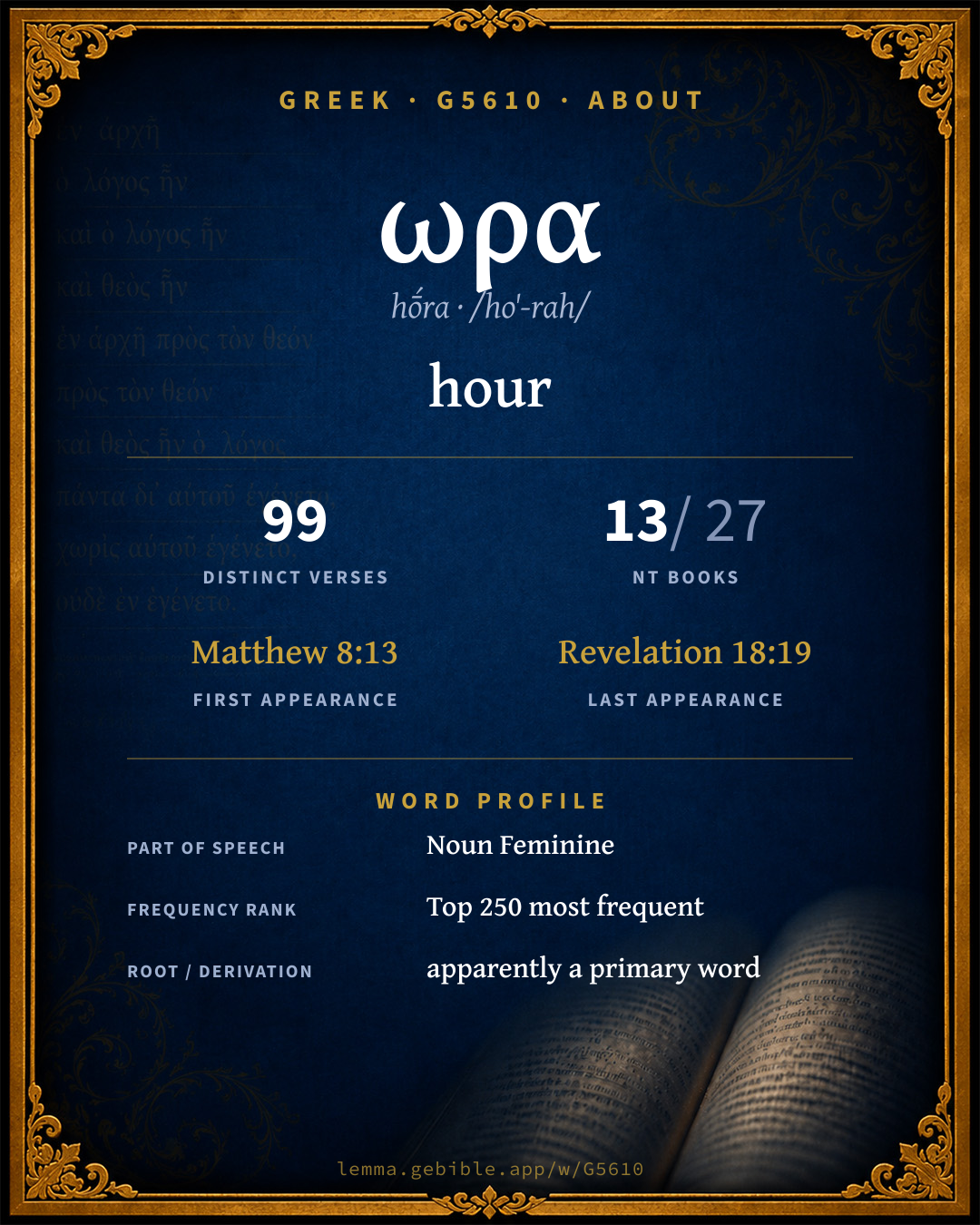
ὥρα
hour
‘hour’ is one of 4 main senses fuller range ↓
Full lexicon entry — Thayer's Greek Lexicon
From Thayer's Greek Lexicon
Where this word appears
See every Nominative-case word in the Greek New Testament →
Grammar key — what these labels mean
Part of speech
- Noun
- A naming word — a person, place, thing, or idea.
Case
- Nominative
- The case of the subject (and the predicate nominative).
- Dative
- The case of the indirect object, means, or location — “to / for / with / in.”
- Accusative
- The case of the direct object and of extent.
- Genitive
- The case of source, possession, or “of” — answers “whose / from what.”
Gender
- Feminine
- Grammatically feminine.
Number
- Singular
- One.
- Plural
- More than one.
Grammatical forms
- Noun, Nominative, Singular, Feminine 33 times (31%)
- Noun, Dative, Singular, Feminine 28 times (26%)
- Noun, Accusative, Singular, Feminine 22 times (21%)
- Noun, Genitive, Singular, Feminine 20 times (19%)
- Noun, Accusative, Plural, Feminine 1 time (1%)
- Noun, Genitive, Plural, Feminine 1 time (1%)
- Noun, Nominative, Plural, Feminine 1 time (1%)
Parsed forms decoded from the imported morphology (Robinson–Tischendorf, public domain), counted across 106 parsed occurrences — not distinct verses.
Every verse where G5610 appears — 99 distinct verses across 13 books. Click any verse to open its interlinear word-by-word view. Verse text shown in the World English Bible for context — . Each verse’s Greek form is shown with its reference; the English is not keyword-highlighted, since the data carries no word-level English alignment. Use “Compare translations” on any verse to read it across multiple English versions. This concordance covers the Greek New Testament; Septuagint (Greek Old Testament) occurrences of this word are not indexed here.
Matthew 20 verses
- Matthew 8:13 ὥρᾳ n dat sg fem Jesus said to the centurion, "Go your way. Let it be done for you as you have believed." His servant was healed in that hour.
- Matthew 9:22 ὥρας n gen sg fem But Jesus, turning around and seeing her, said, "Daughter, cheer up! Your faith has made you well." And the woman was made well from that hour.
- Matthew 10:19 ὥρᾳ n dat sg fem But when they deliver you up, don't be anxious how or what you will say, for it will be given you in that hour what you will say.
- Matthew 14:15 ὥρα n nom sg fem When evening had come, his disciples came to him, saying, "This place is deserted, and the hour is already late. Send the multitudes away, that they may go into the villages, and buy themselves food."
- Matthew 15:28 ὥρας n gen sg fem Then Jesus answered her, "Woman, great is your faith! Be it done to you even as you desire." And her daughter was healed from that hour.
- Matthew 17:18 ὥρας n gen sg fem Jesus rebuked him, the demon went out of him, and the boy was cured from that hour.
- Matthew 18:1 ὥρᾳ n dat sg fem In that hour the disciples came to Jesus, saying, "Who then is greatest in the Kingdom of Heaven?"
- Matthew 20:3 ὥραν n acc sg fem He went out about the third hour, and saw others standing idle in the marketplace.
- Matthew 20:5 ὥραν n acc sg fem Again he went out about the sixth and the ninth hour, and did likewise.
- Matthew 20:9 ὥραν n acc sg fem "When those who were hired at about the eleventh hour came, they each received a denarius.
- Matthew 20:12 ὥραν n acc sg fem saying, 'These last have spent one hour, and you have made them equal to us, who have borne the burden of the day and the scorching heat!'
- Matthew 24:36 ὥρας n gen sg fem But no one knows of that day and hour, not even the angels of heaven, but my Father only.
- Matthew 24:44 ὥρᾳ n dat sg fem Therefore also be ready, for in an hour that you don't expect, the Son of Man will come.
- Matthew 24:50 ὥρᾳ n dat sg fem the lord of that servant will come in a day when he doesn't expect it, and in an hour when he doesn't know it,
- Matthew 25:13 ὥραν n acc sg fem Watch therefore, for you don't know the day nor the hour in which the Son of Man is coming.
- Matthew 26:40 ὥραν n acc sg fem He came to the disciples, and found them sleeping, and said to Peter, "What, couldn't you watch with me for one hour?
- Matthew 26:45 ὥρα n nom sg fem Then he came to his disciples, and said to them, "Sleep on now, and take your rest. Behold, the hour is at hand, and the Son of Man is betrayed into the hands of sinners.
- Matthew 26:55 ὥρᾳ n dat sg fem In that hour Jesus said to the multitudes, "Have you come out as against a robber with swords and clubs to seize me? I sat daily in the temple teaching, and you didn't arrest me.
- Matthew 27:45 ὥρας ὥρας n gen sg fem n gen sg fem Now from the sixth hour there was darkness over all the land until the ninth hour.
- Matthew 27:46 ὥραν n acc sg fem About the ninth hour Jesus cried with a loud voice, saying, "Eli, Eli, lima sabachthani?" That is, "My God, my God, why have you forsaken me?"
Mark 10 verses
- Mark 6:35 ὥρας ὥρα n gen sg fem n nom sg fem When it was late in the day, his disciples came to him, and said, "This place is deserted, and it is late in the day.
- Mark 11:11 ὥρας n gen sg fem Jesus entered into the temple in Jerusalem. When he had looked around at everything, it being now evening, he went out to Bethany with the twelve.
- Mark 13:11 ὥρᾳ n dat sg fem When they lead you away and deliver you up, don't be anxious beforehand, or premeditate what you will say, but say whatever will be given you in that hour. For it is not you who speak, but the Holy Spirit.
- Mark 13:32 ὥρας n gen sg fem But of that day or that hour no one knows, not even the angels in heaven, nor the Son, but only the Father.
- Mark 14:35 ὥρα n nom sg fem He went forward a little, and fell on the ground, and prayed that, if it were possible, the hour might pass away from him.
- Mark 14:37 ὥραν n acc sg fem He came and found them sleeping, and said to Peter, "Simon, are you sleeping? Couldn't you watch one hour?
- Mark 14:41 ὥρα n nom sg fem He came the third time, and said to them, "Sleep on now, and take your rest. It is enough. The hour has come. Behold, the Son of Man is betrayed into the hands of sinners.
- Mark 15:25 ὥρα n nom sg fem It was the third hour, and they crucified him.
- Mark 15:33 ὥρας ὥρας n gen sg fem n gen sg fem When the sixth hour had come, there was darkness over the whole land until the ninth hour.
- Mark 15:34 ὥρᾳ n dat sg fem At the ninth hour Jesus cried with a loud voice, saying, "Eloi, Eloi, lama sabachthani?" which is, being interpreted, "My God, my God, why have you forsaken me?"
Luke 16 verses
- Luke 1:10 ὥρᾳ n dat sg fem The whole multitude of the people were praying outside at the hour of incense.
- Luke 2:38 ὥρᾳ n dat sg fem Coming up at that very hour, she gave thanks to the Lord, and spoke of him to all those who were looking for redemption in Jerusalem.
- Luke 7:21 ὥρᾳ n dat sg fem In that hour he cured many of diseases and plagues and evil spirits; and to many who were blind he gave sight.
- Luke 10:21 ὥρᾳ n dat sg fem In that same hour Jesus rejoiced in the Holy Spirit, and said, "I thank you, O Father, Lord of heaven and earth, that you have hidden these things from the wise and understanding, and revealed them to little children. Yes, Father, for so it was well-pleasing in your sight."
- Luke 12:12 ὥρᾳ n dat sg fem for the Holy Spirit will teach you in that same hour what you must say."
- Luke 12:39 ὥρᾳ n dat sg fem But know this, that if the master of the house had known in what hour the thief was coming, he would have watched, and not allowed his house to be broken into.
- Luke 12:40 ὥρᾳ n dat sg fem Therefore be ready also, for the Son of Man is coming in an hour that you don't expect him."
- Luke 12:46 ὥρᾳ n dat sg fem then the lord of that servant will come in a day when he isn't expecting him, and in an hour that he doesn't know, and will cut him in two, and place his portion with the unfaithful.
- Luke 13:31 ὥρᾳ n dat sg fem On that same day, some Pharisees came, saying to him, "Get out of here, and go away, for Herod wants to kill you."
- Luke 14:17 ὥρᾳ n dat sg fem He sent out his servant at supper time to tell those who were invited, 'Come, for everything is ready now.'
- Luke 20:19 ὥρᾳ n dat sg fem The chief priests and the scribes sought to lay hands on Him that very hour, but they feared the people--for they knew He had spoken this parable against them.
- Luke 22:14 ὥρα n nom sg fem When the hour had come, he sat down with the twelve apostles.
- Luke 22:53 ὥρα n nom sg fem When I was with you in the temple daily, you didn't stretch out your hands against me. But this is your hour, and the power of darkness."
- Luke 22:59 ὥρας n gen sg fem After about one hour passed, another confidently affirmed, saying, "Truly this man also was with him, for he is a Galilean!"
- Luke 23:44 ὥρα ὥρας n nom sg fem n gen sg fem It was now about the sixth hour, and darkness came over the whole land until the ninth hour.
- Luke 24:33 ὥρᾳ n dat sg fem They rose up that very hour, returned to Jerusalem, and found the eleven gathered together, and those who were with them,
John 24 verses
- John 1:40 ὥρα n nom sg fem One of the two who heard John, and followed him, was Andrew, Simon Peter's brother.
- John 2:4 ὥρα n nom sg fem Jesus said to her, "Woman, what does that have to do with you and me? My hour has not yet come."
- John 4:6 ὥρα n nom sg fem Jacob's well was there. Jesus therefore, being tired from his journey, sat down by the well. It was about the sixth hour.
- John 4:21 ὥρα n nom sg fem Jesus said to her, "Woman, believe me, the hour comes, when neither in this mountain, nor in Jerusalem, will you worship the Father.
- John 4:23 ὥρα n nom sg fem But the hour comes, and now is, when the true worshippers will worship the Father in spirit and truth, for the Father seeks such to be his worshippers.
- John 4:52 ὥραν ὥραν n acc sg fem n acc sg fem So he inquired of them the hour when he began to get better. They said therefore to him, "Yesterday at the seventh hour, the fever left him."
- John 4:53 ὥρᾳ n dat sg fem So the father knew that it was at that hour in which Jesus said to him, "Your son lives." He believed, as did his whole house.
- John 5:25 ὥρα n nom sg fem Most assuredly, I tell you, the hour comes, and now is, when the dead will hear the Son of God's voice; and those who hear will live.
- John 5:28 ὥρα n nom sg fem Don't marvel at this, for the hour comes, in which all that are in the tombs will hear his voice,
- John 5:35 ὥραν n acc sg fem He was the burning and shining lamp, and you were willing to rejoice for a while in his light.
- John 7:30 ὥρα n nom sg fem They sought therefore to take him; but no one laid a hand on him, because his hour had not yet come.
- John 8:20 ὥρα n nom sg fem Jesus spoke these words in the treasury, as he taught in the temple. Yet no one arrested him, because his hour had not yet come.
- John 11:9 ὧραί n nom pl fem Jesus answered, "Aren't there twelve hours of daylight? If a man walks in the day, he doesn't stumble, because he sees the light of this world.
- John 12:23 ὥρα n nom sg fem Jesus answered them, "The time has come for the Son of Man to be glorified.
- John 12:27 ὥρας ὥραν n gen sg fem n acc sg fem "Now my soul is troubled. What shall I say? 'Father, save me from this time?' But for this cause I came to this time.
- John 13:1 ὥρα n nom sg fem Now before the feast of the Passover, Jesus knowing that his time had come that he would depart from this world to the Father, having loved his own who were in the world, he loved them to the end.
- John 16:2 ὥρα n nom sg fem They will put you out of the synagogues. Yes, the time comes that whoever kills you will think that he offers service to God.
- John 16:4 ὥρα n nom sg fem But I have told you these things, so that when the time comes, you may remember that I told you about them. I didn't tell you these things from the beginning, because I was with you.
- John 16:21 ὥρα n nom sg fem A woman, when she gives birth, has sorrow, because her time has come. But when she has delivered the child, she doesn't remember the anguish any more, for the joy that a human being is born into the world.
- John 16:25 ὥρα n nom sg fem I have spoken these things to you in figures of speech. But the time is coming when I will no more speak to you in figures of speech, but will tell you plainly about the Father.
- John 16:32 ὥρα n nom sg fem Behold, the time is coming, yes, and has now come, that you will be scattered, everyone to his own place, and you will leave me alone. Yet I am not alone, because the Father is with me.
- John 17:1 ὥρα n nom sg fem Jesus said these things, and lifting up his eyes to heaven, he said, "Father, the time has come. Glorify your Son, that your Son may also glorify you;
- John 19:14 ὥρα n nom sg fem Now it was the Preparation Day of the Passover, at about the sixth hour. He said to the Jews, "Behold, your King!"
- John 19:27 ὥρας n gen sg fem Then he said to the disciple, "Behold, your mother!" From that hour, the disciple took her to his own home.
Acts 11 verses
- Acts 2:15 ὥρα n nom sg fem For these aren't drunken, as you suppose, seeing it is only the third hour of the day.
- Acts 3:1 ὥραν n acc sg fem Peter and John were going up into the temple at the hour of prayer, the ninth hour.
- Acts 5:7 ὡρῶν n gen pl fem About three hours later, his wife, not knowing what had happened, came in.
- Acts 10:3 ὥραν n acc sg fem At about the ninth hour of the day, he clearly saw in a vision an angel of God coming to him, and saying to him, "Cornelius!"
- Acts 10:9 ὥραν n acc sg fem Now on the next day as they were on their journey, and got close to the city, Peter went up on the housetop to pray at about noon.
- Acts 10:30 ὥρας n gen sg fem Cornelius said, "Four days ago, I was fasting until this hour, and at the ninth hour, I prayed in my house, and behold, a man stood before me in bright clothing,
- Acts 16:18 ὥρᾳ n dat sg fem She was doing this for many days. But Paul, becoming greatly annoyed, turned and said to the spirit, "I charge you in the name of Jesus Christ to come out of her!" It came out that very hour.
- Acts 16:33 ὥρᾳ n dat sg fem He took them the same hour of the night, and washed their stripes, and was immediately baptized, he and all his household.
- Acts 19:34 ὥρας n acc pl fem But when they perceived that he was a Jew, all with one voice for a time of about two hours cried out, "Great is Artemis of the Ephesians!"
- Acts 22:13 ὥρᾳ n dat sg fem came to me, and standing by me said to me, 'Brother Saul, receive your sight!' In that very hour I looked up at him.
- Acts 23:23 ὥρας n gen sg fem He called to himself two of the centurions, and said, "Prepare two hundred soldiers to go as far as Caesarea, with seventy horsemen, and two hundred men armed with spears, at the third hour of the night."
Romans 1 verse
1 Corinthians 2 verses
2 Corinthians 1 verse
Galatians 1 verse
1 Thessalonians 1 verse
Philemon 1 verse
1 John 1 verse
Revelation 10 verses
- Revelation 3:3 ὥραν n acc sg fem Remember therefore how you have received and heard. Keep it, and repent. If therefore you won't watch, I will come as a thief, and you won't know what hour I will come upon you.
- Revelation 3:10 ὥρας n gen sg fem Because you kept my command to endure, I also will keep you from the hour of testing, which is to come on the whole world, to test those who dwell on the earth.
- Revelation 9:15 ὥραν n acc sg fem The four angels were freed who had been prepared for that hour and day and month and year, so that they might kill one third of mankind.
- Revelation 11:13 ὥρᾳ n dat sg fem In that day there was a great earthquake, and a tenth of the city fell. Seven thousand people were killed in the earthquake, and the rest were terrified, and gave glory to the God of heaven.
- Revelation 14:7 ὥρα n nom sg fem He said with a loud voice, "Fear the Lord, and give him glory; for the hour of his judgment has come. Worship him who made the heaven, the earth, the sea, and the springs of waters!"
- Revelation 14:15 ὥρα n nom sg fem Another angel came out from the temple, crying with a loud voice to him who sat on the cloud, "Send forth your sickle, and reap; for the hour to reap has come; for the harvest of the earth is ripe!"
- Revelation 17:12 ὥραν n acc sg fem The ten horns that you saw are ten kings who have received no kingdom as yet, but they receive authority as kings, with the beast, for one hour.
- Revelation 18:10 ὥρᾳ n dat sg fem standing far away for the fear of her torment, saying, 'Woe, woe, the great city, Babylon, the strong city! For your judgment has come in one hour.'
- Revelation 18:16 ὥρᾳ n dat sg fem saying, 'Woe, woe, the great city, she who was dressed in fine linen, purple, and scarlet, and decked with gold and precious stones and pearls!
- Revelation 18:19 ὥρᾳ n dat sg fem They cast dust on their heads, and cried, weeping and mourning, saying, 'Woe, woe, the great city, in which all who had their ships in the sea were made rich by reason of her great wealth!' For in one hour is she made desolate.
About this entry
At a glance — auto-summarized from this page’s data, not written by a person. Every figure links to its source below. This summary describes the numbers; it doesn’t interpret them.
ωρα — transliterated hṓra — is a Greek noun carrying the sense “hour.” Its lexical range runs to 4 senses. With 99 verses in 13 books, it is a moderately common word in the Greek New Testament. It first appears in Matthew 8:13. From the same root come ημερα and ωραιος. Each statement above links to its evidence; the full detail follows below.
Gloss history
Strong's 1890 vs modern scholarship

About this word
Strong's G5610 catalogs a Greek word from the Greek New Testament.
These counts are not copied from any lexicon or concordance. They are computed here, from the morphology-tagged Greek New Testament. What Lemma adds →
- 99
- distinct verses
- The word appears in 99 distinct verses.
- 13 / 27
- NT books
- The word appears in 13 of 27 New Testament books.
- #156
- by frequency
- Top 250 most frequent Greek words (rank 156 of 5,347 Greek words by occurrence).
View all 99 occurrences in the concordance →
By section of the New Testament
By traditional corpus
Conventional, traditional groupings — biblical authorship is debated, so this is a traditional corpus grouping, not an authorship claim. Some books belong to more than one corpus (Luke is in both the Gospels and the Lukan corpus, and so on), so these shares overlap and need not total 100%. Each figure is a share of the word’s 99 distinct verses.
- Gospels 70 verses · 71%
- Johannine 35 verses · 35%
- Lukan (Luke–Acts) 27 verses · 27%
- Revelation 10 verses · 10%
- Pauline corpus 7 verses · 7%
- General (Catholic) Epistles 1 verse · 1%
How translations render this word
Counts come from each version’s own published word-to-Strong’s tagging or interlinear alignment — an approximate guide to how each version renders this word, not a word-level alignment the data otherwise carries. Because each total is that version’s own tagged count, the per-version totals vary from one another and need not match the appearance or distinct-verse counts above. These counts may also differ from a printed concordance because Lemma counts each distinctly tagged rendering and does not collapse phrase taggings into a single head-word total. This is a fixed set of word-tagged versions (KJV, ASV, BSB, ULT) and does not change with the reading translation you choose elsewhere. Each version’s license is shown beside its name below (and on Sources).
- King James Version: Hour 86×, Time 11×, Hours 3×
- American Standard Version: Hour 92×, The 10×, Season 4×
- Berean Standard Bible: Hour 82×, Time 11×, Hours 3×
- unfoldingWord Literal Text: Hour 102×, The 22×, At 4×
King James Version Public Domain
Renders G5610 across 107 tagged occurrences — most commonly:
Plus 4 renderings that appear only once — usually multi-word phrases or single function words the recovered tagging swept in, not distinct renderings. Not rendered by a distinct English word in 1 further occurrence.
American Standard Version Public Domain
Renders G5610 across 118 tagged occurrences — most commonly:
Plus 4 renderings that appear only once — usually multi-word phrases or single function words the recovered tagging swept in, not distinct renderings.
Berean Standard Bible Public Domain
Renders G5610 across 103 tagged occurrences — most commonly:
Plus 4 renderings that appear only once — usually multi-word phrases or single function words the recovered tagging swept in, not distinct renderings. Not rendered by a distinct English word in 3 further occurrences.
unfoldingWord Literal Text CC BY-SA 4.0
Renders G5610 across 138 tagged occurrences — most commonly:
Plus 2 renderings that appear only once — usually multi-word phrases or single function words the recovered tagging swept in, not distinct renderings.
Senses in Thayer's
The 4 senses Thayer's distinguishes for this word, in lexicon order (not ranked by frequency or importance). The full entry — with sub-senses — is in the Lexicon Entry tab.
- a certain definite time or season fixed by natural law and returning with the revolving year
- the daytime (bounded by the rising and setting of the sun), a day
- a twelfth part of the day-time…
- any definite time, point of time, moment
Word origin
Origin: apparently a primary word
Apparently a primary word; an hour (literally or figuratively): - day hour instant season X short [even-] tide (high) time.
— Strong’s Exhaustive Concordance (1890), public domain.
Forms in the corpus
The 6 distinct written forms G5610 takes in the Greek New Testament, most frequent first — each parse links to that case’s occurrences in the concordance.
| Form | Parsing | Example | Uses |
|---|---|---|---|
| ὥρα hṓra | Noun, Nominative, Singular, Feminine | Matthew 14:15 | 33 |
| ὥρᾳ hṓra | Noun, Dative, Singular, Feminine | Matthew 8:13 | 28 |
| ὥραν hṓran | Noun, Accusative, Singular, Feminine | Matthew 20:3 | 22 |
| ὥρας hṓras | Noun, Genitive, Singular, Feminine | Matthew 9:22 | 21 |
| ὡρῶν hōrō̂n | Noun, Genitive, Plural, Feminine | Acts 5:7 | 1 |
| ὧραί hō̂raí | Noun, Nominative, Plural, Feminine | John 11:9 | 1 |
Same root — word family
Other Thayer's entries built from the same root as G5610, grouped by Strong’s listed origin. These share a root / origin per the lexicon — not necessarily a shared meaning. Each links to that word’s own entry.
Derived from this word
Compare all same-root words → They share a root, not necessarily a meaning.
Septuagint usage
The same Greek word ωρα appears 49 times in the Greek Old Testament (Septuagint), across 49 verses in 17 books.
- 49
- LXX occurrences
- Tagged occurrences of this Greek word in the Septuagint.
- 49
- verses
- Distinct Septuagint verses containing this word.
- 17 / 39
- OT books
- The word appears in 17 of the 39 Old Testament books.
Sample Septuagint occurrences
- Genesis 18:10 ὥρα
- Exodus 9:18 ὥρα
- Leviticus 16:2 ὥρα
- Numbers 9:2 ὥρα
- Deuteronomy 11:14 ὥρα
- Joshua 11:6 ὥρα
- Ruth 2:14 ὥρα
- 1 Samuel 25:6 ὥρα
- 2 Samuel 24:15 ὥρα
- 1 Kings 19:2 ὥρα
- 2 Kings 4:16 ὥρα
- Ezra 18:3 ὥρα
Septuagint occurrences (same lexeme)
Every verse where the same Strong’s number (G5610) appears in the Greek Septuagint. Verse text shown in the World English Bible for context; the Greek form is the matched word — the English is not keyword-highlighted.
- Genesis 18:10 ὥρα He said, "I will certainly return to you when the season comes round. Behold, Sarah your wife will have a son." Sarah heard in the tent door, which was behind him.
- Genesis 18:14 ὥρα Is anything too hard for Yahweh? At the set time I will return to you, when the season comes round, and Sarah will have a son."
- Genesis 29:7 ὥρα He said, "Behold, it is still the middle of the day, not time to gather the cattle together. Water the sheep, and go and feed them."
- Exodus 9:18 ὥρα Behold, tomorrow about this time I will cause it to rain a very grievous hail, such as has not been in Egypt since the day it was founded even until now.
- Exodus 10:4 ὥρα Or else, if you refuse to let my people go, behold, tomorrow I will bring locusts into your country,
- Exodus 13:10 ὥρα You shall therefore keep this ordinance in its season from year to year.
- Exodus 18:22 ὥρα Let them judge the people at all times. It shall be that every great matter they shall bring to you, but every small matter they shall judge themselves. So shall it be easier for you, and they shall share the load with you.
- Exodus 18:26 ὥρα They judged the people at all times. They brought the hard causes to Moses, but every small matter they judged themselves.
- Leviticus 16:2 ὥρα and Yahweh said to Moses, "Tell Aaron your brother, not to come at all times into the Most Holy Place within the veil, before the mercy seat which is on the ark; lest he die: for I will appear in the cloud on the mercy seat.
- Numbers 9:2 ὥρα "Moreover let the children of Israel keep the Passover in its appointed season.
- Deuteronomy 11:14 ὥρα that I will give the rain of your land in its season, the former rain and the latter rain, that you may gather in your grain, and your new wine, and your oil.
- Deuteronomy 33:13 ὥρα Of Joseph he said, Blessed of Yahweh be his land, For the precious things of the heavens, for the dew, For the deep that couches beneath,
- Deuteronomy 33:14 ὥρα For the precious things of the fruits of the sun, For the precious things of the growth of the moons,
- Deuteronomy 33:16 ὥρα For the precious things of the earth and the fullness of it, The good will of him who lived in the bush. Let [the blessing] come on the head of Joseph, On the crown of the head of him who was separate from his brothers.
- Joshua 11:6 ὥρα Yahweh said to Joshua, Don't be afraid because of them; for tomorrow at this time will I deliver them up all slain before Israel: you shall hamstring their horses, and burn their chariots with fire.
- Ruth 2:14 ὥρα At meal-time Boaz said to her, Come here, and eat of the bread, and dip your morsel in the vinegar. She sat beside the reapers, and they reached her parched grain, and she ate, and was sufficed, and left of it.
- 1 Samuel 25:6 ὥρα and thus shall you tell him who lives [in prosperity], Peace be to you, and peace be to your house, and peace be to all that you have.
- 2 Samuel 24:15 ὥρα So Yahweh sent a pestilence on Israel from the morning even to the time appointed; and there died of the people from Dan even to Beersheba seventy thousand men.
- 1 Kings 19:2 ὥρα Then Jezebel send a messenger to Elijah, saying, So let the gods do to me, and more also, if I don't make your life as the life of one of them by tomorrow about this time.
- 1 Kings 21:6 ὥρα He said to her, Because I spoke to Naboth the Jezreelite, and said to him, Give me your vineyard for money; or else, if it please you, I will give you [another] vineyard for it: and he answered, I will not give you my vineyard.
- 2 Kings 4:16 ὥρα He said, At this season, when the time comes round, you shall embrace a son. She said, No, my lord, you man of God, do not lie to your handmaid.
- 2 Kings 4:17 ὥρα The woman conceived, and bore a son at that season, when the time came round, as Elisha had said to her.
- 2 Kings 7:1 ὥρα Elisha said, Hear you the word of Yahweh: thus says Yahweh, Tomorrow about this time shall a measure of fine flour be [sold] for a shekel, and two measures of barley for a shekel, in the gate of Samaria.
- 2 Kings 7:18 ὥρα It happened, as the man of God had spoken to the king, saying, Two measures of barley for a shekel, and a measure of fine flour for a shekel, shall be tomorrow about this time in the gate of Samaria;
- 2 Kings 10:6 ὥρα Then he wrote a letter the second time to them, saying, If you be on my side, and if you will listen to my voice, take the heads of the men your master's sons, and come to me to Jezreel by tomorrow this time. Now the king's sons, being seventy persons, were with the great men of the city, who brought them up.
- Ezra 18:3 ὥρα
- Job 5:26 ὥρα You shall come to your grave in a full age, Like a shock of grain comes in its season.
- Job 15:32 ὥρα It shall be accomplished before his time. His branch shall not be green.
- Job 15:33 ὥρα He shall shake off his unripe grape as the vine, And shall cast off his flower as the olive tree.
- Job 24:1 ὥρα "Why aren't times laid up by the Almighty? Why don't those who know him see his days?
- Job 24:6 ὥρα They cut their provender in the field. They glean the vineyard of the wicked.
- Job 36:28 ὥρα Which the skies pour down And drop on man abundantly.
- Job 38:23 ὥρα Which I have reserved against the time of trouble, Against the day of battle and war?
- Isaiah 52:7 ὥρα How beautiful on the mountains are the feet of him who brings good news, who publishes peace, who brings good news of good, who publishes salvation, who says to Zion, Your God reigns!
- Daniel 4:10 ὥρα Thus were the visions of my head on my bed: I saw, and, behold, a tree in the midst of the earth; and the height of it was great.
- Daniel 4:12 ὥρα The leaves of it were beautiful, and the fruit of it much, and in it was food for all: the animals of the field had shadow under it, and the birds of the sky lived in the branches of it, and all flesh was fed from it.
- Daniel 4:19 ὥρα Then Daniel, whose name was Belteshazzar, was stricken mute for a while, and his thoughts troubled him. The king answered, Belteshazzar, don't let the dream, or the interpretation, trouble you. Belteshazzar answered, My lord, the dream be to those who hate you, and the interpretation of it to your adversaries.
- Daniel 5:5 ὥρα In the same hour came forth the fingers of a man's hand, and wrote over against the lampstand on the plaster of the wall of the king's palace: and the king saw the part of the hand that wrote.
- Daniel 8:17 ὥρα So he came near where I stood; and when he came, I was frightened, and fell on my face: but he said to me, Understand, son of man; for the vision belongs to the time of the end.
- Daniel 8:19 ὥρα He said, Behold, I will make you know what shall be in the latter time of the indignation; for it belongs to the appointed time of the end.
- Daniel 9:21 ὥρα yes, while I was speaking in prayer, the man Gabriel, whom I had seen in the vision at the beginning, being caused to fly swiftly, touched me about the time of the evening offering.
- Daniel 11:6 ὥρα At the end of years they shall join themselves together; and the daughter of the king of the south shall come to the king of the north to make an agreement: but she shall not retain the strength of her arm; neither shall he stand, nor his arm; but she shall be given up, and those who brought her, and he who became the father of her, and he who strengthened her in those times.
- Daniel 11:35 ὥρα Some of those who are wise shall fall, to refine them, and to purify, and to make them white, even to the time of the end; because it is yet for the time appointed.
- Daniel 11:40 ὥρα At the time of the end shall the king of the south contend with him; and the king of the north shall come against him like a whirlwind, with chariots, and with horsemen, and with many ships; and he shall enter into the countries, and shall overflow and pass through.
- Daniel 11:45 ὥρα He shall plant the tents of his palace between the sea and the glorious holy mountain; yet he shall come to his end, and none shall help him.
- Daniel 12:1 ὥρα "At that time shall Michael stand up, the great prince who stands for the children of your people; and there shall be a time of trouble, such as never was since there was a nation even to that same time: and at that time your people shall be delivered, everyone who shall be found written in the book.
- Daniel 12:13 ὥρα But go you your way until the end be; for you shall rest, and shall stand in your lot, at the end of the days.
- Hosea 2:11 ὥρα I will also cause all her celebrations to cease: Her feasts, her new moons, her Sabbaths, and all her solemn assemblies.
- Zechariah 10:1 ὥρα Ask of Yahweh rain in the spring time, Yahweh who makes storm clouds, And he gives rain showers to everyone for the plants in the field.
These are occurrences of the same Greek lexeme (G5610) in the Septuagint — not a translation of any one Hebrew word. The store carries no word-level Hebrew↔Greek alignment, so no Hebrew original is asserted here. Counts come from the recovered LXX Strong's tagging — high-frequency vocabulary is well covered, while rare or late forms may be untagged — so they reflect tagged occurrences and may slightly undercount.