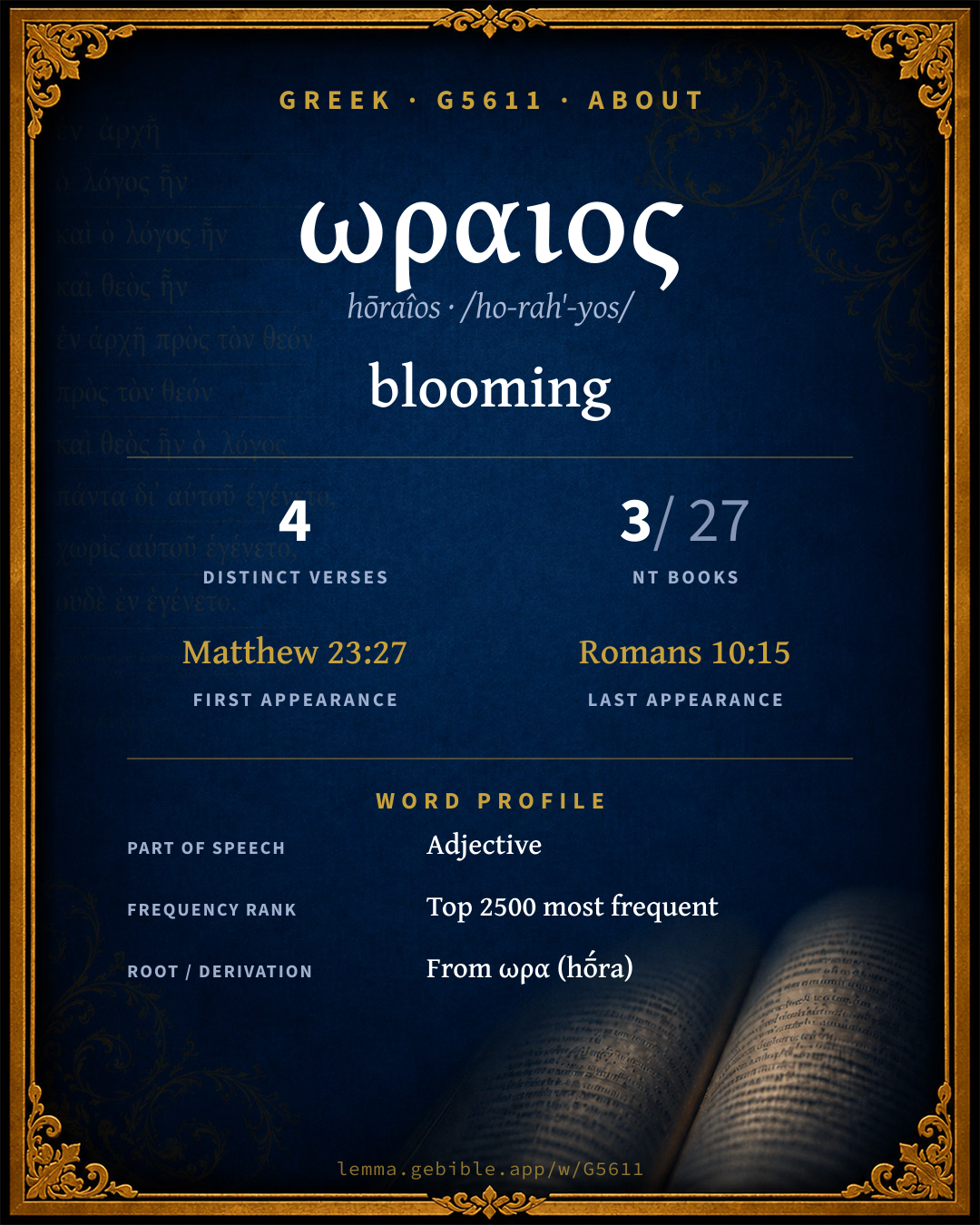
ὡραῖος
blooming
Full lexicon entry — Thayer's Greek Lexicon
From Thayer's Greek Lexicon
Where this word appears
See every Nominative-case word in the Greek New Testament →
Grammar key — what these labels mean
Part of speech
- Adjective
- A word that describes or qualifies a noun.
Case
- Nominative
- The case of the subject (and the predicate nominative).
- Accusative
- The case of the direct object and of extent.
- Dative
- The case of the indirect object, means, or location — “to / for / with / in.”
Gender
- Masculine
- Grammatically masculine.
- Feminine
- Grammatically feminine.
Number
- Plural
- More than one.
- Singular
- One.
Grammatical forms
- Adjective, Nominative, Plural, Masculine 2 times (50%)
- Adjective, Accusative, Singular, Feminine 1 time (25%)
- Adjective, Dative, Singular, Feminine 1 time (25%)
Parsed forms decoded from the imported morphology (Robinson–Tischendorf, public domain), counted across 4 parsed occurrences — not distinct verses.
Every verse where G5611 appears — 4 distinct verses across 3 books. Click any verse to open its interlinear word-by-word view. Verse text shown in the World English Bible for context — . Each verse’s Greek form is shown with its reference; the English is not keyword-highlighted, since the data carries no word-level English alignment. Use “Compare translations” on any verse to read it across multiple English versions. This concordance covers the Greek New Testament; Septuagint (Greek Old Testament) occurrences of this word are not indexed here.
Matthew 1 verse
Acts 2 verses
- Acts 3:2 ὡραίαν adj acc sg fem A certain man who was lame from his mother's womb was being carried, whom they laid daily at the door of the temple which is called Beautiful, to ask gifts for the needy of those who entered into the temple.
- Acts 3:10 ὡραίᾳ adj dat sg fem They recognized him, that it was he who used to sit begging for gifts for the needy at the Beautiful Gate of the temple. They were filled with wonder and amazement at what had happened to him.
Romans 1 verse
About this entry
At a glance — auto-summarized from this page’s data, not written by a person. Every figure links to its source below. This summary describes the numbers; it doesn’t interpret them.
“blooming” is the headline sense of the Greek adjective ωραιος (hōraîos). A scarce word — 4 verses in all of the Greek New Testament. More than half of its appearances fall in Acts. Scripture first uses it in Matthew 23:27. It shares a root with ωρα and ημερα. The sections below give every sense, occurrence, and version rendering.
Gloss history
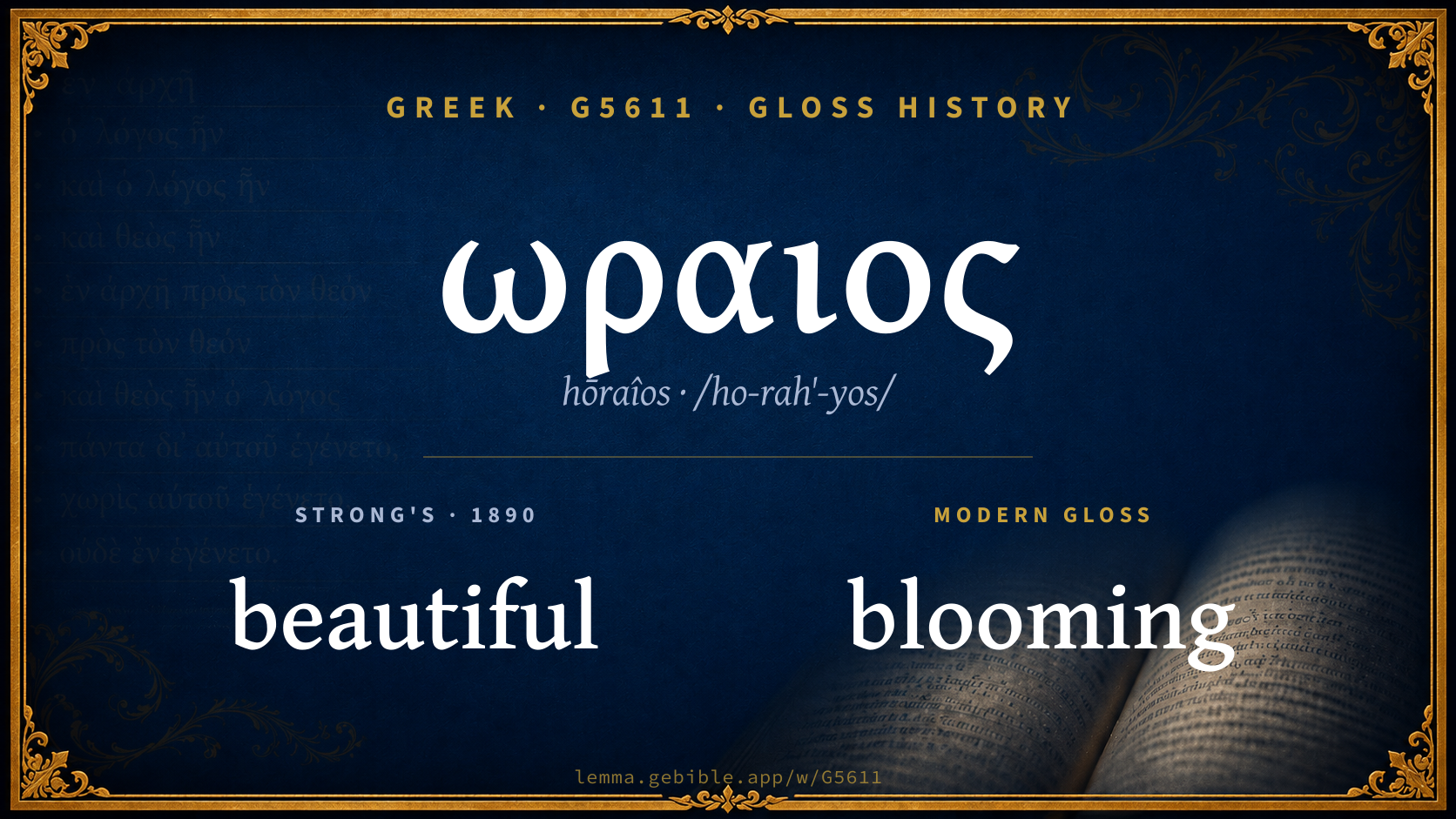
Strong's 1890 vs modern scholarship
About this word
Strong's G5611 catalogs a Greek word from the Greek New Testament.
These counts are not copied from any lexicon or concordance. They are computed here, from the morphology-tagged Greek New Testament. What Lemma adds →
- 4
- distinct verses
- The word appears in 4 distinct verses.
- 3 / 27
- NT books
- The word appears in 3 of 27 New Testament books.
- #1,877
- by frequency
- Top 2500 most frequent Greek words (rank 1,877 of 5,347 Greek words by occurrence).
View all 4 occurrences in the concordance →
By section of the New Testament
By traditional corpus
Conventional, traditional groupings — biblical authorship is debated, so this is a traditional corpus grouping, not an authorship claim. Some books belong to more than one corpus (Luke is in both the Gospels and the Lukan corpus, and so on), so these shares overlap and need not total 100%. Each figure is a share of the word’s 4 distinct verses.
- Lukan (Luke–Acts) 2 verses · 50%
- Gospels 1 verse · 25%
- Pauline corpus 1 verse · 25%
How translations render this word
Counts come from each version’s own published word-to-Strong’s tagging or interlinear alignment — an approximate guide to how each version renders this word, not a word-level alignment the data otherwise carries. Because each total is that version’s own tagged count, the per-version totals vary from one another and need not match the appearance or distinct-verse counts above. These counts may also differ from a printed concordance because Lemma counts each distinctly tagged rendering and does not collapse phrase taggings into a single head-word total. This is a fixed set of word-tagged versions (KJV, ASV, BSB, ULT) and does not change with the reading translation you choose elsewhere. Each version’s license is shown beside its name below (and on Sources).
- King James Version: Beautiful 4×
- American Standard Version: Beautiful 4×
- Berean Standard Bible: Beautiful 4×
- unfoldingWord Literal Text: Beautiful 4×
King James Version Public Domain
Renders G5611 across 4 tagged occurrences — most commonly:
American Standard Version Public Domain
Renders G5611 across 4 tagged occurrences — most commonly:
Berean Standard Bible Public Domain
Renders G5611 across 4 tagged occurrences — most commonly:
unfoldingWord Literal Text CC BY-SA 4.0
Renders G5611 across 4 tagged occurrences — most commonly:
Senses in Thayer's
The 1 sense Thayer's distinguishes for this word, in lexicon order (not ranked by frequency or importance). The full entry — with sub-senses — is in the Lexicon Entry tab.
- blooming, beautiful (used of the human body)
Word origin
Derived from ωρα (hṓra) (G5610) — hour.
From G5610 ; belonging to the right hour or season ( timely ) that is (by implication) flourishing ( beauteous [figuratively]): - beautiful.
— Strong’s Exhaustive Concordance (1890), public domain.
Forms in the corpus
The 3 distinct written forms G5611 takes in the Greek New Testament, most frequent first — each parse links to that case’s occurrences in the concordance.
| Form | Parsing | Example | Uses |
|---|---|---|---|
| ὡραῖοι hōraîoi | Adjective, Nominative, Plural, Masculine | Matthew 23:27 | 2 |
| ὡραίαν hōraían | Adjective, Accusative, Singular, Feminine | Acts 3:2 | 1 |
| ὡραίᾳ hōraía | Adjective, Dative, Singular, Feminine | Acts 3:10 | 1 |
Same root — word family
Other Thayer's entries built from the same root as G5611, grouped by Strong’s listed origin. These share a root / origin per the lexicon — not necessarily a shared meaning. Each links to that word’s own entry.
Derives from
Shares the same root
Compare all same-root words → They share a root, not necessarily a meaning.
Septuagint usage
The same Greek word ωραιος appears 23 times in the Greek Old Testament (Septuagint), across 23 verses in 13 books.
- 23
- LXX occurrences
- Tagged occurrences of this Greek word in the Septuagint.
- 23
- verses
- Distinct Septuagint verses containing this word.
- 13 / 39
- OT books
- The word appears in 13 of the 39 Old Testament books.
Sample Septuagint occurrences
- Genesis 2:9 ὡραῖος
- Leviticus 23:40 ὡραῖος
- 1 Samuel 9:20 ὡραῖος
- 2 Samuel 1:23 ὡραῖος
- 1 Kings 1:6 ὡραῖος
- 2 Chronicles 36:19 ὡραῖος
- Job 18:13 ὡραῖος
- Psalms 44:3 ὡραῖος
- Song of Solomon 1:16 ὡραῖος
- Isaiah 63:1 ὡραῖος
- Jeremiah 11:16 ὡραῖος
- Lamentations 2:2 ὡραῖος
Septuagint occurrences (same lexeme)
Every verse where the same Strong’s number (G5611) appears in the Greek Septuagint. Verse text shown in the World English Bible for context; the Greek form is the matched word — the English is not keyword-highlighted.
- Genesis 2:9 ὡραῖος Out of the ground Yahweh God made every tree to grow that is pleasant to the sight, and good for food; the tree of life also in the midst of the garden, and the tree of the knowledge of good and evil.
- Genesis 3:6 ὡραῖος When the woman saw that the tree was good for food, and that it was a delight to the eyes, and that the tree was to be desired to make one wise, she took of the fruit of it, and ate; and she gave some to her husband with her, and he ate.
- Genesis 26:7 ὡραῖος The men of the place asked him about his wife. He said, "She is my sister," for he was afraid to say, "My wife," lest, he thought, the men of the place might kill me for Rebekah, because she was beautiful to look on.
- Genesis 29:17 ὡραῖος Leah's eyes were weak, but Rachel was beautiful and well favored.
- Genesis 39:6 ὡραῖος He left all that he had in Joseph's hand. He didn't concern himself with anything, except for the food which he ate. Joseph was well-built and handsome.
- Leviticus 23:40 ὡραῖος You shall take on the first day the fruit of goodly trees, branches of palm trees, and boughs of thick trees, and willows of the brook; and you shall rejoice before Yahweh your God seven days.
- 1 Samuel 9:20 ὡραῖος As for your donkeys who were lost three days ago, don't set your mind on them; for they are found. For whom is all that is desirable in Israel? Is it not for you, and for all your father's house?
- 2 Samuel 1:23 ὡραῖος Saul and Jonathan were lovely and pleasant in their lives, In their death they were not divided: They were swifter than eagles, They were stronger than lions.
- 1 Kings 1:6 ὡραῖος His father had not displeased him at any time in saying, Why have you done so? and he was also a very goodly man; and he was born after Absalom.
- 2 Chronicles 36:19 ὡραῖος They burnt the house of God, and broke down the wall of Jerusalem, and burnt all the palaces of it with fire, and destroyed all the goodly vessels of it.
- Job 18:13 ὡραῖος The members of his body shall be devoured, The firstborn of death shall devour his members.
- Psalms 44:3 ὡραῖος For they didn't get the land in possession by their own sword, Neither did their own arm save them; But your right hand, and your arm, and the light of your face, Because you were favorable to them.
- Psalms 64:13 ὡραῖος
- Song of Solomon 1:16 ὡραῖος Behold, you are beautiful, my beloved, yes, pleasant; And our couch is verdant. Lover
- Song of Solomon 2:14 ὡραῖος My dove in the clefts of the rock, In the hiding places of the mountainside, Let me see your face. Let me hear your voice; For your voice is sweet, and your face is lovely.
- Song of Solomon 4:3 ὡραῖος Your lips are like scarlet thread. Your mouth is lovely. Your temples are like a piece of a pomegranate behind your veil.
- Song of Solomon 6:4 ὡραῖος You are beautiful, my love, as Tirzah, Lovely as Jerusalem, Awesome as an army with banners.
- Song of Solomon 6:7 ὡραῖος Your temples are like a piece of a pomegranate behind your veil.
- Isaiah 63:1 ὡραῖος Who is this who comes from Edom, with dyed garments from Bozrah? this who is glorious in his clothing, marching in the greatness of his strength? I who speak in righteousness, mighty to save.
- Jeremiah 11:16 ὡραῖος Yahweh called your name, A green olive tree, beautiful with goodly fruit: with the noise of a great tumult he has kindled fire on it, and the branches of it are broken.
- Lamentations 2:2 ὡραῖος The Lord has swallowed up all the habitations of Jacob, and has not pitied: He has thrown down in his wrath the strongholds of the daughter of Judah; He has brought them down to the ground; he has profaned the kingdom and the princes of it.
- Joel 1:19 ὡραῖος Yahweh, I cry to you, For the fire has devoured the pastures of the wilderness, And the flame has burned all the trees of the field.
- Joel 1:20 ὡραῖος Yes, the animals of the field pant to you, For the water brooks have dried up, And the fire has devoured the pastures of the wilderness.
These are occurrences of the same Greek lexeme (G5611) in the Septuagint — not a translation of any one Hebrew word. The store carries no word-level Hebrew↔Greek alignment, so no Hebrew original is asserted here. Counts come from the recovered LXX Strong's tagging — high-frequency vocabulary is well covered, while rare or late forms may be untagged — so they reflect tagged occurrences and may slightly undercount.