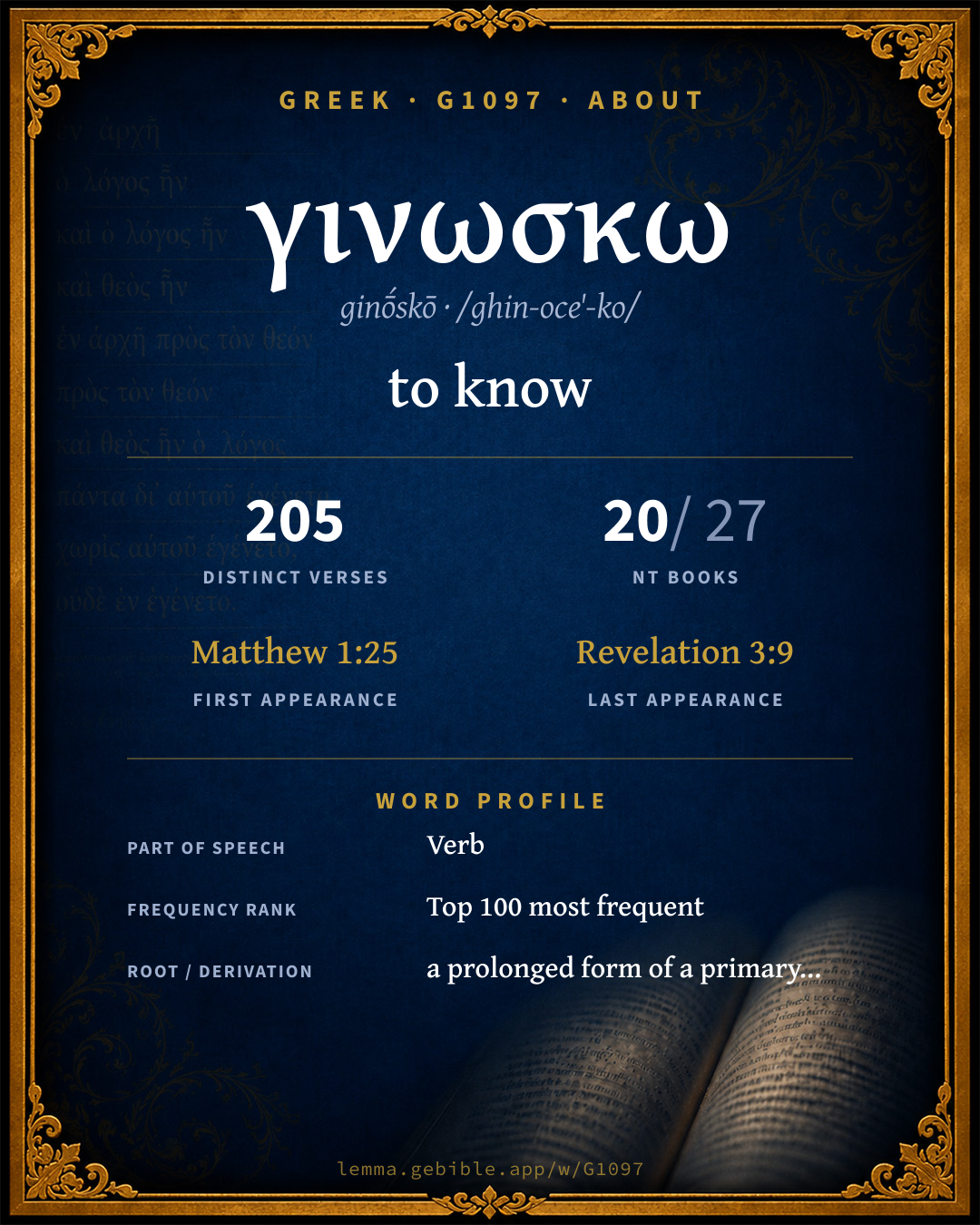
γινώσκω
to know
‘to know’ is one of 4 main senses fuller range ↓
Full lexicon entry — Thayer's Greek Lexicon
From Thayer's Greek Lexicon
Where this word appears
See every Aorist-tense verb in the Greek New Testament →
Grammar key — what these labels mean
Part of speech
- Verb
- An action or state-of-being word.
Tense
- Aorist
- Action viewed as a simple whole, without regard to duration — often past (perfective aspect).
- Present
- Ongoing or general action in present time (imperfective aspect).
- Future
- Action expected in future time.
- Perfect
- A completed past action with continuing present results.
- Imperfect
- Continuous or repeated action in past time (“was writing”).
- Pluperfect
- A past action completed before another past point (“had written”).
Voice
- Active
- The subject performs the action.
- Middle deponent
- Middle in form but active in meaning.
- Passive
- The subject receives the action.
Mood
- Indicative
- States a fact or asks a factual question (the mood of reality).
- Infinitive
- A verbal noun (“to write”), unmarked for person or number.
- Participle
- A verbal adjective (“writing,” “having written”).
- Subjunctive
- Expresses probability, purpose, or possibility (the mood of contingency).
- Imperative
- Expresses a command or request.
Case
- Nominative
- The case of the subject (and the predicate nominative).
- Accusative
- The case of the direct object and of extent.
- Dative
- The case of the indirect object, means, or location — “to / for / with / in.”
Person
- 3rd person
- The one spoken about (“he / she / it / they”).
- 2nd person
- The one addressed (“you”).
- 1st person
- The speaker (“I / we”).
Gender
- Masculine
- Grammatically masculine.
- Feminine
- Grammatically feminine.
Number
- Plural
- More than one.
- Singular
- One.
20 verses where G1097 appears in the Aorist tense in the Book of John. Filtered view — show all forms. Click any verse to open its interlinear word-by-word view. Verse text shown in the World English Bible for context — . Each verse’s Greek form is shown with its reference; the English is not keyword-highlighted, since the data carries no word-level English alignment. Use “Compare translations” on any verse to read it across multiple English versions. This concordance covers the Greek New Testament; Septuagint (Greek Old Testament) occurrences of this word are not indexed here.
John
- John 1:10 ἔγνω aor act ind 3sg He was in the world, and the world was made through him, and the world didn't recognize him.
- John 4:1 ἔγνω aor act ind 3sg Therefore when the Lord knew that the Pharisees had heard that Jesus was making and baptizing more disciples than John
- John 4:53 ἔγνω aor act ind 3sg So the father knew that it was at that hour in which Jesus said to him, "Your son lives." He believed, as did his whole house.
- John 5:6 γνοὺς aor act ptcp nom sg masc When Jesus saw him lying there, and knew that he had been sick for a long time, he asked him, "Do you want to be made well?"
- John 6:15 γνοὺς aor act ptcp nom sg masc Jesus therefore, perceiving that they were about to come and take him by force, to make him king, withdrew again to the mountain by himself.
- John 7:26 ἔγνωσαν aor act ind 3pl Behold, he speaks openly, and they say nothing to him. Can it be that the rulers indeed know that this is truly the Christ?
- John 7:51 γνῷ aor act subj 3sg "Does our law judge a man, unless it first hears from him personally and knows what he does?"
- John 8:27 ἔγνωσαν aor act ind 3pl They didn't understand that he spoke to them about the Father.
- John 10:6 ἔγνωσαν aor act ind 3pl Jesus spoke this parable to them, but they didn't understand what he was telling them.
- John 10:38 γνῶτε γινώσκητε aor act subj 2pl pres act subj 2pl But if I do them, though you don't believe me, believe the works; that you may know and believe that the Father is in me, and I in the Father."
- John 11:57 γνῷ aor act subj 3sg Now the chief priests and the Pharisees had commanded that if anyone knew where he was, he should report it, that they might seize him.
- John 12:9 Ἔγνω aor act ind 3sg A large crowd therefore of the Jews learned that he was there, and they came, not for Jesus' sake only, but that they might see Lazarus also, whom he had raised from the dead.
- John 12:16 ἔγνωσαν aor act ind 3pl His disciples didn't understand these things at first, but when Jesus was glorified, then they remembered that these things were written about him, and that they had done these things to him.
- John 13:28 ἔγνω aor act ind 3sg Now no man at the table knew why he said this to him.
- John 14:31 γνῷ aor act subj 3sg But that the world may know that I love the Father, and as the Father commanded me, even so I do. Arise, let us go from here.
- John 16:3 ἔγνωσαν aor act ind 3pl They will do these things because they have not known the Father, nor me.
- John 16:19 ἔγνω aor act ind 3sg Therefore Jesus perceived that they wanted to ask him, and he said to them, "Do you inquire among yourselves concerning this, that I said, 'A little while, and you won't see me, and again a little while, and you will see me?'
- John 17:8 ἔγνωσαν aor act ind 3pl for the words which you have given me I have given to them, and they received them, and knew for sure that I came forth from you, and they have believed that you sent me.
- John 17:25 ἔγνω ἔγνων ἔγνωσαν aor act ind 3sg aor act ind 1sg aor act ind 3pl Righteous Father, the world hasn't known you, but I knew you; and these knew that you sent me.
- John 19:4 γνῶτε aor act subj 2pl Then Pilate went out again, and said to them, "Behold, I bring him out to you, that you may know that I find no basis for a charge against him."
About this entry
At a glance — auto-summarized from this page’s data, not written by a person. Every figure links to its source below. This summary describes the numbers; it doesn’t interpret them.
The Greek verb γινωσκω centers on the idea of “to know.” One archaism survives in the King James Version — “knoweth” — where modern Bibles read “know”; see the renderings breakdown. The Greek New Testament uses it across 205 verses — common. First canonically at Matthew 1:25, it enters the text early. Lexicons map it across 4 senses. Dig into 205-verse concordance and the renderings breakdown below.
Gloss history
Strong's 1890 vs modern scholarship

About this word
Strong's G1097 catalogs a Greek word from the Greek New Testament.
These counts are not copied from any lexicon or concordance. They are computed here, from the morphology-tagged Greek New Testament. What Lemma adds →
- 205
- distinct verses
- The word appears in 205 distinct verses.
- 20 / 27
- NT books
- The word appears in 20 of 27 New Testament books.
- #72
- by frequency
- Top 100 most frequent Greek words (rank 72 of 5,347 Greek words by occurrence).
View all 205 occurrences in the concordance →
By section of the New Testament
By traditional corpus
Conventional, traditional groupings — biblical authorship is debated, so this is a traditional corpus grouping, not an authorship claim. Some books belong to more than one corpus (Luke is in both the Gospels and the Lukan corpus, and so on), so these shares overlap and need not total 100%. Each figure is a share of the word’s 205 distinct verses.
- Gospels 109 verses · 53%
- Johannine 75 verses · 37%
- Pauline corpus 45 verses · 22%
- Lukan (Luke–Acts) 44 verses · 21%
- General (Catholic) Epistles 27 verses · 13%
- Hebrews 4 verses · 2%
- Revelation 4 verses · 2%
How translations render this word
Counts come from each version’s own published word-to-Strong’s tagging or interlinear alignment — an approximate guide to how each version renders this word, not a word-level alignment the data otherwise carries. Because each total is that version’s own tagged count, the per-version totals vary from one another and need not match the appearance or distinct-verse counts above. These counts may also differ from a printed concordance because Lemma counts each distinctly tagged rendering and does not collapse phrase taggings into a single head-word total. This is a fixed set of word-tagged versions (KJV, ASV, BSB, ULT) and does not change with the reading translation you choose elsewhere. Each version’s license is shown beside its name below (and on Sources).
- King James Version: Know 33×, Knew 21×, Knoweth 14×
- American Standard Version: Know 40×, Knew 16×, Knoweth 16×
- Berean Standard Bible: Know 31×, Knows 10×, Understand 10×
- unfoldingWord Literal Text: Know 59×, You know 11×, Knew 9×
King James Version Public Domain
Renders G1097 across 244 tagged occurrences — most commonly:
Plus other, less common renderings. Plus 58 renderings that appear only once — usually multi-word phrases or single function words the recovered tagging swept in, not distinct renderings. Not rendered by a distinct English word in 2 further occurrences.
American Standard Version Public Domain
Renders G1097 across 242 tagged occurrences — most commonly:
Plus other, less common renderings. Plus 63 renderings that appear only once — usually multi-word phrases or single function words the recovered tagging swept in, not distinct renderings.
Berean Standard Bible Public Domain
Renders G1097 across 220 tagged occurrences — most commonly:
Plus other, less common renderings. Plus 76 renderings that appear only once — usually multi-word phrases or single function words the recovered tagging swept in, not distinct renderings. Not rendered by a distinct English word in 1 further occurrence.
unfoldingWord Literal Text CC BY-SA 4.0
Renders G1097 across 277 tagged occurrences — most commonly:
Plus other, less common renderings. Plus 65 renderings that appear only once — usually multi-word phrases or single function words the recovered tagging swept in, not distinct renderings.
Senses in Thayer's
The 4 senses Thayer's distinguishes for this word, in lexicon order (not ranked by frequency or importance). The full entry — with sub-senses — is in the Lexicon Entry tab.
- to learn to know, come to know, get a knowledge of perceive, feel
- to know, understand, perceive, have knowledge of
- Jewish idiom for sexual intercourse between a man and a woman
- to become acquainted with, to know
Word origin
Origin: a prolonged form of a primary verb
A prolonged form of a primary verb; to know (absolutely) in a great variety of applications and with many implications (as shown at left with others not thus clearly expressed): - allow be aware (of) feel (have) known (-ledge) perceive be resolved can speak be sure understand.
— Strong’s Exhaustive Concordance (1890), public domain.
Forms in the corpus
The 60 distinct written forms G1097 takes in the Greek New Testament, most frequent first — each parse links to that tense’s occurrences in the concordance.
Same root — word family
Other Thayer's entries built from the same root as G1097, grouped by Strong’s listed origin. These share a root / origin per the lexicon — not necessarily a shared meaning. Each links to that word’s own entry.
Derived from this word
- γνωμη gnṓmē G1106 mind
- γνωριζω gnōrízō G1107 to make known
- γνωσις gnōsis G1108 knowledge
- γνωστης gnṓstēs G1109 expert
- γνωστος gnōstós G1110 known
- νους noûs G3563 mind
- ονομα ónoma G3686 name
Compare all same-root words → Showing 4 of 8 — not the complete family. They share a root, not necessarily a meaning.
Septuagint usage
The same Greek word γινωσκω appears 579 times in the Greek Old Testament (Septuagint), across 541 verses in 33 books.
- 579
- LXX occurrences
- Tagged occurrences of this Greek word in the Septuagint.
- 541
- verses
- Distinct Septuagint verses containing this word.
- 33 / 39
- OT books
- The word appears in 33 of the 39 Old Testament books.
Sample Septuagint occurrences
- Genesis 2:17 γιγνώσκω
- Exodus 2:25 γιγνώσκω
- Leviticus 4:14 γιγνώσκω
- Numbers 11:23 γιγνώσκω
- Deuteronomy 4:39 γιγνώσκω
- Joshua 3:7 γιγνώσκω
- Judges 2:7 γιγνώσκω
- Ruth 3:4 γιγνώσκω
- 1 Samuel 1:19 γιγνώσκω
- 2 Samuel 3:25 γιγνώσκω
- 1 Kings 1:4 γιγνώσκω
- 2 Kings 2:3 γιγνώσκω
Septuagint occurrences (same lexeme)
Every verse where the same Strong’s number (G1097) appears in the Greek Septuagint — showing the first 50 of 541. Verse text shown in the World English Bible for context; the Greek form is the matched word — the English is not keyword-highlighted.
- Genesis 2:17 γιγνώσκω but of the tree of the knowledge of good and evil, you shall not eat of it: for in the day that you eat of it you will surely die."
- Genesis 3:5 γιγνώσκω for God knows that in the day you eat it, your eyes will be opened, and you will be like God, knowing good and evil."
- Genesis 3:7 γιγνώσκω Both of their eyes were opened, and they knew that they were naked. They sewed fig leaves together, and made themselves aprons.
- Genesis 3:22 γιγνώσκω Yahweh God said, "Behold, the man has become like one of us, knowing good and evil. Now, lest he put forth his hand, and also take of the tree of life, and eat, and live forever..."
- Genesis 4:1 γιγνώσκω The man knew Eve his wife. She conceived, and gave birth to Cain, and said, "I have gotten a man with Yahweh's help."
- Genesis 4:9 γιγνώσκω Yahweh said to Cain, "Where is Abel, your brother?" He said, "I don't know. Am I my brother's keeper?"
- Genesis 4:17 γιγνώσκω Cain knew his wife. She conceived, and gave birth to Enoch. He built a city, and called the name of the city, after the name of his son, Enoch.
- Genesis 4:25 γιγνώσκω Adam knew his wife again. She gave birth to a son, and named him Seth. For, she said, "God has appointed me another child instead of Abel, for Cain killed him."
- Genesis 8:11 γιγνώσκω The dove came back to him at evening, and, behold, in her mouth was an olive leaf plucked off. So Noah knew that the waters were abated from off the earth.
- Genesis 9:24 γιγνώσκω Noah awoke from his wine, and knew what his youngest son had done to him.
- Genesis 12:11 γιγνώσκω It happened, when he was come near to enter into Egypt, that he said to Sarai his wife, "See now, I know that you are a beautiful woman to look on.
- Genesis 15:8 γιγνώσκω He said, "Lord Yahweh, how will I know that I will inherit it?"
- Genesis 15:13 γιγνώσκω He said to Abram, "Know for sure that your seed will live as foreigners in a land that is not theirs, and will serve them. They will afflict them four hundred years.
- Genesis 18:21 γιγνώσκω I will go down now, and see whether they have done altogether according to the cry of it, which is come to me. If not, I will know."
- Genesis 19:8 γιγνώσκω See now, I have two virgin daughters. Please let me bring them out to you, and do you to them as is good in your eyes. Only don't do anything to these men, because they have come under the shadow of my roof."
- Genesis 20:6 γιγνώσκω God said to him in the dream, "Yes, I know that in the integrity of your heart you have done this, and I also withheld you from sinning against me. Therefore I didn't allow you to touch her.
- Genesis 20:7 γιγνώσκω Now therefore, restore the man's wife. For he is a prophet, and he will pray for you, and you will live. If you don't restore her, know for sure that you will die, you, and all who are yours."
- Genesis 21:26 γιγνώσκω Abimelech said, "I don't know who has done this thing. Neither did you tell me, neither did I hear of it, until today."
- Genesis 22:12 γιγνώσκω He said, "Don't lay your hand on the boy, neither do anything to him. For now I know that you fear God, seeing you have not withheld your son, your only son, from me."
- Genesis 24:14 γιγνώσκω Let it happen, that the young lady to whom I will say, 'Please let down your pitcher, that I may drink.' She will say, 'Drink, and I will also give your camels a drink.' Let the same be she who you have appointed for your servant Isaac. Thereby will I know that you have shown kindness to my master."
- Genesis 24:16 γιγνώσκω The young lady was very beautiful to look at, a virgin, neither had any man known her. She went down to the spring, filled her pitcher, and came up.
- Genesis 24:21 γιγνώσκω The man looked steadfastly at her, holding his peace, to know whether Yahweh had made his journey prosperous or not.
- Genesis 24:44 γιγνώσκω She will tell me, "Drink, and I will also draw for your camels." Let the same be the woman whom Yahweh has appointed for my master's son.'
- Genesis 27:2 γιγνώσκω He said, "See now, I am old. I don't know the day of my death.
- Genesis 29:5 γιγνώσκω He said to them, "Do you know Laban, the son of Nahor?" They said, "We know him."
- Genesis 30:26 γιγνώσκω Give me my wives and my children for whom I have served you, and let me go: for you know my service with which I have served you."
- Genesis 30:29 γιγνώσκω He said to him, "You know how I have served you, and how your cattle have fared with me.
- Genesis 33:13 γιγνώσκω Jacob said to him, "My lord knows that the children are tender, and that the flocks and herds with me have their young, and if they overdrive them one day, all the flocks will die.
- Genesis 38:9 γιγνώσκω Onan knew that the seed wouldn't be his; and it happened, when he went in to his brother's wife, that he spilled it on the ground, lest he should give seed to his brother.
- Genesis 38:16 γιγνώσκω He turned to her by the way, and said, "Please come, let me come in to you:" for he didn't know that she was his daughter-in-law. She said, "What will you give me, that you may come in to me?"
- Genesis 38:26 γιγνώσκω Judah acknowledged them, and said, "She is more righteous than I, because I didn't give her to Shelah, my son." He knew her again no more.
- Genesis 39:8 γιγνώσκω But he refused, and said to his master's wife, "Behold, my master doesn't know what is with me in the house, and he has put all that he has into my hand.
- Genesis 39:23 γιγνώσκω The keeper of the prison didn't look after anything that was under his hand, because Yahweh was with him; and that which he did, Yahweh made it prosper.
- Genesis 42:33 γιγνώσκω The man, the lord of the land, said to us, 'Hereby will I know that you are honest men. Leave one of your brothers with me, and take grain for the famine of your houses, and go your way.
- Genesis 42:34 γιγνώσκω Bring your youngest brother to me. Then I will know that you are not spies, but that you are honest men. So I will deliver your brother to you, and you shall trade in the land.'"
- Genesis 44:27 γιγνώσκω Your servant, my father, said to us, 'You know that my wife bore me two sons:
- Exodus 2:25 γιγνώσκω God saw the children of Israel, and God was concerned about them.
- Exodus 6:7 γιγνώσκω and I will take you to me for a people, and I will be to you a God; and you shall know that I am Yahweh your God, who brings you out from under the burdens of the Egyptians.
- Exodus 7:5 γιγνώσκω The Egyptians shall know that I am Yahweh, when I stretch forth my hand on Egypt, and bring out the children of Israel from among them."
- Exodus 7:17 γιγνώσκω Thus says Yahweh, "In this you shall know that I am Yahweh. Behold, I will strike with the rod that is in my hand on the waters which are in the river, and they shall be turned to blood.
- Exodus 9:29 γιγνώσκω Moses said to him, "As soon as I have gone out of the city, I will spread abroad my hands to Yahweh. The thunders shall cease, neither shall there be any more hail; that you may know that the earth is Yahweh's.
- Exodus 10:2 γιγνώσκω and that you may tell in the hearing of your son, and of your son's son, what things I have done to Egypt, and my signs which I have done among them; that you may know that I am Yahweh."
- Exodus 14:4 γιγνώσκω I will harden Pharaoh's heart, and he will follow after them; and I will get honor over Pharaoh, and over all his host; and the Egyptians shall know that I am Yahweh." They did so.
- Exodus 14:18 γιγνώσκω The Egyptians shall know that I am Yahweh, when I have gotten myself honor over Pharaoh, over his chariots, and over his horsemen."
- Exodus 16:6 γιγνώσκω Moses and Aaron said to all the children of Israel, "At evening, then you shall know that Yahweh has brought you out from the land of Egypt;
- Exodus 16:12 γιγνώσκω "I have heard the murmurings of the children of Israel. Speak to them, saying, 'At evening you shall eat meat, and in the morning you shall be filled with bread: and you shall know that I am Yahweh your God.'"
- Exodus 18:11 γιγνώσκω Now I know that Yahweh is greater than all gods because of the thing in which they dealt arrogantly against them."
- Exodus 22:9 γιγνώσκω For every matter of trespass, whether it be for ox, for donkey, for sheep, for clothing, or for any kind of lost thing, about which one says, 'This is mine,' the cause of both parties shall come before God. He whom God condemns shall pay double to his neighbor.
- Exodus 25:22 γιγνώσκω There I will meet with you, and I will tell you from above the mercy seat, from between the two cherubim which are on the ark of the testimony, all that I command you for the children of Israel.
- Exodus 29:42 γιγνώσκω It shall be a continual burnt offering throughout your generations at the door of the tent of meeting before Yahweh, where I will meet with you, to speak there to you.
These are occurrences of the same Greek lexeme (G1097) in the Septuagint — not a translation of any one Hebrew word. The store carries no word-level Hebrew↔Greek alignment, so no Hebrew original is asserted here. Counts come from the recovered LXX Strong's tagging — high-frequency vocabulary is well covered, while rare or late forms may be untagged — so they reflect tagged occurrences and may slightly undercount.