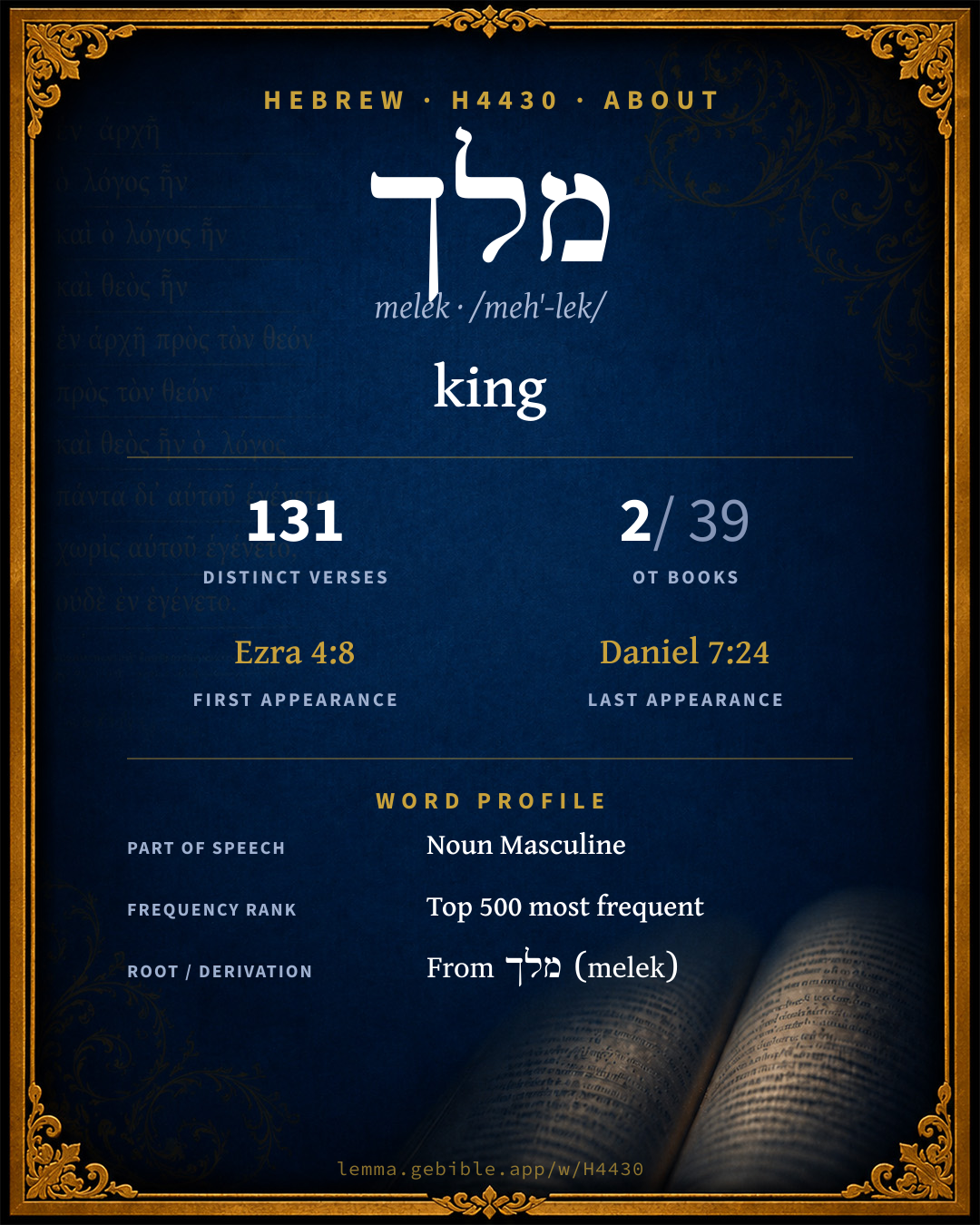
מֶ֫לֶךְ
king
Full lexicon entry — Brown-Driver-Briggs (BDB)
From Brown-Driver-Briggs (BDB)
Where this word appears
See every Absolute-state word in the Hebrew Bible →
Grammar key — what these labels mean
Part of speech
- Noun
- A naming word — a person, place, thing, or idea.
Noun type
- Common
- A common noun — a general class of person, place, or thing (“king,” “city,” “water”), not a specific name.
State
- Absolute
- The independent form of a noun, not bound to a following word.
- Construct
- A noun bound to a following noun in a possessive / “of” relationship (the construct chain).
Gender
- Masculine
- Grammatically masculine.
Number
- Plural
- More than one (in Hebrew, generally three or more).
- Singular
- One.
Grammatical forms
- Particle, Definite Article 158 times (88%)
- Noun, Common, Masculine, Plural, Absolute 11 times (6%)
- Noun, Common, Masculine, Singular, Construct 8 times (4%)
- Noun, Common, Masculine, Singular, Absolute 3 times (2%)
Parsed forms decoded from the imported morphology (morphhb / Westminster Leningrad Codex — WLC text public domain, morphhb tagging CC BY 4.0), counted across 180 parsed occurrences — not distinct verses.
Every verse where H4430 appears — 131 distinct verses across 2 books. Click any verse to open its interlinear word-by-word view. Verse text shown in the World English Bible for context — . Each verse’s Hebrew form is shown with its reference; the English is not keyword-highlighted, since the data carries no word-level English alignment. Use “Compare translations” on any verse to read it across multiple English versions. This concordance covers the Hebrew Bible; Septuagint (Greek Old Testament) occurrences are not indexed here.
Ezra 37 verses
- Ezra 4:8 מַלְכָּ֖/א n c ms det + ptcl def.art Rehum the chancellor and Shimshai the scribe wrote a letter against Jerusalem to Artaxerxes the king in this sort:
- Ezra 4:11 מַלְכָּ֑/א n c ms det + ptcl def.art This is the copy of the letter that they sent to Artaxerxes the king: Your servants the men beyond the River, and so forth.
- Ezra 4:12 לְ/מַלְכָּ֔/א prep + n c ms det + ptcl def.art Be it known to the king, that the Jews who came up from you are come to us to Jerusalem; they are building the rebellious and the bad city, and have finished the walls, and repaired the foundations.
- Ezra 4:13 לְ/מַלְכָּ֔/א מַלְכִ֖ים prep + n c ms det + ptcl def.art n c mp Be it known now to the king that if this city is built, and the walls finished, they will not pay tribute, custom, or toll, and in the end it will be hurtful to the kings.
- Ezra 4:14 מַלְכָּ֔/א לְ/מַלְכָּֽ/א n c ms det + ptcl def.art ptcl do + n c ms det + ptcl def.art Now because we eat the salt of the palace, and it is not appropriate for us to see the king's dishonor, therefore have we sent and informed the king;
- Ezra 4:15 מַלְכִין֙ n c mp that search may be made in the book of the records of your fathers: so shall you find in the book of the records, and know that this city is a rebellious city, and hurtful to kings and provinces, and that they have moved sedition within the same of old time; for which cause was this city laid waste.
- Ezra 4:16 לְ/מַלְכָּ֔/א ptcl do + n c ms det + ptcl def.art We inform the king that, if this city be built, and the walls finished, by this means you shall have no portion beyond the River.
- Ezra 4:17 מַלְכָּ֗/א n c ms det + ptcl def.art [Then] sent the king an answer to Rehum the chancellor, and to Shimshai the scribe, and to the rest of their companions who dwell in Samaria, and in the rest [of the country] beyond the River: Peace, and so forth.
- Ezra 4:19 מַלְכִ֖ין n c mp I decreed, and search has been made, and it is found that this city of old time has made insurrection against kings, and that rebellion and sedition have been made therein.
- Ezra 4:20 וּ/מַלְכִ֣ין conj + n c mp There have been mighty kings also over Jerusalem, who have ruled over all [the country] beyond the River; and tribute, custom, and toll, was paid to them.
- Ezra 4:22 מַלְכִֽין n c mp Take heed that you not be slack herein: why should damage grow to the hurt of the kings?
- Ezra 4:23 מַלְכָּ֔/א n c ms det + ptcl def.art Then when the copy of king Artaxerxes' letter was read before Rehum, and Shimshai the scribe, and their companions, they went in haste to Jerusalem to the Jews, and made them to cease by force and power.
- Ezra 4:24 מֶֽלֶךְ n c ms cs Then ceased the work of the house of God which is at Jerusalem; and it ceased until the second year of the reign of Darius king of Persia.
- Ezra 5:6 מַלְכָּֽ/א n c ms det + ptcl def.art The copy of the letter that Tattenai, the governor beyond the River, and Shetharbozenai, and his companions the Apharsachites, who were beyond the River, sent to Darius the king;
- Ezra 5:7 מַלְכָּ֖/א n c ms det + ptcl def.art they sent a letter to him, in which was written thus: To Darius the king, all peace.
- Ezra 5:8 לְ/מַלְכָּ֗/א prep + n c ms det + ptcl def.art Be it known to the king, that we went into the province of Judah, to the house of the great God, which is built with great stones, and timber is laid in the walls; and this work goes on with diligence and prospers in their hands.
- Ezra 5:11 וּ/מֶ֤לֶךְ conj + n c ms Thus they returned us answer, saying, We are the servants of the God of heaven and earth, and are building the house that was built these many years ago, which a great king of Israel built and finished.
- Ezra 5:12 מֶֽלֶךְ n c ms cs But after that our fathers had provoked the God of heaven to wrath, he gave them into the hand of Nebuchadnezzar king of Babylon, the Chaldean, who destroyed this house, and carried the people away into Babylon.
- Ezra 5:13 מַלְכָּ֖/א מַלְכָּ/א֙ n c ms det + ptcl def.art n c ms det + ptcl def.art But in the first year of Cyrus king of Babylon, Cyrus the king made a decree to build this house of God.
- Ezra 5:14 מַלְכָּ֗/א n c ms det + ptcl def.art The gold and silver vessels also of the house of God, which Nebuchadnezzar took out of the temple that was in Jerusalem, and brought into the temple of Babylon, those did Cyrus the king take out of the temple of Babylon, and they were delivered to one whose name was Sheshbazzar, whom he had made governor;
- Ezra 5:17 מַלְכָּ֣/א מַלְכָּ֣/א מַלְכָּ/א֙ מַלְכָּ֛/א n c ms det + ptcl def.art n c ms det + ptcl def.art n c ms det + ptcl def.art n c ms det + ptcl def.art Now therefore, if it seem good to the king, let there be search made in the king's treasure-house, which is there at Babylon, whether it be so, that a decree was made of Cyrus the king to build this house of God at Jerusalem; and let the king send his pleasure to us concerning this matter.
- Ezra 6:1 מַלְכָּ֖/א n c ms det + ptcl def.art Then Darius the king made a decree, and search was made in the house of the archives, where the treasures were laid up in Babylon.
- Ezra 6:3 מַלְכָּ֗/א מַלְכָּ/א֮ n c ms det + ptcl def.art n c ms det + ptcl def.art In the first year of Cyrus the king, Cyrus the king made a decree: Concerning the house of God at Jerusalem, let the house be built, the place where they offer sacrifices, and let the foundations of it be strongly laid; the height of it sixty cubits, and the breadth of it sixty cubits;
- Ezra 6:4 מַלְכָּ֖/א n c ms det + ptcl def.art with three courses of great stones, and a course of new timber: and let the expenses be given out of the king's house.
- Ezra 6:8 מַלְכָּ֗/א n c ms det + ptcl def.art Moreover I make a decree what you shall do to these elders of the Jews for the building of this house of God: that of the king's goods, even of the tribute beyond the River, expenses be given with all diligence to these men, that they be not hindered.
- Ezra 6:10 מַלְכָּ֖/א n c ms det + ptcl def.art that they may offer sacrifices of sweet savor to the God of heaven, and pray for the life of the king, and of his sons.
- Ezra 6:12 מֶ֤לֶךְ n c ms and the God who has caused his name to dwell there overthrow all kings and peoples who shall put forth their hand to alter [the same], to destroy this house of God which is at Jerusalem. I Darius have made a decree; let it be done with all diligence.
- Ezra 6:13 מַלְכָּ֛/א n c ms det + ptcl def.art Then Tattenai, the governor beyond the River, Shetharbozenai, and their companions, because that Darius the king had sent, did accordingly with all diligence.
- Ezra 6:14 מֶ֥לֶךְ n c ms cs The elders of the Jews built and prospered, through the prophesying of Haggai the prophet and Zechariah the son of Iddo. They built and finished it, according to the commandment of the God of Israel, and according to the decree of Cyrus, and Darius, and Artaxerxes king of Persia.
- Ezra 6:15 מַלְכָּֽ/א n c ms det + ptcl def.art This house was finished on the third day of the month Adar, which was in the sixth year of the reign of Darius the king.
- Ezra 7:12 מֶ֖לֶךְ מַלְכַיָּ֑/א n c ms cs n c mp det + ptcl def.art Artaxerxes, king of kings, to Ezra the priest, the scribe of the law of the God of heaven, perfect and so forth.
- Ezra 7:14 מַלְכָּ֜/א n c ms det + ptcl def.art Because you are sent of the king and his seven counselors, to inquire concerning Judah and Jerusalem, according to the law of your God which is in your hand,
- Ezra 7:15 מַלְכָּ֣/א n c ms det + ptcl def.art and to carry the silver and gold, which the king and his counselors have freely offered to the God of Israel, whose habitation is in Jerusalem,
- Ezra 7:20 מַלְכָּֽ/א n c ms det + ptcl def.art Whatever more shall be needful for the house of your God, which you shall have occasion to bestow, bestow it out of the king's treasure-house.
- Ezra 7:21 מַלְכָּ/א֙ n c ms det + ptcl def.art I, even I Artaxerxes the king, do make a decree to all the treasurers who are beyond the River, that whatever Ezra the priest, the scribe of the law of the God of heaven, shall require of you, it be done with all diligence,
- Ezra 7:23 מַלְכָּ֖/א n c ms det + ptcl def.art Whatever is commanded by the God of heaven, let it be done exactly for the house of the God of heaven; for why should there be wrath against the realm of the king and his sons?
- Ezra 7:26 מַלְכָּ֔/א n c ms det + ptcl def.art Whoever will not do the law of your God, and the law of the king, let judgment be executed on him with all diligence, whether it be to death, or to banishment, or to confiscation of goods, or to imprisonment.
Daniel 94 verses
- Daniel 2:4 מַלְכָּ/א֙ n c ms det + ptcl def.art Then spoke the Chaldeans to the king in the Syrian language, O king, live forever: tell your servants the dream, and we will show the interpretation.
- Daniel 2:5 מַלְכָּ/א֙ n c ms det + ptcl def.art The king answered the Chaldeans, The thing is gone from me: if you don't make known to me the dream and the interpretation of it, you shall be cut in pieces, and your houses shall be made a dunghill.
- Daniel 2:7 מַלְכָּ֕/א n c ms det + ptcl def.art They answered the second time and said, Let the king tell his servants the dream, and we will show the interpretation.
- Daniel 2:8 מַלְכָּ/א֙ n c ms det + ptcl def.art The king answered, I know of a certainty that you would gain time, because you see the thing is gone from me.
- Daniel 2:10 מַלְכָּ/א֙ מַלְכָּ֔/א מֶ֨לֶךְ֙ n c ms det + ptcl def.art n c ms det + ptcl def.art n c ms The Chaldeans answered before the king, and said, There is not a man on the earth who can show the king's matter, because no king, lord, or ruler, has asked such a thing of any magician, or enchanter, or Chaldean.
- Daniel 2:11 מַלְכָּ֤/ה מַלְכָּ֑/א n c ms det + ptcl def.art n c ms det + ptcl def.art It is a rare thing that the king requires, and there is no other who can show it before the king, except the gods, whose dwelling is not with flesh.
- Daniel 2:12 מַלְכָּ֕/א n c ms det + ptcl def.art For this cause the king was angry and very furious, and commanded to destroy all the wise men of Babylon.
- Daniel 2:14 מַלְכָּ֑/א n c ms det + ptcl def.art Then Daniel returned answer with counsel and prudence to Arioch the captain of the king's guard, who was gone forth to kill the wise men of Babylon;
- Daniel 2:15 מַלְכָּ֔/א מַלְכָּ֑/א n c ms det + ptcl def.art n c ms det + ptcl def.art he answered Arioch the king's captain, Why is the decree so urgent from the king? Then Arioch made the thing known to Daniel.
- Daniel 2:16 מַלְכָּ֑/א לְ/מַלְכָּֽ/א n c ms det + ptcl def.art prep + n c ms det + ptcl def.art Daniel went in, and desired of the king that he would appoint him a time, and he would show the king the interpretation.
- Daniel 2:21 מַלְכִ֖ין מַלְכִ֑ין n c mp n c mp He changes the times and the seasons; he removes kings, and sets up kings; he gives wisdom to the wise, and knowledge to those who have understanding;
- Daniel 2:23 מַלְכָּ֖/א n c ms det + ptcl def.art I thank you, and praise you, you God of my fathers, who have given me wisdom and might, and have now made known to me what we desired of you; for you have made known to us the king's matter.
- Daniel 2:24 מַלְכָּ֔/א מַלְכָּ֔/א לְ/מַלְכָּ֥/א n c ms det + ptcl def.art n c ms det + ptcl def.art prep + n c ms det + ptcl def.art Therefore Daniel went in to Arioch, whom the king had appointed to destroy the wise men of Babylon; he went and said thus to him: Don't destroy the wise men of Babylon; bring me in before the king, and I will show to the king the interpretation.
- Daniel 2:25 מַלְכָּ֑/א לְ/מַלְכָּ֥/א n c ms det + ptcl def.art prep + n c ms det + ptcl def.art Then Arioch brought in Daniel before the king in haste, and said thus to him, I have found a man of the children of the captivity of Judah, who will make known to the king the interpretation.
- Daniel 2:26 מַלְכָּ/א֙ n c ms det + ptcl def.art The king answered Daniel, whose name was Belteshazzar, Are you able to make known to me the dream which I have seen, and the interpretation of it?
- Daniel 2:27 מַלְכָּ֖/א מַלְכָּ֣/א לְ/מַלְכָּֽ/א n c ms det + ptcl def.art n c ms det + ptcl def.art prep + n c ms det + ptcl def.art Daniel answered before the king, and said, The secret which the king has demanded can neither wise men, enchanters, magicians, nor soothsayers, show to the king;
- Daniel 2:28 לְ/מַלְכָּ/א֙ prep + n c ms det + ptcl def.art but there is a God in heaven who reveals secrets, and he has made known to the king Nebuchadnezzar what shall be in the latter days. Your dream, and the visions of your head on your bed, are these:
- Daniel 2:29 מַלְכָּ֗/א n c ms det + ptcl def.art as for you, O king, your thoughts came [into your mind] on your bed, what should happen hereafter; and he who reveals secrets has made known to you what shall happen.
- Daniel 2:30 לְ/מַלְכָּ֣/א prep + n c ms det + ptcl def.art But as for me, this secret is not revealed to me for any wisdom that I have more than any living, but to the intent that the interpretation may be made known to the king, and that you may know the thoughts of your heart.
- Daniel 2:31 מַלְכָּ֗/א n c ms det + ptcl def.art You, O king, saw, and, behold, a great image. This image, which was mighty, and whose brightness was excellent, stood before you; and the aspect of it was awesome.
- Daniel 2:36 מַלְכָּֽ/א n c ms det + ptcl def.art This is the dream; and we will tell the interpretation of it before the king.
- Daniel 2:37 מַלְכָּ֔/א מֶ֖לֶךְ מַלְכַיָּ֑/א n c ms det + ptcl def.art n c ms cs n c mp det + ptcl def.art You, O king, are king of kings, to whom the God of heaven has given the kingdom, the power, and the strength, and the glory;
- Daniel 2:44 מַלְכַיָּ֣/א n c mp det + ptcl def.art In the days of those kings shall the God of heaven set up a kingdom which shall never be destroyed, nor shall the sovereignty of it be left to another people; but it shall break in pieces and consume all these kingdoms, and it shall stand forever.
- Daniel 2:45 לְ/מַלְכָּ֔/א prep + n c ms det + ptcl def.art Because you saw that a stone was cut out of the mountain without hands, and that it broke in pieces the iron, the brass, the clay, the silver, and the gold; the great God has made known to the king what shall happen hereafter: and the dream is certain, and the interpretation of it sure.
- Daniel 2:46 מַלְכָּ֤/א n c ms det + ptcl def.art Then the king Nebuchadnezzar fell on his face, and worshiped Daniel, and commanded that they should offer an offering and sweet odors to him.
- Daniel 2:47 מַלְכָּ֨/א מַלְכִ֖ין n c ms det + ptcl def.art n c mp The king answered to Daniel, and said, Of a truth your God is the God of gods, and the Lord of kings, and a revealer of secrets, seeing you have been able to reveal this secret.
- Daniel 2:48 מַלְכָּ֜/א n c ms det + ptcl def.art Then the king made Daniel great, and gave him many great gifts, and made him to rule over the whole province of Babylon, and to be chief governor over all the wise men of Babylon.
- Daniel 2:49 מַלְכָּ֔/א מַלְכָּֽ/א n c ms det + ptcl def.art n c ms det + ptcl def.art Daniel requested of the king, and he appointed Shadrach, Meshach, and Abednego, over the affairs of the province of Babylon: but Daniel was in the gate of the king.
- Daniel 3:1 מַלְכָּ֗/א n c ms det + ptcl def.art Nebuchadnezzar the king made an image of gold, whose height was sixty cubits, and the breadth of it six cubits: he set it up in the plain of Dura, in the province of Babylon.
- Daniel 3:2 מַלְכָּ֡/א מַלְכָּֽ/א n c ms det + ptcl def.art n c ms det + ptcl def.art Then Nebuchadnezzar the king sent to gather together the satraps, the deputies, and the governors, the judges, the treasurers, the counselors, the sheriffs, and all the rulers of the provinces, to come to the dedication of the image which Nebuchadnezzar the king had set up.
- Daniel 3:3 מַלְכָּ֑/א n c ms det + ptcl def.art Then the satraps, the deputies, and the governors, the judges, the treasurers, the counselors, the sheriffs, and all the rulers of the provinces, were gathered together to the dedication of the image that Nebuchadnezzar the king had set up; and they stood before the image that Nebuchadnezzar had set up.
- Daniel 3:5 מַלְכָּֽ/א n c ms det + ptcl def.art that whenever you hear the sound of the horn, flute, zither, lyre, harp, pipe, and all kinds of music, you fall down and worship the golden image that Nebuchadnezzar the king has set up;
- Daniel 3:7 מַלְכָּֽ/א n c ms det + ptcl def.art Therefore at that time, when all the peoples heard the sound of the horn, flute, zither, lyre, harp, pipe, and all kinds of music, all the peoples, the nations, and the languages, fell down and worshiped the golden image that Nebuchadnezzar the king had set up.
- Daniel 3:9 מַלְכָּ֑/א מַלְכָּ֖/א n c ms det + ptcl def.art n c ms det + ptcl def.art They answered Nebuchadnezzar the king, O king, live for ever.
- Daniel 3:10 מַלְכָּ/א֮ n c ms det + ptcl def.art You, O king, have made a decree, that every man that shall hear the sound of the horn, flute, zither, lyre, harp, pipe, and all kinds of music, shall fall down and worship the golden image;
- Daniel 3:12 מַלְכָּ/א֙ n c ms det + ptcl def.art There are certain Jews whom you have appointed over the affairs of the province of Babylon: Shadrach, Meshach, and Abednego; these men, O king, have not regarded you: they don't serve your gods, nor worship the golden image which you have set up.
- Daniel 3:13 מַלְכָּֽ/א n c ms det + ptcl def.art Then Nebuchadnezzar in [his] rage and fury commanded to bring Shadrach, Meshach, and Abednego. Then they brought these men before the king.
- Daniel 3:16 לְ/מַלְכָּ֑/א prep + n c ms det + ptcl def.art Shadrach, Meshach, and Abednego answered the king, Nebuchadnezzar, we have no need to answer you in this matter.
- Daniel 3:17 מַלְכָּ֖/א n c ms det + ptcl def.art If it be [so], our God whom we serve is able to deliver us from the burning fiery furnace; and he will deliver us out of your hand, O king.
- Daniel 3:18 מַלְכָּ֑/א n c ms det + ptcl def.art But if not, be it known to you, O king, that we will not serve your gods, nor worship the golden image which you have set up.
- Daniel 3:22 מַלְכָּ/א֙ n c ms det + ptcl def.art Therefore because the king's commandment was urgent, and the furnace exceeding hot, the flame of the fire killed those men who took up Shadrach, Meshach, and Abednego.
- Daniel 3:24 מַלְכָּ֔/א לְ/מַלְכָּ֔/א מַלְכָּֽ/א n c ms det + ptcl def.art prep + n c ms det + ptcl def.art n c ms det + ptcl def.art Then Nebuchadnezzar the king was astonished, and rose up in haste: he spoke and said to his counselors, Didn't we cast three men bound into the midst of the fire? They answered the king, True, O king.
- Daniel 3:27 מַלְכָּ/א֒ n c ms det + ptcl def.art The satraps, the deputies, and the governors, and the king's counselors, being gathered together, saw these men, that the fire had no power on their bodies, nor was the hair of their head singed, neither were their pants changed, nor had the smell of fire passed on them.
- Daniel 3:28 מַלְכָּ/א֙ n c ms det + ptcl def.art Nebuchadnezzar spoke and said, Blessed be the God of Shadrach, Meshach, and Abednego, who has sent his angel, and delivered his servants who trusted in him, and have changed the king's word, and have yielded their bodies, that they might not serve nor worship any god, except their own God.
- Daniel 3:30 מַלְכָּ֗/א n c ms det + ptcl def.art Then the king promoted Shadrach, Meshach, and Abednego in the province of Babylon.
- Daniel 4:1 מַלְכָּ֗/א n c ms det + ptcl def.art Nebuchadnezzar the king, to all the peoples, nations, and languages, who dwell in all the earth: Peace be multiplied to you.
- Daniel 4:18 מַלְכָּ֣/א n c ms det + ptcl def.art This dream I, king Nebuchadnezzar, have seen; and you, Belteshazzar, declare the interpretation, because all the wise men of my kingdom are not able to make known to me the interpretation; but you are able; for the spirit of the holy gods is in you.
- Daniel 4:19 מַלְכָּ֜/א n c ms det + ptcl def.art Then Daniel, whose name was Belteshazzar, was stricken mute for a while, and his thoughts troubled him. The king answered, Belteshazzar, don't let the dream, or the interpretation, trouble you. Belteshazzar answered, My lord, the dream be to those who hate you, and the interpretation of it to your adversaries.
- Daniel 4:22 מַלְכָּ֔/א n c ms det + ptcl def.art it is you, O king, that are grown and become strong; for your greatness is grown, and reaches to the sky, and your dominion to the end of the earth.
- Daniel 4:23 מַלְכָּ֡/א n c ms det + ptcl def.art Whereas the king saw a watcher and a holy one coming down from the sky, and saying, Hew down the tree, and destroy it; nevertheless leave the stump of the roots of it in the earth, even with a band of iron and brass, in the tender grass of the field, and let it be wet with the dew of the sky: and let his portion be with the animals of the field, until seven times pass over him;
- Daniel 4:24 מַלְכָּ֑/א מַלְכָּֽ/א n c ms det + ptcl def.art n c ms cs + sfx pers 1cs this is the interpretation, O king, and it is the decree of the Most High, which is come on my lord the king:
- Daniel 4:27 מַלְכָּ֗/א n c ms det + ptcl def.art Therefore, O king, let my counsel be acceptable to you, and break off your sins by righteousness, and your iniquities by showing mercy to the poor; if there may be a lengthening of your tranquillity.
- Daniel 4:28 מַלְכָּֽ/א n c ms det + ptcl def.art All this came on the king Nebuchadnezzar.
- Daniel 4:30 מַלְכָּ/א֙ n c ms det + ptcl def.art The king spoke and said, Is not this great Babylon, which I have built for the royal dwelling-place, by the might of my power and for the glory of my majesty?
- Daniel 4:31 מַלְכָּ֔/א מַלְכָּ֔/א n c ms det + ptcl def.art n c ms det + ptcl def.art While the word was in the king's mouth, there fell a voice from the sky, [saying], O king Nebuchadnezzar, to you it is spoken: The kingdom is departed from you:
- Daniel 4:37 לְ/מֶ֣לֶךְ prep + n c ms cs Now I, Nebuchadnezzar, praise and extol and honor the King of heaven; for all his works are truth, and his ways justice; and those who walk in pride he is able to abase.
- Daniel 5:1 מַלְכָּ֗/א n c ms det + ptcl def.art Belshazzar the king made a great feast to a thousand of his lords, and drank wine before the thousand.
- Daniel 5:2 מַלְכָּ/א֙ n c ms det + ptcl def.art Belshazzar, while he tasted the wine, commanded to bring the golden and silver vessels which Nebuchadnezzar his father had taken out of the temple which was in Jerusalem; that the king and his lords, his wives and his concubines, might drink from it.
- Daniel 5:3 מַלְכָּ/א֙ n c ms det + ptcl def.art Then they brought the golden vessels that were taken out of the temple of the house of God which was at Jerusalem; and the king and his lords, his wives and his concubines, drank from them.
- Daniel 5:5 מַלְכָּ֑/א וּ/מַלְכָּ֣/א n c ms det + ptcl def.art conj + n c ms det + ptcl def.art In the same hour came forth the fingers of a man's hand, and wrote over against the lampstand on the plaster of the wall of the king's palace: and the king saw the part of the hand that wrote.
- Daniel 5:6 מַלְכָּ/א֙ n c ms det + ptcl def.art Then the king's face was changed in him, and his thoughts troubled him; and the joints of his loins were loosened, and his knees struck one against another.
- Daniel 5:7 מַלְכָּ/א֙ מַלְכָּ֜/א n c ms det + ptcl def.art n c ms det + ptcl def.art The king cried aloud to bring in the enchanters, the Chaldeans, and the soothsayers. The king spoke and said to the wise men of Babylon, Whoever shall read this writing, and show me the interpretation of it, shall be clothed with purple, and have a chain of gold about his neck, and shall be the third ruler in the kingdom.
- Daniel 5:8 מַלְכָּ֑/א לְ/מַלְכָּֽ/א n c ms det + ptcl def.art prep + n c ms det + ptcl def.art Then came in all the king's wise men; but they could not read the writing, nor make known to the king the interpretation.
- Daniel 5:9 מַלְכָּ֤/א n c ms det + ptcl def.art Then was king Belshazzar greatly troubled, and his face was changed in him, and his lords were perplexed.
- Daniel 5:10 מַלְכָּ/א֙ מַלְכָּ/א֙ n c ms det + ptcl def.art n c ms det + ptcl def.art [Now] the queen by reason of the words of the king and his lords came into the banquet house: the queen spoke and said, O king, live forever; don't let your thoughts trouble you, nor let your face be changed.
- Daniel 5:11 וּ/מַלְכָּ֤/א מַלְכָּֽ/א conj + n c ms det + ptcl def.art n c ms det + ptcl def.art There is a man in your kingdom, in whom is the spirit of the holy gods; and in the days of your father light and understanding and wisdom, like the wisdom of the gods, were found in him; and the king Nebuchadnezzar your father, the king, [I say], your father, made him master of the magicians, enchanters, Chaldeans, and soothsayers;
- Daniel 5:12 מַלְכָּ֥/א n c ms det + ptcl def.art because an excellent spirit, and knowledge, and understanding, interpreting of dreams, and showing of dark sentences, and dissolving of doubts, were found in the same Daniel, whom the king named Belteshazzar. Now let Daniel be called, and he will show the interpretation.
- Daniel 5:13 מַלְכָּ֑/א מַלְכָּ֜/א מַלְכָּ֥/א n c ms det + ptcl def.art n c ms det + ptcl def.art n c ms det + ptcl def.art Then was Daniel brought in before the king. The king spoke and said to Daniel, Are you that Daniel, who are of the children of the captivity of Judah, whom the king my father brought out of Judah?
- Daniel 5:17 מַלְכָּ֔/א לְ/מַלְכָּ֔/א n c ms det + ptcl def.art prep + n c ms det + ptcl def.art Then Daniel answered before the king, Let your gifts be to yourself, and give your rewards to another; nevertheless I will read the writing to the king, and make known to him the interpretation.
- Daniel 5:18 מַלְכָּ֑/א n c ms det + ptcl def.art You king, the Most High God gave Nebuchadnezzar your father the kingdom, and greatness, and glory, and majesty:
- Daniel 5:30 מַלְכָּ֥/א n c ms det + ptcl def.art In that night Belshazzar the Chaldean King was slain.
- Daniel 6:2 וּ/מַלְכָּ֖/א conj + n c ms det + ptcl def.art and over them three presidents, of whom Daniel was one; that these satraps might give account to them, and that the king should have no damage.
- Daniel 6:3 וּ/מַלְכָּ֣/א conj + n c ms det + ptcl def.art Then this Daniel was distinguished above the presidents and the satraps, because an excellent spirit was in him; and the king thought to set him over the whole realm.
- Daniel 6:6 מַלְכָּ֑/א מַלְכָּ֖/א n c ms det + ptcl def.art n c ms det + ptcl def.art Then these presidents and satraps assembled together to the king, and said thus to him, King Darius, live forever.
- Daniel 6:7 מַלְכָּ֔/א מַלְכָּ֔/א n c ms det + ptcl def.art n c ms det + ptcl def.art All the presidents of the kingdom, the deputies and the satraps, the counselors and the governors, have consulted together to establish a royal statute, and to make a strong interdict, that whoever shall ask a petition of any god or man for thirty days, save of you, O king, he shall be cast into the den of lions.
- Daniel 6:8 מַלְכָּ֔/א n c ms det + ptcl def.art Now, O king, establish the interdict, and sign the writing, that it not be changed, according to the law of the Medes and Persians, which doesn't alter.
- Daniel 6:9 מַלְכָּ/א֙ n c ms det + ptcl def.art Therefore king Darius signed the writing and the interdict.
- Daniel 6:12 מַלְכָּ/א֮ מַלְכָּ/א֒ מַלְכָּ֔/א מַלְכָּ֜/א n c ms det + ptcl def.art n c ms det + ptcl def.art n c ms det + ptcl def.art n c ms det + ptcl def.art Then they came near, and spoke before the king concerning the king's interdict: Haven't you signed an interdict, that every man who shall make petition to any god or man within thirty days, save to you, O king, shall be cast into the den of lions? The king answered, The thing is true, according to the law of the Medes and Persians, which doesn't alter.
- Daniel 6:13 מַלְכָּ/א֒ מַלְכָּ/א֙ n c ms det + ptcl def.art n c ms det + ptcl def.art Then answered they and said before the king, That Daniel, who is of the children of the captivity of Judah, doesn't regard you, O king, nor the interdict that you have signed, but makes his petition three times a day.
- Daniel 6:14 מַלְכָּ֜/א n c ms det + ptcl def.art Then the king, when he heard these words, was sore displeased, and set his heart on Daniel to deliver him; and he labored until the going down of the sun to rescue him.
- Daniel 6:15 מַלְכָּ֑/א לְ/מַלְכָּ֗/א מַלְכָּ/א֙ מַלְכָּ֥/א n c ms det + ptcl def.art prep + n c ms det + ptcl def.art n c ms det + ptcl def.art n c ms det + ptcl def.art Then these men assembled together to the king, and said to the king, Know, O king, that it is a law of the Medes and Persians, that no interdict nor statute which the king establishes may be changed.
- Daniel 6:16 מַלְכָּ֣/א מַלְכָּ/א֙ n c ms det + ptcl def.art n c ms det + ptcl def.art Then the king commanded, and they brought Daniel, and cast him into the den of lions. [Now] the king spoke and said to Daniel, Your God whom you serve continually, he will deliver you.
- Daniel 6:17 מַלְכָּ֜/א n c ms det + ptcl def.art A stone was brought, and laid on the mouth of the den; and the king sealed it with his own signet, and with the signet of his lords; that nothing might be changed concerning Daniel.
- Daniel 6:18 מַלְכָּ֤/א n c ms det + ptcl def.art Then the king went to his palace, and passed the night fasting; neither were instruments of music brought before him: and his sleep fled from him.
- Daniel 6:19 מַלְכָּ֔/א n c ms det + ptcl def.art Then the king arose very early in the morning, and went in haste to the den of lions.
- Daniel 6:20 מַלְכָּ֜/א n c ms det + ptcl def.art When he came near to the den to Daniel, he cried with a lamentable voice; the king spoke and said to Daniel, Daniel, servant of the living God, is your God, whom you serve continually, able to deliver you from the lions?
- Daniel 6:21 מַלְכָּ֖/א מַלְכָּ֖/א n c ms det + ptcl def.art n c ms det + ptcl def.art Then said Daniel to the king, O king, live forever.
- Daniel 6:22 מַלְכָּ֔/א n c ms det + ptcl def.art My God has sent his angel, and has shut the lions' mouths, and they have not hurt me; because as before him innocence was found in me; and also before you, O king, have I done no hurt.
- Daniel 6:23 מַלְכָּ֗/א n c ms det + ptcl def.art Then was the king exceeding glad, and commanded that they should take Daniel up out of the den. So Daniel was taken up out of the den, and no manner of hurt was found on him, because he had trusted in his God.
- Daniel 6:24 מַלְכָּ֗/א n c ms det + ptcl def.art The king commanded, and they brought those men who had accused Daniel, and they cast them into the den of lions, them, their children, and their wives; and the lions had the mastery of them, and broke all their bones in pieces, before they came to the bottom of the den.
- Daniel 6:25 מַלְכָּ֗/א n c ms det + ptcl def.art Then king Darius wrote to all the peoples, nations, and languages, who dwell in all the earth: Peace be multiplied to you.
- Daniel 7:1 מֶ֣לֶךְ n c ms cs In the first year of Belshazzar king of Babylon Daniel had a dream and visions of his head on his bed: then he wrote the dream and told the sum of the matters.
- Daniel 7:17 מַלְכִ֖ין n c mp These great animals, which are four, are four kings, who shall arise out of the earth.
- Daniel 7:24 מַלְכִ֖ין מַלְכִ֖ין n c mp n c mp As for the ten horns, out of this kingdom shall ten kings arise: and another shall arise after them; and he shall be diverse from the former, and he shall put down three kings.
About this entry
At a glance — auto-summarized from this page’s data, not written by a person. Every figure links to its source below. This summary describes the numbers; it doesn’t interpret them.
מלך (melek) is a Hebrew noun most often rendered “king.” It clusters heavily in Daniel, which alone accounts for 72% of its uses. It turns up in 131 verses across 2 books, a common footprint. Scripture first uses it in Ezra 4:8. It clusters with מלך, מלכה and מלך under a shared root. For the data behind this summary, explore the sense tree and the renderings breakdown below.
Gloss history
Strong's 1890 vs modern scholarship
About this word
Strong's H4430 catalogs a Hebrew word from the Hebrew Old Testament.
These counts are not copied from any lexicon or concordance. They are computed here, from the morphology-tagged Hebrew Old Testament. What Lemma adds →
- 131
- distinct verses
- The word appears in 131 distinct verses.
- 2 / 39
- OT books
- The word appears in 2 of 39 Old Testament books.
- #259
- by frequency
- Top 500 most frequent Hebrew words (rank 259 of 8,640 Hebrew words by occurrence).
View all 131 occurrences in the concordance →
By traditional corpus
Conventional, traditional groupings — biblical authorship is debated, so this is a traditional corpus grouping, not an authorship claim. Each share is this word’s portion of its verses in that division of the Hebrew canon. Each figure is a share of the word’s 131 distinct verses.
- Writings (Ketuvim) 131 verses · 100%
How translations render this word
Counts come from each version’s own published word-to-Strong’s tagging or interlinear alignment — an approximate guide to how each version renders this word, not a word-level alignment the data otherwise carries. Because each total is that version’s own tagged count, the per-version totals vary from one another and need not match the appearance or distinct-verse counts above. These counts may also differ from a printed concordance because Lemma counts each distinctly tagged rendering and does not collapse phrase taggings into a single head-word total. This is a fixed set of word-tagged versions (KJV, ASV, BSB, ULT) and does not change with the reading translation you choose elsewhere. Each version’s license is shown beside its name below (and on Sources).
BDB lists this Strong’s number as 2 distinct words (homographs). Each count above pools all of them and is not split by sense — see the Senses section below. A low-frequency rendering may belong to a different one of those words, not the primary meaning.
- King James Version†: King 135×, King's 15×, Kings 15×
- American Standard Version†: King 148×, Kings 15×, Him 2×
- Berean Standard Bible†: King 128×, Kings 12×, Royal 8×
- unfoldingWord Literal Text†: King 158×, Kings 14×, King of 6×
King James Version Public Domain
Renders H4430 across 180† tagged occurrences — most commonly:
Plus 11 renderings that appear only once — usually multi-word phrases or single function words the recovered tagging swept in, not distinct renderings.
American Standard Version Public Domain
Renders H4430 across 180† tagged occurrences — most commonly:
Plus 11 renderings that appear only once — usually multi-word phrases or single function words the recovered tagging swept in, not distinct renderings.
Berean Standard Bible Public Domain
Renders H4430 across 165† tagged occurrences — most commonly:
Plus 7 renderings that appear only once — usually multi-word phrases or single function words the recovered tagging swept in, not distinct renderings. Not rendered by a distinct English word in 15 further occurrences.
unfoldingWord Literal Text CC BY-SA 4.0
Renders H4430 across 184† tagged occurrences — most commonly:
Plus 6 renderings that appear only once — usually multi-word phrases or single function words the recovered tagging swept in, not distinct renderings.
9 senses and sub-senses in the full BDB
What do BDB’s symbols mean?
BDB uses these scholarly abbreviations:
| Symbol | Meaning |
|---|---|
| 𝔊 | the Septuagint (the ancient Greek translation, LXX) |
| 𝔙 | the Vulgate (the Latin translation) |
| 𝔖 | the Syriac version (the Peshitta) |
| 𝔗 | the Targum (the Aramaic translation) |
| ψ | the Psalms |
| √ | root (the underlying root or stem) |
| ‖ | parallel passage (a synonymous or contrasted parallel) |
| † | the dagger: every passage where the word occurs is cited |
The 9 senses and sub-senses the full Brown-Driver-Briggs lexicon distinguishes for this word, in lexicon order (not ranked by frequency), with BDB’s own verbatim wording and sub-sense lettering. Shown in Hebrew script with BDB’s own scholarly abbreviations. The condensed entry is in the Lexicon Entry tab. See also the Forms in the corpus table below.
מלך I king (NH id.
- 1. king: of Egypt Gn 39:20 f. Ex 1:8 f. Dt 11:3 1 K 3:1; of Mesopotamia, Shinar, Assyrian, Babyl., Pers., etc. Ju 3:8, 10 Gn 14:1 f. 2 K 15:19, 20, 29; 17:3 f.; 18:13 f.; 24:1, 11 f. Ezr 1:1 f.; 4:3 f. Est 1:2 +, 1 K 11:18, 40; 14:25 2 K 17:4 f.; 23:29 +; of Canaan, Philist., Edom, Moab, etc. (often of single city): Gn 14:2 f. v 18; 20:2; 26:1, 8; 36:31 Nu 20:14; 21:1 f.; 22:4, 10 Dt 1:4; 3:1 f. Jos 2:2 (often in Jos), Ju 1:7; 5:19; 8:5, 12; 11:12 f.; 2 K 3:4 f. +; of Aram, Hamath, etc. 2 S 8:3 f. v 9 1 K 15:18; 20:1 f.; 22:3 2 K 5:1 f.; 8:7 f v 29; 9:14, 15; 15:37; 16:5 f. +; of Tyre, etc. 2 S 5:11; 1 K 5:15; 9:11; 16 +, etc.; especially of Israel (undivided, and of both divisions) Gn 36:31 Nu 23:21; 24:7 Dt 17:14 f. Ju 17:6; 18:1; 19:1; 21:25; 1 S 2:10; 8:5 f. 2 S 2:4 f. 1 K 1:33, 34 f. + very often; cf. also Ju 9:5.—2 S 18:29b del. הַמּ׳ We Klo Dr Kit Bu. Note that in early books המלך דוד is nearly always said; in late books usually דוד (שׁלמה וגו׳) המלך; cf. Aramaic כּוֹרֶשׁ מַלְכָּא, etc. e.g. Genesis 39:20
- 2. of Davidic king, as under divine protection, 1 S 2:10 (‖ מְשִׁיחוֹ), ψ 2:6; 18:51; 89:19; 61:7, cf. 99:4; so in (Messianic) prediction Ho 3:5 Is 32:1 Je 23:5 Ez 37:22, 24 Zc 9:9. e.g. 1 Samuel 2:10
- 3. used of י׳ as king of Israel 1 S 12:12; poet. Dt 33:5 cf. ψ 5:3; 10:16; 29:10; 44:5; 48:3; 68:25; 74:12; 84:4; 145:1; 149:2 Is 41:21; 43:15; 44:6 Zp 3:15; מֶלֶךְ הַכָּבוֹד ψ 24:7, 8, 9, 10(×2); universal king ψ 47:3, 8; 95:3; 98:6 Je 10:7, 10, cf. 46:18; 48:15; 51:57 Zc 14:9, 16, 17 Mal 1:14; of false god Am 5:26. e.g. 1 Samuel 12:12
- 4. in fable, king of trees Ju 9:8, 15; fig. of crocodile Jb 41:26; מ׳ אֵין לָאַרְבֶּה Pr 30:27; of death, מֶלָךְ בַּלָּהוֹת Jb 18:14. e.g. Judges 9:8
- 5. combinations are:—
- a. הַמּ׳ הַגָּדוֹל 2 K 18:19, 28 = Is 36:4, 13 (of Assyrian king: cf. Assyrian šarru rabû); מ׳ גָּדוֹל Ec 9:14 (indef.); of י׳ Mal 1:14, מ׳ ג׳ עַל־כל־אלהים ψ 95:3; עוֹלָם מ׳ Je 10:10 (of י׳); מ׳ מְלָכִים Ez 26:7 (king of Babyl.) e.g. 2 Kings 18:19
- b. יְחִי הַמֶּלֶךְ 1 S 10:24 2 S 16:16(×2) 1 K 1:34, 39 2 K 11:12 2 Ch 23:11; מֶלָךְ בירושׁלם Ec 1:1, cf. 1 Sa 15:26; 2 S 5:2 1 K 14:2 1 Ch 29:25 2 S 2:11 (היה מ׳ בחברון על־) 1 K 11:37 2 Ch 28:4 Ec 1:12. e.g. 1 Samuel 10:24
- c. following a very (one or two acc.) שִׂים מ׳ על Dt 17:14, 15(×2) 1 S 10:19; שִׂים לָנוּ מ׳ 1 S 8:5; שִׂים לְמ׳ 1 K 10:9; נָתַן מ׳ לְ 1 S 8:6 Ho 13:10, 11; נָתַן עַל 1 S 12:13 2 Ch 2:10 Ne 9:37; 13:26; הִמְלִיךְ לְמֶלֶךְ Ju 9:6 1 S 15:11; הִמְלִיךְ מ׳ על 1 S 12:1; הִמְלִיךְ מ׳ לְ 1 S 8:22; מָשַׁח מ׳ עַל Ju 9:8; מָשַׁח לְמ׳ 1 K 1:45; מָשַׁח לְמ׳ עַל Ju 9:15 1 S 15:1, 17; 2 S 2:4; 5:3, 12; 12:7 1 K 1:34 1 Ch 11:3; 14:8; מ׳ יִהְיֶה על 1 S 8:19; בִּקֵּשׁ למ׳ על 2 S 3:17; הֵכִין לְמ׳ על 2 S 5:12 1 Ch 14:2; הֵקִים מ׳ על 1 K 14:14 Dt 28:36; יָשַׁב עַל־כִּסֵּא י׳ לְמ׳ תַּחַת וגו׳ 1 Ch 29:23, cf. Pr 20:8; נָתַן עַל־כִּסֵּא לְמ׳ לְי׳ אלהיך 2 Ch 9:8. e.g. Deuteronomy 17:14
- d. מַעֲדַנֵּי־מֶלֶךְ Gn 49:20 royal dainties, fig.; מִשְׁתֵּה הַמּ׳ 1 S 25:36 royal feast (in sim.); אֶבֶן הַמּ׳ 2 S 14:26 king’s weight; יַד־הַמּ׳ 1 K 10:13 royal bounty (in sim.); גִּזֵּי הַמּ׳ Am 7:1 king’s mowings; מִקְדַּשׁ מ׳ Am 7:13 royal sanctuary; עֲטֶרֶת מַלְכָּם 2 S 12:30 crown of their king = 1 Ch 20:2 (but read מִלְכֹּם 𝔊 We Klo Dr Kit Kau—not Bu KitChr. Hpt); cf. also בַּיִת, עֵמֶק, גַּן, שָׁוֵה, etc.—N.pr. אבימלך, אחימלך, אלימלך, נתן מלך, עבד מלך, v. sub אב, אח, etc. e.g. Genesis 49:20
מלך II m. son of Micah, a Benjamite (on מ׳ as individ. name v. GrayProp. N. 116, 112 n. 4
Senses from the full Brown-Driver-Briggs lexicon (Brown, Driver, Briggs; Oxford 1906 — public domain), digitized via Sefaria, supplemented by the OpenScriptures HebrewLexicon (CC BY 4.0). Full attribution on Sources.
Word origin
I. n.m. king (NH id.; MI 1.5.10.18.23 מלך; 1:4 המלכן; Ph. מלך; Zinj. מלך DHMSendsch. 60; Assyrian maliku, malku, prince (Assyrian šarru = king); Arabic مَلِكٌ king (orig. Heb. מַלִךְ inferred, LagBN 73 BaNB § 112 WMMAs. u. Europ. 76); Sab. מלכן SabDenkmNo. 1; cstr. מלך, pl. אמלך CISiv. 37; cf. Ethiopic አምላክ God (and Nöl.c.); Aramaic ܡܠܶܟ, מְלֵיךְ; Palm. מלך מלכא VogNo. 28; Nab. מלכא EutNab. 1);—מ׳ abs. Gn 36:31 + (ins. also 2 S 13:17 𝔊 Th We Dr Kit Bu, and v 34 𝔊 We Dr Kit Bu); in p. always מֶ֑לֶךְ Gn 49:20 + 238 times (so also n.pr. in -מֶלֶךְ); cstr. Gn 14:1 +; sf. מַלְכִּי 2 S 19:44 + 6 times, etc.; pl. מְלָכִים Gn 14:9 +; מְלָכִין Pr 31:3; cstr. מַלְכֵי Gn 17:6 +; sf. מְלָכֶיהָ Is 7:16 + 3 times; מַלְכֵיהֶם Dt 7:24 + 16 times, etc.;—
II. n.pr.m. son of Micah, a Benjamite (on מ׳ as individ. name v. GrayProp. N. 116, 112 n. 4; cf. Ph. n.pr. מלך (v. Bloch); Sab. n.pr. מלכם CIS iv. 1; Palm. n.pr. מלכו VogPalm. 92 al. Nab. id., EutNab 21, 4 al. VogNab. 1, 2);—1 Ch 8:35 (𝔊 Μελχηλ), 9:41 (𝔊 Μαλαχ; 𝔊L Μελχιηλ in both).
— Brown-Driver-Briggs (Oxford 1906, public domain), digitized via Sefaria, supplemented by the OpenScriptures HebrewLexicon (CC BY 4.0). See Sources.
Derived from מלך (melek) (H4428) — king.
Jastrow Dictionary
A second Hebrew/Aramaic lexicon for comparison, covering Aramaic and post-biblical (Talmudic, Targumic, Midrashic) usage that the biblical-Hebrew BDB does not. Matched by lemma rather than by Strong’s number, so a lemma may carry more than one Jastrow headword (shown separately below), and the entries cover usage well beyond the Bible.
*מַלָּךְ
- (= מַה לָךְ) what is it to thee?; of no practical value. Sabb. 150ᵃ sq. חשבונות של מ׳ ושל מה בכך (Ms. M. מה לך, v. Rabb. D. S. a. l. note) accounts of ‘what is it to thee?’ and of ‘what is in it?’, i.e. for no practical purpose. [Oth. opin., v. Ar.]
מָלַךְ
- (b. h.) [to lead in council,] to preside; to officiate; to be ruler. B. Bath. 164ᵇ מ׳ שנה מונין לו שתים when he has been in office one year, they date (in documents) ‘the second year’. Meg. 11ᵃ (ref. to המֹלֵךְ, Esth. I, 1) מ׳ מעצמו started a dynasty with himself (had no claims of succession). Ib. מָלְכוּ בכיפה, v. כִּיפָּה. Zeb. 118ᵇ עשרה שנה שמ׳ וכ׳ ten years during which Samuel ruled alone, ושנה שמ׳ שאול וכ׳ and one year during which Saul and Samuel ruled conjointly; Tem. 15ᵃ; a. fr. e.g. Esther 1:1
- [to be led,]
- 1. to take council, to ask advice or permission. Ber. 3ᵇ נִמְלָכִין בסנהדרין they ask the Sanhedrin for their confirmation. Ib. 4ᵃ כל מה … אני נ׳ במפיבשת וכ׳ in whatever I undertake, I consult the opinion of M., my teacher. Ib. 29ᵇ וכשאתה … הִמָּלֵךְ בקונך וצא and when thou art about to go on a journey, take council of thy Maker (pray) and go out. B. Mets. 14ᵃ צריך לִימָּלֵךְ the scribe must ask for authorization (to insert in the contract); a. fr.
- 2. [to take council with one’s self,] to reconsider, change one’s mind. Gitt. III, 1. Dem. III, 2 הלוקח … ונ׳ להחזיר if one buys vegetables …. and then decides to return (the goods). Ib. 3 נטלן לאוכלן ונ׳ להצניע if he took them up to eat them and changed his mind (deciding) to keep them; a. fr.
- to appoint or elect for rulership, to acknowledge the authority of. Snh. 64ᵃ שהִמְלִיכוּהוּ עליהם, v. מוֹלֶךְ. Y. Ned. IX, beg. 41ᵇ (ref. to Ps. LXXXI, 10) זר שבקרבך אל תַּמְלִיכֵהוּ עליך allow not the tyrant within thee (the evil inclination) to rule over thee. Ab. Zar. 18ᵃ אומה זו מן השמים הִמְלִיכוּהָ this (Roman) nation has been given the rulership by divine decree. R. Hash. 16ᵃ אמרו לפני … מלכיות שתַּמְלִיכוּנִי עליכם recite before me verses of homage (v. מַלְכוּת), in order that you may declare me your ruler; a. fr. e.g. Psalms 81:10
מְלַךְ
- 1. to rule. Targ. Gen. XXXVII, 8; a. fr.—Part. מָלִיךְ. Targ. Jer. XXXIII, 21 (ed. Wil. מְלִיךְ, corr. acc.); a. fr.—Ab. Zar. 10ᵃ בעינא דיִמְלַךְ וכ׳ I desire that my son Severus be king after me; ib. דיִמְלוֹךְ.—Ber. 64ᵃ מ׳ רבה Rabbah officiated (as teacher and judge); a. fr.
- 2. (mostly מליך) to decide. Targ. Is. XIV, 27. Ib. XXIII, 8 (ed. Ven. מַלִּיךְ). Ib. 9 מִילְכָהּ ed. Lag. (some ed. מלכא, read: מִלְכָהּ); a. fr.—Part. pass. מְלִיךְ. Ib. XIV, 26; a. e.
- 3. to advise. Targ. II Sam. XVII, 7. Targ. I Kings I, 12; a. fr.
- 1. to advise. Targ. Job XXVI, 3.
- 2. to decide, v. supra.
- 1. = preced. = preced. Hif. Targ. I Kings III, 7; a. fr.
- 2. to counsel, persuade. Targ. Josh. XV, 18. Targ. Y. Deut. XXX, 6; a. e.—[Targ. Prov. VIII, 15 מַמְלְכִין ed. Lag. rule (oth. ed. מלכין).]
- , אִמְּ׳ = preced. Nif.—Targ. Is. XXXII, 7; a. fr.—B. Bath. 4ᵃ בתר דעבדין מִתְמַלְּכִין do people ask for advice (or permission) after they have acted? Ber. 27ᵇ אִימְּלִיךְ וכ׳ consult my family. Ib. אזיל ואִמְּ׳ וכ׳ he went and consulted his wife. Ned. 54ᵃ כל מילתא דצריך שליחא לאִמְּלוּכֵי וכ׳ any change of order for which the messenger has to ask special authorization, is heterogeneous (to the object of the original commission); כל מילתא דמִימְּלִיךְ שליח עלה וכ׳ a change for which the messenger asks for instructions is homogeneous. Sot. 43ᵇ אי אימ׳ עלה if he reconsiders his original disposal; a. fr.
מֶלֶךְ
- preced.) leader in council, chief, king. Ber. 3ᵇ אדוננו המ׳ our lord the king! Tosef. Snh. VIII, 5, a. fr. מ׳ מלכי המלכים the Most Supreme King (the Lord). Ib. IX, 8 אפי׳ מ׳ של מלכים even a king of kings (great sovereign). Snh. 38ᵃ, a. fr. מ׳ בו"ד (v. בָּשָׂר) a human chief. Ab. Zar. 10ᵃ אין מושיבין מ׳ בן מ׳ they (the Romans) do not allow the son of a king to succeed his father. Kerith. 5ᵇ מ׳ ראשון a first king, starter of a dynasty. Shebu. 6ᵇ מַלְכֹּו של זה this hyparch’s chief. Num. R. s. 18 משה מ׳ וכ׳ Moses has made himself the chief, and Aaron is high priest &c.; a. v. fr.—Pl. מְלָכִים. Hor. 12ᵃ כיצד מושחין את המ׳ וכ׳ how are kings anointed? By drawing with the oil the outlines of a crown; Ker. 5ᵇ. Ib. מַלְכֵי בית דוד the kings of the house of David (southern kingdom); מ׳ ישראל the kings of the northern kingdom; a. v. fr.—בַּת מְ׳ Princess, name of a demon afflicting the eye, also a certain disorder of the eye, v. בַּת I. Sabb. 109ᵃ (Var. בת חורין, v. Rabb. D. S. a. l. note).—Pl. בנות מֶלֶךְ. Tosef. B. Kam. IX, 27 יצאו בנות מ׳ the ‘princesses’ (humors of the eye) escaped (in consequence of a blow).
מֶלֶךְ ²
- Targ. Ps. XXIV, 7; 9. Targ. Ex. I, 8; a. fr.—Snh. 110ᵃ איהו הוה מ׳ he (Moses) himself is chief. Y. Yeb. XVI, 15ᶜ, v. אָרְסְקִינָס. Y. Ter. VIII, 46ᵇ bot. אתעביד מ׳ he (Dioclet) became king; a. fr.—Pl. מַלְכֵין, מַלְכַיָּא, מַלְכֵי. Targ. Gen. XVII, 6. Ib. XIV, 5. Targ. Prov. VIII, 15; a. fr.—Gitt. 62ᵃ שלמא עלייכו מ׳ (to scholars) peace be with you, chiefs!—Shebu. 6ᵇ תרי מ׳ וכ׳ two kings and two viceroys (hyparchs); a. fr.
מֵלַךְ
- (preced. wds.) counsel, advice. Targ. Is. III, 3. Targ. Y. Deut. VIII, 18 (O. עצה; h. text כֹּחַ); a. fr.—Pl. מִלְכִין, מִלְכַיָּא, מִי׳. Targ. Is. XXV, 1. Targ. Job XII, 17 (not מַ׳). Targ. Hos. X, 6; a. e.
A Dictionary of the Targumim, the Talmud Babli and Yerushalmi, and the Midrashic Literature (Marcus Jastrow; London, Luzac, 1903) — Public Domain. Digitized via Sefaria. Digitized via Sefaria. Full attribution on Sources.
Forms in the corpus
The 43 distinct written forms H4430 takes in the Hebrew Bible, most frequent first — each parse links to that state’s occurrences in the concordance. Hebrew forms include their vowel points and cantillation, so a single lemma takes many written forms.
| Form | Parsing | Example | Uses |
|---|---|---|---|
| מַלְכָּ/א֙ | Particle, Definite Article | Daniel 2:4 | 22 |
| מַלְכָּ֔/א | Particle, Definite Article | Daniel 2:10 | 20 |
| מַלְכָּ֑/א | Particle, Definite Article | Daniel 2:11 | 16 |
| מַלְכָּ֖/א | Particle, Definite Article | Daniel 2:23 | 14 |
| מַלְכָּ֗/א | Particle, Definite Article | Daniel 2:29 | 14 |
| מַלְכָּֽ/א | Particle, Definite Article | Daniel 2:36 | 13 |
| מַלְכָּ֜/א | Particle, Definite Article | Daniel 2:48 | 9 |
| לְ/מַלְכָּ֔/א | Particle, Definite Article | Daniel 2:45 | 6 |
| מַלְכִ֖ין | Noun, Common, Masculine, Plural, Absolute | Daniel 2:21 | 6 |
| מַלְכָּ֣/א | Particle, Definite Article | Daniel 2:27 | 6 |
| לְ/מַלְכָּֽ/א | Particle, Definite Article | Daniel 2:16 | 4 |
| מַלְכָּ֥/א | Particle, Definite Article | Daniel 5:12 | 4 |
| מַלְכָּ/א֒ | Particle, Definite Article | Daniel 3:27 | 3 |
| מַלְכָּ/א֮ | Particle, Definite Article | Daniel 3:10 | 3 |
| מַלְכָּ֤/א | Particle, Definite Article | Daniel 2:46 | 3 |
| וּ/מַלְכָּ֣/א | Particle, Definite Article | Daniel 5:5 | 2 |
| לְ/מַלְכָּ֗/א | Particle, Definite Article | Daniel 6:15 | 2 |
| לְ/מַלְכָּ֥/א | Particle, Definite Article | Daniel 2:24 | 2 |
| מֶ֖לֶךְ | Noun, Common, Masculine, Singular, Construct | Daniel 2:37 | 2 |
| מֶֽלֶךְ | Noun, Common, Masculine, Singular, Construct | Ezra 4:24 | 2 |
| מַלְכַיָּ֑/א | Particle, Definite Article | Daniel 2:37 | 2 |
| מַלְכָּ֕/א | Particle, Definite Article | Daniel 2:7 | 2 |
| מַלְכָּ֛/א | Particle, Definite Article | Ezra 5:17 | 2 |
| מַלְכָּ֡/א | Particle, Definite Article | Daniel 3:2 | 2 |
| וּ/מֶ֤לֶךְ | Noun, Common, Masculine, Singular, Absolute | Ezra 5:11 | 1 |
| וּ/מַלְכִ֣ין | Noun, Common, Masculine, Plural, Absolute | Ezra 4:20 | 1 |
| וּ/מַלְכָּ֖/א | Particle, Definite Article | Daniel 6:2 | 1 |
| וּ/מַלְכָּ֤/א | Particle, Definite Article | Daniel 5:11 | 1 |
| לְ/מֶ֣לֶךְ | Noun, Common, Masculine, Singular, Construct | Daniel 4:37 | 1 |
| לְ/מַלְכָּ/א֙ | Particle, Definite Article | Daniel 2:28 | 1 |
| לְ/מַלְכָּ֑/א | Particle, Definite Article | Daniel 3:16 | 1 |
| לְ/מַלְכָּ֣/א | Particle, Definite Article | Daniel 2:30 | 1 |
| מֶ֣לֶךְ | Noun, Common, Masculine, Singular, Construct | Daniel 7:1 | 1 |
| מֶ֤לֶךְ | Noun, Common, Masculine, Singular, Absolute | Ezra 6:12 | 1 |
| מֶ֥לֶךְ | Noun, Common, Masculine, Singular, Construct | Ezra 6:14 | 1 |
| מֶ֨לֶךְ֙ | Noun, Common, Masculine, Singular, Absolute | Daniel 2:10 | 1 |
| מַלְכִ֑ין | Noun, Common, Masculine, Plural, Absolute | Daniel 2:21 | 1 |
| מַלְכִ֖ים | Noun, Common, Masculine, Plural, Absolute | Ezra 4:13 | 1 |
| מַלְכִֽין | Noun, Common, Masculine, Plural, Absolute | Ezra 4:22 | 1 |
| מַלְכִין֙ | Noun, Common, Masculine, Plural, Absolute | Ezra 4:15 | 1 |
| מַלְכַיָּ֣/א | Particle, Definite Article | Daniel 2:44 | 1 |
| מַלְכָּ֤/ה | Particle, Definite Article | Daniel 2:11 | 1 |
| מַלְכָּ֨/א | Particle, Definite Article | Daniel 2:47 | 1 |
Same root — word family
Other BDB entries built from the same root as H4430, grouped by Strong’s listed origin. These share a root / origin per the lexicon — not necessarily a shared meaning. Each links to that word’s own entry.
Derives from
Shares the same root
Proper names from this root
People and places named from this root — a name, not an additional meaning of the word.
- מלך Melek H4429 Melech
- מלכיאל Malkîyʼêl H4439 Malchiel
- מלכיה Malkîyâh H4441 Malchijah
- מלכיצדק Malkîy-Tsedeq H4442 Melchizedek
- מלכירם Malkîyrâm H4443 Malchiram
- מלכישוע Malkîyshûwaʻ H4444 Malchishua
- מלכם Malkâm H4445 Milcom
Compare all same-root words → Showing 4 of 10 — not the complete family. 7 of the same-root words are proper names (people or places). They share a root, not necessarily a meaning.
Septuagint verse parallels
This word appears in 127 verses that also exist in the Greek Old Testament (Septuagint), out of the 131 Hebrew verses it occurs in. You can read those verses in Greek by switching the Old Testament edition to the Septuagint.
Read these verses in the Septuagint
This is a verse-level parallel only — the same verses exist in both the Hebrew and Greek Old Testaments. No word-level Hebrew↔Greek correspondence is claimed: the data carries no such alignment, so no Greek word is shown as this Hebrew word’s translation. Coverage is not total — the Septuagint omits the deuterocanon and renumbers the Psalms, so some Hebrew verses have no direct Greek parallel.