Ezra 6:4

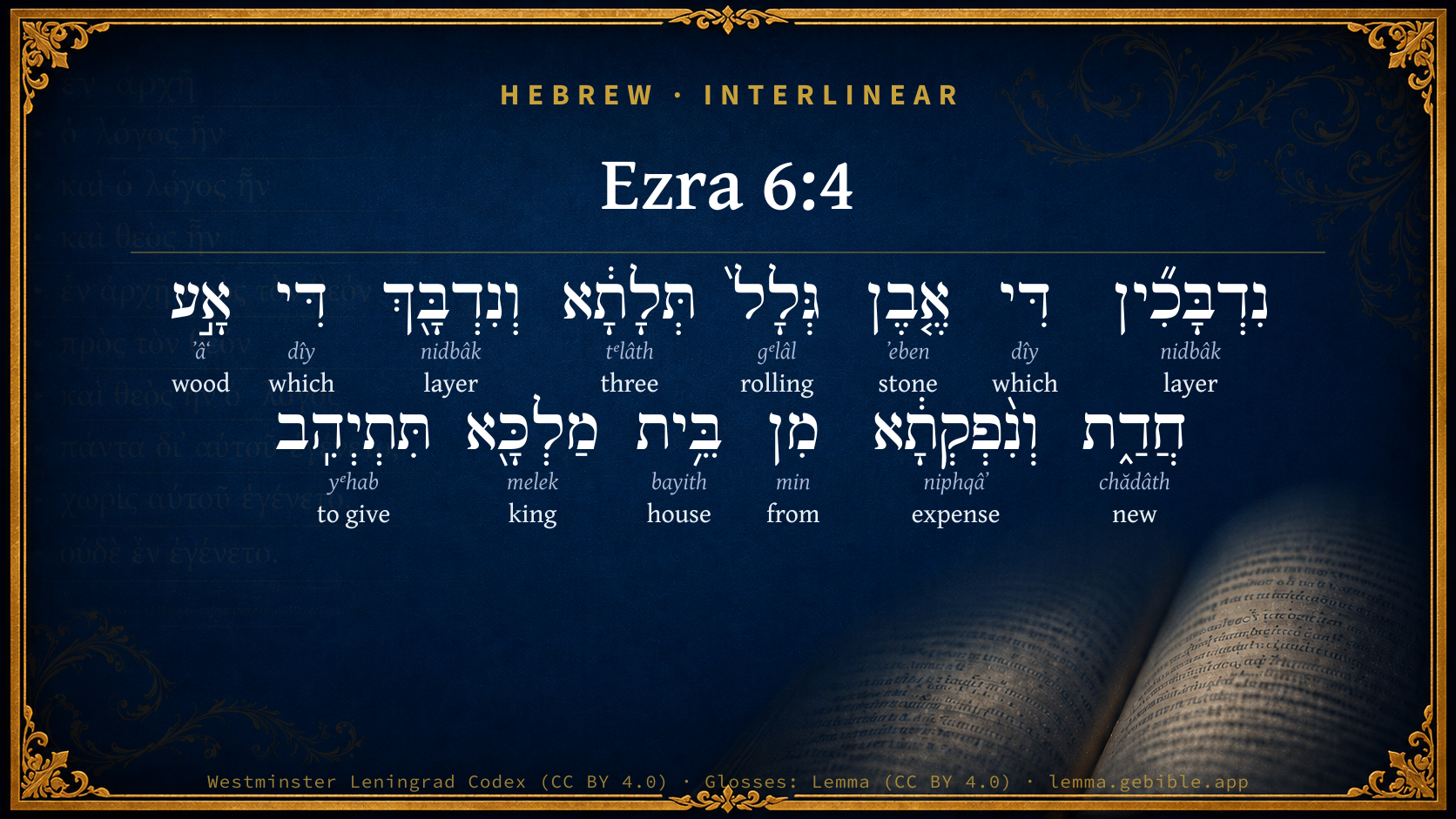
Hebrew (Westminster Leningrad Codex) Ezra 6:4 appears in the Hebrew Old Testament. The text above is from the Westminster Leningrad Codex. Each word links to its Strong’s number, a concise gloss, and parsing drawn from the Open Scriptures Hebrew Bible morphology. Click any word for its full Brown-Driver-Briggs (BDB) entry.
Download image
Cite this verse

Ezra 6:4 (World English Bible). Public Domain. Lemma interlinear Bible study tool, https://lemma.gebible.app/v/ezra/6/4.

Show BibTeX & RIS
BibTeX
RIS
English Translation
with three courses of great stones, and a course of new timber: and let the expenses be given out of the king's house.
World English Bible · Public Domain
Highlights
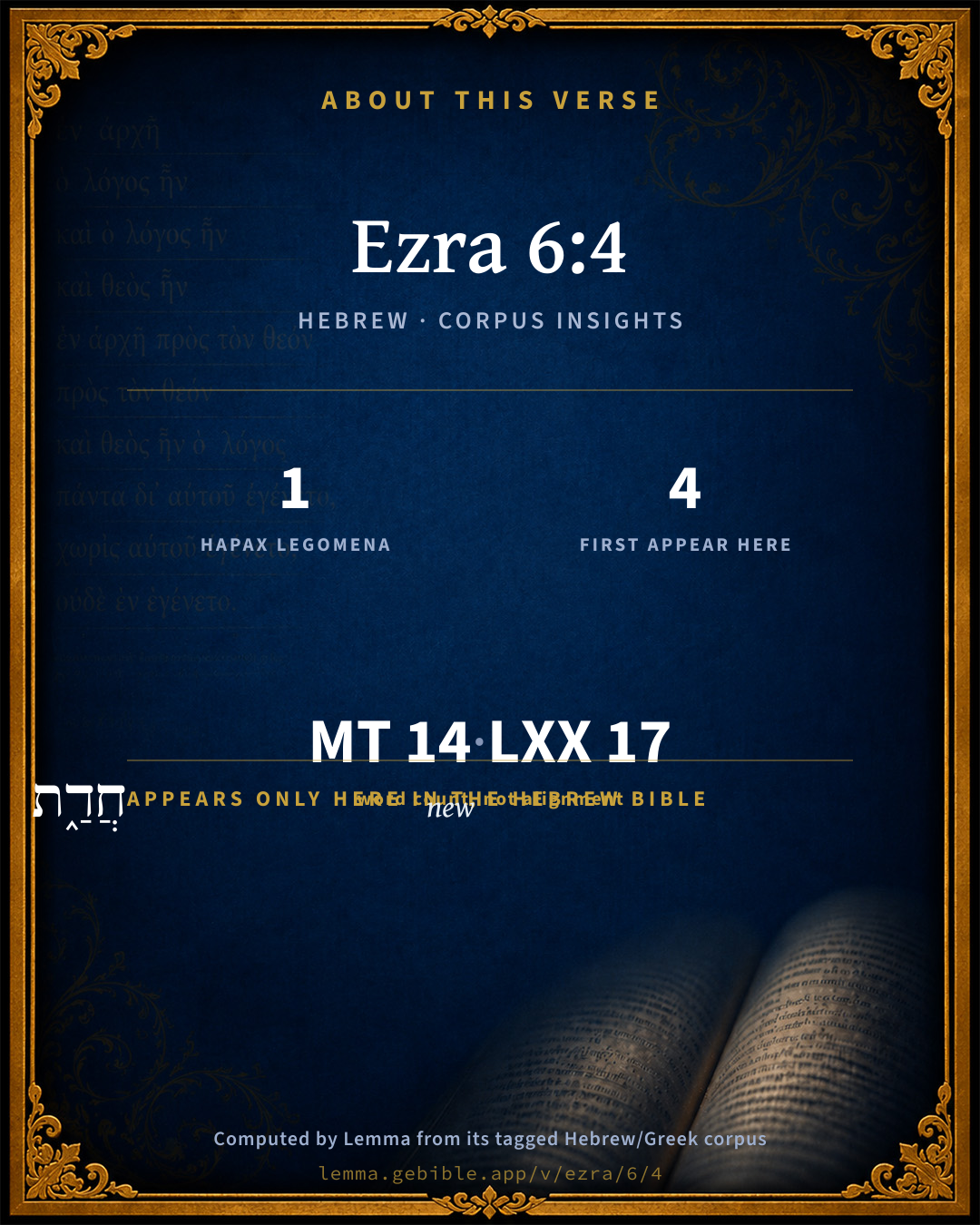
  • 1 hapax legomenon — only here in the Hebrew Bible
  • 4 first appearances in the Hebrew Bible
Full analysis ↓
Download a study sheet

One document with this verse’s original text, its word-by-word gloss line, the meaning frame, cross-references with their text, attributed commentary, and full source and license credits — printable, and it pastes into notes with its structure intact.

This verse Autodidact and up

Study sheet (.html) Plain text (.txt)

A passage Seminary Student

Up to 50 verses in one chapter. A passage sheet keeps up to 6 commentary sources and 12 cross-references per verse, in the order this page ranks them, and says so on the sheet whenever that leaves anything out. Ask for a single verse and you get the Autodidact verse sheet above.

Everything on this page stays free to read, with no account — the sheet is a download of what is already on screen, not access to it.

Want to remove ads? Support Godless Engineer
Compare translations 3

The same verse in 3 English versions, stacked beneath the original-language interlinear above. Click any original word for its lexicon entry.

Each is an independent rendering of the whole verse — the interlinear is not word-aligned to these translations.

Highlighted words mark where these versions differ — a whole-verse word diff, not a word-by-word alignment.

  • World English Bible Public Domain
    with three courses of great stones, and a course of new timber: and let the expenses be given out of the king's house.
  • King James Version Public Domain
    With three rows of great stones, and a row of new timber: and let the expenses be given out of the king's house:
  • unfoldingWord Literal Text CC BY-SA 4.0
    with three layers of large stone and a layer of new timber. And let the cost be given from the house of the king.

unfoldingWord Literal Text — © unfoldingWord, licensed CC BY-SA 4.0. Word-aligned USFM3 via Door43 (git.door43.org/unfoldingWord/en_ult).

Versions to compare (up to 4)

3 of 4 selected

Show all 18 translations

Every available English version of this verse, each an independent rendering of the whole verse.

  • World English Bible Public Domain
    with three courses of great stones, and a course of new timber: and let the expenses be given out of the king's house.
  • Berean Standard Bible Public Domain
    with three layers of cut stones and one of timbers. The costs are to be paid from the royal treasury.
  • Majority Standard Bible Public Domain
    with three layers of cut stones and one of timbers. The costs are to be paid from the royal treasury.
  • King James Version Public Domain
    With three rows of great stones, and a row of new timber: and let the expenses be given out of the king's house:
  • American Standard Version (1901) Public Domain
    with three courses of great stones, and a course of new timber: and let the expenses be given out of the king's house.
  • Revised Version (1885) Public Domain
    with three rows of great stones, and a row of new timber: and let the expenses be given out of the king’s house:
  • Geneva Bible (1599) Public Domain
    Three orders of great stones, and one order of timber, and let the expenses be giuen of the Kings house.
  • Douay-Rheims (1899) Public Domain
    Three rows of unpolished stones, and so rows of new timber: and the charges shall be given out of the king's house.
  • Young's Literal Translation Public Domain
    three rows of rolled stones, and a row of new wood, and the outlay let be given out of the king's house.
  • Literal Standard Version CC BY-SA 4.0
    three rows of rolled stones, and a row of new wood, and let the outlay be given out of the king’s house.
  • Unlocked Literal Bible CC BY-SA 4.0
    with three rows of large stones and a row of new timber, and let the cost be paid by the king's house.
  • unfoldingWord Literal Text CC BY-SA 4.0
    with three layers of large stone and a layer of new timber. And let the cost be given from the house of the king.
  • Darby Bible Public Domain
    [with] three rows of great stones, and a row of new timber; and let the expenses be given out of the king's house:
  • World Messianic Bible Public Domain
    with three courses of great stones and a course of new timber. Let the expenses be given out of the king’s house.
  • Webster's Bible Public Domain
    With three rows of great stones, and a row of new timber: and let the expenses be given out of the king's house:
  • Free Bible Version CC BY-SA 4.0
    with three layers of stone blocks and one of timber. Expenses are to be paid from the royal treasury.
  • Bible in Basic English Public Domain
    With three lines of great stones and one line of new wood supports; and let the necessary money be given out of the king's store-house;
  • JPS Tanakh (1917) Public Domain
    with three rows of great stones, and a row of new timber, and let the expenses be given out of the king's house;

Literal Standard Version (2020), Covenant Press — licensed CC BY-SA 4.0. Text via the HelloAO Bible API (eBible.org). Unlocked Literal Bible (unfoldingWord) — licensed CC BY-SA 4.0. Text via the HelloAO Bible API (eBible.org). unfoldingWord Literal Text — © unfoldingWord, licensed CC BY-SA 4.0. Word-aligned USFM3 via Door43 (git.door43.org/unfoldingWord/en_ult). Free Bible Version, Dr. Jonathan Gallagher — licensed CC BY-SA 4.0. Text via the HelloAO Bible API (eBible.org).

Word by word

More ways to search: Search by grammar → Find every occurrence → Compare this word →

Practice this passage: Drill this verse → Learn its vocabulary →

About this verse

These counts appear in no published source. They are computed here, from the morphology-tagged text and Lemma’s own curated glosses. What Lemma adds →

14
words
12
distinct lemmas
Historical
section

Notable vocabulary

1 hapax legomenon — a word that appears only here in the entire Hebrew Bible:

First appearance in Scripture

These words make their first canonical appearance in the Hebrew Bible here:

  • נִדְבָּכִ֞ין layer H5073
  • תְּלָתָ֔א three H8532
  • חֲדַ֑ת new H2323
  • וְנִ֨פְקְתָ֔א expense H5313

Grammatical profile

  • 1 noun
  • 11 adjectives
  • 2 particles

Repetition

Words recur within this verse — often emphatic in Hebrew:

  • נִדְבָּכִ֞ין layer H5073 ×2
  • דִּי which H1768 ×2

Hebrew & Septuagint length

In English translation the verse runs 23 words from the Hebrew and 27 from the Septuagint (LXX English) — closely comparable.

A rough comparison of the two English renderings, which tokenize alike — not a word-level alignment.

Word counts can differ between the Hebrew and the Greek without any difference in meaning — e.g. the Hebrew direct-object marker אֵת has no separate Greek word, and Greek often adds the article ὁ.

In the original languages it is 14 Hebrew tokens and 17 Greek tokens — but the two are counted differently (Hebrew bundles its prefixes and suffixes into one token; the Greek is in lemma form), so that isn’t a like-for-like length.

Cross-references

7

Topical passages linked to Ezra 6:4 in the Treasury of Scripture Knowledge — connected by theme and wording, ordered by reader-vote popularity; previews shown in the World English Bible.

  • 1 Kings 6:36 He built the inner court with three courses of hewn stone, and a course of cedar beams.
  • Psalms 68:29 Because of your temple at Jerusalem, Kings shall bring presents to you.
  • Ezra 7:20–23 Whatever more shall be needful for the house of your God, which you shall have occasion to bestow, bestow it out of the king's treasure-house.
  • Psalms 72:10 The kings of Tarshish and of the isles will bring tribute. The kings of Sheba and Seba shall offer gifts.
  • Isaiah 49:23 Kings shall be your nursing fathers, and their queens your nursing mothers: they shall bow down to you with their faces to the earth, and lick the dust of your feet; and you shall know that I am Yahweh; and those who wait for me shall not be disappointed.
  • Isaiah 60:6–10 The multitude of camels shall cover you, the dromedaries of Midian and Ephah; all they from Sheba shall come; they shall bring gold and frankincense, and shall proclaim the praises of Yahweh.
  • Revelation 12:16 The earth helped the woman, and the earth opened its mouth and swallowed up the river which the dragon spewed out of his mouth.

Cross-references courtesy of OpenBible.info (CC BY 4.0).

Hebrew and Greek witnesses Masoretic Hebrew ↔ Greek Septuagint

The same verse in the two great witnesses to the Old Testament, shown verse-for-verse.

These are two independent witnesses, not word-aligned to each other, and the Septuagint is shown in lemma (dictionary) form.

Hebrew Ezra 6:4 Masoretic · Westminster Leningrad Codex

נִדְבָּכִ֞ין דִּי אֶ֤בֶן גְּלָל֙ תְּלָתָ֔א וְנִדְבָּ֖ךְ דִּי אָ֣ע חֲדַ֑ת וְנִ֨פְקְתָ֔א מִן בֵּ֥ית מַלְכָּ֖א תִּתְיְהִֽב

with three courses of great stones, and a course of new timber: and let the expenses be given out of the king's house.

World English Bible · Public Domain

Greek LXX Ezra 6:4 Septuagint · lemma form

καί δόμος λίθινος κραταιός τρεῖς καί δόμος ξύλινος εἷς καί ὁ δαπάνη ἐκ οἶκος ὁ βασιλεύς δίδωμι

And let there be three strong layers of stone, and one layer of timber; and the expense shall be paid out of the house of the king.

LXX2012 (modern English Septuagint) · Public Domain

In the Septuagint this is one book — Esdras B (2 Esdras): Ezra is chapters 1–10, Nehemiah 11–23.

On this verse, The Pulpit Commentary discusses the Septuagint’s reading. Read the note in Commentary ↓

Hebrew: Westminster Leningrad Codex (CC BY 4.0). Greek: Septuagint (public domain); English from LXX2012 (modern English Septuagint) (Public Domain). How the Septuagint differs from the Hebrew →

Commentary

Notes on Ezra 6:4 from classic Christian and Jewish commentators (each source and its license shown beneath its notes). The classic Christian expositions comment on the surrounding passage and are grouped to its opening verse, so a note may address several verses; the Jewish commentaries on the Tanakh (Rashi and others) are per-verse, so they appear only where the commentator wrote on this verse.

Lemma curates 59 commentaries, every one of them public domain or Creative Commons licensed, each selected and text-cleaned for this edition rather than reprinted as found. About our sources →

Trapp's Complete Commentary

John Trapp

Ezr 6:4 [With] three rows of great stones, and a row of new timber: and let the expenses be given out of the king’s house:

Ver. 4. Out of the king’s house] i.e. Out of the royal revenue in those parts, Ezr 7:20. Herodotus testifieth that Cyrus and Darius (who married his daughter Atossa, and made him his pattern for imitation) were highly honoured among the Persians for their kingly munificence; God hath threatened that the nation and kingdom that will not serve the Church shall perish; yea, those nations shall be utterly wasted, Isa 60:12 Ezr 6:12.

John Trapp, A Commentary or Exposition upon All the Books of the Old and New Testament (1647–1656) — public domain. Text from a community e-Sword module.

The Biblical Illustrator

Joseph S. Exell

Ezr_6:4

And let the expenses be given out of the kings house.

A believers expenses

I. What are our expenses? The expenses referred to in the text are those connected with the return of the Jews to their own land, the rebuilding of the temple and its continual sacrifices.

1. Our release from the thraldom of sin involved enormous expenditure (1Pe_1:18-19).

2. The important steps of public profession of faith in Christ, and of union with His Church, need peculiar supplies of grace.

3. There is much new material to be built up in our habits and life.

4. Our bodies being temples of the Holy Ghost, every physical power and every mental faculty should be a vessel unto honour, sanctified and meet for the Masters use.

5. Our hearts are altars whereon should be offered the sacrifices of worship and praise.

II. Where shall we find means to meet these expenses?

1. The Word of Gods truth.

2. The throne of His grace.

3. The fellowship of His people.

4. The dispensation of His providence.

5. The opposition of His foes.

The Persian monarch was naturally Israels enemy, yet God arranges that he shall pay Israels expenses. Even the lions we may meet shall supply sweet honey for our nourishment and refreshment.

6. The work of Christ (Php_4:19).

III. How shall we act in the presence of such abundance?

1. We need not be afraid of exhausting Heavens treasures.

2. We dare not be slow in availing ourselves of these supplies.

3. We cannot help wondering at the goodness of the King.

4. We will not forget to express our gratitude to the King.

5. We must not be so selfish as to hide these glad tidings. (R. S. Latimer.)

The Biblical Illustrator, edited by Joseph S. Exell (c. 1880s–1900s) — public domain. Text from a community e-Sword module.

Tyndale Open Study Notes

Tyndale Open Resources

6:4 All expenses will be paid by the royal treasury. Although it seems surprising that the Persians would do this, it was consistent with Persian practice elsewhere (e.g., at Sais and Elephantine in Egypt, and at Ur in Mesopotamia). Such generosity was designed to ensure loyalty to Persia.

Tyndale Open Study Notes — © Tyndale Open Resources, licensed CC BY-SA 4.0. Text via the HelloAO Bible API.

Geneva Bible (1599)

Geneva Bible translators

Or, Marble.

Or, rows, or courses.

Geneva Bible (1599) marginal notes — public domain. Text via Bolls.life.

Adam Clarke's Commentary

Verse 4. Three rows of great stones, and a row of new timber] We have noticed this kind of building before, three courses of stones, and then a course of strong balk; and this continued to the square of the building.

And let the expenses be given] Cyrus had ordered wood to be cut at Libanus, and conveyed to Joppa at his expense; but it does not appear that he furnished the other expenses of the building, for we have already seen that the Jews contributed for the defraying of all others. But it appears that he provided at his own expense the sacrifices and offerings for the temple. See Ezr 6:9.

Adam Clarke's Commentary on the Bible (1810–1826) — public domain. Text from a community e-Sword/MySword module.

The Cambridge Bible for Schools and Colleges

gen. ed. J. J. S. Perowne

4. a row of new timber] R.V. marg. ‘According to the Sept. one row of timber.’ It has been much disputed what ‘the three rows of great stones and the row of timber’ can mean. (1) Some explain by three storeys of stones surmounted by one of wood, the elevation of the Temple. (2) Others by ‘three layers of stone followed by one of wood’, the material of the walls. (3) Others by ‘three courses of stone backed by a wainscote of wood’, the thickness of the walls. (4) But in all probability the verse should be explained by reference to 1Ki_6:36, where ‘three rows of hewn stone and a row of cedar beams’ are the construction of the walls of the inner court.

expences] R.V. expenses.

out of the king’s house] i.e. from the royal revenue. To be defrayed probably from the purse of the ‘Abhar Nahara’ satrapy. This payment had obviously ceased, or its existence would have been known to Tattenai and the other officials. During the disturbances which took place at the close of Cyrus’s reign, the officers of the provincial treasury probably found it convenient to stop this annual contribution. The voluntary subscriptions mentioned in Ezr_2:68-69 would therefore have been rendered necessary. Some have suspected that this part of the decree was never really carried out.

The Cambridge Bible for Schools and Colleges (gen. ed. J. J. S. Perowne; Cambridge University Press, 1878–1918) — public domain. Text from a community e-Sword module.

John Gill's Exposition

With three rows of great stones,.... Which Jarchi interprets of the walls of it, and these stones of marble; and so Ben Melech:

and a row of new timber; of cedar wood upon the rows of stone, see Kg1 6:36 or for the lining and wainscoting the walls:

and let the expenses be given out of the king's house; treasury, or exchequer; but it does not appear that this part of the decree was observed, at least hitherto; but the Jews built at their own expense, and perhaps did not exactly observe the directions given as to the dimensions of the house.

John Gill's Exposition of the Whole Bible (1746–1763) — public domain (CC PDM 1.0). Text via the HelloAO Bible API.

Albert Barnes' Notes on the Bible

The word translated “row” occurs only in this passage. Some regard it as a “course,” and suppose that after every three courses of stone there followed a course of timber. Others understand three “storeys” of stone, with a fourth “storey” of woodwork on the summit (compare 1Ki 6:5-6). Others consider that Cyrus intended to limit the thickness of the walls, which were not to exceed a breadth of three rows of stone, with an inner wooden wainscotting.

Let the expenses be given out of the king’s house - i. e., “out of the Persian revenue,” a portion of the decree which was probably not observed during the later years of Cyrus and during the reign of Cambyses, and hence the burthen fell upon the Jews themselves Ezr 2:68-69.

Albert Barnes' Notes on the Bible (1834–1885) — public domain. Text from a community e-Sword/MySword module.

Haydock's Catholic Bible Commentary

Unpolished, to correspond with the polished stones and cedar employed by Solomon, 3 Kings vi. 36. (Menochius) --- Protestants, "great stones." See chap. v. 8. --- Charges. It appears that the Jews furnished money and meat to pay for the wood, chap. i. 4., and iii. 7. Some annual sum might be assigned by Cyrus, either for the building, or for the daily holocausts. (Calmet)

George Leo Haydock (1774–1849), Haydock's Catholic Family Bible and Commentary, 1859 edition — public domain. Excludes Psalms (Douay-Rheims chapter numbering differs from Protestant) and Deuterocanonical books (Catholic canon only).

Matthew Poole's English Annotations

With three rows of great stones, and a row of new timber; as Solomon’s temple was built, 1Ki 6:36; whereof Darius was informed by some of the Jews, who also desired that it might be done in this manner.

Matthew Poole's English Annotations on the Holy Bible (1683–1685) — public domain. Text from a community e-Sword/MySword module.

Whedon's Commentary on the Bible

Daniel D. Whedon

4. With three rows of… stones — There is no with in the Chaldee, and the passage has the appearance of a fragmentary excerpt. The language, however, reminds us of 1Ki_6:36, (see note there,) and may, perhaps, be best understood of the platform of the inner court, which, like that of the first temple, was to have three layers of stone and one of new timber.

Daniel D. Whedon (gen. ed.), Commentary on the Old and New Testaments (1874–1909) — public domain. Text from a community e-Sword module.

The Pulpit Commentary

With three rows of great stones, and a row of new timber. The Septuagint interpreter understood by this that the new temple was to be four storeys high, three storeys being built of stone, and one of timber. The two wings of the temple of Solomon were undoubtedly three storeys. (1Ki_6:6) But it is perhaps doubtful whether the word nidbak ever means "storey." Most commentators suppose three courses of stone, and then a course of timber, repeated from foundation to summit; but there is no known example of such a mode of building. The expences were to be given out of the king"s house, defrayed, i.e. , out of the royal revenue; but either this intention of Cyrus was not carried out, or it was understood to apply only to the materials. Large sums were subscribed by the Jews themselves towards the building, (Ezr_2:69) and large payments were made by them to the persons employed upon the work. (Ezr_3:7)

The Pulpit Commentary (1880–1919), ed. H.D.M. Spence-Jones & Joseph S. Exell — public domain. Text from a community e-Sword module.

Rashi

Rabbi Shlomo Yitzchaki (Rashi)

rows Aram. נִדְבָּכִין, an expression for walls. The walls were of marble. marble Aram. גְּלָל (marmre in Old French).

and a row and a wall of new wood from within, in the manner of the building of the Temple that Solomon built.

and the expenditures And the expenditures for the needs of the House and for the other matters pertaining to the House shall be given them from the royal palace.

Rashi on the Tanakh — English translations: “The Judaica Press complete Tanach with Rashi, translated by A. J. Rosenberg” (CC BY 4.0); “Pentateuch with Rashi's commentary by M. Rosenbaum and A.M. Silbermann, 1929-1934” (public domain); “The Metsudah Tanach series, Lakewood, N.J” (CC BY 4.0); and “The Book of Joshua, Metsudah Publications, 1997” (CC BY 4.0). Text via Sefaria.

Lesson kit

Teaching starters — assembled from the data on this page, not authored interpretation. Every prompt links to the verse data it draws on. Edit before teaching.

Ezra, in the Historical, opens this verse with 14 words (12 distinct Hebrew lemmas). Its most distinctive word is chădâth (“new”). A historical commentator’s framing appears above. Read the whole chapter for the surrounding context.

Discussion questions

  1. What does “new” (chădâth) contribute to the verse as a whole?
  2. This verse holds 1 word here found nowhere else in the Hebrew Bible. What might the rare word draw attention to?
  3. 4 words here appear for the first time in Scripture. What is being introduced at this debut?
  4. 1 Kings 6:36 shares this passage’s theme. How do the two illuminate each other?
  5. “layer” occurs 2× in this one verse. What is the effect of the repetition?
  6. The translations on this page render this verse differently — a whole-verse word diff, not a word-by-word alignment. What might account for the different wordings?
  7. Reading how Trapp's Complete Commentary and The Biblical Illustrator read this verse, where do the two commentators agree and where do they part?

Things to notice

  • 1 word in this verse appears nowhere else in the Hebrew Bible.
  • 4 words make their first canonical appearance in Scripture here.
  • This verse counts 14 Hebrew ↔ 17 Greek words.
  • These translations choose different wording for 15 words in this verse.
  • “layer” occurs 2× in this single verse.

Reading settings

Reading text

Shown beneath each verse's original-language words.

Old Testament
Old Testament edition

Read the OT as the Masoretic Hebrew (MT) or the Greek Septuagint (LXX).

English shown for the Greek Septuagint (in the Hebrew ↔ Greek comparison).

Comparing translations? Open the Compare panel on any verse page to stack up to four side by side.