
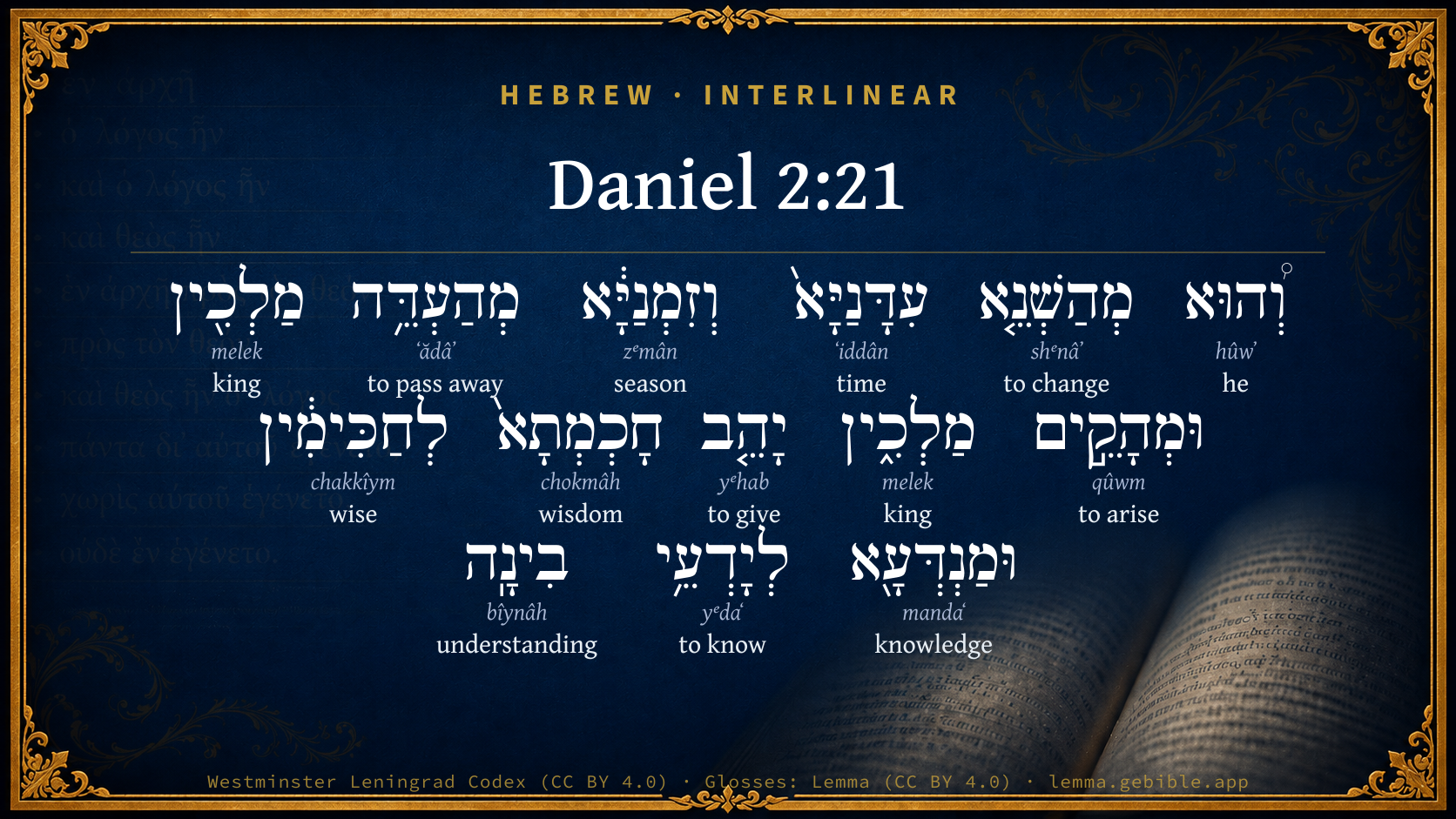
Daniel 2:21

Hebrew (Westminster Leningrad Codex) Daniel 2:21 appears in the Hebrew Old Testament. The text above is from the Westminster Leningrad Codex. Each word links to its Strong’s number, a concise gloss, and parsing drawn from the Open Scriptures Hebrew Bible morphology. Click any word for its full Brown-Driver-Briggs (BDB) entry.
Download image
Cite this verse

Daniel 2:21 (World English Bible). Public Domain. Lemma interlinear Bible study tool, https://lemma.gebible.app/v/daniel/2/21.

Show BibTeX & RIS
BibTeX
RIS
English Translation
He changes the times and the seasons; he removes kings, and sets up kings; he gives wisdom to the wise, and knowledge to those who have understanding;
World English Bible · Public Domain
Highlights
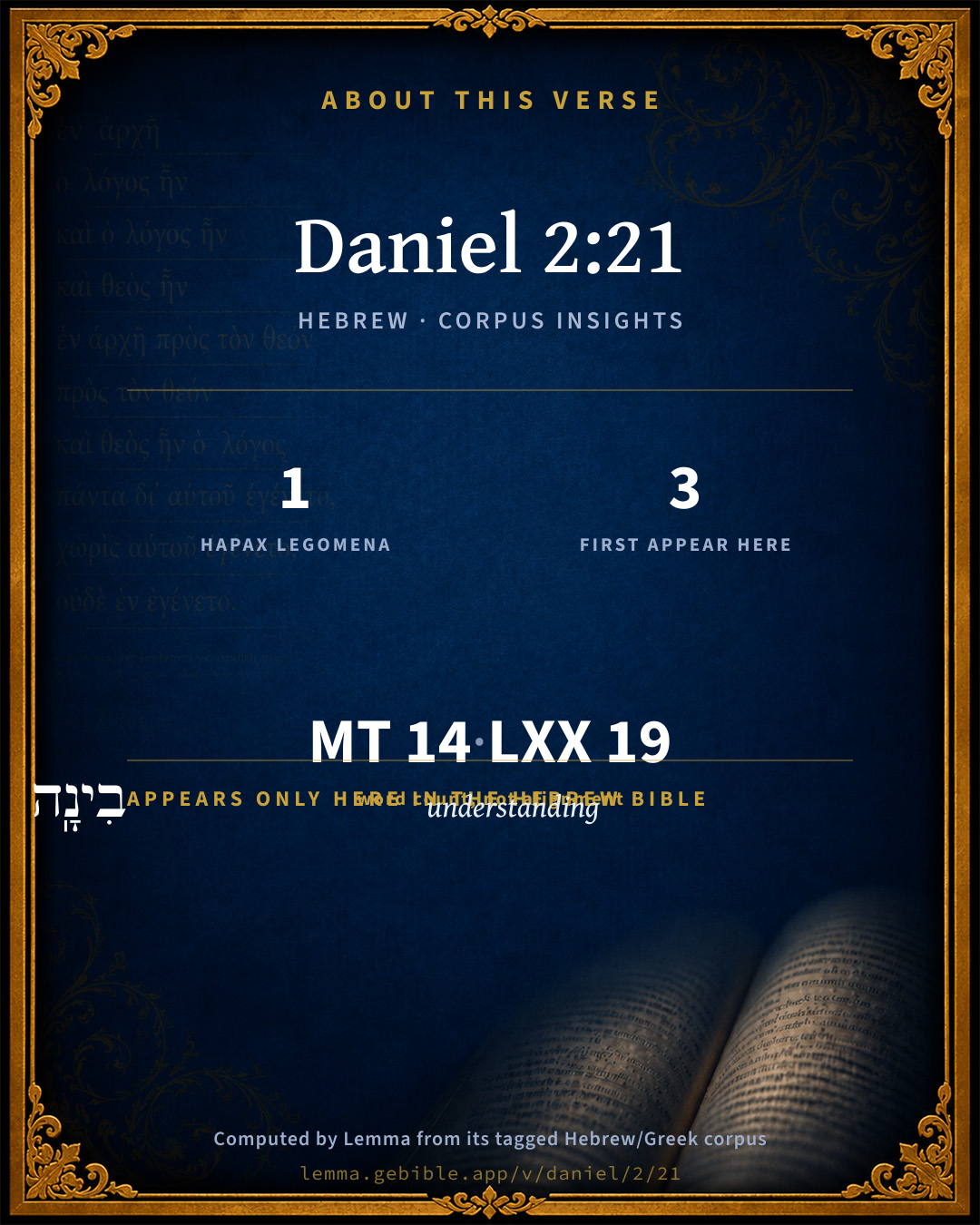
  • 1 hapax legomenon — only here in the Hebrew Bible
  • 3 first appearances in the Hebrew Bible
Full analysis ↓
Download a study sheet

One document with this verse’s original text, its word-by-word gloss line, the meaning frame, cross-references with their text, attributed commentary, and full source and license credits — printable, and it pastes into notes with its structure intact.

This verse Autodidact and up

Study sheet (.html) Plain text (.txt)

A passage Seminary Student

Up to 50 verses in one chapter. A passage sheet keeps up to 6 commentary sources and 12 cross-references per verse, in the order this page ranks them, and says so on the sheet whenever that leaves anything out. Ask for a single verse and you get the Autodidact verse sheet above.

Everything on this page stays free to read, with no account — the sheet is a download of what is already on screen, not access to it.

Want to remove ads? Support Godless Engineer
Compare translations 3

The same verse in 3 English versions, stacked beneath the original-language interlinear above. Click any original word for its lexicon entry.

Each is an independent rendering of the whole verse — the interlinear is not word-aligned to these translations.

Highlighted words mark where these versions differ — a whole-verse word diff, not a word-by-word alignment.

  • World English Bible Public Domain
    He changes the times and the seasons; he removes kings, and sets up kings; he gives wisdom to the wise, and knowledge to those who have understanding;
  • King James Version Public Domain
    And he changeth the times and the seasons: he removeth kings, and setteth up kings: he giveth wisdom unto the wise, and knowledge to them that know understanding:
  • unfoldingWord Literal Text CC BY-SA 4.0
    He changes the times and seasons; he removes kings and sets up kings. He gives wisdom to the wise and knowledge to those who have understanding.

unfoldingWord Literal Text — © unfoldingWord, licensed CC BY-SA 4.0. Word-aligned USFM3 via Door43 (git.door43.org/unfoldingWord/en_ult).

Versions to compare (up to 4)

3 of 4 selected

Show all 18 translations

Every available English version of this verse, each an independent rendering of the whole verse.

  • World English Bible Public Domain
    He changes the times and the seasons; he removes kings, and sets up kings; he gives wisdom to the wise, and knowledge to those who have understanding;
  • Berean Standard Bible Public Domain
    He changes the times and seasons; He removes kings and establishes them. He gives wisdom to the wise and knowledge to the discerning.
  • Majority Standard Bible Public Domain
    He changes the times and seasons; He removes kings and establishes them. He gives wisdom to the wise and knowledge to the discerning.
  • King James Version Public Domain
    And he changeth the times and the seasons: he removeth kings, and setteth up kings: he giveth wisdom unto the wise, and knowledge to them that know understanding:
  • American Standard Version (1901) Public Domain
    And he changeth the times and the seasons; he removeth kings, and setteth up kings; he giveth wisdom unto the wise, and knowledge to them that have understanding;
  • Revised Version (1885) Public Domain
    And he changeth the times and the seasons: he removeth kings, and setteth up kings: he giveth wisdom unto the wise, and knowledge to them that know understanding:
  • Geneva Bible (1599) Public Domain
    And hee changeth the times and seasons: he taketh away kings: he setteth vp kings: he giueth wisedome vnto the wise, and vnderstanding to those that vnderstand.
  • Douay-Rheims (1899) Public Domain
    And he changeth times and ages: taketh away kingdoms and establisheth them, giveth wisdom to the wise, and knowledge to them that have understanding.
  • Young's Literal Translation Public Domain
    And He is changing times and seasons, He is causing kings to pass away, and He is raising up kings; He is giving wisdom to the wise, and knowledge to those possessing understanding.
  • Literal Standard Version CC BY-SA 4.0
    And He is changing times and seasons, He is causing kings to pass away, and He is raising up kings; He is giving wisdom to the wise, and knowledge to those possessing understanding.
  • Unlocked Literal Bible CC BY-SA 4.0
    He changes the times and seasons; he removes kings and places kings on their thrones. He gives wisdom to the wise and knowledge to those who have understanding.
  • unfoldingWord Literal Text CC BY-SA 4.0
    He changes the times and seasons; he removes kings and sets up kings. He gives wisdom to the wise and knowledge to those who have understanding.
  • Darby Bible Public Domain
    And it is he that changeth times and seasons; He deposeth kings, and setteth up kings; He giveth wisdom to the wise, And knowledge to them that know understanding.
  • World Messianic Bible Public Domain
    He changes the times and the seasons. He removes kings and sets up kings. He gives wisdom to the wise, and knowledge to those who have understanding.
  • Webster's Bible Public Domain
    And he changeth the times and the seasons; he removeth kings, and setteth up kings; he giveth wisdom to the wise, and knowledge to them that know understanding:
  • Free Bible Version CC BY-SA 4.0
    He is in charge of time and history. He removes kings, and he sets kings in place. He gives wisdom to make people wise; he gives knowledge to people so they can understand.
  • Bible in Basic English Public Domain
    By him times and years are changed: by him kings are taken away and kings are lifted up: he gives wisdom to the wise, and knowledge to those whose minds are awake:
  • JPS Tanakh (1917) Public Domain
    And He changeth the times and the seasons; He removeth kings, and setteth up kings; He giveth wisdom unto the wise, and knowledge to them that know understanding;

Literal Standard Version (2020), Covenant Press — licensed CC BY-SA 4.0. Text via the HelloAO Bible API (eBible.org). Unlocked Literal Bible (unfoldingWord) — licensed CC BY-SA 4.0. Text via the HelloAO Bible API (eBible.org). unfoldingWord Literal Text — © unfoldingWord, licensed CC BY-SA 4.0. Word-aligned USFM3 via Door43 (git.door43.org/unfoldingWord/en_ult). Free Bible Version, Dr. Jonathan Gallagher — licensed CC BY-SA 4.0. Text via the HelloAO Bible API (eBible.org).

Word by word

More ways to search: Search by grammar → Find every occurrence → Compare this word →

Practice this passage: Drill this verse → Learn its vocabulary →

בִינָֽה
bîynâh
H999
“understanding”
Adjective, N, Common
Part of Speech
Adjective
Gender
Common
Full BDB Definition

Origin: corresponding to H998

TWOT: 2627

understanding, discernment
  1. וְ֠הוּא hûwʼ H1932 “and · he” Adjective, C + Pronoun, Personal, 3rd Person, Masculine, Singular
  2. מְהַשְׁנֵ֤א shᵉnâʼ H8133 “changing” Adjective, V
  3. עִדָּנַיָּא֙ ʻiddân H5732 “times · the” Adjective, N, Common + Particle, Definite Article
  4. וְזִמְנַיָּ֔א zᵉmân H2166 “and · seasons · the” Adjective, C + Noun, Common, Masculine, Plural, Determined + Particle, Definite Article
  5. מְהַעְדֵּ֥ה ʻădâʼ H5709 “passing away” Adjective, V
  6. מַלְכִ֖ין melek H4430 “kings” Adjective, N, Common
  7. וּמְהָקֵ֣ים qûwm H6966 “and · arising” Adjective, C + Verb, Hiphil, Participle Active, Masculine, Singular, Absolute
  8. מַלְכִ֑ין melek H4430 “kings” Adjective, N, Common
  9. יָהֵ֤ב yᵉhab H3052 “giving” Adjective, V
  10. חָכְמְתָא֙ chokmâh H2452 “wisdom · the” Adjective, N, Common + Particle, Definite Article
  11. לְחַכִּימִ֔ין chakkîym H2445 “to/for · wise men” Adjective, R + Noun, Common, Masculine, Plural, Absolute
  12. וּמַנְדְּעָ֖א mandaʻ H4486 “and · knowledge · the” Adjective, C + Noun, Common, Masculine, Singular, Determined + Particle, Definite Article
  13. לְיָדְעֵ֥י yᵉdaʻ H3046 “to/for · knowing” Adjective, R + Verb, Qal, Participle Active, Masculine, Plural, Construct

About this verse

These counts appear in no published source. They are computed here, from the morphology-tagged text and Lemma’s own curated glosses. What Lemma adds →

14
words
13
distinct lemmas
Prophets
section

Notable vocabulary

1 hapax legomenon — a word that appears only here in the entire Hebrew Bible:

  • בִינָֽה understanding H999

First appearance in Scripture

These words make their first canonical appearance in the Hebrew Bible here:

  • מְהַעְדֵּ֥ה to pass away H5709
  • וּמַנְדְּעָ֖א knowledge H4486
  • בִינָֽה understanding H999

Shared distinctive vocabulary

וּמַנְדְּעָ֖א knowledge H4486 occurs in 4 verses of the Hebrew Bible. Also found in:

Grammatical profile

  • 2 verbs
  • 1 noun
  • 6 adjectives
  • 1 pronoun
  • 4 particles

Verb forms

  • וּמְהָקֵ֣ים Hiphil · Participle Active
  • לְיָדְעֵ֥י Qal · Participle Active

Repetition

A word recurs within this verse — often emphatic in Hebrew:

  • מַלְכִ֖ין king H4430 ×2

Hebrew & Septuagint length

In English translation the verse runs 27 words from the Hebrew and 24 from the Septuagint (LXX English) — closely comparable.

A rough comparison of the two English renderings, which tokenize alike — not a word-level alignment.

Word counts can differ between the Hebrew and the Greek without any difference in meaning — e.g. the Hebrew direct-object marker אֵת has no separate Greek word, and Greek often adds the article ὁ.

In the original languages it is 14 Hebrew tokens and 19 Greek tokens — but the two are counted differently (Hebrew bundles its prefixes and suffixes into one token; the Greek is in lemma form), so that isn’t a like-for-like length.

Cross-references

33

Topical passages linked to Daniel 2:21 in the Treasury of Scripture Knowledge — connected by theme and wording, ordered by reader-vote popularity; previews shown in the World English Bible.

  • Psalms 75:5–7 Don't lift up your horn on high. Don't speak with a stiff neck."
  • Psalms 31:14–15 But I trust in you, Yahweh. I said, "You are my God."
  • Psalms 113:7–8 He raises up the poor out of the dust. Lifts up the needy from the ash heap;
  • Daniel 4:17 The sentence is by the decree of the watchers, and the demand by the word of the holy ones; to the intent that the living may know that the Most High rules in the kingdom of men, and gives it to whoever he will, and sets up over it the lowest of men.
  • Daniel 7:25 He shall speak words against the Most High, and shall wear out the saints of the Most High; and he shall think to change the times and the law; and they shall be given into his hand until a time and times and half a time.
  • James 3:15–17 This wisdom is not that which comes down from above, but is earthly, sensual, and demonic.
  • Job 34:24–29 He breaks in pieces mighty men in ways past finding out, And sets others in their place.
  • Daniel 4:32 and you shall be driven from men; and they dwelling shall be with the animals of the field; you shall be made to eat grass as oxen; and seven times shall pass over you; until you know that the Most High rules in the kingdom of men, and gives it to whoever he will.
  • Proverbs 8:15–16 By me kings reign, And princes decree justice.
  • 2 Chronicles 1:10–12 Give me now wisdom and knowledge, that I may go out and come in before this people; for who can judge this your people, that is so great?
  • Acts 13:21–22 Afterward they asked for a king, and God gave to them Saul the son of Kish, a man of the tribe of Benjamin, for forty years.
  • Luke 1:51–52 He has shown strength with his arm. He has scattered the proud in the imagination of their heart.
  • Job 12:18 He loosens the bond of kings, He binds their loins with a belt.
  • 1 Kings 4:29 God gave Solomon wisdom and understanding exceeding much, and very great understanding, even as the sand that is on the sea-shore.
  • Jeremiah 27:5–7 I have made the earth, the men and the animals that are on the surface of the earth, by my great power and by my outstretched arm; and I give it to whom it seems right to me.
  • Luke 21:15 for I will give you a mouth and wisdom which all your adversaries will not be able to withstand or to contradict.
  • 1 Samuel 2:7–8 Yahweh makes poor, and makes rich: He brings low, he also lifts up.
  • Proverbs 2:6–7 For Yahweh gives wisdom. Out of his mouth comes knowledge and understanding.
  • James 1:5 But if any of you lacks wisdom, let him ask of God, who gives to all liberally and without reproach; and it will be given to him.
  • James 1:17 Every good gift and every perfect gift is from above, coming down from the Father of lights, with whom can be no variation, nor turning shadow.
  • 1 Kings 3:28 All Israel heard of the judgment which the king had judged; and they feared the king: for they saw that the wisdom of God was in him, to do justice.
  • Exodus 31:3 and I have filled him with the Spirit of God, in wisdom, and in understanding, and in knowledge, and in all manner of workmanship,
  • 1 Kings 3:8–12 Your servant is in the midst of your people which you have chosen, a great people, that can't be numbered nor counted for multitude.
  • 1 Chronicles 22:12 May Yahweh give you discretion and understanding, and put you in charge of Israel; that so you may keep the law of Yahweh your God.
  • Daniel 2:9 But if you don't make known to me the dream, there is but one law for you; for you have prepared lying and corrupt words to speak before me, until the time be changed: therefore tell me the dream, and I shall know that you can show me the interpretation of it.
  • 1 Corinthians 1:30 But of him, you are in Christ Jesus, who was made to us wisdom from God, and righteousness and sanctification, and redemption:
  • 1 Kings 10:24 All the earth sought the presence of Solomon, to hear his wisdom, which God had put in his heart.
  • 1 Chronicles 29:30 with all his reign and his might, and the times that went over him, and over Israel, and over all the kingdoms of the countries.
  • Ecclesiastes 3:1–8 For everything there is a season, and a time for every purpose under heaven:
  • Exodus 31:6 I, behold, I have appointed with him Oholiab, the son of Ahisamach, of the tribe of Dan; and in the heart of all who are wise-hearted I have put wisdom, that they may make all that I have commanded you:
  • Daniel 11:6 At the end of years they shall join themselves together; and the daughter of the king of the south shall come to the king of the north to make an agreement: but she shall not retain the strength of her arm; neither shall he stand, nor his arm; but she shall be given up, and those who brought her, and he who became the father of her, and he who strengthened her in those times.
  • Revelation 19:16 He has on his garment and on his thigh a name written, "KING OF KINGS, AND LORD OF LORDS."
  • Esther 1:13 Then the king said to the wise men, who knew the times, (for so was the king's manner toward all who knew law and judgment;

Cross-references courtesy of OpenBible.info (CC BY 4.0).

Hebrew and Greek witnesses Masoretic Hebrew ↔ Greek Septuagint

The same verse in the two great witnesses to the Old Testament, shown verse-for-verse.

These are two independent witnesses, not word-aligned to each other, and the Septuagint is shown in lemma (dictionary) form.

Hebrew Daniel 2:21 Masoretic · Westminster Leningrad Codex

וְ֠הוּא מְהַשְׁנֵ֤א עִדָּנַיָּא֙ וְזִמְנַיָּ֔א מְהַעְדֵּ֥ה מַלְכִ֖ין וּמְהָקֵ֣ים מַלְכִ֑ין יָהֵ֤ב חָכְמְתָא֙ לְחַכִּימִ֔ין וּמַנְדְּעָ֖א לְיָדְעֵ֥י בִינָֽה

He changes the times and the seasons; he removes kings, and sets up kings; he gives wisdom to the wise, and knowledge to those who have understanding;

World English Bible · Public Domain

Greek LXX Daniel 2:21 Septuagint · lemma form

καί αὐτός ἀλλοιόω καιρός καί χρόνος μεταἵστημι βασιλεύς καί καταἵστημι δίδωμι σοφός σοφία καί σύνεσις ὁ ἐν ἐπιστήμη εἰμί

And he changes times and seasons: he appoints kings, and removes them, giving wisdom to the wise, and prudence to them that have understanding:

LXX2012 (modern English Septuagint) · Public Domain

On this verse, The Pulpit Commentary discusses the Septuagint’s reading. Read the note in Commentary ↓

Hebrew: Westminster Leningrad Codex (CC BY 4.0). Greek: Septuagint (public domain); English from LXX2012 (modern English Septuagint) (Public Domain). How the Septuagint differs from the Hebrew →

Commentary

Notes on Daniel 2:21 from classic Christian and Jewish commentators (each source and its license shown beneath its notes). The classic Christian expositions comment on the surrounding passage and are grouped to its opening verse, so a note may address several verses; the Jewish commentaries on the Tanakh (Rashi and others) are per-verse, so they appear only where the commentator wrote on this verse.

Lemma curates 59 commentaries, every one of them public domain or Creative Commons licensed, each selected and text-cleaned for this edition rather than reprinted as found. About our sources →

Trapp's Complete Commentary

John Trapp

Dan 2:21 And he changeth the times and the seasons: he removeth kings, and setteth up kings: he giveth wisdom unto the wise, and knowledge to them that know understanding:

Ver. 21. He changeth the times and the seasons, &c.] And so showeth that strength is his, such as is irresistible.

He removeth kings, &c.] As by the king’s dream, Daniel was well advertised.

He giveth wisdom unto the wise.] And so showeth that wisdom is his; since all the wisdom found in the creature is but a spark of his flame, a drop of his ocean.

John Trapp, A Commentary or Exposition upon All the Books of the Old and New Testament (1647–1656) — public domain. Text from a community e-Sword module.

Tyndale Open Study Notes

Tyndale Open Resources

2:21 The dream revealed the Lord as the sovereign king of history (see 2:29-45).

Tyndale Open Study Notes — © Tyndale Open Resources, licensed CC BY-SA 4.0. Text via the HelloAO Bible API.

Ibn Ezra

Rabbi Abraham ibn Ezra

[Daniel 2:21] V'hu (וְהוּא - And He): According to His wisdom, He changes times (mehasshne ʿiddanayya - מְהַשְׁנֵא עִדָּנַיָּא), removes kings (mehaʿdeh malkhin - מְהַעְדֵּה מַלְכִין), and establishes (umehakem - וּמְהָקֵים) others in their place – and [He does] that which He sees [fit] in His wisdom. And the wisdom that man knows, He has given it.

Ibn Ezra on the Tanakh — English translations: “Sefaria Community Translation” (CC0 1.0 (public-domain dedication)); “Yalkut, Sifsei Chachomim Chumash, Metsudah Publications, 2009” (CC BY 4.0); and “Commentary of Ibn Ezra on Isaiah - trans. by M. Friedlander, 1873” (public domain). Text via Sefaria.

Jamieson, Fausset & Brown

Robert Jamieson, A. R. Fausset & David Brown

changeth . . . times . . . seasons--"He herein gives a general preparatory intimation, that the dream of Nebuchadnezzar is concerning the changes and successions of kingdoms" [JEROME]. The "times" are the phases and periods of duration of empires (compare Dan 7:25; Ch1 12:32; Ch1 29:30); the "seasons" the fitting times for their culmination, decline, and fall (Ecc 3:1; Act 1:7; Th1 5:1). The vicissitudes of states, with their times and seasons, are not regulated by chance or fate, as the heathen thought, but by God.

removed kings-- (Job 12:18; Psa 75:6-7; Jer 27:5; compare Sa1 2:7-8).

giveth wisdom-- (Kg1 3:9-12; Jam 1:5).

Jamieson, Fausset & Brown — Commentary Critical and Explanatory on the Whole Bible (1871) — public domain (CC PDM 1.0). Text via the HelloAO Bible API.

Adam Clarke's Commentary

Verse 21. He changeth the times] Time, duration, succession are his, and under his dominion. It is in the course of his providence that one king is put down, and another raised up; and therefore he can distinctly tell what he has purposed to do in the great empires of the earth.

Adam Clarke's Commentary on the Bible (1810–1826) — public domain. Text from a community e-Sword/MySword module.

John Calvin's Commentaries

Daniel explains, in these words, what might have been obscure; for he teaches God to be the true fountain of wisdom and virtue, while he does not confine them to himself alone, but diffuses them through heaven and earth. And we must mark this diligently; for when Paul affirms God alone to be wise, this praise does not seem magnificent enough, (Romans 16:27;) but when we think of God’s wisdom, and set before our eyes all around and about us, then we feel more strongly the import of Paul’s words, that God only is wise. God, therefore, as I have already stated, does not keep His wisdom confined to himself, but makes it flow throughout the whole world. The full sense of the verse is, — whatever wisdom and power exists in the world, is a testimony to the Almighty’s. This is man’s ingratitude; whenever they find anything worthy of praise in themselves or others, they claim it directly as their own, and thus God’s glory is diminished by the depravity of those who obtain their blessings from him. We are here taught not to detract anything from God’s wisdom and power, since wherever these qualities are conspicuous in the world, they ought rather to reflect his glory. We now perceive the Prophet’s meaning — God places before our eyes, as in a glass, the proofs of his wisdom and power, when the affairs of the world roll on, and mankind become powerful through wisdom, and some are raised on high, and others fall to the ground. Experience teaches us these events do not proceed from human skill, or through the equable course of nature, while the loftiest kings are cast down and others elevated to the highest posts of honor. Daniel, therefore, admonishes us not to seek in heaven alone for God’s wisdom and power, since it is apparent to us on earth, and proofs of it are daily presented to our observation. We now see how these two verses are mutually united He had stated wisdom to belong exclusively to God; he now shews that it is not hidden within him, but is made manifest to us; and we may perceive by familiar experience, how all wisdom flows from him as its exclusive fountain. We ought to feel the same concurring power also.

It is he, then, who changes times and portions of time. We know it to be ascribed to fortune when the world passes through such uncertain changes that everything is daily changing. hence the profane consider all things to be acted on by blind impulse, and others affirm the human race to be a kind of sport to God, since men are tossed about like balls. But, as I have already said, it is not surprising to find men of a perverse and corrupt disposition thus perverting the object of all God’s works. For our own practical improvement we should consider what the Prophet is here teaching, how revolutions, as they are called, are testimonies of God’s power, and point out with the finger to the truth that the affairs of men are ruled by the Most High. For we must of necessity adopt one or the other of these views, either that nature rules over human events, or else fortune turns about in every direction, things which ought to have an even course. As far as nature is concerned, its course would be even, unless God by his singular counsel, as we have seen, thus changes the course of the times. Yet those philosophers who assign the supreme authority to nature are much sounder than others who place fortune in the highest rank. For if we admit for a moment this latter opinion that fortune directs human affairs by a kind of blind impulse, whence comes this fortune? If you ask them for a definition, what answer will they make? They will surely be compelled to confess this, the word “fortune” explains nothing. But neither God nor nature will have any place in this vain and changeable government of the world, where all things throw themselves into distinct forms without the least order or connection. And if this be granted, truly the doctrine of Ephcurus will be received, because if God resigns the supreme government of the world, so that all things are rashly mingled together, he is no longer God. But in this variety he rather displays his hand in claiming for himself the empire over the world. In so many changes, then, which meet us on every side, and by which the whole face of things is renewed, we must remember that the Providence of God shines forth; and things do not flow on in an even course, because then the peculiar property of God might with some shew of reason be ascribed to nature. God, I say, so changes empires, and times, and seasons, that we should learn to look up to him. If the sun always rose and set at the same period, or at least certain symmetrical changes took place yearly, without any casual change; if the days of winter were not short, and those of summer not long, we might then discover the same order of nature, and in this way God would be rejected from his own dominion. But when the days of winter not only differ in length from those of summer, but even spring does not always retain the same temperature, but is sometimes stormy and snowy, and at others warm and genial; and since summers are so various, no year being just like the former one; since the air is changed every hour, and the heavens put on new appearances — when we discern all these things, God rouses us up, that we may not grow torpid in our own grossness, and erect nature into a deity, and de-wive him of his lawful honor, and transfer to our own fancy what he claims for himself alone. If then, in these ordinary events, we are compelled to acknowledge God’s Providence, if any change of greater moment arises, as when God transfers empires from one hand to another, and all but transforms the whole world, ought we not then to be the more affected, unless we are utterly stupid? Daniel, therefore, very reasonably corrects the perverse opinion which commonly seizes upon the senses of all, that the world either rolls on by chance, or that nature is the supreme deity, when he asserts — God changes times and seasons.

It is evident from the context, that he is here properly speaking of empires, since he appoints and removes kings We feel great difficulty in believing kings placed upon their thrones by a divine power, and afterwards deposed again, since we naturally fancy that they acquire their power by their own talents, or by hereditary right, or by fortuitous accident Meanwhile all thought of God is excluded, when the industrly, or valor, or success, or any other quality of man is extolled! Hence it is said in the Psalms, neither from the east nor the west, but God alone is the judge. (Psalm 75:6, 7.) The Prophet there derides the discourses of those who call themselves Wise, and who gather up reasons from all sides to shew how power is assigned to man, by either his own counsel and valor, or by good fortune or other human and inferior instruments. Look round, says he, wherever you please, from the rising to the setting of the sun, and you will find no reason why one man becomes lord of his fellow-creatures rather than another. God alone is the judge; that is, the government must remain entirely with the one God. So also in this passage, the Lord is said to appoint kings, and to raise them from the rest of mankind as he pleases. As this argument is a most important one, it might be treated more copiously; but since the same opportunity will occur in other passages, I comment but shortly on the contents of this verse; for we shall often have to treat of the state of kingdoms and of their ruin and changes. I am therefore unwilling to add anything more at present, as it is sufficient to explain Daniel’s intention thus briefly.

He afterwards adds, — he gives wisdom to the wise, and knowledge to those who are endued with it In this second clause, the Prophet confirms what we have already said, that God’s wisdom is not shrouded in darkness, but is manifested to us, as he daily gives us sure and remarkable proofs of this. Meanwhile he here corrects the ingratitude of men who assume to themselves the praise of their own excellencies which spring from God, and thus become almost sacrilegious. Daniel, therefore, asserts that men have no wisdom but what springs from God. Men are, indeed, clever and intelligent, but the question arises, whether it springs from themselves? He also shews us how mankind are to be blamed in claiming anything as their own, since they have really nothing belonging to them, however they may be wrapt, in admiration of themselves. Who then will boast of becoming wise by his own innate strength? Has he originated the intellect with which he is endowed? Because God is the sole author of wisdom and knowledge, the gifts by which he has adorned men ought not to obscure his glory, but rather to illustrate it. He afterwards adds —

John Calvin's Commentaries (1540-1563) — public domain. Text from the Calvin Translation Society English edition (1840s-50s) via the Christian Classics Ethereal Library (ccel.org). Calvin's coverage is partial (roughly two-thirds of the Bible); uncommented books and verses are honest gaps, never fabricated. The 19th-century editor's footnotes and remarks are omitted so the notes are faithfully Calvin's own voice.

Ellicott's Commentary for English Readers

(21) Changeth times—i.e., He orders the events which occur at different times and seasons. Daniel refers to the dream which had been recently revealed to him, in which the changes of future times and seasons were depicted in so marvellous a way. “Times” are opposed to “seasons,” as circumstances of time may be contrasted with epochs of time. (Comp. Dan_7:12.)

He removeth.—Comp. 1Sa_2:8.

Wisdom . . .—Comp. Jer_32:19.

The wise—i.e., wise men generally. Wise men become what they are, not through their own study and natural ability, but by the grace and mercy of God.

A Bible Commentary for English Readers, edited by Charles John Ellicott (1878–1897) — public domain. Text from a community e-Sword module.

The Cambridge Bible for Schools and Colleges

gen. ed. J. J. S. Perowne

21. the times and the seasons] more exactly seasons and times; cf. Dan_7:12; Act_1:7; 1Th_5:1. The meaning is, History does not move with the regularity of a clock: the order of things established at a given time is not necessarily permanent; it frequently happens that kings are overthrown and a new régime is established.

he giveth wisdom, &c.] The doxology now assumes special reference to Daniel’s own case. As Joseph ascribed his skill in interpreting dreams to God (Gen_40:8; Gen_41:16), so Daniel acknowledges that He is the source of wisdom to those who possess it.

know understanding] Cf. Pro_4:1.

The Cambridge Bible for Schools and Colleges (gen. ed. J. J. S. Perowne; Cambridge University Press, 1878–1918) — public domain. Text from a community e-Sword module.

John Gill's Exposition

And he changeth the times and the season,.... Not only of day and night, summer and winter, and times and seasons of prosperity and adversity; but all the changes and revolutions in states and kingdoms, in all times and ages, are from him; and particularly those pointed at in the following dream, in the Babylonian, Persian, Grecian, and Roman monarchies:

he removeth kings, and setteth up kings; he is King of kings, and Lord of lords; by him they reign, and continue on their thrones, as long as he pleases; and then he removes them by death or otherwise, and places others in their stead; and who are sometimes raised from a low estate; and this he does in the ordinary course of Providence; see Psa 75:6 and particularly Daniel might have in view the removal of the Babylonian monarchs, and setting up kings of the race of the Medes and Persians; and then the degrading them, and advancing the Grecians to the height of monarchy; and then reducing of them, and raising the Romans to a greater degree of power and authority; and at last crushing them all in their turns, to make way for the kingdom of his Son:

he giveth wisdom to the wise, and knowledge to them that know understanding: an increase of wisdom and knowledge, to wise politicians and counsellors of state, to form wise schemes of peace or war, to make wise laws, and govern kingdoms in a prudent manner; and to wise master builders or ministers of the word, to speak the wisdom of God in a mystery, to diffuse the knowledge of Christ everywhere, and make known the mysteries of grace to the sons of men; particularly to Daniel and his companions, who were wise and knowing men, the interpretation of the king's dream.

John Gill's Exposition of the Whole Bible (1746–1763) — public domain (CC PDM 1.0). Text via the HelloAO Bible API.

Albert Barnes' Notes on the Bible

And he changeth the times and the seasons - The object of this is to assert the general control of God in reference to all changes which occur. The assertion is made, undoubtedly, in view of the revolutions in empire which Daniel now saw, from the signification of the dream, were to take place under the Divine hand. Foreseeing now these vast changes denoted by different parts of the image Dan 2:36-45, stretching into far-distant times, Daniel was led to ascribe to God the control over “all” the revolutions which occur on earth. There is no essential difference between the words “times” and “seasons.” The words in Chaldee denote stated or appointed seasons; and the idea of times “appointed, set, determined,” enters into both. Times and seasons are not under the control of chance, but are bounded by established laws; and yet God, who appointed these laws, has power to change them, and all the changes which occur under those laws are produced by his agency. Thus the changes which occur in regard to day and night, spring and summer, autumn and winter, clouds and sunshine, health and sickness, childhood and youth, manhood and age, are under his control. Such changes, being in accordance with certain laws, may be regarded as “appointed,” or “set,” and yet the laws and the revolutions consequent on them are all under his control. So in regard to the revolutions of empire. By the arrangements of his providence he secures such revolutions as he shall see it to be best should occur, and in all of them his high hand should be regarded. The words “seasons” and “times” are of frequent occurrence in Daniel, and are sometimes used in a peculiar sense (see the notes at Dan 7:12, Dan 7:25), but they seem here to be employed in their usual and general signification, to denote that “all” the revolutions which occur on earth are under his control.

He removeth kings, and setteth up kings - He has absolute control over all the sovereigns of the earth, to place on the throne whom he will, and to remove them when he pleases. This was doubtless suggested to Daniel, and was made the foundation of this portion of his hymn of praise, from what he was permitted to see in the disclosures made to him in the interpretation of the dream. He then saw (compare Dan 2:37-45) that there would be most important revolutions of kingdoms under the hand of God, and being deeply impressed with these great prospective changes, he makes this general statement, that it was the prerogative of God to do this at pleasure. Nebuchadnezzar was brought to feel this, and to recognize it, when he said Dan 4:17, “The Most High ruleth in the kingdom of men, and giveth it to whomsoever he will;” “he doeth according to his will in the army of heaven, and among the inhabitants of the earth: none can stay his hand, or say unto him, What doest thou?”

Dan 4:32, Dan 4:35. This claim is often asserted for God in the Scriptures as a proof of his supremacy and greatness. “For promotion cometh neither from the east, nor from the west, nor from the south: but God is the judge; he putteth down one, and setteth up another,” Psa 75:6-7. Compare 1Sa 2:7-8. Thus he claimed absolute control over Sennacherib to employ him at his pleasure in executing his purposes of punishment on the Hebrew nation Isa 10:5-7, and thus over Cyrus to execute his purposes on Babylon, and to restore his people to their land, Isa 45:1, following See also Isa 46:10-11. In this manner, all the kings of the earth may be regarded as under his control; and if the Divine plan were fully understood it would be found that each one has received his appointment under the Divine direction, to accomplish some important part in carrying forward the Divine plans to their fulfillment. A history of human affairs, showing the exact purpose of God in regard to each ruler who has occupied a throne, and the exact object which God designed to accomplish by placing “him” on the throne at the time when he did, would be a far more important and valuable history than any which has been written. Of many such rulers, like Cyrus, Sennacherib, Pilate, Henry VIII, Edward VI, and the Elector of Saxony, we can see the reason why they lived and reigned when they did; and doubtless God has had some important end to accomplish in the development of his great plans in the case of every one who has ever occupied a throne.

He giveth wisdom unto the wise ... - He is the source of all true wisdom and knowledge. This is often claimed for God in the Scriptures. Compare Pro 2:6-7 :

“For the Lord giveth wisdom;

Out of his mouth cometh knowledge and understanding.

He layeth up sound wisdom for the righteous;

He is a buckler to them that walk uprightly.”

See also 1Ki 3:9-12; Exo 31:3. God claims to be the source of all wisdom and knowledge. He originally formed each human intellect, and made it what it is; he opens before it the paths of knowledge; he gives to it clearness of perception; he preserves its powers so that they do not become deranged; he has power to make suggestions, to direct the laws of association, to fix the mind on important thoughts, and to open before it new and interesting views of truth. And as it would be found, if the history could be written, that God has placed each monarch on the throne with a distinct reference to some important purpose in the development of his great plans, so probably it would be seen that each important work of genius which has been written; each invention in the arts; and each discovery in science has been, for a similar purpose, under his control. He has created the great intellect just at the time when it was needful that such a discovery or invention should be made, and having prepared the world for it by the course of events, the discovery or invention has occurred just at the time when, on the whole, it was most desirable that it should.

Albert Barnes' Notes on the Bible (1834–1885) — public domain. Text from a community e-Sword/MySword module.

Haydock's Catholic Bible Commentary

CHAPTER II.

George Leo Haydock (1774–1849), Haydock's Catholic Family Bible and Commentary, 1859 edition — public domain. Excludes Psalms (Douay-Rheims chapter numbering differs from Protestant) and Deuterocanonical books (Catholic canon only).

Matthew Poole's English Annotations

God made time; God made the sun, moon, and stars, the measure of time; he made the day and the night, and seasons of the year, yea, the revolutions and change of times; he can make bad times better, and turn night into day. He can make the sun go backward or stand still, as in Ahaz’s and Joshua’s time; it is the great part of God’s power and prerogative to change times. Daniel here attributes that to God which heathens attributed to nature, which they deified, or to chance; seeing that God only, that made all by his power, doth rule, and sometimes overrule all by his providence.

Matthew Poole's English Annotations on the Holy Bible (1683–1685) — public domain. Text from a community e-Sword/MySword module.

The Pulpit Commentary

And he changeth the times and the seasons: he removeth kings, and setteth up kings: he giveth wisdom unto the wise, and knowledge to them that know understanding. In regard to this verse, Theodotion and the Septuagint only differ in this from the Massoretic text, that they omit the repetition of the word "kings." The Peshitta has a different sense in the middle clause. "He maketh (Peshitta, mabed) kings and confirmeth (Peshitta, maqeem) kings" The Syriac translators have evidently read hdej (meh deh), "to remove," as dbehm (meha"bed), to make" The utter want of contrast in this reading condemns it. In regard to the Aramaic of this passage, the carrying on of the preformative h, the sign of the haphel conjugation, is a proof of the early date of the Aramaic. In later Aramaic, h gives place to a, and a disappears after the other preformative as lfeqy, not lfeqa Changeth times and seasons. Nebuchadnezzar was anxious lest the time in which he might make advantageous use of the information conveyed by the dream should pass away, and a new "time" be established. Not improbably Nebuchadnezzar, like most heathens, imagined that his gods were limited by some unseen power like the Greek Fate, and, however wishful they might be to be propitious to their worshippers only in certain collocations of the heavenly bodies could they carry out their wish. God, the God of heaven, the God of the despised Hebrews, he it was who arranged the times and the seasons, he made the sun to rise, he makes summer and winter, he leads out the host of the stars, alike the star of Nebo and the star of Marduk. The two words "time" and "season" are nearly synonymous. Perhaps the first is more indefinite than the other. Our own opinion is that the first has more the idea of space of time, and the latter more of point of time; but really they are almost synonymous. He removeth kings, and setteth up kings. In this there seems to be a special reference to the contents of the vision, which showed that in the time to come, not only kings but dynasties were to be set up and overthrown. The former clause regarded God as the God of nature. This looks u pen him as the God of providence, by whom "kings reign, and princes decree.justice." He giveth wisdom unto the wise, and knowledge to them that know understand-lag. This address to God goes further. Daniel sees in the faculties and mental acquirements of men the manifestation of God. It is the inspiration of the Almighty that giveth understanding. All the power man has of acquiring knowledge, all the faculty he has for using that knowledge aright, all come from God.

The Pulpit Commentary (1880–1919), ed. H.D.M. Spence-Jones & Joseph S. Exell — public domain. Text from a community e-Sword module.

John Wesley's Explanatory Notes

He changeth - God can make the sun go back or stand still, as in Ahaz and Joshua's time, it is the great part of God's power and prerogative to change times. Daniel here attributes that to God, which Heathens attributed to nature, or chance. God only, that made all by his power, doth rule, and over-rule all by his providence.

John Wesley, Explanatory Notes Upon the Whole Bible (1754–1765) — public domain. Text via the GEBible commentary corpus.

unfoldingWord translationNotes

Door43 World Missions Community

General Information:

These verses are also part of Daniel's prayer.

he removes kings

"he takes away kings' authority to rule"

places kings on their thrones

Here being on the "throne" refers to ruling over a kingdom. AT: "makes new kings rule over their kingdoms" (See: Metonymy)

the light lives with him

"the light comes from where God is"

translationWords

king

throne

wise

reveal

darkness

light

unfoldingWord translationNotes — © Distant Shores Media and the Door43 World Missions Community, licensed CC BY-SA 4.0. Source: git.door43.org/Door43/en_tn.

Rashi

Rabbi Shlomo Yitzchaki (Rashi)

changes [as translated,] changes.

removes He removes kings, for he understood from the dream that Nebuchadnezzar’s kingdom would terminate, and another kingdom would rise.

Rashi on the Tanakh — English translations: “The Judaica Press complete Tanach with Rashi, translated by A. J. Rosenberg” (CC BY 4.0); “Pentateuch with Rashi's commentary by M. Rosenbaum and A.M. Silbermann, 1929-1934” (public domain); “The Metsudah Tanach series, Lakewood, N.J” (CC BY 4.0); and “The Book of Joshua, Metsudah Publications, 1997” (CC BY 4.0). Text via Sefaria.

Lesson kit

Teaching starters — assembled from the data on this page, not authored interpretation. Every prompt links to the verse data it draws on. Edit before teaching.

Daniel, in the Prophets, opens this verse with 14 words (13 distinct Hebrew lemmas). Its most distinctive word is bîynâh (“understanding”). A historical commentator’s framing appears above. Read the whole chapter for the surrounding context.

Discussion questions

  1. What does “understanding” (bîynâh) contribute to the verse as a whole?
  2. This verse holds 1 word here found nowhere else in the Hebrew Bible. What might the rare word draw attention to?
  3. 3 words here appear for the first time in Scripture. What is being introduced at this debut?
  4. Daniel 4:34 shares the word «knowledge» with this verse. How do the two illuminate each other?
  5. “king” occurs 2× in this one verse. What is the effect of the repetition?
  6. The translations on this page render this verse differently — a whole-verse word diff, not a word-by-word alignment. What might account for the different wordings?
  7. The verb «וּמְהָקֵ֣ים» is Hiphil Participle Active. How does its form color the action?
  8. Reading how Trapp's Complete Commentary and Tyndale Open Study Notes read this verse, where do the two commentators agree and where do they part?

Things to notice

  • 1 word in this verse appears nowhere else in the Hebrew Bible.
  • 3 words make their first canonical appearance in Scripture here.
  • This verse counts 14 Hebrew ↔ 19 Greek words.
  • These translations choose different wording for 11 words in this verse.
  • “king” occurs 2× in this single verse.

Reading settings

Reading text

Shown beneath each verse's original-language words.

Old Testament
Old Testament edition

Read the OT as the Masoretic Hebrew (MT) or the Greek Septuagint (LXX).

English shown for the Greek Septuagint (in the Hebrew ↔ Greek comparison).

Comparing translations? Open the Compare panel on any verse page to stack up to four side by side.