
Daniel 2:48

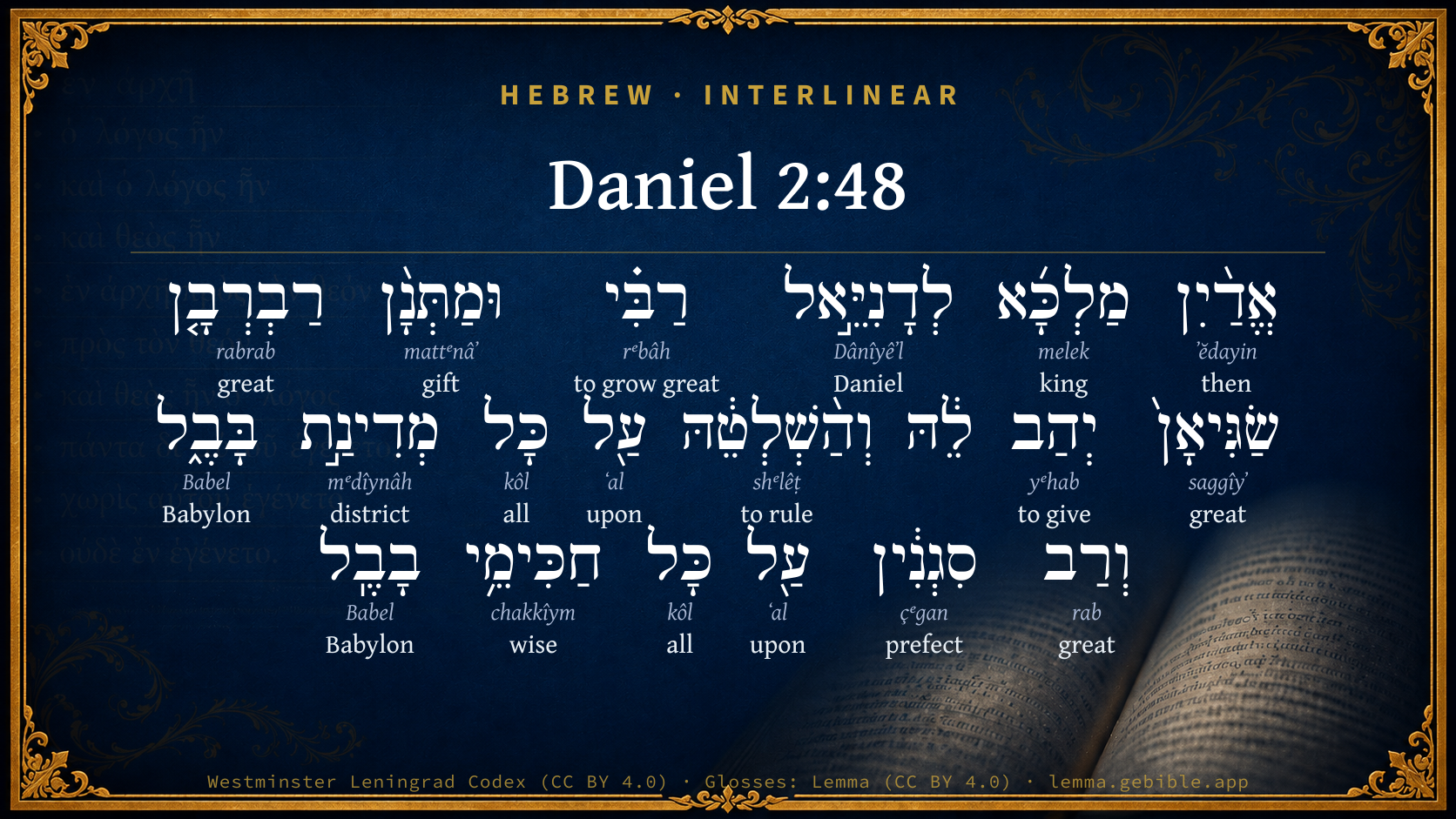
Hebrew (Westminster Leningrad Codex) Daniel 2:48 appears in the Hebrew Old Testament. The text above is from the Westminster Leningrad Codex. Each word links to its Strong’s number, a concise gloss, and parsing drawn from the Open Scriptures Hebrew Bible morphology. Click any word for its full Brown-Driver-Briggs (BDB) entry.
Download image
Cite this verse

Daniel 2:48 (World English Bible). Public Domain. Lemma interlinear Bible study tool, https://lemma.gebible.app/v/daniel/2/48.

Show BibTeX & RIS
BibTeX
RIS
English Translation
Then the king made Daniel great, and gave him many great gifts, and made him to rule over the whole province of Babylon, and to be chief governor over all the wise men of Babylon.
World English Bible · Public Domain
Highlights
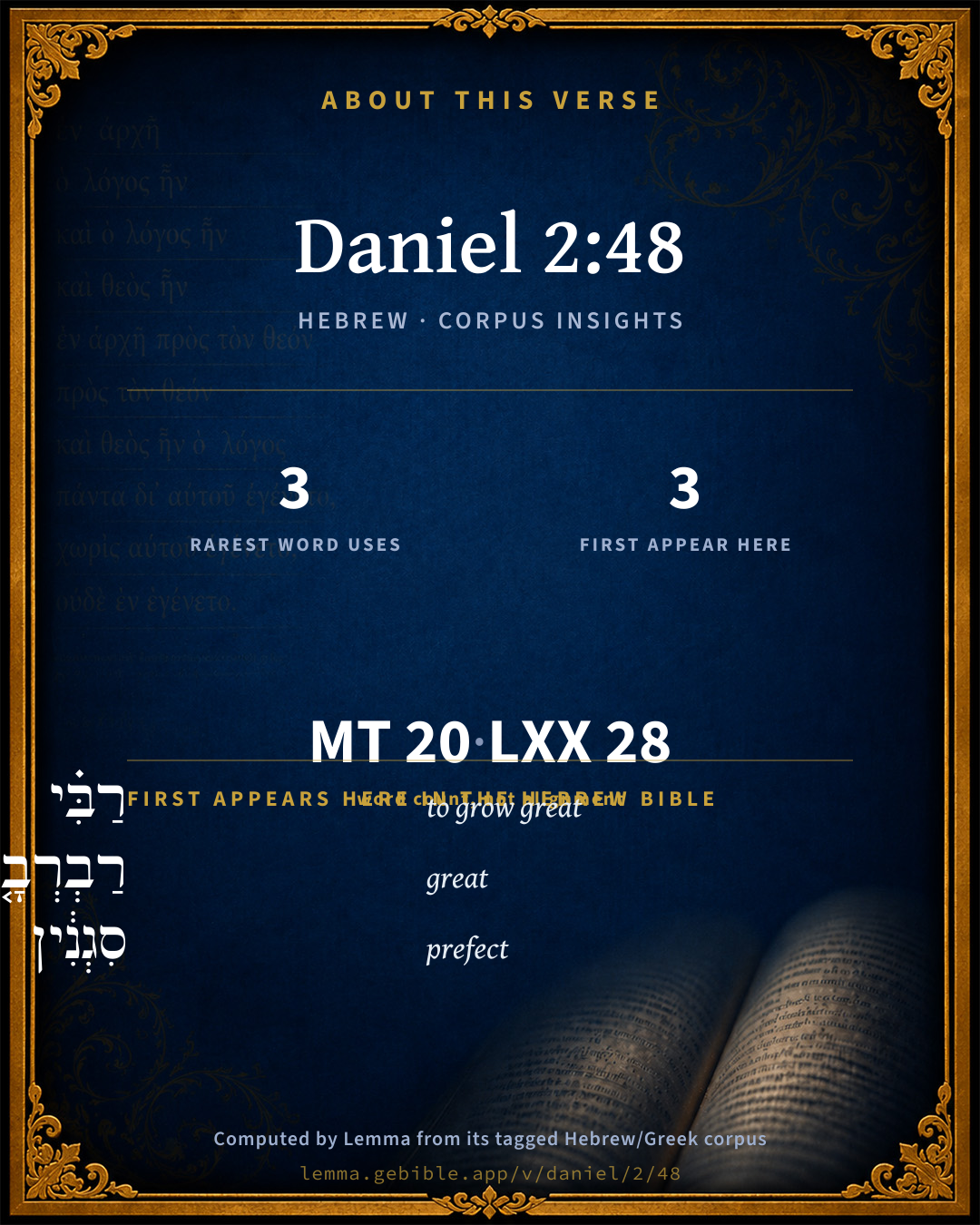
  • 3 first appearances in the Hebrew Bible
Full analysis ↓
Download a study sheet

One document with this verse’s original text, its word-by-word gloss line, the meaning frame, cross-references with their text, attributed commentary, and full source and license credits — printable, and it pastes into notes with its structure intact.

This verse Autodidact and up

Study sheet (.html) Plain text (.txt)

A passage Seminary Student

Up to 50 verses in one chapter. A passage sheet keeps up to 6 commentary sources and 12 cross-references per verse, in the order this page ranks them, and says so on the sheet whenever that leaves anything out. Ask for a single verse and you get the Autodidact verse sheet above.

Everything on this page stays free to read, with no account — the sheet is a download of what is already on screen, not access to it.

Want to remove ads? Support Godless Engineer
Compare translations 3

The same verse in 3 English versions, stacked beneath the original-language interlinear above. Click any original word for its lexicon entry.

Each is an independent rendering of the whole verse — the interlinear is not word-aligned to these translations.

Highlighted words mark where these versions differ — a whole-verse word diff, not a word-by-word alignment.

  • World English Bible Public Domain
    Then the king made Daniel great, and gave him many great gifts, and made him to rule over the whole province of Babylon, and to be chief governor over all the wise men of Babylon.
  • King James Version Public Domain
    Then the king made Daniel a great man, and gave him many great gifts, and made him ruler over the whole province of Babylon, and chief of the governors over all the wise men of Babylon.
  • unfoldingWord Literal Text CC BY-SA 4.0
    Then the king gave Daniel high honors and gave him many great gifts, and he made him ruler over the whole province of Babylon and chief prefect over all the wise men of Babylon.

unfoldingWord Literal Text — © unfoldingWord, licensed CC BY-SA 4.0. Word-aligned USFM3 via Door43 (git.door43.org/unfoldingWord/en_ult).

Versions to compare (up to 4)

3 of 4 selected

Show all 18 translations

Every available English version of this verse, each an independent rendering of the whole verse.

  • World English Bible Public Domain
    Then the king made Daniel great, and gave him many great gifts, and made him to rule over the whole province of Babylon, and to be chief governor over all the wise men of Babylon.
  • Berean Standard Bible Public Domain
    Then the king promoted Daniel and gave him many generous gifts. He made him ruler over the entire province of Babylon and chief administrator over all the wise men of Babylon.
  • Majority Standard Bible Public Domain
    Then the king promoted Daniel and gave him many generous gifts. He made him ruler over the entire province of Babylon and chief administrator over all the wise men of Babylon.
  • King James Version Public Domain
    Then the king made Daniel a great man, and gave him many great gifts, and made him ruler over the whole province of Babylon, and chief of the governors over all the wise men of Babylon.
  • American Standard Version (1901) Public Domain
    Then the king made Daniel great, and gave him many great gifts, and made him to rule over the whole province of Babylon, and to be chief governor over all the wise men of Babylon.
  • Revised Version (1885) Public Domain
    Then the king made Daniel great, and gave him many great gifts, and made him to rule over the whole province of Babylon, and to be chief governor over all the wise men of Babylon.
  • Geneva Bible (1599) Public Domain
    So the King made Daniel a great man, and gaue him many and great giftes. Hee made him gouernour ouer the whole prouince of Babel, and chiefe of the rulers, and aboue all the wise men of Babel.
  • Douay-Rheims (1899) Public Domain
    Then the king advanced Daniel to a high station, and gave him many and great gifts: and he made him governor over all the provinces of Babylon, and chief of the magistrates over all the wise men of Babylon.
  • Young's Literal Translation Public Domain
    Then the king hath made Daniel great, and many great gifts he hath given to him, and hath caused him to rule over all the province of Babylon, and chief of the perfects over all the wise men of Babylon.
  • Literal Standard Version CC BY-SA 4.0
    Then the king has made Daniel great, and many great gifts he has given to him, and has caused him to rule over all the province of Babylon, and chief of the prefects over all the wise men of Babylon.
  • Unlocked Literal Bible CC BY-SA 4.0
    Then the king made Daniel highly honored and gave him many wonderful gifts. He made him ruler over the whole province of Babylon. Daniel became chief governor over the wisest men of Babylon.
  • unfoldingWord Literal Text CC BY-SA 4.0
    Then the king gave Daniel high honors and gave him many great gifts, and he made him ruler over the whole province of Babylon and chief prefect over all the wise men of Babylon.
  • Darby Bible Public Domain
    Then the king made Daniel great, and gave him many great gifts, and made him ruler over the whole province of Babylon, and chief of the governors over all the wise men of Babylon.
  • World Messianic Bible Public Domain
    Then the king made Daniel great and gave him many great gifts, and made him rule over the whole province of Babylon and to be chief governor over all the wise men of Babylon.
  • Webster's Bible Public Domain
    Then the king made Daniel a great man, and gave him many great gifts, and made him ruler over the whole province of Babylon, and chief of the governors over all the wise men of Babylon.
  • Free Bible Version CC BY-SA 4.0
    Then the king promoted Daniel to a high position and gave him many expensive gifts, making him governor over the whole province of Babylon and head of all the wise men of Babylon.
  • Bible in Basic English Public Domain
    Then the king made Daniel great, and gave him offerings in great number, and made him ruler over all the land of Babylon, and chief over all the wise men of Babylon.
  • JPS Tanakh (1917) Public Domain
    Then the king made Daniel great, and gave him many great gifts, and made him to rule over the whole province of Babylon, and to be chief prefect over all the wise men of Babylon.

Literal Standard Version (2020), Covenant Press — licensed CC BY-SA 4.0. Text via the HelloAO Bible API (eBible.org). Unlocked Literal Bible (unfoldingWord) — licensed CC BY-SA 4.0. Text via the HelloAO Bible API (eBible.org). unfoldingWord Literal Text — © unfoldingWord, licensed CC BY-SA 4.0. Word-aligned USFM3 via Door43 (git.door43.org/unfoldingWord/en_ult). Free Bible Version, Dr. Jonathan Gallagher — licensed CC BY-SA 4.0. Text via the HelloAO Bible API (eBible.org).

Word by word

More ways to search: Search by grammar → Find every occurrence → Compare this word →

Practice this passage: Drill this verse → Learn its vocabulary →

וּמַתְּנָ֨ן
mattᵉnâʼ
H4978
“and · gifts”
Adjective, C + Noun, Common, Feminine, Plural, Absolute
Part of Speech
Adjective + Noun
Type
Common
Gender
Feminine
Number
Plural
State
Absolute
Full BDB Definition

Origin: corresponding to H4979

TWOT: 2880a

gift
  1. אֱדַ֨יִן ʼĕdayin H116 “then” Adjective, D
  2. מַלְכָּ֜א melek H4430 “king · the” Adjective, N, Common + Particle, Definite Article
  3. לְדָנִיֵּ֣אל Dânîyêʼl H1841 “to/for · Daniel” Adjective, R + Noun, Proper
  4. רַבִּ֗י rᵉbâh H7236 “to grow great” Adjective, V, Plural
  5. רַבְרְבָ֤ן rabrab H7260 “great” Adjective, A
  6. שַׂגִּיאָן֙ saggîyʼ H7690 “great” Adjective, A
  7. יְהַב yᵉhab H3052 “to give” Adjective, V, Plural
  8. וְהַ֨שְׁלְטֵ֔הּ shᵉlêṭ H7981 “and · to rule · him” Adjective, C + Verb, Hiphil, Perfect, 3rd Person, Masculine, Singular + Suffix, Personal, 3rd Person, Masculine, Singular
  9. עַ֖ל ʻal H5922 “upon” Adjective, R
  10. כָּל kôl H3606 “all of” Adjective, N, Common
  11. מְדִינַ֣ת mᵉdîynâh H4083 “district of” Adjective, N, Common
  12. בָּבֶ֑ל Babel H895 “Babylon” Adjective, N
  13. וְרַב rab H7229 “and · great of” Adjective, C + Adjective, Adjective, Masculine, Singular, Construct
  14. סִגְנִ֔ין çᵉgan H5460 “prefects” Adjective, N, Common
  15. עַ֖ל ʻal H5922 “upon” Adjective, R
  16. כָּל kôl H3606 “all of” Adjective, N, Common
  17. חַכִּימֵ֥י chakkîym H2445 “wise men of” Adjective, N, Common
  18. בָבֶֽל Babel H895 “Babylon” Adjective, N

About this verse

These counts appear in no published source. They are computed here, from the morphology-tagged text and Lemma’s own curated glosses. What Lemma adds →

20
words
16
distinct lemmas
Prophets
section

Notable vocabulary

The rarest word here is וּמַתְּנָ֨ן gift H4978 — appearing just 3 times in the whole Hebrew Bible.

First appearance in Scripture

These words make their first canonical appearance in the Hebrew Bible here:

  • רַבִּ֗י to grow great H7236
  • רַבְרְבָ֤ן great H7260
  • סִגְנִ֔ין prefect H5460

Shared distinctive vocabulary

וּמַתְּנָ֨ן gift H4978 occurs in 3 verses of the Hebrew Bible. Also found in:

Grammatical profile

  • 1 verb
  • 2 nouns
  • 16 adjectives
  • 1 particle

Verb forms

  • וְהַ֨שְׁלְטֵ֔הּ Hiphil · Perfect

Repetition

Words recur within this verse — often emphatic in Hebrew:

  • עַ֖ל upon H5922 ×2
  • כָּל all H3606 ×2
  • בָּבֶ֑ל Babylon H895 ×2

Hebrew & Septuagint length

In English translation the verse runs 35 words from the Hebrew and 33 from the Septuagint (LXX English) — closely comparable.

A rough comparison of the two English renderings, which tokenize alike — not a word-level alignment.

Word counts can differ between the Hebrew and the Greek without any difference in meaning — e.g. the Hebrew direct-object marker אֵת has no separate Greek word, and Greek often adds the article ὁ.

In the original languages it is 20 Hebrew tokens and 28 Greek tokens — but the two are counted differently (Hebrew bundles its prefixes and suffixes into one token; the Greek is in lemma form), so that isn’t a like-for-like length.

Cross-references

18

Topical passages linked to Daniel 2:48 in the Treasury of Scripture Knowledge — connected by theme and wording, ordered by reader-vote popularity; previews shown in the World English Bible.

  • Daniel 2:6 But if you show the dream and the interpretation of it, you shall receive of me gifts and rewards and great honor: therefore show me the dream and the interpretation of it.
  • Daniel 4:9 Belteshazzar, master of the magicians, because I know that the spirit of the holy gods is in you, and no secret troubles you, tell me the visions of my dream that I have seen, and the interpretation of it.
  • Daniel 5:11 There is a man in your kingdom, in whom is the spirit of the holy gods; and in the days of your father light and understanding and wisdom, like the wisdom of the gods, were found in him; and the king Nebuchadnezzar your father, the king, [I say], your father, made him master of the magicians, enchanters, Chaldeans, and soothsayers;
  • Genesis 41:39–43 Pharaoh said to Joseph, "Because God has shown you all of this, there is none so discreet and wise as you.
  • Daniel 5:16 But I have heard of you, that you can give interpretations, and dissolve doubts; now if you can read the writing, and make known to me the interpretation of it, you shall be clothed with purple, and have a chain of gold about your neck, and shall be the third ruler in the kingdom.
  • Daniel 5:29 Then commanded Belshazzar, and they clothed Daniel with purple, and put a chain of gold about his neck, and made proclamation concerning him, that he should be the third ruler in the kingdom.
  • Numbers 22:16–17 They came to Balaam, and said to him, Thus says Balak the son of Zippor, Please let nothing hinder you from coming to me:
  • Numbers 24:11 Therefore now flee you to your place: I thought to promote you to great honor; but, behold, Yahweh has kept you back from honor.
  • 1 Samuel 17:25 The men of Israel said, Have you seen this man who is come up? surely to defy Israel is he come up: and it shall be, that the man who kills him, the king will enrich him with great riches, and will give him his daughter, and make his father's house free in Israel.
  • 1 Samuel 25:2 There was a man in Maon, whose possessions were in Carmel; and the man was very great, and he had three thousand sheep, and a thousand goats: and he was shearing his sheep in Carmel.
  • 2 Samuel 19:32 Now Barzillai was a very aged man, even eighty years old: and he had provided the king with sustenance while he lay at Mahanaim; for he was a very great man.
  • 2 Kings 5:1 Now Naaman, captain of the host of the king of Syria, was a great man with his master, and honorable, because by him Yahweh had given victory to Syria: he was also a mighty man of valor, [but he was] a leper.
  • Job 1:3 His possessions also were seven thousand sheep, three thousand camels, five hundred yoke of oxen, five hundred she-donkeys, and a very great household; so that this man was the greatest of all the children of the east.
  • Jeremiah 5:5 I will get me to the great men, and will speak to them; for they know the way of Yahweh, and the law of their God. But these with one accord have broken the yoke, and burst the bonds.
  • Daniel 3:1 Nebuchadnezzar the king made an image of gold, whose height was sixty cubits, and the breadth of it six cubits: he set it up in the plain of Dura, in the province of Babylon.
  • Daniel 3:12 There are certain Jews whom you have appointed over the affairs of the province of Babylon: Shadrach, Meshach, and Abednego; these men, O king, have not regarded you: they don't serve your gods, nor worship the golden image which you have set up.
  • Daniel 3:30 Then the king promoted Shadrach, Meshach, and Abednego in the province of Babylon.
  • Daniel 6:1–2 It pleased Darius to set over the kingdom one hundred twenty satraps, who should be throughout the whole kingdom;

Cross-references courtesy of OpenBible.info (CC BY 4.0).

Hebrew and Greek witnesses Masoretic Hebrew ↔ Greek Septuagint

The same verse in the two great witnesses to the Old Testament, shown verse-for-verse.

These are two independent witnesses, not word-aligned to each other, and the Septuagint is shown in lemma (dictionary) form.

Hebrew Daniel 2:48 Masoretic · Westminster Leningrad Codex

אֱדַ֨יִן מַלְכָּ֜א לְדָנִיֵּ֣אל רַבִּ֗י וּמַתְּנָ֨ן רַבְרְבָ֤ן שַׂגִּיאָן֙ יְהַב לֵ֔הּ וְהַ֨שְׁלְטֵ֔הּ עַ֖ל כָּל מְדִינַ֣ת בָּבֶ֑ל וְרַב סִגְנִ֔ין עַ֖ל כָּל חַכִּימֵ֥י בָבֶֽל

Then the king made Daniel great, and gave him many great gifts, and made him to rule over the whole province of Babylon, and to be chief governor over all the wise men of Babylon.

World English Bible · Public Domain

Greek LXX Daniel 2:48 Septuagint · lemma form

τότε ὁ βασιλεύς ναβουχοδονοσορ δανιηλ μεγαλύνω καί δίδωμι δωρεά μέγας καί πολύς καταἵστημι ἐπί ὁ πρᾶγμα ὁ βαβυλωνία καί ἀποδεικνύω αὐτός ἄρχων καί ἡγέομαι πᾶς ὁ σοφιστής βαβυλωνία

And the king promoted Daniel, and gave him great and abundant gifts, and set him over the whole province of Babylon, and made him chief satrap over all the wise men of Babylon.

LXX2012 (modern English Septuagint) · Public Domain

On this verse, The Pulpit Commentary discusses the Septuagint’s reading. Read the note in Commentary ↓

Hebrew: Westminster Leningrad Codex (CC BY 4.0). Greek: Septuagint (public domain); English from LXX2012 (modern English Septuagint) (Public Domain). How the Septuagint differs from the Hebrew →

Commentary

Notes on Daniel 2:48 from classic Christian and Jewish commentators (each source and its license shown beneath its notes). The classic Christian expositions comment on the surrounding passage and are grouped to its opening verse, so a note may address several verses; the Jewish commentaries on the Tanakh (Rashi and others) are per-verse, so they appear only where the commentator wrote on this verse.

Lemma curates 59 commentaries, every one of them public domain or Creative Commons licensed, each selected and text-cleaned for this edition rather than reprinted as found. About our sources →

Trapp's Complete Commentary

John Trapp

Dan 2:48 Then the king made Daniel a great man, and gave him many great gifts, and made him ruler over the whole province of Babylon, and chief of the governors over all the wise [men] of Babylon.

Ver. 48. Then the king made Daniel a great man.] This was, saith Broughton, about two years before the captivity of Jeconiah, when the good figs were to be brought to Babylon; an encouragement for the faithful to go willingly, their own nobles being so advanced in that court.

And gave him many great gifts.] This Porphyry, that atheist, snarleth at, viz., that Daniel received these rewards and honours. But why might he not, since the gifts he could bestow upon the poor captives, his fellow brethren, and the honours he could also improve to their benefit, himself did neither ambitiously seek them, nor was vainly puffed up by them. A noble pair of like English spirits we have lately had among us, Dr Ussher and Dr Preston, contemporaries and intimate friends to one another. The former, {a} when he was consecrated Bishop of Meath in Ireland, had this anagram of his name given him, "JAMES MEATH, I am the same." The latter, {b} when he might have chosen his own mitre, but denied all preferment that courted his acceptance, had this anagram made of him, "JOHANNES PRESTONIUS, En stas pius in honore." Behold, you stand holy, in honour.

{a} Dr Bernard in his Life.

{b} Mr Fuller’s Church History, fol. 119.

John Trapp, A Commentary or Exposition upon All the Books of the Old and New Testament (1647–1656) — public domain. Text from a community e-Sword module.

Tyndale Open Study Notes

Tyndale Open Resources

2:48 Daniel was made ruler over Babylon as the king’s deputy (cp. Gen 41:37-46).

Tyndale Open Study Notes — © Tyndale Open Resources, licensed CC BY-SA 4.0. Text via the HelloAO Bible API.

Ibn Ezra

Rabbi Abraham ibn Ezra

[Daniel 2:48] Edayin malka... rabbi (אֱדַיִן מַלְכָּא... רַבִּי - Then the king... elevated): Elevated (rabbi - רַבִּי): [Means] He made great/elevated (gadal - גָּדַל). There are those who say that province (medinat - מְדִינַת) [as in "province of Babylon"] means a district/province (machoz - מָחוֹז). If so, how could Ahasuerus have one hundred and twenty-seven provinces (medinah)? [Esther 1:1]. And [even] a king who has [only] ten [such districts] is [considered] a great king! And it is written: “...robbery, and perversion of justice and righteousness you see in the province (ba-medinah - בַּמְּדִינָה)” [Ecclesiastes 5:7] – [this context suggests] that the meaning is the capital city (ʿir ha-meluchah - עִיר הַמְּלוּכָה). And it is written [Aramaic]: “in the province (medinata) of Media” [Ezra 6:2]. Furthermore: “And I was in Shushan the capital (ha-birah - הַבִּירָה), which is in Elam the province (ha-medinah - הַמְּדִינָה)” [Daniel 8:2]. And if Elam is a [standard] province/district (machoz), why did it not say “in the province of Elam” (b'medinat ʿElam - בִּמְדִינַת עֵילָם) just as they interpreted “province of Babylon” (medinat Bavel - מְדִינַת בָּבֶל)?!

[Daniel 2:48] v'rav signin (וְרַב־סִגְנִין - and chief prefect): [The word signin, prefects/governors] is like [the Hebrew cognate s'ganim in passages such as]: “And he shall come upon rulers (s'ganim - סְגָנִים)” [Isaiah 41:25].

Ibn Ezra on the Tanakh — English translations: “Sefaria Community Translation” (CC0 1.0 (public-domain dedication)); “Yalkut, Sifsei Chachomim Chumash, Metsudah Publications, 2009” (CC BY 4.0); and “Commentary of Ibn Ezra on Isaiah - trans. by M. Friedlander, 1873” (public domain). Text via Sefaria.

Geneva Bible (1599)

Geneva Bible translators

Not that the Prophet was desirous of gifts or honor, but because by this means he might relieve his poor brethren, which were grievously oppressed in this their captivity, and also he received them, lest he should offend this cruel king, which willingly gave them.

Geneva Bible (1599) marginal notes — public domain. Text via Bolls.life.

Jamieson, Fausset & Brown

Robert Jamieson, A. R. Fausset & David Brown

One reason for Nebuchadnezzar having been vouchsafed such a dream is here seen; namely, that Daniel might be promoted, and the captive people of God be comforted: the independent state of the captives during the exile and the alleviation of its hardships, were much due to Daniel.

Jamieson, Fausset & Brown — Commentary Critical and Explanatory on the Whole Bible (1871) — public domain (CC PDM 1.0). Text via the HelloAO Bible API.

Adam Clarke's Commentary

Verse 48. Made Daniel a great man] By,

1. Giving him many rich gifts.

2. By making him governor over the whole province of Babylon. And,

3. By making him the chief or president over all the wise men.

Adam Clarke's Commentary on the Bible (1810–1826) — public domain. Text from a community e-Sword/MySword module.

John Calvin's Commentaries

Here also another point is added, namely, how King Nebuchadnezzar raised God’s Prophet and adorned him with the highest honors. We have spoken of that preposterous worship which he himself displayed and commanded others to offer. As far as concerns gifts and the discharge of public duties, we can neither condemn Nebuchadnezzar for honoring God’s servant, nor yet Daniel for suffering himself to be thus exalted. All God’s servants ought to take care not to make a gain of their office, and we know how very pestilent the disease is when prophets and teachers are addicted to gain, or easily receive the gifts offered them. For where there is no contempt of money, many vices necessarily spring up, since all avaricious and covetous men adulterate God’s word and makes, traffic of it. (2 Corinthians 2:17.) Hence all prophets and ministers of God ought to watch against being covetous of gifts. But as far as Daniel is concerned, he might receive what the king offered him just as Joseph could lawfully undertake the government of the whole of Egypt. (Genesis 41:40.) There is no doubt that Daniel had other views than his private and personal advantage. We must not believe him covetous of gain while he bore his exile so patiently, and, besides this, when at the hazard of his life he had preferred abstinence from the royal food to alienating himself from the people of God. As he manifestly preferred the shame of the cross by which God’s people were then oppressed, to opulence, luxury, and honor, who will think him blinded by avarice through receiving gifts? But since he saw the sons of God miserably and cruelly oppressed by the Chaldeans, he wished as far as he could to succor them in their miseries. As he well knew this would afford some consolation and support to his race, he allowed himself to be made prefect of a province. And the same reason influenced him to seek some place of authority for his companions, as follows, —

John Calvin's Commentaries (1540-1563) — public domain. Text from the Calvin Translation Society English edition (1840s-50s) via the Christian Classics Ethereal Library (ccel.org). Calvin's coverage is partial (roughly two-thirds of the Bible); uncommented books and verses are honest gaps, never fabricated. The 19th-century editor's footnotes and remarks are omitted so the notes are faithfully Calvin's own voice.

Ellicott's Commentary for English Readers

(48) The Province.—According to Dan_3:2, the Babylonian empire consisted of several provinces, each of which had its own ruler or Shilton. Daniel became ruler of this one province of Babylon. What the other office was to which he was advanced may possibly be explained when further discoveries have been made. Hitherto it has been inexplicable.

A Bible Commentary for English Readers, edited by Charles John Ellicott (1878–1897) — public domain. Text from a community e-Sword module.

The Cambridge Bible for Schools and Colleges

gen. ed. J. J. S. Perowne

48. made Daniel a great man] made Daniel great, i.e. advanced, promoted him.

made him to rule, &c.] i.e., probably, made him administrator of the principal province of the empire, in which the capital was; opp. to the local ‘provinces,’ Dan_3:2.

and (appointed him) chief of the praefects over, &c.] The idea appears to be (Hitz., Keil, Pusey, p. 20) that each division, or class (Dan_2:2), of the ‘wise men’ had its own head; and Daniel was promoted to have the supervision of them all. Cf. Dan_4:9, Dan_5:11 (‘made him chief of the magicians, enchanters, Chaldeans, and determiners of fates’). ‘Praefect’ (segan, Heb. sâgân) recurs Dan_3:2-3; Dan_3:27, Dan_6:7; and is found also in Jer_51:23; Jer_51:28; Jer_51:57; Eze_23:6; Eze_23:12; Eze_23:23; Isa_41:25 (A.V. in Jer., Ez. rulers, in Is. princes; R.V. always deputy or ruler). It is a Hebraized form of the Assyrian shaknu (from shakânu, to appoint), a word used constantly in the inscriptions of the ‘praefect’ appointed by the Assyrian king to govern a conquered district, or a city. Here the term is used more generally, as it is also in Ezr_9:2, Neh_2:16; Neh_4:14; Neh_4:19; Neh_5:7; Neh_5:17; Neh_7:5; Neh_12:40; Neh_13:11, of certain civic officials in Jerusalem (A.V., R.V., ‘ruler’).

On the historical difficulty arising out of this statement respecting Daniel, see the Introd. p. lv, not[212].

[212] ote Cf. Ryle, Canon of the O. T., p. 104 ff.

The Cambridge Bible for Schools and Colleges (gen. ed. J. J. S. Perowne; Cambridge University Press, 1878–1918) — public domain. Text from a community e-Sword module.

John Gill's Exposition

Then the king made Daniel a great man,.... Advanced him to posts of great honour and dignity he was a great man before in spiritual things, in which he was made great by the Lord; and now he was made a great man in worldly things, through the providence of God; those that honour him he will honour:

and gave him many great gifts: gifts great in value, and many in number; rich garments, gold, silver, precious stones, and large estates to support his honour and grandeur; and which Daniel accepted of, not merely for his own use, but to do good with to his poor brethren the Jews in captivity:

and made him ruler over the whole province of Babylon; the whole monarchy was divided into several provinces, over each of which was a deputy governor; this of Babylon was the chief of them, Babylon being the metropolis of the empire; the whole government of which, and all belonging to it, was given to Daniel; a proof of the king's high esteem for him:

and chief of the governors over all the wise men of Babylon; here was an university consisting of several colleges, over each of which there was a governor, and Daniel was the president of them all; or the principal or chancellor of the university: this office he might accept of, that he might have an opportunity of inculcating true knowledge, and of checking and correcting what was impious and unlawful.

John Gill's Exposition of the Whole Bible (1746–1763) — public domain (CC PDM 1.0). Text via the HelloAO Bible API.

Albert Barnes' Notes on the Bible

There the king made Daniel a great man - That is, he gave him an honorable appointment; he so honored him that he was regarded as a great man. He was really made great by the grace of God, and the extraordinary favor which God had bestowed upon him, but the estimate which the king had of his greatness was shown by the tokens of the royal favor. “And gave him many great gifts.” This is a common way of showing esteem in the East. The estimate in which one holds another is evinced by the variety and richness of the presents conferred on him. Hence, all persons of distinction expect gifts of those who approach them as expressive of their regard for them, and of the esteem in which they are held. Compare Dan 2:6.

And made him ruler over the whole province of Babylon - Chaldee, השׁלטה hasheleṭēh - caused him to preside over, or to rule over, from the verb שׁלט shelaṭ, “to rule,” and commonly applied to one who rules as a prince, or in an elevated office. From this word the terms “sultan” and “sultana” are derived.

And chief of the governors over all the wise men of Babylon - This would seem to be an appointment which did not pertain to him as governor of the province of Babylon, or as presiding in the capital, but was a separate appointment, and, therefore, an additional mark of favor. The phrase “chief of the governors” would seem to imply that the magi of Babylon were disposed in certain orders or classes, each of which had its appropriate head, like the head of a college or university. Daniel was placed over the whole as the president, principal, or chancellor. It had been the policy of Nebuchadnezzar to assemble at the capital the principal talent and learning of the realm. Compare the notes at Dan 1:18-20; Dan 2:2. Daniel thus, in both these stations of honor at an early period of life, though recently an unknown stranger, and a captive; was exalted to the highest honors which could be conferred on a subject, and raised to posts of distinction which would usually be regarded as the highest rewards which could be obtained by a long life of devotedness to the welfare of the country.

Albert Barnes' Notes on the Bible (1834–1885) — public domain. Text from a community e-Sword/MySword module.

Haydock's Catholic Bible Commentary

Provinces, or that of Babylonia, which was the first. --- Wise men. This would not engage him in any idolatrous practices.

George Leo Haydock (1774–1849), Haydock's Catholic Family Bible and Commentary, 1859 edition — public domain. Excludes Psalms (Douay-Rheims chapter numbering differs from Protestant) and Deuterocanonical books (Catholic canon only).

Matthew Poole's English Annotations

Made Daniel a great man, Chald. rabbi, magnified him.

Many great gifts; an estate suitable to his honour.

Ruler over the whole province of Babylon; gnal col medina over the chief province of Babylon, which was head, because of the metropolis; the word is also Arabic, and therefore used in Spain at this day.

Chief of the governors over all the wise men of Babylon: see Dan 4:9. Daniel was chief of them in wisdom, for he could unfold what none of the wise men could. Again, he was chief in place and power, he had the rule and inspection of them which were students and professors of wisdom and learning, into their studies and manners, like a perpetual lord chancellor. Not that this holy prophet gave any encouragement to them in their unlawful arts and divinations, but rather discouraged and corrected them, leaching them the knowledge of the true God: thus doth the true religion top all the world, and make the grandeur thereof stoop to it, for it is the wisdom of God and the power of God.

Matthew Poole's English Annotations on the Holy Bible (1683–1685) — public domain. Text from a community e-Sword/MySword module.

Whedon's Commentary on the Bible

Daniel D. Whedon

48, 49. If this means that Daniel was really appointed viceroy, or shalit, of the province and official head (rab?) of the order of Magi, he must very soon have lost that position (Dan_2:13), which might have been arbitrarily given him out of temporary spite toward the Babylonian priests and taken from him when the king and these ecclesiastics became reconciled. (See note Dan_2:5.) Zockler says, “What really was conferred on the prophet was probably merely a decisive influence over the administration of the province of Babylon.” For a time, at least, Daniel was “in the gate of the king.” This perhaps may only mean that he abode at the royal court, though, strictly speaking, the “gate” was the most sacred part of the temple or palace, and was, therefore, used for the highest judicial functions (Trumbull, Threshold Covenant). At Persepolis (Susa) on the doorways the king is represented rendering justice at the palace gate. A Babylonian tablet written in the twenty-eighth year of Nebuchadnezzar contains the challenge of a certain person to his opponent to bring his witnesses to the gate of the house Bel-idden, and testify, and so the most sacred city of the empire was named Babylon, “the gate of the gods.” The high court of Turkey is still called the Sublime Porte, or Exalted Gateway.

Daniel D. Whedon (gen. ed.), Commentary on the Old and New Testaments (1874–1909) — public domain. Text from a community e-Sword module.

The Pulpit Commentary

Vers. 48, 49. Then the king made Daniel a great man, and gave him many great gifts, and made him ruler over the whole province of Babylon, and chief of the governors over all the wise men of Babylon. Then Daniel requested of the king, and he set Shadrach, Meshach, and Abed-nego, over the affairs of the province of Babylon: but Daniel sat in the gate of the king. In the Greek versions there is not much to be observed. The Septuagint renders the last clause of ver. 48 "chief and ruler (arconta kaimenon) of all the wise men of Babylon," reading us gan instead of signeen. Theodotion"s is a fairly accurate rendering of the Massoretic text, as is also Jerome. The Peshitta renders this clause, "He made Daniel head over all the mighty men (rabiheela), and over all the wise men of Babylon." The translator must have inserted, or found before him inserted, the preposition l (el), "over," between tab and signeen , evidently a false reading, due to ignorance of the form Babylonianand Assyrian titles assumed. The word g; s; or gs:, was originally maintained to be Persian. Hitzig connects it with an Arabic root, sajan, but the true derivation is now found to be shokun (Assyrian), governor. " It appears in Hebrew in Jeremiah, Ezekiel, and the deutero-Isaiah, as well as in Ezra and Nehemiah, showing the unlikelihood of any Persian derivation. Hitzig appears to regard Daniel as made the king"s regent over the whole empire of Babylon; but this is not at all the meaning of the words. We must not be led away to believe that all this promotion befell Daniel at once; the statement here is summary, and includes many steps, and perhaps several years. Even at the utmost of his exaltation, he is not represented here as being made the regent of Nebuchadnezzar. as Hitzig would maintain. It is really only the province of Babylon, if we may not restrict the meaning of the word medeena even further, and regard it as equivalent to "city." We admit that this restriction of significance is not supported by the versions, but the fact that in so many cases we have traces of Syriac influences in Daniel, and that medeena means in Syriac "a city," renders this supposition not an impossible one. The precise limits of the province of Babylon in the days of Nebuchadnezzar cannot be settled. In later times it consisted mainly of the territory between the Tigris and the Euphrates, south of the murus Medius, with some territory between the latter river and the desert (Professor Rawlinson). It may be that the satrapy of Babylon was of considerably less extent. The word hashleet means "to cause to rule." This would be made true by making Daniel overseer in any department of the government of the province. It is not necessary to maintain that Nebuchadnezzar made Daniel satrap of Babylonia; at the same time, shalet is the title given to the satrap of Babylon. M. Lenormant thinks there must be an interpolation when Daniel is said to be set over all the governors of the wise men in Babylon. His arguments are founded mainly on the belief that the castes of astrologers, soothsayers, and magians all that were included in the class of hakmeen were hereditary, a thing which has not been proved. A difficulty has been urged by Lenormant that Daniel, as a zealous Jew, could not become head of a college of idolatrous priests. While there may be some force in this, one must beware of testing the actions of a Jew of the sixth century B.C. by criteria and principles applicable to one of later times. At all events, this militates strongly against the idea that the Book of Daniel was written in the age of the Maccabees. When we see Daniel thus, a youth of probably two or three and twenty, promoted ultimately to be over the province of Babylon, and to be one of the king"s most trusted councillors, Ezekiel"s saying, which places him between Noah and Job, (Eze_14:14) becomes natural. Daniel had already been some years in the king"s privy council before Ezekiel was carried into captivity. We do not know how long after the beginning of his prophetic work we are to date the prophecy of the fourteenth chapter it may have been eight or nine years after. But even if it were only six years, Daniel would by this time have been for eleven years a member of the privy council of the Babylonian monarch, and possibly for a considerable portion of that period governor of the province of Babylon. At any rate, Daniel would bulk very large in the eyes of the poor Jewish captives. Though contemporary, he was so far removed from his fellow-countrymen in social position, that his goodness and greatness would be subject to similar exaggeration to that which happens to heroes of a long-past age. A better argument may be drawn from the fact that sagan is always a civil title. The insertion of the word hakmeen might easily be due to some scribe who thought that as Daniel was one of the wise men, head of them would be more likely than head of the civil governors of the province, and placed it as a suggestion of what ought to take the place of signeen; a copyist following, inserted it in the text. If we compare this chapter with the sixth, we find Daniel one of three who were to receive the accounts of the various governors. Daniel was thus, if we may apply to his office a title drawn from our own political usage, secretary of state for Babylonia. It is characteristic of Daniel, that having been made rich and great by the king, and having received many gifts at the hand of the king, does not satisfy him; he entreats favour for his friends also. Hitzig"s objection that Daniel would have the appointment of his subordinates, would only be valid if Daniel had been made satrap If his shaletship extended merely to some one department of governmental work and that seems to follow from the last clause of this verse it isunlikely that he would have this power. Shadrach, Meshach, and Abednego are set over the "business" (el,eedt,") of the province of Babylon. This word, in Targumic Aramaic, is very generally used of constructions where labour is employed. We may regard their position as one something like being members of a labour bureau. Nebuchadezzar was a very great builder, so much so that almost all the bricks that have been got in Babylon are stamped with his name. While his Ninevite predecessors record in their inscriptions their campaigns, the kings they conquered, and the cities they sacked, the inscriptions of Nebuchadnezzar are almost entirely occupied with the various structures temples, palaces, ramparts, and canals which he had caused to be made. These buildings would need perpetual surveying. Further, as a great military genius, roads and canals would also be. important objects, in the carrying out of which captives would be employed. And the products of this enforced labour would have to be surveyed carefully. This seems more probable than that Daniel got these three friends appointed to do the work he himself was appointed to. The only plausible suggestion against this would be that Daniel desired that his friends be set jointly over the province of Babylon instead of himself, and, for his own part, he preferred to remain in the gate of the king. We know that those who wished to undermine a favourite in an Eastern court, frequently intrigued to get him promoted to a governorship, and then poisoned the mind of the king against him. On the other hand. the fact that Daniel had his province in Babylon, and would always be near the king when he was in his capital, rendered the implied precaution needless. But Daniel sat in the gate of the king. The gate of the king was the gate of his palace or the entrance to the central court from which all the apartments branched off. In the gate the kings of the East acted as judges over their people; in the gate the king held councils. Hence to sit in the gate of the king conveyed the twofold idea of being the king"s representative on the throne of judgment, and of being the counsellor of the king member of the privy council, to employ a modem term.

The Pulpit Commentary (1880–1919), ed. H.D.M. Spence-Jones & Joseph S. Exell — public domain. Text from a community e-Sword module.

Keil & Delitzsch

C. F. Keil & F. Delitzsch

After Nebuchadnezzar had given honour to the God of the Jews, he rewarded Daniel, the servant of this God, with gifts, and by elevating him to high offices of state. רבּי, to make great, is more fully defined by the following passages. השׁלטהּ, he made him a man of power, ruler over the province of Babylon, i.e., vicegerent, governor of this province. According to Dan 3:2, the Chaldean kingdom consisted of several מדינתא, each of which had its own שׁלטון. The following סגנין ורב depends zeugmatically, however, on השׁלטהּ: and (made him) president over all the wise men. סגנין, Hebr. סגנים, vicegerent, prefect, is an Aryan word incorporated into the Hebrew, ζωγάνης in Athen., but not yet certainly authenticated in Old Persian; vide (Spiegel in Delitzsch on Isa 41:25. The wise men of Babylon were divided into classes according to their principal functions, under סגנין, chiefs, whose president (= רב־מג, Jer 39:3) Daniel was.

Keil & Delitzsch — Biblical Commentary on the Old Testament (1861–1891) — public domain (CC PDM 1.0). Text via the HelloAO Bible API. (Old Testament only.)

unfoldingWord translationNotes

Door43 World Missions Community

He made him ruler

"The king made Daniel the ruler"

Shadrach ... Meshach ... Abednego

These were the Babylonian names of the three Jewish men who were brought to Babylon with Daniel. See how you translated these names in Daniel 1:7

translationWords

king

Daniel

honor

amazed

rule

Babylon

chief

govern

appoint

administration

unfoldingWord translationNotes — © Distant Shores Media and the Door43 World Missions Community, licensed CC BY-SA 4.0. Source: git.door43.org/Door43/en_tn.

Rashi

Rabbi Shlomo Yitzchaki (Rashi)

elevated Daniel He elevated Daniel over all the princes.

Rashi on the Tanakh — English translations: “The Judaica Press complete Tanach with Rashi, translated by A. J. Rosenberg” (CC BY 4.0); “Pentateuch with Rashi's commentary by M. Rosenbaum and A.M. Silbermann, 1929-1934” (public domain); “The Metsudah Tanach series, Lakewood, N.J” (CC BY 4.0); and “The Book of Joshua, Metsudah Publications, 1997” (CC BY 4.0). Text via Sefaria.

Lesson kit

Teaching starters — assembled from the data on this page, not authored interpretation. Every prompt links to the verse data it draws on. Edit before teaching.

Daniel, in the Prophets, opens this verse with 20 words (16 distinct Hebrew lemmas). Its most distinctive word is mattᵉnâʼ (“gift”). A historical commentator’s framing appears above. Read the whole chapter for the surrounding context.

Discussion questions

  1. The word mattᵉnâʼ carries the sense “gift.” How does it shape the verse?
  2. 3 words make their first appearance in Scripture here. What does this debut establish?
  3. How does Daniel 2:6, which shares the word «gift», read alongside this verse?
  4. What does the repetition of “upon” (2× in this one verse) do in this verse?
  5. The translations on this page render this verse differently — a whole-verse word diff, not a word-by-word alignment. What might account for the different wordings?
  6. «וְהַ֨שְׁלְטֵ֔הּ» is a Hiphil Perfect verb. How does that grammatical form shape the action described?
  7. Compare how Trapp's Complete Commentary and Tyndale Open Study Notes read this verse. Where do they agree or differ?

Things to notice

Reading settings

Reading text

Shown beneath each verse's original-language words.

Old Testament
Old Testament edition

Read the OT as the Masoretic Hebrew (MT) or the Greek Septuagint (LXX).

English shown for the Greek Septuagint (in the Hebrew ↔ Greek comparison).

Comparing translations? Open the Compare panel on any verse page to stack up to four side by side.