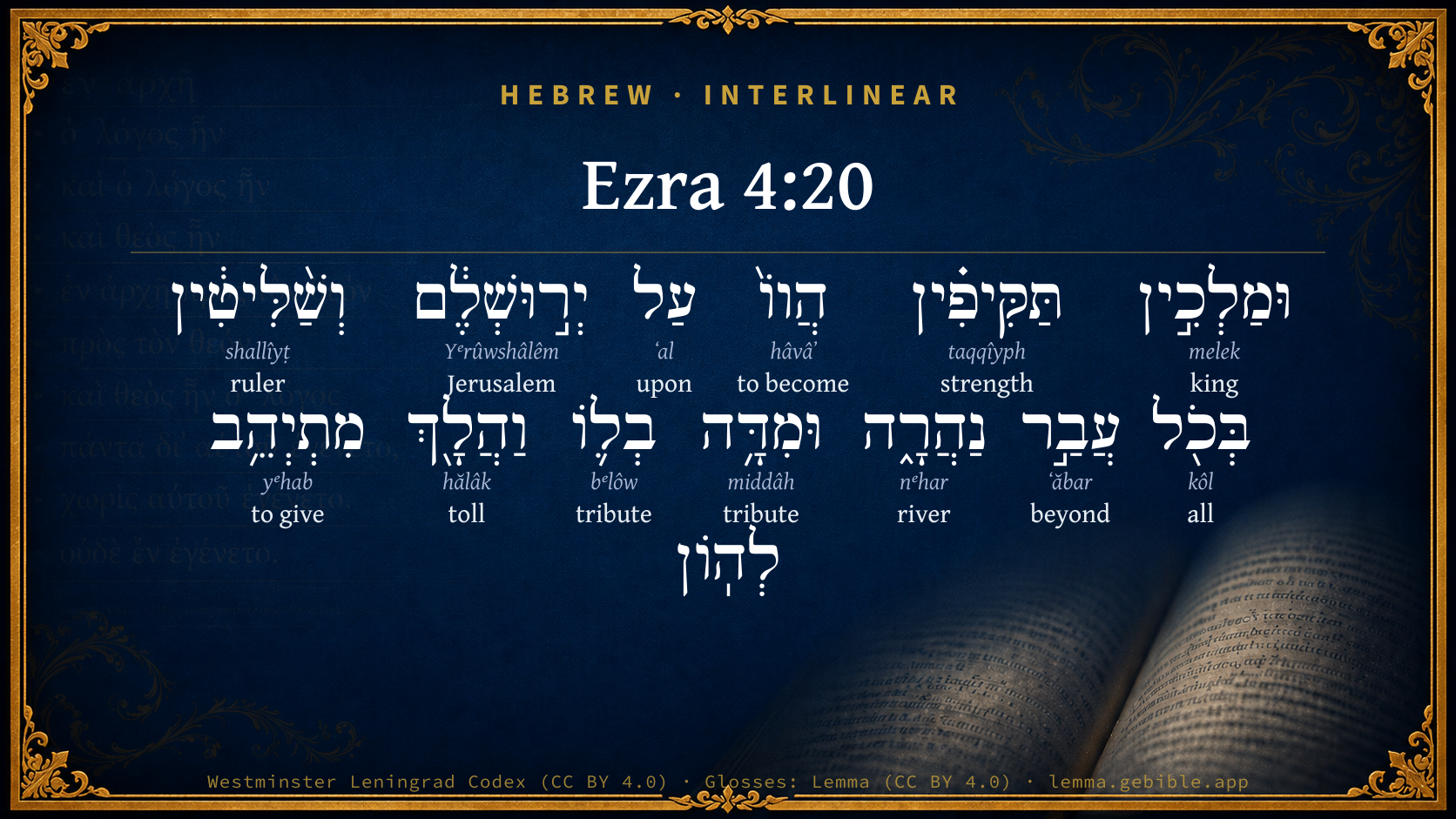
Ezra 4:20

Hebrew (Westminster Leningrad Codex) Ezra 4:20 appears in the Hebrew Old Testament. The text above is from the Westminster Leningrad Codex. Each word links to its Strong’s number, a concise gloss, and parsing drawn from the Open Scriptures Hebrew Bible morphology. Click any word for its full Brown-Driver-Briggs (BDB) entry.
Download image
Cite this verse

Ezra 4:20 (World English Bible). Public Domain. Lemma interlinear Bible study tool, https://lemma.gebible.app/v/ezra/4/20.

Show BibTeX & RIS
BibTeX
RIS
English Translation
There have been mighty kings also over Jerusalem, who have ruled over all [the country] beyond the River; and tribute, custom, and toll, was paid to them.
World English Bible · Public Domain
Highlights
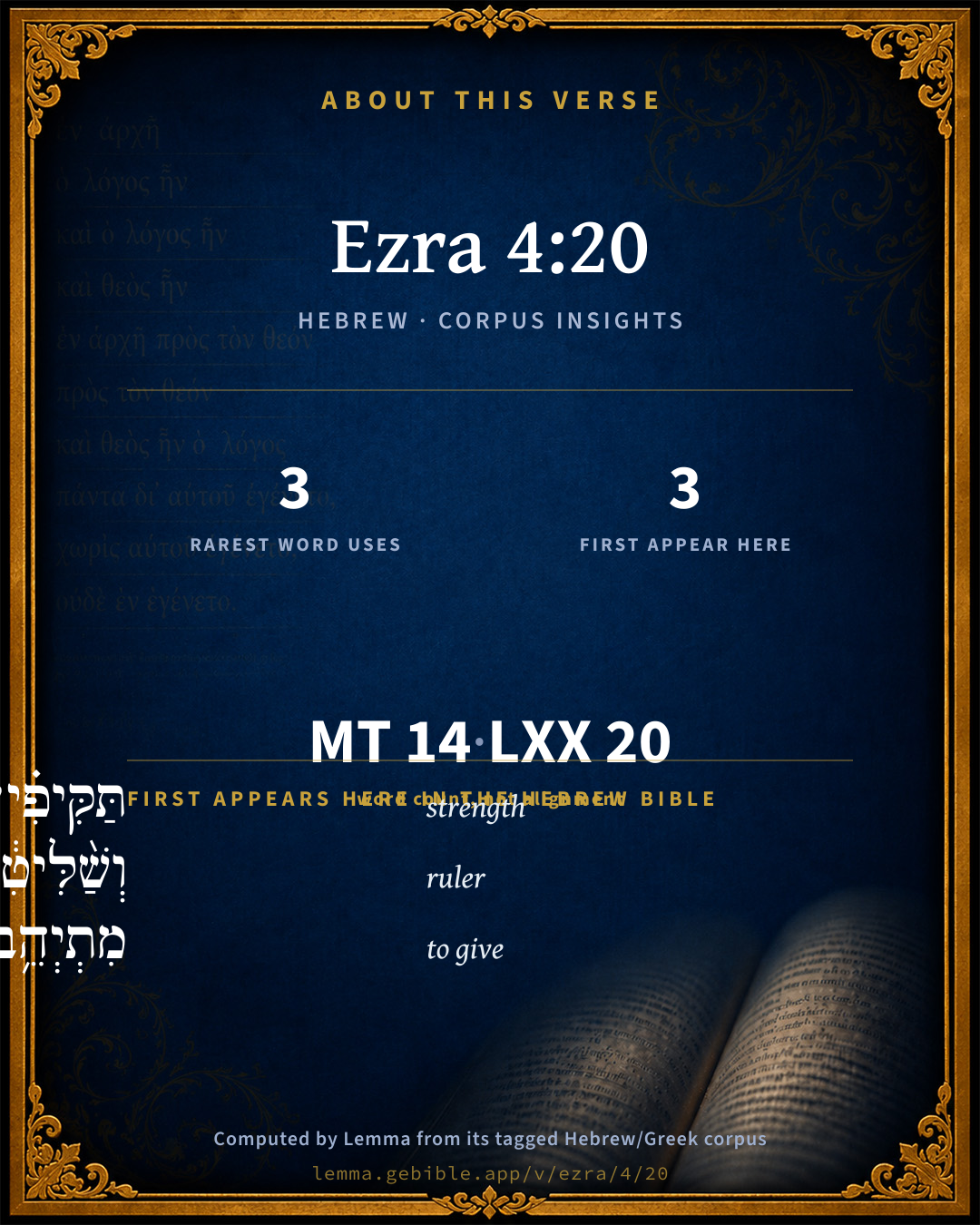
  • 3 first appearances in the Hebrew Bible
Full analysis ↓
Download a study sheet

One document with this verse’s original text, its word-by-word gloss line, the meaning frame, cross-references with their text, attributed commentary, and full source and license credits — printable, and it pastes into notes with its structure intact.

This verse Autodidact and up

Study sheet (.html) Plain text (.txt)

A passage Seminary Student

Up to 50 verses in one chapter. A passage sheet keeps up to 6 commentary sources and 12 cross-references per verse, in the order this page ranks them, and says so on the sheet whenever that leaves anything out. Ask for a single verse and you get the Autodidact verse sheet above.

Everything on this page stays free to read, with no account — the sheet is a download of what is already on screen, not access to it.

Want to remove ads? Support Godless Engineer
Compare translations 3

The same verse in 3 English versions, stacked beneath the original-language interlinear above. Click any original word for its lexicon entry.

Each is an independent rendering of the whole verse — the interlinear is not word-aligned to these translations.

Highlighted words mark where these versions differ — a whole-verse word diff, not a word-by-word alignment.

  • World English Bible Public Domain
    There have been mighty kings also over Jerusalem, who have ruled over all [the country] beyond the River; and tribute, custom, and toll, was paid to them.
  • King James Version Public Domain
    There have been mighty kings also over Jerusalem, which have ruled over all countries beyond the river; and toll, tribute, and custom, was paid unto them.
  • unfoldingWord Literal Text CC BY-SA 4.0
    And mighty kings were over Jerusalem, even rulers over all of Beyond the River; and tax, tribute, and custom were paid to them.

unfoldingWord Literal Text — © unfoldingWord, licensed CC BY-SA 4.0. Word-aligned USFM3 via Door43 (git.door43.org/unfoldingWord/en_ult).

Versions to compare (up to 4)

3 of 4 selected

Show all 18 translations

Every available English version of this verse, each an independent rendering of the whole verse.

  • World English Bible Public Domain
    There have been mighty kings also over Jerusalem, who have ruled over all [the country] beyond the River; and tribute, custom, and toll, was paid to them.
  • Berean Standard Bible Public Domain
    And mighty kings have ruled over Jerusalem and exercised authority over the whole region west of the Euphrates; and tribute, duty, and toll were paid to them.
  • Majority Standard Bible Public Domain
    And mighty kings have ruled over Jerusalem and exercised authority over the whole region west of the Euphrates; and tribute, duty, and toll were paid to them.
  • King James Version Public Domain
    There have been mighty kings also over Jerusalem, which have ruled over all countries beyond the river; and toll, tribute, and custom, was paid unto them.
  • American Standard Version (1901) Public Domain
    There have been mighty kings also over Jerusalem, who have ruled over all `the country' beyond the River; and tribute, custom, and toll, was paid unto them.
  • Revised Version (1885) Public Domain
    There have been mighty kings also over Jerusalem, which have ruled over all the country beyond the river; and tribute, custom, and toll, was paid unto them.
  • Geneva Bible (1599) Public Domain
    There haue bene mightie kings also ouer Ierusalem, which haue ruled ouer all beyonde the Riuer, and tolle, tribute, and custome was giuen vnto them.
  • Douay-Rheims (1899) Public Domain
    For there have been powerful kings in Jerusalem, who hare had dominion over all the country that is beyond the river: and have received tribute, and toll and revenues.
  • Young's Literal Translation Public Domain
    and mighty kings have been over Jerusalem, even rulers over all beyond the river, and toll, tribute, and custom is given to them.
  • Literal Standard Version CC BY-SA 4.0
    and mighty kings have been over Jerusalem, even rulers over all beyond the river, and toll, tribute, and custom is given to them.
  • Unlocked Literal Bible CC BY-SA 4.0
    Mighty kings have ruled over Jerusalem and had power over everything in the Province Beyond the River. Tribute and taxes were paid to them.
  • unfoldingWord Literal Text CC BY-SA 4.0
    And mighty kings were over Jerusalem, even rulers over all of Beyond the River; and tax, tribute, and custom were paid to them.
  • Darby Bible Public Domain
    And there have been mighty kings over Jerusalem, who have ruled over all beyond the river; and tribute, tax, and toll were paid to them.
  • World Messianic Bible Public Domain
    There have also been mighty kings over Jerusalem who have ruled over all the country beyond the River; and tribute, custom, and toll was paid to them.
  • Webster's Bible Public Domain
    There have also been mighty kings over Jerusalem, who have ruled over all countries beyond the river; and toll, tribute, and custom, was paid to them.
  • Free Bible Version CC BY-SA 4.0
    Powerful kings have ruled over Jerusalem and throughout the whole area west of the Euphrates, and they received tax, tribute, and fees.
  • Bible in Basic English Public Domain
    Further, there have been great kings in Jerusalem, ruling over all the country across the river, to whom they gave taxes and payments in goods and forced payments.
  • JPS Tanakh (1917) Public Domain
    There have been mighty kings also over Jerusalem, who have ruled over all the country beyond the River; and tribute, impost, and toll, was paid unto them.

Literal Standard Version (2020), Covenant Press — licensed CC BY-SA 4.0. Text via the HelloAO Bible API (eBible.org). Unlocked Literal Bible (unfoldingWord) — licensed CC BY-SA 4.0. Text via the HelloAO Bible API (eBible.org). unfoldingWord Literal Text — © unfoldingWord, licensed CC BY-SA 4.0. Word-aligned USFM3 via Door43 (git.door43.org/unfoldingWord/en_ult). Free Bible Version, Dr. Jonathan Gallagher — licensed CC BY-SA 4.0. Text via the HelloAO Bible API (eBible.org).

Word by word

More ways to search: Search by grammar → Find every occurrence → Compare this word →

Practice this passage: Drill this verse → Learn its vocabulary →

בְל֛וֹ
bᵉlôw
H1093
“tribute”
Adjective, N, Common
Part of Speech
Adjective
Gender
Common
Full BDB Definition

Origin: from a root corresponding to H1086

TWOT: 2632

tribute
  1. וּמַלְכִ֣ין melek H4430 “and · kings” Adjective, C + Noun, Common, Masculine, Plural, Absolute
  2. תַּקִּיפִ֗ין taqqîyph H8624 “strength” Adjective, A
  3. הֲווֹ֙ hâvâʼ H1934 “to become” Adjective, V, Plural
  4. עַל ʻal H5922 “upon” Adjective, R
  5. יְר֣וּשְׁלֶ֔ם Yᵉrûwshâlêm H3390 “Jerusalem” Adjective, N
  6. וְשַׁ֨לִּיטִ֔ין shallîyṭ H7990 “and · ruler” Adjective, C + Adjective, Adjective, Masculine, Plural, Absolute
  7. בְּכֹ֖ל kôl H3606 “in/at · all of” Adjective, R + Noun, Common, Masculine, Singular, Construct
  8. עֲבַ֣ר ʻăbar H5675 “beyond” Adjective, N
  9. נַהֲרָ֑ה nᵉhar H5103 “river · the” Adjective, N + Particle, Definite Article
  10. וּמִדָּ֥ה middâh H4061 “and · tribute” Adjective, C + Noun, Common, Feminine, Singular, Absolute
  11. וַהֲלָ֖ךְ hălâk H1983 “and · toll” Adjective, C + Noun, Common, Masculine, Singular, Absolute
  12. מִתְיְהֵ֥ב yᵉhab H3052 “given” Adjective, V, Singular

About this verse

These counts appear in no published source. They are computed here, from the morphology-tagged text and Lemma’s own curated glosses. What Lemma adds →

14
words
13
distinct lemmas
Historical
section

Notable vocabulary

The rarest word here is בְל֛וֹ tribute H1093 — appearing just 3 times in the whole Hebrew Bible.

First appearance in Scripture

These words make their first canonical appearance in the Hebrew Bible here:

  • תַּקִּיפִ֗ין strength H8624
  • וְשַׁ֨לִּיטִ֔ין ruler H7990
  • מִתְיְהֵ֥ב to give H3052

Shared distinctive vocabulary

בְל֛וֹ tribute H1093 occurs in 3 verses of the Hebrew Bible. Also found in:

Grammatical profile

  • 4 nouns
  • 9 adjectives
  • 1 particle

Hebrew & Septuagint length

In English translation the verse runs 27 words from the Hebrew and 26 from the Septuagint (LXX English) — closely comparable.

A rough comparison of the two English renderings, which tokenize alike — not a word-level alignment.

Word counts can differ between the Hebrew and the Greek without any difference in meaning — e.g. the Hebrew direct-object marker אֵת has no separate Greek word, and Greek often adds the article ὁ.

In the original languages it is 14 Hebrew tokens and 20 Greek tokens — but the two are counted differently (Hebrew bundles its prefixes and suffixes into one token; the Greek is in lemma form), so that isn’t a like-for-like length.

Cross-references

16

Topical passages linked to Ezra 4:20 in the Treasury of Scripture Knowledge — connected by theme and wording, ordered by reader-vote popularity; previews shown in the World English Bible.

  • Genesis 15:18 In that day Yahweh made a covenant with Abram, saying, "To your seed have I given this land, from the river of Egypt to the great river, the river Euphrates:
  • 1 Kings 4:21 Solomon ruled over all the kingdoms from the River to the land of the Philistines, and to the border of Egypt: they brought tribute, and served Solomon all the days of his life.
  • 1 Chronicles 18:3 David struck Hadarezer king of Zobah to Hamath, as he went to establish his dominion by the river Euphrates.
  • Psalms 72:8 He shall have dominion also from sea to sea, From the River to the ends of the earth.
  • Joshua 1:3–4 Every place that the sole of your foot shall tread on, to you have I given it, as I spoke to Moses.
  • 1 Kings 4:24 For he had dominion over all [the region] on this side the River, from Tiphsah even to Gaza, over all the kings on this side the River: and he had peace on all sides round about him.
  • 1 Chronicles 18:6 Then David put [garrisons] in Syria of Damascus; and the Syrians became servants to David, and brought tribute. Yahweh gave victory to David wherever he went.
  • 1 Chronicles 18:13 He put garrisons in Edom; and all the Edomites became servants to David. Yahweh gave victory to David wherever he went.
  • 1 Chronicles 19:19 When the servants of Hadarezer saw that they were put to the worse before Israel, they made peace with David, and served him: neither would the Syrians help the children of Ammon any more.
  • 2 Chronicles 9:14 besides that which the traders and merchants brought: and all the kings of Arabia and the governors of the country brought gold and silver to Solomon.
  • 2 Chronicles 9:23–24 All the kings of the earth sought the presence of Solomon, to hear his wisdom, which God had put in his heart.
  • 2 Chronicles 17:11 Some of the Philistines brought Jehoshaphat presents, and silver for tribute; the Arabians also brought him flocks, seven thousand and seven hundred rams, and seven thousand and seven hundred male goats.
  • 2 Chronicles 26:7–8 God helped him against the Philistines, and against the Arabians who lived in Gur Baal, and the Meunim.
  • Ezra 4:13 Be it known now to the king that if this city is built, and the walls finished, they will not pay tribute, custom, or toll, and in the end it will be hurtful to the kings.
  • Ezra 4:16 We inform the king that, if this city be built, and the walls finished, by this means you shall have no portion beyond the River.
  • Ezra 7:24 Also we inform you, that touching any of the priests and Levites, the singers, porters, Nethinim, or servants of this house of God, it shall not be lawful to impose tribute, custom, or toll, on them.

Cross-references courtesy of OpenBible.info (CC BY 4.0).

Hebrew and Greek witnesses Masoretic Hebrew ↔ Greek Septuagint

The same verse in the two great witnesses to the Old Testament, shown verse-for-verse.

These are two independent witnesses, not word-aligned to each other, and the Septuagint is shown in lemma (dictionary) form.

Hebrew Ezra 4:20 Masoretic · Westminster Leningrad Codex

וּמַלְכִ֣ין תַּקִּיפִ֗ין הֲווֹ֙ עַל יְר֣וּשְׁלֶ֔ם וְשַׁ֨לִּיטִ֔ין בְּכֹ֖ל עֲבַ֣ר נַהֲרָ֑ה וּמִדָּ֥ה בְל֛וֹ וַהֲלָ֖ךְ מִתְיְהֵ֥ב לְהֽוֹן

There have been mighty kings also over Jerusalem, who have ruled over all [the country] beyond the River; and tribute, custom, and toll, was paid to them.

World English Bible · Public Domain

Greek LXX Ezra 4:20 Septuagint · lemma form

καί βασιλεύς ἰσχυρός γίγνομαι ἐπί ἰερουσαλήμ καί ἐπικρατέω ὅλος ὁ ἑσπέρα ὁ ποταμός καί φόρος πλήρης καί μέρος δίδωμι αὐτός

And there were powerful kings in Jerusalem, and they ruled over all the country beyond the river, and abundant revenues and tribute were given to them.

LXX2012 (modern English Septuagint) · Public Domain

In the Septuagint this is one book — Esdras B (2 Esdras): Ezra is chapters 1–10, Nehemiah 11–23.

Hebrew: Westminster Leningrad Codex (CC BY 4.0). Greek: Septuagint (public domain); English from LXX2012 (modern English Septuagint) (Public Domain). How the Septuagint differs from the Hebrew →

Commentary

Notes on Ezra 4:20 from classic Christian and Jewish commentators (each source and its license shown beneath its notes). The classic Christian expositions comment on the surrounding passage and are grouped to its opening verse, so a note may address several verses; the Jewish commentaries on the Tanakh (Rashi and others) are per-verse, so they appear only where the commentator wrote on this verse.

Lemma curates 59 commentaries, every one of them public domain or Creative Commons licensed, each selected and text-cleaned for this edition rather than reprinted as found. About our sources →

Trapp's Complete Commentary

John Trapp

Ezr 4:20 There have been mighty kings also over Jerusalem, which have ruled over all [countries] beyond the river; and toll, tribute, and custom, was paid unto them.

Ver. 20. Beyond the river] Euphrates, the boundary of Solomon’s empire, 1Ki 4:21; 1Ki 4:24, as it was also promised, Gen 15:18 Exo 23:31 Deu 11:24 Jos 1:4.

John Trapp, A Commentary or Exposition upon All the Books of the Old and New Testament (1647–1656) — public domain. Text from a community e-Sword module.

Adam Clarke's Commentary

Verse 20. Beyond the river] That is, the Euphrates. Both David and Solomon carried their conquests beyond this river. See 2Sa 8:3, c., and 1Kg 4:21, where it is said, Solomon reigned over all kingdoms from the river (Euphrates) unto the land of the Philistines and unto the borders of Egypt.

Adam Clarke's Commentary on the Bible (1810–1826) — public domain. Text from a community e-Sword/MySword module.

Ellicott's Commentary for English Readers

(20) Mighty kings.—David and Solomon, and some few kings down to Josiah, had extended their sway and made nations tributary (2 Samuel 8; 1 Kings 10). The earlier kings’ names would perhaps be referred to historically, though not immediately connected with Persian annals.

A Bible Commentary for English Readers, edited by Charles John Ellicott (1878–1897) — public domain. Text from a community e-Sword module.

The Cambridge Bible for Schools and Colleges

gen. ed. J. J. S. Perowne

20. over all countries] R.V. the country. Literally, ‘over all beyond the river’. The words refer to the warning of the Samaritan letter (Ezr_4:16) that the king might lose the W. bank of the Euphrates.

toll, tribute, and custom] R.V. custom, tribute, and toll. See note on Ezr_4:13.

‘The mighty kings’, here referred to, have been identified with Menahem (2Ki_15:16) and Josiah (2Ch_34:6-7; 2Ch_35:18). It is, however, needless to restrict the allusion of the present verse to those whose names appear in the Inscriptions or are involved in the ascertained history of Assyria and Babylon. Israelite traditions, oral or written, would probably have been accessible to those whom the king appointed to search into the past history of the race. The tradition of the golden age of David’s rule and Solomon’s empire would be rehearsed with pride by the captive Jew. The remoteness of the period mattered little. It was the boast of this people that their kings had once ruled over all the country W. of the Euphrates. This information coupled with the names of, perhaps, one or two of the other great kings, such as Omri, Jeroboam II., Menahem, Uzziah, Jotham and Josiah would be pretext enough for speaking of ‘the mighty kings’.

The Cambridge Bible for Schools and Colleges (gen. ed. J. J. S. Perowne; Cambridge University Press, 1878–1918) — public domain. Text from a community e-Sword module.

John Gill's Exposition

Give ye now commandment to cause these men to cease,.... From building:

and that this city be not builded until another commandment shall be given from me; he might suspect that this case, in all its circumstances, was not truly stated, and that hereafter he might see reason to recede from the present orders he gave; and the rather, as by searching, and perhaps on his own knowledge, must have observed, that his father Cyrus had shown favour to the Jews, and had not only set them at liberty, but had encouraged them to rebuild their temple; which might be what they were about, and was the case, and nothing else, except their houses to dwell in.

John Gill's Exposition of the Whole Bible (1746–1763) — public domain (CC PDM 1.0). Text via the HelloAO Bible API.

Albert Barnes' Notes on the Bible

Mighty kings ... - If this reference can scarcely have been to David or Solomon (see marginal reference), of whom neither the Babylonian nor the Assyrian archives would be likely to have had any account - it would probably be to Menahem 2Ki 15:16 and Josiah (2Ch 34:6-7; 2Ch 35:18).

Albert Barnes' Notes on the Bible (1834–1885) — public domain. Text from a community e-Sword/MySword module.

Haydock's Catholic Bible Commentary

Kings; only David and Solomon. (Menochius) --- They had made some on the east side of the river pay tribute, though the king may speak of the countries on the west.

George Leo Haydock (1774–1849), Haydock's Catholic Family Bible and Commentary, 1859 edition — public domain. Excludes Psalms (Douay-Rheims chapter numbering differs from Protestant) and Deuterocanonical books (Catholic canon only).

Whedon's Commentary on the Bible

Daniel D. Whedon

20. Mighty kings also over Jerusalem — Reference is especially to Solomon, who reigned over all kingdoms between Egypt and the Euphrates, and received tribute from them. 1Ki_4:21. David’s conquests had also extended to the Euphrates. 2Sa_8:3.

Toll, tribute, and custom — See on Ezr_4:13.

Daniel D. Whedon (gen. ed.), Commentary on the Old and New Testaments (1874–1909) — public domain. Text from a community e-Sword module.

The Pulpit Commentary

Mighty kings. David and Solomon best answer to this description, possessing as they did a kingdom which extended from the Euphrates to the borders of Egypt, (1Ki_4:21, 1Ki_4:24) and drawing tribute from the various petty princes or chiefs of the nations dwelling within those limits (2Sa_8:6-12; 1Ki_10:14, 1Ki_10:25) Josiah had perhaps, more recently, possessed an almost equally extensive sway.

The Pulpit Commentary (1880–1919), ed. H.D.M. Spence-Jones & Joseph S. Exell — public domain. Text from a community e-Sword module.

unfoldingWord translationNotes

Door43 World Missions Community

the Province Beyond the River

This is the name of the province that was west of the Euphrates River. It was across the river from the city of Susa. See how you translated this in Esra 4:10. (See: How to Translate Names)

Tribute and taxes were paid to them

This can be translated in active form. AT: "The people in Jerusalem paid tribute and taxes to those kings" or "Those kings were able to collect tribute and taxes" (See: Active or Passive)

make a decree

"make a law"

Be careful not to neglect this

The litotes "not to neglect" is an understatement to emphasize that the writers want Artaxerxes to do what they tell him to do. AT: "Be careful to do this" (See: Litotes)

Why allow this threat to grow and cause more loss for the royal interests?

Artaxerxes uses a question to tell them that he understands that he will lose taxes and honor if the city is built. AT: "You must make sure that this threat does not grow and cause more loss for the royal interests." (See: Rhetorical Question)

threat to grow

Danger is spoken of as if it were a plant that could increase in size. AT: "danger to become worse" (See: Metaphor)

cause more loss for the royal interests

The words "the royal interests" are a metonym for the king himself. AT: "cause more bad things to happen to the kings" (See: Metonymy)

translationWords

Jerusalem

power

decree

unfoldingWord translationNotes — © Distant Shores Media and the Door43 World Missions Community, licensed CC BY-SA 4.0. Source: git.door43.org/Door43/en_tn.

Rashi

Rabbi Shlomo Yitzchaki (Rashi)

And mighty kings and mighty kings were in Jerusalem who were the rulers and governors over the entire side of the river on the side of Israel, as it says regarding Solomon (I Kings 5:4): “For he had dominion over all this side of the river, etc.” And taxes and the head tax were given to them, for the nations paid them tribute.

Rashi on the Tanakh — English translations: “The Judaica Press complete Tanach with Rashi, translated by A. J. Rosenberg” (CC BY 4.0); “Pentateuch with Rashi's commentary by M. Rosenbaum and A.M. Silbermann, 1929-1934” (public domain); “The Metsudah Tanach series, Lakewood, N.J” (CC BY 4.0); and “The Book of Joshua, Metsudah Publications, 1997” (CC BY 4.0). Text via Sefaria.

Lesson kit

Teaching starters — assembled from the data on this page, not authored interpretation. Every prompt links to the verse data it draws on. Edit before teaching.

Ezra, in the Historical, opens this verse with 14 words (13 distinct Hebrew lemmas). Its most distinctive word is bᵉlôw (“tribute”). A historical commentator’s framing appears above. Read the whole chapter for the surrounding context.

Discussion questions

  1. The word bᵉlôw carries the sense “tribute.” How does it shape the verse?
  2. 3 words here appear for the first time in Scripture. What is being introduced at this debut?
  3. Ezra 4:13 shares the word «tribute» with this verse. How do the two illuminate each other?
  4. These translations render this verse differently; the difference is in the English rendering, not the original. What questions does that raise?
  5. Reading how Trapp's Complete Commentary and Adam Clarke's Commentary read this verse, where do the two commentators agree and where do they part?

Things to notice

Reading settings

Reading text

Shown beneath each verse's original-language words.

Old Testament
Old Testament edition

Read the OT as the Masoretic Hebrew (MT) or the Greek Septuagint (LXX).

English shown for the Greek Septuagint (in the Hebrew ↔ Greek comparison).

Comparing translations? Open the Compare panel on any verse page to stack up to four side by side.