Daniel 5:18

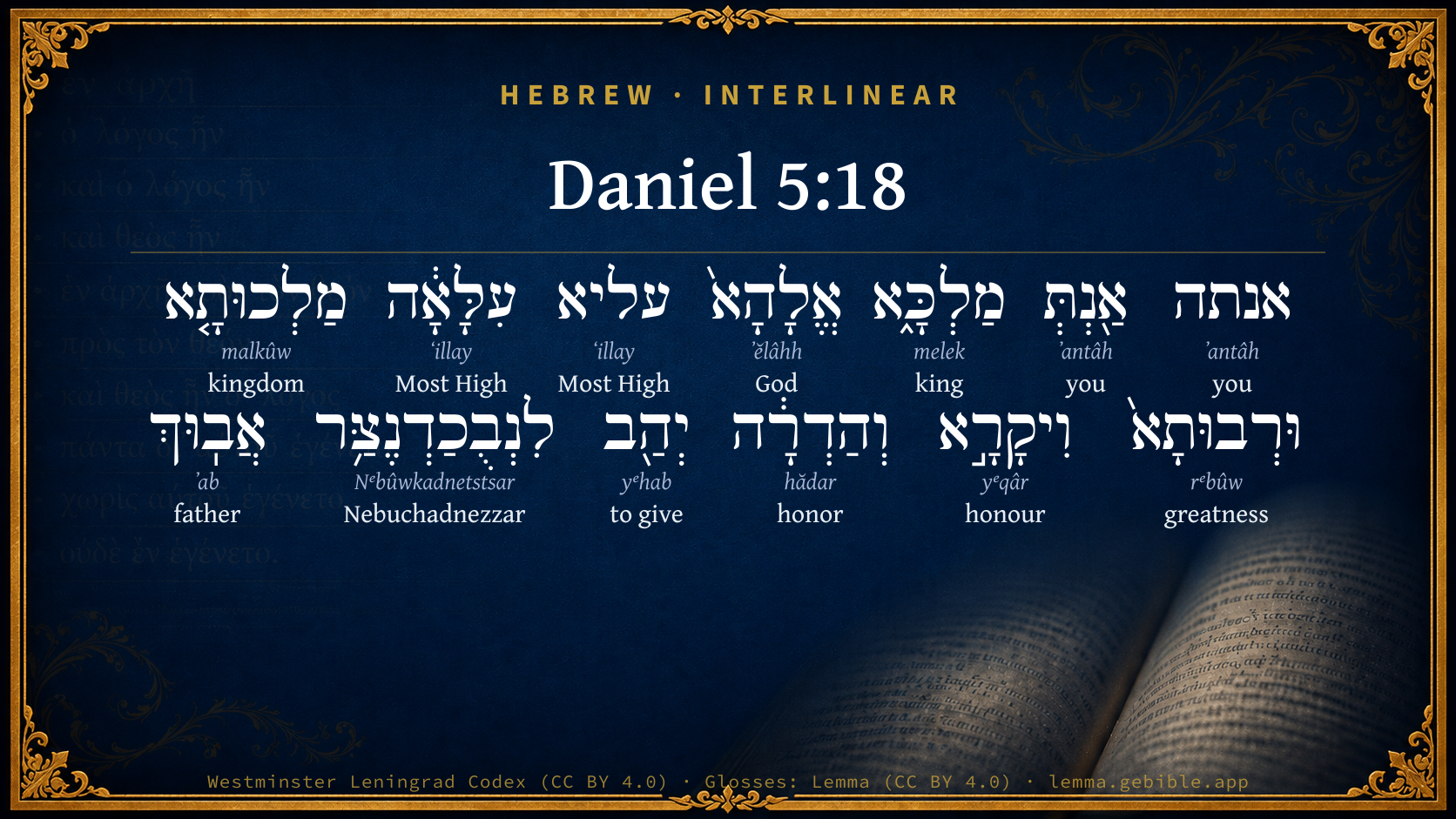
Hebrew (Westminster Leningrad Codex) Daniel 5:18 appears in the Hebrew Old Testament. The text above is from the Westminster Leningrad Codex. Each word links to its Strong’s number, a concise gloss, and parsing drawn from the Open Scriptures Hebrew Bible morphology. Click any word for its full Brown-Driver-Briggs (BDB) entry.
Download image
Cite this verse

Daniel 5:18 (World English Bible). Public Domain. Lemma interlinear Bible study tool, https://lemma.gebible.app/v/daniel/5/18.

Show BibTeX & RIS
BibTeX
RIS
English Translation
You king, the Most High God gave Nebuchadnezzar your father the kingdom, and greatness, and glory, and majesty:
World English Bible · Public Domain
Download a study sheet

One document with this verse’s original text, its word-by-word gloss line, the meaning frame, cross-references with their text, attributed commentary, and full source and license credits — printable, and it pastes into notes with its structure intact.

This verse Autodidact and up

Study sheet (.html) Plain text (.txt)

A passage Seminary Student

Up to 50 verses in one chapter. A passage sheet keeps up to 6 commentary sources and 12 cross-references per verse, in the order this page ranks them, and says so on the sheet whenever that leaves anything out. Ask for a single verse and you get the Autodidact verse sheet above.

Everything on this page stays free to read, with no account — the sheet is a download of what is already on screen, not access to it.

Want to remove ads? Support Godless Engineer
Compare translations 3

The same verse in 3 English versions, stacked beneath the original-language interlinear above. Click any original word for its lexicon entry.

Each is an independent rendering of the whole verse — the interlinear is not word-aligned to these translations.

Highlighted words mark where these versions differ — a whole-verse word diff, not a word-by-word alignment.

  • World English Bible Public Domain
    You king, the Most High God gave Nebuchadnezzar your father the kingdom, and greatness, and glory, and majesty:
  • King James Version Public Domain
    O thou king, the most high God gave Nebuchadnezzar thy father a kingdom, and majesty, and glory, and honour:
  • unfoldingWord Literal Text CC BY-SA 4.0
    As for you, O king, the Most High God gave Nebuchadnezzar your father kingship, greatness, honor, and majesty.

unfoldingWord Literal Text — © unfoldingWord, licensed CC BY-SA 4.0. Word-aligned USFM3 via Door43 (git.door43.org/unfoldingWord/en_ult).

Versions to compare (up to 4)

3 of 4 selected

Show all 18 translations

Every available English version of this verse, each an independent rendering of the whole verse.

  • World English Bible Public Domain
    You king, the Most High God gave Nebuchadnezzar your father the kingdom, and greatness, and glory, and majesty:
  • Berean Standard Bible Public Domain
    As for you, O king, the Most High God gave your father Nebuchadnezzar sovereignty and greatness, glory and honor.
  • Majority Standard Bible Public Domain
    As for you, O king, the Most High God gave your father Nebuchadnezzar sovereignty and greatness, glory and honor.
  • King James Version Public Domain
    O thou king, the most high God gave Nebuchadnezzar thy father a kingdom, and majesty, and glory, and honour:
  • American Standard Version (1901) Public Domain
    O thou king, the Most High God gave Nebuchadnezzar thy father the kingdom, and greatness, and glory, and majesty:
  • Revised Version (1885) Public Domain
    O thou king, the Most High God gave Nebuchadnezzar thy father the kingdom, and greatness, and glory, and majesty:
  • Geneva Bible (1599) Public Domain
    O King, heare thou, The most high God gaue vnto Nebuchad-nezzar thy father a kingdome, and maiestie, and honour and glory.
  • Douay-Rheims (1899) Public Domain
    O king, the most high God gave to Nabuchodonosor thy father a kingdom, and greatness, and glory, and honour.
  • Young's Literal Translation Public Domain
    thou, O king, God Most High, a kingdom, and greatness, and glory, and honour, gave to Nebuchadnezzar thy father:
  • Literal Standard Version CC BY-SA 4.0
    you, O king, God Most High, a kingdom, and greatness, and glory, and honor, gave to your father Nebuchadnezzar:
  • Unlocked Literal Bible CC BY-SA 4.0
    As for you, king, the Most High God gave Nebuchadnezzar your father the kingdom, greatness, honor, and majesty.
  • unfoldingWord Literal Text CC BY-SA 4.0
    As for you, O king, the Most High God gave Nebuchadnezzar your father kingship, greatness, honor, and majesty.
  • Darby Bible Public Domain
    O thou king, the Most High God gave Nebuchadnezzar thy father the kingdom, and greatness, and glory, and majesty;
  • World Messianic Bible Public Domain
    “To you, king, the Most High God gave Nebuchadnezzar your father the kingdom, and greatness, and glory, and majesty.
  • Webster's Bible Public Domain
    O thou king, the most high God gave Nebuchadnezzar thy father a kingdom, and majesty, and glory, and honor:
  • Free Bible Version CC BY-SA 4.0
    Your Majesty, the Most High God gave your father Nebuchadnezzar this kingdom, and power, glory, and majesty.
  • Bible in Basic English Public Domain
    As for you, O King, the Most High God gave to Nebuchadnezzar, your father, the kingdom and great power and glory and honour:
  • JPS Tanakh (1917) Public Domain
    O thou king, God Most High gave Nebuchadnezzar thy father the kingdom, and greatness, and glory, and majesty;

Literal Standard Version (2020), Covenant Press — licensed CC BY-SA 4.0. Text via the HelloAO Bible API (eBible.org). Unlocked Literal Bible (unfoldingWord) — licensed CC BY-SA 4.0. Text via the HelloAO Bible API (eBible.org). unfoldingWord Literal Text — © unfoldingWord, licensed CC BY-SA 4.0. Word-aligned USFM3 via Door43 (git.door43.org/unfoldingWord/en_ult). Free Bible Version, Dr. Jonathan Gallagher — licensed CC BY-SA 4.0. Text via the HelloAO Bible API (eBible.org).

Word by word

More ways to search: Search by grammar → Find every occurrence → Compare this word →

Practice this passage: Drill this verse → Learn its vocabulary →

וְהַדְרָ֔ה
hădar
H1923
“and · honor · the”
Adjective, C + Noun, Common, Masculine, Singular, Determined + Particle, Definite Article
Part of Speech
Adjective + Noun + Particle
Type
Definite Article
Full BDB Definition

Origin: from H1922

TWOT: 2691a

honour, majesty
  1. אנתה ʼantâh H607 “you” Adjective, P
  2. אַ֖נְתְּ ʼantâh H607 “you” Adjective, P
  3. מַלְכָּ֑א melek H4430 “king · the” Adjective, N, Common + Particle, Definite Article
  4. אֱלָהָא֙ ʼĕlâhh H426 “God · the” Adjective, N, Common + Particle, Definite Article
  5. עליא ʻillay H5943 “Most High · the” Adjective, A + Particle, Definite Article
  6. עִלָּאָ֔ה ʻillay H5943 “Most High · the” Adjective, A + Particle, Definite Article
  7. מַלְכוּתָ֤א malkûw H4437 “kingdom · the” Adjective, N, Common + Particle, Definite Article
  8. וּרְבוּתָא֙ rᵉbûw H7238 “and · greatness · the” Adjective, C + Noun, Common, Feminine, Singular, Determined + Particle, Definite Article
  9. וִיקָרָ֣א yᵉqâr H3367 “and · honour · the” Adjective, C + Noun, Common, Masculine, Singular, Determined + Particle, Definite Article
  10. יְהַ֖ב yᵉhab H3052 “to give” Adjective, V
  11. לִנְבֻכַדְנֶצַּ֥ר Nᵉbûwkadnetstsar H5020 “to/for · Nebuchadnezzar” Adjective, R + Noun, Proper
  12. אֲבֽוּךְ ʼab H2 “father · your” Adjective, N, Common + Suffix, Personal, 2nd Person, Masculine, Singular

About this verse

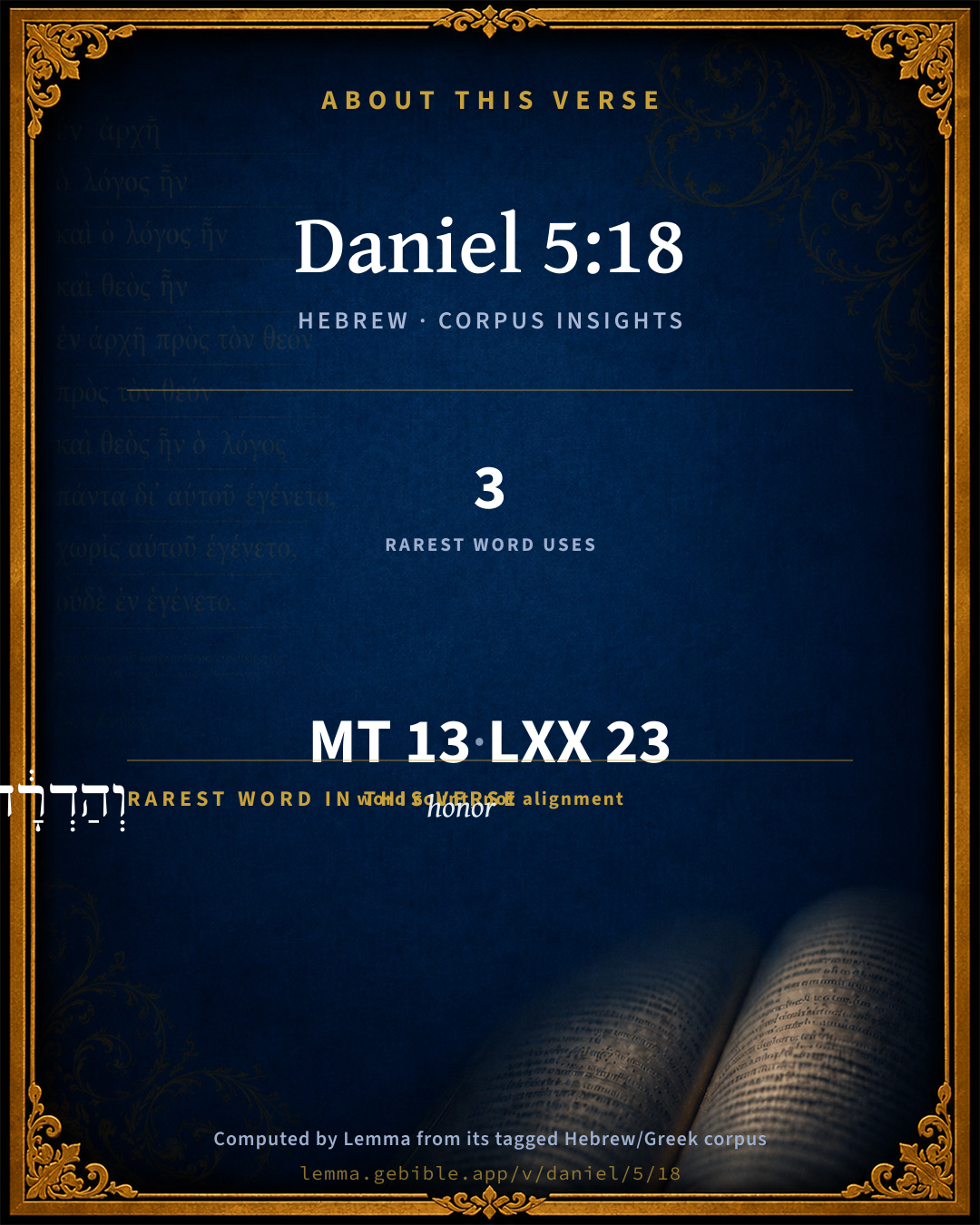
These counts appear in no published source. They are computed here, from the morphology-tagged text and Lemma’s own curated glosses. What Lemma adds →

13
words
11
distinct lemmas
Prophets
section

Notable vocabulary

The rarest word here is וְהַדְרָ֔ה honor H1923 — appearing just 3 times in the whole Hebrew Bible.

Shared distinctive vocabulary

וְהַדְרָ֔ה honor H1923 occurs in 3 verses of the Hebrew Bible. Also found in:

Grammatical profile

  • 1 noun
  • 4 adjectives
  • 8 particles

Repetition

Words recur within this verse — often emphatic in Hebrew:

  • עליא Most High H5943 ×2
  • אנתה you H607 ×2

Hebrew & Septuagint length

In English translation the verse runs 18 words from the Hebrew and 19 from the Septuagint (LXX English) — closely comparable.

A rough comparison of the two English renderings, which tokenize alike — not a word-level alignment.

Word counts can differ between the Hebrew and the Greek without any difference in meaning — e.g. the Hebrew direct-object marker אֵת has no separate Greek word, and Greek often adds the article ὁ.

In the original languages it is 13 Hebrew tokens and 23 Greek tokens — but the two are counted differently (Hebrew bundles its prefixes and suffixes into one token; the Greek is in lemma form), so that isn’t a like-for-like length.

Cross-references

18

Topical passages linked to Daniel 5:18 in the Treasury of Scripture Knowledge — connected by theme and wording, ordered by reader-vote popularity; previews shown in the World English Bible.

  • Daniel 2:37–38 You, O king, are king of kings, to whom the God of heaven has given the kingdom, the power, and the strength, and the glory;
  • Daniel 4:17 The sentence is by the decree of the watchers, and the demand by the word of the holy ones; to the intent that the living may know that the Most High rules in the kingdom of men, and gives it to whoever he will, and sets up over it the lowest of men.
  • Daniel 4:22–25 it is you, O king, that are grown and become strong; for your greatness is grown, and reaches to the sky, and your dominion to the end of the earth.
  • Deuteronomy 32:8 When the Most High gave to the nations their inheritance, When he separated the children of men, He set the bounds of the peoples According to the number of the children of Israel.
  • Psalms 7:17 I will give thanks to Yahweh according to his righteousness, And will sing praise to the name of Yahweh Most High.
  • Psalms 9:2 I will be glad and rejoice in you. I will sing praise to your name, O Most High.
  • Psalms 47:2 For Yahweh Most High is awesome. He is a great King over all the earth.
  • Psalms 92:8 But you, Yahweh, are on high forevermore.
  • Jeremiah 27:7 All the nations shall serve him, and his son, and his son's son, until the time of his own land come: and then many nations and great kings shall make him their bondservant.
  • Lamentations 3:35 To turn aside the right of a man before the face of the Most High,
  • Lamentations 3:38 Doesn't evil and good come out of the mouth of the Most High?
  • Daniel 3:17–18 If it be [so], our God whom we serve is able to deliver us from the burning fiery furnace; and he will deliver us out of your hand, O king.
  • Daniel 4:2 It has seemed good to me to show the signs and wonders that the Most High God has worked toward me.
  • Daniel 4:32 and you shall be driven from men; and they dwelling shall be with the animals of the field; you shall be made to eat grass as oxen; and seven times shall pass over you; until you know that the Most High rules in the kingdom of men, and gives it to whoever he will.
  • Daniel 6:22 My God has sent his angel, and has shut the lions' mouths, and they have not hurt me; because as before him innocence was found in me; and also before you, O king, have I done no hurt.
  • Acts 7:48 However, the Most High doesn't dwell in temples made with hands, as the prophet says,
  • Acts 26:13 at noon, O King, I saw on the way a light from the sky, brighter than the sun, shining around me and those who traveled with me.
  • Acts 26:19 "Therefore, King Agrippa, I was not disobedient to the heavenly vision,

Cross-references courtesy of OpenBible.info (CC BY 4.0).

Hebrew and Greek witnesses Masoretic Hebrew ↔ Greek Septuagint

The same verse in the two great witnesses to the Old Testament, shown verse-for-verse.

These are two independent witnesses, not word-aligned to each other, and the Septuagint is shown in lemma (dictionary) form.

Hebrew Daniel 5:18 Masoretic · Westminster Leningrad Codex

אנתה אַ֖נְתְּ מַלְכָּ֑א אֱלָהָא֙ עליא עִלָּאָ֔ה מַלְכוּתָ֤א וּרְבוּתָא֙ וִיקָרָ֣א וְהַדְרָ֔ה יְהַ֖ב לִנְבֻכַדְנֶצַּ֥ר אֲבֽוּךְ

You king, the Most High God gave Nebuchadnezzar your father the kingdom, and greatness, and glory, and majesty:

World English Bible · Public Domain

Greek LXX Daniel 5:18 Septuagint · lemma form

τότε βαλτασαρ ὁ βασιλεύς ἐνδύω ὁ δανιηλ πορφύρα καί μανιάκης χρυσοῦς περιτίθημι αὐτός καί δίδωμι ἐξουσία αὐτός ὁ τρίτος μέρος ὁ βασιλεία αὐτός

O king, the most high God gave to your father Nabuchodonosor a kingdom, and majesty, and honor, and glory:

LXX2012 (modern English Septuagint) · Public Domain

Hebrew: Westminster Leningrad Codex (CC BY 4.0). Greek: Septuagint (public domain); English from LXX2012 (modern English Septuagint) (Public Domain). How the Septuagint differs from the Hebrew →

Commentary

Notes on Daniel 5:18 from classic Christian and Jewish commentators (each source and its license shown beneath its notes). The classic Christian expositions comment on the surrounding passage and are grouped to its opening verse, so a note may address several verses; the Jewish commentaries on the Tanakh (Rashi and others) are per-verse, so they appear only where the commentator wrote on this verse.

Lemma curates 59 commentaries, every one of them public domain or Creative Commons licensed, each selected and text-cleaned for this edition rather than reprinted as found. About our sources →

Trapp's Complete Commentary

John Trapp

Dan 5:18 O thou king, the most high God gave Nebuchadnezzar thy father a kingdom, and majesty, and glory, and honour:

Ver. 18. O thou king, the most high God gave Nebachadnezzar.] See here the necessary and profitable use of history, which hath its name, saith Plato, παρα το ισταναι τον ρουν, from stopping the flux and overflow of impiety in others;

“ Exemplo alterius qui sapit, ille sapit. ”

Domestic examples are most prevalent; as not to profit by them is a great provocation, and yet all too common. {Psa 49:14} Lamech was nothing bettered by Cain’s punishment, but the contrary. Jude inveigheth against such as made no use of Sodom’s ruin; this was a just presage and desert of their own.

And kingdom, and majesty, and glory, and honour.] His offences were much increased by these many obligations.

John Trapp, A Commentary or Exposition upon All the Books of the Old and New Testament (1647–1656) — public domain. Text from a community e-Sword module.

Joseph Benson's Commentary

Dan 5:18-19. O thou king — Before Daniel reads the writing, he judges it proper to remind the king of God’s dealings with Nebuchadnezzar, his progenitor, and of those remarkable instances of divine providence, both in mercy and in judgment, which were intended to be an instructive lesson, as to all princes that should hear of them, so especially to all the descendants of that great monarch. He also, with great fidelity and seriousness, sets Belshazzar’s profane conduct before him, that he might be humbled and brought to repentance. The most high God gave Nebuchadnezzar thy father a kingdom, &c. — His great power, and vast extent of empire, were the gifts of God to him, and were not acquired by his own policy or bravery, or those of his generals and armies. Grotius explains the different terms of this verse thus: A kingdom, that is, a widely-extended empire; majesty, or magnificence among his subjects; glory from his victories; and honour from the enlargement of the city, the building of its walls, temple, and palace. And for the majesty that he gave him — For the vast power, riches, and victorious hand which he gave him; all people, nations, &c., trembled and feared before him, &c. — We have here a strong picture of the absolute and independent power of these princes; they regarded their subjects only as slaves. Xerxes, having assembled the great men of his kingdom, when he had determined to undertake the war against Greece, said to them, “I have assembled you that I might not seem to act solely by my own counsel; but remember that I expect obedience, not advice from you.” — Calmet.

Joseph Benson's Commentary on the Old and New Testaments (1811–1818) — public domain. Text from a community e-Sword module.

Tyndale Open Study Notes

Tyndale Open Resources

5:18-21 Daniel presented Nebuchadnezzar as an object lesson that should have guided his successors. Instead, Belshazzar had made the same mistake of exalting himself and dishonoring the Most High God.

Tyndale Open Study Notes — © Tyndale Open Resources, licensed CC BY-SA 4.0. Text via the HelloAO Bible API.

Ibn Ezra

Rabbi Abraham ibn Ezra

[Daniel 5:18] You (אַ֖נְתְּ - an’t) [O king]: The meaning [of starting with "You"] is: Listen, you, O king (הַטַּעַם שְׁמַע אַתָּה הַמֶּלֶךְ - ha'ta'am sh'ma atah ha'melech).

Ibn Ezra on the Tanakh — English translations: “Sefaria Community Translation” (CC0 1.0 (public-domain dedication)); “Yalkut, Sifsei Chachomim Chumash, Metsudah Publications, 2009” (CC BY 4.0); and “Commentary of Ibn Ezra on Isaiah - trans. by M. Friedlander, 1873” (public domain). Text via Sefaria.

Geneva Bible (1599)

Geneva Bible translators

Before he read the writing, he declareth to the king his great ingratitude toward God, who could not be moved to give him the glory, considering his wonderful work toward his grandfather, and so showeth that he doth not sin of ignorance but of malice.

Geneva Bible (1599) marginal notes — public domain. Text via Bolls.life.

Jamieson, Fausset & Brown

Robert Jamieson, A. R. Fausset & David Brown

God gave--It was not his own birth or talents which gave him the vast empire, as he thought. To make him unlearn his proud thought was the object of God's visitation on him.

majesty--in the eyes of his subjects.

glory--from his victories.

honour--from the enlargement and decoration of the city.

Jamieson, Fausset & Brown — Commentary Critical and Explanatory on the Whole Bible (1871) — public domain (CC PDM 1.0). Text via the HelloAO Bible API.

Adam Clarke's Commentary

Verse 18. Nebuchadnezzar thy father] Or grandfather, as the margin reads, Da 5:2. See Clarke on Da 5:1.

Adam Clarke's Commentary on the Bible (1810–1826) — public domain. Text from a community e-Sword/MySword module.

John Calvin's Commentaries

Before Daniel recites the writing, and adds its interpretation, he explains to King Belshazzar the origin of this prodigy. He did not begin the reading at once, as he might conveniently have done, saying Mene, Mene! as we shall see at the end of the chapter, since the king could not have pro-fired by his abrupt speech. But here Daniel shews it to be by no means surprising, if God put forth his hand and shewed the figure of a hand describing the king’s destruction, since the king had too obstinately provoked his anger. We see then why Daniel begins by this narrative, since King Nebuchadnezzar was a most powerful monarch, subduing the whole world to himself and causing all men to tremble at his word, and was afterwards hurled from the throne of his kingdom. Hence it more clearly appears that Belshazzar did not live in ignorance, for he had so signal and remarkable an example [hat he ought to have conducted himself with moderation. Since then that domestic admonition did not profit him, Daniel shews the time to be ripe for the denunciation of God’s wrath by a formidable and portentous sign. This is the sense of the passage. Passing on to the words themselves, he first says, To King Nebuchadnezzar God gave an empire, and magnificence, and loftiness, and splendor; as if he had said, he was magnificently adorned, as the greatest monarch in the world. We have stated elsewhere, and Daniel repeats it often, that empires are bestowed on men by divine power and not by chance, as Paul announces, There is no power but of God. (Romans 13:1.) God wishes his power to be specially visible in kingdoms. Although, therefore, he takes care of the whole world, and, in the government of the human family even the most miserable things are regulated by his hand, yet his singular providence shines forth in the empire of the world. But since we have often discussed this point at length, and shall have many opportunities of recurring to it, it is now sufficient just briefly to notice the principle, of the exaltation of earthly kings by the hand of God, and not by the chances of fortune.

When Daniel confirms this doctrine, he adds, On account of the magnificence which God conferred upon him, all mortals trembled at the sight of him! By these words he shews how God’s glory is inscribed on kings, although he allows them to reign supreme. This indeed cannot be pointed out with the finger, but the fact is sufficiently clear; kings are divinely armed with authority, and thus retain under their hand and sway a great multitude of subjects. Every one desires the chief power over his fellow-creatures. Whence happens it, since ambition is natural to all men, that many thousands are subject to one, and suffer themselves to be ruled over and endure many oppressions? How could this be, unless God entrusted the sword of power to those whom he wishes to excel? This reason, then, must be diligently noticed, when the Prophet says, All men trembled at the sight of King Nebuchadnezzar, because God conferred upon him that majesty, and wished him to excel all the monarchs of the world. God has many reasons, and often hidden ones, why he raises one man and humbles another; yet this point ought to be uncontroverted by us. No kings can possess any authority unless God extends his hand to them and props them up. When he wishes to remove them from power, they fall of their own accord; not because there is any chance in the changes of the world, but because God, as it is said in the Book of Job, (Job 12:18,) deprives those of the sword whom he had formerly entrusted with it.

It now follows, Whom he wished to slay he slew, and whom he wished to strike he struck Some think the abuse of kingly power is here described; but I had rather take it simply, for Nebuchadnezzar being able to east down some, and to raise others at his will, since it was in his power to give life to some and to slay others. I, therefore, do not refer these words to tyrannical lust, as if Nebuchadnezzar had put many innocent persons to death, and poured forth human blood without any reason; or as if he had despoiled many of their fortunes, and enriched others and adorned them with honor and wealth. I do not take it so. I think it refers to his arbitrary power over life and death, and over the rise of some and the ruin of others. On the whole, Daniel seems to me to describe the greatness of that royal power which they may freely exercise over their subjects, not through its being lawful, but through the tacit consent of all men. Whatsoever pleases the king, all are compelled to approve of it, or at least no one dares to murmur at it. Since, therefore, the regal license is so great, Daniel here shews how King Nebuchadnezzar was not carried away by his own plans, or purposes, or good fortune, but was entrusted with supreme power and rendered formidable to all men, because God had designed him for his own glory. Meanwhile, kings usually despise what they are permitted to enjoy, and what God allows them. For powerful as they are, they must hereafter render an account to the Supreme King. We are not to gather from this, that kings are appointed by God without any law, or any self-restraint; but the Prophet, as I have said, speaks of the royal power in itself. Since kings, therefore, have power over their subjects for life and death, he says, the life of all men was in the hand of King Nebuchadnezzar. He now adds, When his heart was exalted, then he was cast down (or ejected) from the throne of his kingdom, and they deprived him of his majesty He follows up his own narrative, tie wishes to shew King Belshazzar how God bears with the insolence of those who forget him, when they have obtained the summit of power. Desiring to make this known, he says, King Nebuchadnezzar, thy grandfather, was a mighty monarch. He did not obtain this mightiness by himself, nor could he have retained it, except he had been supported by God’s hand. Now his change of circumstances was a remarkable proof that the pride of those who are ungrateful to God can never be endured unto the end, as they never acknowledge their sway to proceed from his benevolence. When, therefore, says he, his heart was raised up and his spirit strengthened in pride, a sudden change occurred. Hence you and all his posterity ought to be taught, lest pride still further deceive you, and ye profit not by the example of your father; as we shall afterwards relate. Hence this writing has been set before thee, for the purpose of making known the destruction of thy life and kingdom.

John Calvin's Commentaries (1540-1563) — public domain. Text from the Calvin Translation Society English edition (1840s-50s) via the Christian Classics Ethereal Library (ccel.org). Calvin's coverage is partial (roughly two-thirds of the Bible); uncommented books and verses are honest gaps, never fabricated. The 19th-century editor's footnotes and remarks are omitted so the notes are faithfully Calvin's own voice.

Ellicott's Commentary for English Readers

(18) The most high God.—Comp. this and the three following verses with Dan_4:16-17; Dan_4:22-25.

A Bible Commentary for English Readers, edited by Charles John Ellicott (1878–1897) — public domain. Text from a community e-Sword module.

The Cambridge Bible for Schools and Colleges

gen. ed. J. J. S. Perowne

18–24. Before interpreting the writing Daniel reads the king a lesson. Nebuchadnezzar’s pride, combined with his refusal to recognize the sovereignty of the true God, had brought upon him a bitter humiliation: Belshazzar has exhibited the same faults yet more conspicuously: and the present sign has been sent in order to warn him of the impending punishment.

18 the kingdom, and greatness, and glory, and majesty] Cf. Dan_4:22; Dan_4:36.

The Cambridge Bible for Schools and Colleges (gen. ed. J. J. S. Perowne; Cambridge University Press, 1878–1918) — public domain. Text from a community e-Sword module.

John Gill's Exposition

O thou king,.... "Hear" (t), O king; so Aben Ezra supplies it; what he was about to say first, in order to prepare him for the meaning of the handwriting, and the cause of it; or, "thou knowest", as Saadiah supplies it; namely, what follows:

the most high God gave Nebuchadnezzar thy father a kingdom: a very large one, which reached to the ends of the earth: this was not to be ascribed to his predecessor that left it to him; or to his victorious arms, which increased it; or to his idol gods, to whom he attributed it; but to the most high God, from whom promotion alone cometh; and who, being above all gods and kings, sets up, and pulls down, as he pleases; he gave him his large dominions:

and majesty, and glory, and honour; greatness among men; glory and honour from them, on account of the majesty of his person and kingdom; the victories he obtained, and the great things he did to make him famous while he lived, and to perpetuate his memory after death.

(t) So Pagninus, Munster.

John Gill's Exposition of the Whole Bible (1746–1763) — public domain (CC PDM 1.0). Text via the HelloAO Bible API.

Albert Barnes' Notes on the Bible

O thou king, the most high God gave Nebuchadnezzar thy father a kingdom ... - This reference to Nebuchadnezzar is evidently designed to show to Belshazzar the wickedness of his own course, and the reason which he had to apprehend the Divine vengeance, because he had not learned to avoid the sins which brought so great calamities upon his predecessor. As he was acquainted with what had occurred to Nebuchadnezzar; as he had doubtless seen the proclamation which he had made on his recovery from the dreadful malady which God had brought upon him for his pride; and as he had not humbled himself, but had pursued the same course which Nebuchadnezzar did, he had the greater reason to apprehend the judgment of heaven. See Dan 5:22-23. Daniel here traces all the glory which Nebuchadnezzar had to “the most high God,” reminding the king that whatever honor and majesty he had he was equally indebted for it to the same source, and that he must expect a similar treatment from him.

Albert Barnes' Notes on the Bible (1834–1885) — public domain. Text from a community e-Sword/MySword module.

Matthew Poole's English Annotations

This the prophet repeats, to put Belshazzar in mind how God dealt with his father; for it is good for kings to read over the story of their ancestors, and take warning, and take example. In the first they are seamarks, in the second landmarks.

Matthew Poole's English Annotations on the Holy Bible (1683–1685) — public domain. Text from a community e-Sword/MySword module.

Lesson kit

Teaching starters — assembled from the data on this page, not authored interpretation. Every prompt links to the verse data it draws on. Edit before teaching.

Daniel, in the Prophets, opens this verse with 13 words (11 distinct Hebrew lemmas). Its most distinctive word is hădar (“honor”). A historical commentator’s framing appears above. Read the whole chapter for the surrounding context.

Discussion questions

  1. The word hădar carries the sense “honor.” How does it shape the verse?
  2. How does Daniel 4:30, which shares the word «honor», read alongside this verse?
  3. What does the repetition of “Most High” (2× in this one verse) do in this verse?
  4. These translations render this verse differently; the difference is in the English rendering, not the original. What questions does that raise?
  5. Compare how Trapp's Complete Commentary and Joseph Benson's Commentary read this verse. Where do they agree or differ?

Things to notice

Reading settings

Reading text

Shown beneath each verse's original-language words.

Old Testament
Old Testament edition

Read the OT as the Masoretic Hebrew (MT) or the Greek Septuagint (LXX).

English shown for the Greek Septuagint (in the Hebrew ↔ Greek comparison).

Comparing translations? Open the Compare panel on any verse page to stack up to four side by side.