
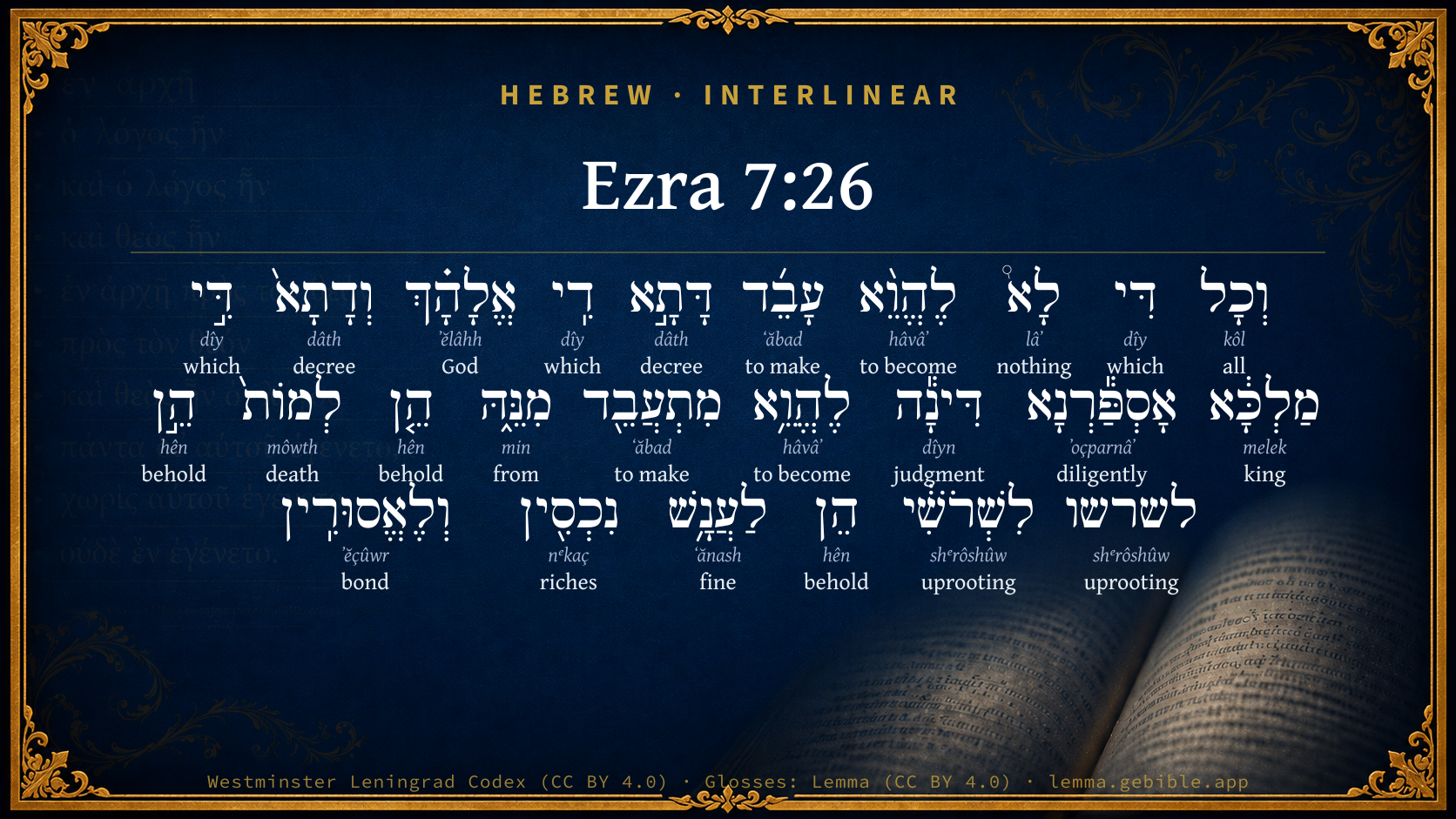
Ezra 7:26

Hebrew (Westminster Leningrad Codex) Ezra 7:26 appears in the Hebrew Old Testament. The text above is from the Westminster Leningrad Codex. Each word links to its Strong’s number, a concise gloss, and parsing drawn from the Open Scriptures Hebrew Bible morphology. Click any word for its full Brown-Driver-Briggs (BDB) entry.
Download image
Cite this verse

Ezra 7:26 (World English Bible). Public Domain. Lemma interlinear Bible study tool, https://lemma.gebible.app/v/ezra/7/26.

Show BibTeX & RIS
BibTeX
RIS
English Translation
Whoever will not do the law of your God, and the law of the king, let judgment be executed on him with all diligence, whether it be to death, or to banishment, or to confiscation of goods, or to imprisonment.
World English Bible · Public Domain
Highlights
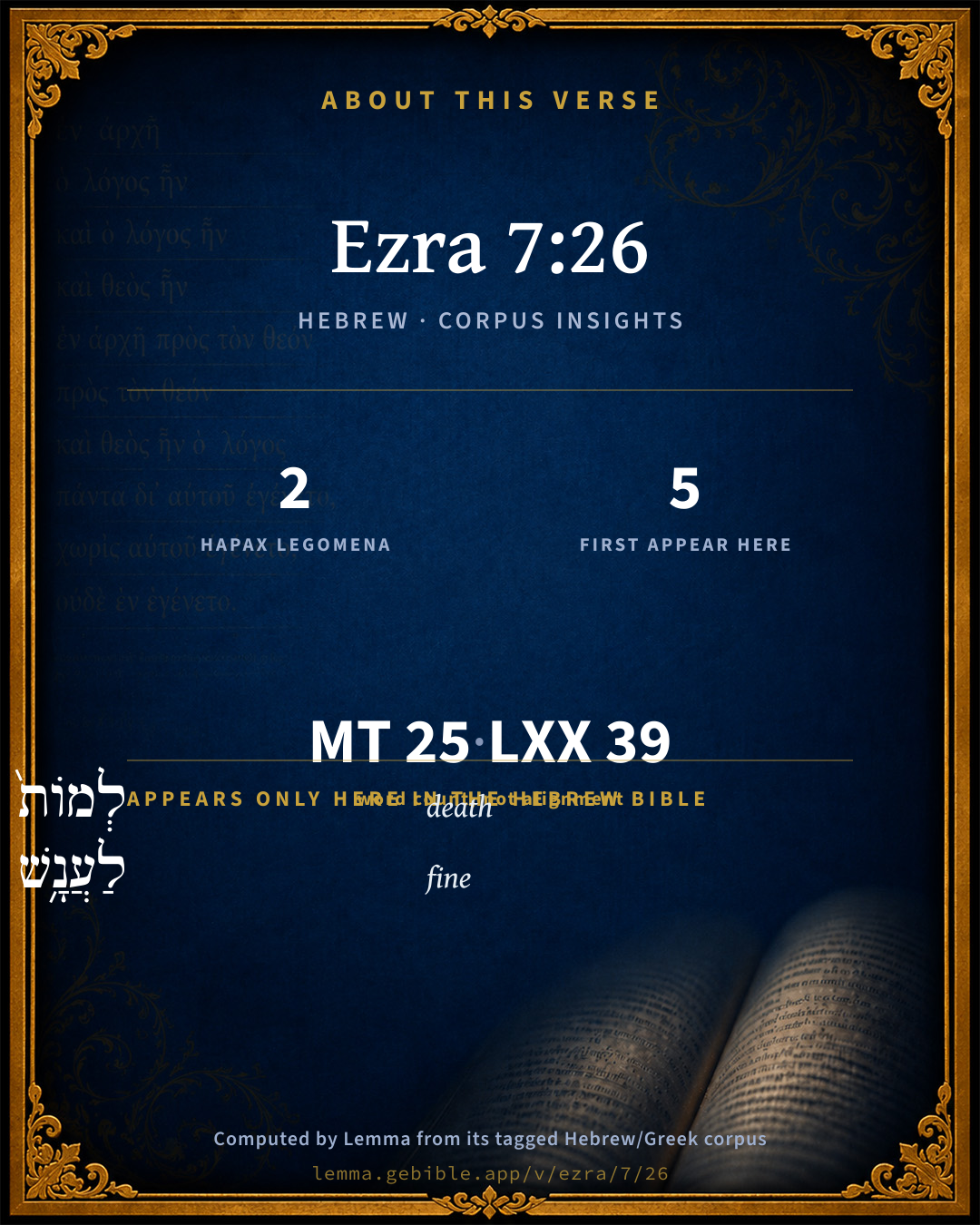
  • 2 hapax legomena — only here in the Hebrew Bible
  • 5 first appearances in the Hebrew Bible
Full analysis ↓
Download a study sheet

One document with this verse’s original text, its word-by-word gloss line, the meaning frame, cross-references with their text, attributed commentary, and full source and license credits — printable, and it pastes into notes with its structure intact.

This verse Autodidact and up

Study sheet (.html) Plain text (.txt)

A passage Seminary Student

Up to 50 verses in one chapter. A passage sheet keeps up to 6 commentary sources and 12 cross-references per verse, in the order this page ranks them, and says so on the sheet whenever that leaves anything out. Ask for a single verse and you get the Autodidact verse sheet above.

Everything on this page stays free to read, with no account — the sheet is a download of what is already on screen, not access to it.

Want to remove ads? Support Godless Engineer
Compare translations 3

The same verse in 3 English versions, stacked beneath the original-language interlinear above. Click any original word for its lexicon entry.

Each is an independent rendering of the whole verse — the interlinear is not word-aligned to these translations.

Highlighted words mark where these versions differ — a whole-verse word diff, not a word-by-word alignment.

  • World English Bible Public Domain
    Whoever will not do the law of your God, and the law of the king, let judgment be executed on him with all diligence, whether it be to death, or to banishment, or to confiscation of goods, or to imprisonment.
  • King James Version Public Domain
    And whosoever will not do the law of thy God, and the law of the king, let judgment be executed speedily upon him, whether it be unto death, or to banishment, or to confiscation of goods, or to imprisonment.
  • unfoldingWord Literal Text CC BY-SA 4.0
    And everyone who will not do the law of your God and the law of the king, judgment shall be exacted from him diligently, whether for death, whether for banishment, whether for confiscation of goods, or for imprisonment.”

unfoldingWord Literal Text — © unfoldingWord, licensed CC BY-SA 4.0. Word-aligned USFM3 via Door43 (git.door43.org/unfoldingWord/en_ult).

Versions to compare (up to 4)

3 of 4 selected

Show all 18 translations

Every available English version of this verse, each an independent rendering of the whole verse.

  • World English Bible Public Domain
    Whoever will not do the law of your God, and the law of the king, let judgment be executed on him with all diligence, whether it be to death, or to banishment, or to confiscation of goods, or to imprisonment.
  • Berean Standard Bible Public Domain
    If anyone does not keep the law of your God and the law of the king, let a strict judgment be executed against him, whether death, banishment, confiscation of property, or imprisonment.
  • Majority Standard Bible Public Domain
    If anyone does not keep the law of your God and the law of the king, let a strict judgment be executed against him, whether death, banishment, confiscation of property, or imprisonment.
  • King James Version Public Domain
    And whosoever will not do the law of thy God, and the law of the king, let judgment be executed speedily upon him, whether it be unto death, or to banishment, or to confiscation of goods, or to imprisonment.
  • American Standard Version (1901) Public Domain
    And whosoever will not do the law of thy God, and the law of the king, let judgment be executed upon him with all diligence, whether it be unto death, or to banishment, or to confiscation of goods, or to imprisonment.
  • Revised Version (1885) Public Domain
    And whosoever will not do the law of thy God, and the law of the king, let judgment be executed upon him with all diligence, whether it be unto death, or to banishment, or to confiscation of goods, or to imprisonment.
  • Geneva Bible (1599) Public Domain
    And whosoeuer will not doe the Lawe of thy God, and the Kings lawe, let him haue iudgement without delay, whether it be vnto death, or to banishment, or to confiscation of goods, or to imprisonment.
  • Douay-Rheims (1899) Public Domain
    And whosoever will not do the law of thy God, and the law of the king diligently, judgment shall be executed upon him, either unto death, or unto banishment, or to the confiscation of goods, or at least to prison.
  • Young's Literal Translation Public Domain
    and any who doth not do the law of thy God, and the law of the king, speedily is judgment done upon him, whether to death, or to banishment, or to confiscation of riches, and to bonds.'
  • Literal Standard Version CC BY-SA 4.0
    and any who does not do the Law of your God, and the law of the king, judgment is done speedily on him, whether to death, or to banishment, or to confiscation of riches, and to bonds.”
  • Unlocked Literal Bible CC BY-SA 4.0
    Punish anyone who does not fully obey God's law or the king's law, whether by death, banishment, confiscation of their goods, or imprisonment.
  • unfoldingWord Literal Text CC BY-SA 4.0
    And everyone who will not do the law of your God and the law of the king, judgment shall be exacted from him diligently, whether for death, whether for banishment, whether for confiscation of goods, or for imprisonment.”
  • Darby Bible Public Domain
    And whosoever will not do the law of thy God and the law of the king, let judgment be executed diligently upon him, whether unto death, or to banishment, or to confiscation of goods, or to imprisonment.
  • World Messianic Bible Public Domain
    Whoever will not do the law of your God and the law of the king, let judgment be executed on him with all diligence, whether it is to death, or to banishment, or to confiscation of goods, or to imprisonment.
  • Webster's Bible Public Domain
    And whoever will not do the law of thy God, and the law of the king, let judgment be executed speedily upon him, whether it be to death, or to banishment, or to confiscation of goods, or to imprisonment.
  • Free Bible Version CC BY-SA 4.0
    Anyone who does not keep the law of your God and the law of the king, will be severely punished, either by death, banishment, seizure of property, or imprisonment.”
  • Bible in Basic English Public Domain
    And if anyone does not keep the law of your God and the law of the king, take care that punishment is given to him, by death or by driving him from his country or by taking away his goods or by putting him in prison.
  • JPS Tanakh (1917) Public Domain
    And whosoever will not do the law of thy God, and the law of the king, let judgment be executed upon him with all diligence, whether it be unto death, or to banishment, or to confiscation of goods, or to imprisonment.'

Literal Standard Version (2020), Covenant Press — licensed CC BY-SA 4.0. Text via the HelloAO Bible API (eBible.org). Unlocked Literal Bible (unfoldingWord) — licensed CC BY-SA 4.0. Text via the HelloAO Bible API (eBible.org). unfoldingWord Literal Text — © unfoldingWord, licensed CC BY-SA 4.0. Word-aligned USFM3 via Door43 (git.door43.org/unfoldingWord/en_ult). Free Bible Version, Dr. Jonathan Gallagher — licensed CC BY-SA 4.0. Text via the HelloAO Bible API (eBible.org).

Word by word

More ways to search: Search by grammar → Find every occurrence → Compare this word →

Practice this passage: Drill this verse → Learn its vocabulary →

לְמוֹת֙
môwth
H4193
“to/for · death”
Adjective, R + Noun, Common, Masculine, Singular, Absolute
Part of Speech
Adjective + Noun
Type
Common
Gender
Masculine
Number
Singular
State
Absolute
Full BDB Definition

Origin: corresponding to H4194

TWOT: 2823

death
  1. וְכָל kôl H3606 “and · all” Adjective, C + Noun, Common, Masculine, Singular, Absolute
  2. דִּי dîy H1768 “which” Adjective, T
  3. לָא֩ lâʼ H3809 “nothing” Adjective, T
  4. לֶהֱוֵ֨א hâvâʼ H1934 “to become” Adjective, V
  5. עָבֵ֜ד ʻăbad H5648 “making” Adjective, V
  6. דָּתָ֣א dâth H1882 “decree · the” Adjective, N, Common + Particle, Definite Article
  7. דִֽי dîy H1768 “which” Adjective, T
  8. אֱלָהָ֗ךְ ʼĕlâhh H426 “God · your” Adjective, N, Common + Suffix, Personal, 2nd Person, Masculine, Singular
  9. וְדָתָא֙ dâth H1882 “and · decree · the” Adjective, C + Noun, Common, Feminine, Singular, Determined + Particle, Definite Article
  10. דִּ֣י dîy H1768 “which” Adjective, T
  11. מַלְכָּ֔א melek H4430 “king · the” Adjective, N, Common + Particle, Definite Article
  12. אָסְפַּ֕רְנָא ʼoçparnâʼ H629 “diligently” Adjective, D
  13. דִּינָ֕ה dîyn H1780 “judgment · the” Adjective, N, Common + Particle, Definite Article
  14. לֶהֱוֵ֥א hâvâʼ H1934 “to become” Adjective, V
  15. מִתְעֲבֵ֖ד ʻăbad H5648 “made” Adjective, V, Singular
  16. מִנֵּ֑הּ min H4481 “from · him” Adjective, R + Suffix, Personal, 3rd Person, Masculine, Singular
  17. הֵ֤ן hên H2006 “behold” Adjective, C
  18. הֵ֣ן hên H2006 “behold” Adjective, C
  19. לשרשו shᵉrôshûw H8332 “to/for · uprooting” Adjective, R + Noun, Common, Feminine, Singular, Absolute
  20. לִשְׁרֹשִׁ֔י shᵉrôshûw H8332 “to/for · uprooting” Adjective, R + Noun, Common, Feminine, Singular, Absolute
  21. הֵן hên H2006 “behold” Adjective, C
  22. לַעֲנָ֥שׁ ʻănash H6065 “to/for · fine of” Adjective, R + Noun, Common, Masculine, Singular, Construct
  23. נִכְסִ֖ין nᵉkaç H5232 “riches” Adjective, N, Common
  24. וְלֶאֱסוּרִֽין ʼĕçûwr H613 “and · to/for · bonds” Adjective, C + Preposition + Noun, Common, Masculine, Plural, Absolute

About this verse

These counts appear in no published source. They are computed here, from the morphology-tagged text and Lemma’s own curated glosses. What Lemma adds →

25
words
17
distinct lemmas
Historical
section

Notable vocabulary

2 hapax legomena — words that appear only here in the entire Hebrew Bible:

  • לְמוֹת֙ death H4193
  • לַעֲנָ֥שׁ fine H6065

First appearance in Scripture

These words make their first canonical appearance in the Hebrew Bible here:

  • דִּינָ֕ה judgment H1780
  • לְמוֹת֙ death H4193
  • לשרשו uprooting H8332
  • לַעֲנָ֥שׁ fine H6065
  • וְלֶאֱסוּרִֽין bond H613

Grammatical profile

  • 6 nouns
  • 15 adjectives
  • 4 particles

Repetition

Words recur within this verse — often emphatic in Hebrew:

  • הֵ֤ן behold H2006 ×3
  • לֶהֱוֵ֨א to become H1934 ×2
  • עָבֵ֜ד to make H5648 ×2
  • דָּתָ֣א decree H1882 ×2
  • לשרשו uprooting H8332 ×2
  • דִּי which H1768 ×3

Hebrew & Septuagint length

In English translation the verse runs 40 words from the Hebrew and 39 from the Septuagint (LXX English) — closely comparable.

A rough comparison of the two English renderings, which tokenize alike — not a word-level alignment.

Word counts can differ between the Hebrew and the Greek without any difference in meaning — e.g. the Hebrew direct-object marker אֵת has no separate Greek word, and Greek often adds the article ὁ.

In the original languages it is 25 Hebrew tokens and 39 Greek tokens — but the two are counted differently (Hebrew bundles its prefixes and suffixes into one token; the Greek is in lemma form), so that isn’t a like-for-like length.

Cross-references

8

Topical passages linked to Ezra 7:26 in the Treasury of Scripture Knowledge — connected by theme and wording, ordered by reader-vote popularity; previews shown in the World English Bible.

  • Ezra 6:11 Also I have made a decree, that whoever shall alter this word, let a beam be pulled out from his house, and let him be lifted up and fastened thereon; and let his house be made a dunghill for this:
  • Deuteronomy 13:1–18 If there arise in the midst of you a prophet, or a dreamer of dreams, and he give you a sign or a wonder,
  • Leviticus 20:1–27 Yahweh spoke to Moses, saying,
  • Exodus 21:1–22 "Now these are the ordinances which you shall set before them.
  • Daniel 6:26 I make a decree, that in all the dominion of my kingdom men tremble and fear before the God of Daniel; for he is the living God, and steadfast forever, His kingdom that which shall not be destroyed; and his dominion shall be even to the end.
  • 2 Chronicles 30:12 Also on Judah came the hand of God to give them one heart, to do the commandment of the king and of the princes by the word of Yahweh.
  • Psalms 52:5 God will likewise destroy you forever. He will take you up, and pluck you out of your tent, And root you out of the land of the living. Selah.
  • Daniel 3:28–29 Nebuchadnezzar spoke and said, Blessed be the God of Shadrach, Meshach, and Abednego, who has sent his angel, and delivered his servants who trusted in him, and have changed the king's word, and have yielded their bodies, that they might not serve nor worship any god, except their own God.

Cross-references courtesy of OpenBible.info (CC BY 4.0).

Hebrew and Greek witnesses Masoretic Hebrew ↔ Greek Septuagint

The same verse in the two great witnesses to the Old Testament, shown verse-for-verse.

These are two independent witnesses, not word-aligned to each other, and the Septuagint is shown in lemma (dictionary) form.

Hebrew Ezra 7:26 Masoretic · Westminster Leningrad Codex

וְכָל דִּי לָא֩ לֶהֱוֵ֨א עָבֵ֜ד דָּתָ֣א דִֽי אֱלָהָ֗ךְ וְדָתָא֙ דִּ֣י מַלְכָּ֔א אָסְפַּ֕רְנָא דִּינָ֕ה לֶהֱוֵ֥א מִתְעֲבֵ֖ד מִנֵּ֑הּ הֵ֤ן לְמוֹת֙ הֵ֣ן לשרשו לִשְׁרֹשִׁ֔י הֵן לַעֲנָ֥שׁ נִכְסִ֖ין וְלֶאֱסוּרִֽין

Whoever will not do the law of your God, and the law of the king, let judgment be executed on him with all diligence, whether it be to death, or to banishment, or to confiscation of goods, or to imprisonment.

World English Bible · Public Domain

Greek LXX Ezra 7:26 Septuagint · lemma form

καί πᾶς ὅς ἄν μή εἰμί ποιέω νόμος ὁ θεός καί νόμος ὁ βασιλεύς ἑτοίμως ὁ κρίμα εἰμί γίγνομαι ἐκ αὐτός ἐάν τε εἰς θάνατος ἐάν τε εἰς παιδεία ἐάν τε εἰς ζημία ὁ βίος ἐάν τε εἰς δεσμός

And whoever shall not do the law of God, and the law of the king readily, judgment shall be taken upon him, whether for death or for chastisement, or for a fine of his property, or casting into prison.

LXX2012 (modern English Septuagint) · Public Domain

In the Septuagint this is one book — Esdras B (2 Esdras): Ezra is chapters 1–10, Nehemiah 11–23.

On this verse, The Cambridge Bible for Schools and Colleges discusses the Septuagint’s reading. Read the note in Commentary ↓

Hebrew: Westminster Leningrad Codex (CC BY 4.0). Greek: Septuagint (public domain); English from LXX2012 (modern English Septuagint) (Public Domain). How the Septuagint differs from the Hebrew →

Commentary

Notes on Ezra 7:26 from classic Christian and Jewish commentators (each source and its license shown beneath its notes). The classic Christian expositions comment on the surrounding passage and are grouped to its opening verse, so a note may address several verses; the Jewish commentaries on the Tanakh (Rashi and others) are per-verse, so they appear only where the commentator wrote on this verse.

Lemma curates 59 commentaries, every one of them public domain or Creative Commons licensed, each selected and text-cleaned for this edition rather than reprinted as found. About our sources →

Trapp's Complete Commentary

John Trapp

Ezr 7:26 And whosoever will not do the law of thy God, and the law of the king, let judgment be executed speedily upon him, whether [it be] unto death, or to banishment, or to confiscation of goods, or to imprisonment.

Ver. 26. And whosoever will not do the law of thy God] In the first place, and then the king’s law, as it is subordinate and subservient to God’s. Obediemus Atridis honesta mandantibus, non aliter, saith he in Euripides (in Iphigenia), If the king command honest things, we will obey him; otherwise not.

Let judgment be executed speedily upon him] Let this be noted against those that hold that magistrates have nothing to do with men in matters of religion. Artaxerxes here interposed, and Ezra blesseth God for it. See Dan 3:29 Deu 13:6 Rom 13:4 1Pe 2:13-14.

John Trapp, A Commentary or Exposition upon All the Books of the Old and New Testament (1647–1656) — public domain. Text from a community e-Sword module.

Joseph Benson's Commentary

Ezr 7:26. Whosoever will not do the law of thy God, &c. — They were not allowed to make new laws, but were to see the law of God duly executed, (which is here made the law of the king,) and therefore were intrusted with the sword, that they might be a terror to evil-doers. What could Jehoshaphat, or Hezekiah, or David himself, as king, have done more for the honour of God and the furtherance of religion?

Joseph Benson's Commentary on the Old and New Testaments (1811–1818) — public domain. Text from a community e-Sword module.

Adam Clarke's Commentary

Verse 26. Whether it be unto death] These include almost every species of punishment which should be inflicted on culprits in any civilized state. With this verse the Chaldee part of this chapter ends.

Adam Clarke's Commentary on the Bible (1810–1826) — public domain. Text from a community e-Sword/MySword module.

Ellicott's Commentary for English Readers

(26) Let judgment be executed speedily upon him.—Hence civil authority is added to religious. All these powers were usually entrusted to the provincial administrators, with more or less of reservation, by the Persians. But it is obvious that their combination in the one person of this servant of Tehovah demanded express statement.

A Bible Commentary for English Readers, edited by Charles John Ellicott (1878–1897) — public domain. Text from a community e-Sword module.

The Cambridge Bible for Schools and Colleges

gen. ed. J. J. S. Perowne

26. Penalty for Contumacy.

whosoever will not do] i.e. whoever of the Israelite race or of those that had attached themselves to the Jewish religion.

speedily] R.V. with all diligence.

death … banishment … confiscation … imprisonment] The king hands over to Ezra plenary powers of punishment.

banishment] R.V. marg. Aram. rooting out. LXX. παιδεία. Vulg. ‘exilium’. ‘Banishment’ is probably the meaning of the word, coming as it does between ‘death’ and ‘confiscation’. Some explain it of ‘excommunication’ or separation ‘from the congregation’.

It is not to be supposed that Ezra’s commission superseded the official governors of the satrapy. Rather his powers (1) to appoint judges (2) to instruct, (3) to inflict penalties, were given him to secure the strengthening of the religious organization based on the Law, which it was his object to make permanent and universal for his countrymen.

The Cambridge Bible for Schools and Colleges (gen. ed. J. J. S. Perowne; Cambridge University Press, 1878–1918) — public domain. Text from a community e-Sword module.

John Gill's Exposition

And hath extended mercy unto me, before the king and his counsellors, and before all the king's mighty princes,.... Before Artaxerxes, his seven counsellors, Ezr 7:14 and the nobles of his realm, in being appointed by them to carry their freewill offerings to Jerusalem, and the king's commands to his treasurers, with leave to take as many of the Jews with him as were willing to go:

and I was strengthened as the hand of the Lord my God was upon me; animated to undertake this work, and execute this commission, being under the influence of divine favour and protection:

and I gathered together out of Israel chief men to go up with me; he went about in the several parts where Israelites dwelt, and persuaded some of the principal men among them to go along with him to Jerusalem, showing them the king's decree, which gave them leave; and their names and numbers are described in the next chapter.

Next: Ezra Chapter 8

John Gill's Exposition of the Whole Bible (1746–1763) — public domain (CC PDM 1.0). Text via the HelloAO Bible API.

Albert Barnes' Notes on the Bible

Banishment - literally, as in the margin. Separation from the congregation is probably intended (compare Ezr 10:8).

Albert Barnes' Notes on the Bible (1834–1885) — public domain. Text from a community e-Sword/MySword module.

Haydock's Catholic Bible Commentary

Banishment. Hebrew literally, "eradication" by death or exile, (Calmet) or by being cut off from all society, chap. x. 8. (De Dieu) --- Septuagint, "correction." (Haydock)

George Leo Haydock (1774–1849), Haydock's Catholic Family Bible and Commentary, 1859 edition — public domain. Excludes Psalms (Douay-Rheims chapter numbering differs from Protestant) and Deuterocanonical books (Catholic canon only).

Matthew Poole's English Annotations

The law of thy God, and the law of the king, to wit, concerning these matters. Or, which law of God is by this my sanction now become my law also, to which I expect their punctual and ready obedience. For as far the civil laws of the empire, Ezra neither was skilful in them, nor was intrusted with the execution of them, which was committed to other hands.

Matthew Poole's English Annotations on the Holy Bible (1683–1685) — public domain. Text from a community e-Sword/MySword module.

Whedon's Commentary on the Bible

Daniel D. Whedon

26. Unto death… banishment… confiscation… imprisonment — All modes of punishment which any highly civilized State may practice.

Daniel D. Whedon (gen. ed.), Commentary on the Old and New Testaments (1874–1909) — public domain. Text from a community e-Sword module.

The Pulpit Commentary

Finally, to Ezra is intrusted distinctly the civil government of the Jewish people, with power to fine, imprison, banish, or put to death offenders, as he may think right. These powers were always intrusted by the Persians to the civil administrators of provinces, who were autocrats within their respective territories, and responsible to the king alone for the exercise of their authority.

The Pulpit Commentary (1880–1919), ed. H.D.M. Spence-Jones & Joseph S. Exell — public domain. Text from a community e-Sword module.

John Wesley's Explanatory Notes

Let judgment - What could David himself, as king, have done more, for the honour of God, and the furtherance of religion?

John Wesley, Explanatory Notes Upon the Whole Bible (1754–1765) — public domain. Text via the GEBible commentary corpus.

Rashi

Rabbi Shlomo Yitzchaki (Rashi)

And whoever does not fulfill and whoever does not fulfill the law of the Holy One, blessed be He, and the law of the king promptly, viz. that he delays the law and the judgment.

judgment The judgment shall be inflicted upon him, upon the one who obstructs justice.

whether to be executed [as translated,] whether to be executed.

uprooted whether to uproot him from the world, him, his offspring and his family (לִשְּׁרשִׁי is desraziner in Old French, to uproot).

fined to be punished with money.

or tortured or to torture him with tortures. Until here is the writ of the letter that King Darius gave to Ezra the scribe in order that he convey it to Jerusalem to show it to the priests and the Levites and the king’s treasurers, in order that they persist in performing the commandments and worshiping the Lord in the Temple and keeping the Torah properly.

Rashi on the Tanakh — English translations: “The Judaica Press complete Tanach with Rashi, translated by A. J. Rosenberg” (CC BY 4.0); “Pentateuch with Rashi's commentary by M. Rosenbaum and A.M. Silbermann, 1929-1934” (public domain); “The Metsudah Tanach series, Lakewood, N.J” (CC BY 4.0); and “The Book of Joshua, Metsudah Publications, 1997” (CC BY 4.0). Text via Sefaria.

Lesson kit

Teaching starters — assembled from the data on this page, not authored interpretation. Every prompt links to the verse data it draws on. Edit before teaching.

Ezra, in the Historical, opens this verse with 25 words (17 distinct Hebrew lemmas). Its most distinctive word is môwth (“death”). A historical commentator’s framing appears above. Read the whole chapter for the surrounding context.

Discussion questions

  1. The word môwth carries the sense “death.” How does it shape the verse?
  2. 2 words here appear nowhere else in the Hebrew Bible. Why might the author reach for such rare wording?
  3. 5 words make their first appearance in Scripture here. What does this debut establish?
  4. How does Ezra 6:11, which shares this passage’s theme, read alongside this verse?
  5. What does the repetition of “behold” (3× in this one verse) do in this verse?
  6. These translations render this verse differently; the difference is in the English rendering, not the original. What questions does that raise?
  7. Compare how Trapp's Complete Commentary and Joseph Benson's Commentary read this verse. Where do they agree or differ?

Things to notice

  • 2 words in this verse appear nowhere else in the Hebrew Bible.
  • 5 words make their first canonical appearance in Scripture here.
  • This verse counts 25 Hebrew ↔ 39 Greek words.
  • These translations choose different wording for 13 words in this verse.
  • “behold” occurs 3× in this single verse.

Reading settings

Reading text

Shown beneath each verse's original-language words.

Old Testament
Old Testament edition

Read the OT as the Masoretic Hebrew (MT) or the Greek Septuagint (LXX).

English shown for the Greek Septuagint (in the Hebrew ↔ Greek comparison).

Comparing translations? Open the Compare panel on any verse page to stack up to four side by side.