
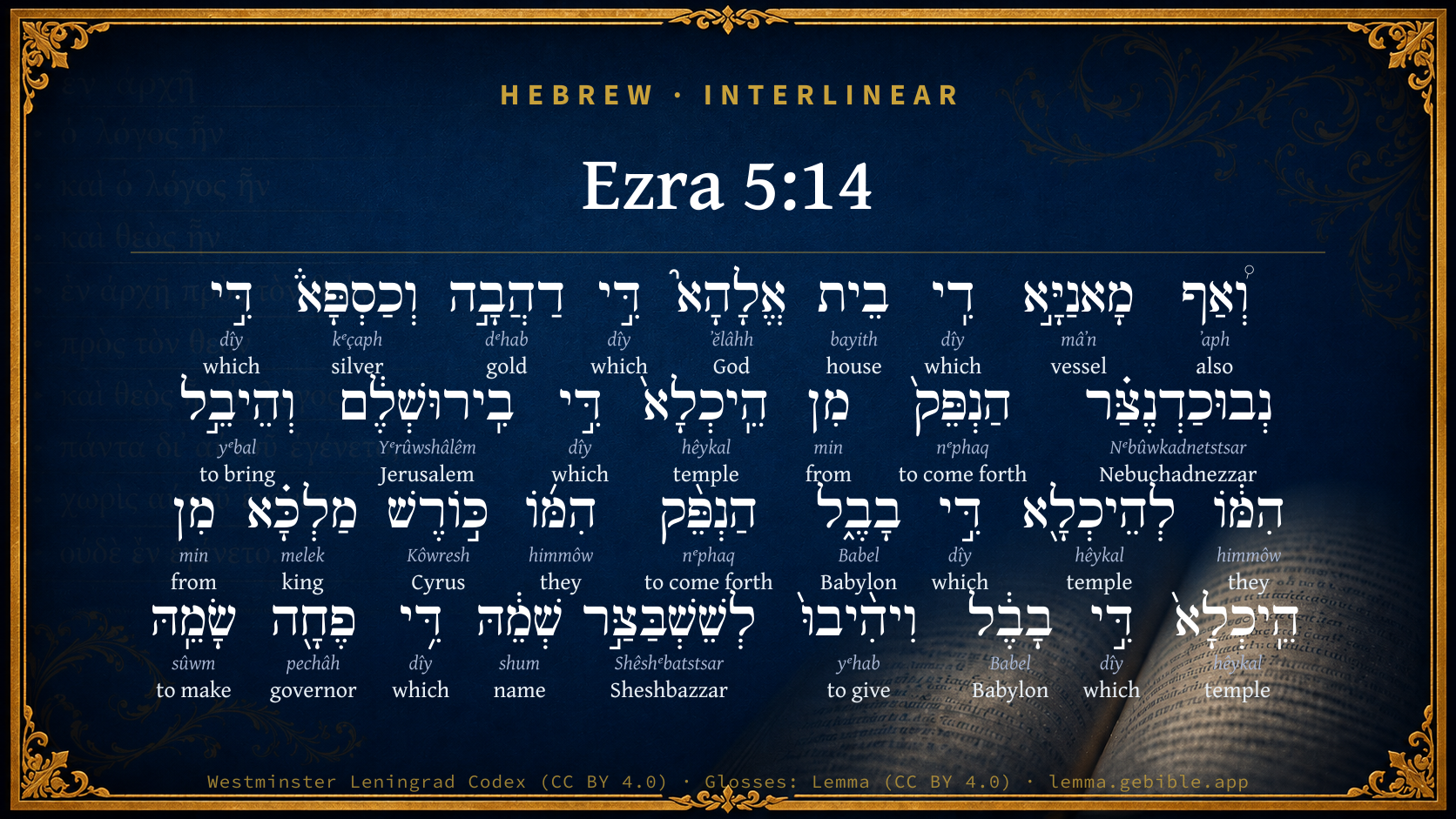
Ezra 5:14

Hebrew (Westminster Leningrad Codex) Ezra 5:14 appears in the Hebrew Old Testament. The text above is from the Westminster Leningrad Codex. Each word links to its Strong’s number, a concise gloss, and parsing drawn from the Open Scriptures Hebrew Bible morphology. Click any word for its full Brown-Driver-Briggs (BDB) entry.
Download image
Cite this verse

Ezra 5:14 (World English Bible). Public Domain. Lemma interlinear Bible study tool, https://lemma.gebible.app/v/ezra/5/14.

Show BibTeX & RIS
BibTeX
RIS
English Translation
The gold and silver vessels also of the house of God, which Nebuchadnezzar took out of the temple that was in Jerusalem, and brought into the temple of Babylon, those did Cyrus the king take out of the temple of Babylon, and they were delivered to one whose name was Sheshbazzar, whom he had made governor;
World English Bible · Public Domain
Highlights
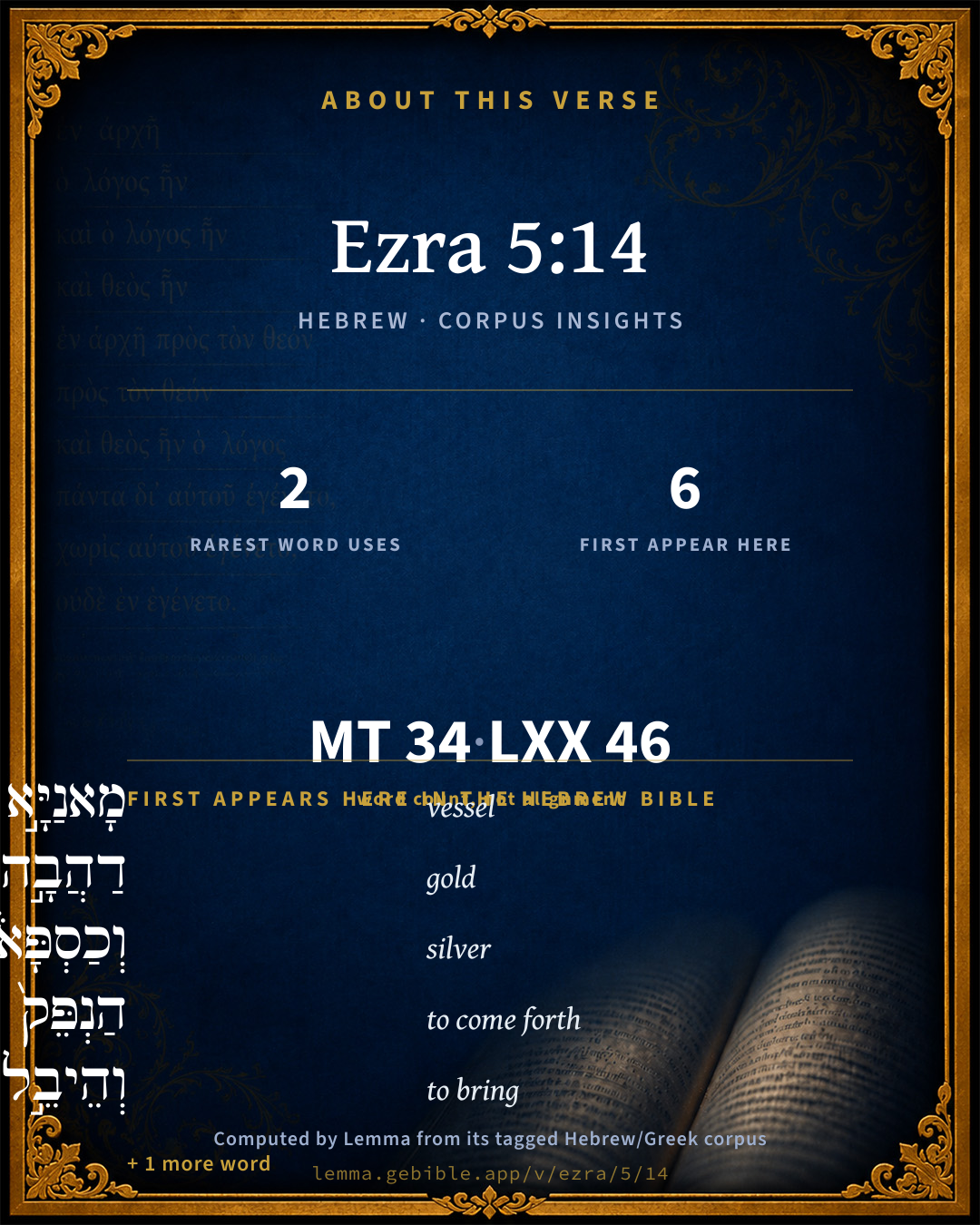
  • 6 first appearances in the Hebrew Bible
Full analysis ↓
Download a study sheet

One document with this verse’s original text, its word-by-word gloss line, the meaning frame, cross-references with their text, attributed commentary, and full source and license credits — printable, and it pastes into notes with its structure intact.

This verse Autodidact and up

Study sheet (.html) Plain text (.txt)

A passage Seminary Student

Up to 50 verses in one chapter. A passage sheet keeps up to 6 commentary sources and 12 cross-references per verse, in the order this page ranks them, and says so on the sheet whenever that leaves anything out. Ask for a single verse and you get the Autodidact verse sheet above.

Everything on this page stays free to read, with no account — the sheet is a download of what is already on screen, not access to it.

Want to remove ads? Support Godless Engineer
Compare translations 3

The same verse in 3 English versions, stacked beneath the original-language interlinear above. Click any original word for its lexicon entry.

Each is an independent rendering of the whole verse — the interlinear is not word-aligned to these translations.

Highlighted words mark where these versions differ — a whole-verse word diff, not a word-by-word alignment.

  • World English Bible Public Domain
    The gold and silver vessels also of the house of God, which Nebuchadnezzar took out of the temple that was in Jerusalem, and brought into the temple of Babylon, those did Cyrus the king take out of the temple of Babylon, and they were delivered to one whose name was Sheshbazzar, whom he had made governor;
  • King James Version Public Domain
    And the vessels also of gold and silver of the house of God, which Nebuchadnezzar took out of the temple that was in Jerusalem, and brought them into the temple of Babylon, those did Cyrus the king take out of the temple of Babylon, and they were delivered unto one, whose name was Sheshbazzar, whom he had made governor;
  • unfoldingWord Literal Text CC BY-SA 4.0
    And also the vessels of the house of God, of gold and silver, that Nebuchadnezzar had taken out from the temple that was in Jerusalem and had brought them to the temple of Babylon—Cyrus the king took them out from the temple of Babylon and they were given to one whose name was Sheshbazzar, whom he had set as governor.

unfoldingWord Literal Text — © unfoldingWord, licensed CC BY-SA 4.0. Word-aligned USFM3 via Door43 (git.door43.org/unfoldingWord/en_ult).

Versions to compare (up to 4)

3 of 4 selected

Show all 18 translations

Every available English version of this verse, each an independent rendering of the whole verse.

  • World English Bible Public Domain
    The gold and silver vessels also of the house of God, which Nebuchadnezzar took out of the temple that was in Jerusalem, and brought into the temple of Babylon, those did Cyrus the king take out of the temple of Babylon, and they were delivered to one whose name was Sheshbazzar, whom he had made governor;
  • Berean Standard Bible Public Domain
    He also removed from the temple of Babylon the gold and silver articles belonging to the house of God, which Nebuchadnezzar had taken and carried there from the temple in Jerusalem. King Cyrus gave these articles to a man named Sheshbazzar, whom he appointed governor
  • Majority Standard Bible Public Domain
    He also removed from the temple of Babylon the gold and silver articles belonging to the house of God, which Nebuchadnezzar had taken and carried there from the temple in Jerusalem. King Cyrus gave these articles to a man named Sheshbazzar, whom he appointed governor
  • King James Version Public Domain
    And the vessels also of gold and silver of the house of God, which Nebuchadnezzar took out of the temple that was in Jerusalem, and brought them into the temple of Babylon, those did Cyrus the king take out of the temple of Babylon, and they were delivered unto one, whose name was Sheshbazzar, whom he had made governor;
  • American Standard Version (1901) Public Domain
    And the gold and silver vessels also of the house of God, which Nebuchadnezzar took out of the temple that was in Jerusalem, and brought into the temple of Babylon, those did Cyrus the king take out of the temple of Babylon, and they were delivered unto one whose name was Sheshbazzar, whom he had made governor;
  • Revised Version (1885) Public Domain
    And the gold and sliver vessels also of the house of God, which Nebuchadnezzar took out of the temple that was in Jerusalem, and brought them into the temple of Babylon, those did Cyrus the king take out of the temple of Babylon, and they were delivered unto one whose name was Sheshbazzar, whom he had made governor;
  • Geneva Bible (1599) Public Domain
    And the vessels of golde and siluer of the house of God, which Nebuchadnezzar tooke out of the Temple, that was in Ierusalem, and brought them into the Temple of Babel, those did Cyrus the king take out of the Temple of Babel, and they gaue them vnto one Sheshbazzar by his name, whome he had made captaine.
  • Douay-Rheims (1899) Public Domain
    And the vessels also of gold and silver of the temple of God, which Nabuchodonosor had taken out of the temple, that was in Jerusalem, and had brought them to the temple of Babylon, king Cyrus brought out of the temple of Babylon, and they were delivered to one Sassabasar, whom also he appointed governor,
  • Young's Literal Translation Public Domain
    and also, the vessels of the house of God, of gold and silver, that Nebuchadnezzar had taken forth out of the temple that `is' in Jerusalem, and brought them to the temple of Babylon, them hath Cyrus the king brought forth out of the temple of Babylon, and they have been given to `one', Sheshbazzar `is' his name, whom he made governor,
  • Literal Standard Version CC BY-SA 4.0
    and also, the vessels of the house of God, of gold and silver, that Nebuchadnezzar had taken forth out of the temple that [is] in Jerusalem, and brought them to the temple of Babylon, them has Cyrus the king brought forth out of the temple of Babylon, and they have been given to [one], Sheshbazzar [is] his name, whom he made governor,
  • Unlocked Literal Bible CC BY-SA 4.0
    King Cyrus also returned the gold and silver objects belonging to the house of God that Nebuchadnezzar had brought from the temple in Jerusalem to the temple in Babylon. He restored them to Sheshbazzar, whom he had made governor.
  • unfoldingWord Literal Text CC BY-SA 4.0
    And also the vessels of the house of God, of gold and silver, that Nebuchadnezzar had taken out from the temple that was in Jerusalem and had brought them to the temple of Babylon—Cyrus the king took them out from the temple of Babylon and they were given to one whose name was Sheshbazzar, whom he had set as governor.
  • Darby Bible Public Domain
    And the vessels also of gold and silver of the house of God, which Nebuchadnezzar took out of the temple that was at Jerusalem and brought into the temple of Babylon, those did king Cyrus take out of the temple of Babylon, and they were delivered to one Sheshbazzar by name, whom he had appointed governor.
  • World Messianic Bible Public Domain
    The gold and silver vessels of God’s house, which Nebuchadnezzar took out of the temple that was in Jerusalem and brought into the temple of Babylon, those Cyrus the king also took out of the temple of Babylon, and they were delivered to one whose name was Sheshbazzar, whom he had made governor.
  • Webster's Bible Public Domain
    And the vessels also of gold and silver of the house of God, which Nebuchadnezzar took out of the temple that was in Jerusalem, and brought them into the temple of Babylon, those did Cyrus the king take out of the temple of Babylon, and they were delivered to one, whose name was Sheshbazzar, whom he had made governor;
  • Free Bible Version CC BY-SA 4.0
    He even gave back the gold and silver items belonging to God's Temple, which Nebuchadnezzar had taken from the Temple in Jerusalem and placed in his temple in Babylon. King Cyrus gave them to a man named Sheshbazzar, whom he had appointed governor,
  • Bible in Basic English Public Domain
    And the gold and silver vessels of the house of God, which Nebuchadnezzar took from the Temple which was in Jerusalem, and put into the house of his god in Babylon, these Cyrus the king took from the house of his god in Babylon, and gave to one named Sheshbazzar, whom he had made ruler;
  • JPS Tanakh (1917) Public Domain
    And the gold and silver vessels also of the house of God, which Nebuchadnezzar took out of the temple that was in Jerusalem, and brought them into the temple of Babylon, those did Cyrus the king take out of the temple of Babylon, and they were delivered unto one whose name was Sheshbazzar, whom he had made governor;

Literal Standard Version (2020), Covenant Press — licensed CC BY-SA 4.0. Text via the HelloAO Bible API (eBible.org). Unlocked Literal Bible (unfoldingWord) — licensed CC BY-SA 4.0. Text via the HelloAO Bible API (eBible.org). unfoldingWord Literal Text — © unfoldingWord, licensed CC BY-SA 4.0. Word-aligned USFM3 via Door43 (git.door43.org/unfoldingWord/en_ult). Free Bible Version, Dr. Jonathan Gallagher — licensed CC BY-SA 4.0. Text via the HelloAO Bible API (eBible.org).

Word by word

More ways to search: Search by grammar → Find every occurrence → Compare this word →

Practice this passage: Drill this verse → Learn its vocabulary →

לְשֵׁשְׁבַּצַּ֣ר
Shêshᵉbatstsar
H8340
“to/for · Sheshbazzar”
Adjective, R + Noun, Proper
Part of Speech
Adjective + Noun
Type
Proper
Full BDB Definition

Origin: corresponding to H8339

TWOT: None

Sheshbazzar = "worshipper of fire" - the prince of Judah at the first return from exile in Babylon; usually identified as the Babylonian name for Zerubbabel
  1. וְ֠אַף ʼaph H638 “and · also” Adjective, C + Particle, Accusative
  2. מָאנַיָּ֣א mâʼn H3984 “vessels · the” Adjective, N, Common + Particle, Definite Article
  3. דִֽי dîy H1768 “which” Adjective, T
  4. בֵית bayith H1005 “house of” Adjective, N, Common
  5. אֱלָהָא֮ ʼĕlâhh H426 “God · the” Adjective, N, Common + Particle, Definite Article
  6. דִּ֣י dîy H1768 “which” Adjective, T
  7. דַהֲבָ֣ה dᵉhab H1722 “gold · the” Adjective, N, Common + Particle, Definite Article
  8. וְכַסְפָּא֒ kᵉçaph H3702 “and · silver · the” Adjective, C + Noun, Common, Masculine, Singular, Determined + Particle, Definite Article
  9. דִּ֣י dîy H1768 “which” Adjective, T
  10. נְבוּכַדְנֶצַּ֗ר Nᵉbûwkadnetstsar H5020 “Nebuchadnezzar” Adjective, N
  11. הַנְפֵּק֙ nᵉphaq H5312 “to come forth” Adjective, V, Plural
  12. מִן min H4481 “from” Adjective, R
  13. הֵֽיכְלָא֙ hêykal H1965 “temple · the” Adjective, N, Common + Particle, Definite Article
  14. דִּ֣י dîy H1768 “which” Adjective, T
  15. בִֽירוּשְׁלֶ֔ם Yᵉrûwshâlêm H3390 “in/at · Jerusalem” Adjective, R + Noun, Proper
  16. וְהֵיבֵ֣ל yᵉbal H2987 “and · to bring” Adjective, C + Verb, Hiphil, Perfect, 3rd Person, Masculine, Singular
  17. הִמּ֔וֹ himmôw H1994 “they” Adjective, P
  18. לְהֵיכְלָ֖א hêykal H1965 “to/for · temple · the” Adjective, R + Noun, Common, Masculine, Singular, Determined + Particle, Definite Article
  19. דִּ֣י dîy H1768 “which” Adjective, T
  20. בָבֶ֑ל Babel H895 “Babylon” Adjective, N
  21. הַנְפֵּ֨ק nᵉphaq H5312 “to come forth” Adjective, V, Plural
  22. הִמּ֜וֹ himmôw H1994 “they” Adjective, P
  23. כּ֣וֹרֶשׁ Kôwresh H3567 “Cyrus” Adjective, N
  24. מַלְכָּ֗א melek H4430 “king · the” Adjective, N, Common + Particle, Definite Article
  25. מִן min H4481 “from” Adjective, R
  26. הֵֽיכְלָא֙ hêykal H1965 “temple · the” Adjective, N, Common + Particle, Definite Article
  27. דִּ֣י dîy H1768 “which” Adjective, T
  28. בָבֶ֔ל Babel H895 “Babylon” Adjective, N
  29. וִיהִ֨יבוּ֙ yᵉhab H3052 “and · to give” Adjective, C + Verb, Qal Passive, Perfect, 3rd Person, Masculine, Plural
  30. שְׁמֵ֔הּ shum H8036 “name · his” Adjective, N, Common + Suffix, Personal, 3rd Person, Masculine, Singular
  31. דִּ֥י dîy H1768 “which” Adjective, T
  32. פֶחָ֖ה pechâh H6347 “governor” Adjective, N, Common
  33. שָׂמֵֽהּ sûwm H7761 “to make · him” Adjective, V, Plural + Suffix, Personal, 3rd Person, Masculine, Singular

About this verse

These counts appear in no published source. They are computed here, from the morphology-tagged text and Lemma’s own curated glosses. What Lemma adds →

34
words
22
distinct lemmas
Historical
section

Notable vocabulary

The rarest word here is לְשֵׁשְׁבַּצַּ֣ר Sheshbazzar H8340 — appearing just 2 times in the whole Hebrew Bible.

First appearance in Scripture

These words make their first canonical appearance in the Hebrew Bible here:

  • מָאנַיָּ֣א vessel H3984
  • דַהֲבָ֣ה gold H1722
  • וְכַסְפָּא֒ silver H3702
  • הַנְפֵּק֙ to come forth H5312
  • וְהֵיבֵ֣ל to bring H2987
  • לְשֵׁשְׁבַּצַּ֣ר Sheshbazzar H8340

Shared distinctive vocabulary

לְשֵׁשְׁבַּצַּ֣ר Sheshbazzar H8340 occurs in 2 verses of the Hebrew Bible. Also found in:

Grammatical profile

  • 2 verbs
  • 2 nouns
  • 21 adjectives
  • 9 particles

Verb forms

  • וְהֵיבֵ֣ל Hiphil · Perfect
  • וִיהִ֨יבוּ֙ Qal Passive · Perfect

Repetition

Words recur within this verse — often emphatic in Hebrew:

  • הֵֽיכְלָא֙ temple H1965 ×3
  • הַנְפֵּק֙ to come forth H5312 ×2
  • בָבֶ֑ל Babylon H895 ×2
  • דִֽי which H1768 ×7
  • מִן from H4481 ×2
  • הִמּ֔וֹ they H1994 ×2

Hebrew & Septuagint length

In English translation the verse runs 56 words from the Hebrew and 55 from the Septuagint (LXX English) — closely comparable.

A rough comparison of the two English renderings, which tokenize alike — not a word-level alignment.

Word counts can differ between the Hebrew and the Greek without any difference in meaning — e.g. the Hebrew direct-object marker אֵת has no separate Greek word, and Greek often adds the article ὁ.

In the original languages it is 34 Hebrew tokens and 46 Greek tokens — but the two are counted differently (Hebrew bundles its prefixes and suffixes into one token; the Greek is in lemma form), so that isn’t a like-for-like length.

Cross-references

15

Topical passages linked to Ezra 5:14 in the Treasury of Scripture Knowledge — connected by theme and wording, ordered by reader-vote popularity; previews shown in the World English Bible.

  • Ezra 6:5 Also let the gold and silver vessels of the house of God, which Nebuchadnezzar took forth out of the temple which is at Jerusalem, and brought to Babylon, be restored, and brought again to the temple which is at Jerusalem, everyone to its place; and you shall put them in the house of God.
  • Ezra 5:16 Then came the same Sheshbazzar, and laid the foundations of the house of God which is in Jerusalem: and since that time even until now has it been in building, and yet it is not completed.
  • Jeremiah 52:19 The cups, and the fire pans, and the basins, and the pots, and the lampstands, and the spoons, and the bowls-that which was of gold, in gold, and that which was of silver, in silver,-the captain of the guard took away.
  • Daniel 5:2–3 Belshazzar, while he tasted the wine, commanded to bring the golden and silver vessels which Nebuchadnezzar his father had taken out of the temple which was in Jerusalem; that the king and his lords, his wives and his concubines, might drink from it.
  • 2 Chronicles 36:7 Nebuchadnezzar also carried of the vessels of the house of Yahweh to Babylon, and put them in his temple at Babylon.
  • 2 Chronicles 36:18 All the vessels of the house of God, great and small, and the treasures of the house of Yahweh, and the treasures of the king, and of his princes, all these he brought to Babylon.
  • Ezra 1:7–11 Also Cyrus the king brought forth the vessels of the house of Yahweh, which Nebuchadnezzar had brought forth out of Jerusalem, and had put in the house of his gods;
  • Ezra 7:27 Blessed be Yahweh, the God of our fathers, who has put such a thing as this in the king's heart, to beautify the house of Yahweh which is in Jerusalem;
  • Proverbs 21:1 The king's heart is in Yahweh's hand like the watercourses. He turns it wherever he desires.
  • Haggai 1:1 In the second year of Darius the king, in the sixth month, in the first day of the month, the Word of Yahweh came by Haggai, the prophet, to Zerubbabel, the son of Shealtiel, governor of Judah, and to Joshua, the son of Jehozadak, the high priest, saying,
  • Haggai 1:14 Yahweh stirred up the spirit of Zerubbabel, the son of Shealtiel, governor of Judah, and the spirit of Joshua, the son of Jehozadak, the high priest, and the spirit of all the remnant of the people; and they came and worked on the house of Yahweh of Hosts, their God,
  • Haggai 2:2 "Speak now to Zerubbabel, the son of Shealtiel, governor of Judah, and to Joshua, the son of Jehozadak, the high priest, and to the remnant of the people, saying,
  • Haggai 2:21 "Speak to Zerubbabel, governor of Judah, saying, 'I will shake the heavens and the earth.
  • Acts 13:7–8 who was with the proconsul, Sergius Paulus, a man of understanding. This man summoned Barnabas and Saul, and sought to hear the word of God.
  • Acts 13:12 Then the proconsul, when he saw what was done, believed, being astonished at the teaching of the Lord.

Cross-references courtesy of OpenBible.info (CC BY 4.0).

Hebrew and Greek witnesses Masoretic Hebrew ↔ Greek Septuagint

The same verse in the two great witnesses to the Old Testament, shown verse-for-verse.

These are two independent witnesses, not word-aligned to each other, and the Septuagint is shown in lemma (dictionary) form.

Hebrew Ezra 5:14 Masoretic · Westminster Leningrad Codex

וְ֠אַף מָאנַיָּ֣א דִֽי בֵית אֱלָהָא֮ דִּ֣י דַהֲבָ֣ה וְכַסְפָּא֒ דִּ֣י נְבוּכַדְנֶצַּ֗ר הַנְפֵּק֙ מִן הֵֽיכְלָא֙ דִּ֣י בִֽירוּשְׁלֶ֔ם וְהֵיבֵ֣ל הִמּ֔וֹ לְהֵיכְלָ֖א דִּ֣י בָבֶ֑ל הַנְפֵּ֨ק הִמּ֜וֹ כּ֣וֹרֶשׁ מַלְכָּ֗א מִן הֵֽיכְלָא֙ דִּ֣י בָבֶ֔ל וִיהִ֨יבוּ֙ לְשֵׁשְׁבַּצַּ֣ר שְׁמֵ֔הּ דִּ֥י פֶחָ֖ה שָׂמֵֽהּ

The gold and silver vessels also of the house of God, which Nebuchadnezzar took out of the temple that was in Jerusalem, and brought into the temple of Babylon, those did Cyrus the king take out of the temple of Babylon, and they were delivered to one whose name was Sheshbazzar, whom he had made governor;

World English Bible · Public Domain

Greek LXX Ezra 5:14 Septuagint · lemma form

καί ὁ σκεῦος ὁ οἶκος ὁ θεός ὁ χρυσοῦς καί ὁ ἀργυροῦς ὅς ναβουχοδονοσορ ἐκφέρω ἀπό οἶκος ὁ ἐν ἰερουσαλήμ καί ἀποφέρω αὐτός εἰς ναός ὁ βασιλεύς ἐκφέρω αὐτός κῦρος ὁ βασιλεύς ἀπό ναός ὁ βασιλεύς καί δίδωμι ὁ σασαβασαρ ὁ θησαυροφύλαξ ὁ ἐπί ὁ θησαυρός

And the gold and silver vessels of the house of God, which Nabuchodonosor brought out from the house that was in Jerusalem, and carried them into the temple of the king, them did king Cyrus bring out from the temple of the king, and gave them to Sabanasar the treasurer, who was over the treasurer;

LXX2012 (modern English Septuagint) · Public Domain

In the Septuagint this is one book — Esdras B (2 Esdras): Ezra is chapters 1–10, Nehemiah 11–23.

On this verse, Haydock's Catholic Bible Commentary discusses the Septuagint’s reading. Read the note in Commentary ↓

Hebrew: Westminster Leningrad Codex (CC BY 4.0). Greek: Septuagint (public domain); English from LXX2012 (modern English Septuagint) (Public Domain). How the Septuagint differs from the Hebrew →

Commentary

Notes on Ezra 5:14 from classic Christian and Jewish commentators (each source and its license shown beneath its notes). The classic Christian expositions comment on the surrounding passage and are grouped to its opening verse, so a note may address several verses; the Jewish commentaries on the Tanakh (Rashi and others) are per-verse, so they appear only where the commentator wrote on this verse.

Lemma curates 59 commentaries, every one of them public domain or Creative Commons licensed, each selected and text-cleaned for this edition rather than reprinted as found. About our sources →

Trapp's Complete Commentary

John Trapp

Ezr 5:14 And the vessels also of gold and silver of the house of God, which Nebuchadnezzar took out of the temple that [was] in Jerusalem, and brought them into the temple of Babylon, those did Cyrus the king take out of the temple of Babylon, and they were delivered unto [one], whose name [was] Sheshbazzar, whom he had made governor;

Ver. 14. The temple of Babylon] For there also was a temple built for Bel. Faciunt et vespae favos: simiae imitantur homines. The devil will needs be God’s ape, and affects to be semblably worshipped.

John Trapp, A Commentary or Exposition upon All the Books of the Old and New Testament (1647–1656) — public domain. Text from a community e-Sword module.

Tyndale Open Study Notes

Tyndale Open Resources

5:14-15 The Jews provided detailed information that the Persians could check for accuracy (see 1:7-11).

Tyndale Open Study Notes — © Tyndale Open Resources, licensed CC BY-SA 4.0. Text via the HelloAO Bible API.

Geneva Bible (1599)

Geneva Bible translators

Read Ezra 1:8.

Geneva Bible (1599) marginal notes — public domain. Text via Bolls.life.

The Cambridge Bible for Schools and Colleges

gen. ed. J. J. S. Perowne

14. And the vessels also of gold and silver] R.V. And the gold and silver vessels. See note on Ezr_1:7-11.

into the temple of Babylon] See note on Ezr_1:7, ‘the house of his gods’, i.e. the great temple at Babylon, which Nebuchadnezzar had restored.

Sheshbazzar, whom he had made governor] Literally ‘pekhah’. In Ezr_1:8, Sheshbazzar is called ‘prince of Judah’. In Hag_1:1 &c. Zerubbabel is called ‘pekhah’. For the identification see note on Ezr_1:8.

The Cambridge Bible for Schools and Colleges (gen. ed. J. J. S. Perowne; Cambridge University Press, 1878–1918) — public domain. Text from a community e-Sword module.

John Gill's Exposition

Of which, and of what is said concerning them, and particularly of the delivery of them to Sheshbazzar, whom Cyrus made governor of Judah, and ordered him to carry them to Jerusalem, and build the temple there, and put them in it, see Ezr 1:7.

.

Ezra 5:16

ezr 5:16

ezr 5:16

ezr 5:16Then came the same Sheshbazzar, and laid the foundation of the house of God which is in Jerusalem,.... Which makes it clear, that by Sheshbazzar is meant Zerubbabel; for he it was that laid the foundation of the temple, or at least by whose order it was laid, see Zac 4:9

and since that time even until now; from the first of Cyrus to the second of Darius, a space of about eighteen years, and just seventy from the destruction of the temple:

hath it been in building, and yet it is not finished; the work going on slowly, not without interruption and intermission, through the enmity of the Samaritans unto them, who had made false representations of them; but these men, Tatnai and those with him, as the Jews gave them a very particular account of things, as above, so they fairly and fully related them in this their letter to the king.

John Gill's Exposition of the Whole Bible (1746–1763) — public domain (CC PDM 1.0). Text via the HelloAO Bible API.

Haydock's Catholic Bible Commentary

Governor. Septuagint, "over the treasury."

George Leo Haydock (1774–1849), Haydock's Catholic Family Bible and Commentary, 1859 edition — public domain. Excludes Psalms (Douay-Rheims chapter numbering differs from Protestant) and Deuterocanonical books (Catholic canon only).

Whedon's Commentary on the Bible

Daniel D. Whedon

14. Sheshbazzar — See on Ezr_1:8.

Daniel D. Whedon (gen. ed.), Commentary on the Old and New Testaments (1874–1909) — public domain. Text from a community e-Sword module.

The Pulpit Commentary

The vessels also of gold and silver. See Ezr_1:7-11. On the great importance attached to these vessels, see the comment on Ezr_1:7. So long as they remained at Babylon they were a tangible evidence of the conquest, a glory to the Babylonians, and a disgrace to the Jews. Their retention was a perpetual desecration. Their restoration by Cyrus was an act at once of piety and of kindliness. On the temple of Babylon, out of which Cyrus took them, see the comment on Ezr_1:7.

The Pulpit Commentary (1880–1919), ed. H.D.M. Spence-Jones & Joseph S. Exell — public domain. Text from a community e-Sword module.

unfoldingWord translationNotes

Door43 World Missions Community

General Information:

The letter from Tattenai to the king that began in Esra 5:7 continues. Tattenai continues to tell the king what the Judeans had told him beginning in (Esra 5:11).

Sheshbazzar

See how you translated this in Esra 1:7.

He restored them

King Cyrus returned the temple objects.

Let the house of God be rebuilt

This can be translated in active form. AT: "I want the Judeans to rebuild the house of God" (See: Active or Passive)

translationWords

gold

silver

house of God

temple

Jerusalem

govern

unfoldingWord translationNotes — © Distant Shores Media and the Door43 World Missions Community, licensed CC BY-SA 4.0. Source: git.door43.org/Door43/en_tn.

Rashi

Rabbi Shlomo Yitzchaki (Rashi)

And also the vessels the holy vessels of silver and gold, which Nebuchadnezzar had taken out of the Temple that is in Jerusalem and brought to his temple that is in Babylon. Cyrus took them out of the temple of the king of Babylon and delivered them to the hand of Sheshbazzar—Daniel, who was called by that name.

and brought them [as translated,] and brought them.

had taken out [as translated,] had taken them out.

whom he appointed governor for he was a prince and a governor and was called by the name governor.

Rashi on the Tanakh — English translations: “The Judaica Press complete Tanach with Rashi, translated by A. J. Rosenberg” (CC BY 4.0); “Pentateuch with Rashi's commentary by M. Rosenbaum and A.M. Silbermann, 1929-1934” (public domain); “The Metsudah Tanach series, Lakewood, N.J” (CC BY 4.0); and “The Book of Joshua, Metsudah Publications, 1997” (CC BY 4.0). Text via Sefaria.

Lesson kit

Teaching starters — assembled from the data on this page, not authored interpretation. Every prompt links to the verse data it draws on. Edit before teaching.

Ezra, in the Historical, opens this verse with 34 words (22 distinct Hebrew lemmas). Its most distinctive word is Shêshᵉbatstsar (“Sheshbazzar”). A historical commentator’s framing appears above. Read the whole chapter for the surrounding context.

Discussion questions

  1. What does “Sheshbazzar” (Shêshᵉbatstsar) contribute to the verse as a whole?
  2. 6 words here appear for the first time in Scripture. What is being introduced at this debut?
  3. Ezra 5:16 shares the word «Sheshbazzar» with this verse. How do the two illuminate each other?
  4. “temple” occurs 3× in this one verse. What is the effect of the repetition?
  5. These translations render this verse differently; the difference is in the English rendering, not the original. What questions does that raise?
  6. The verb «וְהֵיבֵ֣ל» is Hiphil Perfect. How does its form color the action?
  7. Reading how Trapp's Complete Commentary and Tyndale Open Study Notes read this verse, where do the two commentators agree and where do they part?

Things to notice

Reading settings

Reading text

Shown beneath each verse's original-language words.

Old Testament
Old Testament edition

Read the OT as the Masoretic Hebrew (MT) or the Greek Septuagint (LXX).

English shown for the Greek Septuagint (in the Hebrew ↔ Greek comparison).

Comparing translations? Open the Compare panel on any verse page to stack up to four side by side.