
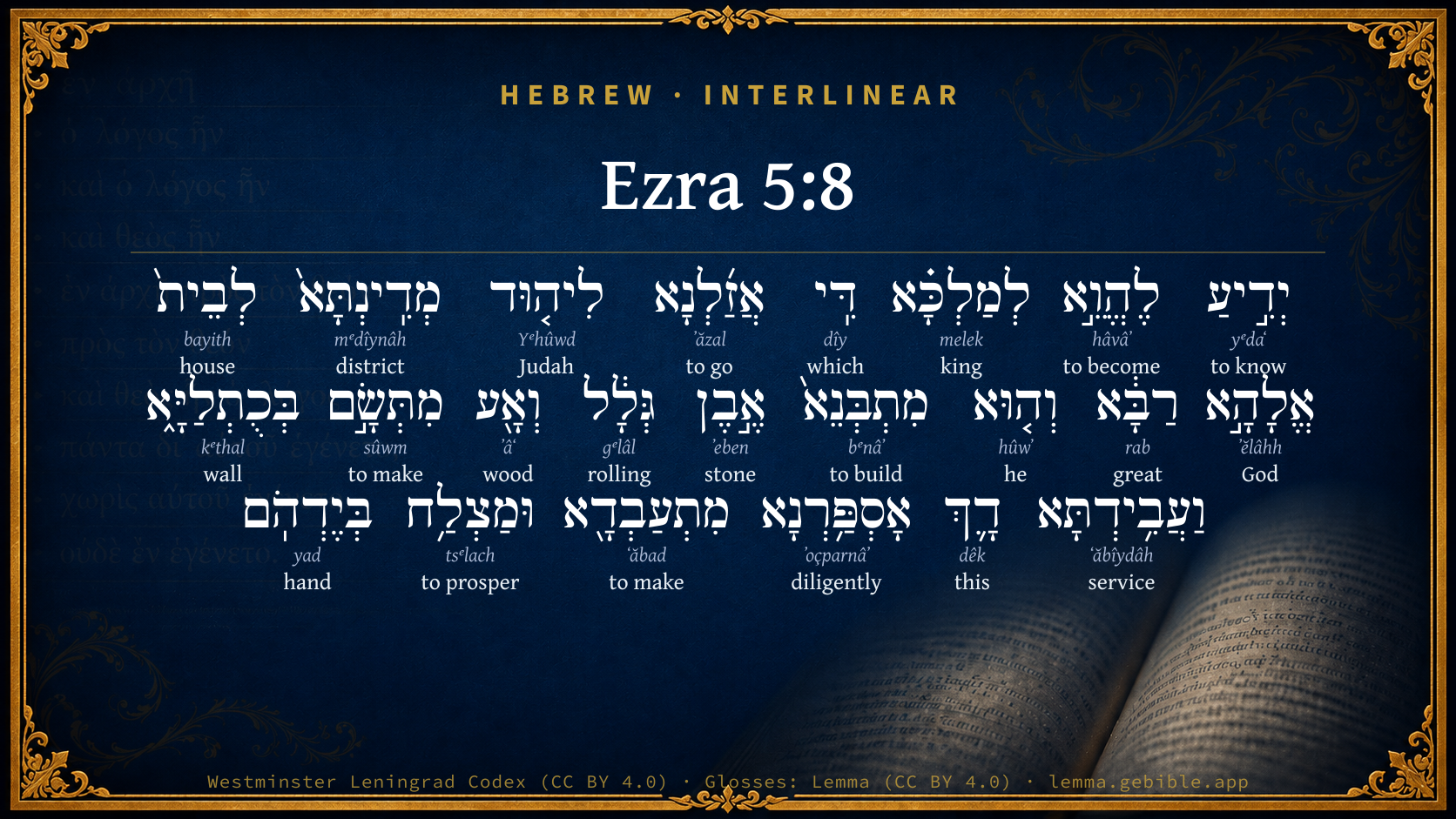
Ezra 5:8

Hebrew (Westminster Leningrad Codex) Ezra 5:8 appears in the Hebrew Old Testament. The text above is from the Westminster Leningrad Codex. Each word links to its Strong’s number, a concise gloss, and parsing drawn from the Open Scriptures Hebrew Bible morphology. Click any word for its full Brown-Driver-Briggs (BDB) entry.
Download image
Cite this verse

Ezra 5:8 (World English Bible). Public Domain. Lemma interlinear Bible study tool, https://lemma.gebible.app/v/ezra/5/8.

Show BibTeX & RIS
BibTeX
RIS
English Translation
Be it known to the king, that we went into the province of Judah, to the house of the great God, which is built with great stones, and timber is laid in the walls; and this work goes on with diligence and prospers in their hands.
World English Bible · Public Domain
Highlights
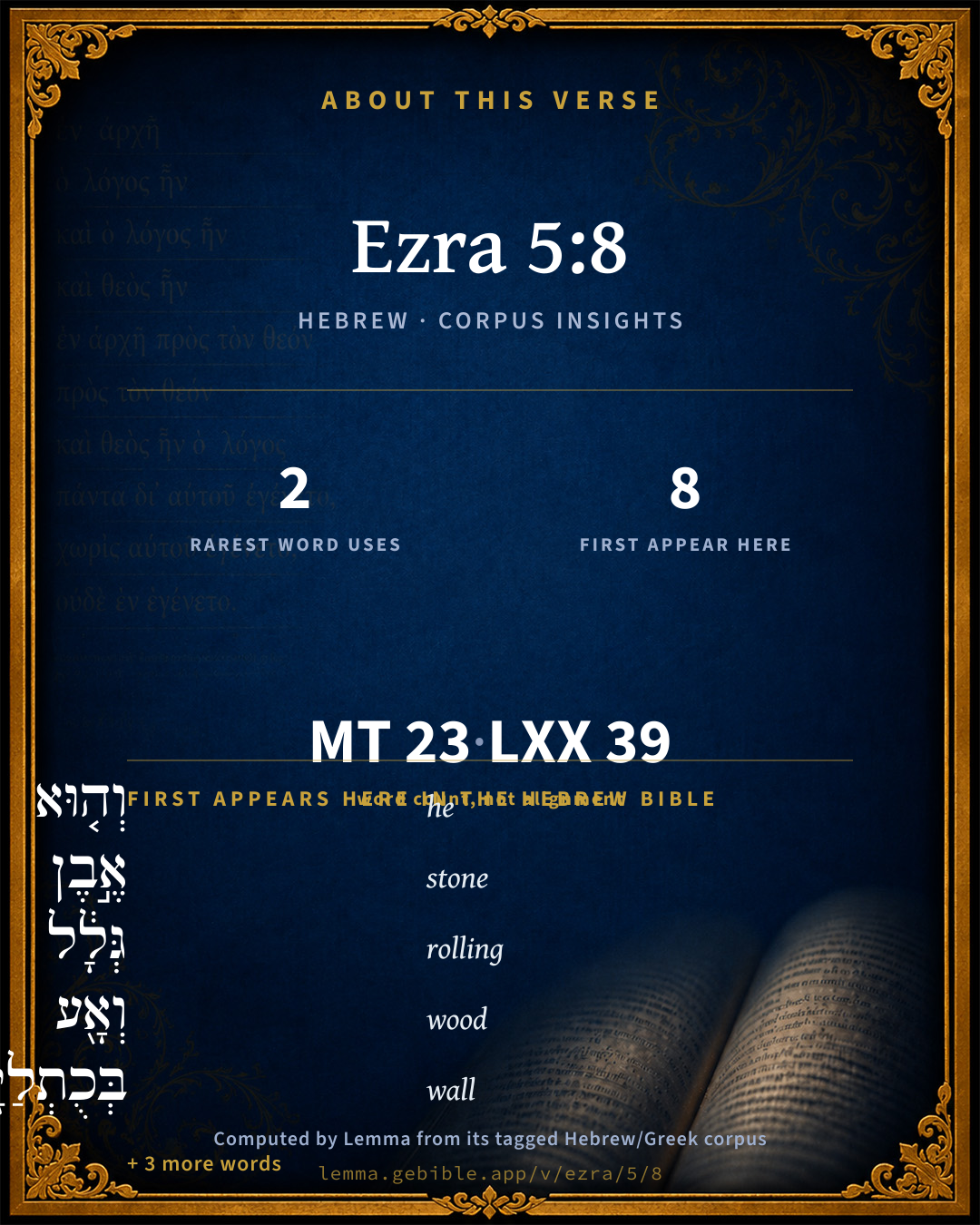
  • 8 first appearances in the Hebrew Bible
Full analysis ↓
Download a study sheet

One document with this verse’s original text, its word-by-word gloss line, the meaning frame, cross-references with their text, attributed commentary, and full source and license credits — printable, and it pastes into notes with its structure intact.

This verse Autodidact and up

Study sheet (.html) Plain text (.txt)

A passage Seminary Student

Up to 50 verses in one chapter. A passage sheet keeps up to 6 commentary sources and 12 cross-references per verse, in the order this page ranks them, and says so on the sheet whenever that leaves anything out. Ask for a single verse and you get the Autodidact verse sheet above.

Everything on this page stays free to read, with no account — the sheet is a download of what is already on screen, not access to it.

Want to remove ads? Support Godless Engineer
Compare translations 3

The same verse in 3 English versions, stacked beneath the original-language interlinear above. Click any original word for its lexicon entry.

Each is an independent rendering of the whole verse — the interlinear is not word-aligned to these translations.

Highlighted words mark where these versions differ — a whole-verse word diff, not a word-by-word alignment.

  • World English Bible Public Domain
    Be it known to the king, that we went into the province of Judah, to the house of the great God, which is built with great stones, and timber is laid in the walls; and this work goes on with diligence and prospers in their hands.
  • King James Version Public Domain
    Be it known unto the king, that we went into the province of Judea, to the house of the great God, which is builded with great stones, and timber is laid in the walls, and this work goeth fast on, and prospereth in their hands.
  • unfoldingWord Literal Text CC BY-SA 4.0
    Let it be known to the king that we went to Judah, the province, to the house of the great God, and it is being built of large stones, and timber is being placed in the walls. And this work is being done diligently and is succeeding in their hand.

unfoldingWord Literal Text — © unfoldingWord, licensed CC BY-SA 4.0. Word-aligned USFM3 via Door43 (git.door43.org/unfoldingWord/en_ult).

Versions to compare (up to 4)

3 of 4 selected

Show all 18 translations

Every available English version of this verse, each an independent rendering of the whole verse.

  • World English Bible Public Domain
    Be it known to the king, that we went into the province of Judah, to the house of the great God, which is built with great stones, and timber is laid in the walls; and this work goes on with diligence and prospers in their hands.
  • Berean Standard Bible Public Domain
    Let it be known to the king that we went into the province of Judah, to the house of the great God. The people are rebuilding it with large stones, and placing timbers in the walls. This work is being carried out diligently and is prospering in their hands.
  • Majority Standard Bible Public Domain
    Let it be known to the king that we went into the province of Judah, to the house of the great God. The people are rebuilding it with large stones and placing timbers in the walls. This work is being carried out diligently and is prospering in their hands.
  • King James Version Public Domain
    Be it known unto the king, that we went into the province of Judea, to the house of the great God, which is builded with great stones, and timber is laid in the walls, and this work goeth fast on, and prospereth in their hands.
  • American Standard Version (1901) Public Domain
    Be it known unto the king, that we went into the province of Judah, to the house of the great God, which is builded with great stones, and timber is laid in the walls; and this work goeth on with diligence and prospereth in their hands.
  • Revised Version (1885) Public Domain
    Be it known unto the king, that we went into the province of Judah, to the house of the great God, which is builded with great stones, and timber is laid in the walls, and this work goeth on with diligence and prospereth in their hands.
  • Geneva Bible (1599) Public Domain
    Be it knowen vnto the King, that we went into the prouince of Iudea, to the house of the great God, which is builded with great stones, and beames are layde in the walles, and this worke is wrought speedily, and prospereth in their hands.
  • Douay-Rheims (1899) Public Domain
    Be it known to the king, that we went to the province of Judea, to the house of the great God, which they are building with unpolished stones, and timber is laid in the walls: and this work is carried on diligently, and advanceth in their hands.
  • Young's Literal Translation Public Domain
    `To Darius the king, all peace! be it known to the king that we have gone to the province of Judah, to the great house of God, and it is built `with' rolled stones, and wood is placed in the walls, and this work is done speedily, and prospering in their hand.
  • Literal Standard Version CC BY-SA 4.0
    “To Darius the king, all peace! Be it known to the king that we have gone to the province of Judah, to the great house of God, and it is built [with] rolled stones, and wood is placed in the walls, and this work is done speedily, and prospering in their hand.
  • Unlocked Literal Bible CC BY-SA 4.0
    Let the king know that we went to Judah to the house of the great God. It is being built with large stones and timbers set in the walls. This work is being done thoroughly and is going forward well in their hands.
  • unfoldingWord Literal Text CC BY-SA 4.0
    Let it be known to the king that we went to Judah, the province, to the house of the great God, and it is being built of large stones, and timber is being placed in the walls. And this work is being done diligently and is succeeding in their hand.
  • Darby Bible Public Domain
    Be it known to the king that we went into the province of Judah, to the house of the great God, which is being built with great stones, and timber is laid in the walls, and this work is being carried on with diligence, and prospers in their hand.
  • World Messianic Bible Public Domain
    Be it known to the king that we went into the province of Judah, to the house of the great God, which is being built with great stones and timber is laid in the walls. This work goes on with diligence and prospers in their hands.
  • Webster's Bible Public Domain
    Be it known to the king, that we went into the province of Judea, to the house of the great God, which is built with great stones, and timber is laid in the walls, and this work proceedeth rapidly, and prospereth in their hands.
  • Free Bible Version CC BY-SA 4.0
    We wish to inform Your Majesty that we went to the province of Judah, to the Temple of the great God. It is being built with large stones, with timber beams being placed on the walls. This work is being done properly and is progressing well.
  • Bible in Basic English Public Domain
    This is to give the king word that we went into the land of Judah, to the house of the great God, which is made of great stones, and has its walls supported with wood, and the work is going on with industry, and they are doing it well.
  • JPS Tanakh (1917) Public Domain
    Be it known unto the king, that we went into the province of Judah, to the house of the great God, which is builded with great stones, and timber is laid in the walls, and this work goeth on with diligence and prospereth in their hands.

Literal Standard Version (2020), Covenant Press — licensed CC BY-SA 4.0. Text via the HelloAO Bible API (eBible.org). Unlocked Literal Bible (unfoldingWord) — licensed CC BY-SA 4.0. Text via the HelloAO Bible API (eBible.org). unfoldingWord Literal Text — © unfoldingWord, licensed CC BY-SA 4.0. Word-aligned USFM3 via Door43 (git.door43.org/unfoldingWord/en_ult). Free Bible Version, Dr. Jonathan Gallagher — licensed CC BY-SA 4.0. Text via the HelloAO Bible API (eBible.org).

Word by word

More ways to search: Search by grammar → Find every occurrence → Compare this word →

Practice this passage: Drill this verse → Learn its vocabulary →

גְּלָ֔ל
gᵉlâl
H1560
“rolling”
Adjective, N, Common
Part of Speech
Adjective
Gender
Common
Full BDB Definition

Origin: from a root corresponding to H1556

TWOT: 2657

rolling
  1. יְדִ֣יעַ yᵉdaʻ H3046 “known” Adjective, V, Singular
  2. לֶהֱוֵ֣א hâvâʼ H1934 “to become” Adjective, V
  3. לְמַלְכָּ֗א melek H4430 “to/for · king · the” Adjective, R + Noun, Common, Masculine, Singular, Determined + Particle, Definite Article
  4. דִּֽי dîy H1768 “which” Adjective, T
  5. אֲזַ֜לְנָא ʼăzal H236 “to go” Adjective, V, Plural
  6. לִיה֤וּד Yᵉhûwd H3061 “to/for · Judah” Adjective, R + Noun, Proper
  7. מְדִֽינְתָּא֙ mᵉdîynâh H4083 “district · the” Adjective, N, Common + Particle, Definite Article
  8. לְבֵית֙ bayith H1005 “to/for · house of” Adjective, R + Noun, Common, Masculine, Singular, Construct
  9. אֱלָהָ֣א ʼĕlâhh H426 “God · the” Adjective, N, Common + Particle, Definite Article
  10. רַבָּ֔א rab H7229 “great · the” Adjective, A + Particle, Definite Article
  11. וְה֤וּא hûwʼ H1932 “and · he” Adjective, C + Pronoun, Personal, 3rd Person, Masculine, Singular
  12. מִתְבְּנֵא֙ bᵉnâʼ H1124 “building” Adjective, V
  13. אֶ֣בֶן ʼeben H69 “stone of” Adjective, N, Common
  14. וְאָ֖ע ʼâʻ H636 “and · wood” Adjective, C + Noun, Common, Masculine, Singular, Absolute
  15. מִתְּשָׂ֣ם sûwm H7761 “making” Adjective, V
  16. בְּכֻתְלַיָּ֑א kᵉthal H3797 “in/at · walls · the” Adjective, R + Noun, Common, Masculine, Plural, Determined + Particle, Definite Article
  17. וַעֲבִ֥ידְתָּא ʻăbîydâh H5673 “and · service · the” Adjective, C + Noun, Common, Feminine, Singular, Determined + Particle, Definite Article
  18. דָ֛ךְ dêk H1791 “this” Adjective, P
  19. אָסְפַּ֥רְנָא ʼoçparnâʼ H629 “diligently” Adjective, D
  20. מִתְעַבְדָ֖א ʻăbad H5648 “making” Adjective, V
  21. וּמַצְלַ֥ח tsᵉlach H6744 “and · prospering” Adjective, C + Verb, a, Participle Active, Masculine, Singular, Absolute
  22. בְּיֶדְהֹֽם yad H3028 “in/at · hand · their” Adjective, R + Noun, Common, Feminine, Singular, Construct + Suffix, Personal, 3rd Person, Masculine, Plural

About this verse

These counts appear in no published source. They are computed here, from the morphology-tagged text and Lemma’s own curated glosses. What Lemma adds →

23
words
23
distinct lemmas
Historical
section

Notable vocabulary

The rarest word here is גְּלָ֔ל rolling H1560 — appearing just 2 times in the whole Hebrew Bible.

First appearance in Scripture

These words make their first canonical appearance in the Hebrew Bible here:

  • וְה֤וּא he H1932
  • אֶ֣בֶן stone H69
  • גְּלָ֔ל rolling H1560
  • וְאָ֖ע wood H636
  • בְּכֻתְלַיָּ֑א wall H3797
  • אָסְפַּ֥רְנָא diligently H629
  • וּמַצְלַ֥ח to prosper H6744
  • בְּיֶדְהֹֽם hand H3028

Shared distinctive vocabulary

גְּלָ֔ל rolling H1560 occurs in 2 verses of the Hebrew Bible. Also found in:

Grammatical profile

  • 1 verb
  • 4 nouns
  • 11 adjectives
  • 1 pronoun
  • 6 particles

Verb forms

  • וּמַצְלַ֥ח Participle Active

Hebrew & Septuagint length

In English translation the verse runs 46 words from the Hebrew and 48 from the Septuagint (LXX English) — closely comparable.

A rough comparison of the two English renderings, which tokenize alike — not a word-level alignment.

Word counts can differ between the Hebrew and the Greek without any difference in meaning — e.g. the Hebrew direct-object marker אֵת has no separate Greek word, and Greek often adds the article ὁ.

In the original languages it is 23 Hebrew tokens and 39 Greek tokens — but the two are counted differently (Hebrew bundles its prefixes and suffixes into one token; the Greek is in lemma form), so that isn’t a like-for-like length.

Cross-references

17

Topical passages linked to Ezra 5:8 in the Treasury of Scripture Knowledge — connected by theme and wording, ordered by reader-vote popularity; previews shown in the World English Bible.

  • Deuteronomy 10:17 For Yahweh your God, he is God of gods, and Lord of lords, the great God, the mighty, and the awesome, who doesn't regard persons, nor takes reward.
  • Deuteronomy 32:31 For their rock is not as our Rock, Even our enemies themselves being judges.
  • Ezra 1:2–3 Thus says Cyrus king of Persia, All the kingdoms of the earth has Yahweh, the God of heaven, given me; and he has charged me to build him a house in Jerusalem, which is in Judah.
  • Ezra 2:1 Now these are the children of the province, who went up out of the captivity of those who had been carried away, whom Nebuchadnezzar the king of Babylon had carried away to Babylon, and who returned to Jerusalem and Judah, everyone to his city;
  • Ezra 6:10 that they may offer sacrifices of sweet savor to the God of heaven, and pray for the life of the king, and of his sons.
  • Ezra 7:23 Whatever is commanded by the God of heaven, let it be done exactly for the house of the God of heaven; for why should there be wrath against the realm of the king and his sons?
  • Nehemiah 7:6 These are the children of the province, who went up out of the captivity of those who had been carried away, whom Nebuchadnezzar the king of Babylon had carried away, and who returned to Jerusalem and to Judah, everyone to his city;
  • Nehemiah 11:3 Now these are the chiefs of the province who lived in Jerusalem: but in the cities of Judah lived everyone in his possession in their cities, [to wit], Israel, the priests, and the Levites, and the Nethinim, and the children of Solomon's servants.
  • Esther 1:1 Now it happened in the days of Ahasuerus (this is Ahasuerus who reigned from India even to Ethiopia, over one hundred twenty-seven provinces),
  • Esther 1:22 for he sent letters into all the king's provinces, into every province according to the writing of it, and to every people after their language, that every man should bear rule in his own house, and should speak according to the language of his people.
  • Psalms 145:3 Great is Yahweh, and greatly to be praised! His greatness is unsearchable.
  • Daniel 2:47 The king answered to Daniel, and said, Of a truth your God is the God of gods, and the Lord of kings, and a revealer of secrets, seeing you have been able to reveal this secret.
  • Daniel 3:26 Then Nebuchadnezzar came near to the mouth of the burning fiery furnace: he spoke and said, Shadrach, Meshach, and Abednego, you servants of the Most High God, come forth, and come here. Then Shadrach, Meshach, and Abednego came forth out of the midst of the fire.
  • Daniel 4:2 It has seemed good to me to show the signs and wonders that the Most High God has worked toward me.
  • Daniel 4:34–37 At the end of the days I, Nebuchadnezzar, lifted up my eyes to heaven, and my understanding returned to me, and I blessed the Most High, and I praised and honored him who lives forever; for his dominion is an everlasting dominion, and his kingdom from generation to generation.
  • Daniel 6:26 I make a decree, that in all the dominion of my kingdom men tremble and fear before the God of Daniel; for he is the living God, and steadfast forever, His kingdom that which shall not be destroyed; and his dominion shall be even to the end.
  • Mark 13:1–2 As he went out of the temple, one of his disciples said to him, "Teacher, see what kind of stones and what kind of buildings!"

Cross-references courtesy of OpenBible.info (CC BY 4.0).

Hebrew and Greek witnesses Masoretic Hebrew ↔ Greek Septuagint

The same verse in the two great witnesses to the Old Testament, shown verse-for-verse.

These are two independent witnesses, not word-aligned to each other, and the Septuagint is shown in lemma (dictionary) form.

Hebrew Ezra 5:8 Masoretic · Westminster Leningrad Codex

יְדִ֣יעַ לֶהֱוֵ֣א לְמַלְכָּ֗א דִּֽי אֲזַ֜לְנָא לִיה֤וּד מְדִֽינְתָּא֙ לְבֵית֙ אֱלָהָ֣א רַבָּ֔א וְה֤וּא מִתְבְּנֵא֙ אֶ֣בֶן גְּלָ֔ל וְאָ֖ע מִתְּשָׂ֣ם בְּכֻתְלַיָּ֑א וַעֲבִ֥ידְתָּא דָ֛ךְ אָסְפַּ֥רְנָא מִתְעַבְדָ֖א וּמַצְלַ֥ח בְּיֶדְהֹֽם

Be it known to the king, that we went into the province of Judah, to the house of the great God, which is built with great stones, and timber is laid in the walls; and this work goes on with diligence and prospers in their hands.

World English Bible · Public Domain

Greek LXX Ezra 5:8 Septuagint · lemma form

γνωστός εἰμί ὁ βασιλεύς ὅτι πορεύομαι εἰς ὁ ἰουδαία χώρα εἰς οἶκος ὁ θεός ὁ μέγας καί αὐτός οἰκοδομέω λίθος ἐκλεκτός καί ξύλον ἐντίθημι ἐν ὁ τοῖχος καί ὁ ἔργον ἐκεῖνος ἐπιδέξιον γίγνομαι καί εὐοδόω ἐν ὁ χείρ αὐτός

Be it known to the king, that we went into the land of Judea, to the house of the great God; and it is building with choice stones, and they are laying timbers in the walls, and that work is prospering, and goes on favorably in their hands.

LXX2012 (modern English Septuagint) · Public Domain

In the Septuagint this is one book — Esdras B (2 Esdras): Ezra is chapters 1–10, Nehemiah 11–23.

On this verse, The Cambridge Bible for Schools and Colleges discusses the Septuagint’s reading. Read the note in Commentary ↓

Hebrew: Westminster Leningrad Codex (CC BY 4.0). Greek: Septuagint (public domain); English from LXX2012 (modern English Septuagint) (Public Domain). How the Septuagint differs from the Hebrew →

Commentary

Notes on Ezra 5:8 from classic Christian and Jewish commentators (each source and its license shown beneath its notes). The classic Christian expositions comment on the surrounding passage and are grouped to its opening verse, so a note may address several verses; the Jewish commentaries on the Tanakh (Rashi and others) are per-verse, so they appear only where the commentator wrote on this verse.

Lemma curates 59 commentaries, every one of them public domain or Creative Commons licensed, each selected and text-cleaned for this edition rather than reprinted as found. About our sources →

Trapp's Complete Commentary

John Trapp

Ezr 5:8 Be it known unto the king, that we went into the province of Judea, to the house of the great God, which is builded with great stones, and timber is laid in the walls, and this work goeth fast on, and prospereth in their hands.

Ver. 8. To the house of the great God] So they style him, because the Pews called and counted him so. The Lord your God, saith Moses, is God of gods, and Lord of lords, a great God, a mighty, and a terrible, &c., Deu 10:17. He is Fortissimus Maximus, Most strong and most great. as Tremelius there renders it: yea, he is a degree above the superlative. Not only is God great, as here; greater, Job 33:12; greatest, Psa 95:3; but greatness itself, Psa 145:3, and to him all other gods (whether deputed or reputed) are but deastri, deunculi, dii minorum gentium, petty deities, poor businesses.

John Trapp, A Commentary or Exposition upon All the Books of the Old and New Testament (1647–1656) — public domain. Text from a community e-Sword module.

Joseph Benson's Commentary

Ezr 5:8. To the house of the great God — Whom the Jews account the great God, the God of gods, esteeming all others to be but little, or rather false gods. And, indeed, thus far the greater part of the Samaritans agreed with them.

Joseph Benson's Commentary on the Old and New Testaments (1811–1818) — public domain. Text from a community e-Sword module.

Tyndale Open Study Notes

Tyndale Open Resources

5:8 the great God: This title was a Persian way of referring to an important high deity; it does not indicate that the provincial authorities believed in Israel’s God. • Following the pattern of Solomon’s Temple (1 Kgs 6:36), after every three rows of prepared stones, a layer of timber was laid in its walls (see Ezra 6:4) to reduce potential damage from earthquakes.

Tyndale Open Study Notes — © Tyndale Open Resources, licensed CC BY-SA 4.0. Text via the HelloAO Bible API.

Geneva Bible (1599)

Geneva Bible translators

Or, masonry.

Geneva Bible (1599) marginal notes — public domain. Text via Bolls.life.

Jamieson, Fausset & Brown

Robert Jamieson, A. R. Fausset & David Brown

the house of the great God, which is builded with great stones--literally, "stones of rolling"; that is, stones of such extraordinary size that they could not be carried--they had to be rolled or dragged along the ground.

Jamieson, Fausset & Brown — Commentary Critical and Explanatory on the Whole Bible (1871) — public domain (CC PDM 1.0). Text via the HelloAO Bible API.

Adam Clarke's Commentary

Verse 8. With great stones] They are making a very strong and a very costly building.

Adam Clarke's Commentary on the Bible (1810–1826) — public domain. Text from a community e-Sword/MySword module.

Ellicott's Commentary for English Readers

(8) To the house of the great God.—A solemn tribute to the God of the Jews, which, however, the decree of Cyrus enables us to understand in this official document. Tatnai probably dwelt at Damascus, and when he went to Jerusalem was deeply impressed. But he only gives a statement of the progress which he observed in the Temple. “The walls here are the walls within the Temple, not the city walls.

A Bible Commentary for English Readers, edited by Charles John Ellicott (1878–1897) — public domain. Text from a community e-Sword module.

The Cambridge Bible for Schools and Colleges

gen. ed. J. J. S. Perowne

8. the province of Judea] R.V. the province of Judah. On ‘the province’ see Ezr_2:1. The A.V. gives the title ‘Judea’, which belongs to a later time, as the name of a country inhabited by the Jews. It occurs first in the Apocrypha (Tob_1:18; 1Ma_3:34; 2Ma_1:10, &c.). ‘Judah’ occurs frequently in Ezra, e.g. Ezr_4:6, Ezr_5:1. The LXX. gives εἰς τὴν Ἰονδαίαν χώραν: the Vulgate ‘ad Judæam provinciam’.

to the house of the great God] The governor uses terms of great reverence towards the God of the Jews. In consequence some have called in question the genuineness of this letter. But there is in reality nothing unusual in the use of such expressions by Eastern potentates with reference to the gods of a conquered or subject country.

with great stones] Literally ‘stones of rolling’. Stone, that is to say, too large for ordinary transport and requiring to be moved on rollers. The immense size of the stones used in the construction of the temples in early days is an unending source of amazement, e.g. Baalbec.

The LXX. renders by ‘chosen stones’ 1Es_6:9, by ‘polished stones very precious’: misunderstanding the original. Such adjectives applied to the foundations of the Temple were perhaps before the mind of the Apostle when he employs the metaphor of the building, cf. 1Pe_2:4-7 (Isa_28:16). Vulg. ‘lapide impolito’.

timber is laid in the walls] i.e. beams or joists for supporting floor or roof. Some suggest party-walls, for the division of chambers.

goeth fast on] R.V. goeth on with diligence. ‘With diligence’, a Persian word ‘osparna’ (used also Ezr_6:8; Ezr_6:12-13, Ezr_7:17; Ezr_7:21; Ezr_7:26) which denotes care and attention as well as energy.

in their hands] referring to the Jews, implied in the words ‘the province of Judah’.

The Cambridge Bible for Schools and Colleges (gen. ed. J. J. S. Perowne; Cambridge University Press, 1878–1918) — public domain. Text from a community e-Sword module.

John Gill's Exposition

Be it known unto the king,.... This seems to have been the usual form of beginning a letter to a king in those days, Ezr 4:12 that we went into the province of Judea; which from a kingdom was reduced to a province, and was become a part of the Babylonian, now Persian, monarchy, see Ezr 2:1 to the house of the great God; as the Jews called the Lord their God; and even the Heathens had a notion that there was one supreme God, though they worshipped inferior ones; and some had a notion that Jehovah the God of the Jews was he:

which is builded with great stones; marble stones; as Jarchi (q), stones of rolling, as it may be rendered; which, according to Aben Ezra, were so large and heavy, that they could not be carried, but were obliged to roll them:

and timber is laid in the walls, cedar wood, as Aben Ezra interprets it, for beams, for flooring and raftering; or rather, is put upon the walls, for the lining and wainscoting of them, which was done with cedar wood:

and this work goeth fast on, and prospereth in their hands; and, unless timely prevented, will soon be finished.

(q) So David de Pomis, Tzemach David, fol. 15. 3.

John Gill's Exposition of the Whole Bible (1746–1763) — public domain (CC PDM 1.0). Text via the HelloAO Bible API.

Albert Barnes' Notes on the Bible

Great stones - literally, as in the margin; i. e., stones so large that they were rolled along, not carried. Others translate “polished stones.”

Albert Barnes' Notes on the Bible (1834–1885) — public domain. Text from a community e-Sword/MySword module.

Haydock's Catholic Bible Commentary

Unpolished. Protestants, "great." (Haydock) --- Hebrew, "to be rolled." See Vitruv. x. 6. Septuagint, "choice stones." Kimchi, &c., "marble." (Calmet) --- 3 Esdras, "polished and precious stones." (Haydock) --- Yet the Vulgate seems more conformable to chap. vi. 4., and Aggeus ii. 2. (Menochius) (Ribera) --- Walls, every fourth course, 3 Kings vi. 36. (Calmet)

George Leo Haydock (1774–1849), Haydock's Catholic Family Bible and Commentary, 1859 edition — public domain. Excludes Psalms (Douay-Rheims chapter numbering differs from Protestant) and Deuterocanonical books (Catholic canon only).

Matthew Poole's English Annotations

The great God; whom the Jews account the great God, the God of gods, esteeming all others to be but little and false gods.

Matthew Poole's English Annotations on the Holy Bible (1683–1685) — public domain. Text from a community e-Sword/MySword module.

The Pulpit Commentary

We went into the province of Judaea. It has been supposed (Pusey"s "Daniel," p. 571), on the strength of a doubtful passage in Nehemiah, (Neh_3:7) that Tatnai ordinarily resided at Jernsalem. But this expression indicates the contrary. Most probably the satrap of Syria held his court at Damascus. The house of the great God is a remarkable expression in the mouth of a heathen. It has some parallels, e.g. the expressions of Cyrus in Ezr_1:2, Ezr_1:3, and of Nebuchadnezzar in Dan_2:47 and Dan_3:29; but they were persons who had been brought to the knowledge that Jehovah was the one true God, under very peculiar and miraculous circumstances. Tatnai, on the other hand, represents the mere ordinary Persian official; and his acknowledgment of the God of the Jews as "the great God" must be held to indicate the general belief of the Persians on the subject. (see the comment on Ezr_1:2) Which is builded. Rather, "being builded." With great stones. Literally, "stones of rolling," which is commonly explained as stones so large that they had to be rolled along the ground. But the squared stones used in building neither were, nor could be, rolled; they are always represented as dragged, generally on a rough sledge. And it is not at all probable that in the "day of small things" (Zec_4:10) the Jews were building with very large stones. The LXX translate "choice stones;" the Vulgate "unpolished" or "rough stone." Some of the Jewish expositors suggest "marble." And timber is laid. A good deal of timber had been employed in the old temple, but chiefly for the floors of chambers, (1Ki_6:10) for the internal lining of the walls (ibid. vers. 9, 15), and probably for the roofing. In the new temple, timber seems to have been employed also as the main material of the party-walls. Here again we have a trace of the economy necessary in the "day of small things."

The Pulpit Commentary (1880–1919), ed. H.D.M. Spence-Jones & Joseph S. Exell — public domain. Text from a community e-Sword module.

John Wesley's Explanatory Notes

Great God - And indeed, thus far the greater part of the Samaritans agreed with them.

John Wesley, Explanatory Notes Upon the Whole Bible (1754–1765) — public domain. Text via the GEBible commentary corpus.

Scofield Reference Notes

C. I. Scofield

great stones

Chald. stones of rolling.

The Scofield Reference Bible (1917 edition), notes by C. I. Scofield — public domain. Text from a community e-Sword module.

unfoldingWord translationNotes

Door43 World Missions Community

General Information:

The letter from Tattenai to the king that began in Esra 5:7 continues.

timbers

wood for building

Who gave you a decree

"Who gave you permission"

translationWords

Judah

house of God

stone

elder

decree

name

unfoldingWord translationNotes — © Distant Shores Media and the Door43 World Missions Community, licensed CC BY-SA 4.0. Source: git.door43.org/Door43/en_tn.

Rashi

Rabbi Shlomo Yitzchaki (Rashi)

Let it be known to the king Let it be a known thing to the king.

that we went that we went to the land of the province of Judea, to the House of the great God.

and it is built And it, the House, is built.

marble Aram. גְּלָּל (marmre in Old French), marble.

and wood is laid in the walls And wood is placed in the walls to reinforce the building in order that it endure for a long time.

was done quickly Aram. אָסְפַּרְנָא מִתְעַבְדָה, was done quickly.

אָסְפַּרְנָא is (espleytosement in Old French), rapidly.

and they succeeded at it Aram. וּמַצְלַח בְּיֶדְהם. And this work was successful in their hands.

Rashi on the Tanakh — English translations: “The Judaica Press complete Tanach with Rashi, translated by A. J. Rosenberg” (CC BY 4.0); “Pentateuch with Rashi's commentary by M. Rosenbaum and A.M. Silbermann, 1929-1934” (public domain); “The Metsudah Tanach series, Lakewood, N.J” (CC BY 4.0); and “The Book of Joshua, Metsudah Publications, 1997” (CC BY 4.0). Text via Sefaria.

Lesson kit

Teaching starters — assembled from the data on this page, not authored interpretation. Every prompt links to the verse data it draws on. Edit before teaching.

Ezra, in the Historical, opens this verse with 23 words (23 distinct Hebrew lemmas). Its most distinctive word is gᵉlâl (“rolling”). A historical commentator’s framing appears above. Read the whole chapter for the surrounding context.

Discussion questions

  1. The word gᵉlâl carries the sense “rolling.” How does it shape the verse?
  2. 8 words make their first appearance in Scripture here. What does this debut establish?
  3. How does Ezra 6:4, which shares the word «rolling», read alongside this verse?
  4. The translations on this page render this verse differently — a whole-verse word diff, not a word-by-word alignment. What might account for the different wordings?
  5. «וּמַצְלַ֥ח» is a Participle Active verb. How does that grammatical form shape the action described?
  6. Compare how Trapp's Complete Commentary and Joseph Benson's Commentary read this verse. Where do they agree or differ?

Things to notice

Reading settings

Reading text

Shown beneath each verse's original-language words.

Old Testament
Old Testament edition

Read the OT as the Masoretic Hebrew (MT) or the Greek Septuagint (LXX).

English shown for the Greek Septuagint (in the Hebrew ↔ Greek comparison).

Comparing translations? Open the Compare panel on any verse page to stack up to four side by side.