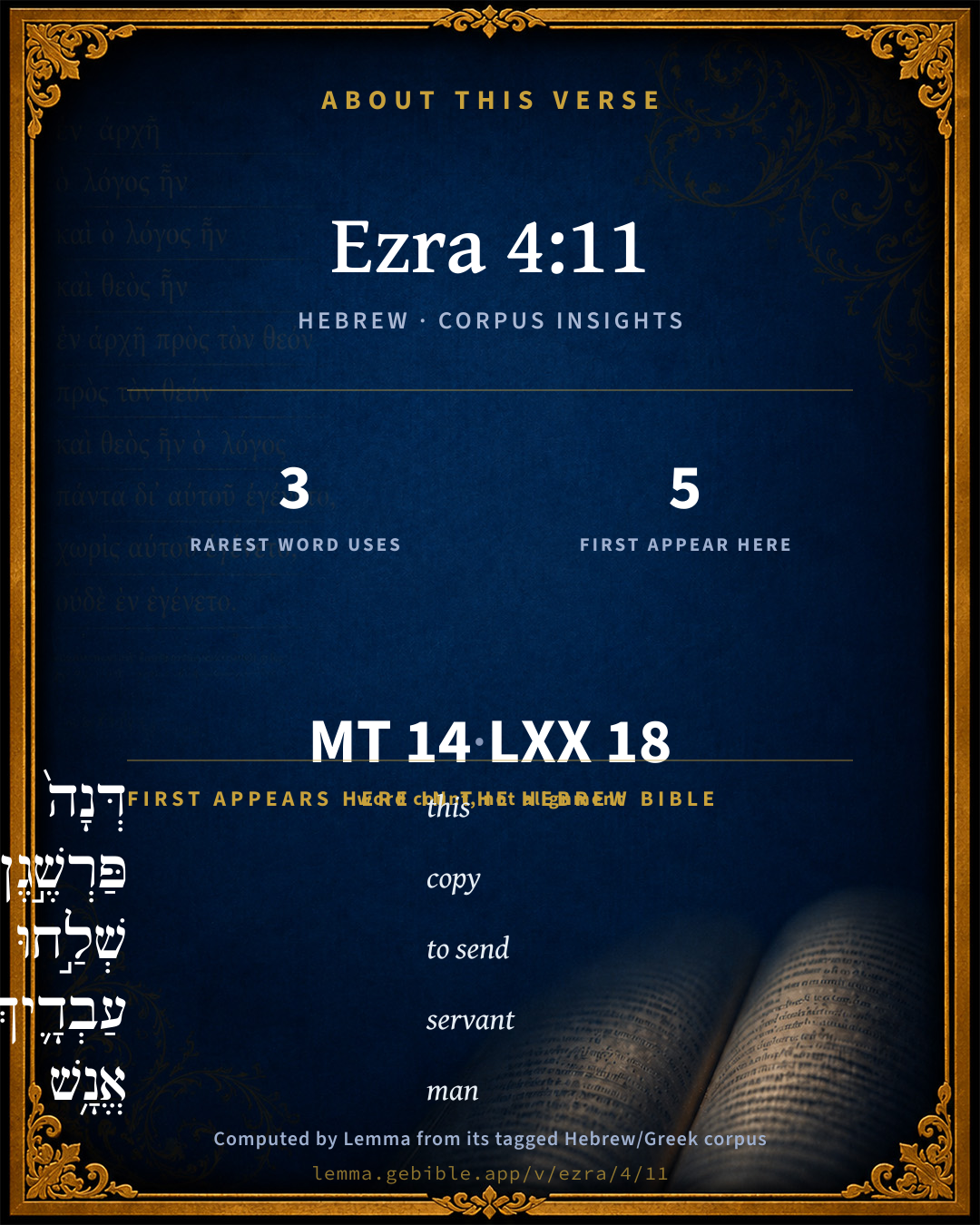
Ezra 4:11

Hebrew (Westminster Leningrad Codex) Ezra 4:11 appears in the Hebrew Old Testament. The text above is from the Westminster Leningrad Codex. Each word links to its Strong’s number, a concise gloss, and parsing drawn from the Open Scriptures Hebrew Bible morphology. Click any word for its full Brown-Driver-Briggs (BDB) entry.
Download image
Cite this verse

Ezra 4:11 (World English Bible). Public Domain. Lemma interlinear Bible study tool, https://lemma.gebible.app/v/ezra/4/11.

Show BibTeX & RIS
BibTeX
RIS
English Translation
This is the copy of the letter that they sent to Artaxerxes the king: Your servants the men beyond the River, and so forth.
World English Bible · Public Domain
Highlights
  • 5 first appearances in the Hebrew Bible
Full analysis ↓
Download a study sheet

One document with this verse’s original text, its word-by-word gloss line, the meaning frame, cross-references with their text, attributed commentary, and full source and license credits — printable, and it pastes into notes with its structure intact.

This verse Autodidact and up

Study sheet (.html) Plain text (.txt)

A passage Seminary Student

Up to 50 verses in one chapter. A passage sheet keeps up to 6 commentary sources and 12 cross-references per verse, in the order this page ranks them, and says so on the sheet whenever that leaves anything out. Ask for a single verse and you get the Autodidact verse sheet above.

Everything on this page stays free to read, with no account — the sheet is a download of what is already on screen, not access to it.

Want to remove ads? Support Godless Engineer
Compare translations 3

The same verse in 3 English versions, stacked beneath the original-language interlinear above. Click any original word for its lexicon entry.

Each is an independent rendering of the whole verse — the interlinear is not word-aligned to these translations.

Highlighted words mark where these versions differ — a whole-verse word diff, not a word-by-word alignment.

  • World English Bible Public Domain
    This is the copy of the letter that they sent to Artaxerxes the king: Your servants the men beyond the River, and so forth.
  • King James Version Public Domain
    This is the copy of the letter that they sent unto him, even unto Artaxerxes the king; Thy servants the men on this side the river, and at such a time.
  • unfoldingWord Literal Text CC BY-SA 4.0
    (This is a copy of the letter that they sent to him.) “To Artaxerxes the king; your servants, men of Beyond-the-River; and now:

unfoldingWord Literal Text — © unfoldingWord, licensed CC BY-SA 4.0. Word-aligned USFM3 via Door43 (git.door43.org/unfoldingWord/en_ult).

Versions to compare (up to 4)

3 of 4 selected

Show all 18 translations

Every available English version of this verse, each an independent rendering of the whole verse.

  • World English Bible Public Domain
    This is the copy of the letter that they sent to Artaxerxes the king: Your servants the men beyond the River, and so forth.
  • Berean Standard Bible Public Domain
    (This is the text of the letter they sent to him.) To King Artaxerxes, From your servants, the men west of the Euphrates:
  • Majority Standard Bible Public Domain
    (This is the text of the letter they sent to him.) To King Artaxerxes, From your servants, the men west of the Euphrates:
  • King James Version Public Domain
    This is the copy of the letter that they sent unto him, even unto Artaxerxes the king; Thy servants the men on this side the river, and at such a time.
  • American Standard Version (1901) Public Domain
    This is the copy of the letter that they sent unto Artaxerxes the king: Thy servants the men beyond the River, and so forth.
  • Revised Version (1885) Public Domain
    This is the copy of the letter that they sent unto Artaxerxes the king; Thy servants the men beyond the river, and so forth.
  • Geneva Bible (1599) Public Domain
    This is the copie of the letter that they sent vnto King Artahshashte, THY SERVANTS the men beyond the Riuer and Cheeneth, salute thee.
  • Douay-Rheims (1899) Public Domain
    (This is the copy of the letter, which they sent to him:) To Artaxerxes the king, thy servants, the men that are on this side of the river, send greeting.
  • Young's Literal Translation Public Domain
    This `is' a copy of a letter that they have sent unto him, unto Artaxerxes the king: `Thy servants, men beyond the river, and at such a time;
  • Literal Standard Version CC BY-SA 4.0
    This [is] a copy of a letter that they have sent to him, to Artaxerxes the king: “Your servants, men beyond the river, and at such a time;
  • Unlocked Literal Bible CC BY-SA 4.0
    This is a copy of the letter that they sent to Artaxerxes: “Your servants, men of the Province Beyond the River, write this:
  • unfoldingWord Literal Text CC BY-SA 4.0
    (This is a copy of the letter that they sent to him.) “To Artaxerxes the king; your servants, men of Beyond-the-River; and now:
  • Darby Bible Public Domain
    This is the copy of the letter that they sent to him: To Artaxerxes the king: Thy servants the men on this side the river, and so forth.
  • World Messianic Bible Public Domain
    This is the copy of the letter that they sent: To King Artaxerxes, from your servants, the people beyond the River.
  • Webster's Bible Public Domain
    This is the copy of the letter that they sent to him, even to Artaxerxes the king: Thy servants the men on this side of the river, and at such a time.
  • Free Bible Version CC BY-SA 4.0
    The following is a copy of the letter they sent to him. To King Artaxerxes, from your servants, men beyond the River Euphrates:
  • Bible in Basic English Public Domain
    This is a copy of the letter which they sent to Artaxerxes the king: Your servants living across the river send these words:
  • JPS Tanakh (1917) Public Domain
    this is the copy of the letter that they sent unto him, even unto Artaxerxes the king — thy servants the men beyond the River — and now

Literal Standard Version (2020), Covenant Press — licensed CC BY-SA 4.0. Text via the HelloAO Bible API (eBible.org). Unlocked Literal Bible (unfoldingWord) — licensed CC BY-SA 4.0. Text via the HelloAO Bible API (eBible.org). unfoldingWord Literal Text — © unfoldingWord, licensed CC BY-SA 4.0. Word-aligned USFM3 via Door43 (git.door43.org/unfoldingWord/en_ult). Free Bible Version, Dr. Jonathan Gallagher — licensed CC BY-SA 4.0. Text via the HelloAO Bible API (eBible.org).

Word by word

More ways to search: Search by grammar → Find every occurrence → Compare this word →

Practice this passage: Drill this verse → Learn its vocabulary →

פַּרְשֶׁ֣גֶן
parshegen
H6573
“copy of”
Adjective, N, Common
Part of Speech
Adjective
Gender
Common
Full BDB Definition

Origin: corresponding to H6572

TWOT: 2948

copy
  1. דְּנָה֙ dên H1836 “this” Adjective, P
  2. אִגַּרְתָּ֔א ʼiggᵉrâʼ H104 “letter · the” Adjective, N, Common + Particle, Definite Article
  3. דִּ֚י dîy H1768 “which” Adjective, T
  4. שְׁלַ֣חוּ shᵉlach H7972 “to send” Adjective, V, Plural
  5. עֲל֔וֹהִי ʻal H5922 “upon · him” Adjective, R + Suffix, Personal, 3rd Person, Masculine, Singular
  6. עַל ʻal H5922 “upon” Adjective, R
  7. אַרְתַּחְשַׁ֖שְׂתְּא ʼArtachshashtâʼ H783 “Artaxerxes” Adjective, N
  8. מַלְכָּ֑א melek H4430 “king · the” Adjective, N, Common + Particle, Definite Article
  9. עַבְדָ֛יךְ ʻăbad H5649 “servants · your” Adjective, N, Common + Suffix, Personal, 2nd Person, Masculine, Singular
  10. אֱנָ֥שׁ ʼĕnâsh H606 “man of” Adjective, N, Common
  11. עֲבַֽר ʻăbar H5675 “beyond” Adjective, N
  12. נַהֲרָ֖ה nᵉhar H5103 “river · the” Adjective, N + Particle, Definite Article
  13. וּכְעֶֽנֶת kᵉʻeneth H3706 “and · now” Adjective, C + Adverb

About this verse

These counts appear in no published source. They are computed here, from the morphology-tagged text and Lemma’s own curated glosses. What Lemma adds →

14
words
13
distinct lemmas
Historical
section

Notable vocabulary

The rarest word here is פַּרְשֶׁ֣גֶן copy H6573 — appearing just 3 times in the whole Hebrew Bible.

First appearance in Scripture

These words make their first canonical appearance in the Hebrew Bible here:

  • דְּנָה֙ this H1836
  • פַּרְשֶׁ֣גֶן copy H6573
  • שְׁלַ֣חוּ to send H7972
  • עַבְדָ֛יךְ servant H5649
  • אֱנָ֥שׁ man H606

Shared distinctive vocabulary

פַּרְשֶׁ֣גֶן copy H6573 occurs in 3 verses of the Hebrew Bible. Also found in:

Grammatical profile

  • 10 adjectives
  • 1 adverb
  • 3 particles

Repetition

A word recurs within this verse — often emphatic in Hebrew:

  • עֲל֔וֹהִי upon H5922 ×2

Hebrew & Septuagint length

In English translation the verse runs 24 words from the Hebrew and 22 from the Septuagint (LXX English) — closely comparable.

A rough comparison of the two English renderings, which tokenize alike — not a word-level alignment.

Word counts can differ between the Hebrew and the Greek without any difference in meaning — e.g. the Hebrew direct-object marker אֵת has no separate Greek word, and Greek often adds the article ὁ.

In the original languages it is 14 Hebrew tokens and 18 Greek tokens — but the two are counted differently (Hebrew bundles its prefixes and suffixes into one token; the Greek is in lemma form), so that isn’t a like-for-like length.

Hebrew and Greek witnesses Masoretic Hebrew ↔ Greek Septuagint

The same verse in the two great witnesses to the Old Testament, shown verse-for-verse.

These are two independent witnesses, not word-aligned to each other, and the Septuagint is shown in lemma (dictionary) form.

Hebrew Ezra 4:11 Masoretic · Westminster Leningrad Codex

דְּנָה֙ פַּרְשֶׁ֣גֶן אִגַּרְתָּ֔א דִּ֚י שְׁלַ֣חוּ עֲל֔וֹהִי עַל אַרְתַּחְשַׁ֖שְׂתְּא מַלְכָּ֑א עַבְדָ֛יךְ אֱנָ֥שׁ עֲבַֽר נַהֲרָ֖ה וּכְעֶֽנֶת

This is the copy of the letter that they sent to Artaxerxes the king: Your servants the men beyond the River, and so forth.

World English Bible · Public Domain

Greek LXX Ezra 4:11 Septuagint · lemma form

οὗτος ὁ διαταγή ὁ ἐπιστολή ὅς ἀποστέλλω πρός αὐτός πρός αρθασασθα βασιλεύς παῖς σύ ἀνήρ πέραν ὁ ποταμός

This is the purport of the letter, which they sent to him: Your servants the men beyond the river to king Arthasastha.

LXX2012 (modern English Septuagint) · Public Domain

In the Septuagint this is one book — Esdras B (2 Esdras): Ezra is chapters 1–10, Nehemiah 11–23.

Hebrew: Westminster Leningrad Codex (CC BY 4.0). Greek: Septuagint (public domain); English from LXX2012 (modern English Septuagint) (Public Domain). How the Septuagint differs from the Hebrew →

Commentary

Notes on Ezra 4:11 from classic Christian and Jewish commentators (each source and its license shown beneath its notes). The classic Christian expositions comment on the surrounding passage and are grouped to its opening verse, so a note may address several verses; the Jewish commentaries on the Tanakh (Rashi and others) are per-verse, so they appear only where the commentator wrote on this verse.

Lemma curates 59 commentaries, every one of them public domain or Creative Commons licensed, each selected and text-cleaned for this edition rather than reprinted as found. About our sources →

Trapp's Complete Commentary

John Trapp

Ezr 4:11 This [is] the copy of the letter that they sent unto him, [even] unto Artaxerxes the king; Thy servants the men on this side the river, and at such a time.

Ver. 11. Thy servants] Not thy subjects only, but thine officers.

John Trapp, A Commentary or Exposition upon All the Books of the Old and New Testament (1647–1656) — public domain. Text from a community e-Sword module.

Tyndale Open Study Notes

Tyndale Open Resources

4:11-22 Ezra includes a copy in Aramaic of the letter sent to Artaxerxes and his reply.

Tyndale Open Study Notes — © Tyndale Open Resources, licensed CC BY-SA 4.0. Text via the HelloAO Bible API.

Adam Clarke's Commentary

Verse 11. And at such a time.] The word וכענת ucheeneth has greatly perplexed all commentators and critics. The versions give us no light; and the Vulgate translates it et dicunt salutem, "and they wish prosperity." Some translate it and so forth; and our translators supposed that it referred to the date, which however is not specified, and might have been as easily entered as the words and at such a time.

In our first translation of the Bible, that by Coverdale, in 1535, the passage stands thus: "And other on this syde the water, and in Canaan."

In that by Becke, 1549, it is thus: "And other on this syde the water, and in Ceneeth:" and in the margin he enters "or peace," "or health."

In Cardmarden's Bible, printed at Rouen, 1566, it stands thus: "And other that are nowe on thys syde the water."

In that printed by Barker, 1615, we find the text thus: "AND OTHER that are beyond the river, and Cheeneth;" on which is the following marginal note: "To wit, Euphrates: and he meaneth in respect of Babel, that they dwelt beyond it." And the note on Cheeneth is, "Which were a certain people that envied the Jews." All this is merely guessing, in the midst of obscurity; most of these having considered the original word כענת Ceeneth as the name of a people; and in this they follow the Syriac, which uses the word Acaneth.

Calmet thinks we should read ובעת ubaeth, "and at this time; " as if they had said, "We wish thee to enjoy the same health and prosperity at all future times, which thou dost at present." This is not remote from the meaning of the Chaldee original.

Adam Clarke's Commentary on the Bible (1810–1826) — public domain. Text from a community e-Sword/MySword module.

Ellicott's Commentary for English Readers

(11) On this side the river.—Literally, beyond the river Euphrates, as written for the Persian court.

And at such a time.—Rather, and so forth; meaning, “Thy servants, as aforesaid,” alluding to the superscription.

A Bible Commentary for English Readers, edited by Charles John Ellicott (1878–1897) — public domain. Text from a community e-Sword module.

The Cambridge Bible for Schools and Colleges

gen. ed. J. J. S. Perowne

11. unto him, even unto Artaxerxes] R.V. unto Artaxerxes the king.

the men on this side the river] R.V. beyond the river. The A.V. does not recognize that the senders of the letter place themselves in the position of the recipient; the expression “beyond the river” applied to a country would to a Persian subject convey as distinct an idea of a particular district as ‘Cisalpine and Transalpine Gaul’ would to a Roman subject whether living in Italy or Gaul.

and at such a time] R.V. ‘and so forth’, i.e. ‘et cætera’. See note on Ezr_4:10. Probably a long and wearisome salutation is thus briefly dispatched.

The Cambridge Bible for Schools and Colleges (gen. ed. J. J. S. Perowne; Cambridge University Press, 1878–1918) — public domain. Text from a community e-Sword module.

John Gill's Exposition

Be it known unto the king,.... The intent of this letter was, that it might be known to the king what follows:

that the Jews which came up from thee to us are come unto Jerusalem; this they observe partly out of contempt of the Jews, having been lately captive in Babylon, and partly to insinuate what ingratitude they were guilty of; that having got their liberty, and come to Jerusalem, they made use of it to the king's detriment:

building the rebellious and the bad city; as they suggest it had been to kings, even his predecessors, in former times, Ezr 4:15

and have set up the walls thereof, and joined the foundations; which was a falsehood; for the most they had done was setting up the walls of their houses in Jerusalem, and laying the foundation of the temple; as for the walls of the city, they had not as yet done anything unto them.

John Gill's Exposition of the Whole Bible (1746–1763) — public domain (CC PDM 1.0). Text via the HelloAO Bible API.

Haydock's Catholic Bible Commentary

Him. This is a gloss. (Calmet) --- Greeting. Protestants, "and at such a time."

George Leo Haydock (1774–1849), Haydock's Catholic Family Bible and Commentary, 1859 edition — public domain. Excludes Psalms (Douay-Rheims chapter numbering differs from Protestant) and Deuterocanonical books (Catholic canon only).

Whedon's Commentary on the Bible

Daniel D. Whedon

11. This is the copy — After this verse (Ezr_4:12-16) we seem to have an exact transcript of the substance of the letter that they sent. What precedes in Ezr_4:9-10 was a sort of paraphrase of the introduction to the letter. See note on Ezr_4:8.

Daniel D. Whedon (gen. ed.), Commentary on the Old and New Testaments (1874–1909) — public domain. Text from a community e-Sword module.

The Pulpit Commentary

This is the copy of the letter. The address having been given, the writer now proceeds to the contents of the letter. Thy servants the men on this side the river, etc. This was a sort of heading inside the letter a repetition in brief of the address.

The Pulpit Commentary (1880–1919), ed. H.D.M. Spence-Jones & Joseph S. Exell — public domain. Text from a community e-Sword module.

Kretzmann's Popular Commentary

Paul E. Kretzmann

The Letter To Artaxerxes

v. 11. This is the copy of the letter that they sent unto him, even unto Artaxerxes the king, at least a summary of the contents, if not an exact copy. Thy servants, the men on this side the river, and at such a time, that is, "and so forth," all the compliments of the introduction being omitted.

v. 12. Be it known unto the king that the Jews which came up from thee to us are come unto Jerusalem, they had been returning from Babylon for a matter of some seventy years then, and small companies were still coming in from the East, building the rebellious and the bad city, and have set up the walls thereof, on which they were still building, and joined the foundations, they were still excavating and working to strengthen the foundations.

v. 13. Be it known now unto the king that, if this city be builded and the walls set up again, then will they not pay toll, the individual poll-tax, tribute, property-tax, and custom, all import and export duties, and so thou shalt endamage the revenue of the kings, and so their action would finally prepare damage for the king.

v. 14. Now, because we have maintenance from the king’s palace, literally, "because with the salt of the palace we are salted," said of living on any one’s bounty, and it was not meet for to see the king’s dishonor, therefore have we sent and certified the king, making known to him the following facts, suggesting the following procedure,

v. 15. that search may be made in the book of the records of thy fathers, this duty being performed by the keeper of the royal archives; so shalt thou find in the book of the records and know that this city is a rebellious city and hurtful unto kings and provinces, whose inhabitants are addicted to uproar and rebellions, and that they have moved sedition within the same of old time; for which cause was this city destroyed.

v. 16. We certify the king that, if this city be builded again and the walls thereof set up, all its defenses finished as in the days of its greatest power, by this means thou shalt have no portion on this side the river, the implication being that the Jews would cause the entire territory south and west of the Euphrates to declare and maintain its independence.

v. 17. Then sent the king an answer unto Rehum, the chancellor, and to Shimshai, the scribe, and to the rest of their companions that dwell in Samaria, all the communities of colonists, and unto the rest beyond the river, Peace, and at such a time, the usual complimentary remarks at the opening of a letter being omitted.

v. 18. The letter which ye sent unto us hath been plainly read before me.

v. 19. And I commanded, by issuing a decree or edict, and search hath been made, and it is found that this city of old time hath made insurrection, rising up in haughty rebellion, against kings and that rebellion and sedition have been made therein.

v. 20. There have been mighty kings also over Jerusalem, which have ruled over all countries beyond the river, this being true of David and Solomon; and toll, tribute, and custom was paid unto them, all the surrounding countries being tributary to their kingdom at that time.

v. 21. Give ye now commandment to cause these men to cease, and that this city be not builded, until another commandment shall be given from me.

v. 22. Take heed now that ye fail not to do this. Why should damage grow to the hurt of the kings? They should make no mistake in averting this damage, since it might so easily grow to be a pest.

v. 23. Now, when the copy of King Artaxerxes’ letter was read before Rehum and Shimshai, the scribe, and their companions, they went up in haste to Jerusalem unto the Jews and made them to cease by force and power, evidently using even troops to enforce their demand. This excursus, showing to what extent the hostility of the Samaritans went and how long it lasted, was inserted for the sake of completeness in characterizing them. The author now returns to his history of the building of the Temple, the last verse of the chapter connecting with v. 5 above.

v. 24. Then ceased the work of the house of God which is at Jerusalem. The foundation had been laid and the altar of burnt offering erected in its former place, but no more work was done. So it ceased unto the second year of the reign of Darius, king of Persia, 520 B. C. The false church is ever the enemy of the true Church and is continually striving to deprive it of its rights and liberties, in order to hinder the spread of the Gospel.

Paul E. Kretzmann, Popular Commentary of the Bible (1921–1924) — public domain. Text from a community e-Sword module.

unfoldingWord translationNotes

Door43 World Missions Community

This is a copy

Ezra includes in his writing the content of the letter sent to King Artaxerxes.

the Province Beyond the River

This is the name of the province that was west of the Euphrates River. It was across the river from the city of Susa. See how you translated this in Esra 4:10. (See: How to Translate Names)

a rebellious city

The city is a metonym for the people who live in it. AT: "a city that they plan to live in and rebel against you" (See: Metonymy)

repaired the foundations

"fixed the foundations" or "mended the foundations"

translationWords

servant

Jew

Jerusalem

rebel

found

unfoldingWord translationNotes — © Distant Shores Media and the Door43 World Missions Community, licensed CC BY-SA 4.0. Source: git.door43.org/Door43/en_tn.

Rashi

Rabbi Shlomo Yitzchaki (Rashi)

This is the meaning of the letter and this is the interpretation of the letter.

the meaning Aram. פַּרְשֶּׁגֶן like (Esther 3:14): “The meaning of (פַּתְשֶּׁגֶן) the writ.

that they sent to him [as translated,] that they sent to him.

to Artaxerxes [as translated,] to Artaxerxes.

Your servants are the people of the other side of the river and Ke’eneth The people of the other side of the river and the people of Ke’eneth are your servants. All the nations counted here are included in this generalization, for they were all on the side of the land of Israel, which is on the opposite side of the river of those dwelling in Babylon, and this is the beginning of the letter: “Your servants are the people of the other side of the river etc.” until, “...you will have no part.”

Rashi on the Tanakh — English translations: “The Judaica Press complete Tanach with Rashi, translated by A. J. Rosenberg” (CC BY 4.0); “Pentateuch with Rashi's commentary by M. Rosenbaum and A.M. Silbermann, 1929-1934” (public domain); “The Metsudah Tanach series, Lakewood, N.J” (CC BY 4.0); and “The Book of Joshua, Metsudah Publications, 1997” (CC BY 4.0). Text via Sefaria.

Lesson kit

Teaching starters — assembled from the data on this page, not authored interpretation. Every prompt links to the verse data it draws on. Edit before teaching.

Ezra, in the Historical, opens this verse with 14 words (13 distinct Hebrew lemmas). Its most distinctive word is parshegen (“copy”). A historical commentator’s framing appears above. Read the whole chapter for the surrounding context.

Discussion questions

  1. How does “copy” (parshegen) shape what this verse is saying?
  2. 5 words here appear for the first time in Scripture. What is being introduced at this debut?
  3. Ezra 4:23 shares the word «copy» with this verse. How do the two illuminate each other?
  4. “upon” occurs 2× in this one verse. What is the effect of the repetition?
  5. The translations on this page render this verse differently — a whole-verse word diff, not a word-by-word alignment. What might account for the different wordings?
  6. Reading how Trapp's Complete Commentary and Tyndale Open Study Notes read this verse, where do the two commentators agree and where do they part?

Things to notice

Reading settings

Reading text

Shown beneath each verse's original-language words.

Old Testament
Old Testament edition

Read the OT as the Masoretic Hebrew (MT) or the Greek Septuagint (LXX).

English shown for the Greek Septuagint (in the Hebrew ↔ Greek comparison).

Comparing translations? Open the Compare panel on any verse page to stack up to four side by side.