
Ezra 7:14

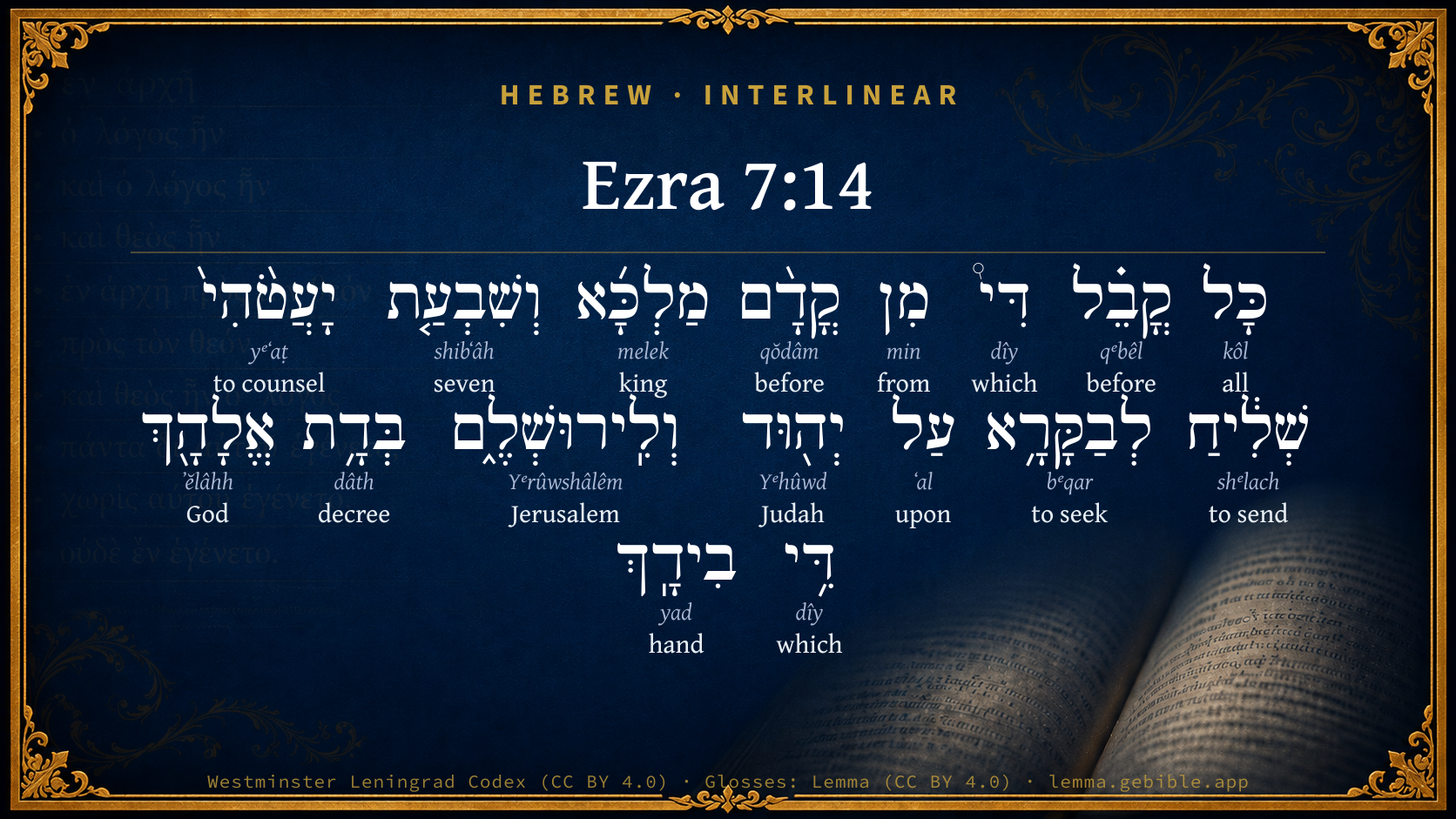
Hebrew (Westminster Leningrad Codex) Ezra 7:14 appears in the Hebrew Old Testament. The text above is from the Westminster Leningrad Codex. Each word links to its Strong’s number, a concise gloss, and parsing drawn from the Open Scriptures Hebrew Bible morphology. Click any word for its full Brown-Driver-Briggs (BDB) entry.
Download image
Cite this verse

Ezra 7:14 (World English Bible). Public Domain. Lemma interlinear Bible study tool, https://lemma.gebible.app/v/ezra/7/14.

Show BibTeX & RIS
BibTeX
RIS
English Translation
Because you are sent of the king and his seven counselors, to inquire concerning Judah and Jerusalem, according to the law of your God which is in your hand,
World English Bible · Public Domain
Highlights
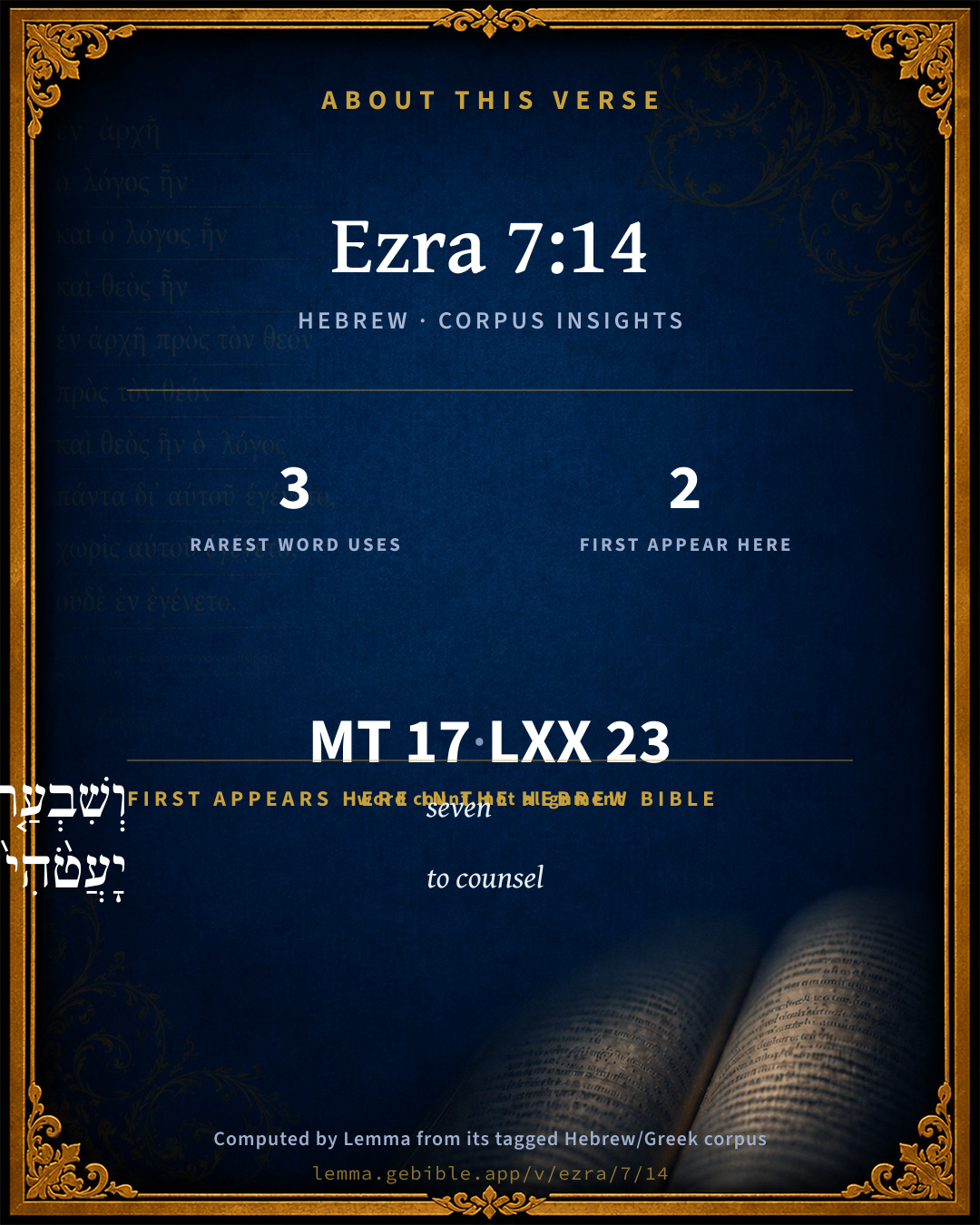
  • 2 first appearances in the Hebrew Bible
Full analysis ↓
Download a study sheet

One document with this verse’s original text, its word-by-word gloss line, the meaning frame, cross-references with their text, attributed commentary, and full source and license credits — printable, and it pastes into notes with its structure intact.

This verse Autodidact and up

Study sheet (.html) Plain text (.txt)

A passage Seminary Student

Up to 50 verses in one chapter. A passage sheet keeps up to 6 commentary sources and 12 cross-references per verse, in the order this page ranks them, and says so on the sheet whenever that leaves anything out. Ask for a single verse and you get the Autodidact verse sheet above.

Everything on this page stays free to read, with no account — the sheet is a download of what is already on screen, not access to it.

Want to remove ads? Support Godless Engineer
Compare translations 3

The same verse in 3 English versions, stacked beneath the original-language interlinear above. Click any original word for its lexicon entry.

Each is an independent rendering of the whole verse — the interlinear is not word-aligned to these translations.

Highlighted words mark where these versions differ — a whole-verse word diff, not a word-by-word alignment.

  • World English Bible Public Domain
    Because you are sent of the king and his seven counselors, to inquire concerning Judah and Jerusalem, according to the law of your God which is in your hand,
  • King James Version Public Domain
    Forasmuch as thou art sent of the king, and of his seven counsellors, to enquire concerning Judah and Jerusalem, according to the law of thy God which is in thine hand;
  • unfoldingWord Literal Text CC BY-SA 4.0
    Because it was sent from before the king and his seven counselors to inquire about Judah and about Jerusalem by the law of your God which is in your hand,

unfoldingWord Literal Text — © unfoldingWord, licensed CC BY-SA 4.0. Word-aligned USFM3 via Door43 (git.door43.org/unfoldingWord/en_ult).

Versions to compare (up to 4)

3 of 4 selected

Show all 18 translations

Every available English version of this verse, each an independent rendering of the whole verse.

  • World English Bible Public Domain
    Because you are sent of the king and his seven counselors, to inquire concerning Judah and Jerusalem, according to the law of your God which is in your hand,
  • Berean Standard Bible Public Domain
    You are sent by the king and his seven counselors to evaluate Judah and Jerusalem according to the Law of your God, which is in your hand.
  • Majority Standard Bible Public Domain
    You are sent by the king and his seven counselors to evaluate Judah and Jerusalem according to the Law of your God, which is in your hand.
  • King James Version Public Domain
    Forasmuch as thou art sent of the king, and of his seven counsellors, to enquire concerning Judah and Jerusalem, according to the law of thy God which is in thine hand;
  • American Standard Version (1901) Public Domain
    Forasmuch as thou art sent of the king and his seven counsellors, to inquire concerning Judah and Jerusalem, according to the law of thy God which is in thy hand,
  • Revised Version (1885) Public Domain
    Forasmuch as thou art sent of the king and his seven counsellors, to inquire concerning Judah and Jerusalem, according to the law of thy God which is in thine hand;
  • Geneva Bible (1599) Public Domain
    Therefore art thou sent of the King and his seuen counsellers, to enquire in Iudah and Ierusalem, according to the lawe of thy God, which is in thine hand,
  • Douay-Rheims (1899) Public Domain
    For thou art sent from before the king, and his seven counsellors, to visit Judea and Jerusalem according to the law of thy God, which is in thy hand.
  • Young's Literal Translation Public Domain
    because that from the king and his seven counsellors thou art sent, to inquire concerning Judah and concerning Jerusalem, with the law of God that `is' in thy hand,
  • Literal Standard Version CC BY-SA 4.0
    because that from the king and his seven counselors you are sent, to inquire concerning Judah and concerning Jerusalem, with the Law of God that [is] in your hand,
  • Unlocked Literal Bible CC BY-SA 4.0
    I, the king, and my seven counselors, send you all out to inquire concerning Judah and Jerusalem according to God's law, which is in your hand.
  • unfoldingWord Literal Text CC BY-SA 4.0
    Because it was sent from before the king and his seven counselors to inquire about Judah and about Jerusalem by the law of your God which is in your hand,
  • Darby Bible Public Domain
    Because thou art sent by the king, and by his seven counsellors, to inquire concerning Judah and Jerusalem, according to the law of thy God which is in thy hand;
  • World Messianic Bible Public Domain
    Because you are sent by the king and his seven counselors to inquire concerning Judah and Jerusalem, according to the law of your God which is in your hand,
  • Webster's Bible Public Domain
    Forasmuch as thou art sent by the king, and by his seven counselors, to inquire concerning Judah and Jerusalem, according to the law of thy God which is in thy hand;
  • Free Bible Version CC BY-SA 4.0
    You are being sent by the king and his seven counselors to investigate the situation in Judah and Jerusalem as it relates to the Law of your God, which you carry with you.
  • Bible in Basic English Public Domain
    Because you are sent by the king and his seven wise men, to get knowledge about Judah and Jerusalem, as you are ordered by the law of your God which is in your hand;
  • JPS Tanakh (1917) Public Domain
    Forasmuch as thou art sent of the king and his seven counsellors, to inquire concerning Judah and Jerusalem, according to the law of thy God which is in thy hand;

Literal Standard Version (2020), Covenant Press — licensed CC BY-SA 4.0. Text via the HelloAO Bible API (eBible.org). Unlocked Literal Bible (unfoldingWord) — licensed CC BY-SA 4.0. Text via the HelloAO Bible API (eBible.org). unfoldingWord Literal Text — © unfoldingWord, licensed CC BY-SA 4.0. Word-aligned USFM3 via Door43 (git.door43.org/unfoldingWord/en_ult). Free Bible Version, Dr. Jonathan Gallagher — licensed CC BY-SA 4.0. Text via the HelloAO Bible API (eBible.org).

Word by word

More ways to search: Search by grammar → Find every occurrence → Compare this word →

Practice this passage: Drill this verse → Learn its vocabulary →

יָעֲטֹ֨הִי֙
yᵉʻaṭ
H3272
“counseling · him”
Adjective, V + Suffix, Personal, 3rd Person, Masculine, Singular
Part of Speech
Adjective
Full BDB Definition

Origin: corresponding to H3289

TWOT: 2772

(Ithpael) to advise, counsel, take counsel - (Peal) counsellor (participle)
  1. כָּל kôl H3606 “all” Adjective, C + Conjunction
  2. קֳבֵ֗ל qᵉbêl H6903 “before” Adjective, C
  3. דִּי֩ dîy H1768 “which” Adjective, C
  4. מִן min H4481 “from” Adjective, R
  5. קֳדָ֨ם qŏdâm H6925 “before” Adjective, R
  6. מַלְכָּ֜א melek H4430 “king · the” Adjective, N, Common + Particle, Definite Article
  7. וְשִׁבְעַ֤ת shibʻâh H7655 “and · seven” Adjective, C + Adjective, Cardinal number, Masculine, Singular, Construct
  8. שְׁלִ֔יחַ shᵉlach H7972 “sent” Adjective, V, Singular
  9. לְבַקָּרָ֥א bᵉqar H1240 “to seek” Adjective, R + Verb, Piel, Infinitive Construct
  10. עַל ʻal H5922 “upon” Adjective, R
  11. יְה֖וּד Yᵉhûwd H3061 “Judah” Adjective, N
  12. וְלִֽירוּשְׁלֶ֑ם Yᵉrûwshâlêm H3390 “and · to/for · Jerusalem” Adjective, C + Preposition + Noun, Proper
  13. בְּדָ֥ת dâth H1882 “in/at · decree of” Adjective, R + Noun, Common, Feminine, Singular, Construct
  14. אֱלָהָ֖ךְ ʼĕlâhh H426 “God · your” Adjective, N, Common + Suffix, Personal, 2nd Person, Masculine, Singular
  15. דִּ֥י dîy H1768 “which” Adjective, T
  16. בִידָֽךְ yad H3028 “in/at · hand · your” Adjective, R + Noun, Common, Feminine, Singular, Construct + Suffix, Personal, 2nd Person, Masculine, Singular

About this verse

These counts appear in no published source. They are computed here, from the morphology-tagged text and Lemma’s own curated glosses. What Lemma adds →

17
words
16
distinct lemmas
Historical
section

Notable vocabulary

The rarest word here is יָעֲטֹ֨הִי֙ to counsel H3272 — appearing just 3 times in the whole Hebrew Bible.

First appearance in Scripture

These words make their first canonical appearance in the Hebrew Bible here:

  • וְשִׁבְעַ֤ת seven H7655
  • יָעֲטֹ֨הִי֙ to counsel H3272

Shared distinctive vocabulary

יָעֲטֹ֨הִי֙ to counsel H3272 occurs in 3 verses of the Hebrew Bible. Also found in:

Grammatical profile

  • 1 verb
  • 3 nouns
  • 11 adjectives
  • 1 conjunction
  • 1 particle

Verb forms

  • לְבַקָּרָ֥א Piel · Infinitive Construct

Repetition

A word recurs within this verse — often emphatic in Hebrew:

  • דִּי֩ which H1768 ×2

Hebrew & Septuagint length

In English translation the verse runs 29 words from the Hebrew and 28 from the Septuagint (LXX English) — closely comparable.

A rough comparison of the two English renderings, which tokenize alike — not a word-level alignment.

Word counts can differ between the Hebrew and the Greek without any difference in meaning — e.g. the Hebrew direct-object marker אֵת has no separate Greek word, and Greek often adds the article ὁ.

In the original languages it is 17 Hebrew tokens and 23 Greek tokens — but the two are counted differently (Hebrew bundles its prefixes and suffixes into one token; the Greek is in lemma form), so that isn’t a like-for-like length.

Cross-references

13

Topical passages linked to Ezra 7:14 in the Treasury of Scripture Knowledge — connected by theme and wording, ordered by reader-vote popularity; previews shown in the World English Bible.

  • Esther 1:14 and the next to him were Carshena, Shethar, Admatha, Tarshish, Meres, Marsena, and Memucan, the seven princes of Persia and Media, who saw the king's face, and sat first in the kingdom),
  • Deuteronomy 17:18–19 It shall be, when he sits on the throne of his kingdom, that he shall write him a copy of this law in a book, out of [that which is] before the priests the Levites:
  • Ezra 1:3 Whoever there is among you of all his people, his God be with him, and let him go up to Jerusalem, which is in Judah, and build the house of Yahweh, the God of Israel (he is God), which is in Jerusalem.
  • Ezra 5:8 Be it known to the king, that we went into the province of Judah, to the house of the great God, which is built with great stones, and timber is laid in the walls; and this work goes on with diligence and prospers in their hands.
  • Ezra 6:12 and the God who has caused his name to dwell there overthrow all kings and peoples who shall put forth their hand to alter [the same], to destroy this house of God which is at Jerusalem. I Darius have made a decree; let it be done with all diligence.
  • Ezra 7:15 and to carry the silver and gold, which the king and his counselors have freely offered to the God of Israel, whose habitation is in Jerusalem,
  • Ezra 7:25–26 You, Ezra, after the wisdom of your God who is in your hand, appoint magistrates and judges, who may judge all the people who are beyond the River, all such as know the laws of your God; and teach you him who doesn't know them.
  • Ezra 7:28 and has extended loving kindness to me before the king, and his counselors, and before all the king's mighty princes. I was strengthened according to the hand of Yahweh my God on me, and I gathered together out of Israel chief men to go up with me.
  • Ezra 8:25 and weighed to them the silver, and the gold, and the vessels, even the offering for the house of our God, which the king, and his counselors, and his princes, and all Israel there present, had offered:
  • Isaiah 8:20 To the law and to the testimony! if they don't speak according to this word, surely there is no morning for them.
  • Daniel 2:47 The king answered to Daniel, and said, Of a truth your God is the God of gods, and the Lord of kings, and a revealer of secrets, seeing you have been able to reveal this secret.
  • Daniel 6:20 When he came near to the den to Daniel, he cried with a lamentable voice; the king spoke and said to Daniel, Daniel, servant of the living God, is your God, whom you serve continually, able to deliver you from the lions?
  • Daniel 6:26 I make a decree, that in all the dominion of my kingdom men tremble and fear before the God of Daniel; for he is the living God, and steadfast forever, His kingdom that which shall not be destroyed; and his dominion shall be even to the end.

Cross-references courtesy of OpenBible.info (CC BY 4.0).

Hebrew and Greek witnesses Masoretic Hebrew ↔ Greek Septuagint

The same verse in the two great witnesses to the Old Testament, shown verse-for-verse.

These are two independent witnesses, not word-aligned to each other, and the Septuagint is shown in lemma (dictionary) form.

Hebrew Ezra 7:14 Masoretic · Westminster Leningrad Codex

כָּל קֳבֵ֗ל דִּי֩ מִן קֳדָ֨ם מַלְכָּ֜א וְשִׁבְעַ֤ת יָעֲטֹ֨הִי֙ שְׁלִ֔יחַ לְבַקָּרָ֥א עַל יְה֖וּד וְלִֽירוּשְׁלֶ֑ם בְּדָ֥ת אֱלָהָ֖ךְ דִּ֥י בִידָֽךְ

Because you are sent of the king and his seven counselors, to inquire concerning Judah and Jerusalem, according to the law of your God which is in your hand,

World English Bible · Public Domain

Greek LXX Ezra 7:14 Septuagint · lemma form

ἀπό πρόσωπον ὁ βασιλεύς καί ὁ ἑπτά σύμβουλος ἀποστέλλω ἐπισκέπτομαι ἐπί ὁ ἰουδαία καί εἰς ἰερουσαλήμ νόμος θεός αὐτός ὁ ἐν χείρ σύ

One has been sent from the king and the seven councillors, to visit Judea and Jerusalem, according to the law of their God that is in your hand.

LXX2012 (modern English Septuagint) · Public Domain

In the Septuagint this is one book — Esdras B (2 Esdras): Ezra is chapters 1–10, Nehemiah 11–23.

Hebrew: Westminster Leningrad Codex (CC BY 4.0). Greek: Septuagint (public domain); English from LXX2012 (modern English Septuagint) (Public Domain). How the Septuagint differs from the Hebrew →

Commentary

Notes on Ezra 7:14 from classic Christian and Jewish commentators (each source and its license shown beneath its notes). The classic Christian expositions comment on the surrounding passage and are grouped to its opening verse, so a note may address several verses; the Jewish commentaries on the Tanakh (Rashi and others) are per-verse, so they appear only where the commentator wrote on this verse.

Lemma curates 59 commentaries, every one of them public domain or Creative Commons licensed, each selected and text-cleaned for this edition rather than reprinted as found. About our sources →

Trapp's Complete Commentary

John Trapp

Ezr 7:14 Forasmuch as thou art sent of the king, and of his seven counsellors, to enquire concerning Judah and Jerusalem, according to the law of thy God which [is] in thine hand;

Ver. 14. And of his seven counsellors] Without whom the king did nothing of moment. This king was better affected to his council than his father Xerxes had been, of whom it is storied, that in his expedition against Greece he called his princes together, as if he would have been advised by them, but spoke to them to this purpose: Lest, saith he, I should seem to follow mine own counsel, I have assembled you. And now do you remember, that it becomes you rather to obey than advise. {Valerius Maximus, l. 9. c. 5. ext. 2. 2:339}

To inquire concerniny Judah] So St Paul sent to inquire what was yet lacking in the faith of the Churches.

According to the law of thy God] Which is not only recta, but regula, the rule and rudder. Those that walked by this rule Ezra was to cherish, and to punish such as did otherwise, being custos utriusque tabulae

Which is in thine hand] Which thou art singularly skilled in, and much exercised about it; that thou mayest both observe it thyself, and also preserve it from other men’s violations.

John Trapp, A Commentary or Exposition upon All the Books of the Old and New Testament (1647–1656) — public domain. Text from a community e-Sword module.

Joseph Benson's Commentary

Ezr 7:14. And of his seven counsellors — His chief nobles and officers of state; of whom see Est 1:10; Est 1:14. This decree, being made by their advice, had the greater authority. To inquire concerning Judah according to the law of thy God — To make inquiry into all abuses and deviations from your law, and to redress them. Which is in thy hand — With which thou art very conversant, and in which thou art well skilled. It may seem strange that the edict should be drawn up in this manner, as it is more in the style of a Jewish supreme governor than of a heathen king; but it is not improbable that Ezra, being in such favour in the Persian court, might get the edict drawn up in the manner and words which he thought would be most proper for the purposes for which he had obtained it.

Joseph Benson's Commentary on the Old and New Testaments (1811–1818) — public domain. Text from a community e-Sword module.

Tyndale Open Study Notes

Tyndale Open Resources

7:14 I and my council of seven: The Greek historian Xenophon knew of this council (Xenophon, Anabasis 1.6.4-5), and Esth 1:14 lists the names of the seven princes of Xerxes, Artaxerxes’ father. • your God’s law: The word translated law in this verse is the Aramaic word dath rather than the Hebrew torah (7:10), suggesting that a Persian wrote this letter (7:11-26).

Tyndale Open Study Notes — © Tyndale Open Resources, licensed CC BY-SA 4.0. Text via the HelloAO Bible API.

Geneva Bible (1599)

Geneva Bible translators

Whereof thou art expert.

To examine who lived according to the Law.

Geneva Bible (1599) marginal notes — public domain. Text via Bolls.life.

Jamieson, Fausset & Brown

Robert Jamieson, A. R. Fausset & David Brown

sent of the king, and of his seven counsellors--This was the fixed number of the privy council of the kings of Persia (Est 1:10, Est 1:14). The document describes, with great clearness and precision, the nature of Ezra's commission and the extent of power and prerogatives with which he was invested. It gave him authority, in the first place, to organize the colony in Judea and institute a regular government, according to the laws of the Hebrew people, and by magistrates and rulers of their own nation (Ezr 7:25-26), with power to punish offenders by fines, imprisonment, exile, or death, according to the degree of their criminality. Secondly, he was empowered to carry a large donation in money, partly from the royal treasury and partly raised by voluntary contributions among his countrymen, to create a fund out of which to make suitable provision for maintaining the regular worship of God in Jerusalem (Ezr 7:16-17). Thirdly, the Persian officers in Syria were commanded to afford him every assistance by gifts of money within a certain specified limit, in carrying out the objects of his patriotic mission (Ezr 7:21).

Jamieson, Fausset & Brown — Commentary Critical and Explanatory on the Whole Bible (1871) — public domain (CC PDM 1.0). Text via the HelloAO Bible API.

Adam Clarke's Commentary

Verse 14. His seven counsellors] It is very likely that the privy counsel of the king consisted of seven persons simply. The names of these seven counsellors or chamberlains may be found in the book of Esther, Es 1:10.

Adam Clarke's Commentary on the Bible (1810–1826) — public domain. Text from a community e-Sword/MySword module.

Ellicott's Commentary for English Readers

(14) Seven counsellors.—These are mentioned in Est_1:14, and were probably the heads of those families who aided Darius Hystaspis against the pseudo-Smerdis, as mentioned by Herodotus.

According to the law of thy God.—Ezra’s commission was first to enquire into the condition of the city and province, with regard to the relation of both to the Divine law.

A Bible Commentary for English Readers, edited by Charles John Ellicott (1878–1897) — public domain. Text from a community e-Sword module.

The Cambridge Bible for Schools and Colleges

gen. ed. J. J. S. Perowne

14. Object of the commission: (a) to investigate.

of the king, and of his seven counsellers] R.V. marg. Aram. ‘from before the king’.

‘The counsellers’ are mentioned again Ezr_7:15; Ezr_7:28. ‘The seven’ here spoken of should be compared with ‘the seven princes of Persia and Media, which saw the king’s face, and sat first in the kingdom’ (Est_1:14).

to enquire] R.V. to inquire. Same word in the original as ‘to make search’ in Ezr_4:15. The object of the enquiry is not defined except by the clause ‘according to the law of thy God’; from which we must conclude that the moral and religious condition of the Jews at Jerusalem having occasioned anxiety to the Jews at Babylon, Ezra, who in some way enjoyed the favour of the court, obtained permission to enquire generally into the position.

Judah and Jerusalem] Cf. Ezr_5:1.

according to the law] Literally ‘with, or, through the law’.

which is in thine hand] Not a book in Ezra’s private possession, but the law of the Israelite people, in which Ezra was reputed to be the best instructed of his day.

The Cambridge Bible for Schools and Colleges (gen. ed. J. J. S. Perowne; Cambridge University Press, 1878–1918) — public domain. Text from a community e-Sword module.

John Gill's Exposition

And to carry the silver and gold, which the king and his counsellors have freely offered unto the God of Israel, whose habitation is in Jerusalem. In the temple built there; for the service of which, either for purchasing and procuring vessels that were wanting in it, or for sacrifices to be offered in it, the king and his nobles had made a voluntary contribution, and intrusted and sent Ezra with it.

And to carry the silver and gold, which the king and his counsellors have freely offered unto the God of Israel, whose habitation is in Jerusalem. In the temple built there; for the service of which, either for purchasing and procuring vessels that were wanting in it, or for sacrifices to be offered in it, the king and his nobles had made a voluntary contribution, and intrusted and sent Ezra with it.

Ezra 7:16

ezr 7:16

ezr 7:16

ezr 7:16And all the silver and gold that thou canst find in all the province of Babylon,.... Not that he might take it wherever he found it, whether the owners of it were willing he should have it or not; but whatever was freely offered by them, as Jarchi, that he was allowed to take, whatever he could get in that way:

with the freewill offering of the people; of the people of the Jews, who thought fit to continue in the province:

and of the priests, offering willingly for the house of their God which is in Jerusalem; those freewill offerings, whether of the natives of Babylon, or of any of the Jewish nation, for the service of the temple at Jerusalem, he had leave and a commission to carry with him.

John Gill's Exposition of the Whole Bible (1746–1763) — public domain (CC PDM 1.0). Text via the HelloAO Bible API.

Albert Barnes' Notes on the Bible

Seven counselors - Herodotus relates that there were seven families pre-eminent in Persia, those of the seven conspirators against the Pseudo-Smerdis (Ezr 4:7 note); and it is reasonable to suppose that the heads of these families formed the special council of the king; the “Achaemenidae,” or royal family, being represented by the head of the branch next in succession to that of the reigning monarch (see the marginal reference).

Albert Barnes' Notes on the Bible (1834–1885) — public domain. Text from a community e-Sword/MySword module.

Haydock's Catholic Bible Commentary

Counsellors. Interpreters of the laws. (Josephus, [Antiquities?] xi. 6.) --- The number seems to have been established at the courts of the Assyrian and Chaldean monarchs, Tobias xii. 15. We find their names, Esther i. 10, 14. The history of this queen happened in the reign of Darius Hystaspes. (Calmet) --- Hand. By this he was to pass sentence, ver. 25. (Haydock) --- The Jews were authorized to follow their own laws (Calmet) under the Persian dominion, ver. 26. (Tirinus)

George Leo Haydock (1774–1849), Haydock's Catholic Family Bible and Commentary, 1859 edition — public domain. Excludes Psalms (Douay-Rheims chapter numbering differs from Protestant) and Deuterocanonical books (Catholic canon only).

Matthew Poole's English Annotations

His seven counsellors; his chief nobles and officers of state, of whom see also Est 1:10,14.

To inquire concerning Judah and Jerusalem, i.e. to make inquiry into all abuses and deviations from your law, and to redress them.

Which is in thine hand; which is now and always in thy hand, being the matter of thy daily study and exercise; which thou now carriest along with thee, the interpretation whereof belongeth unto thee.

Matthew Poole's English Annotations on the Holy Bible (1683–1685) — public domain. Text from a community e-Sword/MySword module.

Whedon's Commentary on the Bible

Daniel D. Whedon

14. His seven counsellors — Seven seems to have been a favourite and sacred number among the Persians as among the Jews. “Besides the royal family itself — or clan of the Achaemenidae — there were six great houses which had a rank superior to that of all the other grandees. According to Herodotus these houses derived their special dignity from the accident that their heads had been fellow-conspirators with Darius Hystaspes, (Herod., 3:84;) but there is reason to suspect that the rank of the families was precedent to the conspiracy in question, certain families conspiring because they were great, and not becoming great because they conspired. At any rate, from the time of Darius I., there seem to have been seven great families, including that of the Achaemenidae, whose chiefs had the privilege of free communication with the monarch, and from which he was legally bound to choose his legitimate wives. The chiefs appear to have been known as ‘the seven princes,’ or the ‘ seven counsellors,’ of the king. Est_1:14. They sat next to him at public festivals; they were privileged to tender him their advice whenever they pleased, (Herod., 3:84, 118;) they recommended important measures of state, and were, in part, responsible for them; they could demand admission to the monarch’s presence at any time, unless he were in the female apartments; they had precedence on all great occasions of ceremony, and enjoyed a rank altogether independent of office. Sometimes — perhaps most commonly — they held office; but they rather conferred a lustre on the position which they consented to fill, than derived any additional splendour from it.” — RAWLINSON, Ancient Monarchies, vol. iii, p. 223.

To inquire concerning Judah — It would seem that Ezra had received some intimation of irregularities among the Jews at Jerusalem, and of their ignorance and neglect of the law, and had asked authority from the king to go and inquire about the matter, and, if possible, rectify it.

In thine hand — In thy possession. Compare Ezr_7:25, where the wisdom of God is spoken of as in the hand of Ezra.

Daniel D. Whedon (gen. ed.), Commentary on the Old and New Testaments (1874–1909) — public domain. Text from a community e-Sword module.

The Pulpit Commentary

Ezra received his commission from the king, and from his seven counsellors, who thus seem to occupy an important position in the Persian state. They are commonly identified with the "seven princes of Persia and Media," mentioned in Esther, (Est_1:14) "which saw the king"s face," and "sate first in the kingdom." A conjecture, which, though not unreasonable, cannot be said to be substantiated, connects the "seven counsellors" with the seven great Persian septs, or families, which had privileges beyond the rest, and among them the right of unrestricted access to the royal presence ("Herod.," 3:84). The commission which Ezra received is described in this verse as one to inquire concerning Judah and Jerusalem; but the subject-matter of the inquiry is not mentioned. He can scarcely have been sent to make inquiry whether the law of Moses was observed or no, since that was certainly not a matter with which the Persian government would concern itself. Probably he was to inquire generally into the material prosperity of the province, and to report thereon.

The Pulpit Commentary (1880–1919), ed. H.D.M. Spence-Jones & Joseph S. Exell — public domain. Text from a community e-Sword module.

John Wesley's Explanatory Notes

According, &c. - To make inquiry into all abuses and deviations from your law, and to redress them. Which - Which is now and always in thine hand, being the matter of thy daily study.

John Wesley, Explanatory Notes Upon the Whole Bible (1754–1765) — public domain. Text via the GEBible commentary corpus.

unfoldingWord translationNotes

Door43 World Missions Community

Connecting Statement:

This continues the decree that King Artaxerxes gave to Ezra.

I, the king, and my seven counselors

The word "I" and the phrase "the king" refer to the same person. The king is reminding the people who hear this letter that he is the author of this letter.

to inquire concerning Judah and Jerusalem according to God's law

What they were to inquire about can be stated more clearly. AT: "to investigate the situation in Judah and Jerusalem, in order to learn whether or not they are obeying God's law" (See: Assumed Knowledge and Implicit Information)

You are to bring the silver and gold

Where they were to bring it can be stated clearly. AT: "You are to bring to Jerusalem the silver and gold" (See: Assumed Knowledge and Implicit Information)

the silver and gold that they have freely offered

"Freely" means that they were not forced to offer the money. They gave it because they wanted to. AT: "the silver and gold that they have willingly offered"

what is freely offered by the people and the priests

This can be expressed active form. AT: "what the people and the priests have freely offered" (See: Assumed Knowledge and Implicit Information)

translationWords

advice

inquire

Judah

Jerusalem

silver

gold

Babylon

people group

priest

house of God

unfoldingWord translationNotes — © Distant Shores Media and the Door43 World Missions Community, licensed CC BY-SA 4.0. Source: git.door43.org/Door43/en_tn.

Rashi

Rabbi Shlomo Yitzchaki (Rashi)

Because of this Because of this, you are sent from the king and his seven advisors who saw the king’s face.

and his seven advisors and his seven advisors; they are the seven who see the king’s face.

to search out Judea An order to seek and to search out the Jews who are in Jerusalem, to see whether they are engaged in the Torah of the Holy One, blessed be He, which is in your hand.

Rashi on the Tanakh — English translations: “The Judaica Press complete Tanach with Rashi, translated by A. J. Rosenberg” (CC BY 4.0); “Pentateuch with Rashi's commentary by M. Rosenbaum and A.M. Silbermann, 1929-1934” (public domain); “The Metsudah Tanach series, Lakewood, N.J” (CC BY 4.0); and “The Book of Joshua, Metsudah Publications, 1997” (CC BY 4.0). Text via Sefaria.

Lesson kit

Teaching starters — assembled from the data on this page, not authored interpretation. Every prompt links to the verse data it draws on. Edit before teaching.

Ezra, in the Historical, opens this verse with 17 words (16 distinct Hebrew lemmas). Its most distinctive word is yᵉʻaṭ (“to counsel”). A historical commentator’s framing appears above. Read the whole chapter for the surrounding context.

Discussion questions

  1. How does “to counsel” (yᵉʻaṭ) shape what this verse is saying?
  2. 2 words here appear for the first time in Scripture. What is being introduced at this debut?
  3. Ezra 7:15 shares the word «to counsel» with this verse. How do the two illuminate each other?
  4. “which” occurs 2× in this one verse. What is the effect of the repetition?
  5. These translations render this verse differently; the difference is in the English rendering, not the original. What questions does that raise?
  6. The verb «לְבַקָּרָ֥א» is Piel Infinitive Construct. How does its form color the action?
  7. Reading how Trapp's Complete Commentary and Joseph Benson's Commentary read this verse, where do the two commentators agree and where do they part?

Things to notice

Reading settings

Reading text

Shown beneath each verse's original-language words.

Old Testament
Old Testament edition

Read the OT as the Masoretic Hebrew (MT) or the Greek Septuagint (LXX).

English shown for the Greek Septuagint (in the Hebrew ↔ Greek comparison).

Comparing translations? Open the Compare panel on any verse page to stack up to four side by side.