
Daniel 6:21

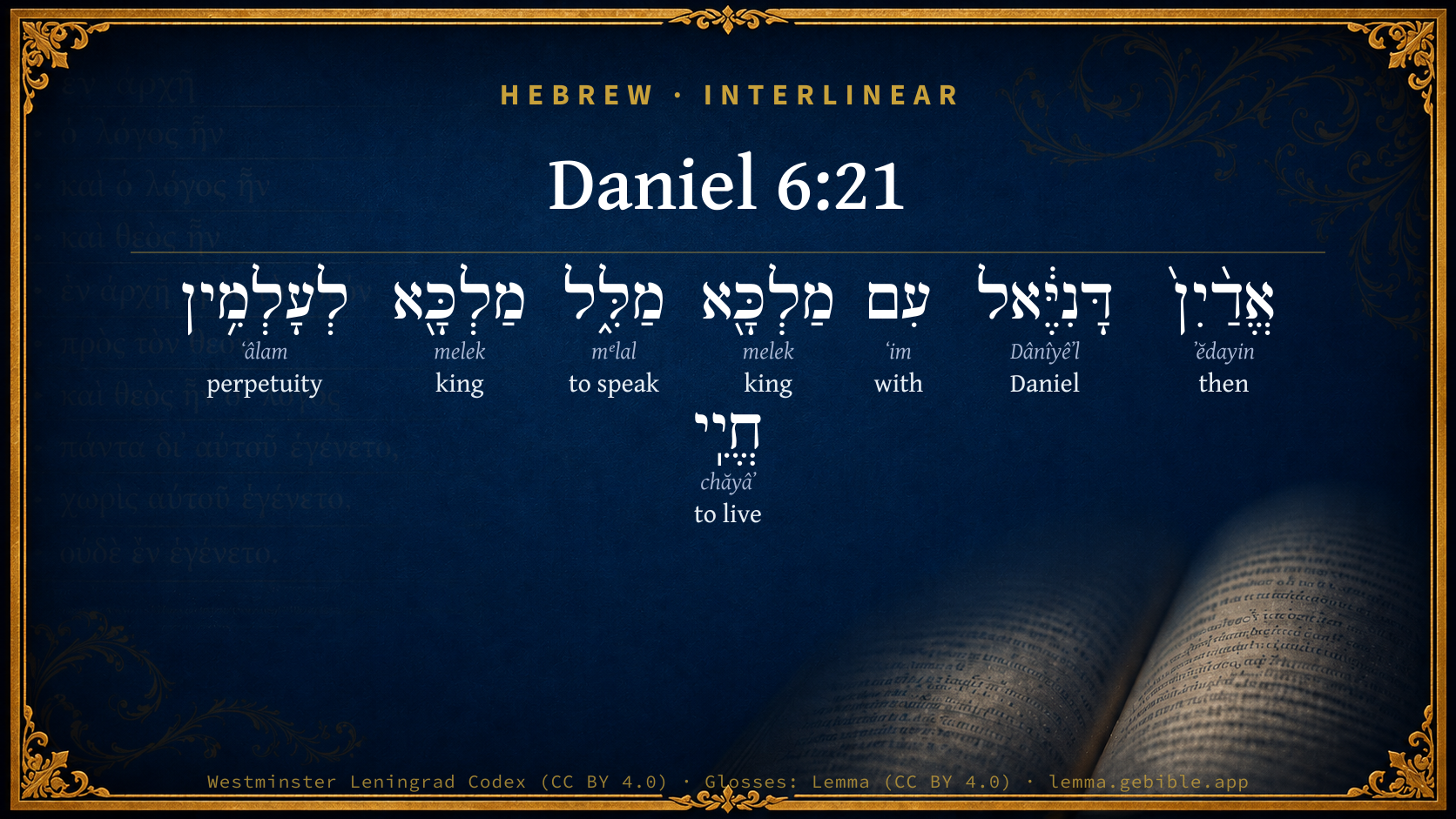
Hebrew (Westminster Leningrad Codex) Daniel 6:21 appears in the Hebrew Old Testament. The text above is from the Westminster Leningrad Codex. Each word links to its Strong’s number, a concise gloss, and parsing drawn from the Open Scriptures Hebrew Bible morphology. Click any word for its full Brown-Driver-Briggs (BDB) entry.
Download image
Cite this verse

Daniel 6:21 (World English Bible). Public Domain. Lemma interlinear Bible study tool, https://lemma.gebible.app/v/daniel/6/21.

Show BibTeX & RIS
BibTeX
RIS
English Translation
Then said Daniel to the king, O king, live forever.
World English Bible · Public Domain
Highlights
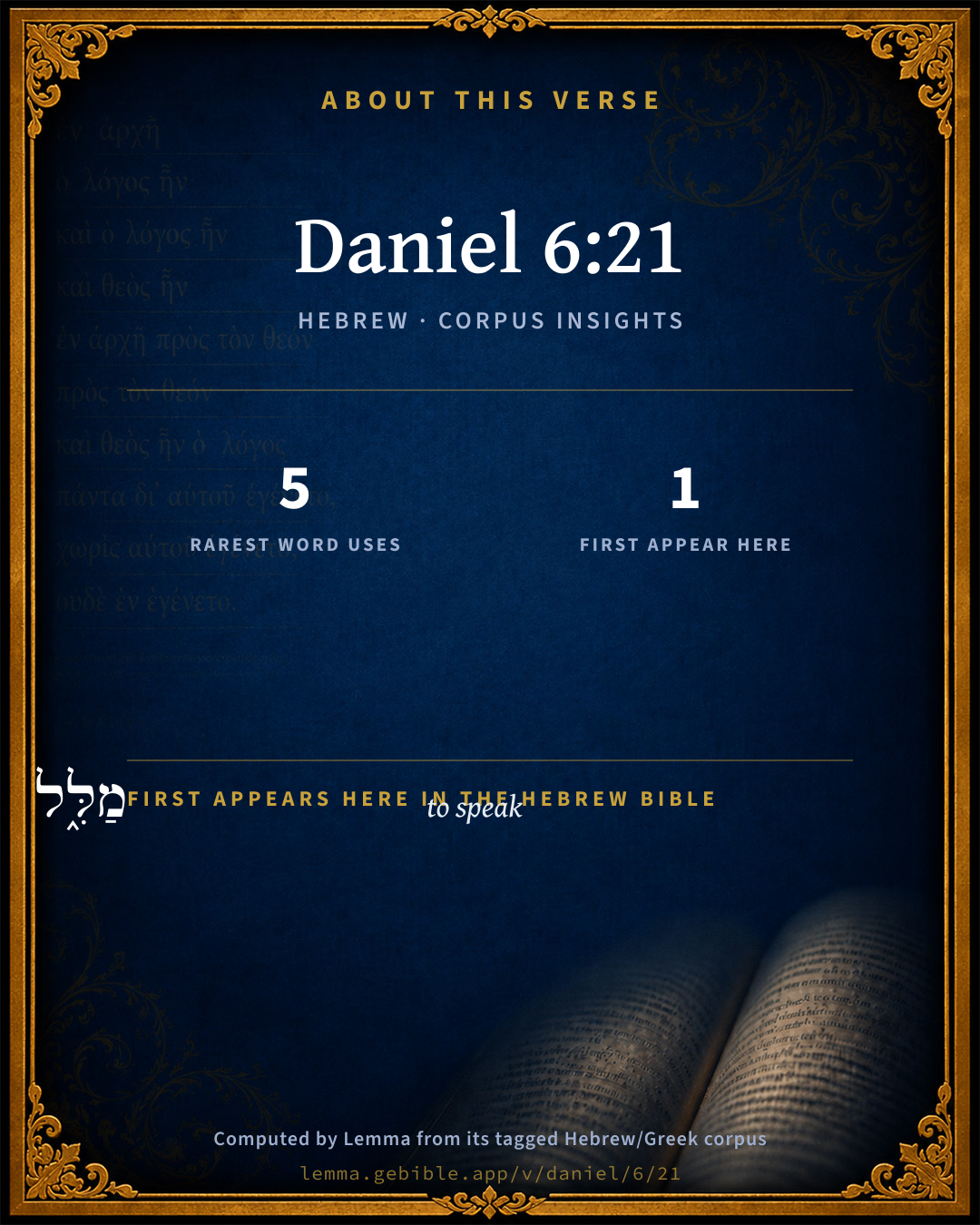
  • 1 first appearance in the Hebrew Bible
Full analysis ↓
Download a study sheet

One document with this verse’s original text, its word-by-word gloss line, the meaning frame, cross-references with their text, attributed commentary, and full source and license credits — printable, and it pastes into notes with its structure intact.

This verse Autodidact and up

Study sheet (.html) Plain text (.txt)

A passage Seminary Student

Up to 50 verses in one chapter. A passage sheet keeps up to 6 commentary sources and 12 cross-references per verse, in the order this page ranks them, and says so on the sheet whenever that leaves anything out. Ask for a single verse and you get the Autodidact verse sheet above.

Everything on this page stays free to read, with no account — the sheet is a download of what is already on screen, not access to it.

Want to remove ads? Support Godless Engineer
Compare translations 3

The same verse in 3 English versions, stacked beneath the original-language interlinear above. Click any original word for its lexicon entry.

Each is an independent rendering of the whole verse — the interlinear is not word-aligned to these translations.

Highlighted words mark where these versions differ — a whole-verse word diff, not a word-by-word alignment.

  • World English Bible Public Domain
    Then said Daniel to the king, O king, live forever.
  • King James Version Public Domain
    Then said Daniel unto the king, O king, live for ever.
  • unfoldingWord Literal Text CC BY-SA 4.0
    Then Daniel spoke to the king, “O king, live forever!

unfoldingWord Literal Text — © unfoldingWord, licensed CC BY-SA 4.0. Word-aligned USFM3 via Door43 (git.door43.org/unfoldingWord/en_ult).

Versions to compare (up to 4)

3 of 4 selected

Show all 18 translations

Every available English version of this verse, each an independent rendering of the whole verse.

  • World English Bible Public Domain
    Then said Daniel to the king, O king, live forever.
  • Berean Standard Bible Public Domain
    Then Daniel replied, “O king, may you live forever!
  • Majority Standard Bible Public Domain
    Then Daniel replied, “O king, may you live forever!
  • King James Version Public Domain
    Then said Daniel unto the king, O king, live for ever.
  • American Standard Version (1901) Public Domain
    Then said Daniel unto the king, O king, live for ever.
  • Revised Version (1885) Public Domain
    Then said Daniel unto the king, O king, live for ever.
  • Geneva Bible (1599) Public Domain
    Then saide Daniel vnto the King, O King, liue for euer.
  • Douay-Rheims (1899) Public Domain
    And Daniel answering the king, said: O king, live for ever:
  • Young's Literal Translation Public Domain
    Then Daniel hath spoken with the king: `O king, to the ages live:
  • Literal Standard Version CC BY-SA 4.0
    Then Daniel has spoken with the king: “O king, live for all ages:
  • Unlocked Literal Bible CC BY-SA 4.0
    Then said Daniel to the king, “King, live forever!
  • unfoldingWord Literal Text CC BY-SA 4.0
    Then Daniel spoke to the king, “O king, live forever!
  • Darby Bible Public Domain
    Then Daniel spoke unto the king, O king, live for ever!
  • World Messianic Bible Public Domain
    Then Daniel said to the king, “O king, live forever!
  • Webster's Bible Public Domain
    \\6:20\\And when he came to the den, he cried with a lamentable voice to Daniel: and the king spoke and said to Daniel, O Daniel, servant of the living God, is thy God, whom thou servest continually, able to deliver thee from the lions?
  • Free Bible Version CC BY-SA 4.0
    Daniel replied, “May Your Majesty the king live forever!
  • Bible in Basic English Public Domain
    And when he came near the hole where Daniel was, he gave a loud cry of grief; the king made answer and said to Daniel, O Daniel, servant of the living God, is your God, whose servant you are at all times, able to keep you safe from the lions?
  • JPS Tanakh (1917) Public Domain
    (6-22) Then said Daniel unto the king: 'O king, live for ever!

Literal Standard Version (2020), Covenant Press — licensed CC BY-SA 4.0. Text via the HelloAO Bible API (eBible.org). Unlocked Literal Bible (unfoldingWord) — licensed CC BY-SA 4.0. Text via the HelloAO Bible API (eBible.org). unfoldingWord Literal Text — © unfoldingWord, licensed CC BY-SA 4.0. Word-aligned USFM3 via Door43 (git.door43.org/unfoldingWord/en_ult). Free Bible Version, Dr. Jonathan Gallagher — licensed CC BY-SA 4.0. Text via the HelloAO Bible API (eBible.org).

Word by word

More ways to search: Search by grammar → Find every occurrence → Compare this word →

Practice this passage: Drill this verse → Learn its vocabulary →

About this verse

These counts appear in no published source. They are computed here, from the morphology-tagged text and Lemma’s own curated glosses. What Lemma adds →

8
words
7
distinct lemmas
Prophets
section

Notable vocabulary

The rarest word here is מַלִּ֑ל to speak H4449 — appearing just 5 times in the whole Hebrew Bible.

First appearance in Scripture

This word makes its first canonical appearance in the Hebrew Bible here:

  • מַלִּ֑ל to speak H4449

Shared distinctive vocabulary

מַלִּ֑ל to speak H4449 occurs in 5 verses of the Hebrew Bible. Also found in:

Grammatical profile

  • 1 noun
  • 5 adjectives
  • 2 particles

Repetition

A word recurs within this verse — often emphatic in Hebrew:

  • מַלְכָּ֖א king H4430 ×2

Hebrew & Septuagint length

In English translation the verse runs 10 words from the Hebrew and 11 from the Septuagint (LXX English) — closely comparable.

A rough comparison of the two English renderings, which tokenize alike — not a word-level alignment.

Word counts can differ between the Hebrew and the Greek without any difference in meaning — e.g. the Hebrew direct-object marker אֵת has no separate Greek word, and Greek often adds the article ὁ.

Cross-references

3

Topical passages linked to Daniel 6:21 in the Treasury of Scripture Knowledge — connected by theme and wording, ordered by reader-vote popularity; previews shown in the World English Bible.

  • Daniel 2:4 Then spoke the Chaldeans to the king in the Syrian language, O king, live forever: tell your servants the dream, and we will show the interpretation.
  • Daniel 6:6 Then these presidents and satraps assembled together to the king, and said thus to him, King Darius, live forever.
  • Nehemiah 2:3 I said to the king, Let the king live forever: why should not my face be sad, when the city, the place of my fathers' tombs, lies waste, and the gates of it are consumed with fire?

Cross-references courtesy of OpenBible.info (CC BY 4.0).

Hebrew and Greek witnesses Masoretic Hebrew ↔ Greek Septuagint

The same verse in the two great witnesses to the Old Testament, shown verse-for-verse.

These are two independent witnesses, not word-aligned to each other, and the Septuagint is shown in lemma (dictionary) form.

Hebrew Daniel 6:21 Masoretic · Westminster Leningrad Codex

אֱדַ֨יִן֙ דָּנִיֶּ֔אל עִם מַלְכָּ֖א מַלִּ֑ל מַלְכָּ֖א לְעָלְמִ֥ין חֱיִֽי

Then said Daniel to the king, O king, live forever.

World English Bible · Public Domain

Greek LXX Daniel 6:21 Septuagint · lemma form

τότε ὁ βασιλεύς καλέω ὁ δανιηλ φωνή μέγας μετά κλαυθμός λέγω ὦ δανιηλ εἰ ἄρα ζάω καί ὁ θεός σύ ὅς λατρεύω ἐνδελεχῶς σώζω σύ ἀπό ὁ λέων καί οὐ ἀχρείοω σύ

And Daniel said to the king, O king, live for ever.

LXX2012 (modern English Septuagint) · Public Domain

On this verse, The Pulpit Commentary discusses the Septuagint’s reading. Read the note in Commentary ↓

Hebrew: Westminster Leningrad Codex (CC BY 4.0). Greek: Septuagint (public domain); English from LXX2012 (modern English Septuagint) (Public Domain). How the Septuagint differs from the Hebrew →

Commentary

Notes on Daniel 6:21 from classic Christian and Jewish commentators (each source and its license shown beneath its notes). The classic Christian expositions comment on the surrounding passage and are grouped to its opening verse, so a note may address several verses; the Jewish commentaries on the Tanakh (Rashi and others) are per-verse, so they appear only where the commentator wrote on this verse.

Lemma curates 59 commentaries, every one of them public domain or Creative Commons licensed, each selected and text-cleaned for this edition rather than reprinted as found. About our sources →

Trapp's Complete Commentary

John Trapp

Dan 6:21 Then said Daniel unto the king, O king, live for ever.

Ver. 21. O king, live for ever.] Daniel doth not curse the king (as some impatient spirits would have done, and as some think the damned in hell do God), but wisheth him a long and happy life, voto amabili. He useth the ordinary form, but with a better mind. His wish of the king’s welfare was non in labris nature sed in fibris, it was from the heart, it was a holy prayer.

John Trapp, A Commentary or Exposition upon All the Books of the Old and New Testament (1647–1656) — public domain. Text from a community e-Sword module.

The Biblical Illustrator

Joseph S. Exell

Dan_6:21-22

My Lord hath sent His Angel.

Daniels Marvellous Deliverances

These words are Daniels religious and thankful acknowledgment of his deliverance.

1. Here is a reverend compellation. O king. Darius was a heathen prince; an enemy to Gods people; and he here makes a wicked law, forbidding religion, and inforcing to idolatry. Yet the prophet acknowledges and honours him, as his king and sovereign.

2. A loyal and pious salutation. Live for ever. He prays for him, wishes him both length and prosperity of life here, and eternity of life and felicity hereafter. He upbraids not the king with tyranny and impiety; charges him not with the cruelty of his usage; threatens him not with vengeance, and judgments from God. He will not pray to the king, but he ceases not to pray for him.

3. Thankful declaration of his marvellous deliverance.

(1) The author; My God. Two things: his helper--God. His hold that he lays upon this helper. My God, by special service and religion, the God of my faith, and piety, and devotion; by special trust and affiance; by present evidence and experience; by resolution, and engagements of holy thankfulness.

(2) The Instrument. Sent His angel. Not my angel, but Gods angel. It is not the angel came, but God sent him. This ministry of an angel, in the delivering of Daniel, adds unto it three excellencies. It makes a comfortable deliverance. As a forlorn and forsaken man, he is visited by an angel. It makes a glorious deliverance. Such a saint shall have not only safety, but honour. It makes an irresistible deliverance. There is no disappointing of this salvation.

(3) The manner of this deliverance: how it was wrought. He shut the mouths of the lions. God delivers not from the den, but when in it. How did he shut the mouths? By a secret power, weakening or restraining them; or by taming and allaying their fierceness; or restraining or slaking their hunger; or by making the prophet appear awful and dreadful to them.

(4) The measure of the deliverance. Complete.

(5) The motive which God graciously respected. A double innocence of the prophet. General, and particulars to this incident. (Geo. Stradling.)

Daniels Deliverance from the Den of Lions

I. THE ANTECEDENTS OF DANIELS MIRACULOUS DELIVERANCE.

1. They remind us that the penalty of greatness is the envy of inferiors. Daniel was as the sun in the Persian kingdom, showing to all who come under his influence what a good ruler really was. But the intense light of his character was too strong for men whose conduct he then condemned, and who were thus made painfully conscious of their own shortcomings.

2. Envy will seek an opportunity of false accusation. It was the envy of the Jewish rulers which was the foundation of their false accusations against Christ.

3. They remind us that it may be the penalty of moral greatness to be condemned by legal greatness. The law of a nation may be a very strong law because of its great antiquity, but it may be a very wicked law notwithstanding, and whoever obeys it may bring himself under the penalty of a much more powerful and a much older law, the law of moral rectitude--a law older than the creation of man.

II. THE MIRACLE ITSELF. The lions did not act according to the instincts of their nature. This holding back of the appetite of the lions is the more remarkable, because the instinct returned as soon as Daniels persecutors took his place in the den. Lessons:

1. The most pressing demands of business are not incompatible with daily waiting upon God in prayer.

2. Escape from trial of our constancy at one time is no guarantee that we shall not be called upon to prove it at another.

3. Sometimes disobedience to man is the highest virtue in the sight of God. When mans laws are in opposition to Gods, the breaking of them is righteousness.

4. We are in the path of obedience to God, even though the obedience leads to death. (Outlines by a London Minister.)

Daniels Preservation from the Lions

For unshaken confidence in his God, zeal in His service, and for His honour, for fearlessness in danger, and for virtuous disregard of all human power and human threatenings, when employed against God and religion, the prophet Daniel is justly conspicuous in Bible history. No character in Scripture has attained more honourable distinction. Three things deserve our attention.

I. THE CONDUCT FOR WHICH DANIEL WAS THROWN INTO THE DEN OF LIONS. Daniels enemies contrived to obtain the kings consent to a wicked decree, binding all men to abstain from worshipping any god, or asking a petition of any god or man, except the king himself, for thirty days. But the prophet, knowing that when human laws are found to clash with the divine commands, it is right to obey God rather than man, continued, regardless of consequences, to pray to his God three times a day, as he had heretofore done. In the discharge of his duty to God, he had no real cause for dismay. God, he knew, was with him. Having, therefore, faithfully performed his duty, he submits to the will of his enemies, commits himself to Him that judges righteously, and calmly and steadily leaves the event in His hands.

II. THE EXTRAORDINARY FACT RECORDED, THAT DANIEL WAS TAKEN UP OUT OF THE DEN UNHURT. By this signal preservation of the life of Daniel among the lions, God displayed at once His power over the creatures of the forest which He had made, and His care over His servants when He calls them out to suffer for His cause. Under the protection of the Almighty, Daniel was as safe in the den of lions as he would have been in the palace, and under the protection of Darius. This God is our God for ever and ever. He will still honour and preserve them that honour Him, still bear up and support His faithful people.

III. The reason assigned for the miraculous interposition of God on Daniels behalf. Because he believed in his God. Mark what honour God puts upon faith. Faith was the spring of Daniels holy obedience to God. Faith gave him peace and comfort, and brought down the angel of God into the lions den. This holy principle has never failed to attract the divine regard, and to insure the approbation of God. This subject may teach us:

1. The importance, under all circumstances, of stedfast adherence to the path of duty. Duties are ours, events are Gods. One common duty of Christians is that of calmly resting under affliction, in patient submission to the will of God.

2. The importance of steady trust in God, especially in the great event of death, that last trial of the Christian.

3. This subject affords a ground of consolation to all faithful Christians in tribulation, and to the surviving friends of the departed saints. (J. Jaques.)

Daniel taken out of the den

His case at first seemed very hard to flesh and blood. But here we see the end of the Lord. All was so over-ruled, that Daniel had no reason to repent of his conduct, or lament the result of it. How much did Daniels stedfastness conduce to the glory of God, and the advancement of his cause! Christians never honour God more than in the fires. But the result terminated in Daniels own honour and welfare. When taken up, how would every eye be drawn to him. What influence would be attached to his character! What weight to his advice and counsel! He is restored. He is promoted by his Sovereign to a higher station. And who would not have done what Darius did? He who had been faithful to his God, was more likely to be faithful to his king. This is indeed one of the ways in which Godliness naturally conduces to a mans present advantage. Constantius, the father of Constantine the Great, wished to know the character of those about him. He, therefore, called together before him, all the chiefs in his suite, and ordered them to offer Sacrifices to his gods (he was a heathen), on pain of being deprived of all their honours and functions. The trial was severe. Many sunk under it. They could not give up everything that was dear and valuable. But some were inflexible. They had bought the truth, and they would not sell it at any price. Whatever they suffered, they were resolved to have a conscience void of offence. But what happened? Those who basely complied, he drove from his presence, while those who nobly refused, he entrusted with the care of his person, and placed them in the most important offices, saying: On these men I can depend--I prize them more than all my treasures. And we know who hath said: Them that honour Me I will honour; but they that despise Me shall be lightly esteemed. (William Jay.)

The Biblical Illustrator, edited by Joseph S. Exell (c. 1880s–1900s) — public domain. Text from a community e-Sword module.

Joseph Benson's Commentary

Dan 6:21-23. Then said Daniel — Daniel knew the king’s voice, though it was now a doleful voice, and spake to him with all the deference and respect that was due to him. O king, live for ever — He does not reproach him for his unkindness to him, and his easiness in yielding to the malice of his persecutors; but, to show that he has heartily forgiven him, he meets him with his good wishes. Observe, reader, we must not upbraid those with the unkindnesses they have done us, who, we know, did them with reluctance, for they are very ready to upbraid themselves with them. My God hath sent his angel — The same bright and glorious being that was seen with Shadrach and his companions in the fiery furnace, (see note on Dan 3:25,) had visited Daniel; and, it is likely, in a visible appearance, had enlightened the dark den, kept Daniel company all night, and had shut the lions’ mouths that they had not in the least hurt him. This heavenly being made even the lions’ den Daniel’s strong hold, his palace, his paradise; he never had a better night in his life. See the power of God over the fiercest creatures, and confide in his power to restrain the roaring lion, that goes about continually seeking to devour, from hurting those that are his! See the care God takes of his faithful worshippers, especially when he calls them out to suffer for him. If he keep their souls from sin, comfort their souls with his peace, and receive their souls to himself, he doth, in effect, stop the lions’ mouths that they cannot hurt them. Forasmuch as before him innocency was found in me — Daniel, in what he had done, had not offended either against God or the king. Before him, to whom he had prayed, he had been continually upright and conscientious in the discharge of his duty, endeavouring to walk unblameably before him. And also before thee, O king, have I done no hurt — He was represented to the king as disaffected to him and his government, because he had not obeyed the new law; but he could appeal to the Searcher of hearts, that he had not disobeyed it out of contumacy or stubbornness, but purely to preserve a good conscience, which is the only true principle of loyalty and obedience: see Rom 13:5. On this subject, as far as we find, Daniel had said nothing before in his own vindication, but had left it to God to clear up his integrity as the light, and God had now done it effectually, by working a miracle for his preservation. Then was the king exceeding glad — To find him alive and well; and commanded that they should take Daniel up out of the den — As Jeremiah was taken out of the dungeon: for as the decree had now been complied with, and its penalty suffered, even Daniel’s persecutors could not but own that the law was satisfied, though they were not; or, if it were altered, it was by a power superior to that of the Medes and Persians. And no manner of hurt was found upon him — He was nowhere crushed, or torn, or scared, or hurt in any way whatever; because he believed in his God — In God’s power, and love, and faithfulness; because he confided in him for protection, while he lived in obedience to his commandments.

Joseph Benson's Commentary on the Old and New Testaments (1811–1818) — public domain. Text from a community e-Sword module.

Tyndale Open Study Notes

Tyndale Open Resources

6:21-22 My God sent his angel: The law of the Medes and Persians proved impotent. God has the power to defend his faithful servant and his own reputation.

Tyndale Open Study Notes — © Tyndale Open Resources, licensed CC BY-SA 4.0. Text via the HelloAO Bible API.

Jamieson, Fausset & Brown

Robert Jamieson, A. R. Fausset & David Brown

Daniel might have indulged in anger at the king, but does not; his sole thought is, God's glory has been set forth in his deliverance.

Jamieson, Fausset & Brown — Commentary Critical and Explanatory on the Whole Bible (1871) — public domain (CC PDM 1.0). Text via the HelloAO Bible API.

John Calvin's Commentaries

Here Daniel answers the king moderately and softly, although he had been cast into the cave by his command. He might have deservedly been angry and expostulated with him, because he had been so impiously deserted by him, for King Darius had found him a faithful servant, and had used his services for his own advantage. When he saw himself oppressed by unjust calumnies, the king did not take his part so heartily as he ought; and at length, being overcome by the threats of his nobles, he ordered Daniel to be cast into the pit. Daniel might, as I have said, have complained of the king’s cruelty and perfidy. He does not do this, but is silent concerning this injury, because his deliverance would sufficiently magnify the glory of God. The holy Prophet desired nothing else, except the king’s welfare, which he prays for. Although he uses the ordinary phrase, yet he speaks from his heart, when he says, O king, live for ever! that is, may God protect thy life and bless thee perpetually. Many salute their kings and even their friends in this way through mere form; but there is no doubt that Daniel heartily wished the king the enjoyment of long life and happiness. He afterwards adds,

John Calvin's Commentaries (1540-1563) — public domain. Text from the Calvin Translation Society English edition (1840s-50s) via the Christian Classics Ethereal Library (ccel.org). Calvin's coverage is partial (roughly two-thirds of the Bible); uncommented books and verses are honest gaps, never fabricated. The 19th-century editor's footnotes and remarks are omitted so the notes are faithfully Calvin's own voice.

The Cambridge Bible for Schools and Colleges

gen. ed. J. J. S. Perowne

21. O king, live for ever] cf. Dan_6:6.

The Cambridge Bible for Schools and Colleges (gen. ed. J. J. S. Perowne; Cambridge University Press, 1878–1918) — public domain. Text from a community e-Sword module.

John Gill's Exposition

My God hath sent his angel,.... Daniel takes up the king's expression, and confirms it; he asserts God to be his God, of which he had given him a proof in sending his angel to him that night; either one of the ministering spirits about him, or the Angel of the covenant, the same with him, said to be like the Son of God, that was seen in the fiery furnace, even the Messiah in human form:

and hath shut the lions' mouths, that they have not hurt me; by taking away hunger from them, or by striking terror into them; so that they had either no inclination to hurt him, or were afraid of him:

forasmuch as before him innocency was found in me; either before God, or before his Angel, Daniel appeared to be an innocent and righteous person; therefore the Lord pleaded his cause, and made it to appear that he was just, and his cause good; for this is not to be understood of the merits of his works, and the causality of them to justify and save; for here he is speaking not of the righteousness of his person, but of his cause; and not of eternal, but temporal salvation:

and also before thee, O king, have I done no hurt: either to his person or government; nothing that was criminal and sinful, but what was just and right, serving daily his God; and this was plain to the king, what he knew and owned; and though he had acted contrary to the decree the lords had craftily obtained, yet it was not out of disrespect to the king, but in obedience to his God; and in doing of which he had done nothing prejudicial to the king's interest.

John Gill's Exposition of the Whole Bible (1746–1763) — public domain (CC PDM 1.0). Text via the HelloAO Bible API.

Albert Barnes' Notes on the Bible

Then said Daniel unto the king, O king, live forever - The common form of salutation in addressing the king. See the note at Dan 2:4. There might be more than mere form in this, for Daniel may have been aware of the true source of the calamities that had come upon him, and of the innocence of the king in the matter; and he doubtless recalled the interest which the king had shown in him when about to be cast into the den of lions, and his expression of confidence that his God would be able to deliver him Dan 6:16, and he could not but have been favorably impressed by the solicitude which the monarch now showed for his welfare in thus early visiting him, and by his anxiety to know whether he were still alive.

Albert Barnes' Notes on the Bible (1834–1885) — public domain. Text from a community e-Sword/MySword module.

Matthew Poole's English Annotations

He prays for the king’s prosperity, though he suffered under his hand.

Matthew Poole's English Annotations on the Holy Bible (1683–1685) — public domain. Text from a community e-Sword/MySword module.

The Pulpit Commentary

Vers. 21, 22. Then said Daniel unto the king, O king, live for ever. My God hath sent his angel, and hath shut the lions" mouths, that they have not hurt me: forasmuch as before him innocency was found in me; and also before thee, O king, have I done no hurt. The Syriac construction, malleel "ira, is to be observed. The rendering of the LXX differs from the Massoretic text in a way that can scarcely be due to differences merely of reading, "Then Daniel called with a loud voice and said O king, I am yet living, and God hath saved me from the lions according to the righteousness found in me before him, and before thee, O king, was neither ignorance nor sin to be found in me; but thou didst hearken to men who deceive kings, and hast east me into the den of lions for my destruction." It is not impossible that the opening clauses of the Massoretic and the LXX respectively, "O king, I am yet living." and "O king, live for ever," have been derived from the same source. The last clause is to all appearance an expansion. Theodotion and the Peshitta agree with the Massoretic text. Daniel answers the king, and declares his safety. The angelology of Daniel is an interesting subject, but here the question is complicated by the fact that there is no reference to angelic interference in the Septuagint. Still all through Scripture God does most of his works through the intervention of angels. To Darius, if he had any such beliefs as afterwards are found associated with Zoru astrianism, the ascription of deliverance to an angel would be natural enough. It is doubt ful whether Cyrus and his followers were not idolaters. The rebuke implied in the state merit that not only before God was Daniel innocent, but in the sight of the king, is sufficiently clear without passing beyond the lines of courtly decorum. The expansion in the LXX is unnecessary, and mars the stately picture; though, on the other hand, the simple answer to the king"s question is more likely than the courtly "O king live for ever."

The Pulpit Commentary (1880–1919), ed. H.D.M. Spence-Jones & Joseph S. Exell — public domain. Text from a community e-Sword module.

unfoldingWord translationNotes

Door43 World Missions Community

For I was found blameless

This can be stated in active form. AT: "He knows that I have done nothing wrong" (See: Active or Passive)

I have done you no harm

"I have not harmed you at all"

translationWords

eternity

messenger

blameless

unfoldingWord translationNotes — © Distant Shores Media and the Door43 World Missions Community, licensed CC BY-SA 4.0. Source: git.door43.org/Door43/en_tn.

Lesson kit

Teaching starters — assembled from the data on this page, not authored interpretation. Every prompt links to the verse data it draws on. Edit before teaching.

Daniel, in the Prophets, opens this verse with 8 words (7 distinct Hebrew lemmas). Its most distinctive word is mᵉlal (“to speak”). A historical commentator’s framing appears above. Read the whole chapter for the surrounding context.

Discussion questions

  1. What does “to speak” (mᵉlal) contribute to the verse as a whole?
  2. The word “to speak” first appears here in Scripture. What is being introduced at this debut?
  3. Daniel 7:8 shares the word «to speak» with this verse. How do the two illuminate each other?
  4. “king” occurs 2× in this one verse. What is the effect of the repetition?
  5. These translations render this verse differently. What is at stake in choosing one wording over another?
  6. Reading how Trapp's Complete Commentary and The Biblical Illustrator read this verse, where do the two commentators agree and where do they part?

Things to notice

  • 1 word makes its first canonical appearance in Scripture here.
  • These translations choose different wording for 4 words in this verse.
  • “king” occurs 2× in this single verse.
  • 7 distinct Hebrew lemmas span 8 words in this verse.

Reading settings

Reading text

Shown beneath each verse's original-language words.

Old Testament
Old Testament edition

Read the OT as the Masoretic Hebrew (MT) or the Greek Septuagint (LXX).

English shown for the Greek Septuagint (in the Hebrew ↔ Greek comparison).

Comparing translations? Open the Compare panel on any verse page to stack up to four side by side.