
Ezra 4:14

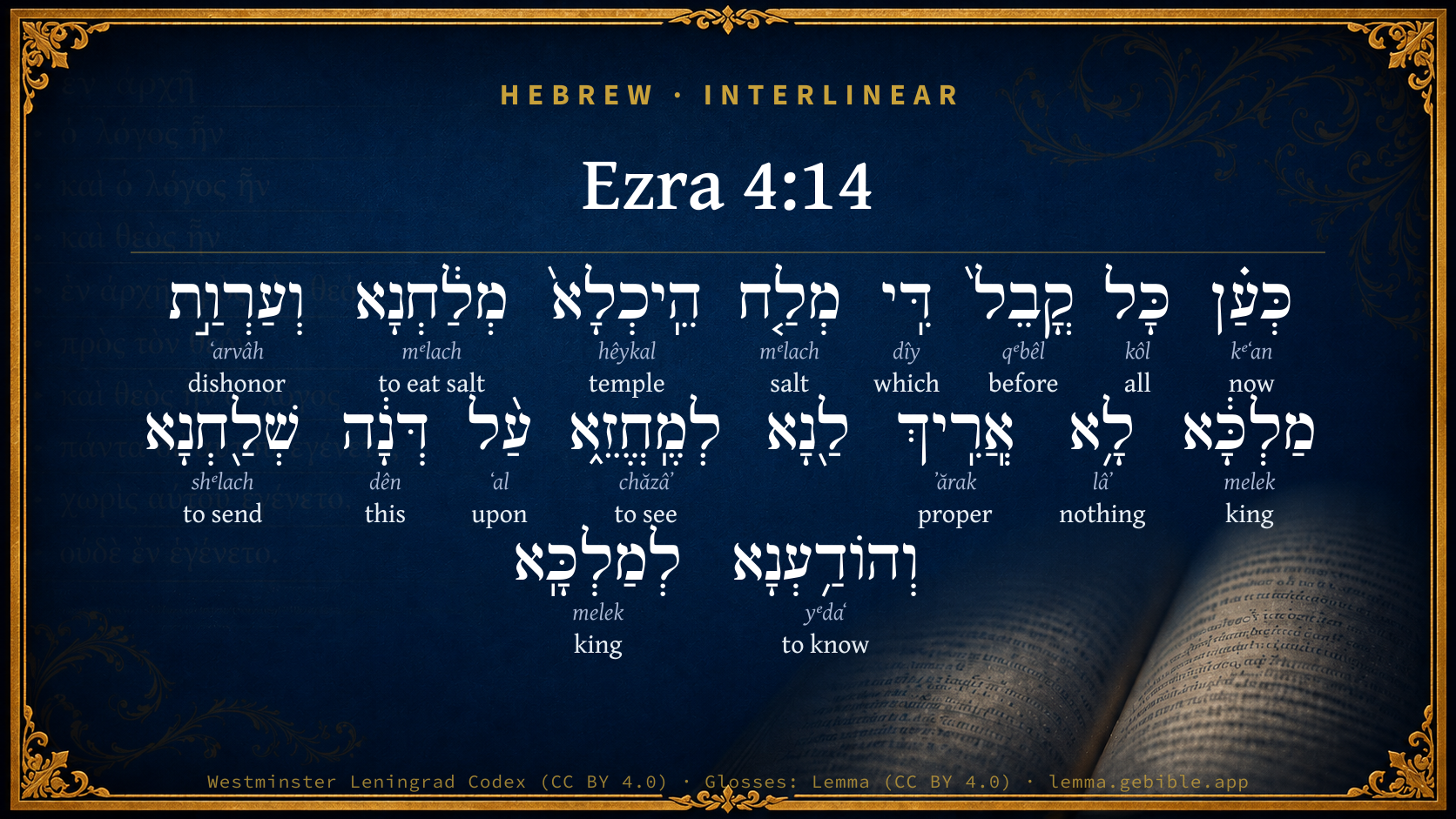
Hebrew (Westminster Leningrad Codex) Ezra 4:14 appears in the Hebrew Old Testament. The text above is from the Westminster Leningrad Codex. Each word links to its Strong’s number, a concise gloss, and parsing drawn from the Open Scriptures Hebrew Bible morphology. Click any word for its full Brown-Driver-Briggs (BDB) entry.
Download image
Cite this verse

Ezra 4:14 (World English Bible). Public Domain. Lemma interlinear Bible study tool, https://lemma.gebible.app/v/ezra/4/14.

Show BibTeX & RIS
BibTeX
RIS
English Translation
Now because we eat the salt of the palace, and it is not appropriate for us to see the king's dishonor, therefore have we sent and informed the king;
World English Bible · Public Domain
Highlights
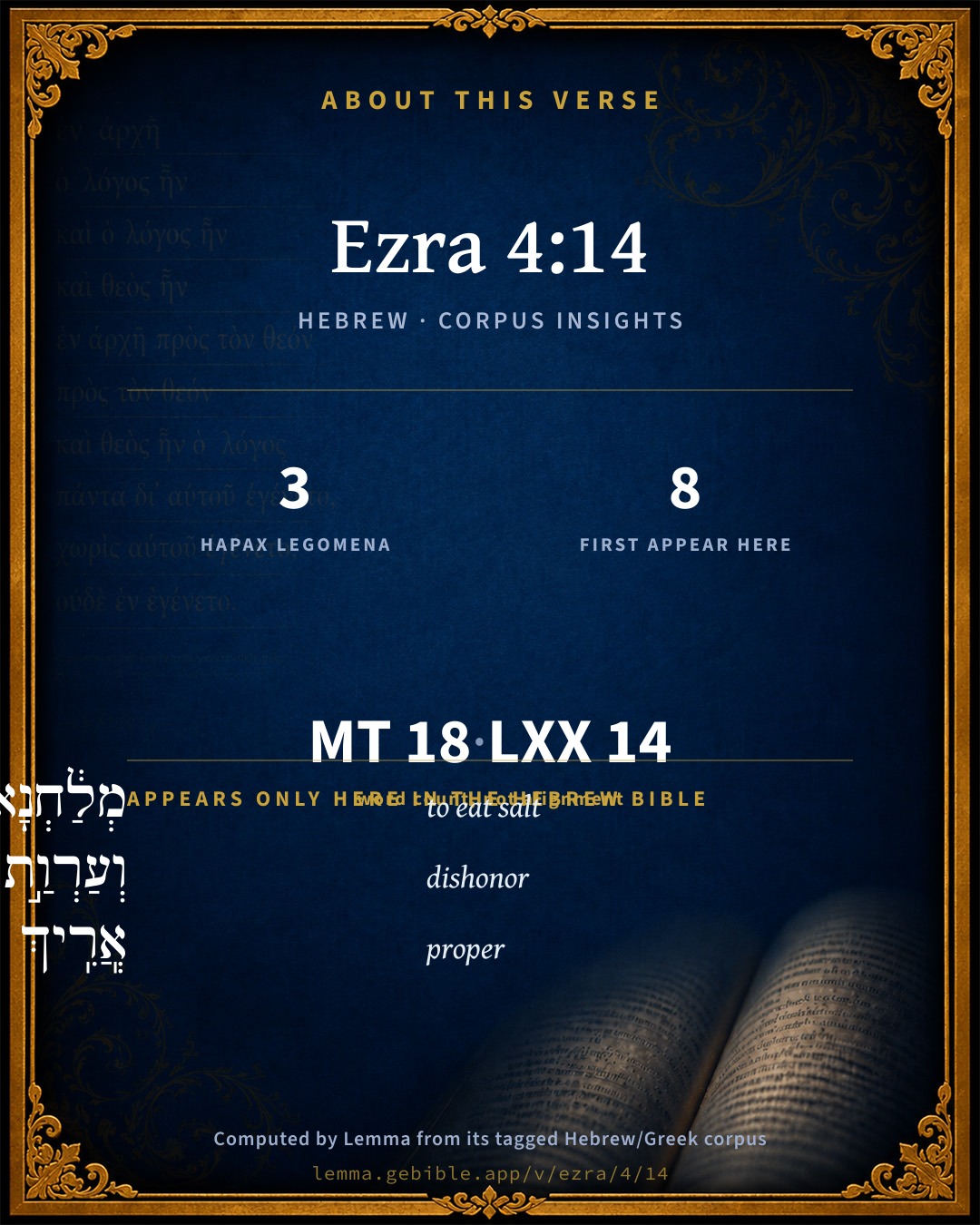
  • 3 hapax legomena — only here in the Hebrew Bible
  • 8 first appearances in the Hebrew Bible
Full analysis ↓
Download a study sheet

One document with this verse’s original text, its word-by-word gloss line, the meaning frame, cross-references with their text, attributed commentary, and full source and license credits — printable, and it pastes into notes with its structure intact.

This verse Autodidact and up

Study sheet (.html) Plain text (.txt)

A passage Seminary Student

Up to 50 verses in one chapter. A passage sheet keeps up to 6 commentary sources and 12 cross-references per verse, in the order this page ranks them, and says so on the sheet whenever that leaves anything out. Ask for a single verse and you get the Autodidact verse sheet above.

Everything on this page stays free to read, with no account — the sheet is a download of what is already on screen, not access to it.

Want to remove ads? Support Godless Engineer
Compare translations 3

The same verse in 3 English versions, stacked beneath the original-language interlinear above. Click any original word for its lexicon entry.

Each is an independent rendering of the whole verse — the interlinear is not word-aligned to these translations.

Highlighted words mark where these versions differ — a whole-verse word diff, not a word-by-word alignment.

  • World English Bible Public Domain
    Now because we eat the salt of the palace, and it is not appropriate for us to see the king's dishonor, therefore have we sent and informed the king;
  • King James Version Public Domain
    Now because we have maintenance from the king's palace, and it was not meet for us to see the king's dishonour, therefore have we sent and certified the king;
  • unfoldingWord Literal Text CC BY-SA 4.0
    Now, because we have eaten the salt of the palace, and it is not appropriate for us to see the nakedness of the king, on account of this we have sent and made known to the king,

unfoldingWord Literal Text — © unfoldingWord, licensed CC BY-SA 4.0. Word-aligned USFM3 via Door43 (git.door43.org/unfoldingWord/en_ult).

Versions to compare (up to 4)

3 of 4 selected

Show all 18 translations

Every available English version of this verse, each an independent rendering of the whole verse.

  • World English Bible Public Domain
    Now because we eat the salt of the palace, and it is not appropriate for us to see the king's dishonor, therefore have we sent and informed the king;
  • Berean Standard Bible Public Domain
    Now because we are in the service of the palace and it is not fitting for us to allow the king to be dishonored, we have sent to inform the king
  • Majority Standard Bible Public Domain
    Now because we are in the service of the palace and it is not fitting for us to allow the king to be dishonored, we have sent to inform the king
  • King James Version Public Domain
    Now because we have maintenance from the king's palace, and it was not meet for us to see the king's dishonour, therefore have we sent and certified the king;
  • American Standard Version (1901) Public Domain
    Now because we eat the salt of the palace, and it is not meet for us to see the king's dishonor, therefore have we sent and certified the king;
  • Revised Version (1885) Public Domain
    Now because we eat the salt of the palace, and it is not meet for us to see the king’s dishonour, therefore have we sent and certified the king;
  • Geneva Bible (1599) Public Domain
    Nowe therefore because wee haue bene brought vp in the Kings palace, it was not meete for vs to see the Kings dishonour: for this cause haue we sent and certified the King,
  • Douay-Rheims (1899) Public Domain
    But we remembering the salt that we have eaten in the palace, and because we count it a crime to see the king wronged, have therefore sent and certified the king,
  • Young's Literal Translation Public Domain
    Now, because that the salt of the palace `is' our salt, and the nakedness of the king we have no patience to see, therefore we have sent and made known to the king;
  • Literal Standard Version CC BY-SA 4.0
    Now because that the salt of the palace [is] our salt, and we have no patience to see the nakedness of the king, therefore we have sent and made known to the king;
  • Unlocked Literal Bible CC BY-SA 4.0
    Surely because we have eaten the palace salt, it is not fitting for us to see any dishonor happen to the king. It is because of this that we are informing the king
  • unfoldingWord Literal Text CC BY-SA 4.0
    Now, because we have eaten the salt of the palace, and it is not appropriate for us to see the nakedness of the king, on account of this we have sent and made known to the king,
  • Darby Bible Public Domain
    Now, since we eat the salt of the palace, and it is not right for us to see the king's injury, therefore have we sent and informed the king;
  • World Messianic Bible Public Domain
    Now because we eat the salt of the palace and it is not appropriate for us to see the king’s dishonor, therefore we have sent and informed the king,
  • Webster's Bible Public Domain
    Now because we have maintenance from the king's palace, and it was not meet for us to see the king's dishonor, therefore have we sent and certified the king;
  • Free Bible Version CC BY-SA 4.0
    Now because we are in the king's service and it is not right for us to see Your Majesty disrespected, we are sending this letter so that you can be informed,
  • Bible in Basic English Public Domain
    Now because we are responsible to the king, and it is not right for us to see the king's honour damaged, we have sent to give the king word of these things,
  • JPS Tanakh (1917) Public Domain
    Now because we eat the salt of the palace, and it is not meet for us to see the king's dishonour, therefore have we sent and announced to the king,

Literal Standard Version (2020), Covenant Press — licensed CC BY-SA 4.0. Text via the HelloAO Bible API (eBible.org). Unlocked Literal Bible (unfoldingWord) — licensed CC BY-SA 4.0. Text via the HelloAO Bible API (eBible.org). unfoldingWord Literal Text — © unfoldingWord, licensed CC BY-SA 4.0. Word-aligned USFM3 via Door43 (git.door43.org/unfoldingWord/en_ult). Free Bible Version, Dr. Jonathan Gallagher — licensed CC BY-SA 4.0. Text via the HelloAO Bible API (eBible.org).

Word by word

More ways to search: Search by grammar → Find every occurrence → Compare this word →

Practice this passage: Drill this verse → Learn its vocabulary →

מְלַ֔חְנָא
mᵉlach
H4415
“to eat salt”
Adjective, V, Plural
Part of Speech
Adjective
Number
Plural
Full BDB Definition

Origin: corresponding to H4414

TWOT: 2828

(Peal) to eat salt
  1. כְּעַ֗ן kᵉʻan H3705 “now” Adjective, D
  2. כָּל kôl H3606 “all” Adjective, C + Conjunction
  3. קֳבֵל֙ qᵉbêl H6903 “before” Adjective, C
  4. דִּֽי dîy H1768 “which” Adjective, C
  5. מְלַ֤ח mᵉlach H4416 “salt of” Adjective, N, Common
  6. הֵֽיכְלָא֙ hêykal H1965 “temple · the” Adjective, N, Common + Particle, Definite Article
  7. וְעַרְוַ֣ת ʻarvâh H6173 “and · dishonor of” Adjective, C + Noun, Common, Feminine, Singular, Construct
  8. מַלְכָּ֔א melek H4430 “king · the” Adjective, N, Common + Particle, Definite Article
  9. לָ֥א lâʼ H3809 “nothing” Adjective, T
  10. אֲֽרִֽיךְ ʼărak H749 “proper” Adjective, A
  11. לְמֶֽחֱזֵ֑א chăzâʼ H2370 “to see” Adjective, R + Verb, Qal, Infinitive Construct
  12. עַ֨ל ʻal H5922 “upon” Adjective, R
  13. דְּנָ֔ה dên H1836 “this” Adjective, P
  14. שְׁלַ֖חְנָא shᵉlach H7972 “to send” Adjective, V, Plural
  15. וְהוֹדַ֥עְנָא yᵉdaʻ H3046 “and · to know” Adjective, C + Verb, Hiphil, Perfect, 1st Person, Common, Plural
  16. לְמַלְכָּֽא melek H4430 “to/for · king · the” Adjective, T + Noun, Common, Masculine, Singular, Determined + Particle, Definite Article

About this verse

These counts appear in no published source. They are computed here, from the morphology-tagged text and Lemma’s own curated glosses. What Lemma adds →

18
words
16
distinct lemmas
Historical
section

Notable vocabulary

3 hapax legomena — words that appear only here in the entire Hebrew Bible:

  • מְלַ֔חְנָא to eat salt H4415
  • וְעַרְוַ֣ת dishonor H6173
  • אֲֽרִֽיךְ proper H749

First appearance in Scripture

These words make their first canonical appearance in the Hebrew Bible here:

  • כָּל all H3606
  • קֳבֵל֙ before H6903
  • מְלַ֤ח salt H4416
  • הֵֽיכְלָא֙ temple H1965
  • מְלַ֔חְנָא to eat salt H4415
  • וְעַרְוַ֣ת dishonor H6173
  • אֲֽרִֽיךְ proper H749
  • לְמֶֽחֱזֵ֑א to see H2370

Shared distinctive vocabulary

מְלַ֤ח salt H4416 occurs in 3 verses of the Hebrew Bible. Also found in:

Grammatical profile

  • 2 verbs
  • 1 noun
  • 11 adjectives
  • 1 conjunction
  • 3 particles

Verb forms

  • לְמֶֽחֱזֵ֑א Qal · Infinitive Construct
  • וְהוֹדַ֥עְנָא Hiphil · Perfect

Repetition

A word recurs within this verse — often emphatic in Hebrew:

  • מַלְכָּ֔א king H4430 ×2

Hebrew & Septuagint length

In English translation the verse runs 29 words from the Hebrew and 26 from the Septuagint (LXX English) — closely comparable.

A rough comparison of the two English renderings, which tokenize alike — not a word-level alignment.

Word counts can differ between the Hebrew and the Greek without any difference in meaning — e.g. the Hebrew direct-object marker אֵת has no separate Greek word, and Greek often adds the article ὁ.

In the original languages it is 18 Hebrew tokens and 14 Greek tokens — but the two are counted differently (Hebrew bundles its prefixes and suffixes into one token; the Greek is in lemma form), so that isn’t a like-for-like length.

Cross-references

3

Topical passages linked to Ezra 4:14 in the Treasury of Scripture Knowledge — connected by theme and wording, ordered by reader-vote popularity; previews shown in the World English Bible.

  • Ezekiel 33:31 They come to you as the people comes, and they sit before you as my people, and they hear your words, but don't do them; for with their mouth they show much love, but their heart goes after their gain.
  • John 12:5–6 "Why wasn't this ointment sold for three hundred denarii, and given to the poor?"
  • John 19:12–15 At this, Pilate was seeking to release him, but the Jews cried out, saying, "If you release this man, you aren't Caesar's friend! Everyone who makes himself a king speaks against Caesar!"

Cross-references courtesy of OpenBible.info (CC BY 4.0).

Hebrew and Greek witnesses Masoretic Hebrew ↔ Greek Septuagint

The same verse in the two great witnesses to the Old Testament, shown verse-for-verse.

These are two independent witnesses, not word-aligned to each other, and the Septuagint is shown in lemma (dictionary) form.

Hebrew Ezra 4:14 Masoretic · Westminster Leningrad Codex

כְּעַ֗ן כָּל קֳבֵל֙ דִּֽי מְלַ֤ח הֵֽיכְלָא֙ מְלַ֔חְנָא וְעַרְוַ֣ת מַלְכָּ֔א לָ֥א אֲֽרִֽיךְ לַ֖נָא לְמֶֽחֱזֵ֑א עַ֨ל דְּנָ֔ה שְׁלַ֖חְנָא וְהוֹדַ֥עְנָא לְמַלְכָּֽא

Now because we eat the salt of the palace, and it is not appropriate for us to see the king's dishonor, therefore have we sent and informed the king;

World English Bible · Public Domain

Greek LXX Ezra 4:14 Septuagint · lemma form

καί ἀσχημοσύνη βασιλεύς οὐ ἐκεἰμί ἐγώ ὁράω διά οὗτος πέμπω καί γνωρίζω ὁ βασιλεύς

And it is not lawful for us to see the dishonor of the king: therefore have we sent and made known the matter to the king;

LXX2012 (modern English Septuagint) · Public Domain

In the Septuagint this is one book — Esdras B (2 Esdras): Ezra is chapters 1–10, Nehemiah 11–23.

On this verse, The Cambridge Bible for Schools and Colleges discusses the Septuagint’s reading. Read the note in Commentary ↓

Hebrew: Westminster Leningrad Codex (CC BY 4.0). Greek: Septuagint (public domain); English from LXX2012 (modern English Septuagint) (Public Domain). How the Septuagint differs from the Hebrew →

Commentary

Notes on Ezra 4:14 from classic Christian and Jewish commentators (each source and its license shown beneath its notes). The classic Christian expositions comment on the surrounding passage and are grouped to its opening verse, so a note may address several verses; the Jewish commentaries on the Tanakh (Rashi and others) are per-verse, so they appear only where the commentator wrote on this verse.

Lemma curates 59 commentaries, every one of them public domain or Creative Commons licensed, each selected and text-cleaned for this edition rather than reprinted as found. About our sources →

Trapp's Complete Commentary

John Trapp

Ezr 4:14 Now because we have maintenance from [the king’s] palace, and it was not meet for us to see the king’s dishonour, therefore have we sent and certified the king;

Ver. 14. Now because we have maintenance from the king’s palace] Chaldee, are salted with the salt of the palace, Salarium de regis palatio pereipimus, have our salary from the court, as Junius rendereth it. The great use of salt makes it here put for all kind of commodity; like as bread is called pants, as if it were το παν, the all and whole of our sustenance, Deu 8:3.

And it was not meet for us to see the king’s dishonour] Chaldee, nakedness, privities, which uncovered, cause contempt, as it befell Noah in his drunkenness; and the king of Spain, when by Queen Elizabeth proclaimed bankrupt.

Therefore have we sent and certified the king] As knowing that Beneficium postulat officium, Bounty commands duty. Ingratitude is a monster in nature, a solecism in good manners, &c. Lycurgus would make no law against it, because he held that none could be so unreasonable as to be guilty of it. Yet Alphonsus complained of his ungrateful courtiers; and so did Frederick III, emperor of Germany. Queen Elizabeth also said, that in trust she had oft found treason. That traitor Parry had vowed her death, although he had been condemned for burglary, and saved by her pardon (Speed).

John Trapp, A Commentary or Exposition upon All the Books of the Old and New Testament (1647–1656) — public domain. Text from a community e-Sword module.

The Biblical Illustrator

Joseph S. Exell

Ezr_4:14

Now because we have maintenance from the kings palace.

Good cause for great zeal

I. We acknowledge a very gracious fact.

1. We have been maintained from the Kings palace--

(1) In things temporal.

(2) In things spiritual.

2. Our maintenance from the Kings palace has cost His Majesty dear. He spared not His own Son.

3. We have had a bountiful supply.

4. We have had an unfailing portion.

5. The supply has ennobled us.

6. How cheering it is to have such a soul-satisfying portion in God.

II. Here is a duty recognised. By every sense of propriety we are bound not to see God dishonoured--

1. By ourselves.

2. By those who dwell under our roof.

3. By those with whom we have influence; particularly those who desire to unite with us in Church fellowship. We must not receive into our membership persons of unhallowed life--those who know not the truth as it is in Jesus.

4. By the mutilation and misrepresentation of His Word.

5. By a neglect of His ordinances.

6. By a general decline of His Church.

7. By so many rejecting His gospel. We cannot prevent their doing so, but we can weep for them, pray for them, etc.

III. A course of action pursued. Certified the king. It is a holy exercise of the saints to report to the Lord the sins and the sorrows they observe among the people and to plead for their removal. (C. H. Spurgeon.)

The Biblical Illustrator, edited by Joseph S. Exell (c. 1880s–1900s) — public domain. Text from a community e-Sword module.

Joseph Benson's Commentary

Ezr 4:14. Now because we have maintenance from the king’s palace — In the Hebrew it is, we are salted with the salt of the palace. That is, are sustained by the king’s munificence, or have a salary from him, as Junius translates it. In ancient times, it appears, it was usual to allow those who had deserved well, and on that account were honourably provided for at the king’s charge, among other things, a daily quantity of salt; it being a thing very necessary in human life. Locke, however, who translates the clause, we have eaten of the king’s salt, understands the meaning to be, “We have engaged ourselves in a covenant of friendship with him.” It was not meet for us to see the king’s dishonour — Thus they represent themselves as very loyal to the government, and mightily concerned for the honour and interest of it; and hence they urge the king to put a stop to the building of the city and temple of Jerusalem, as what would certainly be to his loss and dishonour.

Joseph Benson's Commentary on the Old and New Testaments (1811–1818) — public domain. Text from a community e-Sword module.

Tyndale Open Study Notes

Tyndale Open Resources

4:14 Since we are your loyal subjects: The Aramaic phrase we eat the salt of the palace was a metaphor for taking an oath of loyalty to the king. • The letter’s authors claimed that their only interest was to preserve the honor of the king, but they were actually grasping for power and political advantage over the Jews.

Tyndale Open Study Notes — © Tyndale Open Resources, licensed CC BY-SA 4.0. Text via the HelloAO Bible API.

Geneva Bible (1599)

Geneva Bible translators

Hebrew, in the Chaldea, we have eaten the salt of the palace.

Geneva Bible (1599) marginal notes — public domain. Text via Bolls.life.

Jamieson, Fausset & Brown

Robert Jamieson, A. R. Fausset & David Brown

we have maintenance from the king's palace--literally, "we are salted with the salt of the palace." "Eating a prince's salt" is an Oriental phrase, equivalent to "receiving maintenance from him."

Jamieson, Fausset & Brown — Commentary Critical and Explanatory on the Whole Bible (1871) — public domain (CC PDM 1.0). Text via the HelloAO Bible API.

Adam Clarke's Commentary

Verse 14. Now because we have maintenance from the king's palace] More literally: Now because at all times we are salted with the salt of the palace; i.e., We live on the king's bounty, and must be faithful to our benefactor. Salt was used as the emblem of an incorruptible covenant; and those who ate bread and salt together were considered as having entered into a very solemn covenant. These hypocrites intimated that they felt their conscience bound by the league between them and the king; and therefore could not conscientiously see any thing going on that was likely to turn to the king's damage. They were probably also persons in the pay of the Persian king.

Adam Clarke's Commentary on the Bible (1810–1826) — public domain. Text from a community e-Sword/MySword module.

Ellicott's Commentary for English Readers

(14) Maintenance.—more exactly, we eat the salt of the palace. This seems to be a general expression for dependence on the king, whose dishonour or loss they profess themselves unwilling to behold.

A Bible Commentary for English Readers, edited by Charles John Ellicott (1878–1897) — public domain. Text from a community e-Sword module.

The Cambridge Bible for Schools and Colleges

gen. ed. J. J. S. Perowne

14. have maintenance from the king’s palace] R.V. eat the salt of the palace; which preserves the metaphor of the original. The LXX. omitted the clause: Vulg. ‘memores salis, quod in palatio comedimus’: 1Es_2:20, ‘forasmuch as the things pertaining to the Temple are now on hand’, which substitutes a different sentence for one that was not intelligible. The old Jewish translation ‘because we aforetime destroyed the Temple’, adopted by many former commentators (cf. Luther, ‘Nun wir alle dabei sind, die wir den Tempel zerstöret haben’), seems to have been based upon the old symbolical custom of ‘sowing with salt’ the site of a town or place that had been destroyed, e.g. Jdg_9:45, and upon the idea of unfruitfulness associated with salt (cf. ‘a salt land and not inhabited’, Jer_17:6; Deu_29:23; Zep_2:9; cf. Heb. Job_39:6; Psa_107:34). Others, with the same conception, ‘we have salted (Jerusalem) with the salt of the palace’, i.e. assisted the Imperial armies in its destruction. ‘The palace’ in the original is the same word (‘heycâl’) as that used for ‘the temple’ in Ezr_3:6, Ezr_5:14. The ambiguity of this word and the use of a rare metaphor has given rise to the difficulty of translation. Literally, the words mean ‘because we have salted the palace’s salt’. The explanation then will be not, as has been suggested, ‘because we have been entertained (guest friends, i.e. are the king’s friends), at the palace’, but ‘because we are in the king’s service’. The writers as representatives of colonies and dependent districts were very probably officials, and therefore members of the great network of Persian government.

The English word ‘salary’ from salarium or salt-money is generally compared with this phrase.

and it was not meet] R.V. and it is not meet.

dishonour] literally ‘nakedness’. A strong metaphor, which the LXX. ἀσχημοσύνη reproduces. Cf. Lev_18:7, &c. The order is emphatic, ‘and the shame of the king it is not meet for us to see’. The Vulg. ‘læsiones’ gives the technical Latin word for ‘damage’ in a general sense.

The Cambridge Bible for Schools and Colleges (gen. ed. J. J. S. Perowne; Cambridge University Press, 1878–1918) — public domain. Text from a community e-Sword module.

John Gill's Exposition

That search may be made in the book of the records of thy fathers,.... That is, his predecessors in the Babylonian monarchy; though, as the Medes and Persians were included in that, and joined the Babylonians in their wars with others, and particularly with the Jews, the records of the Medes and Persians might also be applied to:

so shalt thou find in the book of the records, and know that this city is a rebellious city, and hurtful unto kings and provinces, and that they have moved sedition within the same of old time; against the king of Babylon, particularly in the times of Jehoiakim and Zedekiah:

for which cause was this city destroyed; as it was by Nebuchadnezzar; see Kg2 24:1.

John Gill's Exposition of the Whole Bible (1746–1763) — public domain (CC PDM 1.0). Text via the HelloAO Bible API.

Albert Barnes' Notes on the Bible

We have maintenance - See the margin. The phrase “to eat a man’s salt” is common in the East to this day; and is applied not only to those who receive salaries, but to all who obtain their subsistence by means of another. The Persian satraps had no salaries, but taxed their provinces for the support of themselves and their courts.

Albert Barnes' Notes on the Bible (1834–1885) — public domain. Text from a community e-Sword/MySword module.

Haydock's Catholic Bible Commentary

Eaten. Chaldean, "on account of the salt, with which we have been salted, from the palace." The king’s officers were fed from his table. Salt is put for all their emoluments; (Calmet) and hence the word salary is derived. (Pliny, [Natural History?] xxxi. 7.) We may also translate, "because we have demolished the temple, and because," &c. (Kimchi; Grotius, &c.) But this seems to refined. (Calmet) --- Protestants, "Now because we have maintenance from the king’s palace, and it is not meet," &c. To have neglected their master’s interests, would have betrayed great ingratitude and perfidy; particularly if they had entered into a covenant of salt, or solemnly engaged to be ever faithful servants, as the nature of their office implied, Numbers xviii. 19., and 2 Paralipomenon xiii. 5. (Haydock) --- Palace, being honoured with much distinction. (Delrio, adag. 215.)

George Leo Haydock (1774–1849), Haydock's Catholic Family Bible and Commentary, 1859 edition — public domain. Excludes Psalms (Douay-Rheims chapter numbering differs from Protestant) and Deuterocanonical books (Catholic canon only).

Matthew Poole's English Annotations

Thus they pretend the king’s service to their own malicious designs and private interests.

Matthew Poole's English Annotations on the Holy Bible (1683–1685) — public domain. Text from a community e-Sword/MySword module.

Whedon's Commentary on the Bible

Daniel D. Whedon

14. We have maintenance from the king’s palace — Omit the interpolation, kings, of the translators. This version gives the sense, but the margin gives the Chaldee more correctly: We are salted with the salt of the palace. To take or eat one’s salt is a common saying among many nations for receiving one’s living from another. Our word salary comes from the Latin word for salt, (sal,) and arose from the custom of paying Roman soldiers in salt. These Samaritans profess great zeal for the king, inasmuch as they obtained their living from him.

Daniel D. Whedon (gen. ed.), Commentary on the Old and New Testaments (1874–1909) — public domain. Text from a community e-Sword module.

The Pulpit Commentary

We have maintenance from the king"s palace. The marginal rendering is better, and shows the true sense. "Eating a man"s salt" in the East is deriving one"s subsistence from him. The man who eats another"s salt is bound to look after his interests. It was not meet for us to see the king"s dishonour. Rather, "the king"s detriment or loss it was not meet for us to stand by tamely and see the king stript of his due.

The Pulpit Commentary (1880–1919), ed. H.D.M. Spence-Jones & Joseph S. Exell — public domain. Text from a community e-Sword module.

unfoldingWord translationNotes

Door43 World Missions Community

we have eaten the palace salt

Possible meanings are that this refers to 1) the writers being loyal to the king or 2) the king giving the writers special honors. AT: "we are loyal to you" or "you have honored us by making us your officials" (See: Metonymy)

a rebellious city

The city is a metonym for the people who live in it. AT: "a city in which live people who have rebelled against your father" (See: Metonymy)

the city was destroyed

This can be translated in active form, in which case you will need to make explicit who destroyed the city. The "city" represents the people who live in it. AT: "the Babylonians destroyed the city" (See: Active or Passive and Assumed Knowledge and Implicit Information and Metonymy)

if this city and wall are built

This can be translated in active form. See how you translated these words in Esra 4:13. AT: "if they build the city and wall" (See: Active or Passive)

there will be nothing remaining for you

Here "nothing" is an exaggeration to make the king think that he will be losing much tax money if the Judeans rebel. (See: Hyperbole and Generalization)

the Province Beyond the River

This is the name of the province that was west of the Euphrates River. It was across the river from the city of Susa. See how you translated this in Esra 4:10. (See: How to Translate Names)

translationWords

dishonor

king

province

unfoldingWord translationNotes — © Distant Shores Media and the Door43 World Missions Community, licensed CC BY-SA 4.0. Source: git.door43.org/Door43/en_tn.

Rashi

Rabbi Shlomo Yitzchaki (Rashi)

Now in view of this, that we wish to destroy the Temple Now in view of this matter, that we wish to implement the destruction of the Temple. דִי מְלַח is an expression of destruction and desolation, like Jer. 17:6): “barren (מְלֵחָה) land that is uninhabitable.”

we wish to destroy We wish to demolish and to destroy.

and... the king’s disgrace Aram. וְעַרְוַת מַלְכָּא, lit. and the king’s nakedness.

it is improper Aram. לָא אַרִיךְ, it is improper for us to see. אַרִיךְ means proper, like “Is it proper (אַרִיךְ) or improper (לָא אַרִיךְ)?” in Tractate Succah (44b).

therefore therefore we have sent and notified the king.

Rashi on the Tanakh — English translations: “The Judaica Press complete Tanach with Rashi, translated by A. J. Rosenberg” (CC BY 4.0); “Pentateuch with Rashi's commentary by M. Rosenbaum and A.M. Silbermann, 1929-1934” (public domain); “The Metsudah Tanach series, Lakewood, N.J” (CC BY 4.0); and “The Book of Joshua, Metsudah Publications, 1997” (CC BY 4.0). Text via Sefaria.

Lesson kit

Teaching starters — assembled from the data on this page, not authored interpretation. Every prompt links to the verse data it draws on. Edit before teaching.

Ezra, in the Historical, opens this verse with 18 words (16 distinct Hebrew lemmas). Its most distinctive word is mᵉlach (“to eat salt”). A historical commentator’s framing appears above. Read the whole chapter for the surrounding context.

Discussion questions

  1. The word mᵉlach carries the sense “to eat salt.” How does it shape the verse?
  2. 3 words here appear nowhere else in the Hebrew Bible. Why might the author reach for such rare wording?
  3. 8 words make their first appearance in Scripture here. What does this debut establish?
  4. How does Ezra 6:9, which shares the word «salt», read alongside this verse?
  5. What does the repetition of “king” (2× in this one verse) do in this verse?
  6. These translations render this verse differently; the difference is in the English rendering, not the original. What questions does that raise?
  7. «לְמֶֽחֱזֵ֑א» is a Qal Infinitive Construct verb. How does that grammatical form shape the action described?
  8. Compare how Trapp's Complete Commentary and The Biblical Illustrator read this verse. Where do they agree or differ?

Things to notice

  • 3 words in this verse appear nowhere else in the Hebrew Bible.
  • 8 words make their first canonical appearance in Scripture here.
  • This verse counts 18 Hebrew ↔ 14 Greek words.
  • These translations choose different wording for 16 words in this verse.
  • “king” occurs 2× in this single verse.

Reading settings

Reading text

Shown beneath each verse's original-language words.

Old Testament
Old Testament edition

Read the OT as the Masoretic Hebrew (MT) or the Greek Septuagint (LXX).

English shown for the Greek Septuagint (in the Hebrew ↔ Greek comparison).

Comparing translations? Open the Compare panel on any verse page to stack up to four side by side.