Ezra 6:10

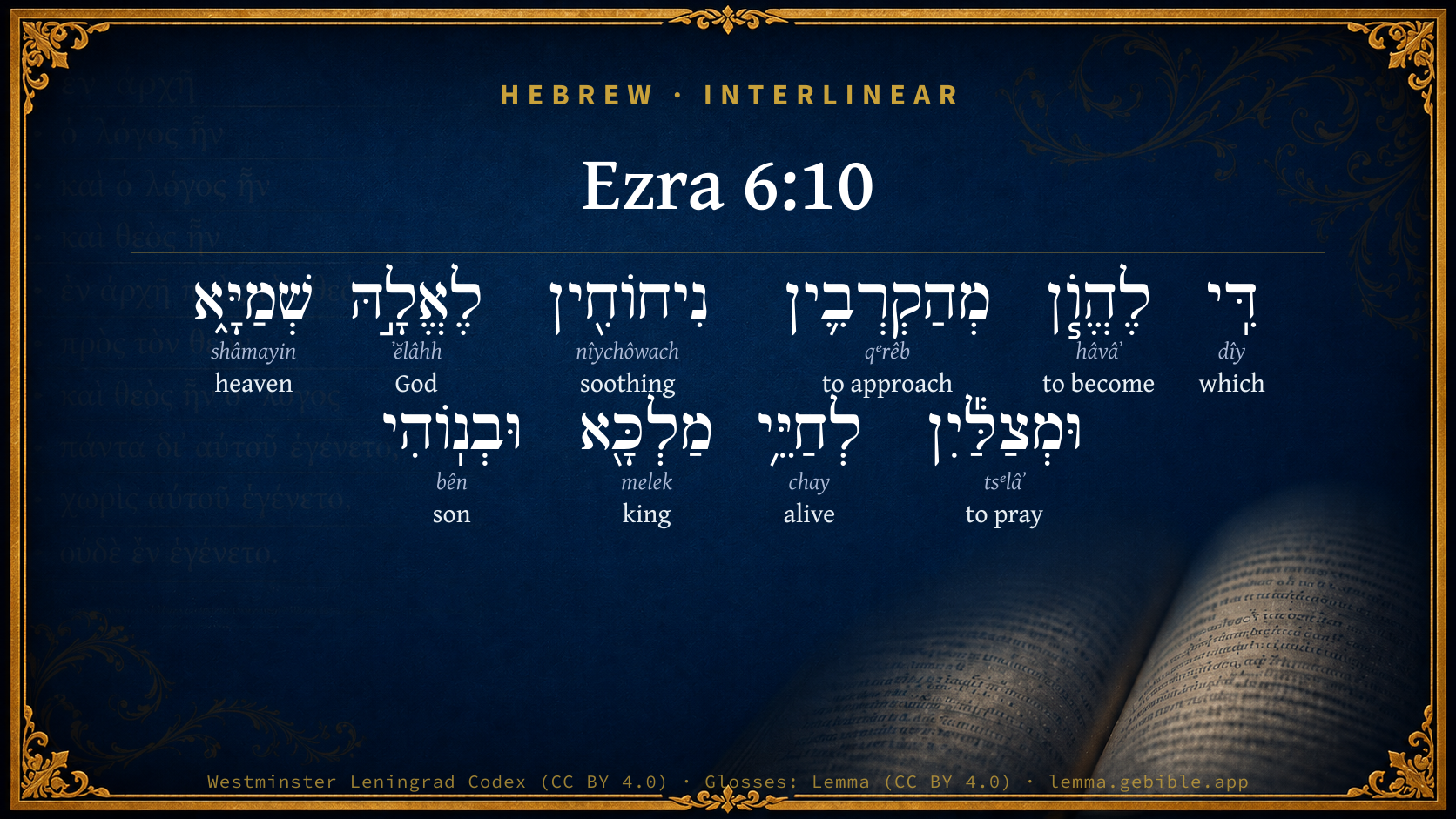
Hebrew (Westminster Leningrad Codex) Ezra 6:10 appears in the Hebrew Old Testament. The text above is from the Westminster Leningrad Codex. Each word links to its Strong’s number, a concise gloss, and parsing drawn from the Open Scriptures Hebrew Bible morphology. Click any word for its full Brown-Driver-Briggs (BDB) entry.
Download image
Cite this verse

Ezra 6:10 (World English Bible). Public Domain. Lemma interlinear Bible study tool, https://lemma.gebible.app/v/ezra/6/10.

Show BibTeX & RIS
BibTeX
RIS
English Translation
that they may offer sacrifices of sweet savor to the God of heaven, and pray for the life of the king, and of his sons.
World English Bible · Public Domain
Highlights
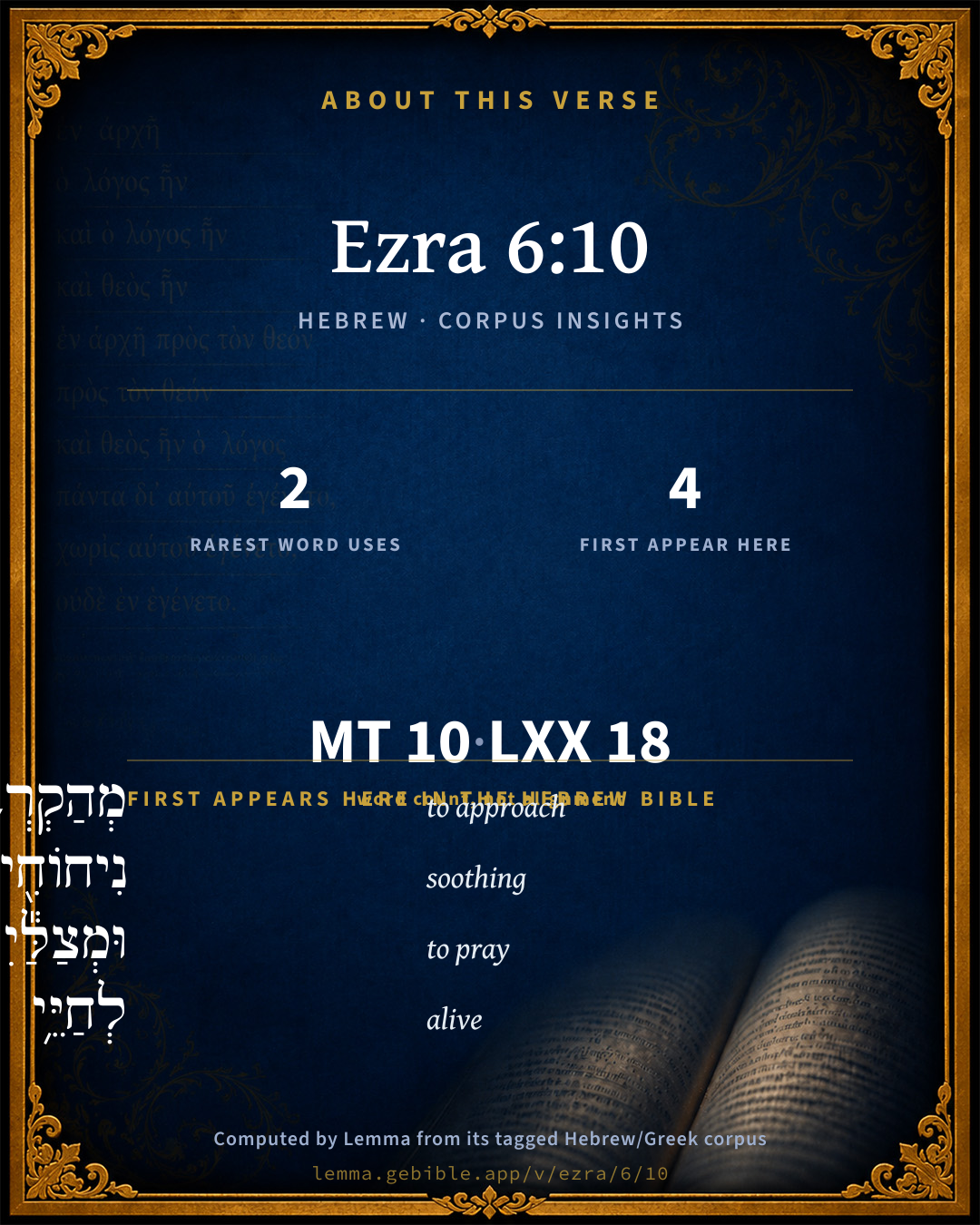
  • 4 first appearances in the Hebrew Bible
Full analysis ↓
Download a study sheet

One document with this verse’s original text, its word-by-word gloss line, the meaning frame, cross-references with their text, attributed commentary, and full source and license credits — printable, and it pastes into notes with its structure intact.

This verse Autodidact and up

Study sheet (.html) Plain text (.txt)

A passage Seminary Student

Up to 50 verses in one chapter. A passage sheet keeps up to 6 commentary sources and 12 cross-references per verse, in the order this page ranks them, and says so on the sheet whenever that leaves anything out. Ask for a single verse and you get the Autodidact verse sheet above.

Everything on this page stays free to read, with no account — the sheet is a download of what is already on screen, not access to it.

Want to remove ads? Support Godless Engineer
Compare translations 3

The same verse in 3 English versions, stacked beneath the original-language interlinear above. Click any original word for its lexicon entry.

Each is an independent rendering of the whole verse — the interlinear is not word-aligned to these translations.

Highlighted words mark where these versions differ — a whole-verse word diff, not a word-by-word alignment.

  • World English Bible Public Domain
    that they may offer sacrifices of sweet savor to the God of heaven, and pray for the life of the king, and of his sons.
  • King James Version Public Domain
    That they may offer sacrifices of sweet savours unto the God of heaven, and pray for the life of the king, and of his sons.
  • unfoldingWord Literal Text CC BY-SA 4.0
    so that they may be offering sweet-smelling sacrifices to the God of heaven and praying for the life of the king and his sons.

unfoldingWord Literal Text — © unfoldingWord, licensed CC BY-SA 4.0. Word-aligned USFM3 via Door43 (git.door43.org/unfoldingWord/en_ult).

Versions to compare (up to 4)

3 of 4 selected

Show all 18 translations

Every available English version of this verse, each an independent rendering of the whole verse.

  • World English Bible Public Domain
    that they may offer sacrifices of sweet savor to the God of heaven, and pray for the life of the king, and of his sons.
  • Berean Standard Bible Public Domain
    Then they will be able to offer sacrifices of a sweet aroma to the God of heaven and to pray for the lives of the king and his sons.
  • Majority Standard Bible Public Domain
    Then they will be able to offer sacrifices of a sweet aroma to the God of heaven and to pray for the lives of the king and his sons.
  • King James Version Public Domain
    That they may offer sacrifices of sweet savours unto the God of heaven, and pray for the life of the king, and of his sons.
  • American Standard Version (1901) Public Domain
    that they may offer sacrifices of sweet savor unto the God of heaven, and pray for the life of the king, and of his sons.
  • Revised Version (1885) Public Domain
    that they may offer sacrifices of sweet savour unto the God of heaven, and pray for the life of the king, and of his sons.
  • Geneva Bible (1599) Public Domain
    That they may haue to offer sweete odours vnto the God of heauen, and praye for the Kings life, and for his sonnes.
  • Douay-Rheims (1899) Public Domain
    And let them offer oblations to the God of heaven, and pray for the life of the king, and of his children.
  • Young's Literal Translation Public Domain
    that they be bringing near sweet savours to the God of heaven, and praying for the life of the king, and of his sons.
  • Literal Standard Version CC BY-SA 4.0
    that they are bringing sweet savors near to the God of the heavens, and praying for the life of the king, and of his sons.
  • Unlocked Literal Bible CC BY-SA 4.0
    Do this so they will bring the offering in to the God of Heaven and pray for me, the king, and my sons.
  • unfoldingWord Literal Text CC BY-SA 4.0
    so that they may be offering sweet-smelling sacrifices to the God of heaven and praying for the life of the king and his sons.
  • Darby Bible Public Domain
    that they may present sweet odours to the God of the heavens, and pray for the life of the king and of his sons.
  • World Messianic Bible Public Domain
    that they may offer sacrifices of pleasant aroma to the God of heaven, and pray for the life of the king and of his sons.
  • Webster's Bible Public Domain
    That they may offer sacrifices of sweet savors to the God of heaven, and pray for the life of the king, and of his sons.
  • Free Bible Version CC BY-SA 4.0
    In this way they can offer sacrifices that are acceptable to the God of heaven, and pray for the lives of the king and his sons.
  • Bible in Basic English Public Domain
    So that they may make offerings of a sweet smell to the God of heaven, with prayers for the life of the king and of his sons.
  • JPS Tanakh (1917) Public Domain
    that they may offer sacrifices of sweet savour unto the God of heaven, and pray for the life of the king, and of his sons.

Literal Standard Version (2020), Covenant Press — licensed CC BY-SA 4.0. Text via the HelloAO Bible API (eBible.org). Unlocked Literal Bible (unfoldingWord) — licensed CC BY-SA 4.0. Text via the HelloAO Bible API (eBible.org). unfoldingWord Literal Text — © unfoldingWord, licensed CC BY-SA 4.0. Word-aligned USFM3 via Door43 (git.door43.org/unfoldingWord/en_ult). Free Bible Version, Dr. Jonathan Gallagher — licensed CC BY-SA 4.0. Text via the HelloAO Bible API (eBible.org).

Word by word

More ways to search: Search by grammar → Find every occurrence → Compare this word →

Practice this passage: Drill this verse → Learn its vocabulary →

About this verse

These counts appear in no published source. They are computed here, from the morphology-tagged text and Lemma’s own curated glosses. What Lemma adds →

10
words
10
distinct lemmas
Historical
section

Notable vocabulary

The rarest word here is נִיחוֹחִ֖ין soothing H5208 — appearing just 2 times in the whole Hebrew Bible.

First appearance in Scripture

These words make their first canonical appearance in the Hebrew Bible here:

  • מְהַקְרְבִ֛ין to approach H7127
  • נִיחוֹחִ֖ין soothing H5208
  • וּמְצַלַּ֕יִן to pray H6739
  • לְחַיֵּ֥י alive H2417

Shared distinctive vocabulary

נִיחוֹחִ֖ין soothing H5208 occurs in 2 verses of the Hebrew Bible. Also found in:

Grammatical profile

  • 1 verb
  • 3 nouns
  • 4 adjectives
  • 2 particles

Verb forms

  • וּמְצַלַּ֕יִן Piel · Participle Active

Hebrew & Septuagint length

In English translation the verse runs 25 words from the Hebrew and 25 from the Septuagint (LXX English) — the same length.

A rough comparison of the two English renderings, which tokenize alike — not a word-level alignment.

Word counts can differ between the Hebrew and the Greek without any difference in meaning — e.g. the Hebrew direct-object marker אֵת has no separate Greek word, and Greek often adds the article ὁ.

In the original languages it is 10 Hebrew tokens and 18 Greek tokens — but the two are counted differently (Hebrew bundles its prefixes and suffixes into one token; the Greek is in lemma form), so that isn’t a like-for-like length.

Cross-references

7

Topical passages linked to Ezra 6:10 in the Treasury of Scripture Knowledge — connected by theme and wording, ordered by reader-vote popularity; previews shown in the World English Bible.

  • Ezra 7:23 Whatever is commanded by the God of heaven, let it be done exactly for the house of the God of heaven; for why should there be wrath against the realm of the king and his sons?
  • Jeremiah 29:7 Seek the peace of the city where I have caused you to be carried away captive, and pray to Yahweh for it; for in the peace of it shall you have peace.
  • 1 Timothy 2:1–2 I exhort therefore, first of all, that petitions, prayers, intercessions, and givings of thanks, be made for all men:
  • Genesis 8:21 Yahweh smelled the sweet savor. Yahweh said in his heart, "I will not again curse the ground any more for man's sake, because the imagination of man's heart is evil from his youth; neither will I ever again strike everything living, as I have done.
  • Ephesians 5:2 Walk in love, even as Christ also loved you, and gave himself up for us, an offering and a sacrifice to God for a sweet-smelling fragrance.
  • Leviticus 1:9 but its innards and its legs he shall wash with water. The priest shall burn the whole on the altar, for a burnt offering, an offering made by fire, of a sweet savor to Yahweh.
  • Leviticus 1:13 but the innards and the legs he shall wash with water. The priest shall offer the whole, and burn it on the altar. It is a burnt offering, an offering made by fire, of a sweet savor to Yahweh.

Cross-references courtesy of OpenBible.info (CC BY 4.0).

Hebrew and Greek witnesses Masoretic Hebrew ↔ Greek Septuagint

The same verse in the two great witnesses to the Old Testament, shown verse-for-verse.

These are two independent witnesses, not word-aligned to each other, and the Septuagint is shown in lemma (dictionary) form.

Hebrew Ezra 6:10 Masoretic · Westminster Leningrad Codex

דִּֽי לֶהֱוֺ֧ן מְהַקְרְבִ֛ין נִיחוֹחִ֖ין לֶאֱלָ֣הּ שְׁמַיָּ֑א וּמְצַלַּ֕יִן לְחַיֵּ֥י מַלְכָּ֖א וּבְנֽוֹהִי

that they may offer sacrifices of sweet savor to the God of heaven, and pray for the life of the king, and of his sons.

World English Bible · Public Domain

Greek LXX Ezra 6:10 Septuagint · lemma form

ἵνα εἰμί προςφέρω εὐωδία ὁ θεός ὁ οὐρανός καί προςεὔχομαι εἰς ζωή ὁ βασιλεύς καί ὁ υἱός αὐτός

that they may offer sweet savours to the God of heaven, and that they may pray for the life of the king and his sons.

LXX2012 (modern English Septuagint) · Public Domain

In the Septuagint this is one book — Esdras B (2 Esdras): Ezra is chapters 1–10, Nehemiah 11–23.

On this verse, The Cambridge Bible for Schools and Colleges discusses the Septuagint’s reading. Read the note in Commentary ↓

Hebrew: Westminster Leningrad Codex (CC BY 4.0). Greek: Septuagint (public domain); English from LXX2012 (modern English Septuagint) (Public Domain). How the Septuagint differs from the Hebrew →

Commentary

Notes on Ezra 6:10 from classic Christian and Jewish commentators (each source and its license shown beneath its notes). The classic Christian expositions comment on the surrounding passage and are grouped to its opening verse, so a note may address several verses; the Jewish commentaries on the Tanakh (Rashi and others) are per-verse, so they appear only where the commentator wrote on this verse.

Lemma curates 59 commentaries, every one of them public domain or Creative Commons licensed, each selected and text-cleaned for this edition rather than reprinted as found. About our sources →

Trapp's Complete Commentary

John Trapp

Ezr 6:10 That they may offer sacrifices of sweet savours unto the God of heaven, and pray for the life of the king, and of his sons.

Ver. 10. That they may pray for the life of the king] For God, at his pleasure, cutteth off the spirits of princes, Psa 76:12, he crops them off with ease, as one would do a flower; slips them off, as one would do a bunch of grapes; as he dealt by Alexander the Great, Attila, that terror of the world, and King Henry II of France, who upon the marriage of his sister to the king of Spain, was so puffed up, that he called himself by a new title, Tres-heureuse Roy, the thrice happy king. But, to confute him, in solemnizing that marriage, he was slain at tilt, by the captain of his guard (though against his will, but not without God’s determinate counsel), in the very beginning of his supposed happiness. Death is the only king against whom there is no rising up. The mortal scythe is master of the royal sceptre, saith one, and it moweth down the lilies of the crown as well as the grass of the field; pray, therefore, for the life of the king, saith this king here; let the priests shout and say, Let the king live for ever, Neh 2:3.

And of his sons] Some of whom had soon died, say some: he therefore calleth for prayers for the preservation of the rest.

John Trapp, A Commentary or Exposition upon All the Books of the Old and New Testament (1647–1656) — public domain. Text from a community e-Sword module.

Joseph Benson's Commentary

Ezr 6:10. And pray for the life of the king and his sons — Persuaded that he, whom he once and again reverently calls the God of heaven, was ready to hear and answer his people in all things for which they called upon him, he desires an interest in their prayers for himself and family, and in order that he might obtain it, was kind to them. For though the Jews were not allowed to desire the heathen to pray to their deities for them, because they were forbidden to acknowledge any other gods but one: yet the heathen might with reason ask the Jews to pray to Jehovah for them; because they acknowledged a plurality of gods, and allowed the God of Israel to be really a God, as well as those they themselves worshipped. And the Jews were not prohibited either by reason or revelation from addressing their prayers to God for the heathen, when they were desired by them so to do. What then are we to think of the spirit of those Christians, so called, who hold it unlawful to pray for those whom they denominate heretics, though they are not heathen, but worshippers of the same living and true God, whom they themselves profess to worship? Let them blush when they read this, to think how far the spirit of the Jewish religion excels theirs!

Joseph Benson's Commentary on the Old and New Testaments (1811–1818) — public domain. Text from a community e-Sword module.

Tyndale Open Study Notes

Tyndale Open Resources

6:10 pray for the welfare of the king and his sons: In the Cyrus Cylinder (a Persian account of Cyrus’s defeat of Babylon), King Cyrus requests, “May all the gods whom I have resettled in their sacred cities ask [the Babylonian gods] Bel and Nebo daily for a long life for me” (see 1:1-4).

Tyndale Open Study Notes — © Tyndale Open Resources, licensed CC BY-SA 4.0. Text via the HelloAO Bible API.

Adam Clarke's Commentary

Verse 10. And pray for the life of the king, and of his sons.] Even heathens believed that offerings made in their behalf to the God of the Jews would be available. And this principle has had considerable influence in certain states where there was even a form of religion established by the law, to induce them to tolerate other forms, that the state might have the benefit of their prayers.

Adam Clarke's Commentary on the Bible (1810–1826) — public domain. Text from a community e-Sword/MySword module.

Ellicott's Commentary for English Readers

(10) That they may offer sacrifices . . . and pray for the life of the king.—Two ends are to be answered: the God of heaven is to be honoured, and the dynasty of Darius interceded for by the Jews. (Comp. Jer_29:7.)

Of sweet savours.—The word occurs again only in Dan_2:46, and there is translated “sweet odours,” meaning incense. The connection of this with the prayer following justifies the same translation here, and, moreover, indicates under what good instruction the decree was drawn up.

A Bible Commentary for English Readers, edited by Charles John Ellicott (1878–1897) — public domain. Text from a community e-Sword module.

The Cambridge Bible for Schools and Colleges

gen. ed. J. J. S. Perowne

10. The king’s special desire, propitiatory sacrifice and intercessory prayer to be offered on behalf of his dynasty.

sacrifices of sweet savours] R.V. sacrifices of sweet savour. One word in the original; it occurs also in Dan_2:46 ‘Then the king Nebuchadnezzar … worshipped Daniel, and commanded that they should offer an oblation and sweet odours unto him’. The expression recalls the ‘burnt offering … of a sweet savour unto the Lord’ (Exo_29:18; Exo_29:25; Lev_1:9; Lev_1:13; Lev_1:17; Lev_2:2-3; Lev_2:9; Lev_2:12) which should be compared with Gen_8:21. This interpretation lays stress upon the acceptableness of the propitiatory offering. Others giving the word a more material sense consider it to mean especially the incense used in offerings (LXX. εὐωδίας; Vulg. oblationes).

pray for the life, &c.] Compare especially Jer_29:7 ‘and seek the peace of the city whither I have caused you to be carried away captive, and pray unto the Lord for it; for in the peace thereof shall ye have peace.’

Allusions to sacrifice and prayer for Gentile rulers will be found also in Bar_1:10-12, where Ezr_6:11 especially should be compared with this passage ‘And pray for the life of Nebuchodonosor king of Babylon, and for the life of Balthasar his son, that their days may be upon earth as the days of heaven’. See also 1Ma_7:33; 1Ma_12:11; 2Ma_3:35; 2Ma_13:23.

and of his sons] i.e. for the prosperity of Darius’s dynasty. We hear of two wives of Darius, Atossa, daughter of Cyrus, and Tarsys, daughter of Smerdis.

The Cambridge Bible for Schools and Colleges (gen. ed. J. J. S. Perowne; Cambridge University Press, 1878–1918) — public domain. Text from a community e-Sword module.

John Gill's Exposition

Also I have made a decree, that whosoever shall alter this word,.... Act contrary to this command, will not obey it, but as much as in him lies changes and revokes it:

let timber be pulled down from his house, and being set up, let him, be hanged thereon; that is, let a beam be taken from it, and a gallows or gibbet made of it, and hang him on it:

and let his house be made a dunghill for this; be pulled down, and never rebuilt more; see Gill on Dan 2:2; see Gill on Dan 2:9.

John Gill's Exposition of the Whole Bible (1746–1763) — public domain (CC PDM 1.0). Text via the HelloAO Bible API.

Whedon's Commentary on the Bible

Daniel D. Whedon

10. Offer sacrifices of sweet savours — Or, offer sweet odours.

The God of heaven — The same respectful and devout Monotheism appears in this letter of Darius as in the proclamation of Cyrus. See note on Ezr_1:2.

It is interesting to find this same Darius, in his great inscription at Behistun, declaring, “The temples which the Magian had destroyed I rebuilt. The sacred offices of the state, both the religious chants and the worship, I restored to the people which the Magian had deprived them of.” This, doubtless, refers to the state religion of the Persians, which Darius re-established in place of the Magianism which the usurper had sought to revive; but it shows how Darius, like Cyrus, would naturally have a sympathy for the religion of the Jews, and sustain the action of his great predecessor toward them.

Pray for the life of the king — The Persian monarch anticipates, by more than five centuries, the exhortations of an apostle of Christ. Comp. 1Ti_2:1-2.

Daniel D. Whedon (gen. ed.), Commentary on the Old and New Testaments (1874–1909) — public domain. Text from a community e-Sword module.

The Pulpit Commentary

That they may offer sacrifices of sweet savours. Either incense, as in Dan_2:46, or "sacrifices that are pleasing and acceptable". (see Gen_8:21; Num_28:2) And pray for the life of the king. The Jews have always maintained the practice of praying for the civil ruler of any country in which they have had their abode. Jeremiah s exhortation to "seek the peace" of Babylon (Num_29:7) was understood in this way, and the tradition has been handed down even to the present day. Under monarchs so favour-able to them as the Achaemenian Persians the duty would certainly not have been neglected. And of his sons. In Persia "the royal house" was the special object of regard. Individual kings must die, but the house would go on (see the speech of Artemisia to Xerxes in "Herod.," 8:102; and compare the references to the "gods of the royal house" in the Inscriptions). Kings took special care of their sons. Thus Cyrus sent Cambyses back to Persia when he was about to attack the Massagetae ("Herod.," 1:208), and Xerxes gave several of his sons into the charge of Artemisia, to convey them by ship to Asia, while he himself took the long and perilous journey by land (ibid. 8:103).

The Pulpit Commentary (1880–1919), ed. H.D.M. Spence-Jones & Joseph S. Exell — public domain. Text from a community e-Sword module.

Rashi

Rabbi Shlomo Yitzchaki (Rashi)

That they should in order that they should offer up pleasing sacrificing to the God of the heavens, and that they should pray for the life of the king and his children.

Rashi on the Tanakh — English translations: “The Judaica Press complete Tanach with Rashi, translated by A. J. Rosenberg” (CC BY 4.0); “Pentateuch with Rashi's commentary by M. Rosenbaum and A.M. Silbermann, 1929-1934” (public domain); “The Metsudah Tanach series, Lakewood, N.J” (CC BY 4.0); and “The Book of Joshua, Metsudah Publications, 1997” (CC BY 4.0). Text via Sefaria.

Lesson kit

Teaching starters — assembled from the data on this page, not authored interpretation. Every prompt links to the verse data it draws on. Edit before teaching.

Ezra, in the Historical, opens this verse with 10 words (10 distinct Hebrew lemmas). Its most distinctive word is nîychôwach (“soothing”). A historical commentator’s framing appears above. Read the whole chapter for the surrounding context.

Discussion questions

  1. How does “soothing” (nîychôwach) shape what this verse is saying?
  2. 4 words make their first appearance in Scripture here. What does this debut establish?
  3. How does Daniel 2:46, which shares the word «soothing», read alongside this verse?
  4. The translations on this page render this verse differently — a whole-verse word diff, not a word-by-word alignment. What might account for the different wordings?
  5. «וּמְצַלַּ֕יִן» is a Piel Participle Active verb. How does that grammatical form shape the action described?
  6. Compare how Trapp's Complete Commentary and Joseph Benson's Commentary read this verse. Where do they agree or differ?

Things to notice

Reading settings

Reading text

Shown beneath each verse's original-language words.

Old Testament
Old Testament edition

Read the OT as the Masoretic Hebrew (MT) or the Greek Septuagint (LXX).

English shown for the Greek Septuagint (in the Hebrew ↔ Greek comparison).

Comparing translations? Open the Compare panel on any verse page to stack up to four side by side.