
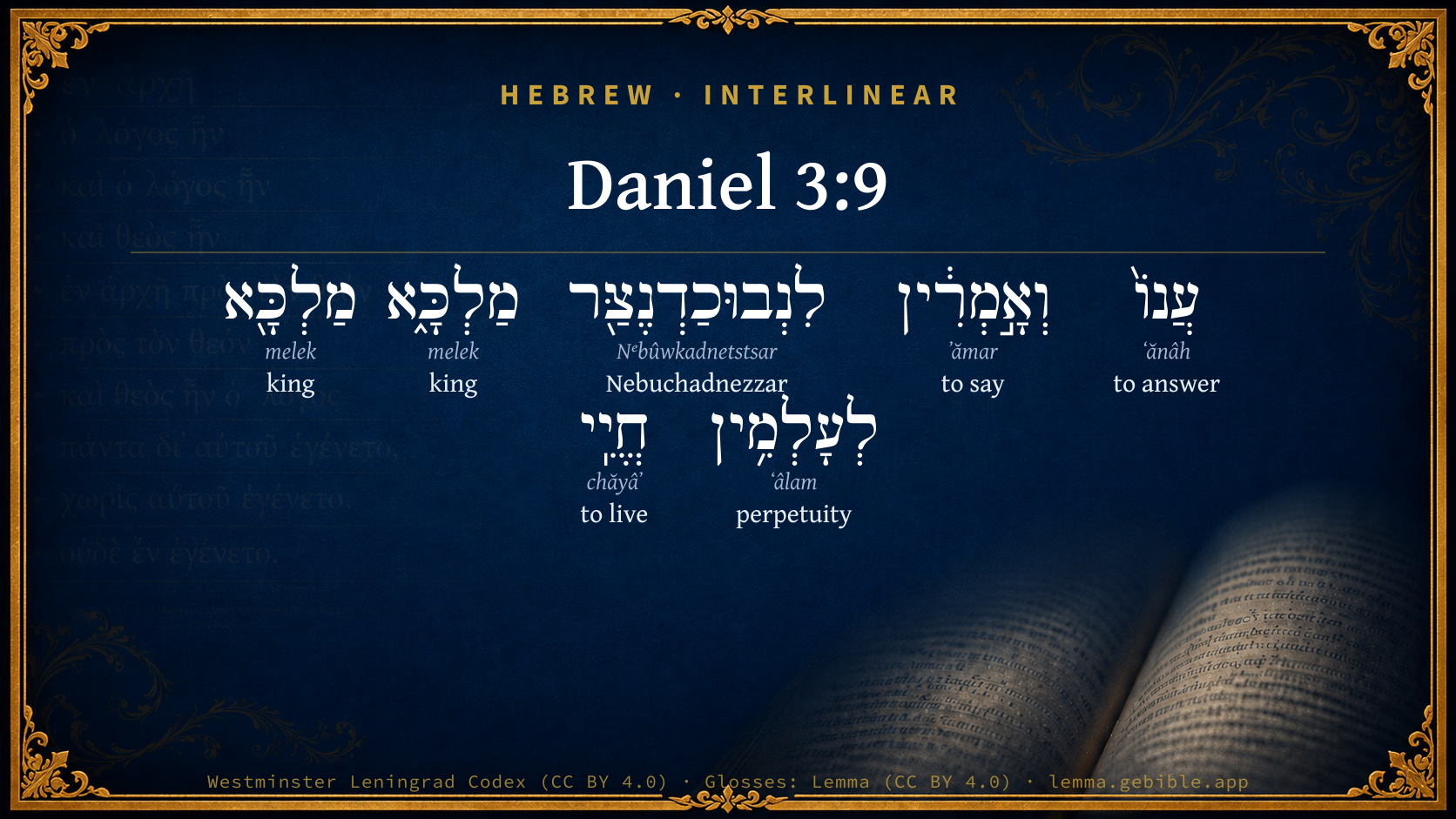
Daniel 3:9

Hebrew (Westminster Leningrad Codex) Daniel 3:9 appears in the Hebrew Old Testament. The text above is from the Westminster Leningrad Codex. Each word links to its Strong’s number, a concise gloss, and parsing drawn from the Open Scriptures Hebrew Bible morphology. Click any word for its full Brown-Driver-Briggs (BDB) entry.
Download image
Cite this verse

Daniel 3:9 (World English Bible). Public Domain. Lemma interlinear Bible study tool, https://lemma.gebible.app/v/daniel/3/9.

Show BibTeX & RIS
BibTeX
RIS
English Translation
They answered Nebuchadnezzar the king, O king, live for ever.
World English Bible · Public Domain
Download a study sheet

One document with this verse’s original text, its word-by-word gloss line, the meaning frame, cross-references with their text, attributed commentary, and full source and license credits — printable, and it pastes into notes with its structure intact.

This verse Autodidact and up

Study sheet (.html) Plain text (.txt)

A passage Seminary Student

Up to 50 verses in one chapter. A passage sheet keeps up to 6 commentary sources and 12 cross-references per verse, in the order this page ranks them, and says so on the sheet whenever that leaves anything out. Ask for a single verse and you get the Autodidact verse sheet above.

Everything on this page stays free to read, with no account — the sheet is a download of what is already on screen, not access to it.

Want to remove ads? Support Godless Engineer
Compare translations 3

The same verse in 3 English versions, stacked beneath the original-language interlinear above. Click any original word for its lexicon entry.

Each is an independent rendering of the whole verse — the interlinear is not word-aligned to these translations.

Highlighted words mark where these versions differ — a whole-verse word diff, not a word-by-word alignment.

  • World English Bible Public Domain
    They answered Nebuchadnezzar the king, O king, live for ever.
  • King James Version Public Domain
    They spake and said to the king Nebuchadnezzar, O king, live for ever.
  • unfoldingWord Literal Text CC BY-SA 4.0
    They responded and said to King Nebuchadnezzar, “O king, live forever!

unfoldingWord Literal Text — © unfoldingWord, licensed CC BY-SA 4.0. Word-aligned USFM3 via Door43 (git.door43.org/unfoldingWord/en_ult).

Versions to compare (up to 4)

3 of 4 selected

Show all 18 translations

Every available English version of this verse, each an independent rendering of the whole verse.

  • World English Bible Public Domain
    They answered Nebuchadnezzar the king, O king, live for ever.
  • Berean Standard Bible Public Domain
    saying to King Nebuchadnezzar, “O king, may you live forever!
  • Majority Standard Bible Public Domain
    saying to King Nebuchadnezzar, “O king, may you live forever!
  • King James Version Public Domain
    They spake and said to the king Nebuchadnezzar, O king, live for ever.
  • American Standard Version (1901) Public Domain
    They answered and said to Nebuchadnezzar the king, O king, live for ever.
  • Revised Version (1885) Public Domain
    They answered and said to Nebuchadnezzar the king, O king, live for ever.
  • Geneva Bible (1599) Public Domain
    For they spake and said to the King Nebuchad-nezzar, O King, liue for euer.
  • Douay-Rheims (1899) Public Domain
    And said to king Nabuchodonosor: O king, live for ever:
  • Young's Literal Translation Public Domain
    they have answered, yea, they are saying to Nebuchadnezzar the king, `O king, to the ages live!
  • Literal Standard Version CC BY-SA 4.0
    they have answered, indeed, they are saying to Nebuchadnezzar the king, “O king, live for all ages!
  • Unlocked Literal Bible CC BY-SA 4.0
    They said to Nebuchadnezzar the king, “King, live forever!
  • unfoldingWord Literal Text CC BY-SA 4.0
    They responded and said to King Nebuchadnezzar, “O king, live forever!
  • Darby Bible Public Domain
    They spoke and said to the king Nebuchadnezzar, O king, live for ever!
  • World Messianic Bible Public Domain
    They answered Nebuchadnezzar the king, “O king, live for ever!
  • Webster's Bible Public Domain
    They spoke and said to the king Nebuchadnezzar, O king, live for ever.
  • Free Bible Version CC BY-SA 4.0
    They said to King Nebuchadnezzar, “May Your Majesty the king live forever!
  • Bible in Basic English Public Domain
    They made answer and said to Nebuchadnezzar the king, O King, have life for ever.
  • JPS Tanakh (1917) Public Domain
    They spoke and said to Nebuchadnezzar the king: 'O king, live for ever!

Literal Standard Version (2020), Covenant Press — licensed CC BY-SA 4.0. Text via the HelloAO Bible API (eBible.org). Unlocked Literal Bible (unfoldingWord) — licensed CC BY-SA 4.0. Text via the HelloAO Bible API (eBible.org). unfoldingWord Literal Text — © unfoldingWord, licensed CC BY-SA 4.0. Word-aligned USFM3 via Door43 (git.door43.org/unfoldingWord/en_ult). Free Bible Version, Dr. Jonathan Gallagher — licensed CC BY-SA 4.0. Text via the HelloAO Bible API (eBible.org).

Word by word

More ways to search: Search by grammar → Find every occurrence → Compare this word →

Practice this passage: Drill this verse → Learn its vocabulary →

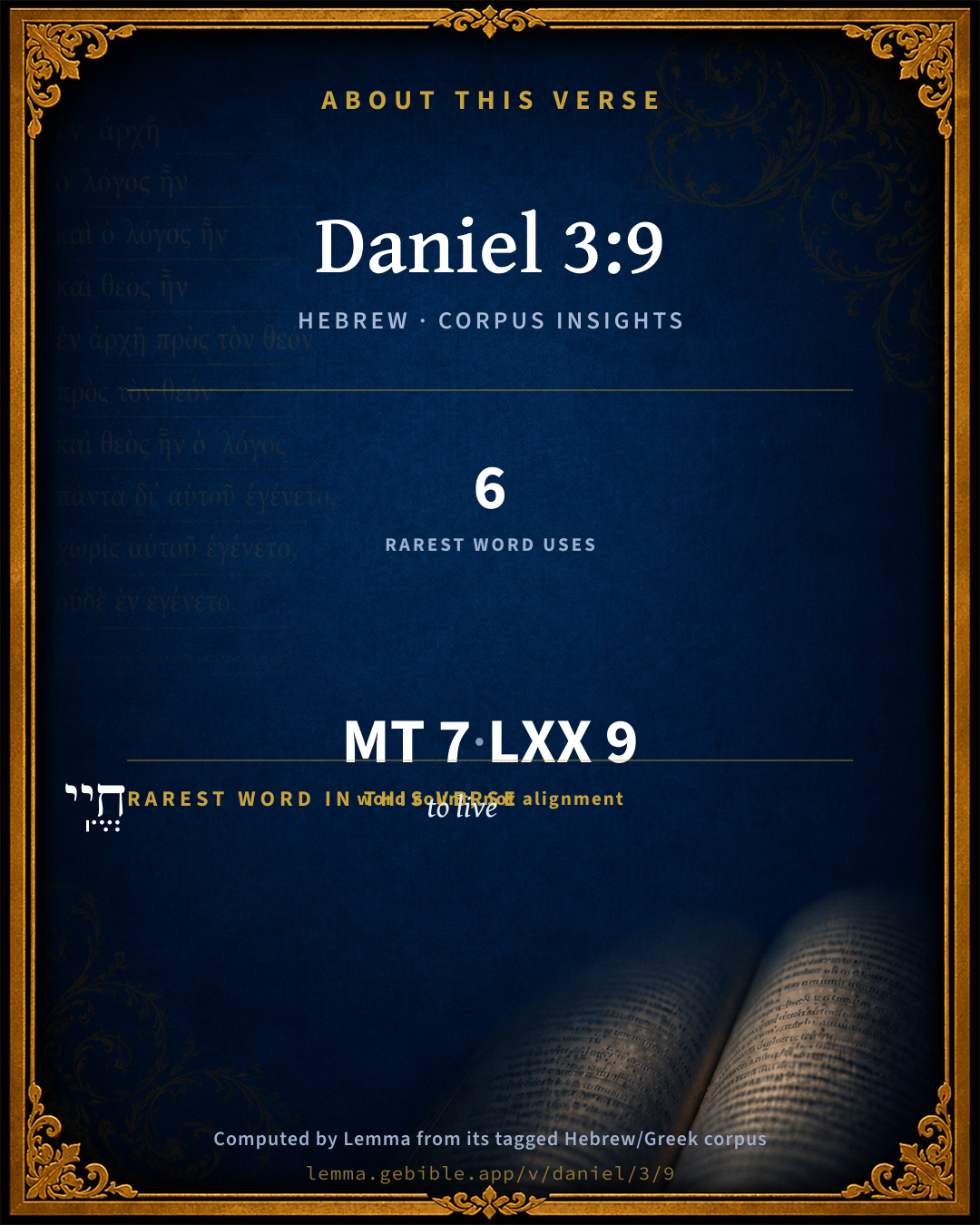
About this verse

These counts appear in no published source. They are computed here, from the morphology-tagged text and Lemma’s own curated glosses. What Lemma adds →

7
words
6
distinct lemmas
Prophets
section

Notable vocabulary

The rarest word here is חֱיִֽי to live H2418 — appearing just 6 times in the whole Hebrew Bible.

Shared distinctive vocabulary

חֱיִֽי to live H2418 occurs in 6 verses of the Hebrew Bible. Also found in:

Grammatical profile

  • 1 verb
  • 2 nouns
  • 2 adjectives
  • 2 particles

Verb forms

  • וְאָ֣מְרִ֔ין Qal · Participle Active

Repetition

A word recurs within this verse — often emphatic in Hebrew:

  • מַלְכָּ֑א king H4430 ×2

Hebrew & Septuagint length

In English translation the verse runs 10 words from the Hebrew and 5 from the Septuagint (LXX English) — the Septuagint runs noticeably shorter here. See the side-by-side →

A rough comparison of the two English renderings, which tokenize alike — not a word-level alignment.

Word counts can differ between the Hebrew and the Greek without any difference in meaning — e.g. the Hebrew direct-object marker אֵת has no separate Greek word, and Greek often adds the article ὁ.

In the original languages it is 7 Hebrew tokens and 9 Greek tokens — but the two are counted differently (Hebrew bundles its prefixes and suffixes into one token; the Greek is in lemma form), so that isn’t a like-for-like length.

Cross-references

6

Topical passages linked to Daniel 3:9 in the Treasury of Scripture Knowledge — connected by theme and wording, ordered by reader-vote popularity; previews shown in the World English Bible.

  • Daniel 5:10 [Now] the queen by reason of the words of the king and his lords came into the banquet house: the queen spoke and said, O king, live forever; don't let your thoughts trouble you, nor let your face be changed.
  • Daniel 6:6 Then these presidents and satraps assembled together to the king, and said thus to him, King Darius, live forever.
  • Daniel 2:4 Then spoke the Chaldeans to the king in the Syrian language, O king, live forever: tell your servants the dream, and we will show the interpretation.
  • Daniel 6:21 Then said Daniel to the king, O king, live forever.
  • Daniel 3:4–5 Then the herald cried aloud, To you it is commanded, peoples, nations, and languages,
  • Romans 13:7 Give therefore to everyone what you owe: taxes to whom taxes are due; customs to whom customs; respect to whom respect; honor to whom honor.

Cross-references courtesy of OpenBible.info (CC BY 4.0).

Hebrew and Greek witnesses Masoretic Hebrew ↔ Greek Septuagint

The same verse in the two great witnesses to the Old Testament, shown verse-for-verse.

Here the Septuagint runs noticeably shorter than the Hebrew — LXX2012 (modern English Septuagint) 5 words vs World English Bible 10. A rough length comparison of the two English translations, not a word-level alignment — read both below.

These are two independent witnesses, not word-aligned to each other, and the Septuagint is shown in lemma (dictionary) form.

Hebrew Daniel 3:9 Masoretic · Westminster Leningrad Codex

עֲנוֹ֙ וְאָ֣מְרִ֔ין לִנְבוּכַדְנֶצַּ֖ר מַלְכָּ֑א מַלְכָּ֖א לְעָלְמִ֥ין חֱיִֽי

They answered Nebuchadnezzar the king, O king, live for ever.

World English Bible · Public Domain

Greek LXX Daniel 3:9 Septuagint · lemma form

καί ὑπολαμβάνω εἶπον κύριος βασιλεύς εἰς ὁ αἰών ζάω

O king, live for ever.

LXX2012 (modern English Septuagint) · Public Domain

On this verse, The Pulpit Commentary discusses the Septuagint’s reading. Read the note in Commentary ↓

Hebrew: Westminster Leningrad Codex (CC BY 4.0). Greek: Septuagint (public domain); English from LXX2012 (modern English Septuagint) (Public Domain). How the Septuagint differs from the Hebrew →

Commentary

Notes on Daniel 3:9 from classic Christian and Jewish commentators (each source and its license shown beneath its notes). The classic Christian expositions comment on the surrounding passage and are grouped to its opening verse, so a note may address several verses; the Jewish commentaries on the Tanakh (Rashi and others) are per-verse, so they appear only where the commentator wrote on this verse.

Lemma curates 59 commentaries, every one of them public domain or Creative Commons licensed, each selected and text-cleaned for this edition rather than reprinted as found. About our sources →

Trapp's Complete Commentary

John Trapp

Dan 3:9 They spake and said to the king Nebuchadnezzar, O king, live for ever.

Ver. 9. They spake and said, … O king, live for ever.] Thus they insinuate themselves by flattery. So Act 24:2-3.

John Trapp, A Commentary or Exposition upon All the Books of the Old and New Testament (1647–1656) — public domain. Text from a community e-Sword module.

Ibn Ezra

Rabbi Abraham ibn Ezra

[Daniel 3:9] They spoke up (עֲנוֹ - ʿano): This is the customary practice (mishpat) for those speaking to the king: to offer a prayer that his days may be long (l'hitpallel she-ya'arichu yamav).

Ibn Ezra on the Tanakh — English translations: “Sefaria Community Translation” (CC0 1.0 (public-domain dedication)); “Yalkut, Sifsei Chachomim Chumash, Metsudah Publications, 2009” (CC BY 4.0); and “Commentary of Ibn Ezra on Isaiah - trans. by M. Friedlander, 1873” (public domain). Text via Sefaria.

Jamieson, Fausset & Brown

Robert Jamieson, A. R. Fausset & David Brown

live for ever--A preface of flattery is closely akin to the cruelty that follows. So Act 24:2-3, &c., Tertullus in accusing Paul before Felix.

Jamieson, Fausset & Brown — Commentary Critical and Explanatory on the Whole Bible (1871) — public domain (CC PDM 1.0). Text via the HelloAO Bible API.

The Cambridge Bible for Schools and Colleges

gen. ed. J. J. S. Perowne

9. spake] answered (R.V.): see on Dan_2:20.

the king Nebuchadnezzar] Nebuchadnezzar the king,—the regular order in Aramaic (Dan_3:1-2; Dan_3:5; Dan_3:7 &c.), and often in late Hebrew (as Hag_1:1; Hag_1:15; Neh_2:1; Neh_5:14). In early Hebrew the order is almost uniformly ‘the king David,’ ‘the king Solomon,’ &c.

O king, live for ever] Cf. on Dan_2:4.

The Cambridge Bible for Schools and Colleges (gen. ed. J. J. S. Perowne; Cambridge University Press, 1878–1918) — public domain. Text from a community e-Sword module.

John Gill's Exposition

They spake and said to Nebuchadnezzar,.... Having got access unto him, and within his hearing, they expressed themselves in the following manner:

O king, live for ever; this they said to show their fidelity and hearty attachment to him, and their regard to his welfare, and the continuance of his life; and the rather to ingratiate themselves into his affections, and gain audience of him; See Gill on Dan 2:4.

John Gill's Exposition of the Whole Bible (1746–1763) — public domain (CC PDM 1.0). Text via the HelloAO Bible API.

Albert Barnes' Notes on the Bible

O king, live for ever - A customary form of address to a monarch, implying that long life was regarded as an eminent blessing. See the notes at Dan 2:4.

Albert Barnes' Notes on the Bible (1834–1885) — public domain. Text from a community e-Sword/MySword module.

Whedon's Commentary on the Bible

Daniel D. Whedon

9. This was the regular form of address, found in hundreds of inscriptions.

Daniel D. Whedon (gen. ed.), Commentary on the Old and New Testaments (1874–1909) — public domain. Text from a community e-Sword module.

The Pulpit Commentary

Vers. 9-12. They spake and said to the King Nebuchadnezzar, O king, live for ever. Thou, O king, hast made a decree, that every man that shall hear the sound of the cornet, flute, harp, sackbut, psaltery, and dulcimer, and all kinds of music, shall fall down and worship the golden image: and whoso falleth not down and worshippeth, that he should be cast into the midst of a burning fiery furnace. There are certain Jews whom thou hast set over the affairs of the province of Babylon, Shadrach, Meshach, and Abed-nego; these men, O king, have not regarded thee; they serve not thy gods, nor worship the golden image which thou hast set up. The differences here between the Septuagint and the Massoretic are slight. Only, it may be observed, that in the repetition of the decree to the king, sumfwnia does not occur. Instead of saying, "they serve not thy gods," it renders, "thine idol they do not serve." Further, the word tdbi (abeedath), translated "business," is omitted, probably implying the omission in the original text of wOht; y. Theodotion"s Version is considerably briefer in regard to the ninth verse, as it omits "answered and said," and "Nebuchadnezzar;" otherwise it is in closer agreement with the Massoretic text, only it too omits sumfwnia. In the Peshitta we find a variation in the ninth verse; its rendering begins, "And they said to Nebuchadnezzar the king." As before mentioned, in the list of instruments pesanterin is omitted, and kinnor appears; otherwise the agreement is close with the Massoretic text. The Vulgate agrees with the Peshitta in its rendering of the ninth verse, but, unlike the Greek Version, inserts symphonia , and unlike the Peshitta, inserts psalterium. As to the Aramaic text, the most noticeable thing is the fact that in the K"thib, instead of aynpoMWs (sumphonia) there appears ay; npoysi (siphonia). The twelfth verse has this peculiarity in it, that it is the only case where tyA, the sign of the accusative, so frequent in the Targums, occurs in Biblical Aramaic. In the inscription on the Hadad Statue at Sindschirli, line 28, we have htw (v-th-h) as the sign of the acensative; as in the case before us, it serves for the oblique case of a pronoun. The adulatory address with which these Chaldeans begin is quite in accordance with Eastern usage. The point of the accusation against these three officials was that, being officials, they did not confirm by obedience the solemn decree of the monarch. Further, if this statue or obelisk were erected to Marduk (Merodach), whom Nebuchadnezzar specially worshipped, and whom he regarded as his special protector, the element of treason against the state might be implied in this refusal to give due obeisance to the tutelary god of the Babylonian Empire and its sovereign. The politics and warfare of that period proceeded on the assumption that the gods directly interfered in the affairs of the nations. Any slight done to the national god would as it was believed be avenged on the nation who had suffered it to pass unpunished. They summoned deities to leave cities they were besieging, and tried to persuade the inhabitants that even their god was on the side of the besieger. Thus Sennacherib (2Ki_19:22) asserts that Jehovah must be offended with Hezekiah. and Pharaoh-Necho claimed to Josiah that he went at God"s command to fight against Assyria. (2Ch_35:21) According to heathen notions generally, Chaldean and Babylonian included, some very slight inadvertence might vitiate a sacrifice, and change it from being a propitiation to the gods to an offence to them. If an inadvertence might thus be maleficent, much more direct disrespect such as that shown by these Jewish officials. But the accusers lay stress on another side of the matter. Nebuchadnezzar had set them over the affairs of the province of Babylon; but he had set up the golden image. There was thus an element of personal disrespect hinted at, made all the more heinous that the element of ingratitude was also present. But how is it that Daniel is not introduced into this narrative? Why was it that he was not attacked rather than his friends? It may be argued that this is another tradition, and that the union of Daniel with the three friends is due to that dovetailing of which so many traces are found or alleged to be found in the Pentateuch. But the editor who did the dovetailing in the present instance, did more than dovetail they are introduced at various points in the narrative of the preceding chapter. Why did he not complete his work, and explain why Daniel was absent? If it is a work of imagination, it is necessary to account for the absence of Daniel; even if it is the result of editorial labour, still the absence of Daniel has to be accounted for or explained away. This would press heavily on one writing in the days of the Maccabees. On one chronicling events as they occurred, this might easily be passed over, because at the time every one in Babylon would be perfectly aware why Daniel was not there. The absence of all reference to Daniel in this chapter is an indirect proof of the antiquity and genuineness of the book of which it forms part. The reasons for Daniel"s absence may easily be imagined. He might have been sent on official duty to a distant province of the empire, or, though this is not so likely, his presence at this festival might not be required A prosaic but possible solution of Daniel"s absence might be illness. If he were known to be incapacitated by sickness from taking part in any public function, the Chaldeans would not damage their case by referring to him.

The Pulpit Commentary (1880–1919), ed. H.D.M. Spence-Jones & Joseph S. Exell — public domain. Text from a community e-Sword module.

Rashi

Rabbi Shlomo Yitzchaki (Rashi)

They spoke up and said Aram. עֲנוֹ, they shouted. Every [expression of] עֲנִיָה in Scriptures is an expression of raising the voice.

Rashi on the Tanakh — English translations: “The Judaica Press complete Tanach with Rashi, translated by A. J. Rosenberg” (CC BY 4.0); “Pentateuch with Rashi's commentary by M. Rosenbaum and A.M. Silbermann, 1929-1934” (public domain); “The Metsudah Tanach series, Lakewood, N.J” (CC BY 4.0); and “The Book of Joshua, Metsudah Publications, 1997” (CC BY 4.0). Text via Sefaria.

Lesson kit

Teaching starters — assembled from the data on this page, not authored interpretation. Every prompt links to the verse data it draws on. Edit before teaching.

Daniel, in the Prophets, opens this verse with 7 words (6 distinct Hebrew lemmas). Its most distinctive word is chăyâʼ (“to live”). The Greek Septuagint runs shorter here. A historical commentator’s framing appears above. Read the whole chapter for the surrounding context.

Discussion questions

  1. What does “to live” (chăyâʼ) contribute to the verse as a whole?
  2. How does Daniel 2:4, which shares the word «to live», read alongside this verse?
  3. What does the repetition of “king” (2× in this one verse) do in this verse?
  4. The Septuagint runs shorter here than the Hebrew. What might account for the difference?
  5. These translations render this verse differently; the difference is in the English rendering, not the original. What questions does that raise?
  6. «וְאָ֣מְרִ֔ין» is a Qal Participle Active verb. How does that grammatical form shape the action described?
  7. Compare how Trapp's Complete Commentary and Ibn Ezra read this verse. Where do they agree or differ?

Things to notice

Reading settings

Reading text

Shown beneath each verse's original-language words.

Old Testament
Old Testament edition

Read the OT as the Masoretic Hebrew (MT) or the Greek Septuagint (LXX).

English shown for the Greek Septuagint (in the Hebrew ↔ Greek comparison).

Comparing translations? Open the Compare panel on any verse page to stack up to four side by side.