Daniel 6:18

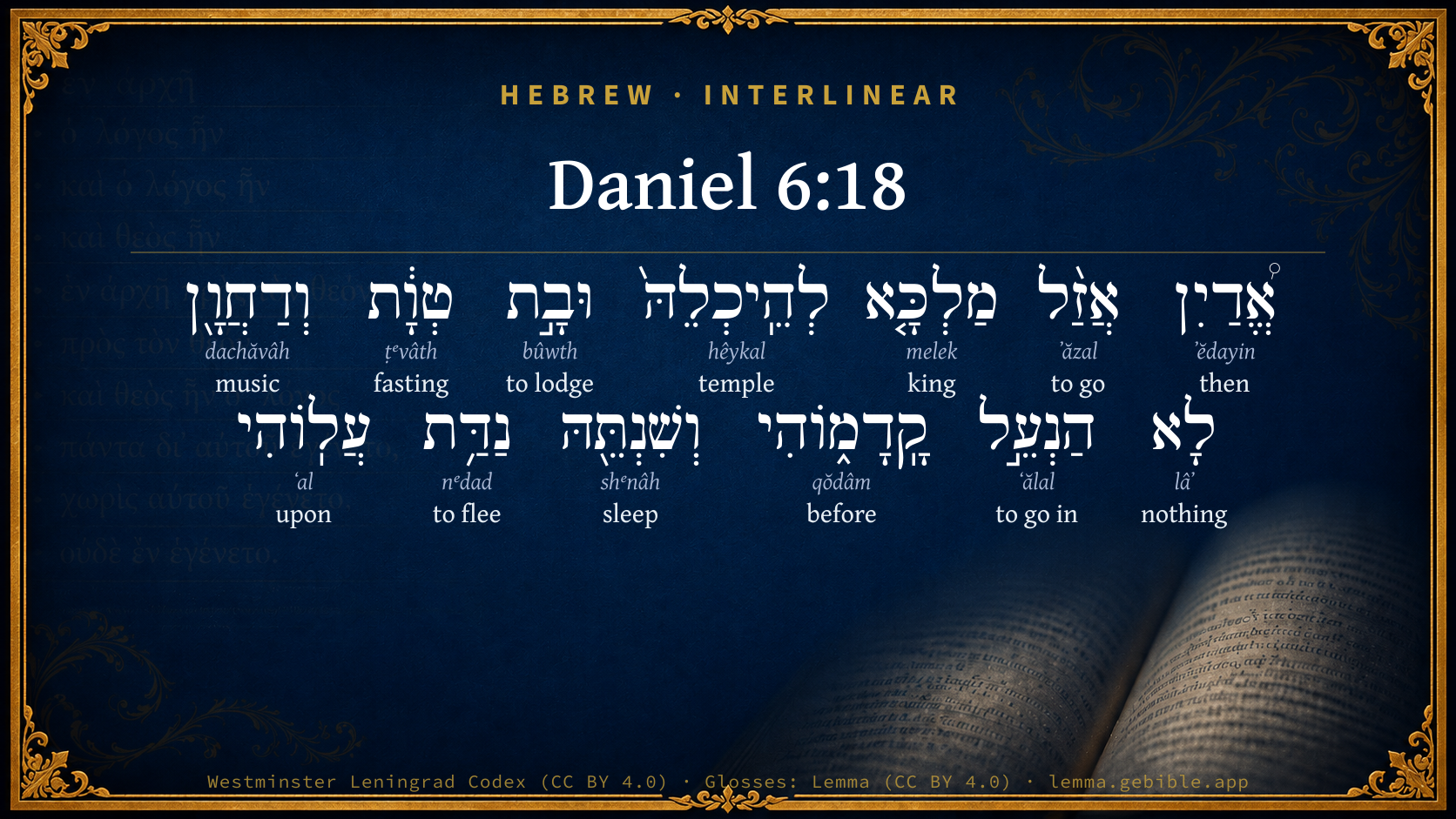
Hebrew (Westminster Leningrad Codex) Daniel 6:18 appears in the Hebrew Old Testament. The text above is from the Westminster Leningrad Codex. Each word links to its Strong’s number, a concise gloss, and parsing drawn from the Open Scriptures Hebrew Bible morphology. Click any word for its full Brown-Driver-Briggs (BDB) entry.
Download image
Cite this verse

Daniel 6:18 (World English Bible). Public Domain. Lemma interlinear Bible study tool, https://lemma.gebible.app/v/daniel/6/18.

Show BibTeX & RIS
BibTeX
RIS
English Translation
Then the king went to his palace, and passed the night fasting; neither were instruments of music brought before him: and his sleep fled from him.
World English Bible · Public Domain
Highlights
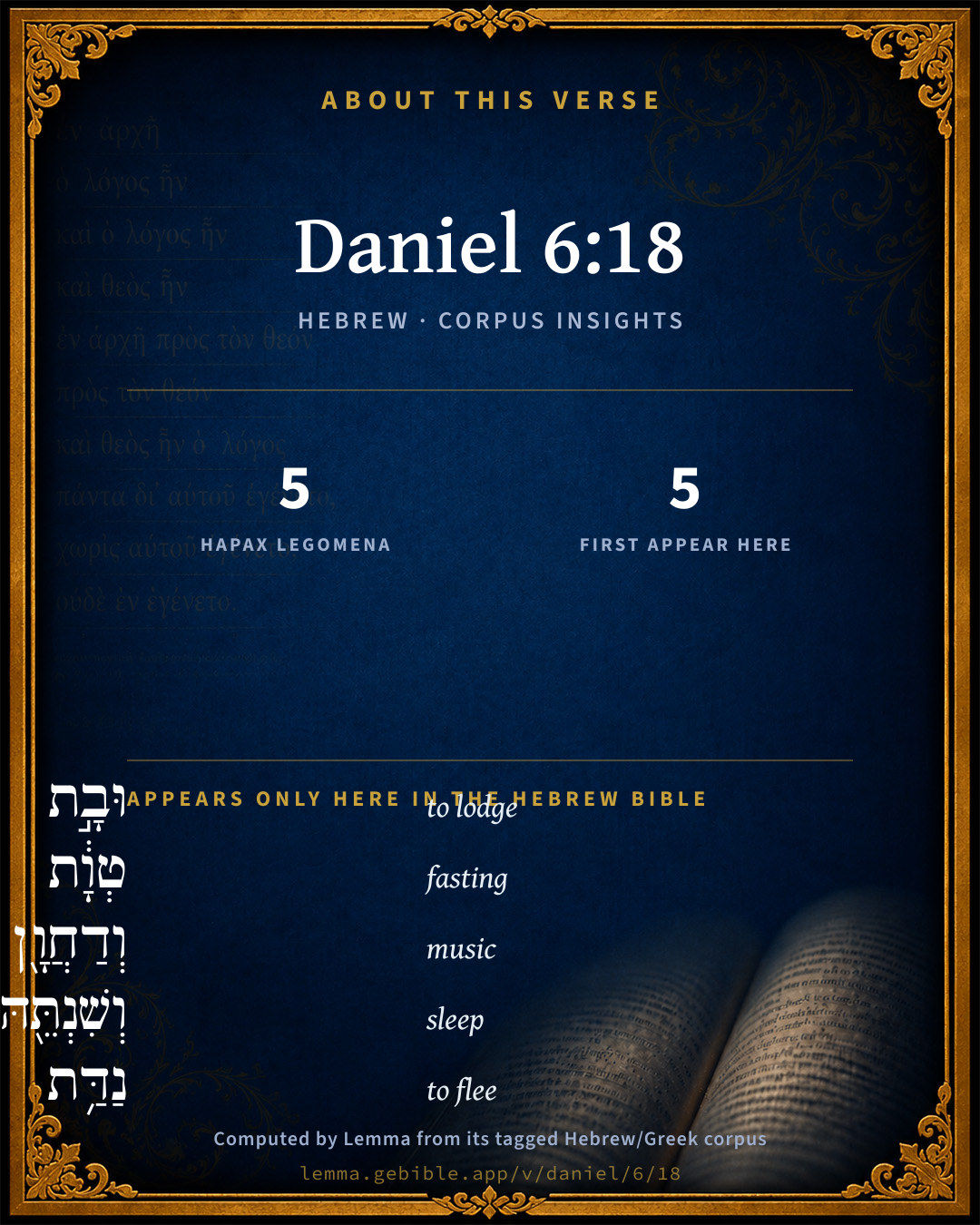
  • 5 hapax legomena — only here in the Hebrew Bible
  • 5 first appearances in the Hebrew Bible
Full analysis ↓
Download a study sheet

One document with this verse’s original text, its word-by-word gloss line, the meaning frame, cross-references with their text, attributed commentary, and full source and license credits — printable, and it pastes into notes with its structure intact.

This verse Autodidact and up

Study sheet (.html) Plain text (.txt)

A passage Seminary Student

Up to 50 verses in one chapter. A passage sheet keeps up to 6 commentary sources and 12 cross-references per verse, in the order this page ranks them, and says so on the sheet whenever that leaves anything out. Ask for a single verse and you get the Autodidact verse sheet above.

Everything on this page stays free to read, with no account — the sheet is a download of what is already on screen, not access to it.

Want to remove ads? Support Godless Engineer
Compare translations 3

The same verse in 3 English versions, stacked beneath the original-language interlinear above. Click any original word for its lexicon entry.

Each is an independent rendering of the whole verse — the interlinear is not word-aligned to these translations.

Highlighted words mark where these versions differ — a whole-verse word diff, not a word-by-word alignment.

  • World English Bible Public Domain
    Then the king went to his palace, and passed the night fasting; neither were instruments of music brought before him: and his sleep fled from him.
  • King James Version Public Domain
    Then the king went to his palace, and passed the night fasting: neither were instruments of musick brought before him: and his sleep went from him.
  • unfoldingWord Literal Text CC BY-SA 4.0
    Then the king went to his palace and spent the night fasting. No entertainment was brought before him, and his sleep fled from him.

unfoldingWord Literal Text — © unfoldingWord, licensed CC BY-SA 4.0. Word-aligned USFM3 via Door43 (git.door43.org/unfoldingWord/en_ult).

Versions to compare (up to 4)

3 of 4 selected

Show all 18 translations

Every available English version of this verse, each an independent rendering of the whole verse.

  • World English Bible Public Domain
    Then the king went to his palace, and passed the night fasting; neither were instruments of music brought before him: and his sleep fled from him.
  • Berean Standard Bible Public Domain
    Then the king went to his palace and spent the night fasting. No entertainment was brought before him, and sleep fled from him.
  • Majority Standard Bible Public Domain
    Then the king went to his palace and spent the night fasting. No entertainment was brought before him, and sleep fled from him.
  • King James Version Public Domain
    Then the king went to his palace, and passed the night fasting: neither were instruments of musick brought before him: and his sleep went from him.
  • American Standard Version (1901) Public Domain
    Then the king went to his palace, and passed the night fasting; neither were instruments of music brought before him: and his sleep fled from him.
  • Revised Version (1885) Public Domain
    Then the king went to his palace, and passed the night fasting: neither were instruments of music brought before him: and his sleep fled from him.
  • Geneva Bible (1599) Public Domain
    Then the King went vnto his palace, and remained fasting, neither were the instruments of musike brought before him, and his sleepe went from him.
  • Douay-Rheims (1899) Public Domain
    And the king went away to his house and laid himself down without taking supper, and meat was not set before him, and even sleep departed from him.
  • Young's Literal Translation Public Domain
    Then hath the king gone to his palace, and he hath passed the night fasting, and dahavan have not been brought up before him, and his sleep hath fled `from' off him.
  • Literal Standard Version CC BY-SA 4.0
    Then the king has gone to his palace, and he has passed the night fasting, and dahavan have not been brought up before him, and his sleep has fled [from] off him.
  • Unlocked Literal Bible CC BY-SA 4.0
    Then the king went to his palace and he went through the night fasting. No entertainment was brought before him, and sleep fled from him.
  • unfoldingWord Literal Text CC BY-SA 4.0
    Then the king went to his palace and spent the night fasting. No entertainment was brought before him, and his sleep fled from him.
  • Darby Bible Public Domain
    Then the king went to his palace, and passed the night fasting; neither were concubines brought before him; and his sleep fled from him.
  • World Messianic Bible Public Domain
    Then the king went to his palace, and passed the night fasting. No musical instruments were brought before him; and his sleep fled from him.
  • Webster's Bible Public Domain
    \\6:17\\And a stone was brought, and laid upon the mouth of the den; and the king sealed it with his own signet, and with the signet of his lords; that the purpose might not be changed concerning Daniel.
  • Free Bible Version CC BY-SA 4.0
    Then the king went back to his palace. He ate nothing at all that night and refused any kind of entertainment. He couldn't sleep a wink.
  • Bible in Basic English Public Domain
    Then they got a stone and put it over the mouth of the hole, and it was stamped with the king's stamp and with the stamp of the lords, so that the decision about Daniel might not be changed.
  • JPS Tanakh (1917) Public Domain
    (6-19) Then the king went to his palace, and passed the night fasting; neither were diversions brought before him; and his sleep fled from him.

Literal Standard Version (2020), Covenant Press — licensed CC BY-SA 4.0. Text via the HelloAO Bible API (eBible.org). Unlocked Literal Bible (unfoldingWord) — licensed CC BY-SA 4.0. Text via the HelloAO Bible API (eBible.org). unfoldingWord Literal Text — © unfoldingWord, licensed CC BY-SA 4.0. Word-aligned USFM3 via Door43 (git.door43.org/unfoldingWord/en_ult). Free Bible Version, Dr. Jonathan Gallagher — licensed CC BY-SA 4.0. Text via the HelloAO Bible API (eBible.org).

Word by word

More ways to search: Search by grammar → Find every occurrence → Compare this word →

Practice this passage: Drill this verse → Learn its vocabulary →

וּבָ֣ת
bûwth
H956
“and · to lodge”
Adjective, C + Verb, Qal, Perfect, 3rd Person, Masculine, Singular
Part of Speech
Adjective + Verb
Stem
Qal
Form
Perfect
Person
3rd Person
Gender
Masculine
Number
Singular
Full BDB Definition

Origin: apparent denominative from H1005

TWOT: 2629

(Peal) to pass the night, lodge
  1. אֱ֠דַיִן ʼĕdayin H116 “then” Adjective, D
  2. אֲזַ֨ל ʼăzal H236 “to go” Adjective, V, Plural
  3. מַלְכָּ֤א melek H4430 “king · the” Adjective, N, Common + Particle, Definite Article
  4. לְהֵֽיכְלֵהּ֙ hêykal H1965 “to/for · temple · his” Adjective, R + Noun, Common, Masculine, Singular, Construct + Suffix, Personal, 3rd Person, Masculine, Singular
  5. טְוָ֔ת ṭᵉvâth H2908 “fasting” Adjective, D
  6. וְדַחֲוָ֖ן dachăvâh H1761 “and · music” Adjective, C + Noun, Common, Feminine, Plural, Absolute
  7. לָא lâʼ H3809 “nothing” Adjective, T
  8. הַנְעֵ֣ל ʻălal H5954 “to go in” Adjective, V, Plural
  9. קָֽדָמ֑וֹהִי qŏdâm H6925 “before · him” Adjective, R + Suffix, Personal, 3rd Person, Masculine, Singular
  10. וְשִׁנְתֵּ֖הּ shᵉnâh H8139 “and · sleep · his” Adjective, C + Noun, Common, Feminine, Singular, Construct + Suffix, Personal, 3rd Person, Masculine, Singular
  11. נַדַּ֥ת nᵉdad H5075 “to flee” Adjective, V, Plural
  12. עֲלֽוֹהִי ʻal H5922 “upon · him” Adjective, R + Suffix, Personal, 3rd Person, Masculine, Singular

About this verse

These counts appear in no published source. They are computed here, from the morphology-tagged text and Lemma’s own curated glosses. What Lemma adds →

13
words
13
distinct lemmas
Prophets
section

Notable vocabulary

5 hapax legomena — words that appear only here in the entire Hebrew Bible:

  • וּבָ֣ת to lodge H956
  • טְוָ֔ת fasting H2908
  • וְדַחֲוָ֖ן music H1761
  • וְשִׁנְתֵּ֖הּ sleep H8139
  • נַדַּ֥ת to flee H5075

First appearance in Scripture

These words make their first canonical appearance in the Hebrew Bible here:

  • וּבָ֣ת to lodge H956
  • טְוָ֔ת fasting H2908
  • וְדַחֲוָ֖ן music H1761
  • וְשִׁנְתֵּ֖הּ sleep H8139
  • נַדַּ֥ת to flee H5075

Shared distinctive vocabulary

אֲזַ֨ל to go H236 occurs in 7 verses of the Hebrew Bible. Also found in:

Grammatical profile

  • 1 verb
  • 3 nouns
  • 8 adjectives
  • 1 particle

Verb forms

  • וּבָ֣ת Qal · Perfect

Hebrew & Septuagint length

In English translation the verse runs 26 words from the Hebrew and 36 from the Septuagint (LXX English) — closely comparable.

A rough comparison of the two English renderings, which tokenize alike — not a word-level alignment.

Word counts can differ between the Hebrew and the Greek without any difference in meaning — e.g. the Hebrew direct-object marker אֵת has no separate Greek word, and Greek often adds the article ὁ.

Cross-references

13

Topical passages linked to Daniel 6:18 in the Treasury of Scripture Knowledge — connected by theme and wording, ordered by reader-vote popularity; previews shown in the World English Bible.

  • Esther 6:1 On that night the king couldn't sleep; and he commanded to bring the book of records of the chronicles, and they were read before the king.
  • Daniel 2:1 In the second year of the reign of Nebuchadnezzar, Nebuchadnezzar dreamed dreams; and his spirit was troubled, and his sleep went from him.
  • 2 Samuel 12:16–17 David therefore begged God for the child; and David fasted, and went in, and lay all night on the earth.
  • Psalms 77:4 You hold my eyelids open. I am so troubled that I can't speak.
  • 2 Samuel 19:24 Mephibosheth the son of Saul came down to meet the king; and he had neither dressed his feet, nor trimmed his beard, nor washed his clothes, from the day the king departed until the day he came home in peace.
  • 1 Kings 21:27 It happened, when Ahab heard those words, that he tore his clothes, and put sackcloth on his flesh, and fasted, and lay in sackcloth, and went softly.
  • Job 21:12 They sing to the tambourine and harp, And rejoice at the sound of the pipe.
  • Psalms 137:2 On the willows in the midst of it, We hung up our harps.
  • Ecclesiastes 2:8 I also gathered silver and gold for myself, and the treasure of kings and of the provinces. I got myself men-singers and women-singers, and the delights of the sons of men--musical instruments, and that of all sorts.
  • Isaiah 24:8–9 The mirth of tambourines ceases, the noise of those who rejoice ends, the joy of the harp ceases.
  • Amos 6:4–6 Who lie on beds of ivory, And stretch themselves on their couches, And eat the lambs out of the flock, And the calves out of the midst of the stall;
  • Jonah 3:3–9 So Jonah arose, and went to Nineveh, according to the word of Yahweh. Now Nineveh was an exceedingly great city, three days' journey across.
  • Revelation 18:22 The voice of harpists, minstrels, flute players, and trumpeters will be heard no more at all in you. No craftsman, of whatever craft, will be found any more at all in you. The sound of a mill will be heard no more at all in you.

Cross-references courtesy of OpenBible.info (CC BY 4.0).

Hebrew and Greek witnesses Masoretic Hebrew ↔ Greek Septuagint

The same verse in the two great witnesses to the Old Testament, shown verse-for-verse.

These are two independent witnesses, not word-aligned to each other, and the Septuagint is shown in lemma (dictionary) form.

Hebrew Daniel 6:18 Masoretic · Westminster Leningrad Codex

אֱ֠דַיִן אֲזַ֨ל מַלְכָּ֤א לְהֵֽיכְלֵהּ֙ וּבָ֣ת טְוָ֔ת וְדַחֲוָ֖ן לָא הַנְעֵ֣ל קָֽדָמ֑וֹהִי וְשִׁנְתֵּ֖הּ נַדַּ֥ת עֲלֽוֹהִי

Then the king went to his palace, and passed the night fasting; neither were instruments of music brought before him: and his sleep fled from him.

World English Bible · Public Domain

Greek LXX Daniel 6:18 Septuagint · lemma form

τότε δανιηλ ῥίπτω εἰς ὁ λάκκος ὁ λέων καί φέρω λίθος καί τίθημι εἰς ὁ στόμα ὁ λάκκος καί σφραγίζω ὁ βασιλεύς ἐν ὁ δακτύλιος ἑαυτοῦ καί ἐν ὁ δακτύλιος ὁ μεγιστάν αὐτός ὅπως μή ἀπό αὐτός αἴρω ὁ δανιηλ ἤ ὁ βασιλεύς αὐτός ἀνασπάω ἐκ ὁ λάκκος

And the king departed to his house, and lay down fasting, and they brought him no food; and his sleep departed from him. But God shut the mouths of the lions, and they not molest Daniel.

LXX2012 (modern English Septuagint) · Public Domain

On this verse, Joseph Benson's Commentary discusses the Septuagint’s reading. Read the note in Commentary ↓

Hebrew: Westminster Leningrad Codex (CC BY 4.0). Greek: Septuagint (public domain); English from LXX2012 (modern English Septuagint) (Public Domain). How the Septuagint differs from the Hebrew →

Commentary

Notes on Daniel 6:18 from classic Christian and Jewish commentators (each source and its license shown beneath its notes). The classic Christian expositions comment on the surrounding passage and are grouped to its opening verse, so a note may address several verses; the Jewish commentaries on the Tanakh (Rashi and others) are per-verse, so they appear only where the commentator wrote on this verse.

Lemma curates 59 commentaries, every one of them public domain or Creative Commons licensed, each selected and text-cleaned for this edition rather than reprinted as found. About our sources →

Matthew Henry's Commentary

Here is, I. The melancholy night which the king had, upon Daniel's account, Dan 6:18. He had said, indeed, that God would deliver him out of the danger, but at the same time he could not forgive himself for throwing him into the danger; and justly might God deprive him of a friend whom he had himself used so barbarously. He went to his palace, vexed at himself for what he had done, and calling himself unwise and unjust for not adhering to the law of God and nature with a non obstante - a negative to the law of the Medes and Persians. He ate no supper, but passed the night fasting; his heart was already full of grief and fear. He forbade the music; nothing is more unpleasing that songs sung to a heavy heart. He went to bed, but got no sleep, was full of tossings to and fro till the dawning of the day. Note, the best way to have a good night is to keep a good conscience, then we may lie down in peace.

II. The solicitous enquiry he made concerning Daniel the next morning, Dan 6:19, Dan 6:20. He was up early, very early; for how could he lie in bed when he could not sleep for dreaming of Daniel, nor lie awake quietly for thinking of him? And he was no sooner up than he went in haste to the den of lions, for he could not satisfy himself to send a servant (that would not sufficiently testify his affection for Daniel), nor had he patience to stay so long as till a servant would return. When he comes to the den, not without some hopes that God had graciously undone what he had wickedly done, he cries, with a lamentable voice, as one full of concern and trouble, O Daniel! art thou alive? He longs to know, yet trembles to ask the question, fearing to be answered with the roaring of the lions after more prey: O Daniel! servant of the living God, has thy God whom thou servest made it to appear that he is able to deliver thee from the lions? If he rightly understood himself when he called him the living God, he could not doubt of his ability to keep Daniel alive, for he that has life in himself quickens whom he will; but has he thought fit in this case to exert his power? What he doubted of we are sure of, that the servants of the living God have a Master who is well able to protect them and bear them out in his service.

III. The joyful news he meets with - that Daniel is alive, is safe, and well, and unhurt in the lions' den, Dan 6:21, Dan 6:22. Daniel knew the king's voice, though it was now a lamentable voice, and spoke to him with all the deference and respect that were due to him: O king! live for ever. He does not reproach him for his unkindness to him, and his easiness in yielding to the malice of his persecutors; but, to show that he has heartily forgiven him, he meets him with his good wishes. Note, We should not upbraid those with the diskindnesses they have done us who, we know, did them with reluctance, and are very ready to upbraid themselves with them. The account Daniel gives the king is very pleasant; it is triumphant. 1. God has preserved his life by a miracle. Darius had called him Daniel's god (thy God whom thou servest), to which Daniel does as it were echo back, Yea, he is my God, whom I own, and who owns me, for he has sent his angel. The same bright and glorious being that was seen in the form of the Son of God with the three children in the fiery furnace had visited Daniel, and, it is likely, in a visible appearance had enlightened the dark den, and kept Daniel company all night, and had shut the lions' mouths, that they had not in the least hurt him. The angel's presence made even the lions' den his strong-hold, his palace, his paradise; he had never had a better night in his life. See the power of God over the fiercest creatures, and believe his power to restrain the roaring lion that goes about continually seeking to devour from hurting those that are his. See the care God takes of his faithful worshippers, especially when he calls them out to suffer for him. If he keeps their souls from sin, comforts their souls with his peace, and receives their souls to himself, he does in effect stop the lions' mouths, that they cannot hurt them. See how ready the angels are to minister for the good of God's people, for they own themselves their fellow servants. 2. God has therein pleaded his cause. He was represented to the king as disaffected to him and his government. We do not find that he said any thing in his own vindication, but left it to God to clear up his integrity as the light; and he did it effectually, by working a miracle for his preservation. Daniel, in what he had done, had not offended either God or the king: Before him whom I prayed to innocency was found in me. He pretends not to a meritorious excellence, but the testimony of his conscience concerning his sincerity is his comfort - As also that before thee, O king! I have done no hurt, nor designed thee any affront.

IV. The discharge of Daniel from his confinement. His prosecutors cannot but own that the law is satisfied, though they are not, or, if it be altered, it is by a power superior to that of the Medes and Persians; and therefore no cause can be shown why Daniel should not be fetched out of the den (Dan 6:23): The king was exceedingly glad to find him alive, and gave orders immediately that they should take him out of the den, as Jeremiah out of the dungeon; and, when they searched, no manner of hurt was found upon him; he was nowhere crushed nor scarred, but was kept perfectly well, because he believed in his God. Note, Those who boldly and cheerfully trust in God to protect them in the way of their duty shall never be made ashamed of their confidence in him, but shall always find him a present help.

V. The committing of his prosecutors to the same prison, or place of execution rather, Dan 6:24. Darius is animated by this miracle wrought for Daniel, and now begins to take courage and act like himself. Those that would not suffer him to show mercy to Daniel shall, now that God has done it for him, be made to feel his resentments; and he will do justice for God who had shown mercy for him. Daniel's accusers, now that his innocency is cleared, and Heaven itself has become his compurgator, have the same punishment inflicted upon them which they designed against him, according to the law of retaliation made against false accusers, Deu 19:18, Deu 19:19. Such they were to be reckoned now that Daniel was proved innocent; for, though the fact was true, yet it was not a fault. They were cast into the den of lions, which perhaps was a punishment newly invented by themselves; however, it was what they maliciously designed for Daniel. Nec lex est justior ulla qum necis artifices arte perire su - No law can be more just than that which adjudges the devisers of barbarity to perish by it, Psa 7:15, Psa 7:16; Psa 9:15, Psa 9:16. And now Solomon's observation is verified (Pro 11:8), The righteous is delivered out of trouble, and the wicked cometh in his stead. In this execution we may observe, 1. The king's severity, in ordering their wives and children to be thrown to the lions with them. How righteous are God's statutes above those of the nations! for God commanded that the children should not die for the fathers' crimes, Deu 24:16. Yet they were put to death in extraordinary cases, as those of Achan, and Saul, and Haman. 2. The lion's fierceness. They had the mastery of them immediately, and tore them to pieces before they came to the bottom of the den. This verified and magnified the miracle of their sparing Daniel; for hereby it appeared that it was not because they had not appetite, but because they had not leave. Mastiffs that are kept muzzled are the more fierce when the muzzle is taken off; so were these lions. And the Lord is known by those judgments which he executes.

Matthew Henry's Commentary on the Whole Bible (1708–1710) — public domain (CC PDM 1.0). Text via the HelloAO Bible API.

Trapp's Complete Commentary

John Trapp

Dan 6:18 Then the king went to his palace, and passed the night fasting: neither were instruments of musick brought before him: and his sleep went from him.

Ver. 18. Then the king went to his palace, and passed the night fasting.] As good reason he had, for the love and loss of such a counsellor, whom he had unwittingly betrayed, but wittingly condemned, and now he is self-condemned for so doing. His conscience was perplexed for his injustice, so that he careth neither for food nor music.

John Trapp, A Commentary or Exposition upon All the Books of the Old and New Testament (1647–1656) — public domain. Text from a community e-Sword module.

Joseph Benson's Commentary

Dan 6:18-20. Then the king went to his palace — Vexed at himself for what he had done, and calling himself unwise and unjust for not adhering to the laws of God and nature, notwithstanding the law of the Medes and Persians; and passed the night fasting — His heart was so full of grief and fear, that he could eat no supper, nor take any kind of refreshment. Neither were instruments of music brought before him — In which, amidst his present distress and trouble, he could take no pleasure. “No doubt Daniel spent a far more pleasant night among the lions, while employed in fervent prayer, and admiring, grateful praise, than either his malicious persecutors, or the king himself,” whose solicitude about Daniel made him very unhappy, and effectually prevented him from closing his eyes in sleep. The king arose very early in the morning — Full of anxiety about Daniel; and went in haste unto the lions’ den — Concerned to know whether the faint hope he entertained of his preservation had been realized. And when he came to the den — The LXX. render it, εν τω εγγιζειν αυτον τω λακκω, in his approaching the den, or, when he came near to the den, as Wintle renders it; he cried with a lamentable, or doleful, voice unto Daniel — Longing to know whether he was yet alive, and yet trembling to ask the question, lest he should be answered by the roaring of the lions after more prey; O Daniel, servant of the living God — Here Darius makes an acknowledgment, that the God whom Daniel served was the true and living God, not an imaginary and fictitious deity. Nebuchadnezzar made the same confession more than once; but neither of these kings had courage to renounce the worship of the false and fictitious deities of their country. Is thy God, whom thou servest continually, able to deliver thee, &c. — That is, has he been able to deliver thee, or has he thought fit in this case to exert his power? What he doubted of, we are sure of, that the servants of the living God have a master who is well able to deliver and protect them; and who will assuredly do both the one and the other, as far as he sees will be for their good and for his glory.

Joseph Benson's Commentary on the Old and New Testaments (1811–1818) — public domain. Text from a community e-Sword module.

Tyndale Open Study Notes

Tyndale Open Resources

6:18 The king spent the night fasting because he mourned over what he had done and hoped that Daniel’s God would rescue him. The king couldn’t sleep at all because he knew that Daniel was an innocent and noble man.

Tyndale Open Study Notes — © Tyndale Open Resources, licensed CC BY-SA 4.0. Text via the HelloAO Bible API.

Jamieson, Fausset & Brown

Robert Jamieson, A. R. Fausset & David Brown

neither were instruments of music, &c.--GESENIUS translates, "concubines." Daniel's mentioning to us as an extraordinary thing of Darius, that he neither approached his table nor his harem, agrees with XENOPHON'S picture of him as devoted to wine and women, vain, and without self-control. He is sorry for the evil which he himself had caused, yet takes no steps to remedy it. There are many such halters between good and bad, who are ill at ease in their sins, yet go forward in them, and are drawn on by others.

Jamieson, Fausset & Brown — Commentary Critical and Explanatory on the Whole Bible (1871) — public domain (CC PDM 1.0). Text via the HelloAO Bible API.

Adam Clarke's Commentary

Verse 18. Passed the night fasting] He neither ate nor drank, had no music to solace, nor sweet odours burnt or brought before him, and he passed the night without sleep. All this points out his great sincerity; and when it is considered that Darius could not be less than sixty-two or sixty-three years of age at this time, it shows more fully the depth of his concern.

Adam Clarke's Commentary on the Bible (1810–1826) — public domain. Text from a community e-Sword/MySword module.

John Calvin's Commentaries

Here Daniel relates the tardy repentance of the king, because although he was in the greatest grief, yet he did not correct his fault. And this occurs to many who are not hardened by contempt of God and their own depravity; they are drawn aside by others, and are dissatisfied with their own vices, while they still indulge in them. Would that the examples of this evil were rare in the world! but they occur everywhere before our eyes. Darius therefore is here proposed to us as intermediate between the ungodly and the wicked — the righteous and the holy. The wicked do not hesitate to stir up the Almighty against them, and after they have dismissed all fears and all shame, they revel in their own licentiousness. Those who are ruled by the fear of God, although they sustain hard contests with the flesh, yet impose a check upon themselves, and bridle their perverse affections. Others are between the two, as I have said, not yet obstinate in their malice, and not quite satisfied with their corruption’s, and still they follow them as if bound to them by ropes. Such was Darius; for he ought constantly to have repelled the calumny of his nobles; but when he saw himself so entangled by them, he ought to have opposed them manfully, and to have reproved them for so abusing their influence over him; yet he did not act thus, but rather bent before their fury. Meanwhile he bewails in his palace, and abstains from all food and delicacies. He thus shews his displeasure at the evil conduct at which he connived. We see then how ineffectual it is for our own conscience to smite us when we sin, and to cause us sorrow for our faults; we must go beyond this, so that sorrow may lead us on to repentance, as also Paul teaches us. (2 Corinthians 7:10.) Darius, then, had reduced himself to difficulties; while he bewails his fault, he does not attempt to correct it. This was, indeed, the beginning of repentance, but nothing more; and when he feels any compunction, this stirs him up and allows him neither peace nor comfort. This lesson, then, we are to learn from Daniel’s narrative of King Darius passing the whole of that night in wailing. It follows afterwards, —

John Calvin's Commentaries (1540-1563) — public domain. Text from the Calvin Translation Society English edition (1840s-50s) via the Christian Classics Ethereal Library (ccel.org). Calvin's coverage is partial (roughly two-thirds of the Bible); uncommented books and verses are honest gaps, never fabricated. The 19th-century editor's footnotes and remarks are omitted so the notes are faithfully Calvin's own voice.

Ellicott's Commentary for English Readers

(18) Instruments of musick.—A word of very doubtful meaning. The root whence it is derived means to rejoice, but what is signified cannot be exactly ascertained.

A Bible Commentary for English Readers, edited by Charles John Ellicott (1878–1897) — public domain. Text from a community e-Sword module.

The Cambridge Bible for Schools and Colleges

gen. ed. J. J. S. Perowne

18. instruments of musick] The meaning of the word thus rendered is unknown. The root in Aram. and Heb. means to thrust, overthrow (Psa_36:12; Psa_118:13). In Arab. it means further to spread, spread out, and is also used specially in the sense compressit feminam. The ancient translators and commentators conjectured a meaning suited to the context. Theod. (ἐδέσματα), Pesh., Jerome (cibi), render food; Rashi (12 cent.), a table (cf. A.V. marg.); Ibn Ezra, stringed instruments (supposing, improbably, to thrust to be used in the sense of to strike); Saad. (10 cent.), dancing-girls; many moderns (from the Arab. meaning of the root, mentioned above), concubines. But it is very doubtful whether it is legitimate to explain an Aram. word from a sense peculiar to Arabic, and there, moreover, only secondary and derived. By assuming a very small corruption in the text (דחון for לחנן), we should, however, obtain the ordinary Aram. word for concubines (Dan_5:2-3; Dan_5:23): so Marti, Prince. But whatever the true meaning, or reading, of the word may be, the general sense of the verse remains the same: the king did not indulge in his usual diversions.

fled (R.V.) from him] lit. fled upon him: in accordance with the idiom explained on Dan_2:1. For ‘fled’ cf. Gen_31:40; Est_6:1.

The Cambridge Bible for Schools and Colleges (gen. ed. J. J. S. Perowne; Cambridge University Press, 1878–1918) — public domain. Text from a community e-Sword module.

John Gill's Exposition

Then the king arose very early in the morning,.... Or, "in the morning with light" (i) as soon as ever light appeared, or the day broke: the word for morning is doubled, and one of the letters in it is larger than usual; and all which denote not only his very great earliness in rising, but his earnestness and solicitude for Daniel, to know whether he was alive or not:

and went in haste unto the den of lions; he did not send a servant, but went in person, and with as much expedition as possible, though a king, and an old man; this shows the great love and strong affection he had for Daniel, and his concern for his good and welfare.

(i) "summa aurora cum luce", Junius & Tremellius; "in tempore aurorae cum luce", Piscator.

John Gill's Exposition of the Whole Bible (1746–1763) — public domain (CC PDM 1.0). Text via the HelloAO Bible API.

Albert Barnes' Notes on the Bible

Then the king went to his palace, and passed the night fasting - Daniel was probably cast into the den soon after the going down of the sun, Dan 6:14. It was not unusual to have suppers then late at night, as it is now in many places. The great anxiety of the king, however, on account of what had occurred, prevented him from participating in the usual evening meal. As to the probability of what is here affirmed, no one can have any doubt who credits the previous statements. In the consciousness of wrong done to a worthy officer of the government; in the deep anxiety which he had to deliver him; in the excitement which must have existed against the cunning and wicked authors of the plot to deceive the king and to ruin Daniel; and in his solicitude and hope that after all Daniel might escape, there is a satisfactory reason for the facts stated that he had no desire for food; that instruments of music were not brought before him; and that he passed a sleepless night.

Neither were instruments of music brought before him - It was usual among the ancients to have music at their meals. This custom prevailed among the Greeks and Romans, and doubtless was common in the Oriental world. It should be observed, however, that there is considerable variety in the interpretation of the word here rendered instruments of music - דחון dachăvân. The margin is table. The Latin Vulgate, “He slept supperless, neither was food brought before him.” The Greek renders it “food,” ἐδέσματα edesmata. So the Syriac. Bertholdt and Gesenius render it concubines, and Saadias dancing girls. Any of these significations would be appropriate; but it is impossible to determine which is the most correct. The word does not occur elsewhere in the Scriptures.

Albert Barnes' Notes on the Bible (1834–1885) — public domain. Text from a community e-Sword/MySword module.

Haydock's Catholic Bible Commentary

Meat. Chaldee: "music," (Calmet) or "incense." (De Dieu.) --- He was tired of his godship, to which he had unguardedly opened his heart. (ver. 6) (Haydock)

George Leo Haydock (1774–1849), Haydock's Catholic Family Bible and Commentary, 1859 edition — public domain. Excludes Psalms (Douay-Rheims chapter numbering differs from Protestant) and Deuterocanonical books (Catholic canon only).

Matthew Poole's English Annotations

Passed the night fasting; yea, and without instruments of music and sleep. The king was in perplexity, he was under great conviction that he had done very dishonourably and cruelly, by hearkening to the counsel of his wicked courtiers; he should have rescinded his rash decree, and rated them for their barbarity against Daniel, and have overruled them, and let him out; he is convinced of all this, and grieves for it, but to little purpose. Many are displeased with themselves for their vices, yet are drawn away with them; and, upon a point of honour, or other carnal ground, never come to true repentance, which consists in a change of heart and life. Herod was like troubled for John Baptist, but for all that, for his oath’s sake to a wanton wretch, and for the company’s sake, he sent and beheaded him, Mat 14:9.

Matthew Poole's English Annotations on the Holy Bible (1683–1685) — public domain. Text from a community e-Sword/MySword module.

Whedon's Commentary on the Bible

Daniel D. Whedon

18. The great king spends a sleepless night in repentance for his hasty act. The “fasting,” which was a sign of sorrow and fear, would naturally be accompanied by prayers and probably sacrifices. (Compare Dan_10:3, and Jon_3:7.) There was no feasting in the palace and no “dancing girls” (R.V., margin) were allowed in his presence.

Daniel D. Whedon (gen. ed.), Commentary on the Old and New Testaments (1874–1909) — public domain. Text from a community e-Sword module.

The Pulpit Commentary

Then the king went to his palace. and passed the night fasting: neither were instruments of music brought before him: and his sleep went from him. In the Massoretic text one of the clauses, "Neither were instruments of music brought before him," has caused great difficulty. The word dahvan, translated "instruments of music," is rendered by Furst, "dancing-girl; "Gesenius, "concubine; "Rosenmuller renders, "odours." The Mediaeval Greek Version translates, "instruments of music." Furst speaks with favour of the Syriac rendering, "food-tables." Han"ayl, the aphel of eilal, has to be noted as a sign of antiquity. The version of the Septuagint is very wide from the Massoretic in the latter part of the verse, "Thus the king returned to his palace, and went to bed fasting, being grieved about Daniel." It is evident that the Septuagint translator had before him deheel instead of dohvan nun in the script of Egyptian Aramaic is very like lamed in the later mode writing, as also yodh and vav. It is possible that the name "Daniel" was read han"eel or, vies versa, as two of the letters are identical If we can accept the Septuagint reading, the difficulty of this mysterious dahoun disappears. Another clause is added here in the Septuagint from ver. 22 (23) Massoretic, though with variations. "Then the God of Daniel, taking thought for him (pronoian poioumenov aujtou) closed the mouths of the lions, that they did not hurt Daniel." This statement is not inserted in Daniel"s answer to the king in the Septuagint, as it is in the Massoretic text. It would almost seem that our present text in both cases is a condensation of a more extended document. This view receives support from the rendering of Theodotion, "And the king departed to his house, and went to bed supperless, and viands were not brought to him, and his sleep went from him, and God closed the mouths of the lions, and they did not hurt Daniel." It will be seen that the last clause here agrees with the concluding clause of the Septuagint. The mysterious word dahvan is rendered here "food" (ejdesmata) a version that is suspicious from the fact that it merely repeats, under another form, the statement that the king went to bed fasting. It is supported by the Peshitta and the Vulgate. This difference can scarcely be due to a various reading. Otherwise the Peshitta and the Vulgate agree with the Massoretic text. The king"s sorrow and humiliation could not be better pictured than it is here: even the feast of the palace had no pleasure for him, he was so grieved about Daniel. But we must also bear in mind that fasting had among the Jews, and, indeed, in the East generally, a relationship to prayer Est_4:16, where fasting takes the place of prayer; see also. (Dan_10:3) It means also repentance. (Jon_3:6-8) Darius, then, repented his hasty decree, and prayed for the deliverance of Daniel.

The Pulpit Commentary (1880–1919), ed. H.D.M. Spence-Jones & Joseph S. Exell — public domain. Text from a community e-Sword module.

Kretzmann's Popular Commentary

Paul E. Kretzmann

Daniel’s Remarkable Deliverance

v. 18. Then the king went to his palace and passed the night fasting, unable to sleep or eat for worry about the fate of Daniel; neither were instruments of music brought before him, rather, "neither were concubines brought to him"; and his sleep went from him, he was in genuine distress, decidedly ill at ease on account of the course into which he had been drawn.

v. 19. Then the king arose very early in the morning, with the dawn, as soon as it became light, and went in haste unto the den of lions, the royal zoological gardens being located conveniently near.

v. 20. And when he came to the den, he cried with a lamentable voice, which testified to the sorrow possessing his heart, unto Daniel; and the king spake and said to Daniel, O Daniel, servant of the living God, whom he was ready to acknowledge as such in accordance with Daniel’s confession, is thy God, whom thou servest continually, with constant, unflagging devotion, able to deliver thee from the lions?

v. 21. Then said Daniel unto the king, calmly answering the king from his position down in the pit, O king, live forever!

v. 22. My God hath sent His angel, who may even have been visible to the eye of Daniel, and hath shut the lions’ mouths that they have not hurt me, forasmuch as before Him innocency was found in me, God had declared him not guilty by preserving him so wonderfully; and also before thee, O king, have I done no hurt, that is, by transgressing the edict of the king he had not become guilty of rebellion against the person of the king, as the king’s personal interest in his case also demonstrated.

v. 23. Then was the king exceeding glad for him, on account of the miraculous deliverance which Daniel had experienced, and commanded that they should take Daniel up out of the den, through an opening which made it convenient for him to be removed. So Daniel was taken up out of the den, and no manner of hurt was found upon him, not so much as a scratch from the paw of one of the ravening beasts, because he believed in his God, and this firm confidence was rewarded by the Lord in this manner.

v. 24. And the king, who now realized that the enemies of Daniel had used him as their instrument in trying to vent their jealous spite, commanded, and they brought those men which had accused Daniel, and they cast them into the den of lions, them, their children, and their wives, according to the custom of the country, and since they were guilty of the same wickedness as the men; and the lions had the mastery of them, fell upon them and overwhelmed them, and brake all their bones in pieces or ever they came at the bottom of the den, they were reduced to a pulp before their bodies reached the bottom of the pit.

v. 25. Then King Darius, still under the influence of the miraculous deliverance which he had witnessed, wrote unto all people, nations, and languages that dwell in all the earth, in issuing a solemn proclamation, Peace be multiplied unto you.

v. 26. I make a decree, That in every dominion of my kingdom, as far as his kingly power extended, men tremble and fear, in reverent awe, before the God of Daniel; for He is the living God and steadfast forever, eternal and unchanging, and His kingdom that which shall not be destroyed, and His dominion shall be even unto the end, outlasting all earthly kingdoms.

v. 27. He delivereth and rescueth, literally, "He is a Deliverer and Rescuer," and He worketh signs and wonders in heaven and in earth, such as are outside the laws of nature, who hath delivered Daniel from the power of the lions, who would ordinarily have torn him to pieces in the twinkling of an eye.

v. 28. So this Daniel, the same one of whom the princes had spoken so contemptuously, prospered in the reign of Darius and in the reign of Cyrus, the Persian, for the Persian monarchy followed shortly after the Median. The miracles which the Lord performs in the interest of His children are intended to serve, among other things, for the unbelievers, so that they also may realize that the God of Israel, the God of the Christians, is the true, living God, the only Savior and Redeemer.

Paul E. Kretzmann, Popular Commentary of the Bible (1921–1924) — public domain. Text from a community e-Sword module.

Rashi

Rabbi Shlomo Yitzchaki (Rashi)

And a stone was brought lit. and one stone was brought. Throughout the entire land of Babylon there are no stones but bricks, as it is written: (Gen 11:3): “Let us make bricks.” We learn that there are no stones in Babylon, but for the occasion, angels brought it [a stone] from the land of Israel. If God stipulated with the Creation on the sea that it should split for the Children of Israel, and on the fire that it cool off for Hananiah and his colleagues, and on the lions that they should not hurt Daniel, He did not stipulate about casting stones or weapons that they should not hurt any man. So the king said, “From the lions I cannot take him away. I shall be careful with him that no man hurt him, and if the miracle comes, let it come.” This does not appear in some editions.

and placed on the mouth of the pit [as translated,] and placed on the mouth of the pit.

with his signet ring with his signet ring so that no one could move it from its place and cast stones upon him to kill him.

that his will about Daniel not be altered so that his will should not be changed; i.e., so that they should not harm him against his [the king’s] will.

Rashi on the Tanakh — English translations: “The Judaica Press complete Tanach with Rashi, translated by A. J. Rosenberg” (CC BY 4.0); “Pentateuch with Rashi's commentary by M. Rosenbaum and A.M. Silbermann, 1929-1934” (public domain); “The Metsudah Tanach series, Lakewood, N.J” (CC BY 4.0); and “The Book of Joshua, Metsudah Publications, 1997” (CC BY 4.0). Text via Sefaria.

Lesson kit

Teaching starters — assembled from the data on this page, not authored interpretation. Every prompt links to the verse data it draws on. Edit before teaching.

Daniel, in the Prophets, opens this verse with 13 words (13 distinct Hebrew lemmas). Its most distinctive word is bûwth (“to lodge”). A historical commentator’s framing appears above. Read the whole chapter for the surrounding context.

Discussion questions

  1. How does “to lodge” (bûwth) shape what this verse is saying?
  2. This verse holds 5 words here found nowhere else in the Hebrew Bible. What might the rare words draw attention to?
  3. 5 words here appear for the first time in Scripture. What is being introduced at this debut?
  4. Ezra 4:23 shares the word «to go» with this verse. How do the two illuminate each other?
  5. These translations render this verse differently; the difference is in the English rendering, not the original. What questions does that raise?
  6. The verb «וּבָ֣ת» is Qal Perfect. How does its form color the action?
  7. Reading how Matthew Henry's Commentary and Trapp's Complete Commentary read this verse, where do the two commentators agree and where do they part?

Things to notice

  • 5 words in this verse appear nowhere else in the Hebrew Bible.
  • 5 words make their first canonical appearance in Scripture here.
  • These translations choose different wording for 8 words in this verse.
  • 13 distinct Hebrew lemmas span 13 words in this verse.

Reading settings

Reading text

Shown beneath each verse's original-language words.

Old Testament
Old Testament edition

Read the OT as the Masoretic Hebrew (MT) or the Greek Septuagint (LXX).

English shown for the Greek Septuagint (in the Hebrew ↔ Greek comparison).

Comparing translations? Open the Compare panel on any verse page to stack up to four side by side.