Ezra 6:15

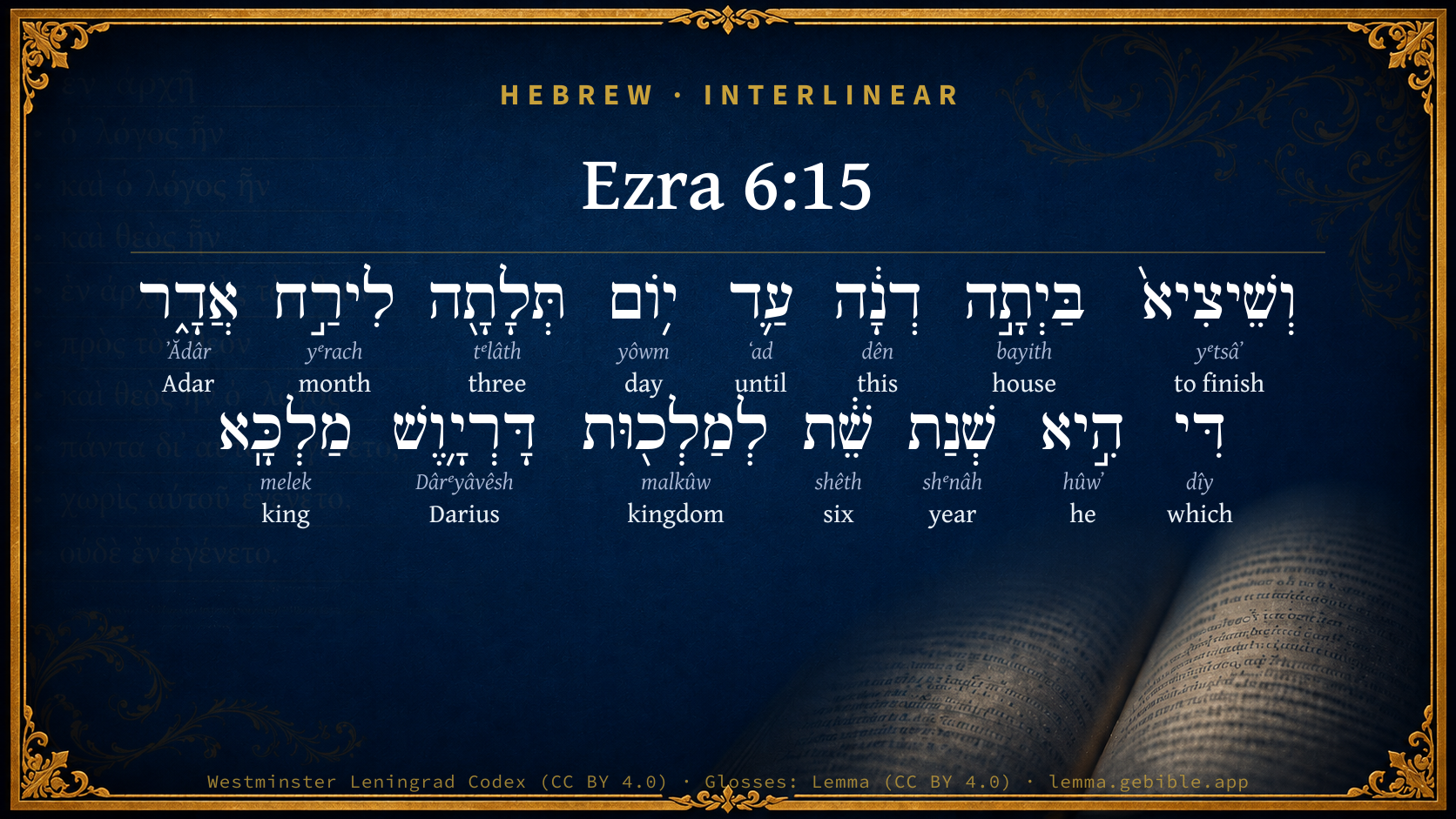
Hebrew (Westminster Leningrad Codex) Ezra 6:15 appears in the Hebrew Old Testament. The text above is from the Westminster Leningrad Codex. Each word links to its Strong’s number, a concise gloss, and parsing drawn from the Open Scriptures Hebrew Bible morphology. Click any word for its full Brown-Driver-Briggs (BDB) entry.
Download image
Cite this verse

Ezra 6:15 (World English Bible). Public Domain. Lemma interlinear Bible study tool, https://lemma.gebible.app/v/ezra/6/15.

Show BibTeX & RIS
BibTeX
RIS
English Translation
This house was finished on the third day of the month Adar, which was in the sixth year of the reign of Darius the king.
World English Bible · Public Domain
Highlights
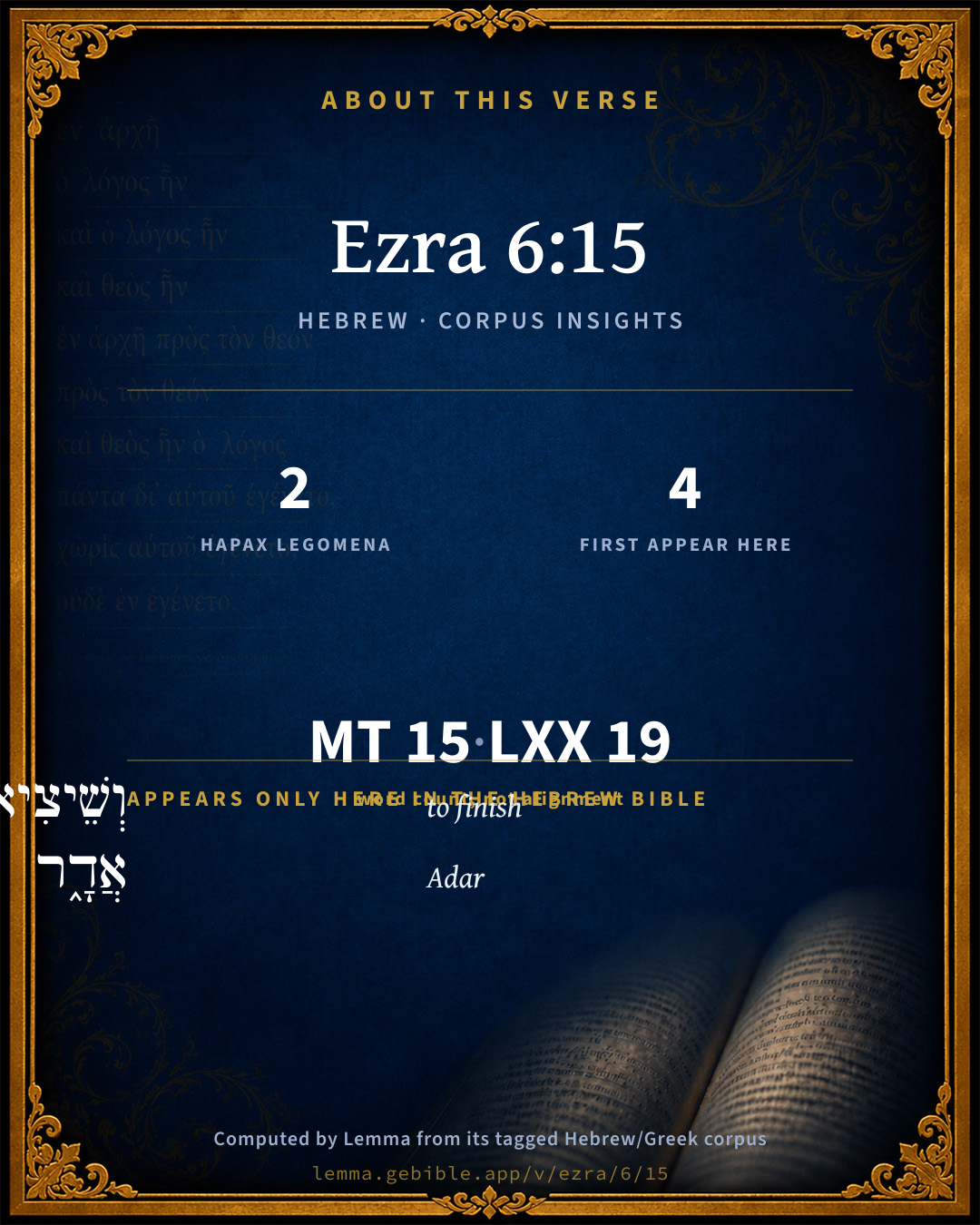
  • 2 hapax legomena — only here in the Hebrew Bible
  • 4 first appearances in the Hebrew Bible
Full analysis ↓
Download a study sheet

One document with this verse’s original text, its word-by-word gloss line, the meaning frame, cross-references with their text, attributed commentary, and full source and license credits — printable, and it pastes into notes with its structure intact.

This verse Autodidact and up

Study sheet (.html) Plain text (.txt)

A passage Seminary Student

Up to 50 verses in one chapter. A passage sheet keeps up to 6 commentary sources and 12 cross-references per verse, in the order this page ranks them, and says so on the sheet whenever that leaves anything out. Ask for a single verse and you get the Autodidact verse sheet above.

Everything on this page stays free to read, with no account — the sheet is a download of what is already on screen, not access to it.

Want to remove ads? Support Godless Engineer
Compare translations 3

The same verse in 3 English versions, stacked beneath the original-language interlinear above. Click any original word for its lexicon entry.

Each is an independent rendering of the whole verse — the interlinear is not word-aligned to these translations.

Highlighted words mark where these versions differ — a whole-verse word diff, not a word-by-word alignment.

  • World English Bible Public Domain
    This house was finished on the third day of the month Adar, which was in the sixth year of the reign of Darius the king.
  • King James Version Public Domain
    And this house was finished on the third day of the month Adar, which was in the sixth year of the reign of Darius the king.
  • unfoldingWord Literal Text CC BY-SA 4.0
    And this house was done by day three of the month of Adar, which was year six of the reign of Darius the king.

unfoldingWord Literal Text — © unfoldingWord, licensed CC BY-SA 4.0. Word-aligned USFM3 via Door43 (git.door43.org/unfoldingWord/en_ult).

Versions to compare (up to 4)

3 of 4 selected

Show all 18 translations

Every available English version of this verse, each an independent rendering of the whole verse.

  • World English Bible Public Domain
    This house was finished on the third day of the month Adar, which was in the sixth year of the reign of Darius the king.
  • Berean Standard Bible Public Domain
    And this temple was completed on the third day of the month of Adar, in the sixth year of the reign of King Darius.
  • Majority Standard Bible Public Domain
    And this temple was completed on the third day of the month of Adar, in the sixth year of the reign of King Darius.
  • King James Version Public Domain
    And this house was finished on the third day of the month Adar, which was in the sixth year of the reign of Darius the king.
  • American Standard Version (1901) Public Domain
    And this house was finished on the third day of the month Adar, which was in the sixth year of the reign of Darius the king.
  • Revised Version (1885) Public Domain
    And this house was finished on the third day of the month Adar, which was in the sixth year of the reign of Darius the king.
  • Geneva Bible (1599) Public Domain
    And this house was finished the thirde day of the moneth Adar, which was the sixt yeere of the reigne of King Darius.
  • Douay-Rheims (1899) Public Domain
    And they were finishing this house of God, until the third day of the month of Adar, which was in the sixth year of the reign of king Darius.
  • Young's Literal Translation Public Domain
    And this house hath gone out till the third day of the month Adar, that is `in' the sixth year of the reign of Darius the king.
  • Literal Standard Version CC BY-SA 4.0
    And this house has gone out until the third day of the month Adar, that is [in] the sixth year of the reign of Darius the king.
  • Unlocked Literal Bible CC BY-SA 4.0
    The house was completed on the third day of the month of Adar, in the sixth year of King Darius' reign.
  • unfoldingWord Literal Text CC BY-SA 4.0
    And this house was done by day three of the month of Adar, which was year six of the reign of Darius the king.
  • Darby Bible Public Domain
    And this house was finished on the third day of the month Adar, which was in the sixth year of the reign of king Darius.
  • World Messianic Bible Public Domain
    This house was finished on the third day of the month Adar, which was in the sixth year of the reign of Darius the king.
  • Webster's Bible Public Domain
    And this house was finished on the third day of the month Adar, which was in the sixth year of the reign of Darius the king.
  • Free Bible Version CC BY-SA 4.0
    The Temple was completed on the third day of the month of Adar, in the sixth year of the reign of King Darius.
  • Bible in Basic English Public Domain
    And the building of this house was complete on the third day of the month Adar, in the sixth year of the rule of Darius the king.
  • JPS Tanakh (1917) Public Domain
    And this house was finished on the third day of the month Adar, which was in the sixth year of the reign of Darius the king.

Literal Standard Version (2020), Covenant Press — licensed CC BY-SA 4.0. Text via the HelloAO Bible API (eBible.org). Unlocked Literal Bible (unfoldingWord) — licensed CC BY-SA 4.0. Text via the HelloAO Bible API (eBible.org). unfoldingWord Literal Text — © unfoldingWord, licensed CC BY-SA 4.0. Word-aligned USFM3 via Door43 (git.door43.org/unfoldingWord/en_ult). Free Bible Version, Dr. Jonathan Gallagher — licensed CC BY-SA 4.0. Text via the HelloAO Bible API (eBible.org).

Word by word

More ways to search: Search by grammar → Find every occurrence → Compare this word →

Practice this passage: Drill this verse → Learn its vocabulary →

וְשֵׁיצִיא֙
yᵉtsâʼ
H3319
“and · to finish”
Adjective, C + Verb, e, Perfect, 3rd Person, Masculine, Singular
Part of Speech
Adjective + Verb
Form
Perfect
Person
3rd Person
Gender
Masculine
Number
Singular
Full BDB Definition

Origin: corresponding to H3318

TWOT: 3028

(Shaphel) to bring to an end, finish, bring out to an end
  1. בַּיְתָ֣ה bayith H1005 “house · the” Adjective, N, Common + Particle, Definite Article
  2. דְנָ֔ה dên H1836 “this” Adjective, P
  3. עַ֛ד ʻad H5705 “until” Adjective, R
  4. י֥וֹם yôwm H3118 “day” Adjective, N, Common
  5. תְּלָתָ֖ה tᵉlâth H8532 “three” Adjective, A
  6. לִירַ֣ח yᵉrach H3393 “to/for · month of” Adjective, R + Noun, Common, Masculine, Singular, Construct
  7. אֲדָ֑ר ʼĂdâr H144 “Adar” Adjective, N
  8. דִּי dîy H1768 “which” Adjective, T
  9. הִ֣יא hûwʼ H1932 “he” Adjective, P
  10. שְׁנַת shᵉnâh H8140 “year of” Adjective, N, Common
  11. שֵׁ֔ת shêth H8353 “six” Adjective, A, Common
  12. לְמַלְכ֖וּת malkûw H4437 “to/for · kingdom of” Adjective, R + Noun, Common, Feminine, Singular, Construct
  13. דָּרְיָ֥וֶשׁ Dârᵉyâvêsh H1868 “Darius” Adjective, N
  14. מַלְכָּֽא melek H4430 “king · the” Adjective, N, Common + Particle, Definite Article

About this verse

These counts appear in no published source. They are computed here, from the morphology-tagged text and Lemma’s own curated glosses. What Lemma adds →

15
words
15
distinct lemmas
Historical
section

Notable vocabulary

2 hapax legomena — words that appear only here in the entire Hebrew Bible:

  • וְשֵׁיצִיא֙ to finish H3319
  • אֲדָ֑ר Adar H144

First appearance in Scripture

These words make their first canonical appearance in the Hebrew Bible here:

  • וְשֵׁיצִיא֙ to finish H3319
  • לִירַ֣ח month H3393
  • אֲדָ֑ר Adar H144
  • שֵׁ֔ת six H8353

Shared distinctive vocabulary

לִירַ֣ח month H3393 occurs in 2 verses of the Hebrew Bible. Also found in:

Grammatical profile

  • 1 verb
  • 2 nouns
  • 10 adjectives
  • 2 particles

Verb forms

  • וְשֵׁיצִיא֙ Perfect

Hebrew & Septuagint length

In English translation the verse runs 25 words from the Hebrew and 25 from the Septuagint (LXX English) — the same length.

A rough comparison of the two English renderings, which tokenize alike — not a word-level alignment.

Word counts can differ between the Hebrew and the Greek without any difference in meaning — e.g. the Hebrew direct-object marker אֵת has no separate Greek word, and Greek often adds the article ὁ.

In the original languages it is 15 Hebrew tokens and 19 Greek tokens — but the two are counted differently (Hebrew bundles its prefixes and suffixes into one token; the Greek is in lemma form), so that isn’t a like-for-like length.

Cross-references

8

Topical passages linked to Ezra 6:15 in the Treasury of Scripture Knowledge — connected by theme and wording, ordered by reader-vote popularity; previews shown in the World English Bible.

  • Esther 3:7 In the first month, which is the month Nisan, in the twelfth year of king Ahasuerus, they cast Pur, that is, the lot, before Haman from day to day, and from month to month, [to] the twelfth [month], which is the month Adar.
  • Esther 9:21 to enjoin those who they should keep the fourteenth day of the month Adar, and the fifteenth day of the same, yearly,
  • Esther 3:13 Letters were sent by posts into all the king's provinces, to destroy, to kill, and to cause to perish, all Jews, both young and old, little children and women, in one day, even on the thirteenth [day] of the twelfth month, which is the month Adar, and to take the spoil of them for a prey.
  • Esther 8:12 on one day in all the provinces of king Ahasuerus, [namely], on the thirteenth [day] of the twelfth month, which is the month Adar.
  • Esther 9:1 Now in the twelfth month, which is the month Adar, on the thirteenth day of the same, when the king's commandment and his decree drew near to be put in execution, on the day that the enemies of the Jews hoped to have rule over them, (whereas it was turned to the contrary, that the Jews had rule over those who hated them),
  • Esther 9:15 The Jews who were in Shushan gathered themselves together on the fourteenth day also of the month Adar, and killed three hundred men in Shushan; but they didn't lay their hand on the spoil.
  • Esther 9:17 [This was done] on the thirteenth day of the month Adar; and on the fourteenth day of the same they rested, and made it a day of feasting and gladness.
  • Esther 9:19 Therefore do the Jews of the villages, who dwell in the unwalled towns, make the fourteenth day of the month Adar [a day of] gladness and feasting, and a good day, and of sending portions one to another.

Cross-references courtesy of OpenBible.info (CC BY 4.0).

Hebrew and Greek witnesses Masoretic Hebrew ↔ Greek Septuagint

The same verse in the two great witnesses to the Old Testament, shown verse-for-verse.

These are two independent witnesses, not word-aligned to each other, and the Septuagint is shown in lemma (dictionary) form.

Hebrew Ezra 6:15 Masoretic · Westminster Leningrad Codex

וְשֵׁיצִיא֙ בַּיְתָ֣ה דְנָ֔ה עַ֛ד י֥וֹם תְּלָתָ֖ה לִירַ֣ח אֲדָ֑ר דִּי הִ֣יא שְׁנַת שֵׁ֔ת לְמַלְכ֖וּת דָּרְיָ֥וֶשׁ מַלְכָּֽא

This house was finished on the third day of the month Adar, which was in the sixth year of the reign of Darius the king.

World English Bible · Public Domain

Greek LXX Ezra 6:15 Septuagint · lemma form

καί τελέω ὁ οἶκος οὗτος ἕως ἡμέρα τρίτος μήν αδαρ ὅς εἰμί ἔτος ἕκτος ὁ βασιλεία δαρεῖος ὁ βασιλεύς

And they finished this house by the third day of the month Adar, which is the sixth year of the reign of Darius the king.

LXX2012 (modern English Septuagint) · Public Domain

In the Septuagint this is one book — Esdras B (2 Esdras): Ezra is chapters 1–10, Nehemiah 11–23.

On this verse, The Cambridge Bible for Schools and Colleges discusses the Septuagint’s reading. Read the note in Commentary ↓

Hebrew: Westminster Leningrad Codex (CC BY 4.0). Greek: Septuagint (public domain); English from LXX2012 (modern English Septuagint) (Public Domain). How the Septuagint differs from the Hebrew →

Commentary

Notes on Ezra 6:15 from classic Christian and Jewish commentators (each source and its license shown beneath its notes). The classic Christian expositions comment on the surrounding passage and are grouped to its opening verse, so a note may address several verses; the Jewish commentaries on the Tanakh (Rashi and others) are per-verse, so they appear only where the commentator wrote on this verse.

Lemma curates 59 commentaries, every one of them public domain or Creative Commons licensed, each selected and text-cleaned for this edition rather than reprinted as found. About our sources →

Trapp's Complete Commentary

John Trapp

Ezr 6:15 And this house was finished on the third day of the month Adar, which was in the sixth year of the reign of Darius the king.

Ver. 15. And this house was finished] About fifteen years after that the foundation had been laid, or twenty at most. The Jews therefore either were out in their account, Joh 2:20, Forty and six years was this temple in building; or else they meant it of Herod’s temple, which was long in building and beautifying, whereby he sought to ingratiate with the Jews, which yet he could never do.

John Trapp, A Commentary or Exposition upon All the Books of the Old and New Testament (1647–1656) — public domain. Text from a community e-Sword module.

Joseph Benson's Commentary

Ezr 6:15. This house was finished in the third day of the month Adar — The tenth of March, in the year of the world 3489, in little more than four years after the Jews had returned to the work, and engaged heartily in it, in consequence of the reproofs and exhortations of Haggai and Zechariah; in something more than two years after the forementioned decree of Darius had been given forth; in about twenty years after the return from captivity; and five hundred and fifteen before the coming of the Messiah.

Joseph Benson's Commentary on the Old and New Testaments (1811–1818) — public domain. Text from a community e-Sword module.

Tyndale Open Study Notes

Tyndale Open Resources

6:15 Israel’s second Temple was finished approximately seventy years after its destruction by Nebuchadnezzar in 586 BC. Herod the Great remodeled and expanded this Temple at the time of Christ. The Temple stood for approximately 585 years until the Roman army of Titus destroyed it in AD 70.

Tyndale Open Study Notes — © Tyndale Open Resources, licensed CC BY-SA 4.0. Text via the HelloAO Bible API.

Geneva Bible (1599)

Geneva Bible translators

And the two and fortieth year after their first return.

This is the twelfth month and containeth part of February and part of March.

Geneva Bible (1599) marginal notes — public domain. Text via Bolls.life.

Adam Clarke's Commentary

Verse 15. This house was finished] The sixth year of Darius mentioned here was about A.M. 3489, twenty years after the foundation had been laid by Zerubbabel, under the reign of Cyrus.

Adam Clarke's Commentary on the Bible (1810–1826) — public domain. Text from a community e-Sword/MySword module.

Ellicott's Commentary for English Readers

(15) The third day of the month Adar, which was in the sixth year.—The event around which this part of the history revolves is dated with due care; it was on the third day of the last month of the ecclesiastical year, B.C. 516-515. Haggai (Hag_1:15) gives the exact date of the re-commencement: the time therefore was four years five months and ten days. But, dating from the first foundation (Ezr_3:10), no less than twenty-one years had elapsed.

A Bible Commentary for English Readers, edited by Charles John Ellicott (1878–1897) — public domain. Text from a community e-Sword module.

The Cambridge Bible for Schools and Colleges

gen. ed. J. J. S. Perowne

15. The date here given is the 3rd of Adar (the 12th month) in the 6th year of Darius (516–515). The month Adar is about equivalent to our March. The name seems to be derived from an Assyrian god ‘Adar’, which appears in such names as Adrammelech. Haggai (Hag_1:15) mentions that the work had been recommenced on the 24th day of the 6th month (Elul = September) in the 2nd year of Darius. It had therefore been going on for nearly 4½ years. But the foundations had been laid twenty years previously, b.c. 536 (see Ezr_3:8).

Another date, the 23rd of Adar, is given in 1Es_7:5. To account for this variation, it has been suggested that the last 8 days of the year would to a scribe seem best suited for the celebration of such a festival as that of the dedication (compare the 8 days in 2Ch_29:17). In order that the regular services of the Temple might seem to have been resumed with the new year, he represented this festival as commencing on the 23rd of the 12th month. This is almost too ingenious. Either the figure ‘twenty’ has accidentally been omitted in the text of our verse, or, as seems equally probable (since the LXX. supports the Hebrew text here), the composer of 1 Esdras has mistaken some letter for the symbol or contraction which represented the number.

The Cambridge Bible for Schools and Colleges (gen. ed. J. J. S. Perowne; Cambridge University Press, 1878–1918) — public domain. Text from a community e-Sword module.

John Gill's Exposition

And the children of Israel,.... Those of the ten tribes that remained after the body of the people were carried captive, or came with the Jews at their return:

the priests and the Levites, and the rest of the children of the captivity; those of the tribes of Judah and Benjamin:

kept the dedication of this house of God with joy; they set it apart for sacred use and service, with feasting and other expressions of joy and gladness, as follows.

John Gill's Exposition of the Whole Bible (1746–1763) — public domain (CC PDM 1.0). Text via the HelloAO Bible API.

Albert Barnes' Notes on the Bible

“Adar” was the twelfth or last month of the Jewish year, corresponding nearly with our March. The sixth year of Darius was 516-515 B.C.

Albert Barnes' Notes on the Bible (1834–1885) — public domain. Text from a community e-Sword/MySword module.

Haydock's Catholic Bible Commentary

Adar, corresponding with our February and March. (Menochius) --- In the latter month they celebrated the Passover, ver. 19. --- Darius. Hence twenty years had elapsed from the first foundation. They might continue to embellish the temple other twenty-seven years, as the Jews assert; (John ii. 20,) unless they speak of the repairs made by Herod, (Baronius; Tirinus) or exaggerate, (Grotius) being under a mistake. (Salien, the year of the world 3537.)

George Leo Haydock (1774–1849), Haydock's Catholic Family Bible and Commentary, 1859 edition — public domain. Excludes Psalms (Douay-Rheims chapter numbering differs from Protestant) and Deuterocanonical books (Catholic canon only).

Whedon's Commentary on the Bible

Daniel D. Whedon

15. Month Adar — The twelfth, or last month of the Jewish year.

Sixth year of… Darius — Having been resumed in the second year of his reign, (Ezr_4:24,) the rebuilding, after that time, took four years.

Daniel D. Whedon (gen. ed.), Commentary on the Old and New Testaments (1874–1909) — public domain. Text from a community e-Sword module.

The Pulpit Commentary

The house was finished on the third day of the month Adar. Haggai (Hag_1:15) gives the exact day of the recommencement of the work as the twenty-fourth of Elul in Darius"s second year. Ezra here gives the exact day of the completion. From Zerubbabel"s laying of the foundation, (Ezr_3:10) the time that had elapsed was twenty-one years. From the recommencement under the inspiriting influence of the two prophets, the time was only four years, five months, and ten days.

HOMILIES BY J.S. EXELL Ver. 15.

Church prosperity.

I THERE WAS A CHANGE OF MOOD IN THOSE WHO HAD SOUGHT TO HINDER THE WORK. Tatnai, who had sought to hinder the building of the temple, now by the royal command does all he can to promote it. The world sometimes changes its mood toward the Church; often from motives of policy or fear; seldom from good will. Civil governors can greatly aid religious builders. When enemies help the Church prospers.

II THERE WAS A FAITHFUL MINISTRY EXERCISED IN THE MIDST OF THE PEOPLE. "They prospered through the prophesying of Haggai" (ver. 14). The ministry has much to do with the prosperity of a Church; men like Haggai and Zechariah cannot fail to inspire their comrades with their own earnest spirit. A faithful pastor will often make a Church prosperous.

III THERE WAS THE COMPLETION OF AN ARDUOUS UNDERTAKING. "And this house was finished" (ver. 15). A great enterprise, which had passed through so many vicissitudes, was now successfully ended. By the completion of its toils the Church indicates its energy, provides for its own welfare, and glorifies God. E.

Church building.

I THAT GOD REQUIRES a HOUSE ESPECIALLY ERECTED FOR HIS WORSHIP. "This house.

1. As a dwelling on the earth. God"s presence pervades the universe; there is no place where it is not. The heaven of heavens cannot contain him, much less the house which we have built; yet in great condescension he manifests a richer presence in his holy sanctuary than in all the world outside. The Shechinah dwells in the temple. God"s dwelling-place is in Zion. Christ is in the midst of his gathered people. (Mat_18:20)

2. As a testimony for the truth. The temple was a testimony to the heathen nations and to all people of the worship and sacrifice due from the Israelites to Jehovah. Our Christian churches testify to our belief in the great God, and to all those sacred truths which he has revealed in his book.

3. As the evidence of a religious feeling. While others are only building houses for themselves; we build also for God; we sacrifice the comfort of our ceiled houses and of our gains so to do. Our churches are evidence of the unselfish and devout sentiments of the human heart.

4. As the means of social philanthropy. We love the nation, and seek its moral welfare, hence we build it a sanctuary.

II THAT THERE ARE A GREAT MANY IMPEDIMENTS IN THE WAY OF BUILDING CHURCHES. The Israelites had many hindrances in their work.

1. The lack of a good heart for the work.

2. The lack of generous gifts for the work.

3. The lack of suitable men to lead the work.

4. The lack of sympathy in men for the moral welfare of God"s cause.

5. The lack of mutual concession to opposing ideas.

6. The lack of right help from the outside circles of society.

Christian enthusiasm, generosity, sympathy, good feeling, are the requisites of successful church building.

III THAT THE COMPLETION OF A NEW CHURCH IS WORTHY OF SPECIAL GRATITUDE. The Israelites would indeed be grateful to see their finished temple.

1. Grateful for the kind providence that had aided them.

2. Grateful for the valiant leaders that had inspired them.

3. Grateful for the persistent spirit of work which had been given them.

4. Grateful that their arduous toils were at an end.

5. Grateful that the glorious worship of God could now be fully celebrated.

6. Grateful that they had a new impulse given to their national life. E.

The Pulpit Commentary (1880–1919), ed. H.D.M. Spence-Jones & Joseph S. Exell — public domain. Text from a community e-Sword module.

Scofield Reference Notes

C. I. Scofield

Adar

twelfth month i.e. March.

The Scofield Reference Bible (1917 edition), notes by C. I. Scofield — public domain. Text from a community e-Sword module.

Rashi

Rabbi Shlomo Yitzchaki (Rashi)

And the completion of this House And the end of the completion of this House was until the third day of the month of Adar, which is the sixth year of King Darius; hence the building of the House took four years.

Rashi on the Tanakh — English translations: “The Judaica Press complete Tanach with Rashi, translated by A. J. Rosenberg” (CC BY 4.0); “Pentateuch with Rashi's commentary by M. Rosenbaum and A.M. Silbermann, 1929-1934” (public domain); “The Metsudah Tanach series, Lakewood, N.J” (CC BY 4.0); and “The Book of Joshua, Metsudah Publications, 1997” (CC BY 4.0). Text via Sefaria.

Lesson kit

Teaching starters — assembled from the data on this page, not authored interpretation. Every prompt links to the verse data it draws on. Edit before teaching.

Ezra, in the Historical, opens this verse with 15 words (15 distinct Hebrew lemmas). Its most distinctive word is yᵉtsâʼ (“to finish”). A historical commentator’s framing appears above. Read the whole chapter for the surrounding context.

Discussion questions

  1. How does “to finish” (yᵉtsâʼ) shape what this verse is saying?
  2. This verse holds 2 words here found nowhere else in the Hebrew Bible. What might the rare words draw attention to?
  3. 4 words here appear for the first time in Scripture. What is being introduced at this debut?
  4. Daniel 4:29 shares the word «month» with this verse. How do the two illuminate each other?
  5. The translations on this page render this verse differently — a whole-verse word diff, not a word-by-word alignment. What might account for the different wordings?
  6. The verb «וְשֵׁיצִיא֙» is Perfect. How does its form color the action?
  7. Reading how Trapp's Complete Commentary and Joseph Benson's Commentary read this verse, where do the two commentators agree and where do they part?

Things to notice

Reading settings

Reading text

Shown beneath each verse's original-language words.

Old Testament
Old Testament edition

Read the OT as the Masoretic Hebrew (MT) or the Greek Septuagint (LXX).

English shown for the Greek Septuagint (in the Hebrew ↔ Greek comparison).

Comparing translations? Open the Compare panel on any verse page to stack up to four side by side.