
Ezra 7:21

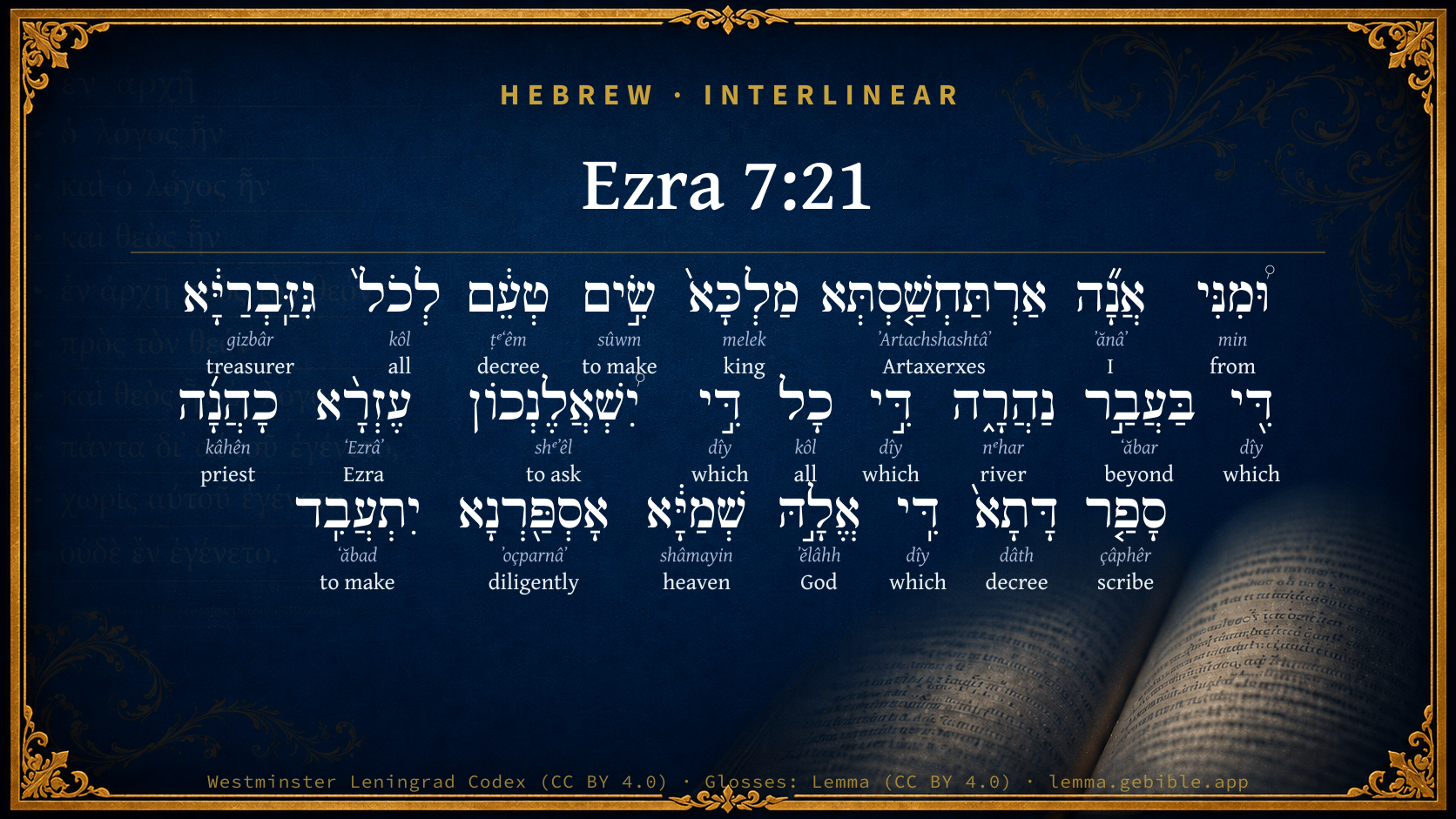
Hebrew (Westminster Leningrad Codex) Ezra 7:21 appears in the Hebrew Old Testament. The text above is from the Westminster Leningrad Codex. Each word links to its Strong’s number, a concise gloss, and parsing drawn from the Open Scriptures Hebrew Bible morphology. Click any word for its full Brown-Driver-Briggs (BDB) entry.
Download image
Cite this verse

Ezra 7:21 (World English Bible). Public Domain. Lemma interlinear Bible study tool, https://lemma.gebible.app/v/ezra/7/21.

Show BibTeX & RIS
BibTeX
RIS
English Translation
I, even I Artaxerxes the king, do make a decree to all the treasurers who are beyond the River, that whatever Ezra the priest, the scribe of the law of the God of heaven, shall require of you, it be done with all diligence,
World English Bible · Public Domain
Highlights
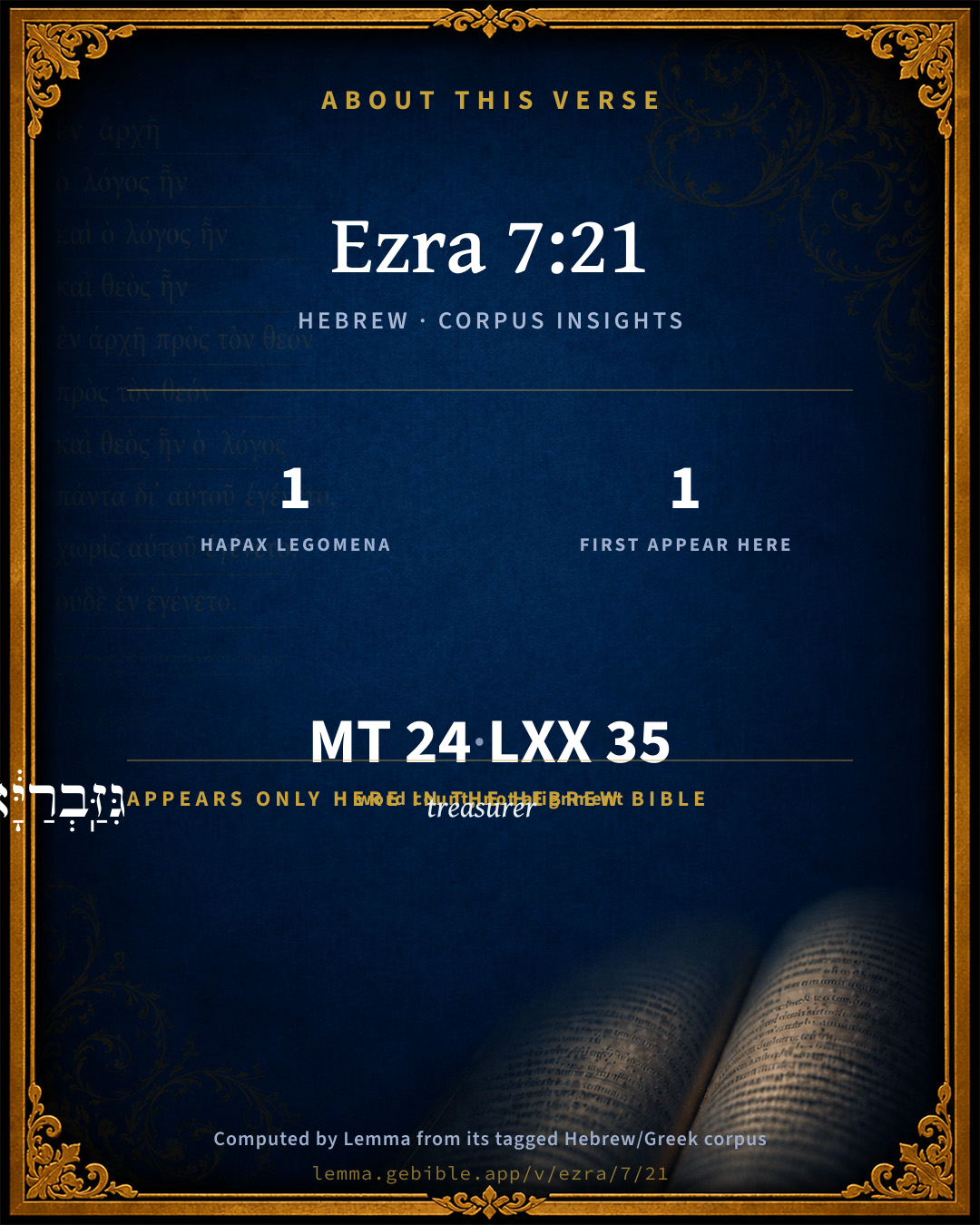
  • 1 hapax legomenon — only here in the Hebrew Bible
  • 1 first appearance in the Hebrew Bible
Full analysis ↓
Download a study sheet

One document with this verse’s original text, its word-by-word gloss line, the meaning frame, cross-references with their text, attributed commentary, and full source and license credits — printable, and it pastes into notes with its structure intact.

This verse Autodidact and up

Study sheet (.html) Plain text (.txt)

A passage Seminary Student

Up to 50 verses in one chapter. A passage sheet keeps up to 6 commentary sources and 12 cross-references per verse, in the order this page ranks them, and says so on the sheet whenever that leaves anything out. Ask for a single verse and you get the Autodidact verse sheet above.

Everything on this page stays free to read, with no account — the sheet is a download of what is already on screen, not access to it.

Want to remove ads? Support Godless Engineer
Compare translations 3

The same verse in 3 English versions, stacked beneath the original-language interlinear above. Click any original word for its lexicon entry.

Each is an independent rendering of the whole verse — the interlinear is not word-aligned to these translations.

Highlighted words mark where these versions differ — a whole-verse word diff, not a word-by-word alignment.

  • World English Bible Public Domain
    I, even I Artaxerxes the king, do make a decree to all the treasurers who are beyond the River, that whatever Ezra the priest, the scribe of the law of the God of heaven, shall require of you, it be done with all diligence,
  • King James Version Public Domain
    And I, even I Artaxerxes the king, do make a decree to all the treasurers which are beyond the river, that whatsoever Ezra the priest, the scribe of the law of the God of heaven, shall require of you, it be done speedily,
  • unfoldingWord Literal Text CC BY-SA 4.0
    And from me myself, Artaxerxes the king, is set a decree for all the treasurers who are in Beyond-the-River: that all that Ezra (the priest, the scribe of the law of the God of heaven) may ask of you, let it be done diligently;

unfoldingWord Literal Text — © unfoldingWord, licensed CC BY-SA 4.0. Word-aligned USFM3 via Door43 (git.door43.org/unfoldingWord/en_ult).

Versions to compare (up to 4)

3 of 4 selected

Show all 18 translations

Every available English version of this verse, each an independent rendering of the whole verse.

  • World English Bible Public Domain
    I, even I Artaxerxes the king, do make a decree to all the treasurers who are beyond the River, that whatever Ezra the priest, the scribe of the law of the God of heaven, shall require of you, it be done with all diligence,
  • Berean Standard Bible Public Domain
    I, King Artaxerxes, decree to all the treasurers west of the Euphrates: Whatever Ezra the priest, the scribe of the Law of the God of heaven, may require of you, it must be provided promptly,
  • Majority Standard Bible Public Domain
    I, King Artaxerxes, decree to all the treasurers west of the Euphrates: Whatever Ezra the priest, the scribe of the Law of the God of heaven, may require of you, it must be provided promptly,
  • King James Version Public Domain
    And I, even I Artaxerxes the king, do make a decree to all the treasurers which are beyond the river, that whatsoever Ezra the priest, the scribe of the law of the God of heaven, shall require of you, it be done speedily,
  • American Standard Version (1901) Public Domain
    And I, even I Artaxerxes the king, do make a decree to all the treasurers that are beyond the River, that whatsoever Ezra the priest, the scribe of the law of the God of heaven, shall require of you, it be done with all diligence,
  • Revised Version (1885) Public Domain
    And I, even I Artaxerxes the king, do make a decree to all the treasurers which are beyond the river, that whatsoever Ezra the priest, the scribe of the law of the God of heaven, shall require of you, it be done with all diligence,
  • Geneva Bible (1599) Public Domain
    And I King Artahshashte haue giuen commandemet to all the treasurers which are beyond the Riuer, that whatsoeuer Ezra the Priest and Scribe of the Law of the God of heauen shall require of you, that it be done incontinently,
  • Douay-Rheims (1899) Public Domain
    I Artaxerxes the king have ordered and decreed to all the keepers of the public chest, that are beyond the river, that whatsoever Esdras the priest, the scribe of the law of the God of heaven, shall require of you, you give it without delay,
  • Young's Literal Translation Public Domain
    `And by me -- I Artaxerxes the king -- is made a decree to all treasurers who `are' beyond the river, that all that Ezra the priest, scribe of the law of the God of heaven, doth ask of you, be done speedily:
  • Literal Standard Version CC BY-SA 4.0
    And by me—I Artaxerxes the king—is made a decree to all treasurers who [are] beyond the river, that all that Ezra the priest, scribe of the Law of the God of the heavens, asks of you, be done speedily:
  • Unlocked Literal Bible CC BY-SA 4.0
    I, King Artaxerxes, make a decree to all the treasurers in the Province Beyond the River, that anything that Ezra asks from you should be given in full,
  • unfoldingWord Literal Text CC BY-SA 4.0
    And from me myself, Artaxerxes the king, is set a decree for all the treasurers who are in Beyond-the-River: that all that Ezra (the priest, the scribe of the law of the God of heaven) may ask of you, let it be done diligently;
  • Darby Bible Public Domain
    And I, I Artaxerxes the king, do give orders to all the treasurers that are beyond the river, that whatever Ezra the priest and scribe of the law of the God of the heavens shall require of you, it be done diligently,
  • World Messianic Bible Public Domain
    I, even I, Artaxerxes the king, make a decree to all the treasurers who are beyond the River, that whatever Ezra the priest, the scribe of the law of the God of heaven, requires of you, it shall be done with all diligence,
  • Webster's Bible Public Domain
    And I, even I Artaxerxes the king, do make a decree to all the treasurers who are beyond the river, that whatever Ezra the priest, the scribe of the law of the God of heaven, shall require of you, it be done speedily,
  • Free Bible Version CC BY-SA 4.0
    I, King Artaxerxes, decree that all the treasurers west of the Euphrates should provide whatever Ezra the priest, the scribe of the Law of the God of heaven, may require from you, and it must be provided in full,
  • Bible in Basic English Public Domain
    And I, even I, Artaxerxes the king, now give orders to all keepers of the king's money across the river, that whatever Ezra the priest, the scribe of the law of the God of heaven, may have need of from you, is to be done with all care,
  • JPS Tanakh (1917) Public Domain
    And I, even I Artaxerxes the king, do make a decree to all the treasurers that are beyond the River, that whatsoever Ezra the priest, the scribe of the Law of the God of heaven, shall require of you, it be done with all diligence,

Literal Standard Version (2020), Covenant Press — licensed CC BY-SA 4.0. Text via the HelloAO Bible API (eBible.org). Unlocked Literal Bible (unfoldingWord) — licensed CC BY-SA 4.0. Text via the HelloAO Bible API (eBible.org). unfoldingWord Literal Text — © unfoldingWord, licensed CC BY-SA 4.0. Word-aligned USFM3 via Door43 (git.door43.org/unfoldingWord/en_ult). Free Bible Version, Dr. Jonathan Gallagher — licensed CC BY-SA 4.0. Text via the HelloAO Bible API (eBible.org).

Word by word

More ways to search: Search by grammar → Find every occurrence → Compare this word →

Practice this passage: Drill this verse → Learn its vocabulary →

גִּזַּֽבְרַיָּ֔א
gizbâr
H1490
“treasurers · the”
Adjective, N, Common + Particle, Definite Article
Part of Speech
Adjective + Particle
Type
Definite Article
Full BDB Definition

Origin: corresponding to H1489

TWOT: 2653

treasurer
  1. וּ֠מִנִּי min H4481 “and · from · me” Adjective, C + Preposition + Suffix, Personal, 1st Person, Common, Singular
  2. אֲנָ֞ה ʼănâʼ H576 “I” Adjective, P, Construct
  3. אַרְתַּחְשַׁ֤סְתְּא ʼArtachshashtâʼ H783 “Artaxerxes” Adjective, N
  4. מַלְכָּא֙ melek H4430 “king · the” Adjective, N, Common + Particle, Definite Article
  5. שִׂ֣ים sûwm H7761 “to make” Adjective, V, Plural
  6. טְעֵ֔ם ṭᵉʻêm H2942 “decree” Adjective, N, Common
  7. לְכֹל֙ kôl H3606 “to/for · all of” Adjective, R + Noun, Common, Masculine, Singular, Construct
  8. דִּ֖י dîy H1768 “which” Adjective, T
  9. בַּעֲבַ֣ר ʻăbar H5675 “in/at · beyond” Adjective, R + Noun, Proper
  10. נַהֲרָ֑ה nᵉhar H5103 “river · the” Adjective, N + Particle, Definite Article
  11. דִּ֣י dîy H1768 “which” Adjective, T
  12. כָל kôl H3606 “all of” Adjective, N, Common
  13. דִּ֣י dîy H1768 “which” Adjective, T
  14. יִ֠שְׁאֲלֶנְכוֹן shᵉʼêl H7593 “to ask · you” Adjective, V + Suffix, Personal, 2nd Person, Masculine, Plural
  15. עֶזְרָ֨א ʻEzrâʼ H5831 “Ezra” Adjective, N
  16. כָהֲנָ֜ה kâhên H3549 “priest · the” Adjective, N, Common + Particle, Definite Article
  17. סָפַ֤ר çâphêr H5613 “scribe of” Adjective, N, Common
  18. דָּתָא֙ dâth H1882 “decree · the” Adjective, N, Common + Particle, Definite Article
  19. דִּֽי dîy H1768 “which” Adjective, T
  20. אֱלָ֣הּ ʼĕlâhh H426 “God of” Adjective, N, Common
  21. שְׁמַיָּ֔א shâmayin H8065 “heaven(s) · the” Adjective, N, Common + Particle, Definite Article
  22. אָסְפַּ֖רְנָא ʼoçparnâʼ H629 “diligently” Adjective, D
  23. יִתְעֲבִֽד ʻăbad H5648 “to make” Adjective, V

About this verse

These counts appear in no published source. They are computed here, from the morphology-tagged text and Lemma’s own curated glosses. What Lemma adds →

24
words
20
distinct lemmas
Historical
section

Notable vocabulary

1 hapax legomenon — a word that appears only here in the entire Hebrew Bible:

  • גִּזַּֽבְרַיָּ֔א treasurer H1490

First appearance in Scripture

This word makes its first canonical appearance in the Hebrew Bible here:

  • גִּזַּֽבְרַיָּ֔א treasurer H1490

Shared distinctive vocabulary

עֶזְרָ֨א Ezra H5831 occurs in 3 verses of the Hebrew Bible. Also found in:

Grammatical profile

  • 2 nouns
  • 15 adjectives
  • 1 preposition
  • 6 particles

Repetition

Words recur within this verse — often emphatic in Hebrew:

  • לְכֹל֙ all H3606 ×2
  • דִּ֖י which H1768 ×4

Hebrew & Septuagint length

In English translation the verse runs 44 words from the Hebrew and 51 from the Septuagint (LXX English) — closely comparable.

A rough comparison of the two English renderings, which tokenize alike — not a word-level alignment.

Word counts can differ between the Hebrew and the Greek without any difference in meaning — e.g. the Hebrew direct-object marker אֵת has no separate Greek word, and Greek often adds the article ὁ.

In the original languages it is 24 Hebrew tokens and 35 Greek tokens — but the two are counted differently (Hebrew bundles its prefixes and suffixes into one token; the Greek is in lemma form), so that isn’t a like-for-like length.

Cross-references

5

Topical passages linked to Ezra 7:21 in the Treasury of Scripture Knowledge — connected by theme and wording, ordered by reader-vote popularity; previews shown in the World English Bible.

  • Ezra 4:16 We inform the king that, if this city be built, and the walls finished, by this means you shall have no portion beyond the River.
  • Ezra 7:6 this Ezra went up from Babylon: and he was a ready scribe in the law of Moses, which Yahweh, the God of Israel, had given; and the king granted him all his request, according to the hand of Yahweh his God on him.
  • Ezra 4:20 There have been mighty kings also over Jerusalem, who have ruled over all [the country] beyond the River; and tribute, custom, and toll, was paid to them.
  • Ezra 6:6 Now therefore, Tattenai, governor beyond the River, Shetharbozenai, and your companions the Apharsachites, who are beyond the River, be you far from there:
  • Ezra 7:10–13 For Ezra had set his heart to seek the law of Yahweh, and to do it, and to teach in Israel statutes and ordinances.

Cross-references courtesy of OpenBible.info (CC BY 4.0).

Hebrew and Greek witnesses Masoretic Hebrew ↔ Greek Septuagint

The same verse in the two great witnesses to the Old Testament, shown verse-for-verse.

These are two independent witnesses, not word-aligned to each other, and the Septuagint is shown in lemma (dictionary) form.

Hebrew Ezra 7:21 Masoretic · Westminster Leningrad Codex

וּ֠מִנִּי אֲנָ֞ה אַרְתַּחְשַׁ֤סְתְּא מַלְכָּא֙ שִׂ֣ים טְעֵ֔ם לְכֹל֙ גִּזַּֽבְרַיָּ֔א דִּ֖י בַּעֲבַ֣ר נַהֲרָ֑ה דִּ֣י כָל דִּ֣י יִ֠שְׁאֲלֶנְכוֹן עֶזְרָ֨א כָהֲנָ֜ה סָפַ֤ר דָּתָא֙ דִּֽי אֱלָ֣הּ שְׁמַיָּ֔א אָסְפַּ֖רְנָא יִתְעֲבִֽד

I, even I Artaxerxes the king, do make a decree to all the treasurers who are beyond the River, that whatever Ezra the priest, the scribe of the law of the God of heaven, shall require of you, it be done with all diligence,

World English Bible · Public Domain

Greek LXX Ezra 7:21 Septuagint · lemma form

καί ἀπό ἐγώ ἐγώ αρθασασθα βασιλεύς τίθημι γνώμη πᾶς ὁ γάζα ὁ ἐν πέραν ὁ ποταμός ὅτι πᾶς ὅς ἄν αἰτέω σύ εσδρας ὁ ἱερεύς καί γραμματεύς ὁ νόμος ὁ θεός ὁ οὐρανός ἑτοίμως γίγνομαι

and from me, whatever it shall seem good to you to give. I king Arthasastha have made a decree for all the treasuries that are in the country beyond the river, that whatever Esdras the priest and scribe of the God of heaven may ask you, it shall be done speedily,

LXX2012 (modern English Septuagint) · Public Domain

In the Septuagint this is one book — Esdras B (2 Esdras): Ezra is chapters 1–10, Nehemiah 11–23.

On this verse, The Cambridge Bible for Schools and Colleges discusses the Septuagint’s reading. Read the note in Commentary ↓

Hebrew: Westminster Leningrad Codex (CC BY 4.0). Greek: Septuagint (public domain); English from LXX2012 (modern English Septuagint) (Public Domain). How the Septuagint differs from the Hebrew →

Commentary

Notes on Ezra 7:21 from classic Christian and Jewish commentators (each source and its license shown beneath its notes). The classic Christian expositions comment on the surrounding passage and are grouped to its opening verse, so a note may address several verses; the Jewish commentaries on the Tanakh (Rashi and others) are per-verse, so they appear only where the commentator wrote on this verse.

Lemma curates 59 commentaries, every one of them public domain or Creative Commons licensed, each selected and text-cleaned for this edition rather than reprinted as found. About our sources →

Trapp's Complete Commentary

John Trapp

Ezr 7:21 And I, [even] I Artaxerxes the king, do make a decree to all the treasurers which [are] beyond the river, that whatsoever Ezra the priest, the scribe of the law of the God of heaven, shall require of you, it be done speedily,

Ver. 21. Let it be done speedily] Without shucking and bucking, without delays and consults: I, even I will have it so, saith the great king; dispute not, therefore, but despatch: Quod ego volo, pro canone sit, because I wish, let him be for the writing, as Constantius the emperor said to Paulinus, Lucifer, and other dissenting bishops.

John Trapp, A Commentary or Exposition upon All the Books of the Old and New Testament (1647–1656) — public domain. Text from a community e-Sword module.

Tyndale Open Study Notes

Tyndale Open Resources

7:21-22 The items listed were typically used as offerings in worship (cp. Exod 27:20; 29:2; Lev 2:4, 13; 14:10; Num 28:7).

Tyndale Open Study Notes — © Tyndale Open Resources, licensed CC BY-SA 4.0. Text via the HelloAO Bible API.

Geneva Bible (1599)

Geneva Bible translators

Which was the river Euphrates, and they were beyond it in respect of Babylon.

Geneva Bible (1599) marginal notes — public domain. Text via Bolls.life.

The Cambridge Bible for Schools and Colleges

gen. ed. J. J. S. Perowne

21. Credit to Ezra to be granted on local treasuries W. of the Euphrates. Limit of credit stated in Ezr_7:22.

treasurers] Officials to be found in each satrapy and province, (LXX. ταῖς γάζαις. Vulg. ‘custodibus arcæ publicæ’). On ‘gizbar’ a treasurer cf. Ezr_1:8.

beyond the river] i.e. this decree only applied to the financiers of the particular satrapy to which Jerusalem belonged.

Ezra the priest, the scribe, &c.] See on Ezr_7:12.

of you] The decree here addresses ‘the treasurers’.

speedily] R.V. with all diligence.

The Cambridge Bible for Schools and Colleges (gen. ed. J. J. S. Perowne; Cambridge University Press, 1878–1918) — public domain. Text from a community e-Sword module.

John Gill's Exposition

Whatsoever is commanded by the God of heaven,.... In the law given by Moses to the people of Israel:

let it be diligently done for the house of the God of heaven; for the service of it, particularly sacrifices:

for why should there be wrath against the realm of the king and his sons? through the neglect of the service of God in the temple, and by reason of the default of the king's treasurers.

John Gill's Exposition of the Whole Bible (1746–1763) — public domain (CC PDM 1.0). Text via the HelloAO Bible API.

Albert Barnes' Notes on the Bible

All the treasurers - The Persian system of taxing the provinces through the satraps involved the establishment in each province of at least one local treasury.

Albert Barnes' Notes on the Bible (1834–1885) — public domain. Text from a community e-Sword/MySword module.

Whedon's Commentary on the Bible

Daniel D. Whedon

21. All the treasurers… beyond the river — The Persian system of finance provided for a royal treasury in every province.

Daniel D. Whedon (gen. ed.), Commentary on the Old and New Testaments (1874–1909) — public domain. Text from a community e-Sword module.

The Pulpit Commentary

Vers. 21-24.

The decree of Artaxerxes to the treasurers.

Embodied in the letter of the Persian king to Ezra we have certain directions addressed through him to the treasurers beyond the river. These directions, though emanating from a heathen source, suggest the principles which should guide liberality in the cause of God, as to its measure, its spirit, and its reasons.

I THE MEASURE.

1. This should be generous. "Whatsoever Ezra the priest," etc.

(1) Provision for the immediate wants of the temple had already been made in the free gifts viz., from the king, from his counsellors, from his people in the province of Babylon, from the Jews abiding there (see vers. 15-20).

(2) This direction was intended to sustain the service in perpetuity. Fitful generosity is better than none; but principle, rather than emotion or passion, should guide. The cause of God should not languish for support until men make their wills and die.

(3) The ministers of the sanctuary were to be exempted from taxation (ver. 24). The reason is that they were dependent for support upon the gifts of the people; and it is respectful to their sacred office that they should be generously treated.

2. It should not be reckless.

(1) Here is a prescribed limit. "Unto," etc. (ver. 22). A talent of silver is estimated as equivalent to so here the limit is f40, 000. The measure (cor) is estimated at 86 gallons, so here the limit is 8600 gallons of wheat. The bath is seven gallons and five pints, so the limit of wine is 760 gallons.

(2) Two things should limit our liberality viz.,

(a) The necessity of the case.

(b) Our ability. If we give what is not ours we act fraudulently.

3. It should be religious. "Whatsoever is commanded by the God of heaven," etc. (ver. 23).

(1) The laws of God are reasonable, merciful, just.

(2) Therefore if "the scribe of the God of heaven," an inspired man, be he Ezra, Moses, or Paul, in the sacred writings, make demands, these should be respected.

(3) But this does not say that uninspired men, because in clerical orders, have any right dogmatically to prescribe to the laity. If there be no sphere for the right of private judgment, there is an end to individual responsibility.

II THE SPIRIT.

1. It should be diligent. "Let it be diligently done for the house of the God of heaven" (ver. 23).

(1) Sacred objects are fittingly called "charities," or objects of love. The cause of God in all its departments should be dear to us, and the claims of these will be diligently studied as a labour of love.

(2) Pains should be taken so to minister liberality that the maximum of good may be attained. Causes should be "sought out". (Job_29:16) Promiscuous relief may encourage deception, and what is given to the worthless is diverted from the worthy.

(3) Careless donors are responsible to God for the misery they might have alleviated by the use of diligence.

2. It should be prompt. "Let it be done speedily" (ver. 21).

(1) This note was rendered necessary by the tardy manner in which things are commonly done in the East. Through this slowness incalculable misery is endured. But "the king"s business requires haste.

(2) Much more the work of God. This is of the utmost importance. Eternal issues depend upon it. Time is running. Souls are perishing.

III THE REASONS.

1. It should be done unto God.

(1) Ezra was to receive from the treasurers what he needed viz., in his capacity as "the priest" and the "scribe of the law of the God of heaven." What he should need for the temple and the altar. What his learning in the law of God should instruct him was needful to the service of the God of heaven (ver. 23).

(2) No higher reason than this can be conceived.

2. The prosperity of the realm required it. "For why should wrath be against the realm?" The history of nations shows that as they became haughty against God they suffered adversity. Egypt. Old Canaan. Nineveh. Babylon.

(2) Why should not a blessing be upon the realm? Was not the hand of God conspicuous in the prosperity of Persia? (see Ezr_1:2) At this very time Longimanus began to be successful against a formidable rebellion in Egypt.

3. The happiness of the royal family is concerned.

(1) "Why should wrath be against the king?" The reverses of a nation are reverses to the king. But the king, like his subjects, has his individual responsibilities to God. His elevation no more exempts him than their obscurity conceals them from his claims upon the personal homage of intellect and heart.

(2) Why should wrath be against the king"s "sons"? God has set mankind in families, so "the seed of the righteous is blessed." History also shows how families are ruined by irreligion. The antediluvians. The posterity of Nebuchadnezzar. (see Dan_5:5) Money is a prodigious power for evil or for good. Those who have it should never cease to pray for grace to use it wisely. J.A.M.

The Pulpit Commentary (1880–1919), ed. H.D.M. Spence-Jones & Joseph S. Exell — public domain. Text from a community e-Sword module.

unfoldingWord translationNotes

Door43 World Missions Community

Connecting Statement:

This continues the decree that King Artaxerxes gave to Ezra.

the Province Beyond the River

This is the name of the province that was west of the Euphrates River. It was across the river from the city of Susa. See how you translated it in Esra 4:10. (See: How to Translate Names)

that anything that Ezra asks from you should be given in full

This can be expressed in active form. "Give Ezra in full anything he asks of you" (See: Active or Passive)

should be given in full

The phrase "in full" here represents whatever quantity necessary to do the work. AT: "should be given as much as he needs" (See: Assumed Knowledge and Implicit Information)

one hundred silver talents

"100 talents of silver." You may convert this to a modern measure. AT: "3,300 kilograms of silver" (See: Numbers and Biblical Weight)

one hundred cors of grain

You may convert this to a modern measure. AT: "22,000 liters of grain" or "twenty thousand liters of grain" (See: Biblical Volume and Numbers)

one hundred baths of oil

You may convert this to a modern measure. AT: 2,200 liters of oil" or "two thousand liters of oil" (See: Biblical Volume and Numbers)

his house

This refers to God's temple.

For why should his wrath come upon the kingdom of me and my sons?

The king uses this question to say that he does not want God's wrath to come upon them. The implied information is that if they do not do give Ezra what he needs, then God will punish the kingdom. AT: "For we do not want God's wrath to come upon the kingdom of me and my sons." or "For if you do not do these things, God's wrath will come upon the kingdom of me and my sons." (See: Rhetorical Question)

For why should his wrath come upon the kingdom of me and my sons

God's wrath represents God punishing them. AT: "For why should God punish the kingdom of me and my sons" or "For if you do not do these things, God will punish the kingdom of me and my sons" (See: Metonymy)

translationWords

king

Artaxerxes

decree

Ezra

wine

God

heaven

wrath

unfoldingWord translationNotes — © Distant Shores Media and the Door43 World Missions Community, licensed CC BY-SA 4.0. Source: git.door43.org/Door43/en_tn.

Rashi

Rabbi Shlomo Yitzchaki (Rashi)

And from me—I And from me—I, King Darius—is issued a command and an authorization to all the treasurers who are on the other side of the river of the side of Israel, who receive my taxes from the nations, that anything that Ezra the priest, the scholar of the Law of the Holy One, blessed be He, requests of you, shall be performed quickly. They should not delay his request up to a hundred talents of silver, with which to purchase sacrifices, and a hundred kors of wheat for meal-offerings, and up to a hundred measures of wine for the libations, and a hundred measures of oil to mingle the meal- offerings, and salt for the sacrifices, according to the matter that is stated (Lev. 2:13): “And every meal-offering you shall salt with salt.”

Rashi on the Tanakh — English translations: “The Judaica Press complete Tanach with Rashi, translated by A. J. Rosenberg” (CC BY 4.0); “Pentateuch with Rashi's commentary by M. Rosenbaum and A.M. Silbermann, 1929-1934” (public domain); “The Metsudah Tanach series, Lakewood, N.J” (CC BY 4.0); and “The Book of Joshua, Metsudah Publications, 1997” (CC BY 4.0). Text via Sefaria.

Lesson kit

Teaching starters — assembled from the data on this page, not authored interpretation. Every prompt links to the verse data it draws on. Edit before teaching.

Ezra, in the Historical, opens this verse with 24 words (20 distinct Hebrew lemmas). Its most distinctive word is gizbâr (“treasurer”). A historical commentator’s framing appears above. Read the whole chapter for the surrounding context.

Discussion questions

  1. How does “treasurer” (gizbâr) shape what this verse is saying?
  2. This verse holds 1 word here found nowhere else in the Hebrew Bible. What might the rare word draw attention to?
  3. The word “treasurer” first appears here in Scripture. What is being introduced at this debut?
  4. Ezra 7:12 shares the word «Ezra» with this verse. How do the two illuminate each other?
  5. “all” occurs 2× in this one verse. What is the effect of the repetition?
  6. The translations on this page render this verse differently — a whole-verse word diff, not a word-by-word alignment. What might account for the different wordings?
  7. Reading how Trapp's Complete Commentary and Tyndale Open Study Notes read this verse, where do the two commentators agree and where do they part?

Things to notice

  • 1 word in this verse appears nowhere else in the Hebrew Bible.
  • 1 word makes its first canonical appearance in Scripture here.
  • This verse counts 24 Hebrew ↔ 35 Greek words.
  • These translations choose different wording for 22 words in this verse.
  • “all” occurs 2× in this single verse.

Reading settings

Reading text

Shown beneath each verse's original-language words.

Old Testament
Old Testament edition

Read the OT as the Masoretic Hebrew (MT) or the Greek Septuagint (LXX).

English shown for the Greek Septuagint (in the Hebrew ↔ Greek comparison).

Comparing translations? Open the Compare panel on any verse page to stack up to four side by side.