
Ezra 4:16

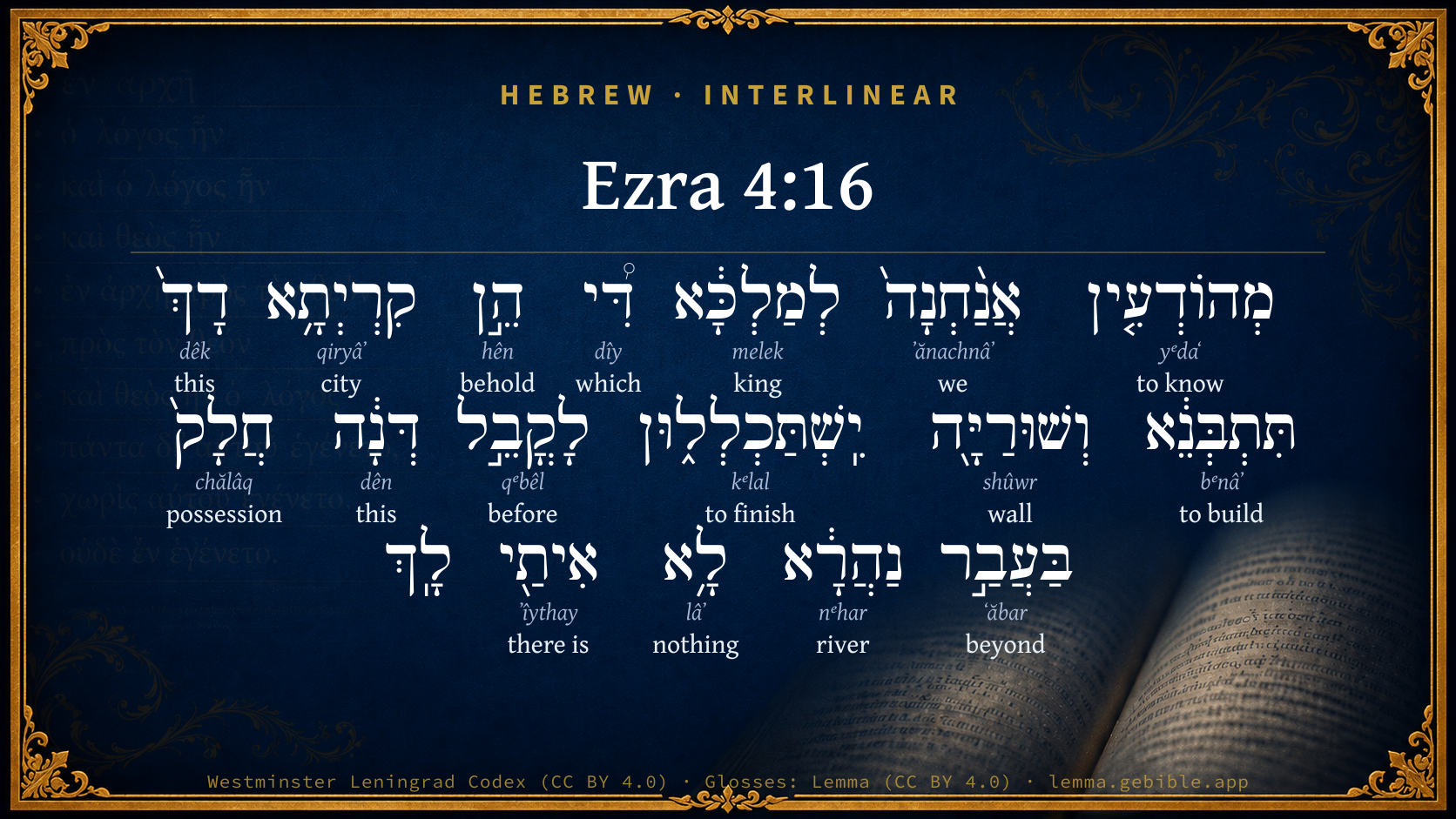
Hebrew (Westminster Leningrad Codex) Ezra 4:16 appears in the Hebrew Old Testament. The text above is from the Westminster Leningrad Codex. Each word links to its Strong’s number, a concise gloss, and parsing drawn from the Open Scriptures Hebrew Bible morphology. Click any word for its full Brown-Driver-Briggs (BDB) entry.
Download image
Cite this verse

Ezra 4:16 (World English Bible). Public Domain. Lemma interlinear Bible study tool, https://lemma.gebible.app/v/ezra/4/16.

Show BibTeX & RIS
BibTeX
RIS
English Translation
We inform the king that, if this city be built, and the walls finished, by this means you shall have no portion beyond the River.
World English Bible · Public Domain
Highlights
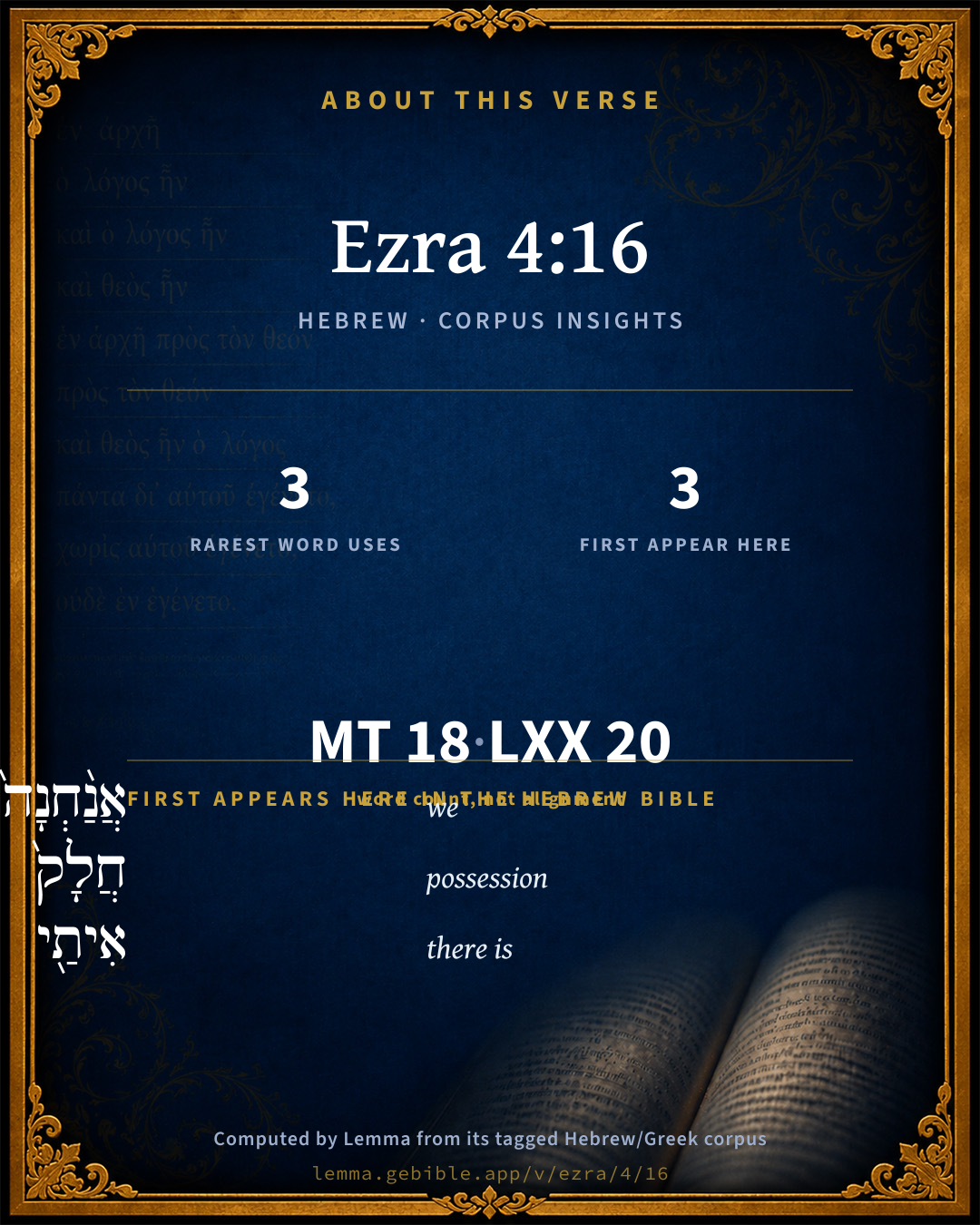
  • 3 first appearances in the Hebrew Bible
Full analysis ↓
Download a study sheet

One document with this verse’s original text, its word-by-word gloss line, the meaning frame, cross-references with their text, attributed commentary, and full source and license credits — printable, and it pastes into notes with its structure intact.

This verse Autodidact and up

Study sheet (.html) Plain text (.txt)

A passage Seminary Student

Up to 50 verses in one chapter. A passage sheet keeps up to 6 commentary sources and 12 cross-references per verse, in the order this page ranks them, and says so on the sheet whenever that leaves anything out. Ask for a single verse and you get the Autodidact verse sheet above.

Everything on this page stays free to read, with no account — the sheet is a download of what is already on screen, not access to it.

Want to remove ads? Support Godless Engineer
Compare translations 3

The same verse in 3 English versions, stacked beneath the original-language interlinear above. Click any original word for its lexicon entry.

Each is an independent rendering of the whole verse — the interlinear is not word-aligned to these translations.

Highlighted words mark where these versions differ — a whole-verse word diff, not a word-by-word alignment.

  • World English Bible Public Domain
    We inform the king that, if this city be built, and the walls finished, by this means you shall have no portion beyond the River.
  • King James Version Public Domain
    We certify the king that, if this city be builded again, and the walls thereof set up, by this means thou shalt have no portion on this side the river.
  • unfoldingWord Literal Text CC BY-SA 4.0
    We are making known to the king that if that city is built and the walls are completed, because of this there will be no share for you in Beyond-the-River.”

unfoldingWord Literal Text — © unfoldingWord, licensed CC BY-SA 4.0. Word-aligned USFM3 via Door43 (git.door43.org/unfoldingWord/en_ult).

Versions to compare (up to 4)

3 of 4 selected

Show all 18 translations

Every available English version of this verse, each an independent rendering of the whole verse.

  • World English Bible Public Domain
    We inform the king that, if this city be built, and the walls finished, by this means you shall have no portion beyond the River.
  • Berean Standard Bible Public Domain
    We advise the king that if this city is rebuilt and its walls are restored, you will have no dominion west of the Euphrates.
  • Majority Standard Bible Public Domain
    We advise the king that if this city is rebuilt and its walls are restored, you will have no dominion west of the Euphrates.
  • King James Version Public Domain
    We certify the king that, if this city be builded again, and the walls thereof set up, by this means thou shalt have no portion on this side the river.
  • American Standard Version (1901) Public Domain
    We certify the king that, if this city be builded, and the walls finished, by this means thou shalt have no portion beyond the River.
  • Revised Version (1885) Public Domain
    We certify the king that, if this city be builded, and the walls finished, by this means thou shalt have no portion beyond the river.
  • Geneva Bible (1599) Public Domain
    Wee certifie the King therefore, that if this citie be buylded, and the foundation of the walles layd, by this meanes the portion beyonde the Riuer shall not be thine.
  • Douay-Rheims (1899) Public Domain
    We certify the king, that if this city be built, and the walls thereof repaired, thou shalt have no possession on this side of the river.
  • Young's Literal Translation Public Domain
    We are making known to the king that, if this city be builded and the walls finished, by this means a portion beyond the river thou hast none.'
  • Literal Standard Version CC BY-SA 4.0
    We are making known to the king that, if this city be built and the walls finished, by this means you have no portion beyond the river.”
  • Unlocked Literal Bible CC BY-SA 4.0
    We are informing the king that if this city and wall are built, then there will be nothing remaining for you in the Province Beyond the River.”
  • unfoldingWord Literal Text CC BY-SA 4.0
    We are making known to the king that if that city is built and the walls are completed, because of this there will be no share for you in Beyond-the-River.”
  • Darby Bible Public Domain
    We inform the king that if this city be built and its walls be completed, by this means thou shalt have no portion on this side the river.
  • World Messianic Bible Public Domain
    We inform the king that if this city is built and the walls finished, then you will have no possession beyond the River.
  • Webster's Bible Public Domain
    We certify the king that, if this city shall be built again, and its walls set up, by this means thou wilt have no portion on this side of the river.
  • Free Bible Version CC BY-SA 4.0
    We wish to inform Your Majesty that if this city is rebuilt and the walls completed, you will lose this province west of the Euphrates.
  • Bible in Basic English Public Domain
    We give you word, that if the building of this town and its walls is made complete, there will be an end of your power in the country across the river.
  • JPS Tanakh (1917) Public Domain
    We announce to the king that, if this city be builded, and the walls finished, by this means thou shalt have no portion beyond the River.'

Literal Standard Version (2020), Covenant Press — licensed CC BY-SA 4.0. Text via the HelloAO Bible API (eBible.org). Unlocked Literal Bible (unfoldingWord) — licensed CC BY-SA 4.0. Text via the HelloAO Bible API (eBible.org). unfoldingWord Literal Text — © unfoldingWord, licensed CC BY-SA 4.0. Word-aligned USFM3 via Door43 (git.door43.org/unfoldingWord/en_ult). Free Bible Version, Dr. Jonathan Gallagher — licensed CC BY-SA 4.0. Text via the HelloAO Bible API (eBible.org).

Word by word

More ways to search: Search by grammar → Find every occurrence → Compare this word →

Practice this passage: Drill this verse → Learn its vocabulary →

חֲלָק֙
chălâq
H2508
“possession”
Adjective, N, Common
Part of Speech
Adjective
Gender
Common
Full BDB Definition

Origin: from a root corresponding to H2505

TWOT: 2732a

portion, possession, lot
  1. מְהוֹדְעִ֤ין yᵉdaʻ H3046 “knowing” Adjective, V
  2. אֲנַ֨חְנָה֙ ʼănachnâʼ H586 “we” Adjective, P, Construct
  3. לְמַלְכָּ֔א melek H4430 “to/for · king · the” Adjective, T + Noun, Common, Masculine, Singular, Determined + Particle, Definite Article
  4. דִּ֠י dîy H1768 “which” Adjective, T
  5. הֵ֣ן hên H2006 “behold” Adjective, C
  6. קִרְיְתָ֥א qiryâʼ H7149 “city · the” Adjective, N, Common + Particle, Definite Article
  7. דָךְ֙ dêk H1791 “this” Adjective, P
  8. תִּתְבְּנֵ֔א bᵉnâʼ H1124 “to build” Adjective, V
  9. וְשׁוּרַיָּ֖ה shûwr H7792 “and · walls · the” Adjective, C + Noun, Common, Masculine, Plural, Determined + Particle, Definite Article
  10. יִֽשְׁתַּכְלְל֑וּן kᵉlal H3635 “to finish” Adjective, V
  11. לָקֳבֵ֣ל qᵉbêl H6903 “to/for · before” Adjective, C + Conjunction
  12. דְּנָ֔ה dên H1836 “this” Adjective, C
  13. בַּעֲבַ֣ר ʻăbar H5675 “in/at · beyond” Adjective, R + Noun, Proper
  14. נַהֲרָ֔א nᵉhar H5103 “river · the” Adjective, N + Particle, Definite Article
  15. לָ֥א lâʼ H3809 “nothing” Adjective, T
  16. אִיתַ֖י ʼîythay H383 “there is” Adjective, T

About this verse

These counts appear in no published source. They are computed here, from the morphology-tagged text and Lemma’s own curated glosses. What Lemma adds →

18
words
17
distinct lemmas
Historical
section

Notable vocabulary

The rarest word here is חֲלָק֙ possession H2508 — appearing just 3 times in the whole Hebrew Bible.

First appearance in Scripture

These words make their first canonical appearance in the Hebrew Bible here:

  • אֲנַ֨חְנָה֙ we H586
  • חֲלָק֙ possession H2508
  • אִיתַ֖י there is H383

Shared distinctive vocabulary

חֲלָק֙ possession H2508 occurs in 3 verses of the Hebrew Bible. Also found in:

Grammatical profile

  • 1 noun
  • 12 adjectives
  • 1 conjunction
  • 4 particles

Hebrew & Septuagint length

In English translation the verse runs 25 words from the Hebrew and 23 from the Septuagint (LXX English) — closely comparable.

A rough comparison of the two English renderings, which tokenize alike — not a word-level alignment.

Word counts can differ between the Hebrew and the Greek without any difference in meaning — e.g. the Hebrew direct-object marker אֵת has no separate Greek word, and Greek often adds the article ὁ.

In the original languages it is 18 Hebrew tokens and 20 Greek tokens — but the two are counted differently (Hebrew bundles its prefixes and suffixes into one token; the Greek is in lemma form), so that isn’t a like-for-like length.

Cross-references

3

Topical passages linked to Ezra 4:16 in the Treasury of Scripture Knowledge — connected by theme and wording, ordered by reader-vote popularity; previews shown in the World English Bible.

  • 2 Samuel 8:3 David struck also Hadadezer the son of Rehob, king of Zobah, as he went to recover his dominion at the River.
  • 1 Kings 4:24 For he had dominion over all [the region] on this side the River, from Tiphsah even to Gaza, over all the kings on this side the River: and he had peace on all sides round about him.
  • Ezra 4:20 There have been mighty kings also over Jerusalem, who have ruled over all [the country] beyond the River; and tribute, custom, and toll, was paid to them.

Cross-references courtesy of OpenBible.info (CC BY 4.0).

Hebrew and Greek witnesses Masoretic Hebrew ↔ Greek Septuagint

The same verse in the two great witnesses to the Old Testament, shown verse-for-verse.

These are two independent witnesses, not word-aligned to each other, and the Septuagint is shown in lemma (dictionary) form.

Hebrew Ezra 4:16 Masoretic · Westminster Leningrad Codex

מְהוֹדְעִ֤ין אֲנַ֨חְנָה֙ לְמַלְכָּ֔א דִּ֠י הֵ֣ן קִרְיְתָ֥א דָךְ֙ תִּתְבְּנֵ֔א וְשׁוּרַיָּ֖ה יִֽשְׁתַּכְלְל֑וּן לָקֳבֵ֣ל דְּנָ֔ה חֲלָק֙ בַּעֲבַ֣ר נַהֲרָ֔א לָ֥א אִיתַ֖י לָֽךְ

We inform the king that, if this city be built, and the walls finished, by this means you shall have no portion beyond the River.

World English Bible · Public Domain

Greek LXX Ezra 4:16 Septuagint · lemma form

γνωρίζω οὖν ἐγώ ὁ βασιλεύς ὅτι ἐάν ὁ πόλις ἐκεῖνος οἰκοδομέω καί ὁ τεῖχος αὐτός καταἀρτίζω οὐ εἰμί σύ εἰρήνη

We therefore declare to the king, that, if that city be built, and its walls be set up, you shall not have peace.

LXX2012 (modern English Septuagint) · Public Domain

In the Septuagint this is one book — Esdras B (2 Esdras): Ezra is chapters 1–10, Nehemiah 11–23.

On this verse, The Cambridge Bible for Schools and Colleges discusses the Septuagint’s reading. Read the note in Commentary ↓

Hebrew: Westminster Leningrad Codex (CC BY 4.0). Greek: Septuagint (public domain); English from LXX2012 (modern English Septuagint) (Public Domain). How the Septuagint differs from the Hebrew →

Commentary

Notes on Ezra 4:16 from classic Christian and Jewish commentators (each source and its license shown beneath its notes). The classic Christian expositions comment on the surrounding passage and are grouped to its opening verse, so a note may address several verses; the Jewish commentaries on the Tanakh (Rashi and others) are per-verse, so they appear only where the commentator wrote on this verse.

Lemma curates 59 commentaries, every one of them public domain or Creative Commons licensed, each selected and text-cleaned for this edition rather than reprinted as found. About our sources →

Trapp's Complete Commentary

John Trapp

Ezr 4:16 We certify the king that, if this city be builded [again], and the walls thereof set up, by this means thou shalt have no portion on this side the river.

Ver. 16. We certify the king] They doubt not of audience, while they sang a song of Utile, which therefore they thus set on with more confidence than charity.

John Trapp, A Commentary or Exposition upon All the Books of the Old and New Testament (1647–1656) — public domain. Text from a community e-Sword module.

Ellicott's Commentary for English Readers

(16) No portion on this side the river.—The same unscrupulous use of language: that is, if the river Euphrates is meant. In the days of Solomon, and once or twice subsequently, the Israelites had advanced towards the river, but it was not likely that they would ever do so again. The letter may, however, have been intended to suggest loosely that Jerusalem might become a centre of general disaffection.

A Bible Commentary for English Readers, edited by Charles John Ellicott (1878–1897) — public domain. Text from a community e-Sword module.

The Cambridge Bible for Schools and Colleges

gen. ed. J. J. S. Perowne

16. be builded again, and the walls thereof set up] R.V. be builded and the walls finished.

by this means] i.e. in consequence of Jerusalem becoming once more a fortified city and so recovering her capacity for rebellion.

thou shalt have no portion on this side the river] R.V. beyond the river. For this expression see note on Ezr_4:12.

no portion] For the use of this phrase cf. Jos_22:25; Jos_22:27, 2Sa_20:1, Joh_13:8 (οὐκ ἔχεις μέρος), 2Co_6:15 (τίς μέρις πιστῷ μετὰ ἀπίστου). The letter concludes with an exaggerated appeal to the king’s alarms.

(1) The Jews would be a centre of rebellion among the Western nations:

(2) A Jewish empire might spring from the fortifications of Jerusalem as an Israelite empire once before had done. In either case the Persian king would find himself deprived of his hold upon the country W. of the Euphrates.

The LXX. read οὐκ ἐστιν σοι εἰρήνη: i.e. thou shalt have no peace. 1Es_2:24, ‘thou shalt from henceforth have no passage into Cœle-Syria and Phœnice’. Both paraphrases of our text.

The Cambridge Bible for Schools and Colleges (gen. ed. J. J. S. Perowne; Cambridge University Press, 1878–1918) — public domain. Text from a community e-Sword module.

John Gill's Exposition

Then sent the king an answer unto Rehum the chancellor, and to Shimshai the scribe,.... This affair, upon examination, being found to be of importance, the king of Persia thought fit to send an answer to the above letter, which was doing them an honour, and gave them the power and authority they wished to have:

and to the rest of their companions that dwelt in Samaria; in the kingdom, province, and cities of Samaria:

and unto the rest beyond the river; the river Euphrates, the rest of the nations before mentioned, Ezr 4:9.

Peace, and at such a time: that is, all health and prosperity, &c.

John Gill's Exposition of the Whole Bible (1746–1763) — public domain (CC PDM 1.0). Text via the HelloAO Bible API.

Haydock's Catholic Bible Commentary

Possession. Septuagint have simply, "peace."

George Leo Haydock (1774–1849), Haydock's Catholic Family Bible and Commentary, 1859 edition — public domain. Excludes Psalms (Douay-Rheims chapter numbering differs from Protestant) and Deuterocanonical books (Catholic canon only).

The Pulpit Commentary

Thou shalt have no portion on this side the river. It is not quite clear whether the river intended here and in ver. 10 is the Euphrates or the Jordan. Generally in the Old Testament hannahar means the Euphrates, but the exaggeration is gross if that river was intended here. Only twice in their history had the Israelites advanced their frontier as far as that stream under Solomon (1Ki_4:21) and under Menahem; (2Ki_15:16) in their present depressed condition it was absurd to imagine that they could rival those early glories. But jealousy does not stop to weigh the reasonableness of its accusations.

The Pulpit Commentary (1880–1919), ed. H.D.M. Spence-Jones & Joseph S. Exell — public domain. Text from a community e-Sword module.

Rashi

Rabbi Shlomo Yitzchaki (Rashi)

We make known to the king [as translated,] we make known to the king.

that if this city that if this city is built, and its walls are founded.

because of this In view of this and because of this, you will have no part in the entire other side of the river, because Israel will rebel against you and take everything out of your hands.

in the other side of the river That is the entire area of the side of Israel, which is on the other side of the river of those who are in Babylon.

Rashi on the Tanakh — English translations: “The Judaica Press complete Tanach with Rashi, translated by A. J. Rosenberg” (CC BY 4.0); “Pentateuch with Rashi's commentary by M. Rosenbaum and A.M. Silbermann, 1929-1934” (public domain); “The Metsudah Tanach series, Lakewood, N.J” (CC BY 4.0); and “The Book of Joshua, Metsudah Publications, 1997” (CC BY 4.0). Text via Sefaria.

Lesson kit

Teaching starters — assembled from the data on this page, not authored interpretation. Every prompt links to the verse data it draws on. Edit before teaching.

Ezra, in the Historical, opens this verse with 18 words (17 distinct Hebrew lemmas). Its most distinctive word is chălâq (“possession”). A historical commentator’s framing appears above. Read the whole chapter for the surrounding context.

Discussion questions

  1. How does “possession” (chălâq) shape what this verse is saying?
  2. 3 words make their first appearance in Scripture here. What does this debut establish?
  3. How does Daniel 4:15, which shares the word «possession», read alongside this verse?
  4. The translations on this page render this verse differently — a whole-verse word diff, not a word-by-word alignment. What might account for the different wordings?
  5. Compare how Trapp's Complete Commentary and Ellicott's Commentary for English Readers read this verse. Where do they agree or differ?

Things to notice

Reading settings

Reading text

Shown beneath each verse's original-language words.

Old Testament
Old Testament edition

Read the OT as the Masoretic Hebrew (MT) or the Greek Septuagint (LXX).

English shown for the Greek Septuagint (in the Hebrew ↔ Greek comparison).

Comparing translations? Open the Compare panel on any verse page to stack up to four side by side.