
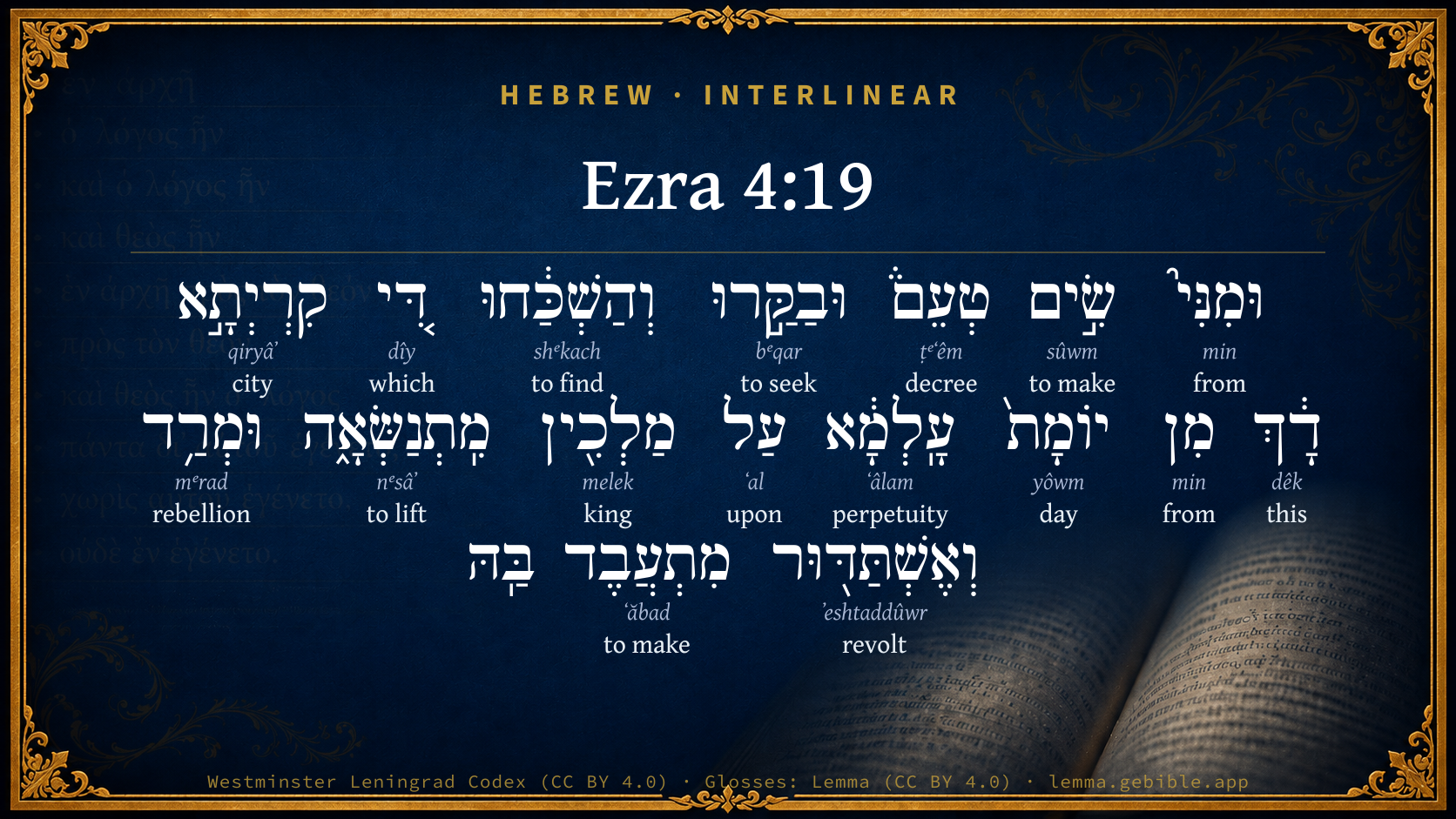
Ezra 4:19

Hebrew (Westminster Leningrad Codex) Ezra 4:19 appears in the Hebrew Old Testament. The text above is from the Westminster Leningrad Codex. Each word links to its Strong’s number, a concise gloss, and parsing drawn from the Open Scriptures Hebrew Bible morphology. Click any word for its full Brown-Driver-Briggs (BDB) entry.
Download image
Cite this verse

Ezra 4:19 (World English Bible). Public Domain. Lemma interlinear Bible study tool, https://lemma.gebible.app/v/ezra/4/19.

Show BibTeX & RIS
BibTeX
RIS
English Translation
I decreed, and search has been made, and it is found that this city of old time has made insurrection against kings, and that rebellion and sedition have been made therein.
World English Bible · Public Domain
Highlights
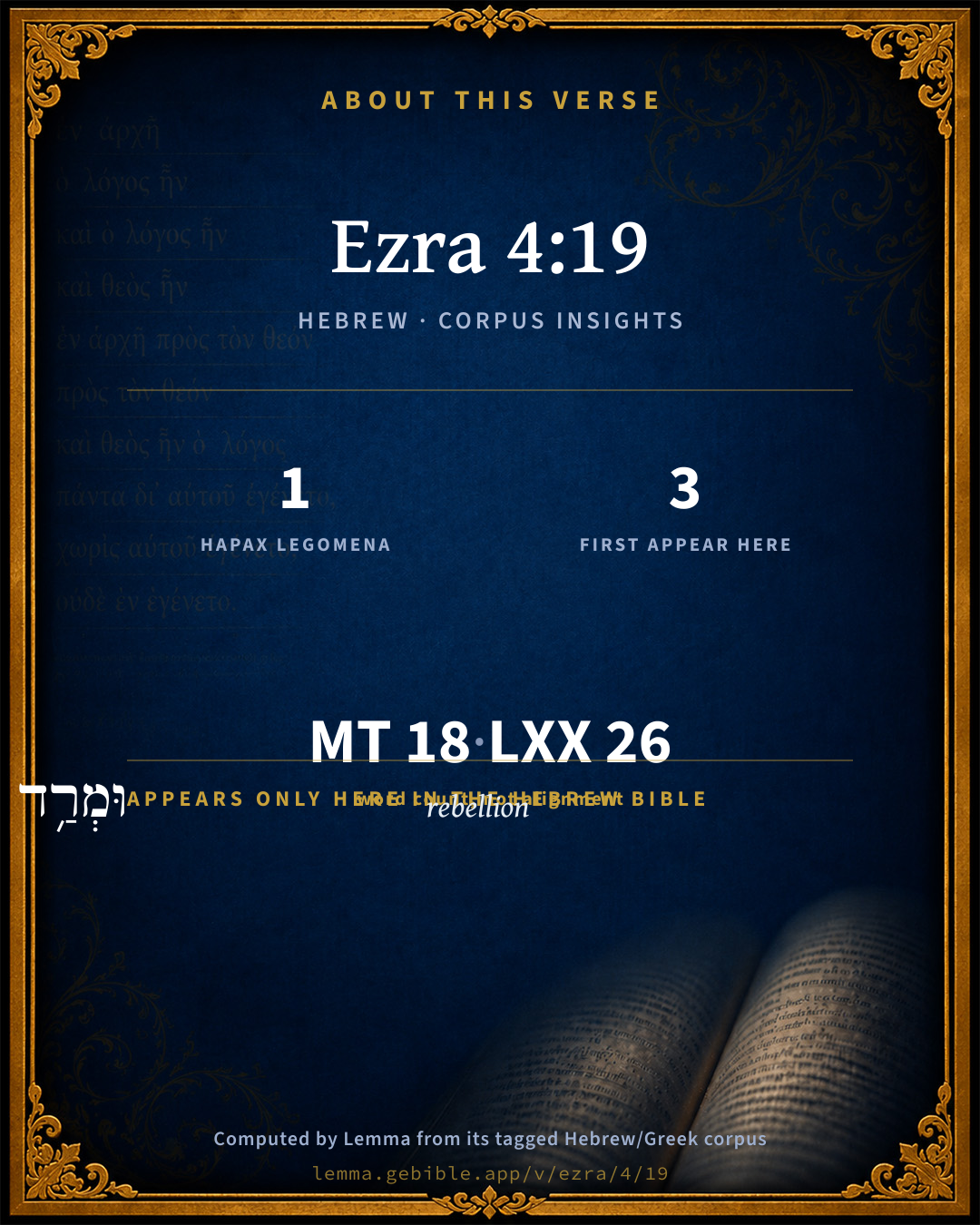
  • 1 hapax legomenon — only here in the Hebrew Bible
  • 3 first appearances in the Hebrew Bible
Full analysis ↓
Download a study sheet

One document with this verse’s original text, its word-by-word gloss line, the meaning frame, cross-references with their text, attributed commentary, and full source and license credits — printable, and it pastes into notes with its structure intact.

This verse Autodidact and up

Study sheet (.html) Plain text (.txt)

A passage Seminary Student

Up to 50 verses in one chapter. A passage sheet keeps up to 6 commentary sources and 12 cross-references per verse, in the order this page ranks them, and says so on the sheet whenever that leaves anything out. Ask for a single verse and you get the Autodidact verse sheet above.

Everything on this page stays free to read, with no account — the sheet is a download of what is already on screen, not access to it.

Want to remove ads? Support Godless Engineer
Compare translations 3

The same verse in 3 English versions, stacked beneath the original-language interlinear above. Click any original word for its lexicon entry.

Each is an independent rendering of the whole verse — the interlinear is not word-aligned to these translations.

Highlighted words mark where these versions differ — a whole-verse word diff, not a word-by-word alignment.

  • World English Bible Public Domain
    I decreed, and search has been made, and it is found that this city of old time has made insurrection against kings, and that rebellion and sedition have been made therein.
  • King James Version Public Domain
    And I commanded, and search hath been made, and it is found that this city of old time hath made insurrection against kings, and that rebellion and sedition have been made therein.
  • unfoldingWord Literal Text CC BY-SA 4.0
    So from me was set a decree, and they searched and discovered that that city since the ancient days has risen up against kings and rebellion and revolt have been made in it.

unfoldingWord Literal Text — © unfoldingWord, licensed CC BY-SA 4.0. Word-aligned USFM3 via Door43 (git.door43.org/unfoldingWord/en_ult).

Versions to compare (up to 4)

3 of 4 selected

Show all 18 translations

Every available English version of this verse, each an independent rendering of the whole verse.

  • World English Bible Public Domain
    I decreed, and search has been made, and it is found that this city of old time has made insurrection against kings, and that rebellion and sedition have been made therein.
  • Berean Standard Bible Public Domain
    I issued a decree, and a search was conducted. It was discovered that this city has revolted against kings from ancient times, engaging in rebellion and sedition.
  • Majority Standard Bible Public Domain
    I issued a decree, and a search was conducted. It was discovered that this city has revolted against kings from ancient times, engaging in rebellion and sedition.
  • King James Version Public Domain
    And I commanded, and search hath been made, and it is found that this city of old time hath made insurrection against kings, and that rebellion and sedition have been made therein.
  • American Standard Version (1901) Public Domain
    And I decreed, and search hath been made, and it is found that this city of old time hath made insurrection against kings, and that rebellion and sedition have been made therein.
  • Revised Version (1885) Public Domain
    And I decreed, and search hath been made, and it is found that this city of old time hath made insurrection against kings, and that rebellion and sedition have been made therein.
  • Geneva Bible (1599) Public Domain
    And I haue commanded and they haue searched, and founde, that this citie of olde time hath made insurrection against kings, and hath rebelled, and rebellion hath bene committed therein.
  • Douay-Rheims (1899) Public Domain
    And I commanded: and search hath been made, and it is found, that this city of old time hath rebelled against kings, and seditions and wars have been raised therein.
  • Young's Literal Translation Public Domain
    and by me a decree hath been made, and they sought, and have found that this city from the days of old against kings is lifting up itself, and rebellion and sedition is made in it,
  • Literal Standard Version CC BY-SA 4.0
    and by me a decree has been made, and they sought, and have found that this city is lifting up itself against kings from the days of old, and rebellion and sedition is made in it,
  • Unlocked Literal Bible CC BY-SA 4.0
    So I ordered an investigation and discovered that in previous days they had rebelled and revolted against kings.
  • unfoldingWord Literal Text CC BY-SA 4.0
    So from me was set a decree, and they searched and discovered that that city since the ancient days has risen up against kings and rebellion and revolt have been made in it.
  • Darby Bible Public Domain
    And I gave orders, and search has been made, and it has been found that this city of old time has made insurrection against the kings, and that rebellion and sedition have been raised therein.
  • World Messianic Bible Public Domain
    I decreed, and search has been made, and it was found that this city has made insurrection against kings in the past, and that rebellion and revolts have been made in it.
  • Webster's Bible Public Domain
    And I commanded, and search hath been made, and it is found that this city of old time hath made insurrection against kings, and that rebellion and sedition have been made in it.
  • Free Bible Version CC BY-SA 4.0
    I ordered a search to be conducted. It was discovered that this city has often risen up in revolt against kings in the past, frequently promoting insurrection and rebellion.
  • Bible in Basic English Public Domain
    And I gave orders for a search to be made, and it is certain that in the past this town has made trouble for kings, and that outbursts against authority have taken place there.
  • JPS Tanakh (1917) Public Domain
    And I decreed, and search hath been made, and it is found that this city of old time hath made insurrection against kings, and that rebellion and sedition have been made therein.

Literal Standard Version (2020), Covenant Press — licensed CC BY-SA 4.0. Text via the HelloAO Bible API (eBible.org). Unlocked Literal Bible (unfoldingWord) — licensed CC BY-SA 4.0. Text via the HelloAO Bible API (eBible.org). unfoldingWord Literal Text — © unfoldingWord, licensed CC BY-SA 4.0. Word-aligned USFM3 via Door43 (git.door43.org/unfoldingWord/en_ult). Free Bible Version, Dr. Jonathan Gallagher — licensed CC BY-SA 4.0. Text via the HelloAO Bible API (eBible.org).

Word by word

More ways to search: Search by grammar → Find every occurrence → Compare this word →

Practice this passage: Drill this verse → Learn its vocabulary →

וּמְרַ֥ד
mᵉrad
H4776
“and · rebellion”
Adjective, C + Noun, Common, Masculine, Singular, Absolute
Part of Speech
Adjective + Noun
Type
Common
Gender
Masculine
Number
Singular
State
Absolute
Full BDB Definition

Origin: from a root corresponding to H4775

TWOT: 2840a

rebellion
  1. וּמִנִּי֮ min H4481 “and · from · me” Adjective, C + Preposition + Suffix, Personal, 1st Person, Common, Singular
  2. שִׂ֣ים sûwm H7761 “to make” Adjective, V, Plural
  3. טְעֵם֒ ṭᵉʻêm H2942 “decree” Adjective, N, Common
  4. וּבַקַּ֣רוּ bᵉqar H1240 “and · to seek” Adjective, C + Verb, Piel, Perfect, 3rd Person, Masculine, Plural
  5. וְהַשְׁכַּ֔חוּ shᵉkach H7912 “and · to find” Adjective, C + Verb, Hiphil, Perfect, 3rd Person, Masculine, Plural
  6. דִּ֚י dîy H1768 “which” Adjective, T
  7. קִרְיְתָ֣א qiryâʼ H7149 “city · the” Adjective, N, Common + Particle, Definite Article
  8. דָ֔ךְ dêk H1791 “this” Adjective, P
  9. מִן min H4481 “from” Adjective, R
  10. יוֹמָת֙ yôwm H3118 “days of” Adjective, N, Common
  11. עָֽלְמָ֔א ʻâlam H5957 “perpetuity · the” Adjective, N, Common + Particle, Definite Article
  12. עַל ʻal H5922 “upon” Adjective, R
  13. מַלְכִ֖ין melek H4430 “kings” Adjective, N, Common
  14. מִֽתְנַשְּׂאָ֑ה nᵉsâʼ H5376 “lifting” Adjective, V
  15. וְאֶשְׁתַּדּ֖וּר ʼeshtaddûwr H849 “and · revolt” Adjective, C + Noun, Common, Masculine, Singular, Absolute
  16. מִתְעֲבֶד ʻăbad H5648 “made” Adjective, V, Singular

About this verse

These counts appear in no published source. They are computed here, from the morphology-tagged text and Lemma’s own curated glosses. What Lemma adds →

18
words
16
distinct lemmas
Historical
section

Notable vocabulary

1 hapax legomenon — a word that appears only here in the entire Hebrew Bible:

  • וּמְרַ֥ד rebellion H4776

First appearance in Scripture

These words make their first canonical appearance in the Hebrew Bible here:

  • שִׂ֣ים to make H7761
  • מִֽתְנַשְּׂאָ֑ה to lift H5376
  • וּמְרַ֥ד rebellion H4776

Shared distinctive vocabulary

וְאֶשְׁתַּדּ֖וּר revolt H849 occurs in 2 verses of the Hebrew Bible. Also found in:

Grammatical profile

  • 2 verbs
  • 2 nouns
  • 11 adjectives
  • 1 preposition
  • 2 particles

Verb forms

  • וּבַקַּ֣רוּ Piel · Perfect
  • וְהַשְׁכַּ֔חוּ Hiphil · Perfect

Repetition

A word recurs within this verse — often emphatic in Hebrew:

  • וּמִנִּי֮ from H4481 ×2

Hebrew & Septuagint length

In English translation the verse runs 31 words from the Hebrew and 32 from the Septuagint (LXX English) — closely comparable.

A rough comparison of the two English renderings, which tokenize alike — not a word-level alignment.

Word counts can differ between the Hebrew and the Greek without any difference in meaning — e.g. the Hebrew direct-object marker אֵת has no separate Greek word, and Greek often adds the article ὁ.

In the original languages it is 18 Hebrew tokens and 26 Greek tokens — but the two are counted differently (Hebrew bundles its prefixes and suffixes into one token; the Greek is in lemma form), so that isn’t a like-for-like length.

Cross-references

7

Topical passages linked to Ezra 4:19 in the Treasury of Scripture Knowledge — connected by theme and wording, ordered by reader-vote popularity; previews shown in the World English Bible.

  • 2 Kings 18:7 Yahweh was with him; wherever he went forth he prospered: and he rebelled against the king of Assyria, and didn't serve him.
  • Proverbs 25:2 It is the glory of God to conceal a thing, But the glory of kings is to search out a matter.
  • Deuteronomy 13:14 then shall you inquire, and make search, and ask diligently; and, behold, if it be truth, and the thing certain, that such abomination is done in the midst of you,
  • 2 Kings 24:20 For through the anger of Yahweh did it happen in Jerusalem and Judah, until he had cast them out from his presence. Zedekiah rebelled against the king of Babylon.
  • Ezra 4:15 that search may be made in the book of the records of your fathers: so shall you find in the book of the records, and know that this city is a rebellious city, and hurtful to kings and provinces, and that they have moved sedition within the same of old time; for which cause was this city laid waste.
  • Ezra 5:17–6:2 Now therefore, if it seem good to the king, let there be search made in the king's treasure-house, which is there at Babylon, whether it be so, that a decree was made of Cyrus the king to build this house of God at Jerusalem; and let the king send his pleasure to us concerning this matter.
  • Ezekiel 17:13–19 and he took of the seed royal, and made a covenant with him; he also brought him under an oath, and took away the mighty of the land;

Cross-references courtesy of OpenBible.info (CC BY 4.0).

Hebrew and Greek witnesses Masoretic Hebrew ↔ Greek Septuagint

The same verse in the two great witnesses to the Old Testament, shown verse-for-verse.

These are two independent witnesses, not word-aligned to each other, and the Septuagint is shown in lemma (dictionary) form.

Hebrew Ezra 4:19 Masoretic · Westminster Leningrad Codex

וּמִנִּי֮ שִׂ֣ים טְעֵם֒ וּבַקַּ֣רוּ וְהַשְׁכַּ֔חוּ דִּ֚י קִרְיְתָ֣א דָ֔ךְ מִן יוֹמָת֙ עָֽלְמָ֔א עַל מַלְכִ֖ין מִֽתְנַשְּׂאָ֑ה וּמְרַ֥ד וְאֶשְׁתַּדּ֖וּר מִתְעֲבֶד בַּֽהּ

I decreed, and search has been made, and it is found that this city of old time has made insurrection against kings, and that rebellion and sedition have been made therein.

World English Bible · Public Domain

Greek LXX Ezra 4:19 Septuagint · lemma form

καί παρά ἐγώ τίθημι γνώμη καί ἐπισκέπτομαι καί εὑρίσκω ὅτι ὁ πόλις ἐκεῖνος ἀπό ἡμέρα αἰών ἐπί βασιλεύς ἐπιαἴρω καί ἀπόστασις καί φυγάδιον γίγνομαι ἐν αὐτός

And a decree has been made by me, and we have examined, and found that city of old time exalts itself against kings, and that rebellions and desertions take place within it.

LXX2012 (modern English Septuagint) · Public Domain

In the Septuagint this is one book — Esdras B (2 Esdras): Ezra is chapters 1–10, Nehemiah 11–23.

Hebrew: Westminster Leningrad Codex (CC BY 4.0). Greek: Septuagint (public domain); English from LXX2012 (modern English Septuagint) (Public Domain). How the Septuagint differs from the Hebrew →

Commentary

Notes on Ezra 4:19 from classic Christian and Jewish commentators (each source and its license shown beneath its notes). The classic Christian expositions comment on the surrounding passage and are grouped to its opening verse, so a note may address several verses; the Jewish commentaries on the Tanakh (Rashi and others) are per-verse, so they appear only where the commentator wrote on this verse.

Lemma curates 59 commentaries, every one of them public domain or Creative Commons licensed, each selected and text-cleaned for this edition rather than reprinted as found. About our sources →

Trapp's Complete Commentary

John Trapp

Ezr 4:19 And I commanded, and search hath been made, and it is found that this city of old time hath made insurrection against kings, and [that] rebellion and sedition have been made therein.

Ver. 19. Hath made insurrection against kings] Chaldee, lift up itself against kings. Pride is painted with a triple crown on her head; upon the first whereof is written Transcendo; , I ascend; upon the second, Non obedio; , I disobey; upon the third, Perturbo. , I throw into confusion; Wat Tyler the rebel dared to say, that all the laws of England should come out of his mouth.

John Trapp, A Commentary or Exposition upon All the Books of the Old and New Testament (1647–1656) — public domain. Text from a community e-Sword module.

Joseph Benson's Commentary

Ezr 4:19-20. That rebellion and sedition have been found therein — One instance or two of it, in latter times, had served to fasten this odious character upon them, as if they had been always guilty of these crimes. There have been mighty kings also over Jerusalem — And therefore the king thought it not advisable to permit them to go on with rebuilding the city, lest they should become powerful again.

Joseph Benson's Commentary on the Old and New Testaments (1811–1818) — public domain. Text from a community e-Sword module.

Tyndale Open Study Notes

Tyndale Open Resources

4:19-20 King Jehoiakim (609–598 BC) had rebelled against Babylon in about 601 BC, and King Zedekiah (597–586 BC) had rebelled in about 588 BC (see 2 Kgs 25:2).

Tyndale Open Study Notes — © Tyndale Open Resources, licensed CC BY-SA 4.0. Text via the HelloAO Bible API.

Adam Clarke's Commentary

Verse 19. Hath made insurrection against kings] Mow true is the proverb, "It is an easy thing to find a staff to beat a dog!" The struggles of the Israelites to preserve or regain their independency, which they had from God, are termed insurrection, rebellion, and sedition: because at last they fell under the power of their oppressors. Had they been successful in these struggles, such offensive words had never been used. In 1688 the people of England struggled to throw off an oppressive government, that was changing the times and the seasons, and overthrowing the religion of the country, and setting up in its place the spurious off-spring of popery and arbitrary government. They were successful; and it is called the Revolution: had they failed it would have been called rebellion; and the parties principally concerned would have been put to death.

Adam Clarke's Commentary on the Bible (1810–1826) — public domain. Text from a community e-Sword/MySword module.

Ellicott's Commentary for English Readers

(19) Insurrection.—Never against Persia; but such as are alluded to in 2 Kings 24

A Bible Commentary for English Readers, edited by Charles John Ellicott (1878–1897) — public domain. Text from a community e-Sword module.

The Cambridge Bible for Schools and Colleges

gen. ed. J. J. S. Perowne

19. And I commanded] R.V. decreed. A more authoritative word. Literally, ‘and from me was a decree made’; and they searched, ‘and found’.

of old time] Cf. Ezr_4:15.

hath made insurrection against kings] By the insurrections against kings and the sedition and rebellion of Jerusalem here mentioned as being recorded in the chronicles of the state is probably meant the treacherous and unstable policy of Jehoiakim, Jehoiachin, and Zedekiah (see 2Ki_24:1; 2Ki_24:10; 2Ki_24:20). Of this the Babylonian records would preserve the testimony. It is less likely that the more ancient records of the Assyrian Empire containing the account of Hezekiah’s revolt from Sennacherib would have been consulted.

The Cambridge Bible for Schools and Colleges (gen. ed. J. J. S. Perowne; Cambridge University Press, 1878–1918) — public domain. Text from a community e-Sword module.

John Gill's Exposition

There have been mighty kings also over Jerusalem, which have ruled over all countries beyond the river,.... As David and Solomon; and the account of these they had in their records, see Sa2 8:1

and toll, tribute, and custom, was paid unto them; as appears from the places referred to; and this served to strengthen the insinuation made to the king, that if these people were suffered to go on building, he would lose his tribute and taxes in those parts.

John Gill's Exposition of the Whole Bible (1746–1763) — public domain (CC PDM 1.0). Text via the HelloAO Bible API.

Albert Barnes' Notes on the Bible

The archives of the Babylonian kingdom would contain accounts of the insurrections raised, or threatened, by Jehoiakim, Jehoiachin, and Zedekiah 2Ki 24:1, 2Ki 24:10, 2Ki 24:20. It does not appear that there had ever been any rebellion against Persia.

Albert Barnes' Notes on the Bible (1834–1885) — public domain. Text from a community e-Sword/MySword module.

Haydock's Catholic Bible Commentary

Seditions: so are styled the just efforts of the Jews, to keep or to regain their liberty. (Calmet)

George Leo Haydock (1774–1849), Haydock's Catholic Family Bible and Commentary, 1859 edition — public domain. Excludes Psalms (Douay-Rheims chapter numbering differs from Protestant) and Deuterocanonical books (Catholic canon only).

The Pulpit Commentary

I commanded, and search has been made. The Pseudo-Smerdis, who was a fanatical adherent of Magism, which disallowed temples altogether (Herod., 1:130), and who had already destroyed the temples of Ormuzd in Persia ("Behistun Ins.," col. 1. par. 14, 5), was naturally willing enough to do as the Samaritans desired, and stop the restoration of the Jewish temple. Accordingly, he had a search made among the state records, and found, as they had expected he would, evidence of insurrections on the part of the Jews against the foreign countries to which they had been subject, as Assyria (2Ki_18:7) and Babylon (ibid. 24:1; Jer_52:3) and also proof of the formidable power possessed by certain Jewish or Israelite kings; upon which he thought himself justified in complying with the Samaritan request, and ordering the work that was going on at Jerusalem to cease (see ver. 21).

The Pulpit Commentary (1880–1919), ed. H.D.M. Spence-Jones & Joseph S. Exell — public domain. Text from a community e-Sword module.

Rashi

Rabbi Shlomo Yitzchaki (Rashi)

the order was given And the order was given by me, the matter of a command that I commanded.

and they searched and found And they searched in the annals of the kings and found written that this city, from days of yore, would raise itself up and exalt itself over all the kings of the nations.

and rebellion. and disobedience were committed there to rebel against the kings of the nations.

Rashi on the Tanakh — English translations: “The Judaica Press complete Tanach with Rashi, translated by A. J. Rosenberg” (CC BY 4.0); “Pentateuch with Rashi's commentary by M. Rosenbaum and A.M. Silbermann, 1929-1934” (public domain); “The Metsudah Tanach series, Lakewood, N.J” (CC BY 4.0); and “The Book of Joshua, Metsudah Publications, 1997” (CC BY 4.0). Text via Sefaria.

Lesson kit

Teaching starters — assembled from the data on this page, not authored interpretation. Every prompt links to the verse data it draws on. Edit before teaching.

Ezra, in the Historical, opens this verse with 18 words (16 distinct Hebrew lemmas). Its most distinctive word is mᵉrad (“rebellion”). A historical commentator’s framing appears above. Read the whole chapter for the surrounding context.

Discussion questions

  1. What does “rebellion” (mᵉrad) contribute to the verse as a whole?
  2. This verse holds 1 word here found nowhere else in the Hebrew Bible. What might the rare word draw attention to?
  3. 3 words here appear for the first time in Scripture. What is being introduced at this debut?
  4. Ezra 4:15 shares the word «revolt» with this verse. How do the two illuminate each other?
  5. “from” occurs 2× in this one verse. What is the effect of the repetition?
  6. These translations render this verse differently; the difference is in the English rendering, not the original. What questions does that raise?
  7. The verb «וּבַקַּ֣רוּ» is Piel Perfect. How does its form color the action?
  8. Reading how Trapp's Complete Commentary and Joseph Benson's Commentary read this verse, where do the two commentators agree and where do they part?

Things to notice

  • 1 word in this verse appears nowhere else in the Hebrew Bible.
  • 3 words make their first canonical appearance in Scripture here.
  • This verse counts 18 Hebrew ↔ 26 Greek words.
  • These translations choose different wording for 22 words in this verse.
  • “from” occurs 2× in this single verse.

Reading settings

Reading text

Shown beneath each verse's original-language words.

Old Testament
Old Testament edition

Read the OT as the Masoretic Hebrew (MT) or the Greek Septuagint (LXX).

English shown for the Greek Septuagint (in the Hebrew ↔ Greek comparison).

Comparing translations? Open the Compare panel on any verse page to stack up to four side by side.