
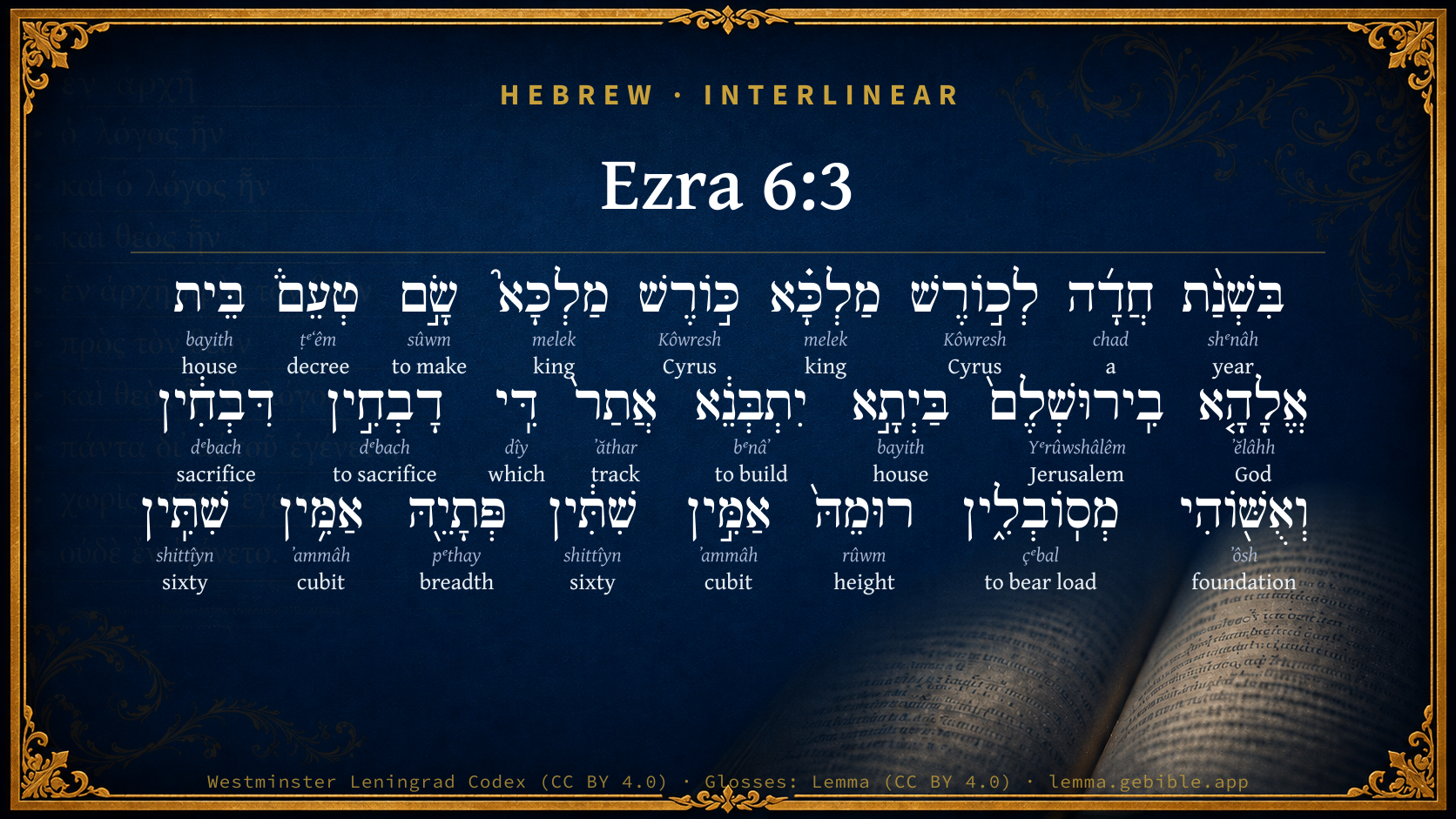
Ezra 6:3

Hebrew (Westminster Leningrad Codex) Ezra 6:3 appears in the Hebrew Old Testament. The text above is from the Westminster Leningrad Codex. Each word links to its Strong’s number, a concise gloss, and parsing drawn from the Open Scriptures Hebrew Bible morphology. Click any word for its full Brown-Driver-Briggs (BDB) entry.
Download image
Cite this verse

Ezra 6:3 (World English Bible). Public Domain. Lemma interlinear Bible study tool, https://lemma.gebible.app/v/ezra/6/3.

Show BibTeX & RIS
BibTeX
RIS
English Translation
In the first year of Cyrus the king, Cyrus the king made a decree: Concerning the house of God at Jerusalem, let the house be built, the place where they offer sacrifices, and let the foundations of it be strongly laid; the height of it sixty cubits, and the breadth of it sixty cubits;
World English Bible · Public Domain
Highlights
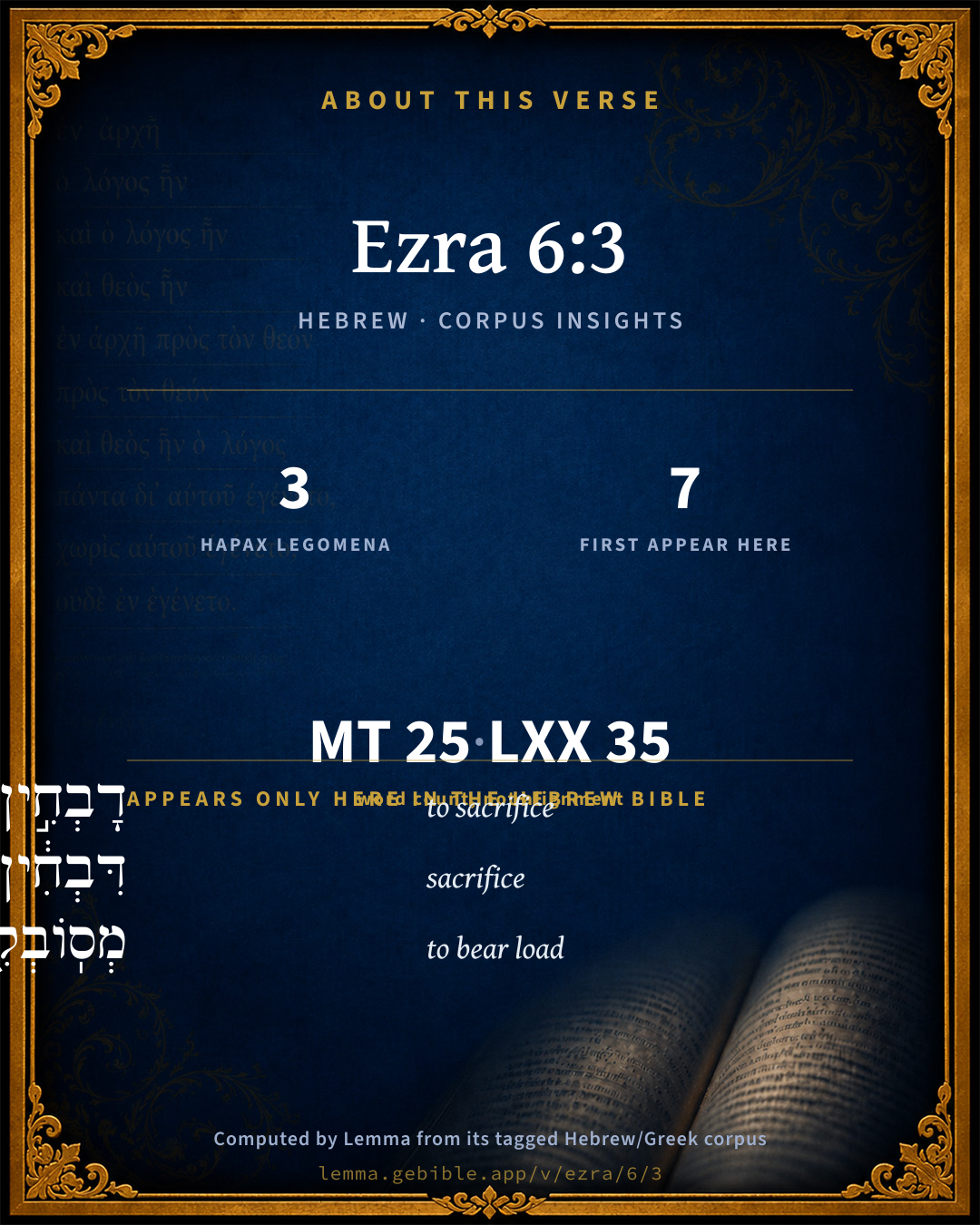
  • 3 hapax legomena — only here in the Hebrew Bible
  • 7 first appearances in the Hebrew Bible
Full analysis ↓
Download a study sheet

One document with this verse’s original text, its word-by-word gloss line, the meaning frame, cross-references with their text, attributed commentary, and full source and license credits — printable, and it pastes into notes with its structure intact.

This verse Autodidact and up

Study sheet (.html) Plain text (.txt)

A passage Seminary Student

Up to 50 verses in one chapter. A passage sheet keeps up to 6 commentary sources and 12 cross-references per verse, in the order this page ranks them, and says so on the sheet whenever that leaves anything out. Ask for a single verse and you get the Autodidact verse sheet above.

Everything on this page stays free to read, with no account — the sheet is a download of what is already on screen, not access to it.

Want to remove ads? Support Godless Engineer
Compare translations 3

The same verse in 3 English versions, stacked beneath the original-language interlinear above. Click any original word for its lexicon entry.

Each is an independent rendering of the whole verse — the interlinear is not word-aligned to these translations.

Highlighted words mark where these versions differ — a whole-verse word diff, not a word-by-word alignment.

  • World English Bible Public Domain
    In the first year of Cyrus the king, Cyrus the king made a decree: Concerning the house of God at Jerusalem, let the house be built, the place where they offer sacrifices, and let the foundations of it be strongly laid; the height of it sixty cubits, and the breadth of it sixty cubits;
  • King James Version Public Domain
    In the first year of Cyrus the king the same Cyrus the king made a decree concerning the house of God at Jerusalem, Let the house be builded, the place where they offered sacrifices, and let the foundations thereof be strongly laid; the height thereof threescore cubits, and the breadth thereof threescore cubits;
  • unfoldingWord Literal Text CC BY-SA 4.0
    “In year one of Cyrus the king, Cyrus the king set a decree about the house of God in Jerusalem: ‘Let the house be built, a place where sacrifices are sacrificed, and let its foundations be raised. Its height will be 60 cubits. Its width will be 60 cubits,

unfoldingWord Literal Text — © unfoldingWord, licensed CC BY-SA 4.0. Word-aligned USFM3 via Door43 (git.door43.org/unfoldingWord/en_ult).

Versions to compare (up to 4)

3 of 4 selected

Show all 18 translations

Every available English version of this verse, each an independent rendering of the whole verse.

  • World English Bible Public Domain
    In the first year of Cyrus the king, Cyrus the king made a decree: Concerning the house of God at Jerusalem, let the house be built, the place where they offer sacrifices, and let the foundations of it be strongly laid; the height of it sixty cubits, and the breadth of it sixty cubits;
  • Berean Standard Bible Public Domain
    In the first year of King Cyrus, he issued a decree concerning the house of God in Jerusalem: Let the house be rebuilt as a place for offering sacrifices, and let its foundations be firmly laid. It is to be sixty cubits high and sixty cubits wide,
  • Majority Standard Bible Public Domain
    In the first year of King Cyrus, he issued a decree concerning the house of God in Jerusalem: Let the house be rebuilt as a place for offering sacrifices, and let its foundations be firmly laid. It is to be sixty cubits high and sixty cubits wide,
  • King James Version Public Domain
    In the first year of Cyrus the king the same Cyrus the king made a decree concerning the house of God at Jerusalem, Let the house be builded, the place where they offered sacrifices, and let the foundations thereof be strongly laid; the height thereof threescore cubits, and the breadth thereof threescore cubits;
  • American Standard Version (1901) Public Domain
    In the first year of Cyrus the king, Cyrus the king made a decree: Concerning the house of God at Jerusalem, let the house be builded, the place where they offer sacrifices, and let the foundations thereof be strongly laid; the height thereof threescore cubits, and the breadth thereof threescore cubits;
  • Revised Version (1885) Public Domain
    In the first year of Cyrus the king, Cyrus the king made a decree; Concerning the house of God at Jerusalem, let the house be builded, the place where they offer sacrifices, and let the foundations thereof be strongly laid; the height thereof threescore cubits, and the breadth thereof threescore cubits;
  • Geneva Bible (1599) Public Domain
    IN THE FIRST yeere of King Cyrus, King Cyrus made a decree for the house of God in Ierusalem, Let the house be buylt, euen the place where they offred sacrifices, and let the walles thereof be ioyned together: let the height thereof be three score cubites, and the breadth thereof three score cubites,
  • Douay-Rheims (1899) Public Domain
    In the first year of Cyrus the king: Cyrus the king decreed, that the house of God should be built, which is in Jerusalem, in the place where they may offer sacrifices, and that they lay the foundations that may support the height of threescore cubits, and the breadth of threescore cubits,
  • Young's Literal Translation Public Domain
    `In the first year of Cyrus the king, Cyrus the king hath made a decree concerning the house of God in Jerusalem: the house let be builded in the place where they are sacrificing sacrifices, and its foundations strongly laid; its height sixty cubits, its breadth sixty cubits;
  • Literal Standard Version CC BY-SA 4.0
    “In the first year of Cyrus the king, Cyrus the king has made a decree concerning the house of God in Jerusalem: let the house be built in the place where they are sacrificing sacrifices, and its foundations strongly laid; its height sixty cubits, its breadth sixty cubits;
  • Unlocked Literal Bible CC BY-SA 4.0
    “In the first year of King Cyrus, Cyrus issued a decree about the house of God in Jerusalem: 'Let the house be rebuilt as a place for sacrifice, let its foundations be laid, let its height be sixty cubits, and its width sixty cubits,
  • unfoldingWord Literal Text CC BY-SA 4.0
    “In year one of Cyrus the king, Cyrus the king set a decree about the house of God in Jerusalem: ‘Let the house be built, a place where sacrifices are sacrificed, and let its foundations be raised. Its height will be 60 cubits. Its width will be 60 cubits,
  • Darby Bible Public Domain
    In the first year of king Cyrus, king Cyrus made a decree [concerning] the house of God at Jerusalem: Let the house be built for a place where they offer sacrifices, and let its foundations be solidly laid; its height sixty cubits, its breadth sixty cubits,
  • World Messianic Bible Public Domain
    In the first year of Cyrus the king, Cyrus the king made a decree: Concerning God’s house at Jerusalem, let the house be built, the place where they offer sacrifices, and let its foundations be strongly laid, with its height sixty cubits and its width sixty cubits;
  • Webster's Bible Public Domain
    In the first year of Cyrus the king, the same Cyrus the king made a decree concerning the house of God at Jerusalem, Let the house be built, the place where they offered sacrifices, and let the foundations of it be strongly laid; the hight of it sixty cubits, and the breadth of it sixty cubits;
  • Free Bible Version CC BY-SA 4.0
    In the first year of King Cyrus, he issued a decree regarding God's Temple in Jerusalem: Let the Temple be rebuilt as a place where sacrifices are offered, and ensure it has strong foundations. Make it sixty cubits high and sixty cubits wide,
  • Bible in Basic English Public Domain
    In the first year of Cyrus the king, Cyrus the king made an order: In connection with the house of God at Jerusalem, let the house be put up, the place where they make offerings, and let the earth for the bases be put in place; let it be sixty cubits high and sixty cubits wide;
  • JPS Tanakh (1917) Public Domain
    In the first year of Cyrus the king, Cyrus the king made a decree: Concerning the house of God at Jerusalem, let the house be builded, the place where they offer sacrifices, and let the foundations thereof be strongly laid; the height thereof threescore cubits, and the breadth thereof threescore cubits;

Literal Standard Version (2020), Covenant Press — licensed CC BY-SA 4.0. Text via the HelloAO Bible API (eBible.org). Unlocked Literal Bible (unfoldingWord) — licensed CC BY-SA 4.0. Text via the HelloAO Bible API (eBible.org). unfoldingWord Literal Text — © unfoldingWord, licensed CC BY-SA 4.0. Word-aligned USFM3 via Door43 (git.door43.org/unfoldingWord/en_ult). Free Bible Version, Dr. Jonathan Gallagher — licensed CC BY-SA 4.0. Text via the HelloAO Bible API (eBible.org).

Word by word

More ways to search: Search by grammar → Find every occurrence → Compare this word →

Practice this passage: Drill this verse → Learn its vocabulary →

דָבְחִ֣ין
dᵉbach
H1684
“sacrificing”
Adjective, V
Part of Speech
Adjective
Full BDB Definition

Origin: corresponding to H2076

TWOT: 2665

(Peal) to sacrifice
  1. בִּשְׁנַ֨ת shᵉnâh H8140 “in/at · year of” Adjective, R + Noun, Common, Feminine, Singular, Construct
  2. חֲדָ֜ה chad H2298 “a” Adjective, A, Common
  3. לְכ֣וֹרֶשׁ Kôwresh H3567 “to/for · Cyrus” Adjective, R + Noun, Proper
  4. מַלְכָּ֗א melek H4430 “king · the” Adjective, N, Common + Particle, Definite Article
  5. כּ֣וֹרֶשׁ Kôwresh H3567 “Cyrus” Adjective, N
  6. מַלְכָּא֮ melek H4430 “king · the” Adjective, N, Common + Particle, Definite Article
  7. שָׂ֣ם sûwm H7761 “to make” Adjective, V, Plural
  8. טְעֵם֒ ṭᵉʻêm H2942 “decree” Adjective, N, Common
  9. בֵּית bayith H1005 “house of” Adjective, N, Common
  10. אֱלָהָ֤א ʼĕlâhh H426 “God · the” Adjective, N, Common + Particle, Definite Article
  11. בִֽירוּשְׁלֶם֙ Yᵉrûwshâlêm H3390 “in/at · Jerusalem” Adjective, R + Noun, Proper
  12. בַּיְתָ֣א bayith H1005 “house · the” Adjective, N, Common + Particle, Definite Article
  13. יִתְבְּנֵ֔א bᵉnâʼ H1124 “to build” Adjective, V
  14. אֲתַר֙ ʼăthar H870 “track” Adjective, N, Common
  15. דִּֽי dîy H1768 “which” Adjective, T
  16. דִּבְחִ֔ין dᵉbach H1685 “sacrifices” Adjective, N, Common
  17. וְאֻשּׁ֖וֹהִי ʼôsh H787 “and · foundations · his” Adjective, C + Noun, Common, Masculine, Plural, Construct + Suffix, Personal, 3rd Person, Masculine, Singular
  18. מְסֽוֹבְלִ֑ין çᵉbal H5446 “borne load” Adjective, V, Singular
  19. רוּמֵהּ֙ rûwm H7314 “height · his” Adjective, N, Common + Suffix, Personal, 3rd Person, Masculine, Singular
  20. אַמִּ֣ין ʼammâh H521 “cubits” Adjective, N, Common
  21. שִׁתִּ֔ין shittîyn H8361 “sixty” Adjective, A, Common
  22. פְּתָיֵ֖הּ pᵉthay H6613 “breadth · his” Adjective, N, Common + Suffix, Personal, 3rd Person, Masculine, Singular
  23. אַמִּ֥ין ʼammâh H521 “cubits” Adjective, N, Common
  24. שִׁתִּֽין shittîyn H8361 “sixty” Adjective, A, Common

About this verse

These counts appear in no published source. They are computed here, from the morphology-tagged text and Lemma’s own curated glosses. What Lemma adds →

25
words
20
distinct lemmas
Historical
section

Notable vocabulary

3 hapax legomena — words that appear only here in the entire Hebrew Bible:

  • דָבְחִ֣ין to sacrifice H1684
  • דִּבְחִ֔ין sacrifice H1685
  • מְסֽוֹבְלִ֑ין to bear load H5446

First appearance in Scripture

These words make their first canonical appearance in the Hebrew Bible here:

  • דָבְחִ֣ין to sacrifice H1684
  • דִּבְחִ֔ין sacrifice H1685
  • מְסֽוֹבְלִ֑ין to bear load H5446
  • רוּמֵהּ֙ height H7314
  • אַמִּ֣ין cubit H521
  • שִׁתִּ֔ין sixty H8361
  • פְּתָיֵ֖הּ breadth H6613

Shared distinctive vocabulary

פְּתָיֵ֖הּ breadth H6613 occurs in 2 verses of the Hebrew Bible. Also found in:

Grammatical profile

  • 4 nouns
  • 17 adjectives
  • 4 particles

Repetition

Words recur within this verse — often emphatic in Hebrew:

  • לְכ֣וֹרֶשׁ Cyrus H3567 ×2
  • מַלְכָּ֗א king H4430 ×2
  • בֵּית house H1005 ×2
  • אַמִּ֣ין cubit H521 ×2
  • שִׁתִּ֔ין sixty H8361 ×2

Hebrew & Septuagint length

In English translation the verse runs 54 words from the Hebrew and 52 from the Septuagint (LXX English) — closely comparable.

A rough comparison of the two English renderings, which tokenize alike — not a word-level alignment.

Word counts can differ between the Hebrew and the Greek without any difference in meaning — e.g. the Hebrew direct-object marker אֵת has no separate Greek word, and Greek often adds the article ὁ.

In the original languages it is 25 Hebrew tokens and 35 Greek tokens — but the two are counted differently (Hebrew bundles its prefixes and suffixes into one token; the Greek is in lemma form), so that isn’t a like-for-like length.

Cross-references

10

Topical passages linked to Ezra 6:3 in the Treasury of Scripture Knowledge — connected by theme and wording, ordered by reader-vote popularity; previews shown in the World English Bible.

  • 2 Chronicles 36:22 Now in the first year of Cyrus king of Persia, that the word of Yahweh by the mouth of Jeremiah might be accomplished, Yahweh stirred up the spirit of Cyrus king of Persia, so that he made a proclamation throughout all his kingdom, and [put it] also in writing, saying,
  • Revelation 21:16 The city lies foursquare, and its length is as great as its breadth. He measured the city with the reed, Twelve thousand twelve stadia. Its length, breadth, and height are equal.
  • Deuteronomy 12:5–6 But to the place which Yahweh your God shall choose out of all your tribes, to put his name there, even to his habitation shall you seek, and there you shall come;
  • 1 Kings 6:2–3 The house which king Solomon built for Yahweh, the length of it was sixty cubits, and the breadth of it twenty [cubits], and the height of it thirty cubits.
  • 2 Chronicles 2:6 But who is able to build him a house, seeing heaven and the heaven of heavens can't contain him? who am I then, that I should build him a house, save only to burn incense before him?
  • 2 Chronicles 3:3–4 Now these are the foundations which Solomon laid for the building of the house of God. The length by cubits after the first measure was sixty cubits, and the breadth twenty cubits.
  • Ezra 5:13–15 But in the first year of Cyrus king of Babylon, Cyrus the king made a decree to build this house of God.
  • Psalms 122:4 Where the tribes go up, even Yah's tribes, According to an ordinance for Israel, To give thanks to the name of Yahweh.
  • Ezekiel 41:13–15 So he measured the house, one hundred cubits long; and the separate place, and the building, with the walls of it, one hundred cubits long;
  • Deuteronomy 12:11–14 then it shall happen that to the place which Yahweh your God shall choose, to cause his name to dwell there, there shall you bring all that I command you: your burnt offerings, and your sacrifices, your tithes, and the heave-offering of your hand, and all your choice vows which you vow to Yahweh.

Cross-references courtesy of OpenBible.info (CC BY 4.0).

Hebrew and Greek witnesses Masoretic Hebrew ↔ Greek Septuagint

The same verse in the two great witnesses to the Old Testament, shown verse-for-verse.

These are two independent witnesses, not word-aligned to each other, and the Septuagint is shown in lemma (dictionary) form.

Hebrew Ezra 6:3 Masoretic · Westminster Leningrad Codex

בִּשְׁנַ֨ת חֲדָ֜ה לְכ֣וֹרֶשׁ מַלְכָּ֗א כּ֣וֹרֶשׁ מַלְכָּא֮ שָׂ֣ם טְעֵם֒ בֵּית אֱלָהָ֤א בִֽירוּשְׁלֶם֙ בַּיְתָ֣א יִתְבְּנֵ֔א אֲתַר֙ דִּֽי דָבְחִ֣ין דִּבְחִ֔ין וְאֻשּׁ֖וֹהִי מְסֽוֹבְלִ֑ין רוּמֵהּ֙ אַמִּ֣ין שִׁתִּ֔ין פְּתָיֵ֖הּ אַמִּ֥ין שִׁתִּֽין

In the first year of Cyrus the king, Cyrus the king made a decree: Concerning the house of God at Jerusalem, let the house be built, the place where they offer sacrifices, and let the foundations of it be strongly laid; the height of it sixty cubits, and the breadth of it sixty cubits;

World English Bible · Public Domain

Greek LXX Ezra 6:3 Septuagint · lemma form

ἐν ἔτος πρῶτος κῦρος βασιλεύς κῦρος ὁ βασιλεύς τίθημι γνώμη περί οἶκος ὁ θεός ὁ ἐν ἰερουσαλήμ οἶκος οἰκοδομέω καί τόπος οὗ θυσιάζω ὁ θυσίασμα καί τίθημι ἔπαρμα ὕψος πῆχυς ἑξήκοντα πλάτος αὐτός πῆχυς ἑξήκοντα

In the first year of king Cyrus, Cyrus the king made a decree concerning the holy house of God that was in Jerusalem, saying, Let the house be built, and the place where they sacrifice the sacrifices. (Also he appointed its elevation, in height sixty cubits; its breadth was of sixty cubits.)

LXX2012 (modern English Septuagint) · Public Domain

In the Septuagint this is one book — Esdras B (2 Esdras): Ezra is chapters 1–10, Nehemiah 11–23.

On this verse, The Cambridge Bible for Schools and Colleges discusses the Septuagint’s reading. Read the note in Commentary ↓

Hebrew: Westminster Leningrad Codex (CC BY 4.0). Greek: Septuagint (public domain); English from LXX2012 (modern English Septuagint) (Public Domain). How the Septuagint differs from the Hebrew →

Commentary

Notes on Ezra 6:3 from classic Christian and Jewish commentators (each source and its license shown beneath its notes). The classic Christian expositions comment on the surrounding passage and are grouped to its opening verse, so a note may address several verses; the Jewish commentaries on the Tanakh (Rashi and others) are per-verse, so they appear only where the commentator wrote on this verse.

Lemma curates 59 commentaries, every one of them public domain or Creative Commons licensed, each selected and text-cleaned for this edition rather than reprinted as found. About our sources →

Trapp's Complete Commentary

John Trapp

Ezr 6:3 In the first year of Cyrus the king [the same] Cyrus the king made a decree [concerning] the house of God at Jerusalem, Let the house be builded, the place where they offered sacrifices, and let the foundations thereof be strongly laid; the height thereof threescore cubits, [and] the breadth thereof threescore cubits;

Ver. 3. The height thereof threescore cubits] Yet was it less than Solomon’s temple, Hag 2:3 Ezr 3:12. Solomon’s cubits therefore were longer (likely) than these here mentioned.

John Trapp, A Commentary or Exposition upon All the Books of the Old and New Testament (1647–1656) — public domain. Text from a community e-Sword module.

Joseph Benson's Commentary

Ezr 6:3. The height thereof threescore cubits — These proportions differ from those of Solomon’s temple, which was but thirty cubits high, only the porch was a hundred and twenty cubits high, and but twenty cubits in breadth. Either therefore Solomon’s cubits were sacred cubits, which were larger than the other, and these but common cubits; or, the sixty cubits of height are meant only for the porch. And the word rendered breadth, should be rendered the extension or the length of it; it being improbable that the king should give orders about the breadth, and none about the length of it.

Joseph Benson's Commentary on the Old and New Testaments (1811–1818) — public domain. Text from a community e-Sword module.

Tyndale Open Study Notes

Tyndale Open Resources

6:3 This decree is recorded in Ezra 1:2-4. • The Temple’s height will be ninety feet, and its width will be ninety feet: The emendations given in the NLT textual note would make these measurements match those of Solomon’s Temple (1 Kgs 6:2, 17, 20). But the larger measurements given here might represent the maximum size that the Persians would fund.

Tyndale Open Study Notes — © Tyndale Open Resources, licensed CC BY-SA 4.0. Text via the HelloAO Bible API.

Adam Clarke's Commentary

Verse 3. The height thereof threescore cubits] This was much larger than the temple of Solomon. This was sixty cubits high, and sixty cubits broad; whereas Solomon's was only twenty cubits broad, and thirty cubits high.

Adam Clarke's Commentary on the Bible (1810–1826) — public domain. Text from a community e-Sword/MySword module.

Ellicott's Commentary for English Readers

(3) Strongly laid.—“Thy foundation shall be laid” (Isa_44:28). The decree adds a word that signifies “with sufficient support.”

A Bible Commentary for English Readers, edited by Charles John Ellicott (1878–1897) — public domain. Text from a community e-Sword module.

The Cambridge Bible for Schools and Colleges

gen. ed. J. J. S. Perowne

3. the same Cyrus the king] R.V. Cyrus the king. See Ezr_5:13.

made a decree concerning the house of God at Jerusalem, Let &c.] R.V. made a decree; concerning &c., let &c. The words ‘concerning the house of God at Jerusalem’ form a kind of heading to the memorandum, of which what follows is a transcript.

where they offered sacrifices] R.V. where they offer sacrifices.

and let the foundations thereof be strongly laid] The meaning of these words in the original is very uncertain They have been variously rendered, (1) ‘and let them set up its foundations’ (active), (2) ‘And let its foundations be set up’ (passive): but neither rendering gives any fresh idea to the preceding clause. (3) The rendering of the A.V. and R.V. ‘let the foundations thereof be strongly laid’ (whether passive, i.e. heavily weighted, or active, i.e. capable of bearing heavy weights), gives a fair sense, the emphasis resting upon the substantial character of the building. It may be doubted whether the text is correct. The transition from this clause to the description of the height and breadth of the building (the length being omitted) is abrupt and awkward.

The rendering of the versions shows the difficulty which the words occasioned and possibly the uncertainty of the text at a very early period. LXX. καὶ ἔθηκαν ἔπαρμα. Vulg. ‘ponant fundamenta supportantia’. 1Es_6:24 ‘With continual fire’ διὰ πυρὸς ἐνδελεχοῦς.

the height thereof, &c.] In view of the uncertainty of the text, it is doubtful whether we can rely upon these statements of dimensions, especially as the length is not specified. Solomon’s temple is described in 1Ki_6:2 as 60 cubits long, 20 broad, and 30 high. Here the temple is to be 60 cubits high and 60 broad. Josephus who, speaking of Zerubbabel’s temple, describes its height as 60 cubits less than that of Solomon’s temple, is clearly comparing the passage in 2Ch_3:4, where the porch of Solomon’s temple is said to be 120 cubits in height, with the statement of our verse. If the dimensions here given are correct, the second temple in breadth and height was much larger than the first. The comparison in respect of size could hardly account for the disparaging criticism of certain Jews alluded to in Zec_4:10; Hag_2:3. The view that the present verse does not give the actual dimensions but only the extreme limits to which the plan might be followed is too obviously an attempt to escape the difficulty to be at all a probable explanation.

The Cambridge Bible for Schools and Colleges (gen. ed. J. J. S. Perowne; Cambridge University Press, 1878–1918) — public domain. Text from a community e-Sword module.

John Gill's Exposition

In the first year of Cyrus the king; the same Cyrus the king made a decree concerning the house of God at Jerusalem, let the house be builded,.... See Ezr 1:1,

the place where they offered sacrifices; to God in times past, ever since it was built by Solomon:

and let the foundations thereof be strongly laid; so as to bear and support the building erected on them, as the word signifies:

the height thereof sixty cubits; which were thirty more than the height of Solomon's temple, Kg1 6:2 though sixty less than the height of the porch, which was one hundred and twenty, Ch2 3:4 and which some take to be the height of the whole house; and hence it may be observed what Herod said (y), that the temple then in being wanted sixty cubits in height of that of Solomon's:

and the breadth thereof sixty cubits; whereas the breadth of Solomon's temple was but twenty, Kg1 6:2, but since it cannot reasonably be thought that the breadth should be equal to the height, and so very disproportionate to Solomon's temple; many learned men understand this of the extension of it as to length, which exactly agrees with the length of the former temple, Kg1 6:2.

(y) Apud Joseph. Antiqu. l. 15. c. 11. sect. 1.

John Gill's Exposition of the Whole Bible (1746–1763) — public domain (CC PDM 1.0). Text via the HelloAO Bible API.

Albert Barnes' Notes on the Bible

It is difficult to reconcile the dimentions here with expressions in Zechariah Zec 4:10, Haggai Hag 2:3, and even Ezra Ezr 3:12, which imply that the second temple was smaller than the first (compare 1Ki 6:2). Perhaps the dimensions here are those which Cyrus required the Jews not to exceed.

Albert Barnes' Notes on the Bible (1834–1885) — public domain. Text from a community e-Sword/MySword module.

Haydock's Catholic Bible Commentary

And....foundations is not found in Septuagint, Syriac, and Arabic, but it is in Chaldean. The temple was thus of larger dimensions than that of Solomon, which was only 30 cubits high, and 20 broad inside, 3 Kings vi. 2. The Rabbins assign 100 for each, (Tr. Middot. iv. 6.) speaking perhaps of the temple rebuilt by Herod, with still greater magnificence. Josephus allows 100 in height, and 60 in breadth. But the Scripture only speaks of 54 cubits breadeth, and 99 in length including the adjoining edifices. (Calmet) --- Breadth, from the front to the end of the holy of holies, which we should call the length. (Tirinus) --- This temple was lower than Solomon’s by one half, (2 Paralipomenon iii. 4.; Menochius) unless those 120 cubits refer only to a tower. (Haydock)

George Leo Haydock (1774–1849), Haydock's Catholic Family Bible and Commentary, 1859 edition — public domain. Excludes Psalms (Douay-Rheims chapter numbering differs from Protestant) and Deuterocanonical books (Catholic canon only).

Matthew Poole's English Annotations

He did not command them to make it so large, for he left the ordering of the proportions of the building to their skill and choice; but he restrained them that they should make it no larger, lest they should hereafter make use of it to other purposes against himself: but those proportions differ much from those of Solomon’s temple, which was but thirty cubits high, only the porch was one hundred and twenty cubits high, and but twenty cubits in breadth. Either therefore Solomon’s cubits were sacred cubits, which were larger than the other, and these were but common cubits; or the sixty cubits of height are meant only of the porch, which he would not have to be so high and magnificent as that of Solomon’s was, lest they should be puffed up with it, and by degrees arrive at their former height and insolence. And the word rendered

breadth, may be, and is by some, rendered more generally, the extension, or amplitude, or the length of it; it being improbable that the king should give orders about the breadth, and none about the length of it.

Matthew Poole's English Annotations on the Holy Bible (1683–1685) — public domain. Text from a community e-Sword/MySword module.

Whedon's Commentary on the Bible

Daniel D. Whedon

3. Be strongly laid — Gesenius and Furst render, be erected, or set up.

Height… breadth… threescore cubits — These proportions differ from those of Solomon’s temple, the height of which was thirty cubits, and its breadth twenty, while only its length was threescore, or sixty cubits. See 1Ki_6:2. But we need not suppose that this record of Cyrus contained the exact measures which were followed in the rebuilding of the temple. Even had he commanded that the building be made of this size, it does not follow that the Jews were careful to observe this part of his orders. Or it may be these numbers are faulty, having been taken down from the indistinct remembrance or careless copying of some Persian scribe, for this record has the appearance of being not a copy of Cyrus’s proclamation to the Jews, but a document prepared by the royal scribe or recorder as a part of the chronicles or annals of Cyrus, to be deposited among the archives of the empire. At any rate, these numbers are not an authoritative guide to estimate the size of the second temple.

Daniel D. Whedon (gen. ed.), Commentary on the Old and New Testaments (1874–1909) — public domain. Text from a community e-Sword module.

The Pulpit Commentary

Let the house be builded, the place where they offered sacrifice. Or, "the place where they may offer sacrifice." It is the future, rather than the past, which Cyrus is contemplating. Let the foundation thereof be strongly laid. Isaiah had prophesied that Cyrus should "say to Jerusalem, Thou shalt be built; and to the temple, Thy foundation shall be. (Isa_44:28) Cyrus adds an injunction that the foundations be laid "supportingly," or "strongly," that so the house may the longer continue. The height thereof threescore cubits. Half the height of the first temple, according to the existing text of Chronicles; (2Ch_3:4) but one-third more than the previous height, as estimated by the author of Kings. (1Ki_6:2) And the breadth thereof threescore cubits. This breadth is thrice that of the main building, according to both Chronicles and Kings. It is even double that of the old temple, with the side chambers, which occupied a space of five cubits, or seven and a half feet, on either wing. That such an enlargement actually took effect would seem to be most improbable; and we may perhaps conclude that Cyrus designed a building on a grander scale than Zerubbabel, with the resources at his disposal, was able to erect. It is curious that Cyrus did not in his decree specify the length of the temple.

The Pulpit Commentary (1880–1919), ed. H.D.M. Spence-Jones & Joseph S. Exell — public domain. Text from a community e-Sword module.

John Wesley's Explanatory Notes

Cubits - Those proportions differ from those of Solomon's temple, which was but thirty cubits high, only the porch was a hundred and twenty cubits high, and but twenty cubits in breadth. Either therefore Solomon's cubits were sacred cubits, which were larger than the other, and these but common cubits. Or, the sixty cubits of height are meant only for the porch. And the word rendered breadth, may be rendered the extension or the length of it; it being improbable that the king should give orders about the breadth, and none about the length of it.

John Wesley, Explanatory Notes Upon the Whole Bible (1754–1765) — public domain. Text via the GEBible commentary corpus.

unfoldingWord translationNotes

Door43 World Missions Community

General Information:

This begins the record of King Cyrus's command that the Jews rebuild God's temple in Jerusalem.

In the first year of King Cyrus

It can be stated clearly that this is the first year of his reign. AT: "In year 1 of the reign of King Cyrus" (See: Assumed Knowledge and Implicit Information and Numbers)

Let the house be rebuilt

This can be stated in active form. AT: "Let the Jews rebuild the house" or "The Jews must rebuild the house" (See: Active or Passive)

sixty cubits

"60 cubits." You may convert this to a modern measure. AT: "twenty-seven meters" (See: Numbers and Biblical Distance)

cubits, with three rows of large stones and a row of new timber

This can be stated as a new sentence. Possible meanings are 1) this describes how to build the foundation. AT: "cubits. Build the foundation on three layers of large stones covered with one layer of timber" or 2) this describes how to build the walls. AT: "cubits. Build the house's walls with three layers of large stones alternating with one layer of timber" (See: Assumed Knowledge and Implicit Information)

let the cost be paid by the king's house

The phrase "the king's house" represents King Cyrus's own wealth in the royal treasury. This can be stated in active form. AT: "I will pay for it with money from the royal treasury" (See: Metonymy and Active or Passive)

translationWords

king

Cyrus

decree

house of God

Jerusalem

sacrifice

gold

silver

Nebuchadnezzar

temple

Babylon

unfoldingWord translationNotes — © Distant Shores Media and the Door43 World Missions Community, licensed CC BY-SA 4.0. Source: git.door43.org/Door43/en_tn.

Rashi

Rabbi Shlomo Yitzchaki (Rashi)

the House of God in Jerusalem regarding the House of God in Jerusalem; what should be with it? “The House should be built.”

a place where they offer up sacrifices which is a place where they offer up sacrifices.

and its walls should be founded Aram. וְאֻשּׁוֹהִי. And its walls should be founded, like (4:12): “and its walls (וְאֻשַּׁיָא) they have joined.”

its height sixty cubits the height of the House was sixty cubits, and sixty cubits was its width.

Rashi on the Tanakh — English translations: “The Judaica Press complete Tanach with Rashi, translated by A. J. Rosenberg” (CC BY 4.0); “Pentateuch with Rashi's commentary by M. Rosenbaum and A.M. Silbermann, 1929-1934” (public domain); “The Metsudah Tanach series, Lakewood, N.J” (CC BY 4.0); and “The Book of Joshua, Metsudah Publications, 1997” (CC BY 4.0). Text via Sefaria.

Lesson kit

Teaching starters — assembled from the data on this page, not authored interpretation. Every prompt links to the verse data it draws on. Edit before teaching.

Ezra, in the Historical, opens this verse with 25 words (20 distinct Hebrew lemmas). Its most distinctive word is dᵉbach (“to sacrifice”). A historical commentator’s framing appears above. Read the whole chapter for the surrounding context.

Discussion questions

  1. How does “to sacrifice” (dᵉbach) shape what this verse is saying?
  2. 3 words here appear nowhere else in the Hebrew Bible. Why might the author reach for such rare wording?
  3. 7 words make their first appearance in Scripture here. What does this debut establish?
  4. How does Daniel 3:1, which shares the word «breadth», read alongside this verse?
  5. What does the repetition of “Cyrus” (2× in this one verse) do in this verse?
  6. These translations render this verse differently; the difference is in the English rendering, not the original. What questions does that raise?
  7. Compare how Trapp's Complete Commentary and Joseph Benson's Commentary read this verse. Where do they agree or differ?

Things to notice

  • 3 words in this verse appear nowhere else in the Hebrew Bible.
  • 7 words make their first canonical appearance in Scripture here.
  • This verse counts 25 Hebrew ↔ 35 Greek words.
  • These translations choose different wording for 22 words in this verse.
  • “Cyrus” occurs 2× in this single verse.

Reading settings

Reading text

Shown beneath each verse's original-language words.

Old Testament
Old Testament edition

Read the OT as the Masoretic Hebrew (MT) or the Greek Septuagint (LXX).

English shown for the Greek Septuagint (in the Hebrew ↔ Greek comparison).

Comparing translations? Open the Compare panel on any verse page to stack up to four side by side.