

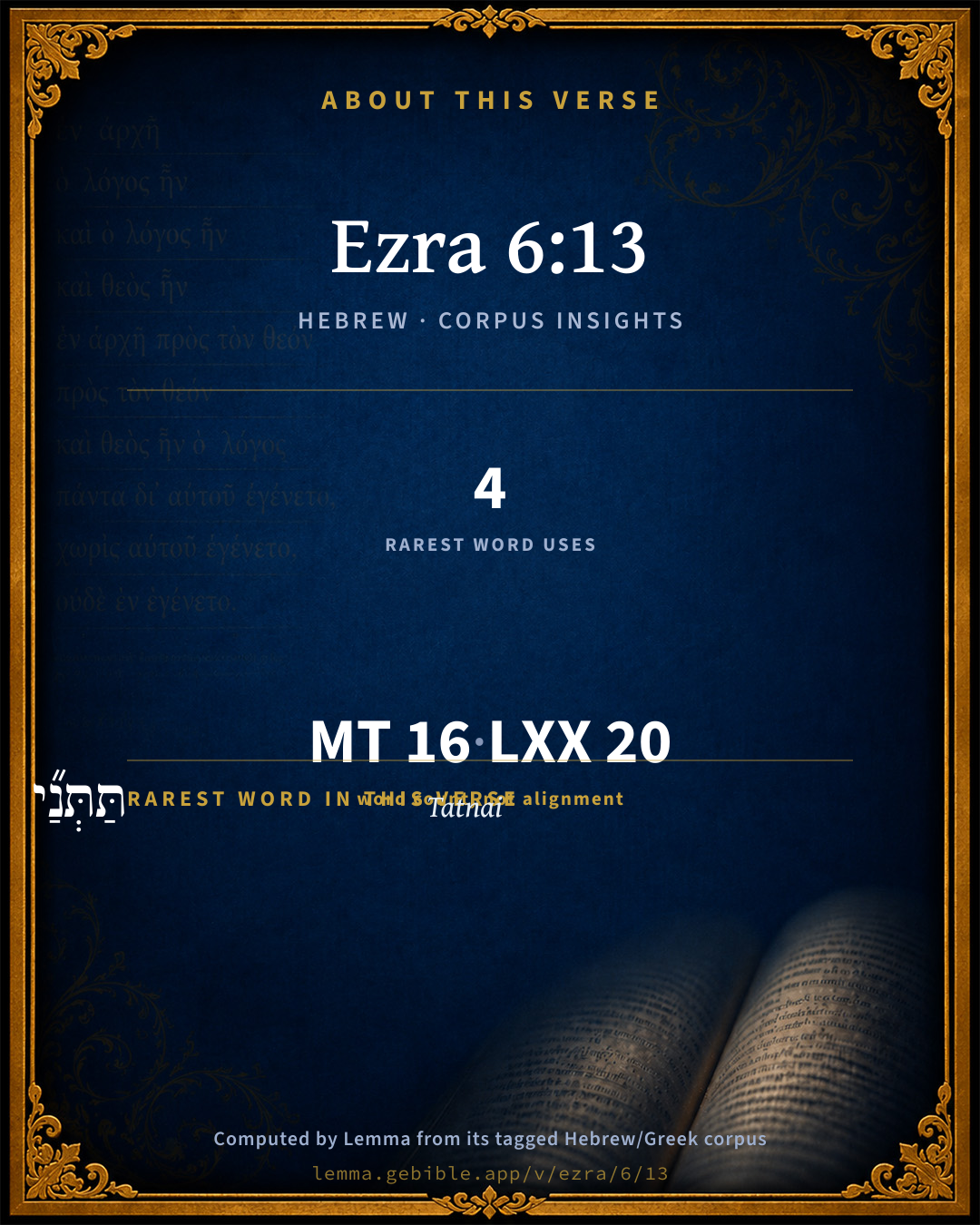
Ezra 6:13

Hebrew (Westminster Leningrad Codex) Ezra 6:13 appears in the Hebrew Old Testament. The text above is from the Westminster Leningrad Codex. Each word links to its Strong’s number, a concise gloss, and parsing drawn from the Open Scriptures Hebrew Bible morphology. Click any word for its full Brown-Driver-Briggs (BDB) entry.
Download image
Cite this verse

Ezra 6:13 (World English Bible). Public Domain. Lemma interlinear Bible study tool, https://lemma.gebible.app/v/ezra/6/13.

Show BibTeX & RIS
BibTeX
RIS
English Translation
Then Tattenai, the governor beyond the River, Shetharbozenai, and their companions, because that Darius the king had sent, did accordingly with all diligence.
World English Bible · Public Domain
Download a study sheet

One document with this verse’s original text, its word-by-word gloss line, the meaning frame, cross-references with their text, attributed commentary, and full source and license credits — printable, and it pastes into notes with its structure intact.

This verse Autodidact and up

Study sheet (.html) Plain text (.txt)

A passage Seminary Student

Up to 50 verses in one chapter. A passage sheet keeps up to 6 commentary sources and 12 cross-references per verse, in the order this page ranks them, and says so on the sheet whenever that leaves anything out. Ask for a single verse and you get the Autodidact verse sheet above.

Everything on this page stays free to read, with no account — the sheet is a download of what is already on screen, not access to it.

Want to remove ads? Support Godless Engineer
Compare translations 3

The same verse in 3 English versions, stacked beneath the original-language interlinear above. Click any original word for its lexicon entry.

Each is an independent rendering of the whole verse — the interlinear is not word-aligned to these translations.

Highlighted words mark where these versions differ — a whole-verse word diff, not a word-by-word alignment.

  • World English Bible Public Domain
    Then Tattenai, the governor beyond the River, Shetharbozenai, and their companions, because that Darius the king had sent, did accordingly with all diligence.
  • King James Version Public Domain
    Then Tatnai, governor on this side the river, Shetharboznai, and their companions, according to that which Darius the king had sent, so they did speedily.
  • unfoldingWord Literal Text CC BY-SA 4.0
    Then Tattenai, the governor of Beyond-the-River, Shethar-Bozenai, and their companions did thus diligently, according to what Darius the king had sent.

unfoldingWord Literal Text — © unfoldingWord, licensed CC BY-SA 4.0. Word-aligned USFM3 via Door43 (git.door43.org/unfoldingWord/en_ult).

Versions to compare (up to 4)

3 of 4 selected

Show all 18 translations

Every available English version of this verse, each an independent rendering of the whole verse.

  • World English Bible Public Domain
    Then Tattenai, the governor beyond the River, Shetharbozenai, and their companions, because that Darius the king had sent, did accordingly with all diligence.
  • Berean Standard Bible Public Domain
    In response, Tattenai the governor of the region west of the Euphrates, Shethar-bozenai, and their associates diligently carried out what King Darius had decreed.
  • Majority Standard Bible Public Domain
    In response, Tattenai the governor of the region west of the Euphrates, Shethar-bozenai, and their associates diligently carried out what King Darius had decreed.
  • King James Version Public Domain
    Then Tatnai, governor on this side the river, Shetharboznai, and their companions, according to that which Darius the king had sent, so they did speedily.
  • American Standard Version (1901) Public Domain
    Then Tattenai, the governor beyond the River, Shethar-bozenai, and their companions, because that Darius the king had sent, did accordingly with all diligence.
  • Revised Version (1885) Public Domain
    Then Tattenai, the governor beyond the river; Shethar-bozenai, and their companions, because that Darius the king had sent, did accordingly with all diligence.
  • Geneva Bible (1599) Public Domain
    Then Tatnai the captaine beyond the Riuer, and Shethar Boznai and their companions, according to that which Darius had sent, so they did speedily.
  • Douay-Rheims (1899) Public Domain
    So then Thathanai, governor of the country beyond the river, and Stharbuzanai, and his counsellors diligently executed what Darius the king had commanded.
  • Young's Literal Translation Public Domain
    Then Tatnai, governor beyond the river, Shethar-Boznai, and their companions, according to that which Darius the king hath sent, so they have done speedily;
  • Literal Standard Version CC BY-SA 4.0
    Then Tatnai, governor beyond the river, Shethar-Boznai, and their companions, according to that which Darius the king has sent, so they have done speedily;
  • Unlocked Literal Bible CC BY-SA 4.0
    Then because of the decree sent by Darius the king, Tattenai, the governor of the Province Beyond the River, and Shethar-Bozenai and his associates, did everything that King Darius had ordered.
  • unfoldingWord Literal Text CC BY-SA 4.0
    Then Tattenai, the governor of Beyond-the-River, Shethar-Bozenai, and their companions did thus diligently, according to what Darius the king had sent.
  • Darby Bible Public Domain
    Then Tatnai, governor on this side the river, Shethar-boznai, and their companions, because of that which king Darius had sent, did so diligently.
  • World Messianic Bible Public Domain
    Then Tattenai, the governor beyond the River, Shetharbozenai, and their companions did accordingly with all diligence, because Darius the king had sent a decree.
  • Webster's Bible Public Domain
    Then Tatnai governor on this side the river, Shethar-boznai, and their companions, according to that which Darius the king had sent, so they did speedily.
  • Free Bible Version CC BY-SA 4.0
    Tattenai, the governor of the province west of the Euphrates, Shethar-bozenai, and their fellow officials faithfully carried out what King Darius had decreed.
  • Bible in Basic English Public Domain
    Then Tattenai, the ruler across the river, and Shethar-bozenai and their people, because of the order given by King Darius, did as he had said with all care.
  • JPS Tanakh (1917) Public Domain
    Then Tattenai, the governor beyond the River, Shethar-bozenai, and their companions, because that Darius the king had thus sent, acted with all diligence.

Literal Standard Version (2020), Covenant Press — licensed CC BY-SA 4.0. Text via the HelloAO Bible API (eBible.org). Unlocked Literal Bible (unfoldingWord) — licensed CC BY-SA 4.0. Text via the HelloAO Bible API (eBible.org). unfoldingWord Literal Text — © unfoldingWord, licensed CC BY-SA 4.0. Word-aligned USFM3 via Door43 (git.door43.org/unfoldingWord/en_ult). Free Bible Version, Dr. Jonathan Gallagher — licensed CC BY-SA 4.0. Text via the HelloAO Bible API (eBible.org).

Word by word

More ways to search: Search by grammar → Find every occurrence → Compare this word →

Practice this passage: Drill this verse → Learn its vocabulary →

תַּתְּנַ֞י
Tattᵉnay
H8674
“Tatnai”
Adjective, N
Part of Speech
Adjective
Full BDB Definition

Origin: of foreign derivation

TWOT: None

Tatnai = "gift" - a Persian governor in Syria who opposed the rebuilding of Jerusalem
  1. אֱ֠דַיִן ʼĕdayin H116 “then” Adjective, D
  2. פַּחַ֧ת pechâh H6347 “governor of” Adjective, N, Common
  3. עֲבַֽר ʻăbar H5675 “beyond” Adjective, N
  4. נַהֲרָ֛ה nᵉhar H5103 “river · the” Adjective, N + Particle, Definite Article
  5. שְׁתַ֥ר Shᵉthar Bôwzᵉnay H8370 “Shethar-boznai” Adjective, N
  6. בּוֹזְנַ֖י Shᵉthar Bôwzᵉnay H8370 “Shethar-boznai” Adjective, N
  7. וּכְנָוָתְה֑וֹן kᵉnâth H3675 “and · companions · their” Adjective, C + Noun, Common, Masculine, Plural, Construct + Suffix, Personal, 3rd Person, Masculine, Plural
  8. לָקֳבֵ֗ל qᵉbêl H6903 “to/for · before” Adjective, R + Preposition
  9. דִּֽי dîy H1768 “which” Adjective, T
  10. שְׁלַ֞ח shᵉlach H7972 “to send” Adjective, V, Plural
  11. דָּרְיָ֧וֶשׁ Dârᵉyâvêsh H1868 “Darius” Adjective, N
  12. מַלְכָּ֛א melek H4430 “king · the” Adjective, N, Common + Particle, Definite Article
  13. כְּנֵ֖מָא kᵉnêmâʼ H3660 “thus” Adjective, D
  14. אָסְפַּ֥רְנָא ʼoçparnâʼ H629 “diligently” Adjective, D
  15. עֲבַֽדוּ ʻăbad H5648 “to make” Adjective, V, Plural

About this verse

These counts appear in no published source. They are computed here, from the morphology-tagged text and Lemma’s own curated glosses. What Lemma adds →

16
words
15
distinct lemmas
Historical
section

Notable vocabulary

The rarest word here is תַּתְּנַ֞י Tatnai H8674 — appearing just 4 times in the whole Hebrew Bible.

Shared distinctive vocabulary

תַּתְּנַ֞י Tatnai H8674 occurs in 4 verses of the Hebrew Bible. Also found in:

Grammatical profile

  • 1 noun
  • 12 adjectives
  • 1 preposition
  • 2 particles

Repetition

A word recurs within this verse — often emphatic in Hebrew:

  • שְׁתַ֥ר Shethar-boznai H8370 ×2

Hebrew & Septuagint length

In English translation the verse runs 23 words from the Hebrew and 25 from the Septuagint (LXX English) — closely comparable.

A rough comparison of the two English renderings, which tokenize alike — not a word-level alignment.

Word counts can differ between the Hebrew and the Greek without any difference in meaning — e.g. the Hebrew direct-object marker אֵת has no separate Greek word, and Greek often adds the article ὁ.

In the original languages it is 16 Hebrew tokens and 20 Greek tokens — but the two are counted differently (Hebrew bundles its prefixes and suffixes into one token; the Greek is in lemma form), so that isn’t a like-for-like length.

Cross-references

7

Topical passages linked to Ezra 6:13 in the Treasury of Scripture Knowledge — connected by theme and wording, ordered by reader-vote popularity; previews shown in the World English Bible.

  • Ezra 4:9 then [wrote] Rehum the chancellor, and Shimshai the scribe, and the rest of their companions, the Dinaites, and the Apharsathchites, the Tarpelites, the Apharsites, the Archevites, the Babylonians, the Shushanchites, the Dehaites, the Elamites,
  • Ezra 4:23 Then when the copy of king Artaxerxes' letter was read before Rehum, and Shimshai the scribe, and their companions, they went in haste to Jerusalem to the Jews, and made them to cease by force and power.
  • Ezra 5:6 The copy of the letter that Tattenai, the governor beyond the River, and Shetharbozenai, and his companions the Apharsachites, who were beyond the River, sent to Darius the king;
  • Ezra 6:6 Now therefore, Tattenai, governor beyond the River, Shetharbozenai, and your companions the Apharsachites, who are beyond the River, be you far from there:
  • Esther 6:11 Then took Haman the clothing and the horse, and arrayed Mordecai, and caused him to ride through the street of the city, and proclaimed before him, Thus shall it be done to the man whom the king delights to honor.
  • Job 5:12–13 He frustrates the devices of the crafty, So that their hands can't perform their enterprise.
  • Proverbs 29:26 Many seek the ruler's favor, But a man's justice comes from Yahweh.

Cross-references courtesy of OpenBible.info (CC BY 4.0).

Hebrew and Greek witnesses Masoretic Hebrew ↔ Greek Septuagint

The same verse in the two great witnesses to the Old Testament, shown verse-for-verse.

These are two independent witnesses, not word-aligned to each other, and the Septuagint is shown in lemma (dictionary) form.

Hebrew Ezra 6:13 Masoretic · Westminster Leningrad Codex

אֱ֠דַיִן תַּתְּנַ֞י פַּחַ֧ת עֲבַֽר נַהֲרָ֛ה שְׁתַ֥ר בּוֹזְנַ֖י וּכְנָוָתְה֑וֹן לָקֳבֵ֗ל דִּֽי שְׁלַ֞ח דָּרְיָ֧וֶשׁ מַלְכָּ֛א כְּנֵ֖מָא אָסְפַּ֥רְנָא עֲבַֽדוּ

Then Tattenai, the governor beyond the River, Shetharbozenai, and their companions, because that Darius the king had sent, did accordingly with all diligence.

World English Bible · Public Domain

Greek LXX Ezra 6:13 Septuagint · lemma form

τότε θανθαναι ἔπαρχος πέραν ὁ ποταμός σαθαρβουζανα καί ὁ σύνδουλος αὐτός πρός ὅς ἀποστέλλω δαρεῖος ὁ βασιλεύς οὕτως ποιέω ἐπιμελῶς

Then Thanthanai the governor on this side beyond the river, Satharbuzanai, and his fellow-servants, according to that which king Darius sent, so they did diligently.

LXX2012 (modern English Septuagint) · Public Domain

In the Septuagint this is one book — Esdras B (2 Esdras): Ezra is chapters 1–10, Nehemiah 11–23.

On this verse, Keil & Delitzsch discusses the Septuagint’s reading. Read the note in Commentary ↓

Hebrew: Westminster Leningrad Codex (CC BY 4.0). Greek: Septuagint (public domain); English from LXX2012 (modern English Septuagint) (Public Domain). How the Septuagint differs from the Hebrew →

Commentary

Notes on Ezra 6:13 from classic Christian and Jewish commentators (each source and its license shown beneath its notes). The classic Christian expositions comment on the surrounding passage and are grouped to its opening verse, so a note may address several verses; the Jewish commentaries on the Tanakh (Rashi and others) are per-verse, so they appear only where the commentator wrote on this verse.

Lemma curates 59 commentaries, every one of them public domain or Creative Commons licensed, each selected and text-cleaned for this edition rather than reprinted as found. About our sources →

Matthew Henry's Commentary

Here we have, I. The Jews' enemies made their friends. When they received this order from the king they came with as much haste to encourage and assist the work as their predecessors had done to put a stop to it, Ezr 4:23. What the king ordered they did, and, because they would not be thought to do it with reluctance, they did it speedily, Ezr 6:13. The king's moderation made them, contrary to their own inclination, moderate too.

II. The building of the temple carried on, and finished in a little time, Ezr 6:14, Ezr 6:15. Now the elders of the Jews built with cheerfulness. For aught I know, the elders themselves laboured at it with their own hands; and, if they did, it was no disparagement to their eldership, but an encouragement to the other workmen. 1. They found themselves bound to it by the commandment of the God of Israel, who had given them power that they might use it in his service. 2. They found themselves shamed into it by the commandment of the heathen kings, Cyrus formerly, Darius now, and Artaxerxes some time after. Can the elders of the Jews be remiss in this good work when these foreign princes appear so warm in it? Shall native Israelites grudge their pains and care about this building when strangers grudge not to be at the expense of it? 3. They found themselves encouraged in it by the prophesying of Haggai and Zechariah, who, it is likely, represented to them (as bishop Patrick suggests) the wonderful goodness of God in inclining the heart of the king of Persia to favour them thus. And now the work went on so prosperously that, in four hears' time, it was brought to perfection. As for God, his work is perfect. The gospel church, that spiritual temple, is long in the building, but it will be finished at last, when the mystical body is completed. Every believer is a living temple, building up himself in his most holy faith. Much opposition is given to this work by Satan and our own corruptions. We trifle, and proceed in it with many stops and pauses; but he that has begun the good work will see it performed, and will bring forth judgment unto victory. Spirits of just men will be made perfect.

III. The dedication of the temple. When it was built, being designed only for sacred uses, they showed by an example how it should be used, which (says bishop Patrick) is the proper sense of the word dedicate. They entered upon it with solemnity and probably with a public declaration of the separating of it from common uses and the surrender of it to the honour of God, to be employed in his worship. 1. The persons employed in this service were not only the priests and Levites who officiated, but the children of Israel, some of each of the twelve tribes, though Judah and Benjamin were the chief, and the rest of the children of the captivity or transportation, which intimates that there were many besides the children of Israel, of other nations, who transported themselves with them, and became proselytes to their religion, unless we read it, even the remnant of the children of the captivity, and then, we may suppose, notice is hereby taken of their mean and afflicted condition, because the consideration of that helped to make them devout and serious in this and other religious exercises. A sad change! The children of Israel have become children of the captivity, and there appears but a remnant of them, according to that prediction (Isa 7:3), Shear-jashub - The remnant shall return. 2. The sacrifices that were offered upon this occasion were bullocks, rams, and lambs (Ezr 6:17), for burnt-offerings and peace-offerings; not to be compared, in number, with what had been offered at the dedication of Solomon's temple, but, being according to their present ability, they were accepted, for, after a great trial of affliction, the abundance of their joy, and their deep poverty, abounded to the riches of their liberality, Co2 8:2. These hundreds were more to them than Solomon's thousands were to him. But, besides these, they offered twelve he-goats for sin-offerings, one for every tribe, to make atonement for their sins, which they looked upon as necessary in order to the acceptance of their services. Thus, by getting iniquity taken away, they would free themselves from that which had been the sting of their late troubles, and which, if not removed, would be a worm at the root of their present comforts. 3. This service was performed with joy. They were all glad to see the temple built and the concerns of it in so good a posture. Let us learn to welcome holy ordinances with joy and attend on them with pleasure. Let us serve the Lord with gladness. Whatever we dedicate to God, let it be done with joy that he will please to accept of it. 4. When they dedicated the house they settled the household. Small comfort could they have in the temple without the temple service, and therefore they set the priests in their divisions and the Levites in their courses, Ezr 6:18. Having set up the worship of God in this dedication, they took care to keep it up, and made the book of Moses their rule, to which they had an eye in this establishment. Though the temple service could not now be performed with so much pomp and plenty as formerly, because of their poverty, yet perhaps it was performed with as much purity and close adherence to the divine institution as ever, which was the true glory of it. No beauty like the beauty of holiness.

IV. The celebration of the passover in the newly-erected temple. Now that they were newly delivered out of their bondage in Babylon it was seasonable to commemorate their deliverance out of their bondage in Egypt. Fresh mercies should put us in mind of former mercies. We may suppose that they had kept the passover, after a sort, every year since their return, for they had an altar and a tabernacle. But they were liable to frequent disturbances from their enemies, were straitened for room, and had not conveniences about them, so that they could not do it with due solemnity till the temple was built; and now they made a joyful festival of it, it falling out in the next month after the temple was finished and dedicated, Ezr 6:19. Notice is here taken, 1. Of the purity of the priests and Levites that killed the passover, Ezr 6:20. In Hezekiah's time the priests were many of them under blame for not purifying themselves. But now it is observed, to their praise, that they were purified together, as one man (so the word is); they were unanimous both in their resolutions and in their endeavours to make and keep themselves ceremonially clean for this solemnity; they joined together in their preparations, that they might help one another, so that all of them were pure, to a man. The purity of ministers adds much to the beauty of their ministrations; so does their unity. 2. Of the proselytes that communicated with them in this ordinance: All such as had separated themselves unto them, had left their country and the superstitions of it and cast in their lot with the Israel of God, and had turned from the filthiness of the heathen of the land, both their idolatries and immoralities, to seek the Lord God of Israel as their God, did eat the passover. See how the proselytes, the converts, are described. They separated themselves from the filthiness of sin and fellowship with sinners, joined themselves with the Israel of God in conformity and communion, and set themselves to seek the God of Israel; and those that do so in sincerity, though strangers and foreigners, are welcome to eat of the gospel feast, as fellow-citizens with the saints and of the household of God. 3. Of the great pleasure and satisfaction wherewith they kept the feast of unleavened bread, Ezr 6:22. The Lord had made them joyful, had given them both cause to rejoice and hearts to rejoice. It was now about twenty years since the foundation of this temple was laid, and we may suppose the old men that then wept at the remembrance of the first temple were most of them dead by this time, so that now there were no tears mingled with their joys. Those that are, upon good grounds, joyful, have therefore reason to be thankful, because it is God that makes them to rejoice. He is the fountain whence all the streams of our joy flow. God has promised to all those who take hold of his covenant that he will make them joyful in his house of prayer. The particular occasion they had for joy at this time was that God had turned the heart of the emperor to them, to strengthen their hands. If those that have been, or who we feared would have been, against us, prove to be for us, we may rejoice in it as a token for good, that our ways please the Lord (Pro 16:7), and he must have the glory of it.

Matthew Henry's Commentary on the Whole Bible (1708–1710) — public domain (CC PDM 1.0). Text via the HelloAO Bible API.

Jamieson, Fausset & Brown

Robert Jamieson, A. R. Fausset & David Brown

THE TEMPLE FINISHED. (Ezr 6:13-15)

Then Tatnai . . . did speedily--A concurrence of favorable events is mentioned as accelerating the restoration of the temple and infusing a new spirit and energy into the workmen, who now labored with unabating assiduity till it was brought to a completion. Its foundation was laid in April, 536 B.C. (Ezr 3:8-10), and it was completed on February 21, 515 B.C., being twenty-one years after it was begun [LIGHTFOOT].

Jamieson, Fausset & Brown — Commentary Critical and Explanatory on the Whole Bible (1871) — public domain (CC PDM 1.0). Text via the HelloAO Bible API.

Trapp's Complete Commentary

John Trapp

Ezr 6:13 Then Tatnai, governor on this side the river, Shetharboznai, and their companions, according to that which Darius the king had sent, so they did speedily.

Ver. 13. So they did speedily] This they did, because they durst do no otherwise; their obedience was wrung out of them, as sour juice is out of a crab, or as distilled water is forced out by the heat of the fire. Thus some perform duties, aud yet hate them; part with sins, and yet love them. Show the malefactor the rack, and he will say or do anything. This is to fear God for his lions, as those mongrels did, 2Ki 17:33-34, timore servili, non amicali, fearing slavery not God, which yet may addere alas, add to their strength, lest they fall under the lash, the correction of the law, for refusing the direction thereof (Beda).

John Trapp, A Commentary or Exposition upon All the Books of the Old and New Testament (1647–1656) — public domain. Text from a community e-Sword module.

Joseph Benson's Commentary

Ezr 6:13. They did it speedily — When they received this order from the king, they applied themselves with as much haste to encourage and assist the work, as their predecessors had used to put a stop to it. Thus the enemies of the Jews were suddenly made their friends.

Joseph Benson's Commentary on the Old and New Testaments (1811–1818) — public domain. Text from a community e-Sword module.

Whedon's Commentary on the Bible

Daniel D. Whedon

THE TEMPLE FINISHED AND DEDICATED, Ezr_6:13-18.

14. Prospered through the prophesying of Haggai… and Zechariah — The extant writings of these prophets give evidence that the Jews needed continual prompting and encouraging in their work, for they had been so long in building that many had become fainthearted and discouraged.

The commandment of… God — Given by the prophets. Compare Hag_1:1; Hag_1:12.

Commandment of Cyrus, and Darius, and Artaxerxes — The mention of Artaxerxes is evidently a prolepsis here, for he can be no other than the Artaxerxes of Ezr_7:1, (compare Ezr_6:12; Ezr_6:21-22,) who is generally allowed to be identical with Artaxerxes Longimanus, the son and successor of Xerxes. But because he so greatly assisted Ezra in matters pertaining to the house of God, (Ezr_7:21-27,) it was quite natural for the compiler of this book, who was doubtless Ezra himself, to mention him in this connexion.

Daniel D. Whedon (gen. ed.), Commentary on the Old and New Testaments (1874–1909) — public domain. Text from a community e-Sword module.

The Pulpit Commentary

CHAPTER 6:13-22

So they did speedily. Tatnai and Shethar-boznai showed no reluctance. They had no enmity against the Jews. Once clearly advertised of the king"s wishes, they carried them out with zeal. The rapid completion of the temple must be in part attributed to their good-will.

HOMILETICS.

Vers. 13-22.

The work completed.

These words form the conclusion of the first and longest portion of this scriptural Book of Ezra. All the remaining portion of the book is divided off from this in three separate ways. It is so, partly, on the question of time, a gap of something like sixty years intervening between the events mentioned at the close of this sixth chapter and those referred to at the beginning of the seventh. It is also divided off in regard to its method, being not so much, like the former portion, a piece of history, strictly so called, as an interesting extract from the life-story of one particular man. And it is, finally, divided off to some extent on the question of subject, inasmuch as it only touches in a subsidiary and altogether supplemental manner on that which the former portion related at length. The proper record of the work of restoring the temple finishes here. Corresponding to all this is the character of the passage itself. It bears the impress, in every way, of being a winding-up of that record. How the material building was finished: how it was solemnly set apart for its proper service: and how it was first employed in that service; these are the only particulars now requiring to be described. These, we shall find, are accordingly described to us here.

I THE BUILDING FINISHED. This was done, as we gather

1. Without delay. There was no delay on the part of Tatnai, etc. in making known the edict of Darius, or in complying with its injunctions. The language was very plain; its tone very urgent; its results, therefore, very prompt. As "the king had sent, so they did speedily" (ver. 13). On the other hand, there was just as little delay on the part of the Jews. The king"s decree and the prophet"s message (ver. 14) together were like wings to their work. They "built," and "prospered," and "finished" (vers. 14, 15), so we are told. It would almost seem, indeed, as though from the time of the arrival of this decree of Darius (probably in the fourth year of his reign; see Wordsworth on ver. 14, and compare dates in Ezr_4:24; Zec_1:1, etc., in connection with time required for sending to Darius, for search, for sending reply, and so on) the Jews looked upon the completion of the temple as a mere question of time, and so at last regarded their condition of captivity as being practically at an end. (see Zec_7:1-3) The very "headstone". (Zec_4:7) of the building was now within sight.

2. Without defect. As God himself wished it to be, "according to the commandment of the God of Israel" (ver. 14), so the building was "finished." That was the main point, of course. But it was not the only point to be marked. We are also to observe that it was "finished" as Cyrus and Darius had given "commandment." Artaxerxes, it is true, long afterwards, did not a little, in a supplementary manner, for the beauty of this house; and, therefore, it is proper that he should be mentioned here in this "commemoration of benefactors." But all that was essentially necessary had not only been fully specified in the decrees of his two predecessors, but had also been fully carried out during the reign of the second. Soon after the beginning of the last month in the sixth year of Darius "this house was finished;" finished as God had intended; finished as he had caused his servants, the kings of Persia, to decree; finished as his own people had been taught to expect. The last stone had been placed; the last test had been applied; all was ready for use. (see prophecies in Zec_4:7-10)

II THE BUILDING SET APART. All was ready for use as to construction. To make it equally ready for use as to condition, it must be solemnly handed over, as it were, to God"s keeping and service. We are next told, therefore, how this was done. Namely

1. With proper joy. " This to be noted first because required first. God can only accept and bless that which is offered with joy (Exo_25:2; 2Co_9:7) Comp. also the joy of David and Israel in offering for the erection of the first temple, (1Ch_29:9) and that of Solomon and all Israel at its dedication. Equally universal, and possibly, on the principle of Luk_15:6, Luk_15:9, Luk_15:24, Luk_15:32, even deeper, was the joy of these "children of the captivity" at this dedication of the second house.

2. With proper humility. That which they were now offering to God had been first given to them by himself; (1Ch_29:14, 1Ch_29:15) and could not, in reality, in any way make any addition to his glory (Psa_16:2 Psa_50:9-12; Luk_17:10) and was utterly inadequate, in fact, for his use (1Ki_8:27; Act_7:48, Act_7:49) Not only so, as coming from such as they were, (see Isa_6:5) it was altogether unfit (as it was) for his service, and required, in consequence, in order to make it so, like themselves, to be "purged." In open acknowledgment of these various truths, by way of thank-offering for his many bounties, by way of adoration of his infinite majesty, by way of appointed propitiation for their own unworthiness, they accompany their offering of this building by the other bleeding offerings here enumerated (ver. 17). Observe especially the number of victims two lambs for every ram, two rams for every bullock; the less the value, the greater the number, as is natural in true thank offerings. Also, in regard to the sin offering, one victim to every tribe; partly, it would seem, in believing reference to that covenant promise of God which was given to the twelve tribes as a whole (1Ki_18:31; Act_26:6, Act_26:7) and partly in order that the humiliation for sin therein involved might be of a truly national kind. All Israel were understood to confess their sins on the heads of those goats.

3. With proper care. It was not much they could offer, (comp. the total of 712 here with the 142, 000 of 2Ch_7:5) but it should be the best in their power. Because God was indulgent, and willing to accept, for his covenant"s sake, what was in itself imperfect and unworthy, they would not therefore be negligent. Rather, they would seek to order everything exactly as he had prescribed, so far as lay in their power. Not merely the house, but the household (Matthew Henry), the "priests" and the "Levites," who should attend to the building and its services, were solemnly then set apart. And all in the way in which God himself had directed his servant Moses to specify and record. All were dedicated, in short, to God"s service according to God" s way.

III THE BUILDING IN USE. Why did it please God, notwithstanding Act_7:48-50, to have such a house among men? Partly to help in separating and consolidating his Israel (see Exo_23:17; Psa_122:4, etc.) In the new circumstances of Israel (see earlier outline) this more needful than ever. Would this restored house, now at last completed and consecrated, answer this end? This first recorded use of it answers this question; and seems, in short, to be recorded with this object in view. What a strong spirit of separation is found in these verses (19-22) throughout.

1. Separation from other nations the very feast observed, that of the passover, being a commemoration of the most conspicuous separation ever made between Israel and the nations. (Exo_12:26, Exo_12:27, also 45, 47)

2. Separation from ceremonial uncleanness even the priests being superseded on this occasion by the Levites, in the matter of killing the passover lambs for all, as not being so universally "pure" (see Rawlinson on ver. 20, who translates, "And the priests were purified, and the Levites as one man were all of them pure").

3. Separation from false brethren no other persons being allowed to join with the returned children of the captivity in celebrating this feast, except those, whether "proselytes from the heathen" or "Israelites" never captive at all, who "had separated themselves unto" these others "from the filthiness of the heathen of the land, to seek the Lord God of Israel." The description is almost scientific in its accuracy and precision. Separated from the heathen; from their "filthiness" too. Separated unto Israel; to seek Israel"s God.

4. Separated with joy. To find themselves once again with a house of their own; to think of all that God had done for them in providing them with such a house, even bringing them help from that very Assyrian land which had formerly been their destruction; (Isa_3:2, etc.) and so now at last, once again, to feel themselves openly and fully a "peculiar people" to the Lord their God, was a very great joy. Nor was this joy at all lessened, but rather increased, by the nature of the feast they were keeping, involving, as it did, not only separation from the heathen (see above), but also as the "feast of unleavened bread" (ver. 22), separation from inward (Exo_12:8, Exo_12:15, Exo_12:18-20; 1Co_5:7, 1Co_5:8) So great a delight, as well as clear a duty, did they feel their present separation to Jehovah. And so thoroughly did this their first use of their just-restored house suit the character of that house. (Psa_93:5) How forcibly all this instructs us

1. As to the real nature of Gods purposes. Looking back on all these six chapters of Ezra, we see one object in view, viz., the restoration of God"s house. Looking on the house now at length completed, we see, however, that even its erection was only a means to an end, viz., the sanctification of God"s people. So even of that spiritual temple, the body of Christ. (Heb_10:10) So of the Sabbath as "made for man". (Mar_2:27) So of all trials and affliction. (Heb_12:10) So of the whole Christian calling, (1Pe_2:9) and the whole work of redemption. (Tit_2:11-14) Does not the very expression indeed, "the means of grace," teach us as much? Unless these means do really minister grace to believers, they fail of their end.

2. As to the true wisdom of Gods people, viz., to seek for the full realisation of these gracious purposes in themselves. Even in being definitely in the way of their realisation there is much joy, but some sorrow as well. (see above, Ezr_3:12, Ezr_3:13) But we read of no such sorrow mingled with joy now that the completion and dedication of the house has been consummated by a similar dedication of the people themselves. Even "unleavened bread" and "bitter herbs" in that case are eaten with "joy." What, indeed, is more natural if we come to consider? "Without holiness no man shall see God". (Heb_12:14) Nor can any man see true happiness without seeing God (Psa_16:11 Psa_17:15; 1Jn_3:2; Rev_22:4) Even as our Lord himself has summed up the argument in Mat_5:8. The nearer to God"s image, through the help of his Spirit and for the sake of his Son, the nearer to his bliss. We may almost describe the whole Christian creed as practically summed up in these words.

HOMILIES BY J.A. MACDONALD Vers. 13-15.

The successful issue.

The vicissitudes through which the building of the temple was carried to its completion figure forth those of the spiritual temple of the Church. This eventful history teaches

I THAT GOD"S PURPOSES WILL BE ACCOMPLISHED.

1. This truth is exemplified in. the creation.

(1) A universe sprang into being in obedience to his voice. (Psa_33:9)

(2) It serves his purposes in all its complicated movement (Psa_147:7-9, 15-18 Ps 148; Col_1:17)

2. This truth is also exemplified in prophecy.

(1) The temple was finished in accordance with prophecy. (Isa_44:27, Isa_44:28) The events which prepared the way were also pre-indicated (see also Jer 50 and Jer 51). These are samples. The whole subject of prophecy proves that God governs the moral world by a plan.

(2) This plan must comprehend all possible contingencies that may arise from the action of free beings. There is a limit to all freedom except that of God. His absolute freedom ultimately limits all that is relative. Lesson To attempt to resist the will of God is indeed madness.

II THAT GOD HONOURS HIS WILLING SERVANTS.

1. He gives them an interest in his work. "They prospered," viz., in the success of God"s work.

(1) They obeyed his commandment because it was his. Love to God animated their zeal.

(2) Thereby their own moral nature became ennobled.

2. He encourages them by his approving voice. "They prospered through the prophesying of Haggai," etc.

(1) His word supplies the noblest motives. To the true servant of God nothing is trifling; he does all to the glory of God. This stamps the most ordinary things with sublimity.

(2) His word gives wisdom, viz., to sustain them in his work against the prudence of the world. (see Ezr_5:5) Also to answer prudently in the face of the enemy. (see Ezr_5:11-15) Prophecy in Christian sanctuaries is a grand thing for business men.

3. He crowns their labours with success.

(1) There may be, there will be, vicissitudes in the way. Even in these there is real success when the signs of it are not visible.

(2) But the issue is sure. The sequel will be glorious. Lesson Trust God when you cannot trace him.

III GOD MAKES UNLIKELY PERSONS HIS WILLING SERVANTS.

1. Several Medo-Persian kings were such.

(1) These were worshippers of the elements. Why should they favour the worship of Jehovah, who had humiliated their idolatry by defeating their gods? The miracles of the Old Testament in general were levelled against Sabianism.

(2) Political as well as religious reasons would render it unlikely that they should favour the return of the Jews. They succeeded to the place of the Babylonish kings, and might be presumed to follow up the policy of Nebuchadnezzar.

(3) But God found means to move the heart of Cyrus. Darius also was moved by him to follow his great predecessor. This he was the more disposed to by nature of the laws of the Medes and Persians, which alter not. Artaxerxes Longimanus, in after years, rendered his service to the people of God.

2. Perhaps Tatnai was another example.

(1) He was unlikely inasmuch as he had been moved by the enemies of Israel. But he seems to have had little sympathy with their malice.

(2) The "speedy" obedience which he rendered to the decree of Darius may have been cheerful. Lesson Let no one despair of the power of the gospel to convert unlikely sinners.

IV THAT GOD MAKES UNWILLING PERSONS SERVE HIS PURPOSES. The people of the land" were in this category.

(1) Their opposition was undoubted. Their conduct hitherto proved this. Their enmity was transmitted to their posterity. (see Neh_2:9, Neh_2:10, 19 4:1-3 6:16; Joh_4:9)

(2) But their opposition was overruled for good. It brought the necessities of Israel, occasioned by the neglect of the decree of Cyrus, under the notice of Darius. The enemies now had to pay and collect taxes to supply those necessities. They do this too "speedily," not because they love God, but because they fear the king (see vers. 11, 12). So God "makes the wrath of man to praise him." Better we should praise him with a loyal heart. "When a man"s ways please the Lord he maketh even his enemies to be at peace with him. J.A.M.

The Pulpit Commentary (1880–1919), ed. H.D.M. Spence-Jones & Joseph S. Exell — public domain. Text from a community e-Sword module.

Keil & Delitzsch

C. F. Keil & F. Delitzsch

The execution of the royal decree, the completion of the building, and the dedication of the new temple. - Ezr 6:13 Tatnai and his associate diligently executed the commands of Darius. "Because Darius the king sent (i.e., despatched to them the letter, whose contents have just been given, Ezr 6:6), they speedily acted accordingly in the manner stated" (כּנמא).

Ezr 6:14

The elders of the Jews, moreover, built, and they prospered through the prophesying of Haggai and Zechariah, who thereby effected the resumption of the work, and promised them success. ב is used of the rule by which, or manner in which anything is done. "They built and finished (the building) according to the commandment of the God of Israel, and according to the command of Cyrus, Darius, and Artachshasta, kings of Persia." The naming of Artachshasta presents some difficulty; for since it is impossible to conceive that a predecessor of Darius is intended by a name which follows the name of that monarch, none but Artaxerxes Longimanus can be meant, and he did not reign till long after the completion of the temple. Cleric. and J. H. Mich. explain the mention of his name by the consideration that Artaxerxes, by his edict (Ezr 7:15, Ezr 7:21), contributed to the maintenance, though not to the building, of the temple.

(Note: "Nam etsi," remarks Calovius in J. H. Mich., adnotatt. uber. ad h. l., "non ad structuram templi conduxerit proprie edictum Artaxerxis, quae Darii secundo anno incepta et sexto absoluta fuit, Ezr 6:15 ad ornamenta tamen et additamenta eam spectasse dubium non est: quae ab ipso, ceu rege post Cyrum et Darium erga Judaeos Persarum omnium benignissimo, profecta hic celebratur." Similarly but more briefly explained by Clericus.)

It may in this instance be questionable whether the name ארתחשׁשׁתא was added by the author of the Chaldee section, or by Ezra when he introduced this into his book. We believe the latter to be the correct view, because the Chaldee section, to judge by the אמרנא, Ezr 5:4, was composed by one who lived contemporaneously with the building of the temple, while from the date of the completion of the temple to the seventh year of Artaxerxes fifty-seven years elapsed.

Ezr 6:15

And this house was finished on the third day of the month Adar (the twelfth month), which is the sixth year of the reign of King Darius. שׁיציא, according to the Keri שׁיצי, with the א dropped, is the Shaphel of יצא, to bring a thing to an end, to finish it. The form שׁיציא is not a participle pass. formed from the Shaphel (Gesen.), for this would be משׁיציא, but a Hebraized passive form of the Shaphel in the meaning of the Targumistic Ishtaphal, like חיתיוּ, Dan 3:13, and חיתית, Dan 6:18, with the active היתיו, Dan 6:17. In the Targums שׁיצי has mostly an active, and only in a few passages the intransitive meaning, to end, to be at the end; comp. Levy, chald. Wrterbuch, s.v.

(Note: Instead of the "third day," which the lxx also has, in accordance with the Hebrew text, 1 Esdr. 7:5 gives the three-and-twentieth day of the month Adar, - a statement which Bertheau arbitrarily insists upon regarding as the original reading, because "the view that the compiler altered the third into the twenty-third day, because it seemed to him more fitting to assume an eight days' celebration of the dedication (comp. Kg1 8:60; Ch2 29:18), and to fill up therewith also the eight last days of the year, is rather far-fetched." Such a view, however, would be entirely consistent with the whole spirit of 1 Esdras.)

Ezr 6:16-17

The sons of Israel, more exactly the priests and the Levites, and the rest of the sons of the captivity, kept the dedication of this house of God with joy. חנכּה עבד = the Hebrew חנכּה עשׂה, to celebrate the dedication (Ch2 7:9). בּחדוה, Hebrew בּשׂמחה; see Neh 8:10. They brought for the dedication a hundred bullocks, two hundred rams, four hundred lambs as burnt-offerings, and twelve he-goats for a sin-offering for all Israel, according to the number of the tribes of Israel, because the temple was intended for the entire covenant people, whose return to the Lord and to the land of their fathers, according to the predictions of the prophets, was hoped for (comp. e.g., Eze 37:15., Jer 31:27.), not, as older expositors thought, because certain families of the ten tribes, who had before settled in Judah, were also among those who returned (J. H. Mich. ad h. l.).

Ezr 6:18

At the same time, the priests and Levites were appointed, according to their classes and divisions, to the service of the temple, that they might henceforth fulfil their office, each class in its week (Ch2 23:4; Kg2 11:9). והקימוּ corresponds with the Hebrew ויּעמידוּ, Ezr 3:8, and elsewhere. As Bertheau justly remarks, "The services of public worship, which after the completion of the temple were to be performed by the priests and Levites, according to ancient ordinance, are here spoken of." With these words the Chaldee section closes.

Keil & Delitzsch — Biblical Commentary on the Old Testament (1861–1891) — public domain (CC PDM 1.0). Text via the HelloAO Bible API. (Old Testament only.)

The Cambridge Bible for Schools and Colleges

gen. ed. J. J. S. Perowne

13–18. Darius’s decree executed: (a) The Temple completed, (14, 15), (b) duly consecrated and dedicated (16–18)

13. according to that which Darius the king had sent] R.V. because that. R.V. marg. ‘because of that which’. The A.V. fails to give the meaning of the original. The rendering of the R.V. margin seems preferable. The prompt action of the governor was the result not so much of the king’s sending (for in any case an answer to the governor’s question was expected) as of the emphatic command contained in the royal letter. In the face of this explicit order, steps were at once taken.

so they did speedily] R.V. did accordingly with all diligence. See Ezr_6:8; Ezr_6:12, Ezr_5:8. We have no reason to suppose that Tattenai himself was ill-disposed against the Jews. His letter to the king (Ezr_5:6, &c.) may have been due to Samaritan representations. But once acquainted with the facts and informed of the king’s wishes, he had no ill-will against an insignificant Jewish settlement at Jerusalem.

The Cambridge Bible for Schools and Colleges (gen. ed. J. J. S. Perowne; Cambridge University Press, 1878–1918) — public domain. Text from a community e-Sword module.

John Gill's Exposition

And the elders of the Jews builded,.... Went on with the building of the temple:

and they prospered through the prophesying of Haggai the prophet and Zechariah the son of Iddo; or grandson, as before; being animated and encouraged by them; and as they foretold and promised it would, be, so it was; they had success in their work, the Lord overruling the heart of Darius the king and his council in their favour:

and they builded and finished it; that is, the temple:

according to the commandment of the God of Israel; by the above prophets, who spoke to them, and prophesied in his name:

and according to the commandment of Cyrus, and Darius, and Artaxerxes king of Persia; the commandment of Cyrus is in Ezr 1:1 that of Darius in this, Ezr 6:8, but who Artaxerxes is, and his commandment, is not easy to say; he cannot be the Artaxerxes between Cyrus and Darius, but one that followed the latter; besides, he was a hinderer of the building, Ezr 4:21, some think this was Xerxes the son and successor of Darius, and who might be partner with his father in the empire at this time, and so is joined with him in this commandment; which is more probable than that he should be his grandson Artaxerxes Longimamus, in whose reign the temple, it is supposed, was beautified and ornamented, though the exterior building of it was before finished; and so he is spoken of by anticipation; and still more plausible than that he should be, with others, Artaxerxes Mnemon, the son of Darius Nothus; but, after all, I am most inclined to think, with Aben Ezra, that he is Darius himself; and the words to be read, Darius, that is, Artaxerxes, king of Persia; Artaxerxes being, as he observes, a common name of the kings of Persia, as Pharaoh was of the kings of Egypt; though this is by some rejected (h); and who goes by this name in the continuance of this history, in whose seventh year, the year after this, Ezra went up to Jerusalem, and, in the twentieth of his reign, Nehemiah, Ezr 7:1, and I find Dr. Lightfoot (i) was of the same mind; and, according to Diodorus Siculus (k), the kings of Persia were called by the name of Artaxerxes after Mnemon; and so they might before; Cambyses is so called in Ezr 4:7. Herodotus (l) says the name signifies "a mighty warrior".

(h) Vid. Rainold de Lib. Apocryph. praelect. 31. p. 271. (i) Works, vol. 1. p. 139. (k) Bibliothec. l. 15. p. 400. (l) Erato, sive, l. 6. c. 98.

John Gill's Exposition of the Whole Bible (1746–1763) — public domain (CC PDM 1.0). Text via the HelloAO Bible API.

Kretzmann's Popular Commentary

Paul E. Kretzmann

The Second Temple Dedicated

v. 13. Then Tatnai, governor on this side the river, Shethar-boznai, and their companions, the officials assisting them, according to that which Darius the king had sent, so they did speedily.

v. 14. And the elders of the Jews builded, they continued work on the Temple, and they prospered through the prophesying of Haggai, the prophet, and Zechariah, the son of Iddo. Not only did these two prophets awaken a proper enthusiasm in the people, but the Lord laid His signal blessing upon the undertaking, so that it progressed without hindrances. And they builded and finished it, according to the commandment of the God of Israel, as still recorded in the first chapter of Haggai, and according to the commandment of Cyrus, and Darius, and Artaxerxes, king of Persia, this successor of Darius being mentioned on account of the gifts which he caused to be brought to Jerusalem by Ezra, Ezr 7:15-19.

v. 15. And this house was finished on the third day of the month Adar, which was in the sixth year of the reign of Darius the king. According to one careful investigator the foundation had been completed in April, 536 B. C. and the entire building was finished on February 21:515 B. C.

v. 16. And the children of Israel, the entire congregation of the returned exiles, the priests, and the Levites, and the rest of the children of the captivity, kept the dedication of this house of God with joy, even as they had celebrated the completion of the foundation,

v. 17. and offered at the dedication of this house of God an hundred bullocks, two hundred rams, four hundred lambs, these being burnt offerings, and for a sin-offering for all Israel, twelve he-goats, according to the number of the tribes of Israel, as at the dedication of the Tabernacle, the present congregation rightly considering itself the representative of the entire ancient people of Israel.

v. 18. And they set the priests in their divisions, as David had arranged for, 1Ch 24:1, and the Levites in their courses, 1Ch 23:6, for the service of God, which is at Jerusalem, every division being entrusted with a special part of the work pertaining to the service of the Lord, as it is written in the book of Moses, Num 3:8; Num 8:14, the entire worship thus being once more instituted and ordered in accordance with the Law and ancient usage.

v. 19. And the children of the captivity kept the Passover upon the fourteenth day of the first month, very shortly after the dedication of the Temple, which may have taken place before the end of the previous month, at the end of the church-year, as soon as the Temple was finished.

v. 20. For the priests and the Levites were purified together, all of them were pure, having taken care to perform the rites of consecration, Exo 19:10, and to be cleansed from all Levitical defilement, and killed the passover for all the children of the captivity, for it gradually became the custom for the Levites to do the slaughtering of all the Passover lambs, since it was so easy for defilement to rest upon the average person in the congregation, and for their brethren, the priests, who were busy at the altar of burnt offering, and for themselves.

v. 21. And the children of Israel which were come again out of captivity and all such as had separated themselves unto them from the filthiness of the heathen of the land, not only by renouncing idolatry, but also by being formally received into the congregation by the usual rites of washings and by circumcision, to seek the Lord God of Israel, did eat,

v. 22. and kept the Feast of Unleavened Bread seven days with joy; for this festival was merely a continuation of the Passover Feast; for the Lord had made them joyful, and turned the heart of the king of Assyria, of the Chaldean king, unto them to strengthen their hands in the work of the house of God, the God of Israel. They were enjoying peace and prosperity and were duly grateful to the Lord, the Giver of all good gifts, for His rich blessings. It is ever a source of joy for the children of God to be privileged to sacrifice prayer and thanksgiving to God, this attitude of mind being further stimulated when they see that God establishes the work of their hands, that the building of His kingdom is carried on successfully.

Paul E. Kretzmann, Popular Commentary of the Bible (1921–1924) — public domain. Text from a community e-Sword module.

unfoldingWord translationNotes

Door43 World Missions Community

Tattenai ... Shethar-Bozenai

Translate the names of these men as you did in Esra 5:03. (See: How to Translate Names)

The house was completed

This can be translated in active form. You may need to make explicit which house they completed. AT: "They completed God's house" or "They finished building the temple" (See: Active or Passive and Assumed Knowledge and Implicit Information)

the third day of the month of Adar

"Adar" is the name of the twelfth and last month of the Hebrew calendar. It is during the cold season. The third day is near the middle of February on Western calendars. (See: Hebrew Months and How to Translate Names and Ordinal Numbers)

sixth year

King Darius had been ruling for five years, so he was now in year number six of his reign. (See: Ordinal Numbers)

translationWords

companion

king

Darius

Jew

Haggai

Zechariah (OT)

prophet

decree

God

Israel

Cyrus

Artaxerxes

Persia

house of God

day

year

unfoldingWord translationNotes — © Distant Shores Media and the Door43 World Missions Community, licensed CC BY-SA 4.0. Source: git.door43.org/Door43/en_tn.

Rashi

Rabbi Shlomo Yitzchaki (Rashi)

as was said [as translated,] as was said.

acted swiftly [as translated,] acted swiftly.

Rashi on the Tanakh — English translations: “The Judaica Press complete Tanach with Rashi, translated by A. J. Rosenberg” (CC BY 4.0); “Pentateuch with Rashi's commentary by M. Rosenbaum and A.M. Silbermann, 1929-1934” (public domain); “The Metsudah Tanach series, Lakewood, N.J” (CC BY 4.0); and “The Book of Joshua, Metsudah Publications, 1997” (CC BY 4.0). Text via Sefaria.

Lesson kit

Teaching starters — assembled from the data on this page, not authored interpretation. Every prompt links to the verse data it draws on. Edit before teaching.

Ezra, in the Historical, opens this verse with 16 words (15 distinct Hebrew lemmas). Its most distinctive word is Tattᵉnay (“Tatnai”). A historical commentator’s framing appears above. Read the whole chapter for the surrounding context.

Discussion questions

  1. The word Tattᵉnay carries the sense “Tatnai.” How does it shape the verse?
  2. Ezra 5:3 shares the word «Tatnai» with this verse. How do the two illuminate each other?
  3. “Shethar-boznai” occurs 2× in this one verse. What is the effect of the repetition?
  4. The translations on this page render this verse differently — a whole-verse word diff, not a word-by-word alignment. What might account for the different wordings?
  5. Reading how Matthew Henry's Commentary and Jamieson, Fausset & Brown read this verse, where do the two commentators agree and where do they part?

Things to notice

Reading settings

Reading text

Shown beneath each verse's original-language words.

Old Testament
Old Testament edition

Read the OT as the Masoretic Hebrew (MT) or the Greek Septuagint (LXX).

English shown for the Greek Septuagint (in the Hebrew ↔ Greek comparison).

Comparing translations? Open the Compare panel on any verse page to stack up to four side by side.