

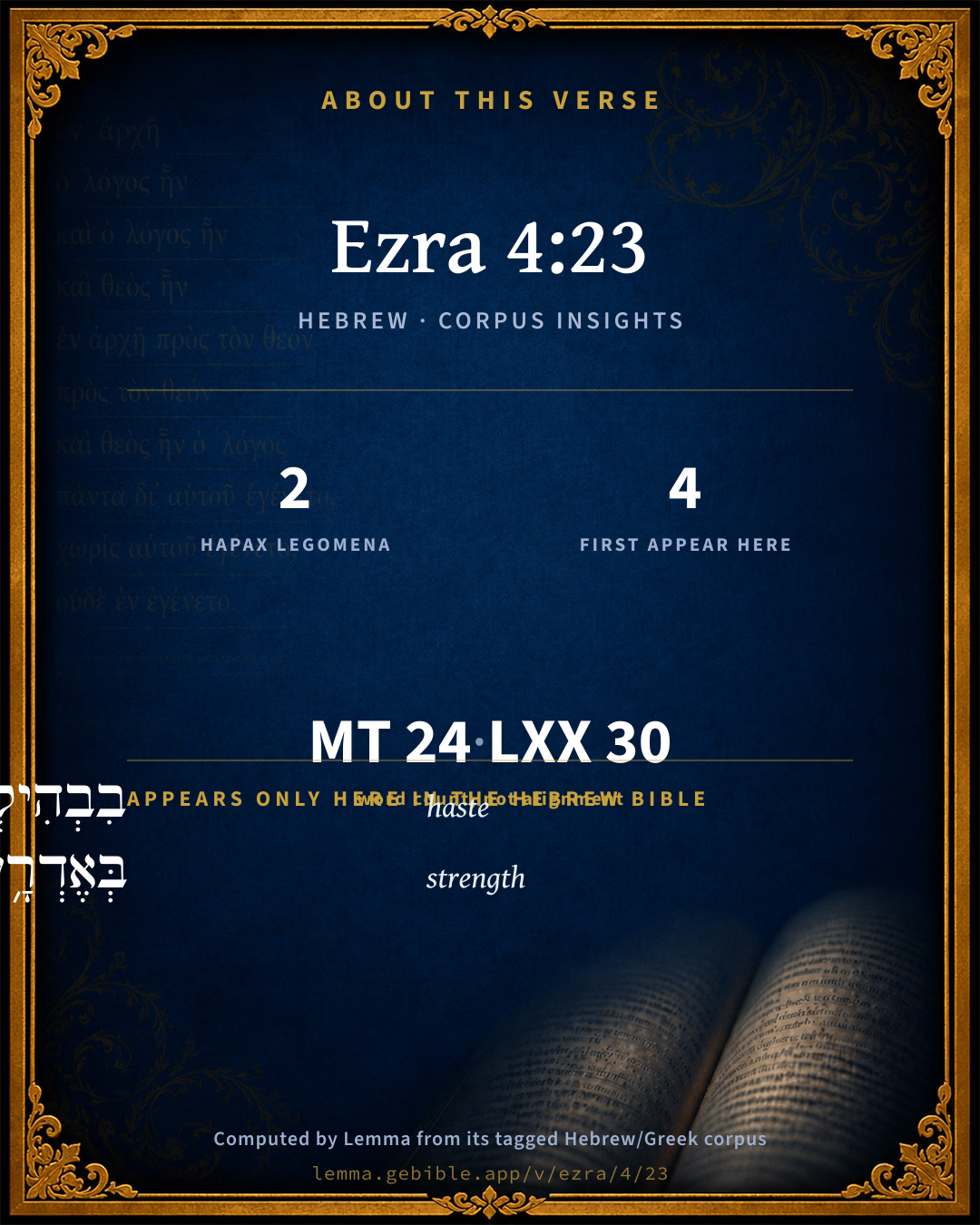
Ezra 4:23

Hebrew (Westminster Leningrad Codex) Ezra 4:23 appears in the Hebrew Old Testament. The text above is from the Westminster Leningrad Codex. Each word links to its Strong’s number, a concise gloss, and parsing drawn from the Open Scriptures Hebrew Bible morphology. Click any word for its full Brown-Driver-Briggs (BDB) entry.
Download image
Cite this verse

Ezra 4:23 (World English Bible). Public Domain. Lemma interlinear Bible study tool, https://lemma.gebible.app/v/ezra/4/23.

Show BibTeX & RIS
BibTeX
RIS
English Translation
Then when the copy of king Artaxerxes' letter was read before Rehum, and Shimshai the scribe, and their companions, they went in haste to Jerusalem to the Jews, and made them to cease by force and power.
World English Bible · Public Domain
Highlights
  • 2 hapax legomena — only here in the Hebrew Bible
  • 4 first appearances in the Hebrew Bible
Full analysis ↓
Download a study sheet

One document with this verse’s original text, its word-by-word gloss line, the meaning frame, cross-references with their text, attributed commentary, and full source and license credits — printable, and it pastes into notes with its structure intact.

This verse Autodidact and up

Study sheet (.html) Plain text (.txt)

A passage Seminary Student

Up to 50 verses in one chapter. A passage sheet keeps up to 6 commentary sources and 12 cross-references per verse, in the order this page ranks them, and says so on the sheet whenever that leaves anything out. Ask for a single verse and you get the Autodidact verse sheet above.

Everything on this page stays free to read, with no account — the sheet is a download of what is already on screen, not access to it.

Want to remove ads? Support Godless Engineer
Compare translations 3

The same verse in 3 English versions, stacked beneath the original-language interlinear above. Click any original word for its lexicon entry.

Each is an independent rendering of the whole verse — the interlinear is not word-aligned to these translations.

Highlighted words mark where these versions differ — a whole-verse word diff, not a word-by-word alignment.

  • World English Bible Public Domain
    Then when the copy of king Artaxerxes' letter was read before Rehum, and Shimshai the scribe, and their companions, they went in haste to Jerusalem to the Jews, and made them to cease by force and power.
  • King James Version Public Domain
    Now when the copy of king Artaxerxes' letter was read before Rehum, and Shimshai the scribe, and their companions, they went up in haste to Jerusalem unto the Jews, and made them to cease by force and power.
  • unfoldingWord Literal Text CC BY-SA 4.0
    Then from when the copy of the letter of Artaxerxes the king was read aloud before Rehum, and Shimshai the scribe, and their companions, they went in a hurry to Jerusalem against the Jews, and they stopped them by an arm and strength.

unfoldingWord Literal Text — © unfoldingWord, licensed CC BY-SA 4.0. Word-aligned USFM3 via Door43 (git.door43.org/unfoldingWord/en_ult).

Versions to compare (up to 4)

3 of 4 selected

Show all 18 translations

Every available English version of this verse, each an independent rendering of the whole verse.

  • World English Bible Public Domain
    Then when the copy of king Artaxerxes' letter was read before Rehum, and Shimshai the scribe, and their companions, they went in haste to Jerusalem to the Jews, and made them to cease by force and power.
  • Berean Standard Bible Public Domain
    When the text of the letter from King Artaxerxes was read to Rehum, Shimshai the scribe, and their associates, they went immediately to the Jews in Jerusalem and forcibly stopped them.
  • Majority Standard Bible Public Domain
    When the text of the letter from King Artaxerxes was read to Rehum, Shimshai the scribe, and their associates, they went immediately to the Jews in Jerusalem and forcibly stopped them.
  • King James Version Public Domain
    Now when the copy of king Artaxerxes' letter was read before Rehum, and Shimshai the scribe, and their companions, they went up in haste to Jerusalem unto the Jews, and made them to cease by force and power.
  • American Standard Version (1901) Public Domain
    Then when the copy of king Artaxerxes' letter was read before Rehum, and Shimshai the scribe, and their companions, they went in haste to Jerusalem unto the Jews, and made them to cease by force and power.
  • Revised Version (1885) Public Domain
    Then when the copy of king Artaxerxes’ letter was read before Rehum, and Shimshai the scribe, and their companions, they went in haste to Jerusalem unto the Jews, and made them to cease by force and power.
  • Geneva Bible (1599) Public Domain
    When the copie of king Artahshashtes letter was read before Rehum and Shimshai the scribe, and their companions, they went vp in all the haste to Ierusalem vnto the Iewes, and caused them to cease by force and power.
  • Douay-Rheims (1899) Public Domain
    Now the copy of the edict of king Artaxerxes was read before Reum Beelteem, and Samsai the scribe, and their counsellors: and they went up in haste to Jerusalem to the Jews, and hindered them with arm and power.
  • Young's Literal Translation Public Domain
    Then from the time that a copy of the letter of king Artaxerxes is read before Rehum, and Shimshai the scribe, and their companions, they have gone in haste to Jerusalem, unto the Jews, and caused them to cease by force and strength;
  • Literal Standard Version CC BY-SA 4.0
    Then from the time that a copy of the letter of King Artaxerxes is read before Rehum, and Shimshai the scribe, and their companions, they have gone in haste to Jerusalem, to the Jews, and caused them to cease by force and strength;
  • Unlocked Literal Bible CC BY-SA 4.0
    When King Artaxerxes' decree was read before Rehum, Shimshai, and their companions, they went out quickly to Jerusalem and forced the Jews to stop building.
  • unfoldingWord Literal Text CC BY-SA 4.0
    Then from when the copy of the letter of Artaxerxes the king was read aloud before Rehum, and Shimshai the scribe, and their companions, they went in a hurry to Jerusalem against the Jews, and they stopped them by an arm and strength.
  • Darby Bible Public Domain
    As soon as the copy of king Artaxerxes' letter was read before Rehum, and Shimshai the scribe, and their companions, they went up in haste to Jerusalem to the Jews, and made them cease by force and power.
  • World Messianic Bible Public Domain
    Then when the copy of King Artaxerxes’ letter was read before Rehum, Shimshai the scribe, and their companions, they went in haste to Jerusalem to the Jews, and made them to cease by force of arms.
  • Webster's Bible Public Domain
    Now when the copy of king Artaxerxes' letter was read before Rehum, and Shimshai the scribe, and their companions, they went up in haste to Jerusalem to the Jews, and made them to cease by force and power.
  • Free Bible Version CC BY-SA 4.0
    As soon as this letter from King Artaxerxes was read to Rehum, Shimshai the scribe, and their fellow officers, they rushed to the Jews in Jerusalem and used their power to forcibly make them stop work.
  • Bible in Basic English Public Domain
    Then, after reading the king's letter, Rehum and Shimshai the scribe and their friends went quickly to Jerusalem, to the Jews, and had them stopped by force.
  • JPS Tanakh (1917) Public Domain
    Then when the copy of king Artaxerxes' letter was read before Rehum, and Shimshai the scribe, and their companions, they went in haste to Jerusalem unto the Jews, and made them to cease by force and power.

Literal Standard Version (2020), Covenant Press — licensed CC BY-SA 4.0. Text via the HelloAO Bible API (eBible.org). Unlocked Literal Bible (unfoldingWord) — licensed CC BY-SA 4.0. Text via the HelloAO Bible API (eBible.org). unfoldingWord Literal Text — © unfoldingWord, licensed CC BY-SA 4.0. Word-aligned USFM3 via Door43 (git.door43.org/unfoldingWord/en_ult). Free Bible Version, Dr. Jonathan Gallagher — licensed CC BY-SA 4.0. Text via the HelloAO Bible API (eBible.org).

Word by word

More ways to search: Search by grammar → Find every occurrence → Compare this word →

Practice this passage: Drill this verse → Learn its vocabulary →

בִבְהִיל֤וּ
bᵉhîylûw
H924
“in/at · haste”
Adjective, R + Noun, Common, Feminine, Singular, Absolute
Part of Speech
Adjective + Noun
Type
Common
Gender
Feminine
Number
Singular
State
Absolute
Full BDB Definition

Origin: from H927

TWOT: 2624a

haste, hastily
  1. אֱדַ֗יִן ʼĕdayin H116 “then” Adjective, D
  2. מִן min H4481 “from” Adjective, R
  3. דִּ֞י dîy H1768 “which” Adjective, T
  4. פַּרְשֶׁ֤גֶן parshegen H6573 “copy of” Adjective, N, Common
  5. נִשְׁתְּוָנָא֙ nishtᵉvân H5407 “letter · the” Adjective, N, Common + Particle, Definite Article
  6. דִּ֚י dîy H1768 “which” Adjective, T
  7. ארתחששתא ʼArtachshashtâʼ H783 “Artaxerxes” Adjective, N
  8. אַרְתַּחְשַׁ֣שְׂתְּ ʼArtachshashtâʼ H783 “Artaxerxes” Adjective, N
  9. מַלְכָּ֔א melek H4430 “king · the” Adjective, N, Common + Particle, Definite Article
  10. קֱרִ֧י qᵉrâʼ H7123 “to call” Adjective, V, Plural
  11. קֳדָם qŏdâm H6925 “before” Adjective, R
  12. רְח֛וּם Rᵉchûwm H7348 “Rehum” Adjective, N
  13. וְשִׁמְשַׁ֥י Shimshay H8124 “and · Shimshai” Adjective, C + Noun, Proper
  14. סָפְרָ֖א çâphêr H5613 “scribe · the” Adjective, N, Common + Particle, Definite Article
  15. וּכְנָוָתְה֑וֹן kᵉnâth H3675 “and · companions · their” Adjective, C + Noun, Common, Masculine, Plural, Construct + Suffix, Personal, 3rd Person, Masculine, Plural
  16. אֲזַ֨לוּ ʼăzal H236 “to go” Adjective, V, Plural
  17. לִירֽוּשְׁלֶם֙ Yᵉrûwshâlêm H3390 “to/for · Jerusalem” Adjective, R + Noun, Proper
  18. עַל ʻal H5922 “upon” Adjective, R
  19. יְה֣וּדָיֵ֔א Yᵉhûwdâʼîy H3062 “Jews · the” Adjective, N + Particle, Definite Article
  20. וּבַטִּ֥לוּ bᵉṭêl H989 “and · to cease” Adjective, C + Verb, Piel, Perfect, 3rd Person, Masculine, Plural
  21. הִמּ֖וֹ himmôw H1994 “they” Adjective, P
  22. בְּאֶדְרָ֥ע ʼedrâʻ H153 “in/at · strength” Adjective, R + Noun, Common, Feminine, Singular, Absolute
  23. וְחָֽיִל chayil H2429 “and · strength” Adjective, C + Noun, Common, Masculine, Singular, Absolute

About this verse

These counts appear in no published source. They are computed here, from the morphology-tagged text and Lemma’s own curated glosses. What Lemma adds →

24
words
22
distinct lemmas
Historical
section

Notable vocabulary

2 hapax legomena — words that appear only here in the entire Hebrew Bible:

  • בִבְהִיל֤וּ haste H924
  • בְּאֶדְרָ֥ע strength H153

First appearance in Scripture

These words make their first canonical appearance in the Hebrew Bible here:

  • אֲזַ֨לוּ to go H236
  • בִבְהִיל֤וּ haste H924
  • בְּאֶדְרָ֥ע strength H153
  • וְחָֽיִל strength H2429

Shared distinctive vocabulary

פַּרְשֶׁ֤גֶן copy H6573 occurs in 3 verses of the Hebrew Bible. Also found in:

Grammatical profile

  • 1 verb
  • 6 nouns
  • 13 adjectives
  • 4 particles

Verb forms

  • וּבַטִּ֥לוּ Piel · Perfect

Repetition

Words recur within this verse — often emphatic in Hebrew:

  • ארתחששתא Artaxerxes H783 ×2
  • דִּ֞י which H1768 ×2

Hebrew & Septuagint length

In English translation the verse runs 37 words from the Hebrew and 41 from the Septuagint (LXX English) — closely comparable.

A rough comparison of the two English renderings, which tokenize alike — not a word-level alignment.

Word counts can differ between the Hebrew and the Greek without any difference in meaning — e.g. the Hebrew direct-object marker אֵת has no separate Greek word, and Greek often adds the article ὁ.

In the original languages it is 24 Hebrew tokens and 30 Greek tokens — but the two are counted differently (Hebrew bundles its prefixes and suffixes into one token; the Greek is in lemma form), so that isn’t a like-for-like length.

Cross-references

5

Topical passages linked to Ezra 4:23 in the Treasury of Scripture Knowledge — connected by theme and wording, ordered by reader-vote popularity; previews shown in the World English Bible.

  • Ezra 4:8–9 Rehum the chancellor and Shimshai the scribe wrote a letter against Jerusalem to Artaxerxes the king in this sort:
  • Ezra 4:17 [Then] sent the king an answer to Rehum the chancellor, and to Shimshai the scribe, and to the rest of their companions who dwell in Samaria, and in the rest [of the country] beyond the River: Peace, and so forth.
  • Proverbs 4:16 For they don't sleep, unless they do evil. Their sleep is taken away, unless they make someone fall.
  • Micah 2:1 Woe to those who devise iniquity And work evil on their beds! When the morning is light, they practice it, Because it is in the power of their hand.
  • Romans 3:15 "Their feet are swift to shed blood.

Cross-references courtesy of OpenBible.info (CC BY 4.0).

Hebrew and Greek witnesses Masoretic Hebrew ↔ Greek Septuagint

The same verse in the two great witnesses to the Old Testament, shown verse-for-verse.

These are two independent witnesses, not word-aligned to each other, and the Septuagint is shown in lemma (dictionary) form.

Hebrew Ezra 4:23 Masoretic · Westminster Leningrad Codex

אֱדַ֗יִן מִן דִּ֞י פַּרְשֶׁ֤גֶן נִשְׁתְּוָנָא֙ דִּ֚י ארתחששתא אַרְתַּחְשַׁ֣שְׂתְּ מַלְכָּ֔א קֱרִ֧י קֳדָם רְח֛וּם וְשִׁמְשַׁ֥י סָפְרָ֖א וּכְנָוָתְה֑וֹן אֲזַ֨לוּ בִבְהִיל֤וּ לִירֽוּשְׁלֶם֙ עַל יְה֣וּדָיֵ֔א וּבַטִּ֥לוּ הִמּ֖וֹ בְּאֶדְרָ֥ע וְחָֽיִל

Then when the copy of king Artaxerxes' letter was read before Rehum, and Shimshai the scribe, and their companions, they went in haste to Jerusalem to the Jews, and made them to cease by force and power.

World English Bible · Public Domain

Greek LXX Ezra 4:23 Septuagint · lemma form

τότε ὁ φορολόγος ὁ αρθασασθα βασιλεύς ἀναγιγνώσκω ἐνώπιον ραουμ καί σαμσαι γραμματεύς καί σύνδουλος αὐτός καί πορεύομαι σπουδή εἰς ἰερουσαλήμ καί ἐν ἰουδά καί καταἐργέω αὐτός ἐν ἵππος καί δύναμις

Then the tribute-gatherer of king Arthasastha read the letter before Reum the chancellor, and Sampsa the scribe, and his fellow-servants: and they went in haste to Jerusalem and through Juda, and caused them to cease with horses and an armed force.

LXX2012 (modern English Septuagint) · Public Domain

In the Septuagint this is one book — Esdras B (2 Esdras): Ezra is chapters 1–10, Nehemiah 11–23.

On this verse, The Cambridge Bible for Schools and Colleges discusses the Septuagint’s reading. Read the note in Commentary ↓

Hebrew: Westminster Leningrad Codex (CC BY 4.0). Greek: Septuagint (public domain); English from LXX2012 (modern English Septuagint) (Public Domain). How the Septuagint differs from the Hebrew →

Commentary

Notes on Ezra 4:23 from classic Christian and Jewish commentators (each source and its license shown beneath its notes). The classic Christian expositions comment on the surrounding passage and are grouped to its opening verse, so a note may address several verses; the Jewish commentaries on the Tanakh (Rashi and others) are per-verse, so they appear only where the commentator wrote on this verse.

Lemma curates 59 commentaries, every one of them public domain or Creative Commons licensed, each selected and text-cleaned for this edition rather than reprinted as found. About our sources →

Trapp's Complete Commentary

John Trapp

Ezr 4:23 Now when the copy of king Artaxerxes’ letter [was] read before Rehum, and Shimshai the scribe, and their companions, they went up in haste to Jerusalem unto the Jews, and made them to cease by force and power.

Ver. 23. They went up in haste] Perurgente diabolo, the devil driving them, and their own malicious dispositions egging them thereunto (Bern.). So, when Queen Mary lay a dying, Harpsfeild, arch-deacon of Canterbury, being at London, made all post-haste home to dispatch those martyrs whom he had then in his cruel custody (Acts and Mon. 1562). So ambitious are wicked men of hell, they take long strides, and mend their pace, as if they feared lest it should be taken up before they come thither.

John Trapp, A Commentary or Exposition upon All the Books of the Old and New Testament (1647–1656) — public domain. Text from a community e-Sword module.

Joseph Benson's Commentary

Ezr 4:23. And made them to cease by force and power — As they abused the king by their misinformations, in the obtaining of this order, so they abused him in the execution of it; for the order was only to prevent the building of the city and its walls. But, having power in their hands, they on this pretence stopped the building of the temple. See what need we have to pray, not only for kings, but for all in authority under them; because the quietness of our lives depends much on the integrity and wisdom of inferior magistrates as well as the supreme.

Joseph Benson's Commentary on the Old and New Testaments (1811–1818) — public domain. Text from a community e-Sword module.

Tyndale Open Study Notes

Tyndale Open Resources

4:23 A military unit probably forced the Jews to stop building and enforced the king’s wishes. Part of the rebuilt wall might have been torn down at this time (cp. Neh 1:3). • This verse ends the parenthetical section that began in Ezra 4:6.

Tyndale Open Study Notes — © Tyndale Open Resources, licensed CC BY-SA 4.0. Text via the HelloAO Bible API.

Adam Clarke's Commentary

Verse 23. Made them to cease by force and power.] Commanded them on pain of the king's displeasure not to proceed, obliging all to remit their labours, and probably bringing an armed force to prevent them from going forward.

Adam Clarke's Commentary on the Bible (1810–1826) — public domain. Text from a community e-Sword/MySword module.

The Cambridge Bible for Schools and Colleges

gen. ed. J. J. S. Perowne

23. Now] R.V. Then, i.e. Thereupon.

read before] cf. 18.

they went up in haste] R.V. they went in haste.—Far from being slack in executing the king’s decree: gratified malice made them prompt as well as desirous to stay the work.

made them to cease by force and power] Literally ‘with an arm and with troops’. Vulg. ‘in brachio et robore’, cf. Eze_17:9, ‘without great power’ (lit. arm); Dan_11:15; Dan_11:31 (‘arms’ = strength). The LXX. render ‘with horses and force’ (ἐν ἵπποις καὶ δυνάμει). The Samaritans stopped the Jews from building “by main force”. If the Jews resisted, resistance was useless in the face of the royal decree.

Perhaps we may see in the reference to the ruinous condition of the walls and defences of Jerusalem, Neh_1:3, the results of the forcible means taken by the Samaritans to cause the work to cease.

The Cambridge Bible for Schools and Colleges (gen. ed. J. J. S. Perowne; Cambridge University Press, 1878–1918) — public domain. Text from a community e-Sword module.

John Gill's Exposition

Then ceased the work of the house of God, which is at Jerusalem,.... How far they had proceeded is not said, whether any further than laying the foundation of it; though probably, by this time, it might be carried to some little height; however, upon this it was discontinued:

so it ceased unto the second year of the reign of Darius king of Persia; not Darius Nothun, as some think, for from the first of Cyrus to the sixth of his reign, when the temple was finished, was upwards of one hundred years; yea, according to some, about one hundred and forty; which would carry the age of Zerubbabel, who both laid the foundation of the temple, and finished it, and the age of those who saw the first temple, to a length that is not probable; but this was Darius Hystaspis, who succeeded Cambyses the son of Cyrus, there being only, between, the short usurpation of Smerdis for seven months.

Next: Ezra Chapter 5

John Gill's Exposition of the Whole Bible (1746–1763) — public domain (CC PDM 1.0). Text via the HelloAO Bible API.

Haydock's Catholic Bible Commentary

Beelteem, is not in Chaldean. --- Arm, or "force." (Protestants) (Haydock)

George Leo Haydock (1774–1849), Haydock's Catholic Family Bible and Commentary, 1859 edition — public domain. Excludes Psalms (Douay-Rheims chapter numbering differs from Protestant) and Deuterocanonical books (Catholic canon only).

Whedon's Commentary on the Bible

Daniel D. Whedon

23. Went up in haste — The haste was the more necessary that the Jews might have no opportunity to learn and expose their misrepresentations of their work. Had they had an opportunity to show that they were building not the city but the temple, the Samaritans might not have been so successful with the king.

By force and power — Literally, by arm and might, that is, by sheer violence. They forced them to cease work.

Daniel D. Whedon (gen. ed.), Commentary on the Old and New Testaments (1874–1909) — public domain. Text from a community e-Sword module.

The Pulpit Commentary

They went up in haste. The "adversaries" lost no time. Having obtained the decree which forbad further building, they proceeded with it to Jerusalem, and by a display of force compelled the Jews to submission. No doubt resistance might have been made, but resistance would have been rebellion.

The Pulpit Commentary (1880–1919), ed. H.D.M. Spence-Jones & Joseph S. Exell — public domain. Text from a community e-Sword module.

John Wesley's Explanatory Notes

To cease. &c. - As they abused the king by their misinformations, in the obtaining of this order, so they abused him in the execution of it; for the order was only to prevent the walling of the city. But having power in their hands, they, on this pretense, stopt the building of the temple. See what need we have to pray, not only for kings, but for all in authority under them: because the quietness of our lives depends much on the integrity and wisdom of inferior magistrates as well as the supreme.

John Wesley, Explanatory Notes Upon the Whole Bible (1754–1765) — public domain. Text via the GEBible commentary corpus.

unfoldingWord translationNotes

Door43 World Missions Community

King Artaxerxes' decree was read

This can be translated in active form, in which case you will need to make explicit who read the decree from the king to the officials. AT: "The messengers from King Artaxerxes read his decree" (See: Active or Passive and Assumed Knowledge and Implicit Information)

Rehum

See how you translated this in Esra 2:1.

Shimshai

See how you translated this in Esra 4:7.

the work on the house of God in Jerusalem stopped until the second year of the reign of Darius

This delay lasted about 16 years.

translationWords

king

Artaxerxes

Jew

house of God

Darius

Persia

unfoldingWord translationNotes — © Distant Shores Media and the Door43 World Missions Community, licensed CC BY-SA 4.0. Source: git.door43.org/Door43/en_tn.

Rashi

Rabbi Shlomo Yitzchaki (Rashi)

then [as translated,] then.

since the interpretation Since the interpretation of the writ of the letter of Artaxerxes the king—he is Cyrus—this incident took place.

was read before for the writ of this letter was read before Rehum and Shimshai and their companies, and they went with speed and haste to Jerusalem, to the Jews, and stopped them with force and might from continuing the construction of the edifice.

to the Jews Aram. עַל יְהוּדָיֵא, lit. On the Jews.

and they Aram. הִמוֹ, equivalent to הֵם.

Rashi on the Tanakh — English translations: “The Judaica Press complete Tanach with Rashi, translated by A. J. Rosenberg” (CC BY 4.0); “Pentateuch with Rashi's commentary by M. Rosenbaum and A.M. Silbermann, 1929-1934” (public domain); “The Metsudah Tanach series, Lakewood, N.J” (CC BY 4.0); and “The Book of Joshua, Metsudah Publications, 1997” (CC BY 4.0). Text via Sefaria.

Lesson kit

Teaching starters — assembled from the data on this page, not authored interpretation. Every prompt links to the verse data it draws on. Edit before teaching.

Ezra, in the Historical, opens this verse with 24 words (22 distinct Hebrew lemmas). Its most distinctive word is bᵉhîylûw (“haste”). A historical commentator’s framing appears above. Read the whole chapter for the surrounding context.

Discussion questions

  1. The word bᵉhîylûw carries the sense “haste.” How does it shape the verse?
  2. 2 words here appear nowhere else in the Hebrew Bible. Why might the author reach for such rare wording?
  3. 4 words make their first appearance in Scripture here. What does this debut establish?
  4. How does Ezra 4:11, which shares the word «copy», read alongside this verse?
  5. What does the repetition of “Artaxerxes” (2× in this one verse) do in this verse?
  6. These translations render this verse differently. What is at stake in choosing one wording over another?
  7. «וּבַטִּ֥לוּ» is a Piel Perfect verb. How does that grammatical form shape the action described?
  8. Compare how Trapp's Complete Commentary and Joseph Benson's Commentary read this verse. Where do they agree or differ?

Things to notice

  • 2 words in this verse appear nowhere else in the Hebrew Bible.
  • 4 words make their first canonical appearance in Scripture here.
  • This verse counts 24 Hebrew ↔ 30 Greek words.
  • These translations choose different wording for 13 words in this verse.
  • “Artaxerxes” occurs 2× in this single verse.

Reading settings

Reading text

Shown beneath each verse's original-language words.

Old Testament
Old Testament edition

Read the OT as the Masoretic Hebrew (MT) or the Greek Septuagint (LXX).

English shown for the Greek Septuagint (in the Hebrew ↔ Greek comparison).

Comparing translations? Open the Compare panel on any verse page to stack up to four side by side.