
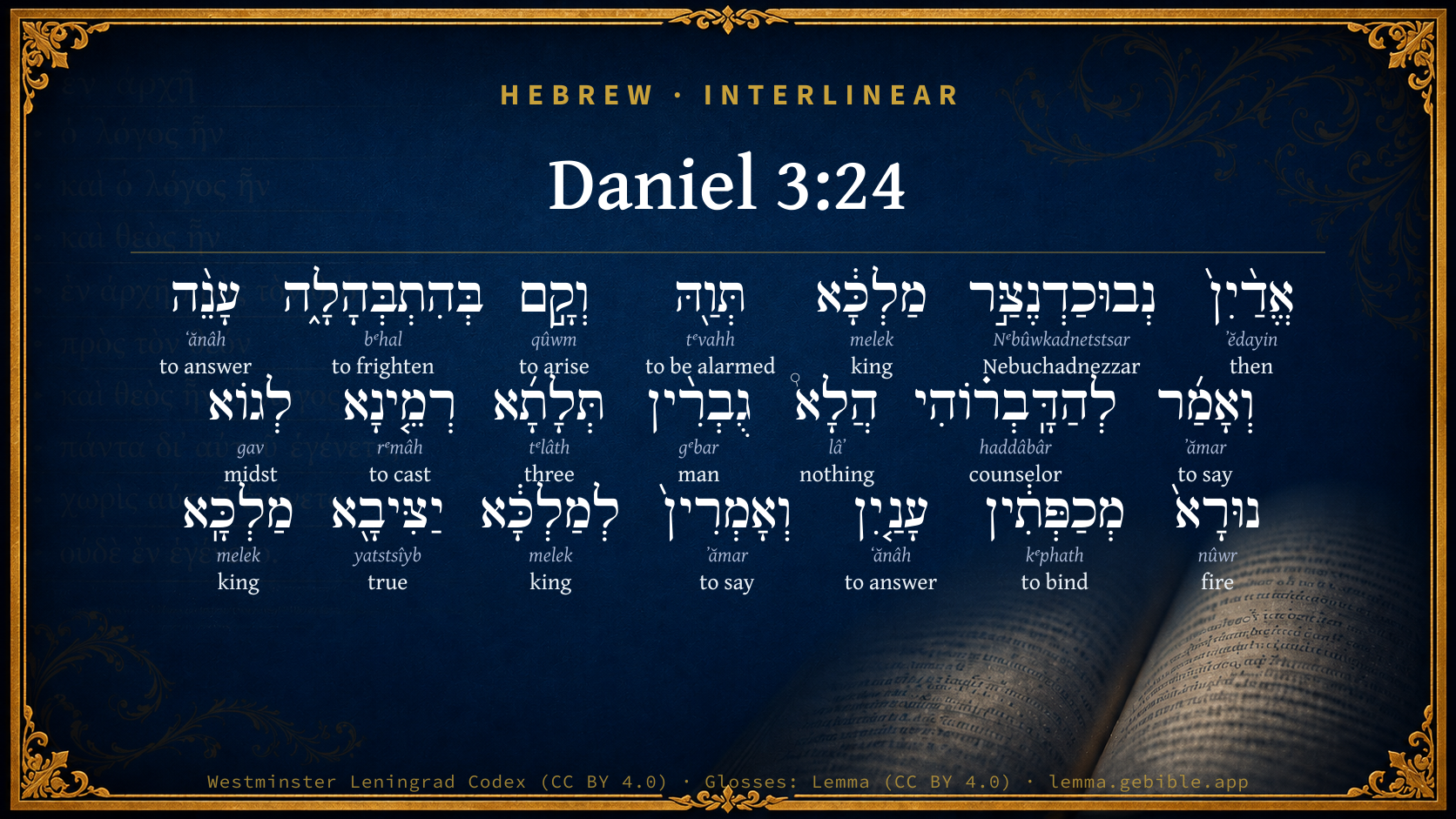
Daniel 3:24

Hebrew (Westminster Leningrad Codex) Daniel 3:24 appears in the Hebrew Old Testament. The text above is from the Westminster Leningrad Codex. Each word links to its Strong’s number, a concise gloss, and parsing drawn from the Open Scriptures Hebrew Bible morphology. Click any word for its full Brown-Driver-Briggs (BDB) entry.
Download image
Cite this verse

Daniel 3:24 (World English Bible). Public Domain. Lemma interlinear Bible study tool, https://lemma.gebible.app/v/daniel/3/24.

Show BibTeX & RIS
BibTeX
RIS
English Translation
Then Nebuchadnezzar the king was astonished, and rose up in haste: he spoke and said to his counselors, Didn't we cast three men bound into the midst of the fire? They answered the king, True, O king.
World English Bible · Public Domain
Highlights
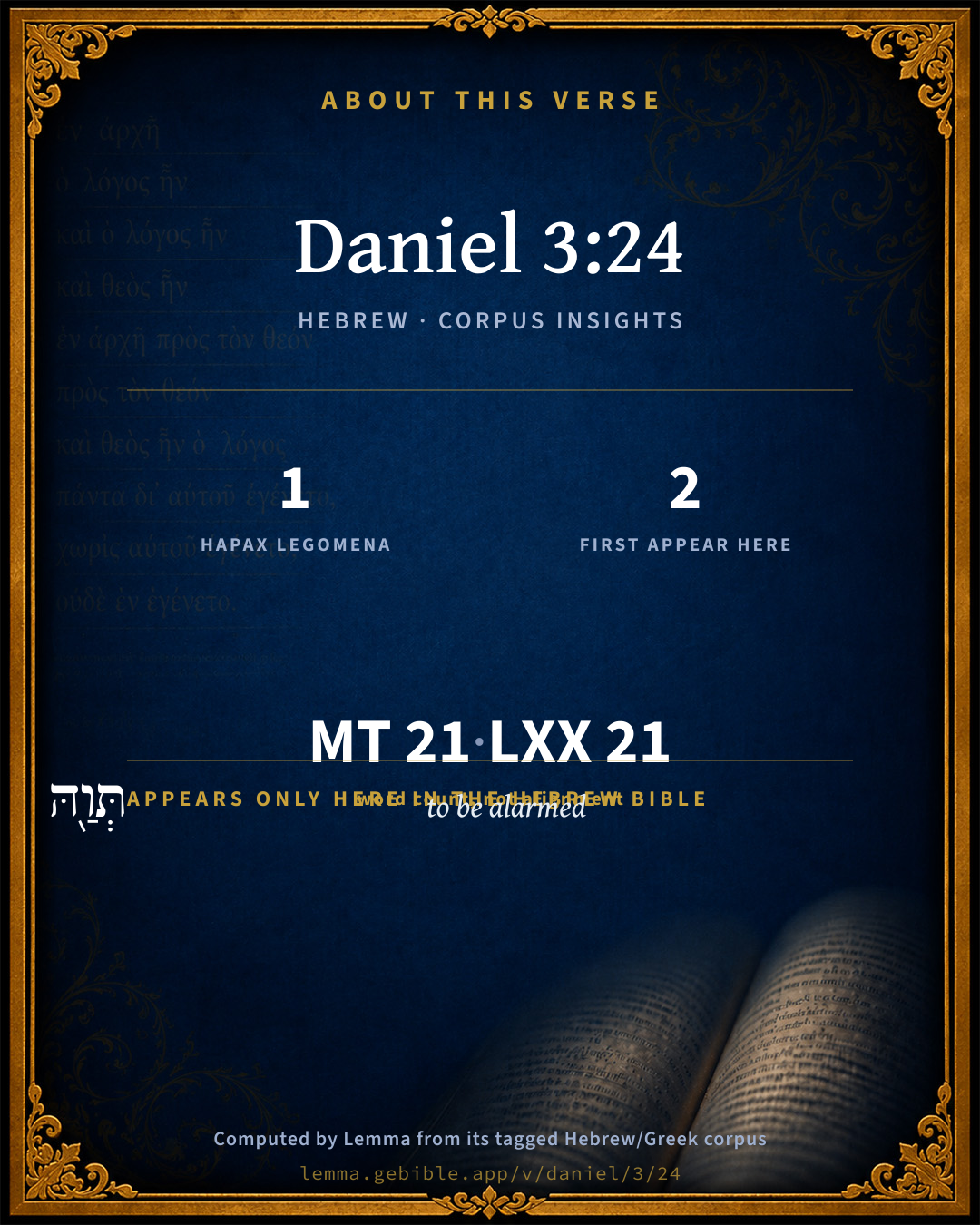
  • 1 hapax legomenon — only here in the Hebrew Bible
  • 2 first appearances in the Hebrew Bible
Full analysis ↓
Download a study sheet

One document with this verse’s original text, its word-by-word gloss line, the meaning frame, cross-references with their text, attributed commentary, and full source and license credits — printable, and it pastes into notes with its structure intact.

This verse Autodidact and up

Study sheet (.html) Plain text (.txt)

A passage Seminary Student

Up to 50 verses in one chapter. A passage sheet keeps up to 6 commentary sources and 12 cross-references per verse, in the order this page ranks them, and says so on the sheet whenever that leaves anything out. Ask for a single verse and you get the Autodidact verse sheet above.

Everything on this page stays free to read, with no account — the sheet is a download of what is already on screen, not access to it.

Want to remove ads? Support Godless Engineer
Compare translations 3

The same verse in 3 English versions, stacked beneath the original-language interlinear above. Click any original word for its lexicon entry.

Each is an independent rendering of the whole verse — the interlinear is not word-aligned to these translations.

Highlighted words mark where these versions differ — a whole-verse word diff, not a word-by-word alignment.

  • World English Bible Public Domain
    Then Nebuchadnezzar the king was astonished, and rose up in haste: he spoke and said to his counselors, Didn't we cast three men bound into the midst of the fire? They answered the king, True, O king.
  • King James Version Public Domain
    Then Nebuchadnezzar the king was astonied, and rose up in haste, and spake, and said unto his counsellors, Did not we cast three men bound into the midst of the fire? They answered and said unto the king, True, O king.
  • unfoldingWord Literal Text CC BY-SA 4.0
    Then King Nebuchadnezzar was astonished and stood up in haste. He said to his counselors, “Did we not throw three men bound into the midst of the fire?” They answered and said to the king, “Certainly, O king.”

unfoldingWord Literal Text — © unfoldingWord, licensed CC BY-SA 4.0. Word-aligned USFM3 via Door43 (git.door43.org/unfoldingWord/en_ult).

Versions to compare (up to 4)

3 of 4 selected

Show all 18 translations

Every available English version of this verse, each an independent rendering of the whole verse.

  • World English Bible Public Domain
    Then Nebuchadnezzar the king was astonished, and rose up in haste: he spoke and said to his counselors, Didn't we cast three men bound into the midst of the fire? They answered the king, True, O king.
  • Berean Standard Bible Public Domain
    Suddenly King Nebuchadnezzar jumped up in amazement and asked his advisers, “Did we not throw three men, firmly bound, into the fire?” “Certainly, O king,” they replied.
  • Majority Standard Bible Public Domain
    Suddenly King Nebuchadnezzar jumped up in amazement and asked his advisers, “Did we not throw three men, firmly bound, into the fire?” “Certainly, O king,” they replied.
  • King James Version Public Domain
    Then Nebuchadnezzar the king was astonied, and rose up in haste, and spake, and said unto his counsellors, Did not we cast three men bound into the midst of the fire? They answered and said unto the king, True, O king.
  • American Standard Version (1901) Public Domain
    Then Nebuchadnezzar the king was astonished, and rose up in haste: he spake and said unto his counsellors, Did not we cast three men bound into the midst of the fire? They answered and said unto the king, True, O king.
  • Revised Version (1885) Public Domain
    Then Nebuchadnezzar the king was astonied, and rose up in haste: he spake and said unto his counsellors, Did not we cast three men bound into the midst of the fire? They answered and said unto the king, True, O king.
  • Geneva Bible (1599) Public Domain
    Then Nebuchad-nezzar the King was astonied and rose vp in haste, and spake, and saide vnto his counsellers, Did not wee cast three men bound into the middes of the fire? Who answered and said vnto the King, It is true, O King.
  • Douay-Rheims (1899) Public Domain
    Then Nabuchodonosor the king was astonished, and rose up in haste, and said to his nobles: Did we not cast three men bound into the midst of the fire? They answered the king, and said: True, O king.
  • Young's Literal Translation Public Domain
    Then Nebuchadnezzar the king hath been astonished, and hath risen in haste; he hath answered and said to his counsellors, `Have we not cast three men into the midst of the fire -- bound?' They have answered and are saying to the king, `Certainly, O king.'
  • Literal Standard Version CC BY-SA 4.0
    Then Nebuchadnezzar the king has been astonished, and has risen in haste; he has answered and said to his counselors, “Have we not cast three men into the midst of the fire—bound?” They have answered and are saying to the king, “Certainly, O king.”
  • Unlocked Literal Bible CC BY-SA 4.0
    Then Nebuchadnezzar the king was amazed and stood up quickly. He asked his advisors, “Did we not throw three men tied up into the fire?” They replied to the king, “Certainly, king.”
  • unfoldingWord Literal Text CC BY-SA 4.0
    Then King Nebuchadnezzar was astonished and stood up in haste. He said to his counselors, “Did we not throw three men bound into the midst of the fire?” They answered and said to the king, “Certainly, O king.”
  • Darby Bible Public Domain
    Then Nebuchadnezzar the king was astonied, and rose up in haste; he spoke and said unto his counsellors, Did not we cast three men bound into the midst of the fire? They answered and said to the king, True, O king.
  • World Messianic Bible Public Domain
    Then Nebuchadnezzar the king was astonished and rose up in haste. He spoke and said to his counselors, “Didn’t we cast three men bound into the middle of the fire?” They answered the king, “True, O king.”
  • Webster's Bible Public Domain
    Then Nebuchadnezzar the king was astonished, and rose up in haste, and spoke, and said to his counselors, Did we not cast three men bound into the midst of the fire? They answered and said to the king, True, O king.
  • Free Bible Version CC BY-SA 4.0
    Then King Nebuchadnezzar suddenly jumped up in amazement. “Didn't we throw three men tied up into the furnace?” he asked his advisors. “Yes, that's right, Your Majesty,” they replied.
  • Bible in Basic English Public Domain
    Then King Nebuchadnezzar, full of fear and wonder, got up quickly, and said to his wise men, Did we not put three men in cords into the fire? and they made answer and said to the king, True, O King.
  • JPS Tanakh (1917) Public Domain
    Then Nebuchadnezzar the king was alarmed, and rose up in haste; he spoke and said unto his ministers: 'Did not we cast three men bound into the midst of the fire?' They answered and said unto the king: 'True, O king.'

Literal Standard Version (2020), Covenant Press — licensed CC BY-SA 4.0. Text via the HelloAO Bible API (eBible.org). Unlocked Literal Bible (unfoldingWord) — licensed CC BY-SA 4.0. Text via the HelloAO Bible API (eBible.org). unfoldingWord Literal Text — © unfoldingWord, licensed CC BY-SA 4.0. Word-aligned USFM3 via Door43 (git.door43.org/unfoldingWord/en_ult). Free Bible Version, Dr. Jonathan Gallagher — licensed CC BY-SA 4.0. Text via the HelloAO Bible API (eBible.org).

Word by word

More ways to search: Search by grammar → Find every occurrence → Compare this word →

Practice this passage: Drill this verse → Learn its vocabulary →

תְּוַ֖הּ
tᵉvahh
H8429
“to be alarmed”
Adjective, V, Plural
Part of Speech
Adjective
Number
Plural
Full BDB Definition

Origin: corresponding to H8539 or perhaps to H7582 through the idea of sweeping to ruin [compare H8428 ]

TWOT: 3054

(Peal) to be startled, be alarmed
  1. אֱדַ֨יִן֙ ʼĕdayin H116 “then” Adjective, D
  2. נְבוּכַדְנֶצַּ֣ר Nᵉbûwkadnetstsar H5020 “Nebuchadnezzar” Adjective, N
  3. מַלְכָּ֔א melek H4430 “king · the” Adjective, N, Common + Particle, Definite Article
  4. וְקָ֣ם qûwm H6966 “and · to arise” Adjective, C + Verb, Qal, Perfect, 3rd Person, Masculine, Singular
  5. בְּהִתְבְּהָלָ֑ה bᵉhal H927 “in/at · to frighten” Adjective, R + Verb, Hothpaal, Infinitive Construct
  6. עָנֵ֨ה ʻănâh H6032 “answering” Adjective, V
  7. וְאָמַ֜ר ʼămar H560 “and · saying” Adjective, C + Verb, Qal, Participle Active, Masculine, Singular, Absolute
  8. לְהַדָּֽבְר֗וֹהִי haddâbâr H1907 “to/for · counselors · his” Adjective, R + Noun, Common, Masculine, Plural, Construct + Suffix, Personal, 3rd Person, Masculine, Singular
  9. הֲלָא֩ lâʼ H3809 “nothing” Adjective, T + Particle, Negative
  10. גֻבְרִ֨ין gᵉbar H1400 “men” Adjective, N, Common
  11. תְּלָתָ֜א tᵉlâth H8532 “three” Adjective, A, Common
  12. רְמֵ֤ינָא rᵉmâh H7412 “to cast” Adjective, V, Plural
  13. לְגוֹא gav H1459 “to/for · midst of” Adjective, R + Noun, Common, Masculine, Singular, Construct
  14. נוּרָא֙ nûwr H5135 “fire · the” Adjective, N, Common + Particle, Definite Article
  15. מְכַפְּתִ֔ין kᵉphath H3729 “binding” Adjective, V
  16. עָנַ֤יִן ʻănâh H6032 “answering” Adjective, V
  17. וְאָמְרִין֙ ʼămar H560 “and · saying” Adjective, C + Verb, Qal, Participle Active, Masculine, Plural, Absolute
  18. לְמַלְכָּ֔א melek H4430 “to/for · king · the” Adjective, R + Noun, Common, Masculine, Singular, Determined + Particle, Definite Article
  19. יַצִּיבָ֖א yatstsîyb H3330 “true” Adjective, A
  20. מַלְכָּֽא melek H4430 “king · the” Adjective, N, Common + Particle, Definite Article

About this verse

These counts appear in no published source. They are computed here, from the morphology-tagged text and Lemma’s own curated glosses. What Lemma adds →

21
words
17
distinct lemmas
Prophets
section

Notable vocabulary

1 hapax legomenon — a word that appears only here in the entire Hebrew Bible:

  • תְּוַ֖הּ to be alarmed H8429

First appearance in Scripture

These words make their first canonical appearance in the Hebrew Bible here:

  • תְּוַ֖הּ to be alarmed H8429
  • לְהַדָּֽבְר֗וֹהִי counselor H1907

Shared distinctive vocabulary

לְהַדָּֽבְר֗וֹהִי counselor H1907 occurs in 4 verses of the Hebrew Bible. Also found in:

Grammatical profile

  • 4 verbs
  • 2 nouns
  • 10 adjectives
  • 5 particles

Verb forms

  • וְקָ֣ם Qal · Perfect
  • בְּהִתְבְּהָלָ֑ה Hothpaal · Infinitive Construct
  • וְאָמַ֜ר Qal · Participle Active
  • וְאָמְרִין֙ Qal · Participle Active

Repetition

Words recur within this verse — often emphatic in Hebrew:

  • מַלְכָּ֔א king H4430 ×3
  • עָנֵ֨ה to answer H6032 ×2
  • וְאָמַ֜ר to say H560 ×2

Hebrew & Septuagint length

In English translation the verse runs 37 words from the Hebrew and 41 from the Septuagint (LXX English) — closely comparable.

A rough comparison of the two English renderings, which tokenize alike — not a word-level alignment.

Word counts can differ between the Hebrew and the Greek without any difference in meaning — e.g. the Hebrew direct-object marker אֵת has no separate Greek word, and Greek often adds the article ὁ.

In the original languages it is 21 Hebrew tokens and 21 Greek tokens — but the two are counted differently (Hebrew bundles its prefixes and suffixes into one token; the Greek is in lemma form), so that isn’t a like-for-like length.

Cross-references

15

Topical passages linked to Daniel 3:24 in the Treasury of Scripture Knowledge — connected by theme and wording, ordered by reader-vote popularity; previews shown in the World English Bible.

  • Daniel 6:7 All the presidents of the kingdom, the deputies and the satraps, the counselors and the governors, have consulted together to establish a royal statute, and to make a strong interdict, that whoever shall ask a petition of any god or man for thirty days, save of you, O king, he shall be cast into the den of lions.
  • Daniel 6:22 My God has sent his angel, and has shut the lions' mouths, and they have not hurt me; because as before him innocence was found in me; and also before you, O king, have I done no hurt.
  • 1 Samuel 17:55 When Saul saw David go forth against the Philistine, he said to Abner, the captain of the host, Abner, whose son is this youth? Abner said, As your soul lives, O king, I can't tell.
  • Daniel 3:2–3 Then Nebuchadnezzar the king sent to gather together the satraps, the deputies, and the governors, the judges, the treasurers, the counselors, the sheriffs, and all the rulers of the provinces, to come to the dedication of the image which Nebuchadnezzar the king had set up.
  • Daniel 3:9–10 They answered Nebuchadnezzar the king, O king, live for ever.
  • Daniel 3:17 If it be [so], our God whom we serve is able to deliver us from the burning fiery furnace; and he will deliver us out of your hand, O king.
  • Daniel 4:22 it is you, O king, that are grown and become strong; for your greatness is grown, and reaches to the sky, and your dominion to the end of the earth.
  • Daniel 4:27 Therefore, O king, let my counsel be acceptable to you, and break off your sins by righteousness, and your iniquities by showing mercy to the poor; if there may be a lengthening of your tranquillity.
  • Daniel 5:6 Then the king's face was changed in him, and his thoughts troubled him; and the joints of his loins were loosened, and his knees struck one against another.
  • Daniel 5:18 You king, the Most High God gave Nebuchadnezzar your father the kingdom, and greatness, and glory, and majesty:
  • Acts 5:23–25 "We found the prison shut and locked, and the guards standing before the doors, but when we opened them, we found no one inside!"
  • Acts 9:6 But rise up, and enter into the city, and you will be told what you must do."
  • Acts 12:13 When Peter knocked at the door of the gate, a maid named Rhoda came to answer.
  • Acts 26:13 at noon, O King, I saw on the way a light from the sky, brighter than the sun, shining around me and those who traveled with me.
  • Acts 26:27 King Agrippa, do you believe the prophets? I know that you believe."

Cross-references courtesy of OpenBible.info (CC BY 4.0).

Hebrew and Greek witnesses Masoretic Hebrew ↔ Greek Septuagint

The same verse in the two great witnesses to the Old Testament, shown verse-for-verse.

These are two independent witnesses, not word-aligned to each other, and the Septuagint is shown in lemma (dictionary) form.

Hebrew Daniel 3:24 Masoretic · Westminster Leningrad Codex

אֱדַ֨יִן֙ נְבוּכַדְנֶצַּ֣ר מַלְכָּ֔א תְּוַ֖הּ וְקָ֣ם בְּהִתְבְּהָלָ֑ה עָנֵ֨ה וְאָמַ֜ר לְהַדָּֽבְר֗וֹהִי הֲלָא֩ גֻבְרִ֨ין תְּלָתָ֜א רְמֵ֤ינָא לְגוֹא נוּרָא֙ מְכַפְּתִ֔ין עָנַ֤יִן וְאָמְרִין֙ לְמַלְכָּ֔א יַצִּיבָ֖א מַלְכָּֽא

Then Nebuchadnezzar the king was astonished, and rose up in haste: he spoke and said to his counselors, Didn't we cast three men bound into the midst of the fire? They answered the king, True, O king.

World English Bible · Public Domain

Greek LXX Daniel 3:24 Septuagint · lemma form

οὕτως οὖν προςεὔχομαι ανανιας καί αζαριας καί μισαηλ καί ὑμνέω ὁ κύριος ὅτε αὐτός ὁ βασιλεύς προςτάσσω ἐνβάλλω εἰς ὁ κάμινος

And Nabuchodonosor heard them singing praises; and he wondered, and rose up in haste, and said to his nobles, Did we not cast three men bound into the midst of the fire? and they said to the king, Yes, O king.

LXX2012 (modern English Septuagint) · Public Domain

On this verse, Albert Barnes' Notes on the Bible discusses the Septuagint’s reading. Read the note in Commentary ↓

Hebrew: Westminster Leningrad Codex (CC BY 4.0). Greek: Septuagint (public domain); English from LXX2012 (modern English Septuagint) (Public Domain). How the Septuagint differs from the Hebrew →

Commentary

Notes on Daniel 3:24 from classic Christian and Jewish commentators (each source and its license shown beneath its notes). The classic Christian expositions comment on the surrounding passage and are grouped to its opening verse, so a note may address several verses; the Jewish commentaries on the Tanakh (Rashi and others) are per-verse, so they appear only where the commentator wrote on this verse.

Lemma curates 59 commentaries, every one of them public domain or Creative Commons licensed, each selected and text-cleaned for this edition rather than reprinted as found. About our sources →

Trapp's Complete Commentary

John Trapp

Dan 3:24 Then Nebuchadnezzar the king was astonied, and rose up in haste, [and] spake, and said unto his counsellors, Did not we cast three men bound into the midst of the fire? They answered and said unto the king, True, O king.

Ver. 24. Then Nebuchadnezzar the king was astonied.] God can soon astonish the stoutest; as he did Dioclesian the tyrant, who laid down the empire in a discontent because he could not, as he desired, root out Christian religion, such was the constance and courage of the professors thereof. Antoninus the emperor set forth an edict in Asia that no Christian should be persecuted; for, said he, it is their joy to die: they are victors, and do vanquish you.

John Trapp, A Commentary or Exposition upon All the Books of the Old and New Testament (1647–1656) — public domain. Text from a community e-Sword module.

Albert Barnes' Notes on the Bible

Then, Nebuchadnezzar the king was astonied - The word “astonied,” which occurs several times in our translation Ezr 9:3; Job 17:8; Job 18:20; Eze 4:17; Dan 3:24; Dan 4:19; Dan 5:9, is but another form for “astonished,” and expresses wonder or amazement. The reasons of the wonder here were that the men who were bound when cast into the furnace were seen alive, and walking unbound; that to them a fourth person was added, walking with them; and that the fourth had the appearance of a Divine personage. It would seem from this, that the furnace was so made that one could conveniently see into it, and also that the king remained near to it to witness the result of the execution of his own order.

And rose up in haste - He would naturally express his surprise to his counselors, and ask an explanation of the remarkable occurrence which he witnessed. “And spake, and said unto his counselors.” Margin, “governors.” The word used here (הדברין haddâberı̂yn) occurs only here and in Dan 3:27; Dan 4:36; Dan 6:7. It is rendered “counselors” in each case. The Vulgate renders it “optimatibus;” the Septuagint, μεγιστᾶσιν megistasin - his nobles, or distinguished men. The word would seem to mean those who were authorized to “speak” (from דבר dâbar); that is, those authorized to give counsel; ministers of state, viziers, cabinet counselors.

Did not we cast three men bound ... - The emphasis here is on the words “three,” and “bound.” It was now a matter of astonishment that there were “four,” and that they were all “loose.” It is not to be supposed that Nebuchadnezzar had any doubt on this subject, or that his recollection had so soon failed him, but this manner of introducing the subject is adopted in order to fix the attention strongly on the fact to which he was about to call their attention, and which was to him so much a matter of surprise.

Albert Barnes' Notes on the Bible (1834–1885) — public domain. Text from a community e-Sword/MySword module.

The Biblical Illustrator

Joseph S. Exell

Dan_3:24

Then Nebuchadnezzar the king was astonished.

The Astonishment of Nebuchadnezzer as he looked into the Fiery Furnace

Consider the causes of his astonishment.

I. HE WAS ASTONISHED AT THE NUMBER HE BEHELD IN THE FURNACE Lo! I see four men; and the form of the fourth is like the Son of God! Some have imagined that by the expression Son of God Nebuchadnezzar meant a son of Jupiter, or of Baal, or of some other heathen deity; but surely it is far more reasonable to suppose that by the power of God, who causeth the wrath of man to praise Him, and of whom we read, He that sitteth in the heavens shall laugh, the king was constrained to utter a great truth in spite of the fury of his spirit and the darkness of his soul. Does it not seem clear that Jehovah was then dealing with Nebuchadnezzar in essentially the same way as He had, ages before, dealt with Balaam, when He caused his opposition to praise Him, and when, in spite of the madness of the prophet, he was constrained, instead of cursing Israel, to give utterance, under a power he could not resist, to truths he did not understand, when he spake of the coming of a Star out of Jacob, and proclaimed: I shall see Him, but not now: I shall behold Him, but not nigh? Can we fail in the light of Scripture to recognise the fourth in the furnace as the Messenger of the covenant of whom we read: In all their afflictions He was afflicted, and the angel of His presence saved them; the Word that was to be made flesh and dwell among men, the only-begotten of the Father, full of grace and truth? That cause of the kings astonishment, seeing four in the furnace, becomes to us illustrative of a precious truth--that God, our Saviour, is with His people in the furnace of affliction. The Lord loveth the righteous. Loving man, He prepares them for home; and affliction, if need be, is one of the preparatory means employed by Him whose fire is in Zion and His furnace in Jerusalem. But neither are others free from trial. The world has its furnaces. Was not Cain in a furnace when he said, My punishment is greater than I can bear? Was not Belshazzar, when, with trembling knees and a terrified soul, he quailed before the writing on the wall: Thou art weighed in the balances and found wanting? Was not Judas, when, casting on the ground the thirty pieces of silver, as if burning not his fingers but his soul, he went out and hanged himself? And multitudes now wandering in the ways of sin are in furnaces of affliction. But when servants of the Lord are in the furnace of affliction they are in the furnace that is in Jerusalem, and in it they are not alone. He who controls and regulates its heat, and can, at His pleasure, take them out of it, is with them in it, as the consolation of Israel, the Saviour thereof, in time of trouble. will not leave you comfortless. Lo! I am with you always; My grace is sufflcient for thee.

II. Another cause of the kings astonishment was this: THEY HAVE NO HURT. How illustrative of the precious truth that Gods people receive no hurt in the furnace of affliction! So the Psalmist seems to have felt when he said, The Lord shall preserve thee from all evil: He shall preserve thy soul. To have discoveries made to us of errors in the judgment, deceitfulness in the heart, self-righteousness in the spirit, and manifold deficiencies previously unnoticed by us in our character and life, may be most humiliating and painful for a season, but far from hurtful to the soul; for such are some of the expressly intended results of sanctified affliction which, injuring none of the Christian graces, gives new vigour to faith, new brightness to hope, new ardour to holy affections, and a tone of new devotedness to the whole spirit and life. Surely, then, it becomes the people of God, amid the various trials of life, to trust and be not afraid, and so glorify in the fires their covenant God and Father.

III. That the king saw in the furnace four men LOOSE, whilst unhurt, was another cause of astonishment. Not power only, but thought, discrimination, and directing influence were acting amid the flames. He who directeth His lightning to the ends of the earth, Lord of all the elements, the God of nature and natures laws, caused the fire to act only in such direction and for such ends as He willed. It acted, but only to burn bonds. That cause of astonishment illustrates another precious truth--that sanctified affliction burns bonds--the bonds of sin, Satan, and the world. Children of God, becoming entangled anew in bonds of various kinds, are often placed by the unerring hand of a faithful and loving Father in the furnace of affliction; and in due season, the bonds being burned, they are led out of the furnace to feel anew and often far more than previously, the glorious liberty of the children of God.

IV. Another cause of the kings astonishment seems to have been this: THEIR DEMEANOUR IN THE FURNACE--walking in the midst of the fire, so calm, self-possessed, joyful. How illustrative of another precious truth, that Gods people are not only supported but enabled to be joyful in tribulation. Before the multitude of amazed spectators went away they must surely have fixed their eyes very intently for a few moments upon the king, the furnace, and the three faithful servants of a great God. Let us do likewise.

1. The king. What is now the state of his mind? One thing he said was this: There is no other God that can deliver after this sort. True, O king. But is there any other god that can deliver at all? Where were thy gods, O Babylon, when some of their self-denying votaries, those mighty men, were being burned to death even outside the furnace? Sadly did Nebuchadnezzar fail to turn to rational and right account that signally favourable opportunity of looking fully at the question, What is truth ? And not very long afterward he was to be seen eating grass with the beasts of the field! What a lesson as to the importance of improving every season of specially favourable opportunity, every day of specially merciful visitation.

2. The furnace. Read as in letters of light among the subsiding glories, such lessons as these: The path of duty is the path of safety; As my days, so shall my strength be; Them that honour God, He will honour; Blessed are all they that put their trust in Him.

3. The three tried ones that have come forth as gold.

(1) They are young men, not Levites, not priests, but young men who have been engaged in secular affairs and in positions of great exposure to many allurements and temptations--representative young men.

(2) The extent of the usefulness of those three young men will never be fully known till time shall be no longer.

(3) Having glorified God in the fires, no one could tell, from their appearance, that they had been near the furnace. (Joseph Elliot.)

The Biblical Illustrator, edited by Joseph S. Exell (c. 1880s–1900s) — public domain. Text from a community e-Sword module.

Joseph Benson's Commentary

Dan 3:24-25. Then Nebuchadnezzar was astonied, and rose up in haste — Some have thought there is something wanting between this and the preceding verse, expressive of the reason of Nebuchadnezzar’s astonishment. Hence Houbigant inserts two verses, which are found in the Vulgate to this purpose: “But an angel of the Lord descended to Azariah and his companions into the furnace, and drove the flame of the fire from the furnace. And they walked in the midst of the flame, praising and blessing the Lord.” The LXX. and Arabic read the beginning of this verse thus: Then Nebuchadnezzar heard them singing praise, and was astonished, &c. But it is probable that either the slaying of the men who executed his sentence was that which astonished Nebuchadnezzar, or rather, his unexpectedly seeing at a distance the young men walking at liberty, and apparently in comfort, in the fiery furnace. He said, Lo, I see four men loose, walking in the midst of the fire — 1st, They were loose from their bonds: the fire, which did not so much as singe their clothes, burned the cords with which they were tied. 2d, They had no hurt, felt no pain or uneasiness in the least; the flame did not scorch them, the smoke did not stifle them: they were alive, and as well as ever in the midst of the flames. See how the God of nature can, when he pleases, control the powers of nature, to make them serve his purposes! Now was fulfilled in the letter that gracious promise, Isa 43:2, When thou walkest through the fire thou shalt not be burned, neither shall the flame kindle upon thee. By faith they quenched the violence of fire. 3d, They walked in the midst of the fire: the furnace was large, so that they had room to walk; they were unhurt, so that they were able to walk; their minds were easy, so that they were disposed to walk as in a paradise, or garden of pleasure. Can a man walk upon hot coals, and his feet not be burnt? Pro 6:28. Yes; they did it with as much pleasure as the king of Tyrus walked up and down in the midst of his precious stones, which sparkled as fire, Eze 28:14. 4th, There was a fourth seen with them in the fire, whose form, says Nebuchadnezzar, is like the Son of God — Or rather, like a son of God, or, of the gods; in agreement with the Hebrew, LXX., and Syriac; that is, “Like a divine and glorious person, sent from the powers above to rescue and deliver these men.” For as Nebuchadnezzar was an idolater, it is scarce to be conceived that he should know any thing concerning the Son of God, the Messiah, and much less of his form and likeness; whereas all the heathen had a notion, which runs through their theology, of the sons of the deities, as powerful beings, sent often to the aid and protection of mankind. But though we can scarce suppose Nebuchadnezzar to have called or known this person to have been the Son of God, the promised Redeemer; yet it is extremely probable, (and so the best Jewish as well as Christian commentators have understood it,) that he was indeed the Son of God, who often appeared in our nature, in a human form, before he assumed that nature for our salvation; the great angel, or messenger of the covenant, who under that character frequently revealed himself to the patriarchs of old; and accordingly, in a subsequent verse, he is called the angel of God, the messenger sent to deliver these servants of the Lord; the same who was afterward sent to Daniel, to preserve him from the rage of the lions. Moreover, we may observe, that as angels are often called sons of God, and as most nations had high ideas of their power, perhaps Nebuchadnezzar might only mean an angel, a celestial delegate; and this seems the more probable from his own words, Dan 3:28, Blessed be God, who hath sent his angel, and delivered his servants, &c. — That angel, or son of God, whom I saw in the furnace, &c: see Christian Mag., vol. 2. page 613. Observe, reader, those that suffer for Christ, have his gracious presence with them in their sufferings, even in the fiery furnace, even in the valley of the shadow of death, and therefore even there they need fear no evil. Hereby Christ showed that what is done against his people, he takes as done against himself: whoever throw them into the furnace, do in effect throw him in; I am Jesus, whom thou persecutest, Act 9:5.

Joseph Benson's Commentary on the Old and New Testaments (1811–1818) — public domain. Text from a community e-Sword module.

Jamieson, Fausset & Brown

Robert Jamieson, A. R. Fausset & David Brown

True, O king--God extorted this confession from His enemies' own mouths.

Jamieson, Fausset & Brown — Commentary Critical and Explanatory on the Whole Bible (1871) — public domain (CC PDM 1.0). Text via the HelloAO Bible API.

John Calvin's Commentaries

Here Daniel relates how God’s power was manifest to the profane — to both the king and his courtiers, who had conspired for the death of these holy men. He says, then, the king trembled at that miracle; since God often compels the impious to acknowledge his power, and when they stupidity themselves, and harden all their senses, they are compelled to feel God’s power whether they will or not. Daniel shews how this happened to King Nebuchadnezzar. He trembled, says he, and rose up quickly, and said to his companions, Did we not cast three men bound into the fire? When they say, It is so, Nebuchadnezzar was doubtless impelled by Divine impulse, and a secret instinct, to inquire of his companions to extract this confession from them. For Nebuchadnezzar might easily approach the furnace, but God wished to extract this confession from his enemies, that both they and the king might allow the rescue of Shadrach, Meshach, and Abed-nego, to have proceeded from no earthly medium, but from the admirable and extraordinary power of God. We may here remark, how the impious are witnesses to God’s power, not willingly, but because God placed this question in the king’s mouth, and also in his not permitting them to escape or turn aside from the confession of the truth. But Nebuchadnezzar says, four men walked in the fire, and the face of the fourth is like the son of a god No doubt God here sent one of his angels, to support by his presence the minds of his saints, lest they should faint. It was indeed a formidable spectacle to see the furnace so hot, and to be cast into it. By this consolation God wished to allay their anxiety, and to soften their grief, by adding an angel as their companion. We know how many angels have been sent to one man, as we read of Elisha. (2 Kings 6:15.) And there is this general rule — He, has given his angels charge over thee, to guard thee in all the ways; and also, The camps of angels are about those who fear God. (Psalm 91:11, and Psalm 34:7.) This, indeed, is especially fulfilled in Christ; but it is extended to the whole body, and to each member of the Church, for God has his own hosts at hand to serve him. But we read again how an angel was often sent to a whole nation. God indeed does not need his angels, while he uses their assistance in condescension to our infirmities. And when we do not regard his power as highly as we ought, he interposes his angels to remove our doubts, as we have formerly said. A single angel was sent to these three men; Nebuchadnezzar calls him a son of God; not because he thought him to be Christ, but according to the common opinion among all people, that angels are sons of God, since a certain divinity is resplendent in them; and hence they call angels generally sons of God. According to this usual custom, Nebuchadnezzar says, the fourth man is like a son of a god. For he could not recognize the, only-begotten Son of God, since, as we have already seen, he was blinded by so many depraved errors. And if any one should say it was enthusiasm, this would be forced and frigid. This simplicity, then, will be sufficient for us, since Nebuchadnezzar spoke in the usual manner, as one of the angels was sent to those three men — since, as I have said, it was then customary to call angels sons of God. Scripture thus speaks, (Psalm 89:6, and elsewhere,) but God never suffered truth to become so buried in the world as not to leave some seed of sound doctrine, at least as a testimony to the profane, and to render them more inexcusable — as we shall treat more at length in the next lecture.

John Calvin's Commentaries (1540-1563) — public domain. Text from the Calvin Translation Society English edition (1840s-50s) via the Christian Classics Ethereal Library (ccel.org). Calvin's coverage is partial (roughly two-thirds of the Bible); uncommented books and verses are honest gaps, never fabricated. The 19th-century editor's footnotes and remarks are omitted so the notes are faithfully Calvin's own voice.

Ellicott's Commentary for English Readers

(24) Was astonied.—He had been watching the proceedings from a distance through the “mouth” (Dan_3:26), which was in the side of the furnace.

A Bible Commentary for English Readers, edited by Charles John Ellicott (1878–1897) — public domain. Text from a community e-Sword module.

The Cambridge Bible for Schools and Colleges

gen. ed. J. J. S. Perowne

24. was astonied] ‘astonied’ is the old, and more correct, form of astonished (Old Eng. astony, astonie, from Old Fr. estonner, Lat. *extonare). Here, however, the meaning is rather, was alarmed, the Aram. tìwah being used in the Targums for Heb. words signifying to fear, as Gen_27:33; 1Ki_1:49.

rose up] from the seat, from which he had been watching the preparations at the furnace.

spake] properly answered, as Dan_3:9. So Dan_3:26; Dan_3:28.

counsellers] ministers (‘counseller, is used—rightly—for an entirely different word in Ezr_7:14-15, 2Sa_15:12, al.), a word (haddâbar) peculiar to Dan. (Dan_3:27, Dan_4:36, Dan_6:7), and of uncertain meaning. The termination bar shews that it is of Persian origin (cf. dethâbar, ‘law-bearer,’ gizbar, ‘treasurer’), but the sense of the first part of the word is not clear (Andreas). The explanation ‘associate-judge’ is questionable, as it implies a contracted, modern form of dethâbar, ‘judge,’ viz. dâwar.

The Cambridge Bible for Schools and Colleges (gen. ed. J. J. S. Perowne; Cambridge University Press, 1878–1918) — public domain. Text from a community e-Sword module.

John Gill's Exposition

He answered and said, lo, I see four men loose,.... Not bound as the three were, when cast in; but quite at liberty in their hands and feet, and separate from one another. As this fiery furnace may be an emblem of the fiery trials and afflictive dispensations the children of God pass through in this world, being not joyous, but grievous to the flesh, though useful to purge and purify; so this and some other circumstances attending these good men in the furnace are applicable to the saints in such cases; for though afflictions are sometimes themselves called cords, with which men are said to be bound, yet by means of them they are loosed from other things from the power and prevalence of sin over them; from the world, and the things of it, they sometimes too much cleave and are glued unto; from a spirit of bondage, and from doubts and fears; their hearts under them being comforted and enlarged with the love of God; he knowing, visiting, and choosing them in the furnace of affliction; or making known himself to them, his love and choice of them; whereby their souls are set at liberty, and the graces of his Spirit are drawn forth into a lively exercise, through his love being shed abroad in them.

Walking in the midst of the fire; the furnace being large enough to walk in, and where they took their walks as in a garden; nor were they concerned to come out of it; nor uneasy at being in it; the violence of the fire being quenched, as the apostle says, referring to this instance, Heb 11:34. Saadiah says, the angel Gabriel, who is over the hail, came and cooled the fire of the furnace. So afflictions are a path to walk in, the narrow way to eternal life, through which all must enter the kingdom of heaven, of which there will be an end. Walking in it supposes strength, which God gives his people at such seasons; and when they have his presence they are unconcerned; none or these things move them, nor can they separate them from the love of Christ; they walk on with pleasure and delight, sing the praises of God, as did Paul and Silas in a prison, and as many martyrs have done in the flames: conversing with Christ, and with his people, they pass on, and pass through the more cheerfully, and are not anxious about their deliverance, but leave it with God to work it in his own time and way; nay, are ready to say with the disciples, it is good for them to be here; and indeed it was better for these good men to be with Christ in the fiery furnace, than to be with Nebuchadnezzar in his palace without him.

And they have no hurt; either in their bodies, or in their garments, neither of them being burnt; they suffered no pain in the one, nor loss in the other. Afflictions do no hurt to the people of God; not to their persons, which are safe in Christ, and to whom he is a hiding place and covert, as from the storm and tempest, so from the force of fire, that it shall not kindle upon them to hurt them; nor to their graces, which are tried, refined, and brightened hereby; faith is strengthened, hope is encouraged, and love made to abound. All the afflictions of the saints are in love, and are designed for good, and do work together for good to them that love God; they are sometimes for their temporal, and often for their spiritual good, and always work for them an exceeding weight of glory.

And the form of the fourth is like the Son of God; like one of the angels, who are called the sons of God; so Jarchi, Saadiah, and Jacchiades; but many of the ancient Christian writers interpret it of Christ the Son of God, whom Nebuchadnezzar, though a Heathen prince, might have some knowledge of from Daniel and other Jews in his court, of whom he had heard them speak as a glorious Person; and this being such an one, he might conclude it was he, or one like to him; and it is highly probable it was he, since it was not unusual for him to appear in a human form, and to be present with his people, as he often is with them, and even in the furnace of affliction; see Isa 43:2, to sympathize with them; to revive and comfort them; to bear them up and support them; to teach and instruct them, and at last to deliver them out of their afflictions.

John Gill's Exposition of the Whole Bible (1746–1763) — public domain (CC PDM 1.0). Text via the HelloAO Bible API.

Haydock's Catholic Bible Commentary

And, &c. "What follows I have not found in the Hebrew volumes." (St. Jerome) (Haydock) --- Here St. Jerome takes notice, that from this verse to ver. 91 was not in the Hebrew in his time. But as it was in all the Greek Bibles, (which were originally translated from the Hebrew) it is more than probable that it had been formerly in the Hebrew; or rather in the Chaldaic, in which the Book of Daniel was written. But this is certain: that it is and has been of old, received by the Church, and read as canonical Scripture in her liturgy and divine offices. (Challoner) --- See the preface. (Worthington)

George Leo Haydock (1774–1849), Haydock's Catholic Family Bible and Commentary, 1859 edition — public domain. Excludes Psalms (Douay-Rheims chapter numbering differs from Protestant) and Deuterocanonical books (Catholic canon only).

Matthew Poole's English Annotations

Rose up in haste: this fear, perturbation, and amazement as the word signifies, surprised the king, being surprised with the strangeness of it, beholding something supernatural in it, together with the disappointment of his design and cruel commands.

True, O king: the Lord extorted this confession from them, though enemies.

Matthew Poole's English Annotations on the Holy Bible (1683–1685) — public domain. Text from a community e-Sword/MySword module.

Whedon's Commentary on the Bible

Daniel D. Whedon

24. Counselors — Probably councilors. One version of the Greek has “his friends.” The word is obscure, but it must refer to the Babylonian officials who surrounded the king.

Daniel D. Whedon (gen. ed.), Commentary on the Old and New Testaments (1874–1909) — public domain. Text from a community e-Sword module.

The Pulpit Commentary

Then Nebuchadnezzar the king was astonied, and rose up in haste, and spake, and said unto his counsellors, Did not we cast three men bound into the midst of the fire? They answered and said unto the king, True, O king. The Greek versions suffer in this verse also from the interpolation of the song. The LXX renders thus: "And it was when the king heard them singing praises, and stood and saw them living, then was Nebuchadnezzar the king astonished and rose up hastily and said to his friends, Did we not cast three men into the fire bound? and thev said to the king, Truly, O king." Theodotion does not seriously differ from this, "And Nebuchadnezzar heard them singing praises, and marvelled, and rose up in haste, and said to his lords, Did we not cast three men into the midst of the fire bound? and they answered, Truly, O king." The Peshitta rendering is, "Then Nebuchadnezzar the king was astonished, and rose up trembling, and answered and said to his princes, Were there not three men which we cast into the midst of the furnace of fierce fire and bound? and they answered the king, It is true, O king." As will be seen, the Peshitta varies less from the Massoretic than do the Greek versions. The Vulgar does not merit remark. The action of the king is introduced abruptly in the Massoretic text. This abruptness was probably the occasion of the interpolations made at this point. It may be observed that the interpolations not-withstanding the efforts of redactors to soften the transition alladd to the difficulty. Theodotion has them immediately walking and praising God. The Septuagint translator, though he omits the walking, implies the praising. We are to unclear-stand the circumstances as of the nature of an auto-da-fe which Nebuchadnezzar was gracing with his presence, much as Philip II attended the burning of the heretics in Madrid. The refusal of worship to the god to whom he had erected the golden image was an act not only of heresy, but also of treason of the blackest kind. The word haddabereen, translated "councillors," is derived by some from the Persian hamdaver (Behrmann and V Bohlen). Gesenius would derive it from rbd, "to do," hence "leaders;" he explains the first syllable of the Hebrew article. The first interpretation is impossible, as is well shown by Bevan (in loco). The supposition of Gesenius is difficult to maintain, as it involves a passage from one language to another. Moses Stuart regards the noun as derived from the aphel, h appearing instead of a. This is not without parallel examples, e.g. dlma. Fuller"s parallel of apalu used along with pal for "son" in Assyrian, shows a habit of introducing initial syllables to help pronunciation. The Septuagint translator probably read habereen; hence the rendering filoi. In the uncertainty as to the meaning of the word. the reading of the LXX may be regarded as at least a possible way out of the difficulty. Some further discoveries, either in Babylon or elsewhere, may enable us to decide. The presence along with the king, at this execution, of the high officials of the empire, was fitted to give it all the solemnity of an "act of faith," hut at the same time, their presence gave a signal meaning to the miracle.

Vers. 24-27.

The unexpected fruits of persecution.

As soon as the fierce tempest in Nebuchadnezzar"s mind had expended its little force, there succeeded the calm of exhaustion. The tyrant is transformed into a servant, and appears like a docile child. Something has produced a strange impression on him perhaps the sudden burning of his own officers, perhaps the unbending fortitude of the three Hebrews, perhaps the natural reaction from high-wrought excitement. Abandoning royal pomp, he visits himself the fiery furnace, that he may discern the wreck of human life wrought by foolish violence. An unexpected sight awaits him.

I PERSECUTION IS HARMLESS TO THE SAINTS. Their experience is not always uniform. God seldom follows precisely the same course twice. The bodily life of the oppressed is not always preserved. Yet, in every case, it is true that no real harm is done to them. Often

Persecution has dragged them into fame, And chased them up to heaven.

On this occasion the material flame, though heated sevenfold, was not nearly so vindictive and deadly as the fiery rage of the king. He had summoned into his service one of the most destructive elements of nature, but it would not obey him. The flame did them no harm: it did them good. It consumed their bends; it did not singe their clothes. It gave them liberty.

It brought them new experience. It put a new sceptre into their hands, and made them kings of nature. They were mightier men than ever. It admitted them into new society, and brought an angel into their circle. God himself gave them new evidence of his presence, his tender concern for them, and his all-sufficient power, Now it is evident that fire has no consuming property of its own. It is a property given and maintained by God. All the forces of nature are like the manuals of an organ touched by a Divine hand. By faith in God these men "quenched the violence of fire.

II PERSECUTION OF THE SAINTS GIVES OCCASION FOR THE MIRACULOUS INTERPOSITION OF GOD. All opposition raised against God only brings out the greater resources of his omnipotence. Satan"s oppression of our race gave scope for the redemptive miracle. Creation is miracle, for the like was not before. Providence, which is but a continuous act of creation, is a miracle. Granting that there is a God, there is nothing unreasonable in miracle. Whenever God is pleased to work, if ordinary methods fail, extraordinary methods are forthwith introduced. No occasion is more fitting for the introduction of miracle than persecution. God has identified himself with his people, and injury done to them is resented as injury done to him. Nor are we to think only of the miracle wrought on the material flame or on the living bodies of these men. That is a narrow view of miracle. There was miraculous agency also displayed in the mind, the temper, and the conduct of these oppressed Hebrews. It was not natural that they should submit to human injustice without a word. It was not natural, but supernatural, that they showed no vindictive spirit nor indulged in any language of personal triumph. Their modesty and self-forgetfulness were as miraculous as their faith. With the ending of the persecution came the ending of the angel"s visit.

III PERSECUTION PATIENTLY ENDURED PRODUCES CONVICTION IN THE UNGODLY. The king himself was overcome by astonishment. He could not believe the evidence of his eyes. He could scarcely trust his memory. Hence he summoned his princes and counsellors to his assistance. He appeals to their recollections. He requires them to see, to investigate, and to understand these strange facts for themselves. In their presence the king himself (not a deputy) entreats these injured Hebrews to come out of the mystic flame. He prays to them whom just now he cruelly condemned. The king styles them, not fanatics, miscreants, traitors he styles them "servants of the most high God." Yes, of that God whom he had awhile despised. The proof of Divine succour and of supernatural protection is complete, undeniable, overwhelming. And, with candour of mind, Nebuchadnezzar yields himself to the evidence. D.

The Pulpit Commentary (1880–1919), ed. H.D.M. Spence-Jones & Joseph S. Exell — public domain. Text from a community e-Sword module.

Keil & Delitzsch

C. F. Keil & F. Delitzsch

The king, who sat watching the issue of the matter, looked through the door into the furnace, and observed that the three who had been cast into it bound, walked about freed from their bonds and unhurt; and, in truth, he saw not the three only, but also a fourth, "like to a son of the gods," beside them. At this sight he was astonished and terrified. He hastily stood up; and having assured himself by a consultation with his counsellors that three men had indeed been cast bound into the furnace, while he saw four walking in the midst of it, he approached the mouth of the furnace and cried to the three to come forth. They immediately came out, and were inspected by the assembled officers of state, and found to be wholly uninjured as to their bodies, their clothes being unharmed also, and without even the smell of fire upon them. הדּברין refers, without doubt, to the officers of the kingdom, ministers or counselors of state standing very near the king, since they are named in Dan 3:27 and Daniel 6:8 (Dan 6:7) along with the first three ranks of officers, and (Dan 4:23 [26]) during Nebuchadnezzar's madness they conducted the affairs of government. The literal meaning of the word, however, is not quite obvious. Its derivation from the Chald. דּברין, duces, with the Hebr. article (Gesen.), which can only be supported by מדברא, Pro 11:14 (Targ.), is decidedly opposed by the absence of all analogies of the blending into one word of the article with a noun in the Semitic language. The Alkoran offers no corresponding analogues, since this word with the article is found only in the more modern dialects. But the meaning which P. v. Bohlen (Symbolae ad interp. s. Codicis ex ling. pers. p. 26) has sought from the Persian word which is translated by simul judex, i.e., socius in judicio, is opposed not only by the fact that the compensation of the Mim by the Dagesch, but also the composition and the meaning, has very little probability.

The fourth whom Nebuchadnezzar saw in the furnace was like in his appearance, i.e., as commanding veneration, to a son of the gods, i.e., to one of the race of the gods. In Dan 3:28 the same personage is called an angel of God, Nebuchadnezzar there following the religious conceptions of the Jews, in consequence of the conversation which no doubt he had with the three who were saved. Here, on the other hand, he speaks in the spirit and meaning of the Babylonian doctrine of the gods, according to the theogonic representation of the συζυγία of the gods peculiar to all Oriental religions, whose existence among the Babylonians the female divinity Mylitta associated with Bel places beyond a doubt; cf. Hgst. Beitr. i. p. 159, and Hv., Kran., and Klief. in loc.

Acting on this assumption, which did not call in question the deliverance of the accused by the miraculous interposition of the Deity, Nebuchadnezzar approached the door of the furnace and cried to the three men to come out, addressing them as the servants (worshippers) of the most high God. This address does not go beyond the circle of heathen ideas. He does not call the God of Shadrach, Meshach, and Abednego the only true God, but only the most high God, the chief of the gods, just as the Greeks called their Zeus ὁ ὕψιστος θεός. The Kethiv עלּיא (in Syr. ̀elāyā̀, to preserve) is here and everywhere in Daniel (v. 32; Dan 4:14, Dan 4:21, etc.) pointed by the Masoretes according to the form עילאה (with )ה prevailing in the Targg. The forms גשׁם, גּשׁמא, are peculiar to Daniel (v. 27f., Dan 4:30; Dan 5:21; Dan 7:11). The Targg. have גּוּשׁמא instead of it.

Keil & Delitzsch — Biblical Commentary on the Old Testament (1861–1891) — public domain (CC PDM 1.0). Text via the HelloAO Bible API. (Old Testament only.)

unfoldingWord translationNotes

Door43 World Missions Community

Did we not throw three men tied up into the fire

"We threw three men tied up into the fire, right"

The brilliance of the fourth is like a son of the gods

The gods were believed to shine brightly with light. AT: "Man four is shining brightly with light as a son of the gods would shine" (See: Ordinal Numbers and Simile)

translationWords

Nebuchadnezzar

king

amazed

false god

unfoldingWord translationNotes — © Distant Shores Media and the Door43 World Missions Community, licensed CC BY-SA 4.0. Source: git.door43.org/Door43/en_tn.

Rashi

Rabbi Shlomo Yitzchaki (Rashi)

was bewildered Aram. תְּוַהּ, wondered.

and stood up in haste Aram. וְקָם בְּהִתְבְּהָלָה.

answered and said Aram. עָנַיִן וְאָמְרִין They answered and said to the king.

The king is true Aram. יַצִיבָא מַלְכָּא The king has spoken the truth.

Rashi on the Tanakh — English translations: “The Judaica Press complete Tanach with Rashi, translated by A. J. Rosenberg” (CC BY 4.0); “Pentateuch with Rashi's commentary by M. Rosenbaum and A.M. Silbermann, 1929-1934” (public domain); “The Metsudah Tanach series, Lakewood, N.J” (CC BY 4.0); and “The Book of Joshua, Metsudah Publications, 1997” (CC BY 4.0). Text via Sefaria.

Ibn Ezra

Rabbi Abraham ibn Ezra

To his companions (לְהַדָּֽבְרוֹהִי - l'haddab'rohi): [This refers to the king's assembled advisors]. [Ibn Ezra compares the concept of them being gathered, perhaps analogically, to the phrase] like: “inside its pen/fold” (בְּתוֹךְ הַדָּֽבְרוֹ - b'tokh haddovro) [Micah 2:12].

Ibn Ezra on the Tanakh — English translations: “Sefaria Community Translation” (CC0 1.0 (public-domain dedication)); “Yalkut, Sifsei Chachomim Chumash, Metsudah Publications, 2009” (CC BY 4.0); and “Commentary of Ibn Ezra on Isaiah - trans. by M. Friedlander, 1873” (public domain). Text via Sefaria.

Lesson kit

Teaching starters — assembled from the data on this page, not authored interpretation. Every prompt links to the verse data it draws on. Edit before teaching.

Daniel, in the Prophets, opens this verse with 21 words (17 distinct Hebrew lemmas). Its most distinctive word is tᵉvahh (“to be alarmed”). A historical commentator’s framing appears above. Read the whole chapter for the surrounding context.

Discussion questions

  1. The word tᵉvahh carries the sense “to be alarmed.” How does it shape the verse?
  2. This verse holds 1 word here found nowhere else in the Hebrew Bible. What might the rare word draw attention to?
  3. 2 words here appear for the first time in Scripture. What is being introduced at this debut?
  4. Daniel 3:27 shares the word «counselor» with this verse. How do the two illuminate each other?
  5. “king” occurs 3× in this one verse. What is the effect of the repetition?
  6. The translations on this page render this verse differently — a whole-verse word diff, not a word-by-word alignment. What might account for the different wordings?
  7. The verb «וְקָ֣ם» is Qal Perfect. How does its form color the action?
  8. Reading how Trapp's Complete Commentary and Albert Barnes' Notes on the Bible read this verse, where do the two commentators agree and where do they part?

Things to notice

  • 1 word in this verse appears nowhere else in the Hebrew Bible.
  • 2 words make their first canonical appearance in Scripture here.
  • This verse counts 21 Hebrew ↔ 21 Greek words.
  • These translations choose different wording for 14 words in this verse.
  • “king” occurs 3× in this single verse.

Reading settings

Reading text

Shown beneath each verse's original-language words.

Old Testament
Old Testament edition

Read the OT as the Masoretic Hebrew (MT) or the Greek Septuagint (LXX).

English shown for the Greek Septuagint (in the Hebrew ↔ Greek comparison).

Comparing translations? Open the Compare panel on any verse page to stack up to four side by side.