
Ezra 6:8

Hebrew (Westminster Leningrad Codex) Ezra 6:8 appears in the Hebrew Old Testament. The text above is from the Westminster Leningrad Codex. Each word links to its Strong’s number, a concise gloss, and parsing drawn from the Open Scriptures Hebrew Bible morphology. Click any word for its full Brown-Driver-Briggs (BDB) entry.
Download image
Cite this verse

Ezra 6:8 (World English Bible). Public Domain. Lemma interlinear Bible study tool, https://lemma.gebible.app/v/ezra/6/8.

Show BibTeX & RIS
BibTeX
RIS
English Translation
Moreover I make a decree what you shall do to these elders of the Jews for the building of this house of God: that of the king's goods, even of the tribute beyond the River, expenses be given with all diligence to these men, that they be not hindered.
World English Bible · Public Domain
Highlights
  • 1 first appearance in the Hebrew Bible
Full analysis ↓
Download a study sheet

One document with this verse’s original text, its word-by-word gloss line, the meaning frame, cross-references with their text, attributed commentary, and full source and license credits — printable, and it pastes into notes with its structure intact.

This verse Autodidact and up

Study sheet (.html) Plain text (.txt)

A passage Seminary Student

Up to 50 verses in one chapter. A passage sheet keeps up to 6 commentary sources and 12 cross-references per verse, in the order this page ranks them, and says so on the sheet whenever that leaves anything out. Ask for a single verse and you get the Autodidact verse sheet above.

Everything on this page stays free to read, with no account — the sheet is a download of what is already on screen, not access to it.

Want to remove ads? Support Godless Engineer
Compare translations 3

The same verse in 3 English versions, stacked beneath the original-language interlinear above. Click any original word for its lexicon entry.

Each is an independent rendering of the whole verse — the interlinear is not word-aligned to these translations.

Highlighted words mark where these versions differ — a whole-verse word diff, not a word-by-word alignment.

  • World English Bible Public Domain
    Moreover I make a decree what you shall do to these elders of the Jews for the building of this house of God: that of the king's goods, even of the tribute beyond the River, expenses be given with all diligence to these men, that they be not hindered.
  • King James Version Public Domain
    Moreover I make a decree what ye shall do to the elders of these Jews for the building of this house of God: that of the king's goods, even of the tribute beyond the river, forthwith expenses be given unto these men, that they be not hindered.
  • unfoldingWord Literal Text CC BY-SA 4.0
    And from me is set a decree for what it is that you shall do with these elders of the Jews to build that house of God. And from the treasures of the king (that is, the tribute of Beyond-the-River) let the expense be given to those men diligently, so that it does not stop.

unfoldingWord Literal Text — © unfoldingWord, licensed CC BY-SA 4.0. Word-aligned USFM3 via Door43 (git.door43.org/unfoldingWord/en_ult).

Versions to compare (up to 4)

3 of 4 selected

Show all 18 translations

Every available English version of this verse, each an independent rendering of the whole verse.

  • World English Bible Public Domain
    Moreover I make a decree what you shall do to these elders of the Jews for the building of this house of God: that of the king's goods, even of the tribute beyond the River, expenses be given with all diligence to these men, that they be not hindered.
  • Berean Standard Bible Public Domain
    I hereby decree what you must do for these elders of the Jews who are rebuilding this house of God: The cost is to be paid in full to these men from the royal treasury out of the taxes of the provinces west of the Euphrates, so that the work will not be hindered.
  • Majority Standard Bible Public Domain
    I hereby decree what you must do for these elders of the Jews who are rebuilding this house of God: The cost is to be paid in full to these men from the royal treasury out of the taxes of the provinces west of the Euphrates, so that the work will not be hindered.
  • King James Version Public Domain
    Moreover I make a decree what ye shall do to the elders of these Jews for the building of this house of God: that of the king's goods, even of the tribute beyond the river, forthwith expenses be given unto these men, that they be not hindered.
  • American Standard Version (1901) Public Domain
    Moreover I make a decree what ye shall do to these elders of the Jews for the building of this house of God: that of the king's goods, even of the tribute beyond the River, expenses be given with all diligence unto these men, that they be not hindered.
  • Revised Version (1885) Public Domain
    Moreover I make a decree what ye shall do to these elders of the Jews for the building of this house of God: that of the king’s goods, even of the tribute beyond the river, expenses be given with all diligence unto these men, that they be not hindered.
  • Geneva Bible (1599) Public Domain
    For I haue giuen a commandement what ye shall doe to the Elders of these Iewes, for the buylding of this house of God, that of the reuenues of the King, which is of the tribute beyonde the Riuer, there be incontinently expenses giuen vnto these men that they cease not.
  • Douay-Rheims (1899) Public Domain
    I also have commanded what must be done by those ancients of the Jews, that the house of God may be built, to wit, that of the king's chest, that is, of the tribute that is paid out of the country beyond the river, the charges be diligently given to those men, lest the work be hindered.
  • Young's Literal Translation Public Domain
    `And by me is made a decree concerning that which ye do with the elders of these Jews to build this house of God, that of the riches of the king, that `are' of the tribute beyond the river, speedily let the outlay be given to these men, that they cease not;
  • Literal Standard Version CC BY-SA 4.0
    And a decree is made by me concerning that which you do with [the] elders of these Jews to build this house of God, that of [the] riches of [the] king, that [are] of [the] tribute beyond [the] river, let the outlay be given speedily to these men, that they do not cease;
  • Unlocked Literal Bible CC BY-SA 4.0
    I am ordering that you must do this for these Jewish elders who build this house of God: Funds from the king's tribute beyond the River will be used to pay these men so they do not have to stop their work.
  • unfoldingWord Literal Text CC BY-SA 4.0
    And from me is set a decree for what it is that you shall do with these elders of the Jews to build that house of God. And from the treasures of the king (that is, the tribute of Beyond-the-River) let the expense be given to those men diligently, so that it does not stop.
  • Darby Bible Public Domain
    Moreover, I give orders what ye shall do to these elders of the Jews, for the building of this house of God: that of the king's goods, of the tribute beyond the river, expenses be diligently given to these men, that they be not hindered.
  • World Messianic Bible Public Domain
    Moreover I make a decree regarding what you shall do for these Jewish elders for the building of this house of God: that of the king’s goods, even of the tribute beyond the River, expenses must be given with all diligence to these men, that they not be hindered.
  • Webster's Bible Public Domain
    Moreover, I make a decree what ye shall do to the elders of these Jews for the building of this house of God: that of the king's goods, even of the tribute beyond the river, forthwith expenses be given to these men, that they be not hindered.
  • Free Bible Version CC BY-SA 4.0
    Furthermore, this is my decree as to what you are to do for these Jewish leaders regarding the rebuilding of this Temple of God. The full expense involved is to be paid from royal income, the tribute of the province west of the Euphrates, so that the work will not be delayed.
  • Bible in Basic English Public Domain
    Further, I give orders as to what you are to do for the responsible men of the Jews in connection with the building of this house of God: that from the king's wealth, that is, from the taxes got together in the land over the river, the money needed is to be given to these men readily, so that their work may not be stopped.
  • JPS Tanakh (1917) Public Domain
    Moreover I make a decree concerning what ye shall do to these elders of the Jews for the building of this house of God; that of the king's goods, even of the tribute beyond the River, expenses be given with all diligence unto these men, that they be not hindered.

Literal Standard Version (2020), Covenant Press — licensed CC BY-SA 4.0. Text via the HelloAO Bible API (eBible.org). Unlocked Literal Bible (unfoldingWord) — licensed CC BY-SA 4.0. Text via the HelloAO Bible API (eBible.org). unfoldingWord Literal Text — © unfoldingWord, licensed CC BY-SA 4.0. Word-aligned USFM3 via Door43 (git.door43.org/unfoldingWord/en_ult). Free Bible Version, Dr. Jonathan Gallagher — licensed CC BY-SA 4.0. Text via the HelloAO Bible API (eBible.org).

Word by word

More ways to search: Search by grammar → Find every occurrence → Compare this word →

Practice this passage: Drill this verse → Learn its vocabulary →

לְמָ֣א
mâʼ
H3964
“to/for · what”
Adjective, R + Pronoun, Indefinite, Common, Singular
Part of Speech
Adjective + Pronoun
Type
Indefinite
Gender
Common
Number
Singular
Full BDB Definition

Origin: corresponding to H4100

TWOT: 2822

what, whatever - what? - whatever, what, whatsoever - how?, why?, wherefore? (with prefixes)
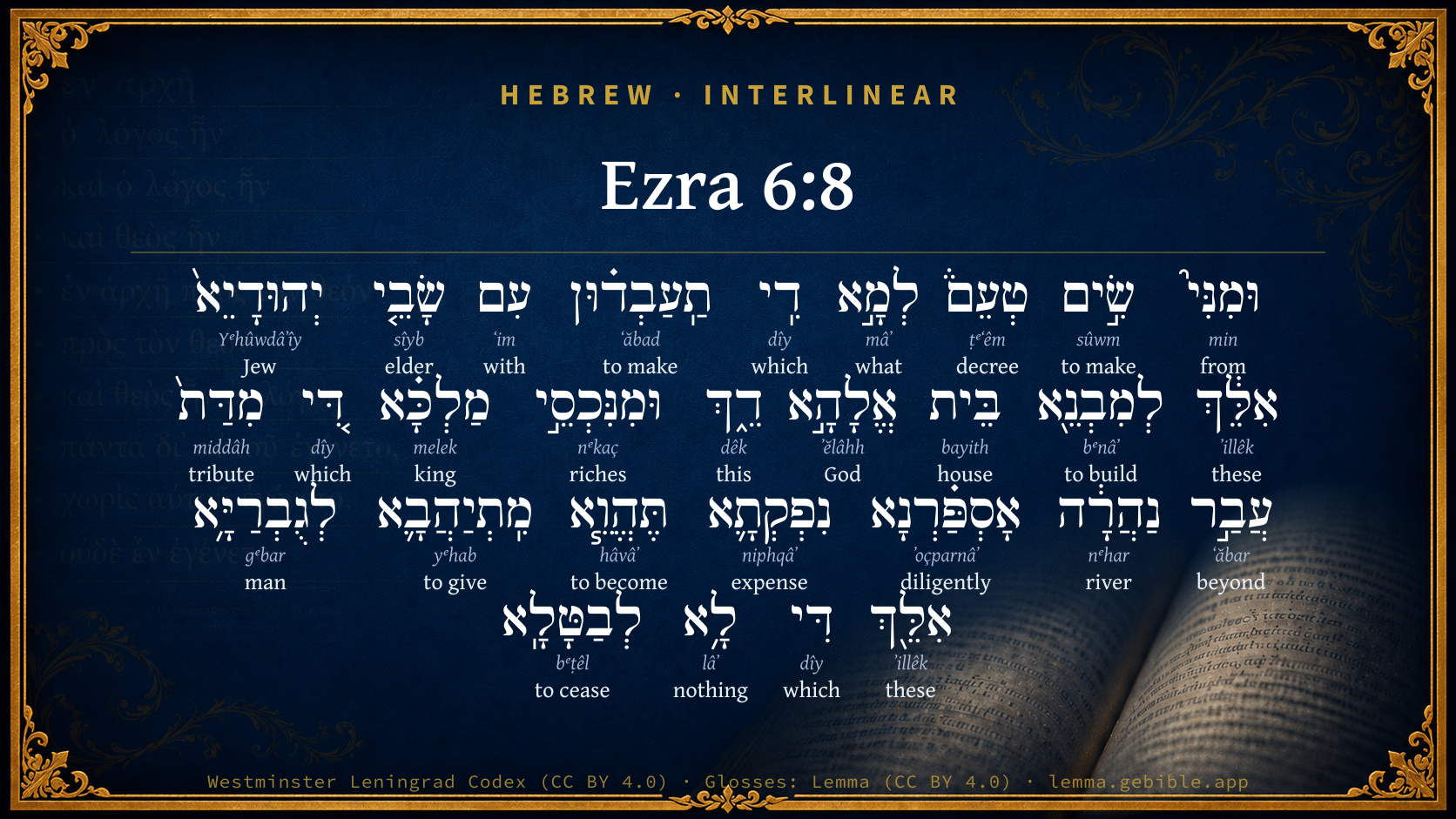
  1. וּמִנִּי֮ min H4481 “and · from · me” Adjective, C + Preposition + Suffix, Personal, 1st Person, Common, Singular
  2. שִׂ֣ים sûwm H7761 “to make” Adjective, V, Plural
  3. טְעֵם֒ ṭᵉʻêm H2942 “decree” Adjective, N, Common
  4. דִֽי dîy H1768 “which” Adjective, T
  5. תַֽעַבְד֗וּן ʻăbad H5648 “to make” Adjective, V
  6. עִם ʻim H5974 “with” Adjective, R
  7. שָׂבֵ֤י sîyb H7868 “elders of” Adjective, N, Common
  8. יְהוּדָיֵא֙ Yᵉhûwdâʼîy H3062 “Jews · the” Adjective, N + Particle, Definite Article
  9. אִלֵּ֔ךְ ʼillêk H479 “these” Adjective, P
  10. לְמִבְנֵ֖א bᵉnâʼ H1124 “to build” Adjective, R + Verb, Qal, Infinitive Construct
  11. בֵּית bayith H1005 “house of” Adjective, N, Common
  12. אֱלָהָ֣א ʼĕlâhh H426 “God · the” Adjective, N, Common + Particle, Definite Article
  13. דֵ֑ךְ dêk H1791 “this” Adjective, P
  14. וּמִנִּכְסֵ֣י nᵉkaç H5232 “and · from · riches of” Adjective, C + Preposition + Noun, Common, Masculine, Plural, Construct
  15. מַלְכָּ֗א melek H4430 “king · the” Adjective, N, Common + Particle, Definite Article
  16. דִּ֚י dîy H1768 “which” Adjective, T
  17. מִדַּת֙ middâh H4061 “tribute of” Adjective, N, Common
  18. עֲבַ֣ר ʻăbar H5675 “beyond” Adjective, N
  19. נַהֲרָ֔ה nᵉhar H5103 “river · the” Adjective, N + Particle, Definite Article
  20. אָסְפַּ֗רְנָא ʼoçparnâʼ H629 “diligently” Adjective, D
  21. נִפְקְתָ֛א niphqâʼ H5313 “expense · the” Adjective, N, Common + Particle, Definite Article
  22. תֶּהֱוֵ֧א hâvâʼ H1934 “to become” Adjective, V
  23. מִֽתְיַהֲבָ֛א yᵉhab H3052 “given” Adjective, V, Singular
  24. לְגֻבְרַיָּ֥א gᵉbar H1400 “to/for · men · the” Adjective, R + Noun, Common, Masculine, Plural, Determined + Particle, Definite Article
  25. אִלֵּ֖ךְ ʼillêk H479 “these” Adjective, P
  26. דִּי dîy H1768 “which” Adjective, C
  27. לָ֥א lâʼ H3809 “nothing” Adjective, T
  28. לְבַטָּלָֽא bᵉṭêl H989 “to cease” Adjective, R + Verb, Piel, Infinitive Construct

About this verse

These counts appear in no published source. They are computed here, from the morphology-tagged text and Lemma’s own curated glosses. What Lemma adds →

29
words
26
distinct lemmas
Historical
section

Notable vocabulary

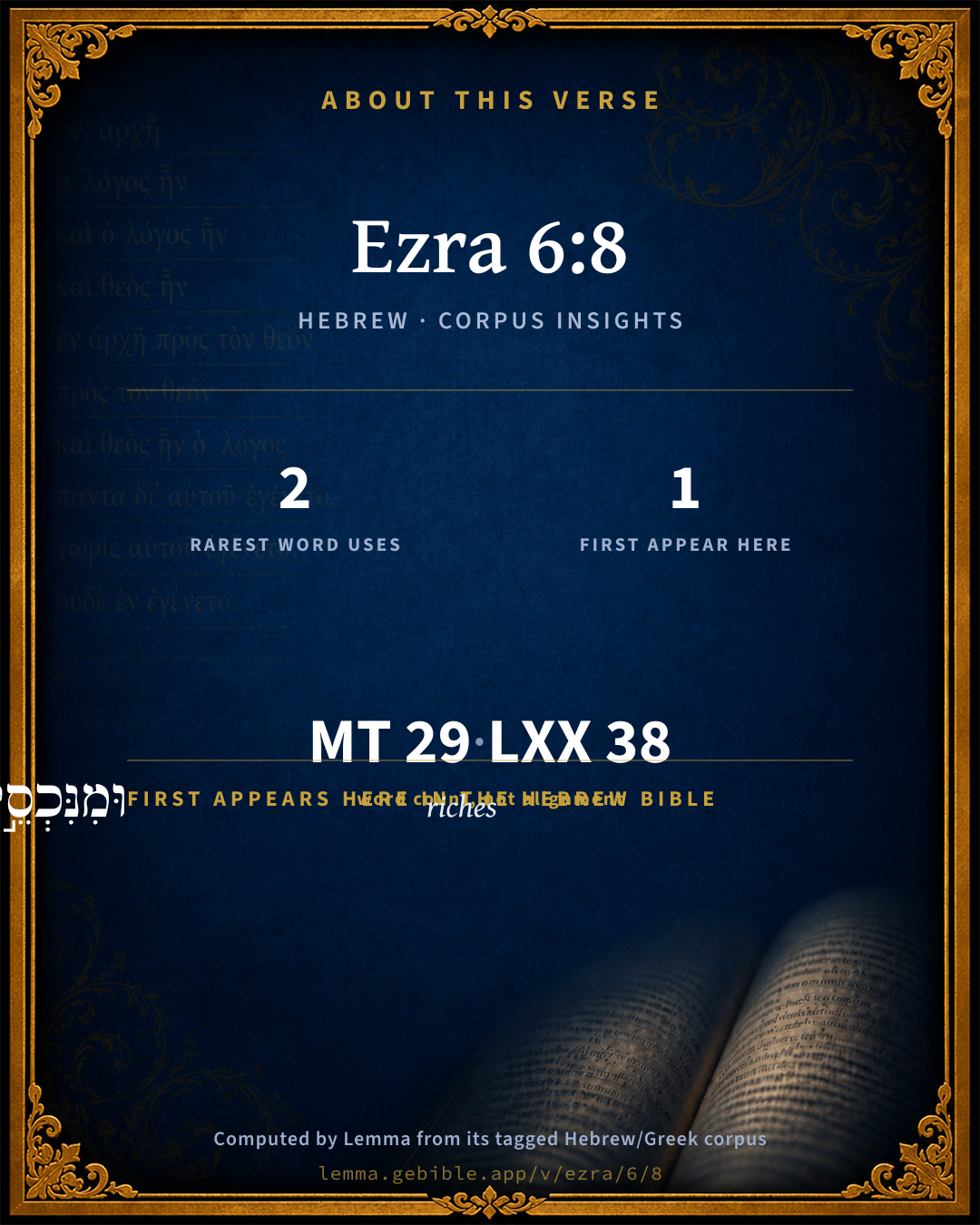
The rarest word here is לְמָ֣א what H3964 — appearing just 2 times in the whole Hebrew Bible.

First appearance in Scripture

This word makes its first canonical appearance in the Hebrew Bible here:

  • וּמִנִּכְסֵ֣י riches H5232

Shared distinctive vocabulary

לְמָ֣א what H3964 occurs in 2 verses of the Hebrew Bible. Also found in:

Grammatical profile

  • 2 verbs
  • 1 noun
  • 18 adjectives
  • 1 pronoun
  • 1 preposition
  • 6 particles

Verb forms

  • לְמִבְנֵ֖א Qal · Infinitive Construct
  • לְבַטָּלָֽא Piel · Infinitive Construct

Repetition

Words recur within this verse — often emphatic in Hebrew:

  • דִֽי which H1768 ×3
  • אִלֵּ֔ךְ these H479 ×2

Hebrew & Septuagint length

In English translation the verse runs 49 words from the Hebrew and 62 from the Septuagint (LXX English) — closely comparable.

A rough comparison of the two English renderings, which tokenize alike — not a word-level alignment.

Word counts can differ between the Hebrew and the Greek without any difference in meaning — e.g. the Hebrew direct-object marker אֵת has no separate Greek word, and Greek often adds the article ὁ.

In the original languages it is 29 Hebrew tokens and 38 Greek tokens — but the two are counted differently (Hebrew bundles its prefixes and suffixes into one token; the Greek is in lemma form), so that isn’t a like-for-like length.

Cross-references

8

Topical passages linked to Ezra 6:8 in the Treasury of Scripture Knowledge — connected by theme and wording, ordered by reader-vote popularity; previews shown in the World English Bible.

  • Ezra 6:4 with three courses of great stones, and a course of new timber: and let the expenses be given out of the king's house.
  • Ezra 7:15–22 and to carry the silver and gold, which the king and his counselors have freely offered to the God of Israel, whose habitation is in Jerusalem,
  • Haggai 2:8 The silver is mine, and the gold is mine,' says Yahweh of Hosts.
  • Ezra 4:16 We inform the king that, if this city be built, and the walls finished, by this means you shall have no portion beyond the River.
  • Ezra 4:20–21 There have been mighty kings also over Jerusalem, who have ruled over all [the country] beyond the River; and tribute, custom, and toll, was paid to them.
  • Ezra 4:23 Then when the copy of king Artaxerxes' letter was read before Rehum, and Shimshai the scribe, and their companions, they went in haste to Jerusalem to the Jews, and made them to cease by force and power.
  • Ezra 5:5 But the eye of their God was on the elders of the Jews, and they did not make them cease, until the matter should come to Darius, and then answer should be returned by letter concerning it.
  • Psalms 68:29–31 Because of your temple at Jerusalem, Kings shall bring presents to you.

Cross-references courtesy of OpenBible.info (CC BY 4.0).

Hebrew and Greek witnesses Masoretic Hebrew ↔ Greek Septuagint

The same verse in the two great witnesses to the Old Testament, shown verse-for-verse.

These are two independent witnesses, not word-aligned to each other, and the Septuagint is shown in lemma (dictionary) form.

Hebrew Ezra 6:8 Masoretic · Westminster Leningrad Codex

וּמִנִּי֮ שִׂ֣ים טְעֵם֒ לְמָ֣א דִֽי תַֽעַבְד֗וּן עִם שָׂבֵ֤י יְהוּדָיֵא֙ אִלֵּ֔ךְ לְמִבְנֵ֖א בֵּית אֱלָהָ֣א דֵ֑ךְ וּמִנִּכְסֵ֣י מַלְכָּ֗א דִּ֚י מִדַּת֙ עֲבַ֣ר נַהֲרָ֔ה אָסְפַּ֗רְנָא נִפְקְתָ֛א תֶּהֱוֵ֧א מִֽתְיַהֲבָ֛א לְגֻבְרַיָּ֥א אִלֵּ֖ךְ דִּי לָ֥א לְבַטָּלָֽא

Moreover I make a decree what you shall do to these elders of the Jews for the building of this house of God: that of the king's goods, even of the tribute beyond the River, expenses be given with all diligence to these men, that they be not hindered.

World English Bible · Public Domain

Greek LXX Ezra 6:8 Septuagint · lemma form

καί ἀπό ἐγώ τίθημι γνώμη μήποτε τις ποιέω μετά ὁ πρεσβύτερος ὁ ἰουδαῖος ὁ οἰκοδομέω οἶκος ὁ θεός ἐκεῖνος καί ἀπό ὑποἄρχω βασιλεύς ὁ φόρος πέραν ὁ ποταμός ἐπιμελῶς δαπάνη εἰμί δίδωμι ὁ ἀνήρ ἐκεῖνος ὁ μή καταἀργέω

Also a decree has been made by me, if haply you⌃ may do somewhat in concert with the elders of the Jews for the building of that house of God: to wit, out of the king's property, even the tributes beyond the river, let there be money to defray the expenses carefully granted to those men, so that they be not hindered.

LXX2012 (modern English Septuagint) · Public Domain

In the Septuagint this is one book — Esdras B (2 Esdras): Ezra is chapters 1–10, Nehemiah 11–23.

On this verse, The Cambridge Bible for Schools and Colleges discusses the Septuagint’s reading. Read the note in Commentary ↓

Hebrew: Westminster Leningrad Codex (CC BY 4.0). Greek: Septuagint (public domain); English from LXX2012 (modern English Septuagint) (Public Domain). How the Septuagint differs from the Hebrew →

Commentary

Notes on Ezra 6:8 from classic Christian and Jewish commentators (each source and its license shown beneath its notes). The classic Christian expositions comment on the surrounding passage and are grouped to its opening verse, so a note may address several verses; the Jewish commentaries on the Tanakh (Rashi and others) are per-verse, so they appear only where the commentator wrote on this verse.

Lemma curates 59 commentaries, every one of them public domain or Creative Commons licensed, each selected and text-cleaned for this edition rather than reprinted as found. About our sources →

Trapp's Complete Commentary

John Trapp

Ezr 6:8 Moreover I make a decree what ye shall do to the elders of these Jews for the building of this house of God: that of the king’s goods, [even] of the tribute beyond the river, forthwith expenses be given unto these men, that they be not hindered.

Ver. 8. Moreover I make a decree] So did some of the heathen emperors for the persecuted Christians, Charles V for the Lutherans (at the motion of Albertus, archbishop of Mentz, and Ludovicus, palatine of Rhine), and Henry III of France for the Protestants; which yet was but sorrily observed though sworn to. It is written by an Italian (no stranger to the court of Rome) that their proverb is, Mercatorum est, non regum stare iuramentis, that it is for merchants, and not for kings, to keep to their oaths.

John Trapp, A Commentary or Exposition upon All the Books of the Old and New Testament (1647–1656) — public domain. Text from a community e-Sword module.

The Biblical Illustrator

Joseph S. Exell

Ezr_6:8-11

Moreover I make a decree what ye shall do to the elders of these Jews.

The Scriptural warrant for an established Church

Look at this history, and consider candidly the great principles involved in these facts. Consider--

I. Who these men were who issued these decrees concerning the building, and concerning the supplies of the house of God at Jerusalem. They were Gentile kings.

II. What it was that these kings ordered. They ordered--

1. The building of the house, and that the expenses incurred thereby should be taken from the kings treasury.

2. The supply of the house, with every item of all the details necessary for carrying out the worship of God--rams, and lambs, and bullocks, and wheat, and wine, and oil, and salt, according to the appointment of the priests.

3. They assigned certain reasons why this should be done.

(1) That sacrifices of sweet savour might be offered to the God of Heaven.

(2) That prayer might be made for the life of the king and his sons.

(3) That wrath might not come upon the kings realm, implying that, if they did not do this, the realm incurred the wrath of God.

4. They insisted upon all this by imposing a heavy penalty upon any recusant subject. The penalty in the decree of Darius was death; the penalty in the decree of Artaxerxes was varying, according to the discretion of the executive magistracy, whether unto death, or to banishment, or to confiscation of goods, or to imprisonment; but in each case, there was a penalty for non-payment.

III. The parties addressed in the decree, and included amongst the contributors. These were not the people only who approved of, and could enjoy the worship of the house, but they included also the adversaries, who did not approve of--who could not enjoy--and who would not join in the worship of the house; yet, although they did not approve, although they would not join in the worship of that house, they were compelled by the kings decree to contribute to the expense of building, and to the continued supply of the materials of that worship. And remember all this was done by those kings, according to the commandment and in harmony with the revealed will of the Lord God of Israel. (H. MNeile, M. A.)

The Biblical Illustrator, edited by Joseph S. Exell (c. 1880s–1900s) — public domain. Text from a community e-Sword module.

Joseph Benson's Commentary

Ezr 6:8-9. That of the king’s goods, forthwith expenses be given — That the work might not be stopped for want of money to carry it on, he orders certain sums to be paid them out of his own revenue. And that which they have need of both young bullocks, &c. — He orders that they should be supplied with every thing they wanted for maintaining the sacrifices at the temple, when it should be built, both for burnt-offerings and meat- offerings. Let it be given them day by day — That the morning and evening sacrifices might not fail to be offered every day.

Joseph Benson's Commentary on the Old and New Testaments (1811–1818) — public domain. Text from a community e-Sword module.

Tyndale Open Study Notes

Tyndale Open Resources

6:8 You must pay the full construction costs: This command fulfilled God’s promise through Haggai (Hag 2:7).

Tyndale Open Study Notes — © Tyndale Open Resources, licensed CC BY-SA 4.0. Text via the HelloAO Bible API.

Geneva Bible (1599)

Geneva Bible translators

For lack of money.

Geneva Bible (1599) marginal notes — public domain. Text via Bolls.life.

Jamieson, Fausset & Brown

Robert Jamieson, A. R. Fausset & David Brown

of the king's goods, even of the tribute beyond the river . . . expenses be given unto these men--The decree granted them the privilege of drawing from his provincial treasury of Syria, to the amount of whatever they required for the furthering of the work and providing sacrifice for the service of the temple, that the priests might daily pray for the health of the king and the prosperity of the empire.

Jamieson, Fausset & Brown — Commentary Critical and Explanatory on the Whole Bible (1871) — public domain (CC PDM 1.0). Text via the HelloAO Bible API.

Ellicott's Commentary for English Readers

(8) Moreover.—I also make my decree.

Of the king’s goods.—From the tribute collected to be sent to Persia sums were previously to be deducted.

A Bible Commentary for English Readers, edited by Charles John Ellicott (1878–1897) — public domain. Text from a community e-Sword module.

The Cambridge Bible for Schools and Colleges

gen. ed. J. J. S. Perowne

8. The injunction; official support, (a) money for the building.

I make a decree] cf. Ezr_6:11, Ezr_4:19, Ezr_7:13.

of the king’s goods, even of the tribute beyond the river] The king addressing the governor of the whole country W. of the Euphrates refers to that portion of the territorial tribute which the governor would remit to the king’s treasury, the greater portion being reserved for his own use and for satrapial administration.

goods] So the LXX. ‘possessions’ (ἀπὸ ὑπαρχόντων): Vulgate ‘treasury’ (arcâ). The Aramaic word occurs again in Ezr_7:26.

The royal contribution lays no burden upon the rest of the satrapy. It literally fulfilled the edict of Cyrus: it was ‘given out of the king’s house’ (Ezr_6:4) when it was paid out of the royal share in the tribute.

forthwith expences be given] R.V. expenses be given with all diligence, ‘with all diligence’ (A.V. ‘forthwith’), see note on chap. Ezr_5:8. LXX. ἐπιμελῶς.

that they be not hindered] According to this translation, the words depend upon the previous clause. So also Vulg. ‘ne impediatur opus’. The verb occurs in Ezr_4:21; Ezr_4:23. Here the hindrance apprehended seems rather to be to the execution of the royal command than to the activity of the Jews. It is probable that we should rather render ‘which is not to be neglected’, a short abrupt clause denoting the urgency of the royal rescript, an instance of the idiom found also in Dan_6:15 ‘no decree … may be changed’ (lit. a decree … not to change). The first part of the injunction relating to the payment will then conclude with a peremptory command for the order to be carried out, just as the second part relating to material for the sacrifices concludes with a demand for unremitting regularity in their supply (Ezr_6:12).

The Cambridge Bible for Schools and Colleges (gen. ed. J. J. S. Perowne; Cambridge University Press, 1878–1918) — public domain. Text from a community e-Sword module.

John Gill's Exposition

And that which they have need of, both young bullocks, and rams, and lambs, for the burnt offerings of the God of heaven,.... All which were used for burnt offerings, see Lev 1:2

wheat, salt, wine, and oil; "wheat", or "fine flour", for the "minchah" or meat offering; "salt", for every offering; "wine", for the drink offerings; and "oil", to be put upon the meat offerings, see Lev 2:1,

according to the appointment of the priests which are at Jerusalem, let it be given them day by day without fail; for the daily sacrifice, and the meat and drink offerings which attended it, Exo 29:38.

John Gill's Exposition of the Whole Bible (1746–1763) — public domain (CC PDM 1.0). Text via the HelloAO Bible API.

Haydock's Catholic Bible Commentary

Hindered. Thus Darius trod in the footsteps, or perhaps exceeded the liberality of Cyrus. (Haydock)

George Leo Haydock (1774–1849), Haydock's Catholic Family Bible and Commentary, 1859 edition — public domain. Excludes Psalms (Douay-Rheims chapter numbering differs from Protestant) and Deuterocanonical books (Catholic canon only).

Matthew Poole's English Annotations

From proceeding in their work for want of money.

Matthew Poole's English Annotations on the Holy Bible (1683–1685) — public domain. Text from a community e-Sword/MySword module.

The Pulpit Commentary

Moreover, I make a decree. Literally, "By me too is a decree made." The decree of Cyrus is not enough. I add to it, and require you

(1) to pay the wages of the workmen employed out of the royal revenue, and

(2) to supply the temple perpetually with all that is needed for the regular sacrifices (see ver. 9). What ye shall do to the elders. Not, "Lest ye do anything to the elders" (LXX); much less, "What must be done by the elders" (Vulg.); but, as in the A. V, "What ye shall do to them how ye shall act towards them. Of the tribute beyond the river forthwith expences be given to these men. The Persian satraps had to collect from their provinces a certain fixed sum as the royal tribute, and had to remit this sum annually to the court. Darius orders that the expenses of the men employed on the temple shall be paid by the satrap of Syria out of the royal tribute of his province, and only the balance remitted. Thus no additional burthen was laid upon the taxpayers.

The Pulpit Commentary (1880–1919), ed. H.D.M. Spence-Jones & Joseph S. Exell — public domain. Text from a community e-Sword module.

unfoldingWord translationNotes

Door43 World Missions Community

General Information:

This continues the record of King Cyrus's command that the Jews rebuild God's temple in Jerusalem, which began in Esra 6:3.

Funds from the king's tribute beyond the River will be used to pay these men

This can be stated in active form. AT: "Use funds from the king's tribute beyond the river to pay these men" (See: Active or Passive)

Funds from the king's tribute beyond the River

"The king's tribute" refers to taxes that people pay the king. AT: "Money from the taxes that you collect for the king from the people beyond the river" (See: Assumed Knowledge and Implicit Information)

Whatever is needed

This can be translated in active form. AT: "Whatever they need" (See: Active or Passive)

translationWords

king

tribute

cow

ewe

lamb

burnt offering

heaven

command

priest

pray

unfoldingWord translationNotes — © Distant Shores Media and the Door43 World Missions Community, licensed CC BY-SA 4.0. Source: git.door43.org/Door43/en_tn.

Rashi

Rabbi Shlomo Yitzchaki (Rashi)

And from me shall be issued an order And from me this command will go forth.

regarding what you shall do regarding that building, the work that you shall do with these elders of the Jews to build the House of the Holy One, blessed be He.

and from the king’s property And from the king’s property they shall make ths building.

from the taxes of the other side of the river from the taxes of the other side of the river, which belong to the king. taxes Aram. מִדַּת, tax, like (4:13): “the king’s due (מִנְדָּה), the head tax, or the meal tax.” quickly Aram. אָסְפַּרְנָא. The building shall quickly be built; esploytosemant in Old French.

The expenses shall be given The expenses shall be given to these men so that they should not idle from their work.

Rashi on the Tanakh — English translations: “The Judaica Press complete Tanach with Rashi, translated by A. J. Rosenberg” (CC BY 4.0); “Pentateuch with Rashi's commentary by M. Rosenbaum and A.M. Silbermann, 1929-1934” (public domain); “The Metsudah Tanach series, Lakewood, N.J” (CC BY 4.0); and “The Book of Joshua, Metsudah Publications, 1997” (CC BY 4.0). Text via Sefaria.

Lesson kit

Teaching starters — assembled from the data on this page, not authored interpretation. Every prompt links to the verse data it draws on. Edit before teaching.

Ezra, in the Historical, opens this verse with 29 words (26 distinct Hebrew lemmas). Its most distinctive word is mâʼ (“what”). A historical commentator’s framing appears above. Read the whole chapter for the surrounding context.

Discussion questions

  1. What does “what” (mâʼ) contribute to the verse as a whole?
  2. The word “riches” first appears here in Scripture. What is being introduced at this debut?
  3. 1 Kings 22:22 shares the word «what» with this verse. How do the two illuminate each other?
  4. “which” occurs 3× in this one verse. What is the effect of the repetition?
  5. The translations on this page render this verse differently — a whole-verse word diff, not a word-by-word alignment. What might account for the different wordings?
  6. The verb «לְמִבְנֵ֖א» is Qal Infinitive Construct. How does its form color the action?
  7. Reading how Trapp's Complete Commentary and The Biblical Illustrator read this verse, where do the two commentators agree and where do they part?

Things to notice

Reading settings

Reading text

Shown beneath each verse's original-language words.

Old Testament
Old Testament edition

Read the OT as the Masoretic Hebrew (MT) or the Greek Septuagint (LXX).

English shown for the Greek Septuagint (in the Hebrew ↔ Greek comparison).

Comparing translations? Open the Compare panel on any verse page to stack up to four side by side.