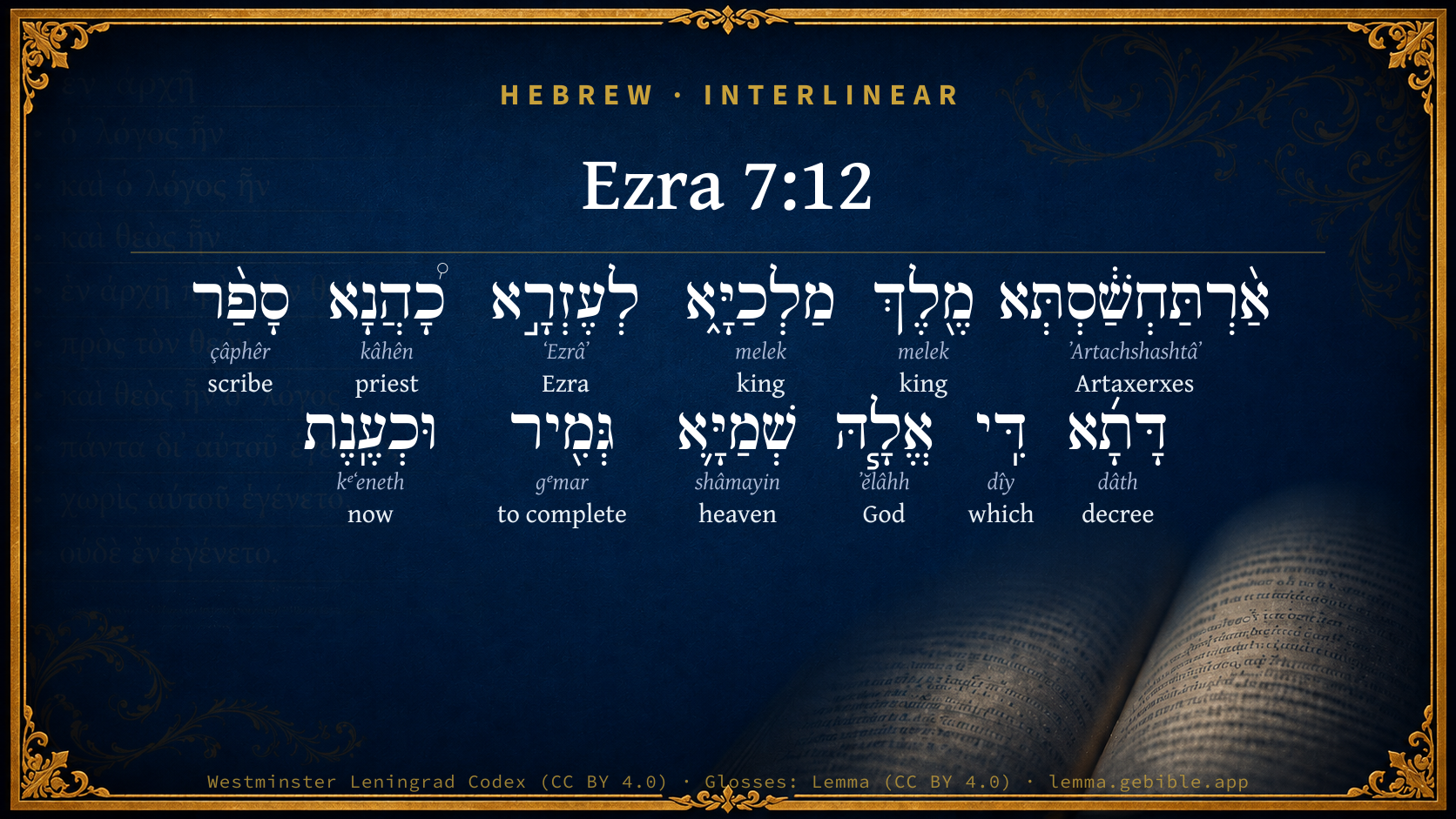
Ezra 7:12

Hebrew (Westminster Leningrad Codex) Ezra 7:12 appears in the Hebrew Old Testament. The text above is from the Westminster Leningrad Codex. Each word links to its Strong’s number, a concise gloss, and parsing drawn from the Open Scriptures Hebrew Bible morphology. Click any word for its full Brown-Driver-Briggs (BDB) entry.
Download image
Cite this verse

Ezra 7:12 (World English Bible). Public Domain. Lemma interlinear Bible study tool, https://lemma.gebible.app/v/ezra/7/12.

Show BibTeX & RIS
BibTeX
RIS
English Translation
Artaxerxes, king of kings, to Ezra the priest, the scribe of the law of the God of heaven, perfect and so forth.
World English Bible · Public Domain
Highlights
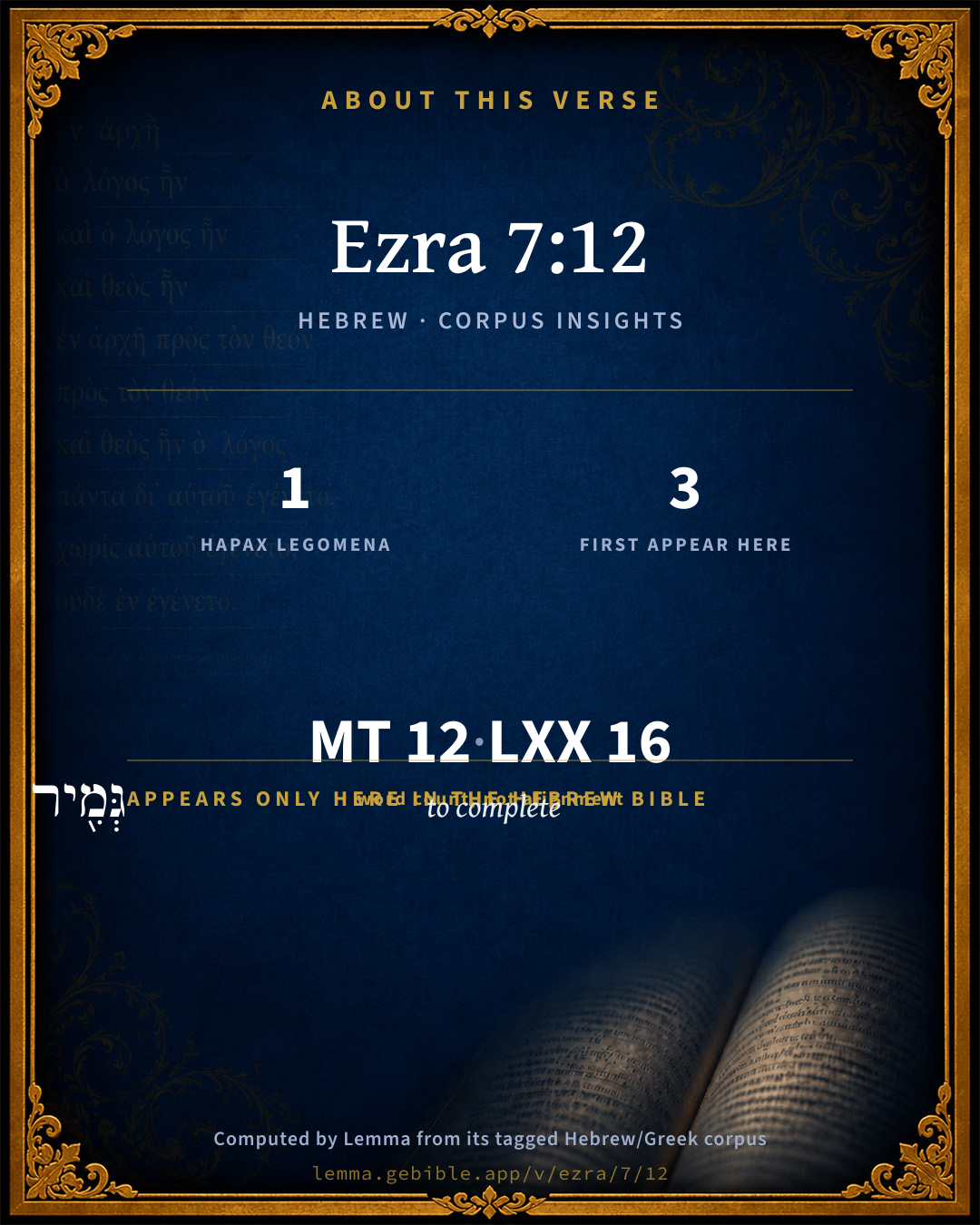
  • 1 hapax legomenon — only here in the Hebrew Bible
  • 3 first appearances in the Hebrew Bible
Full analysis ↓
Download a study sheet

One document with this verse’s original text, its word-by-word gloss line, the meaning frame, cross-references with their text, attributed commentary, and full source and license credits — printable, and it pastes into notes with its structure intact.

This verse Autodidact and up

Study sheet (.html) Plain text (.txt)

A passage Seminary Student

Up to 50 verses in one chapter. A passage sheet keeps up to 6 commentary sources and 12 cross-references per verse, in the order this page ranks them, and says so on the sheet whenever that leaves anything out. Ask for a single verse and you get the Autodidact verse sheet above.

Everything on this page stays free to read, with no account — the sheet is a download of what is already on screen, not access to it.

Want to remove ads? Support Godless Engineer
Compare translations 3

The same verse in 3 English versions, stacked beneath the original-language interlinear above. Click any original word for its lexicon entry.

Each is an independent rendering of the whole verse — the interlinear is not word-aligned to these translations.

Highlighted words mark where these versions differ — a whole-verse word diff, not a word-by-word alignment.

  • World English Bible Public Domain
    Artaxerxes, king of kings, to Ezra the priest, the scribe of the law of the God of heaven, perfect and so forth.
  • King James Version Public Domain
    Artaxerxes, king of kings, unto Ezra the priest, a scribe of the law of the God of heaven, perfect peace, and at such a time.
  • unfoldingWord Literal Text CC BY-SA 4.0
    “Artaxerxes, the king of kings, to Ezra the priest, the scribe of the law of the God of heaven: Peace. And now:

unfoldingWord Literal Text — © unfoldingWord, licensed CC BY-SA 4.0. Word-aligned USFM3 via Door43 (git.door43.org/unfoldingWord/en_ult).

Versions to compare (up to 4)

3 of 4 selected

Show all 18 translations

Every available English version of this verse, each an independent rendering of the whole verse.

  • World English Bible Public Domain
    Artaxerxes, king of kings, to Ezra the priest, the scribe of the law of the God of heaven, perfect and so forth.
  • Berean Standard Bible Public Domain
    Artaxerxes, king of kings. To Ezra the priest, the scribe of the Law of the God of heaven: Greetings.
  • Majority Standard Bible Public Domain
    Artaxerxes, king of kings. To Ezra the priest, the scribe of the Law of the God of heaven: Greetings.
  • King James Version Public Domain
    Artaxerxes, king of kings, unto Ezra the priest, a scribe of the law of the God of heaven, perfect peace, and at such a time.
  • American Standard Version (1901) Public Domain
    Artaxerxes, king of kings, unto Ezra the priest, the scribe of the law of the God of heaven, perfect and so forth.
  • Revised Version (1885) Public Domain
    Artaxerxes, king of kings, unto Ezra the priest, the scribe of the law of the God of heaven, perfect and so forth,
  • Geneva Bible (1599) Public Domain
    ARTAHSHASHTE King of Kings to Ezra the Priest and perfite scribe of the Lawe of the God of heauen, and to Cheeneth.
  • Douay-Rheims (1899) Public Domain
    Artaxerxes king of kings to Esdras the priest, the most learned scribe of the law of the God of heaven, greeting.
  • Young's Literal Translation Public Domain
    `Artaxerxes, king of kings, to Ezra the priest, a perfect scribe of the law of the God of heaven, and at such a time:
  • Literal Standard Version CC BY-SA 4.0
    “Artaxerxes, king of kings, to Ezra the priest, a perfect scribe of the Law of the God of the heavens, and at such a time:
  • Unlocked Literal Bible CC BY-SA 4.0
    “The King of kings Artaxerxes, to the priest Ezra, a scribe of the law of the God of heaven:
  • unfoldingWord Literal Text CC BY-SA 4.0
    “Artaxerxes, the king of kings, to Ezra the priest, the scribe of the law of the God of heaven: Peace. And now:
  • Darby Bible Public Domain
    Artaxerxes, king of kings, to Ezra the priest, an accomplished scribe of the law of the God of the heavens, and so forth.
  • World Messianic Bible Public Domain
    Artaxerxes, king of kings, To Ezra the priest, the scribe of the law of the perfect God of heaven. Now
  • Webster's Bible Public Domain
    Artaxerxes, king of kings, To Ezra the priest, a scribe of the law of the God of heaven, perfect peace, and at such a time.
  • Free Bible Version CC BY-SA 4.0
    “Artaxerxes, king of kings, to Ezra the priest, the scribe of the Law of the God of heaven: Greetings.
  • Bible in Basic English Public Domain
    Artaxerxes, king of kings, to Ezra the priest, scribe of the law of the God of heaven, all peace;
  • JPS Tanakh (1917) Public Domain
    'Artaxerxes, king of kings, unto Ezra the priest, the scribe of the Law of the God of heaven, and so forth. And now

Literal Standard Version (2020), Covenant Press — licensed CC BY-SA 4.0. Text via the HelloAO Bible API (eBible.org). Unlocked Literal Bible (unfoldingWord) — licensed CC BY-SA 4.0. Text via the HelloAO Bible API (eBible.org). unfoldingWord Literal Text — © unfoldingWord, licensed CC BY-SA 4.0. Word-aligned USFM3 via Door43 (git.door43.org/unfoldingWord/en_ult). Free Bible Version, Dr. Jonathan Gallagher — licensed CC BY-SA 4.0. Text via the HelloAO Bible API (eBible.org).

Word by word

More ways to search: Search by grammar → Find every occurrence → Compare this word →

Practice this passage: Drill this verse → Learn its vocabulary →

About this verse

These counts appear in no published source. They are computed here, from the morphology-tagged text and Lemma’s own curated glosses. What Lemma adds →

12
words
11
distinct lemmas
Historical
section

Notable vocabulary

1 hapax legomenon — a word that appears only here in the entire Hebrew Bible:

  • גְּמִ֖יר to complete H1585

First appearance in Scripture

These words make their first canonical appearance in the Hebrew Bible here:

  • לְעֶזְרָ֣א Ezra H5831
  • דָּתָ֜א decree H1882
  • גְּמִ֖יר to complete H1585

Shared distinctive vocabulary

לְעֶזְרָ֣א Ezra H5831 occurs in 3 verses of the Hebrew Bible. Also found in:

Grammatical profile

  • 1 noun
  • 6 adjectives
  • 1 adverb
  • 4 particles

Repetition

A word recurs within this verse — often emphatic in Hebrew:

  • מֶ֖לֶךְ king H4430 ×2

Hebrew & Septuagint length

In English translation the verse runs 22 words from the Hebrew and 25 from the Septuagint (LXX English) — closely comparable.

A rough comparison of the two English renderings, which tokenize alike — not a word-level alignment.

Word counts can differ between the Hebrew and the Greek without any difference in meaning — e.g. the Hebrew direct-object marker אֵת has no separate Greek word, and Greek often adds the article ὁ.

In the original languages it is 12 Hebrew tokens and 16 Greek tokens — but the two are counted differently (Hebrew bundles its prefixes and suffixes into one token; the Greek is in lemma form), so that isn’t a like-for-like length.

Cross-references

11

Topical passages linked to Ezra 7:12 in the Treasury of Scripture Knowledge — connected by theme and wording, ordered by reader-vote popularity; previews shown in the World English Bible.

  • Ezekiel 26:7 For thus says the Lord Yahweh: Behold, I will bring on Tyre Nebuchadrezzar king of Babylon, king of kings, from the north, with horses, and with chariots, and with horsemen, and a company, and much people.
  • Daniel 2:37 You, O king, are king of kings, to whom the God of heaven has given the kingdom, the power, and the strength, and the glory;
  • Ezra 4:17 [Then] sent the king an answer to Rehum the chancellor, and to Shimshai the scribe, and to the rest of their companions who dwell in Samaria, and in the rest [of the country] beyond the River: Peace, and so forth.
  • 1 Kings 4:24 For he had dominion over all [the region] on this side the River, from Tiphsah even to Gaza, over all the kings on this side the River: and he had peace on all sides round about him.
  • 1 Kings 20:1 Ben Hadad the king of Syria gathered all his host together; and there were thirty-two kings with him, and horses and chariots: and he went up and besieged Samaria, and fought against it.
  • Ezra 4:10–11 and the rest of the nations whom the great and noble Osnappar brought over, and set in the city of Samaria, and in the rest [of the country] beyond the River, and so forth.
  • Isaiah 10:8 For he says, Aren't my princes all of them kings?
  • Daniel 2:47 The king answered to Daniel, and said, Of a truth your God is the God of gods, and the Lord of kings, and a revealer of secrets, seeing you have been able to reveal this secret.
  • 1 Timothy 6:15 which in its own times he will show, who is the blessed and only Ruler, the King of kings, and Lord of lords;
  • Revelation 17:14 These will war against the Lamb, and the Lamb will overcome them, for he is Lord of lords, and King of kings. They also will overcome who are with him, called and chosen and faithful."
  • Revelation 19:16 He has on his garment and on his thigh a name written, "KING OF KINGS, AND LORD OF LORDS."

Cross-references courtesy of OpenBible.info (CC BY 4.0).

Hebrew and Greek witnesses Masoretic Hebrew ↔ Greek Septuagint

The same verse in the two great witnesses to the Old Testament, shown verse-for-verse.

These are two independent witnesses, not word-aligned to each other, and the Septuagint is shown in lemma (dictionary) form.

Hebrew Ezra 7:12 Masoretic · Westminster Leningrad Codex

אַ֨רְתַּחְשַׁ֔סְתְּא מֶ֖לֶךְ מַלְכַיָּ֑א לְעֶזְרָ֣א כָ֠הֲנָא סָפַ֨ר דָּתָ֜א דִּֽי אֱלָ֧הּ שְׁמַיָּ֛א גְּמִ֖יר וּכְעֶֽנֶת

Artaxerxes, king of kings, to Ezra the priest, the scribe of the law of the God of heaven, perfect and so forth.

World English Bible · Public Domain

Greek LXX Ezra 7:12 Septuagint · lemma form

αρθασασθα βασιλεύς βασιλεύς εσδρα γραμματεύς νόμος ὁ θεός ὁ οὐρανός τελέω ὁ λόγος καί ὁ ἀπόκρισις

Arthasastha, king of kings, to Esdras, the scribe of the law of the Lord God of heaven, Let the order and the answer be accomplished.

LXX2012 (modern English Septuagint) · Public Domain

In the Septuagint this is one book — Esdras B (2 Esdras): Ezra is chapters 1–10, Nehemiah 11–23.

On this verse, The Cambridge Bible for Schools and Colleges discusses the Septuagint’s reading. Read the note in Commentary ↓

Hebrew: Westminster Leningrad Codex (CC BY 4.0). Greek: Septuagint (public domain); English from LXX2012 (modern English Septuagint) (Public Domain). How the Septuagint differs from the Hebrew →

Commentary

Notes on Ezra 7:12 from classic Christian and Jewish commentators (each source and its license shown beneath its notes). The classic Christian expositions comment on the surrounding passage and are grouped to its opening verse, so a note may address several verses; the Jewish commentaries on the Tanakh (Rashi and others) are per-verse, so they appear only where the commentator wrote on this verse.

Lemma curates 59 commentaries, every one of them public domain or Creative Commons licensed, each selected and text-cleaned for this edition rather than reprinted as found. About our sources →

Adam Clarke's Commentary

Verse 12. Artaxerxes, king of kings] This letter, from the beginning of this verse to the end of Ezr 7:12-26, is in the Aramitic or Chaldee language.

This title of the king would, in Persian, run thus: [Persian] Ardsheer shahinshah, or [Persian] padshah, "Ardsheer, king of kings;" "great or supreme king, or emperor."

Adam Clarke's Commentary on the Bible (1810–1826) — public domain. Text from a community e-Sword/MySword module.

Trapp's Complete Commentary

John Trapp

Ezr 7:12 Artaxerxes, king of kings, unto Ezra the priest, a scribe of the law of the God of heaven, perfect [peace], and at such a time.

Ver. 12. Artaxerxes, king of kings] This is a very high style for any mortal wight; yet ambitiously assumed by monarchs and emperors. It is indeed the proper title of Jesus Christ, who hath upon his vesture and upon his thigh a name written, King of kings, and Lord of lords; kings and captives, lords and lowlies, are all his underlings and vassals, as those good emperors, Constantine, Theodosius, and Valentinian usually called themselves (Socrates). This name of the Lord Christ is said to be written, 1. On his vesture, that all may see it and submit to it. 2. On his thigh, where hangs his sword, to show his absolute and unlimited empire, got out of the hands of his enemies with his sword and with his bow, Psa 45:5. "By me king’s reign," saith he, Pro 8:15. And Nebuchadnezzar is made to know as much, Dan 4:35, who once vain gloriously vaunted that his princes were altogether kings, Isa 10:8. Maximilian, emperor of Germany, also said of himself, that he was a king of kings, but in another sense; for every one of my subjects (quoth he) will be a king; and say I what I can, they will do what they wish (Johan. Manl. loc. com. p. 586).

Of the God of heaven {See Trapp on "Ezr 5:11"}

John Trapp, A Commentary or Exposition upon All the Books of the Old and New Testament (1647–1656) — public domain. Text from a community e-Sword module.

Joseph Benson's Commentary

Ezr 7:12. Unto Ezra the priest, a scribe of the law of the God of heaven — Or, as the Hebrew may be rendered, a perfect scribe of the law, &c., a title which, it seems, Ezra delighted in, and desired no other; no, not when he was advanced to the proconsular dignity, and made the governor of a province. He reckoned it more to his honour to be a scribe of God’s law than to be a peer or prince of the empire.

Joseph Benson's Commentary on the Old and New Testaments (1811–1818) — public domain. Text from a community e-Sword module.

Geneva Bible (1599)

Geneva Bible translators

Some take this for the name of a people, some for time or continuance, meaning that the king wished him long life.

Geneva Bible (1599) marginal notes — public domain. Text via Bolls.life.

Jamieson, Fausset & Brown

Robert Jamieson, A. R. Fausset & David Brown

Artaxerxes, king of kings--That title might have been assumed as, with literal truth, applicable to him, since many of the tributary princes of his empire still retained the name and authority of kings. But it was a probably a mere Orientalism, denoting a great and powerful prince, as the heaven of heavens signified the highest heaven, and vanity of vanities, the greatest vanity. This vainglorious title was assumed by the kings of Assyria, from whom it passed to the sovereigns of Persia.

unto Ezra the priest, a scribe of the law of the God of heaven--The appointment of Ezra to this influential mission was of the highest importance to the Hebrew people, as a large proportion of them were become, in a great measure, strangers both to the language and the institutions of their forefathers.

Jamieson, Fausset & Brown — Commentary Critical and Explanatory on the Whole Bible (1871) — public domain (CC PDM 1.0). Text via the HelloAO Bible API.

Ellicott's Commentary for English Readers

(12) Artaxerxes, king of kings.—Artachshatra in Persian, Artachshasta in Hebrew. The Persian monarchs inherited the title here given from the Babylonians (Dan_2:37). It is not used by the historian, only by the king himself.

Perfect peace, and at such a time.—Literally, perfect, and so forth. The expression occurs only here, and is a difficult one. Our translation follows the apocryphal Esdras, and is on the whole to be accepted, a salutation being implied.

A Bible Commentary for English Readers, edited by Charles John Ellicott (1878–1897) — public domain. Text from a community e-Sword module.

The Cambridge Bible for Schools and Colleges

gen. ed. J. J. S. Perowne

12. king of kings] title common in inscriptions of Persian monarchs. (Cf. of Nebuchadnezzar, Eze_26:7; Dan_2:37.) No mere hyperbole, when the great empire included so many subject kingdoms.

a scribe] R.V. the scribe.

the God of heaven] See note on Ezr_1:2.

perfect peace, and at such a time] R.V. perfect and so forth. The Aramaic word ‘perfect’, ‘g’mir’, occurs only here. The salutation, probably a lengthy affair, is here condensed and the sentence breaks off abruptly. The word ‘perfect’ refers to ‘the scribe’ Ezra and was probably the first of a series of complimentary epithets. So the Vulgate ‘doctissimo’. The A.V. understands the words of salutation, cf. 1 Esdras, ‘hail’ (χαίρειν). The LXX. ‘the word has been ended and the answer’ (τετέλεσται ὁ λόγος καὶ ἡ ἀπόκρισις) is completely at fault. Others render the word as an adverb (= ‘completely’), to be connected either with ‘the scribe’, or with the omitted words of salutation, i.e. the completely (learned) scribe’, or ‘full greetings’.

‘and so forth’, as in Ezr_4:10-11.

12–26. The contents of the letter are given in Aramaic.

The Cambridge Bible for Schools and Colleges (gen. ed. J. J. S. Perowne; Cambridge University Press, 1878–1918) — public domain. Text from a community e-Sword module.

John Gill's Exposition

I make a decree,.... Which, according to the laws of the Medes and Persians, when signed, might not be changed, Dan 6:8,

that all they of the people of Israel, and of his priests and Levites, in my realm; who remained there, and took not the benefit of the edict of Cyrus, which gave them leave to go; but neglecting the opportunity, it seems as if they could not now go out of the realm without a fresh grant, which is hereby given:

which are minded of their own freewill to go up to Jerusalem, go with thee; this decree did not oblige them to go whether they would or not; for they might, notwithstanding this, continue if they pleased; it only gave them leave to make use of the present opportunity of going along with Ezra, if they chose it.

John Gill's Exposition of the Whole Bible (1746–1763) — public domain (CC PDM 1.0). Text via the HelloAO Bible API.

Albert Barnes' Notes on the Bible

The title, “king of kings,” is assumed by almost all the persian monarchs in their inscriptions.

Perfect peace - “Peace” is not in the original, and the word translated “perfect” occurs only in this place. Some prefer to take it as an adjective descriptive of Ezra (see margin); others (Septuagint) as the opening word of the first paragraph of the letter, and give it the meaning, “it is completed.”

Albert Barnes' Notes on the Bible (1834–1885) — public domain. Text from a community e-Sword/MySword module.

Haydock's Catholic Bible Commentary

Kings. This title was placed on the tomb of Cyrus, (Strabo xv.) and denoted a very powerful king. Artaxerxes had many tributaries in Media, Sidon, &c. The kings of Assyria had before assumed such pompous titles, Osee viii. 10. (Calmet) --- The most learned, comes later in the original Chaldean. (Haydock) --- "The priest, scribe of the law,...perfection, (health and happiness, (Calmet) or consummate in learning, &c.; Haydock) as at present." (Calmet) --- Gemir uceheneth, "perfection (Castel. Lexic.) even now," chap. iv. 10. Protestants, "perfect peace, and at such a time." (Haydock)

George Leo Haydock (1774–1849), Haydock's Catholic Family Bible and Commentary, 1859 edition — public domain. Excludes Psalms (Douay-Rheims chapter numbering differs from Protestant) and Deuterocanonical books (Catholic canon only).

The Pulpit Commentary

Artaxerxes, king of kings. "King of kings, kkshayathiya khshaya-thiyanam," an equivalent of the modern shahinshah, was a recognised title of the Persian monarchs, and is found in every Persian inscription of any considerable length (Rawlinson, "Cuneiform Inscriptions of Persis," vol. 1 pp. 195, 271, 279, 287, 292, etc.). It was a title that had been used occasionally, though not at all frequently, by the Assyrian monarchs ("Records of the Past," vol. 3. p. 41; vol. 5. p. 8), and naturally expressed the fact that those monarchs for the most part maintained the native princes on the thrones of the countries which they conquered. (see Isa_10:8) It was less appropriate to the Persians, whose empire was in the main satrapial, but still had a basis of truth to rest upon, since the Persian monarch had always a certain number of tributary kings under him (cf. "Herod.," 5:104, 118; 8:142; Xen., "Anab.," 1:2, "Hellen.," 4:1, The Parthian kings took the title from the time of Mithridates I; and from them it passed to the Sassanians, who style themselves malkan malka, from first to last, upon their coins. The God of heaven. On this favourite Persian expression see comment on Ezr_1:2. Perfect peace. There is nothing in the Chaldee original in any way corresponding to "peace;" and the participle passage being translated as in the margin of the A. V. Ezra the priest, a perfect scribe of the law of the God ofheaven." And at such a time. Rather, "and so forth," as in Ezr_4:10, Ezr_4:11, Ezr_4:17.

The Pulpit Commentary (1880–1919), ed. H.D.M. Spence-Jones & Joseph S. Exell — public domain. Text from a community e-Sword module.

Rashi

Rabbi Shlomo Yitzchaki (Rashi)

the Book of Law [as translated,] the Book of Law.

who has mastered... and Ke’eneth He has mastered it in his hand.

Rashi on the Tanakh — English translations: “The Judaica Press complete Tanach with Rashi, translated by A. J. Rosenberg” (CC BY 4.0); “Pentateuch with Rashi's commentary by M. Rosenbaum and A.M. Silbermann, 1929-1934” (public domain); “The Metsudah Tanach series, Lakewood, N.J” (CC BY 4.0); and “The Book of Joshua, Metsudah Publications, 1997” (CC BY 4.0). Text via Sefaria.

Lesson kit

Teaching starters — assembled from the data on this page, not authored interpretation. Every prompt links to the verse data it draws on. Edit before teaching.

Ezra, in the Historical, opens this verse with 12 words (11 distinct Hebrew lemmas). Its most distinctive word is gᵉmar (“to complete”). A historical commentator’s framing appears above. Read the whole chapter for the surrounding context.

Discussion questions

  1. What does “to complete” (gᵉmar) contribute to the verse as a whole?
  2. This verse holds 1 word here found nowhere else in the Hebrew Bible. What might the rare word draw attention to?
  3. 3 words here appear for the first time in Scripture. What is being introduced at this debut?
  4. Ezra 7:21 shares the word «Ezra» with this verse. How do the two illuminate each other?
  5. “king” occurs 2× in this one verse. What is the effect of the repetition?
  6. The translations on this page render this verse differently — a whole-verse word diff, not a word-by-word alignment. What might account for the different wordings?
  7. Reading how Adam Clarke's Commentary and Trapp's Complete Commentary read this verse, where do the two commentators agree and where do they part?

Things to notice

  • 1 word in this verse appears nowhere else in the Hebrew Bible.
  • 3 words make their first canonical appearance in Scripture here.
  • This verse counts 12 Hebrew ↔ 16 Greek words.
  • These translations choose different wording for 6 words in this verse.
  • “king” occurs 2× in this single verse.

Reading settings

Reading text

Shown beneath each verse's original-language words.

Old Testament
Old Testament edition

Read the OT as the Masoretic Hebrew (MT) or the Greek Septuagint (LXX).

English shown for the Greek Septuagint (in the Hebrew ↔ Greek comparison).

Comparing translations? Open the Compare panel on any verse page to stack up to four side by side.