
Daniel 3:13

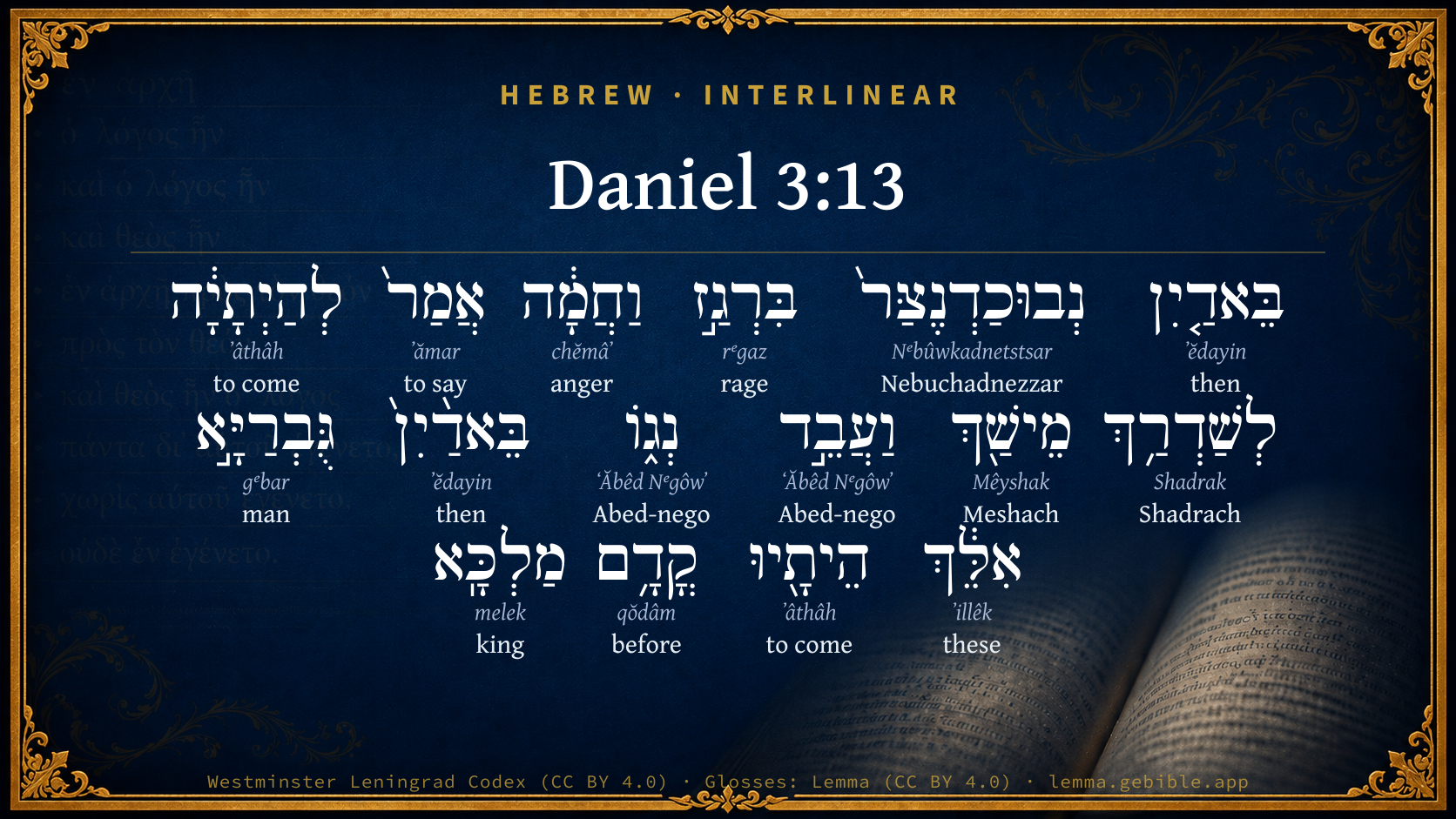
Hebrew (Westminster Leningrad Codex) Daniel 3:13 appears in the Hebrew Old Testament. The text above is from the Westminster Leningrad Codex. Each word links to its Strong’s number, a concise gloss, and parsing drawn from the Open Scriptures Hebrew Bible morphology. Click any word for its full Brown-Driver-Briggs (BDB) entry.
Download image
Cite this verse

Daniel 3:13 (World English Bible). Public Domain. Lemma interlinear Bible study tool, https://lemma.gebible.app/v/daniel/3/13.

Show BibTeX & RIS
BibTeX
RIS
English Translation
Then Nebuchadnezzar in [his] rage and fury commanded to bring Shadrach, Meshach, and Abednego. Then they brought these men before the king.
World English Bible · Public Domain
Highlights
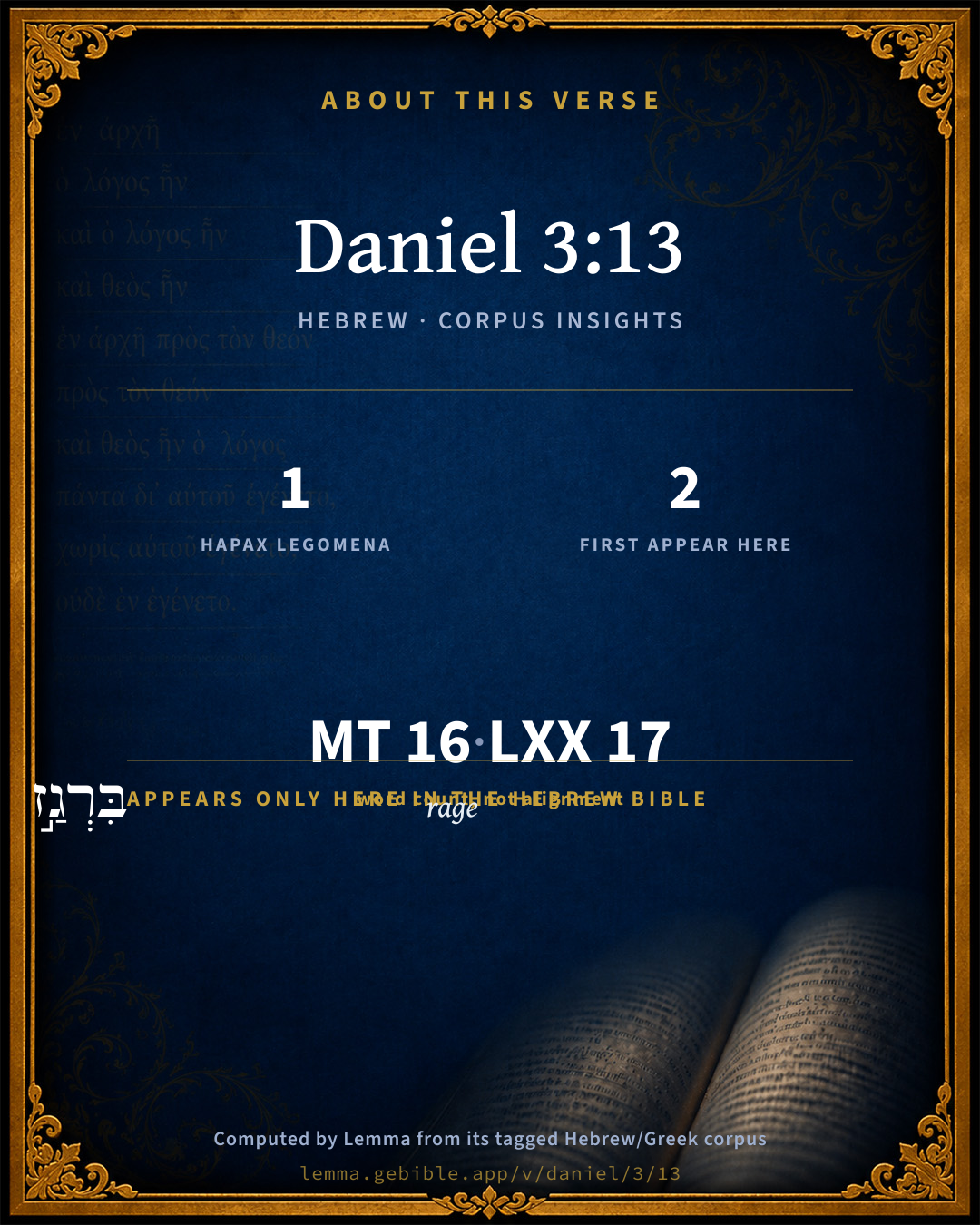
  • 1 hapax legomenon — only here in the Hebrew Bible
  • 2 first appearances in the Hebrew Bible
Full analysis ↓
Download a study sheet

One document with this verse’s original text, its word-by-word gloss line, the meaning frame, cross-references with their text, attributed commentary, and full source and license credits — printable, and it pastes into notes with its structure intact.

This verse Autodidact and up

Study sheet (.html) Plain text (.txt)

A passage Seminary Student

Up to 50 verses in one chapter. A passage sheet keeps up to 6 commentary sources and 12 cross-references per verse, in the order this page ranks them, and says so on the sheet whenever that leaves anything out. Ask for a single verse and you get the Autodidact verse sheet above.

Everything on this page stays free to read, with no account — the sheet is a download of what is already on screen, not access to it.

Want to remove ads? Support Godless Engineer
Compare translations 3

The same verse in 3 English versions, stacked beneath the original-language interlinear above. Click any original word for its lexicon entry.

Each is an independent rendering of the whole verse — the interlinear is not word-aligned to these translations.

Highlighted words mark where these versions differ — a whole-verse word diff, not a word-by-word alignment.

  • World English Bible Public Domain
    Then Nebuchadnezzar in [his] rage and fury commanded to bring Shadrach, Meshach, and Abednego. Then they brought these men before the king.
  • King James Version Public Domain
    Then Nebuchadnezzar in his rage and fury commanded to bring Shadrach, Meshach, and Abednego. Then they brought these men before the king.
  • unfoldingWord Literal Text CC BY-SA 4.0
    Then Nebuchadnezzar in furious rage commanded that Shadrach, Meshach, and Abednego be brought. So they brought these men before the king.

unfoldingWord Literal Text — © unfoldingWord, licensed CC BY-SA 4.0. Word-aligned USFM3 via Door43 (git.door43.org/unfoldingWord/en_ult).

Versions to compare (up to 4)

3 of 4 selected

Show all 18 translations

Every available English version of this verse, each an independent rendering of the whole verse.

  • World English Bible Public Domain
    Then Nebuchadnezzar in [his] rage and fury commanded to bring Shadrach, Meshach, and Abednego. Then they brought these men before the king.
  • Berean Standard Bible Public Domain
    Then Nebuchadnezzar, furious with rage, summoned Shadrach, Meshach, and Abednego. So these men were brought before the king,
  • Majority Standard Bible Public Domain
    Then Nebuchadnezzar, furious with rage, summoned Shadrach, Meshach, and Abednego. So these men were brought before the king,
  • King James Version Public Domain
    Then Nebuchadnezzar in his rage and fury commanded to bring Shadrach, Meshach, and Abednego. Then they brought these men before the king.
  • American Standard Version (1901) Public Domain
    Then Nebuchadnezzar in `his' rage and fury commanded to bring Shadrach, Meshach, and Abed-nego. Then they brought these men before the king.
  • Revised Version (1885) Public Domain
    Then Nebuchadnezzar in his rage and fury commanded to bring Shadrach, Meshach, and Abed-nego. Then they brought these men before the king.
  • Geneva Bible (1599) Public Domain
    Then Nebuchad-nezzar in his anger and wrath commanded that they should bring Shadrach, Meshach, and Abednego: so these men were brought before the King.
  • Douay-Rheims (1899) Public Domain
    Then Nabuchodonosor in fury, and in wrath, commanded that Sidrach, Misach, and Abdenago should be brought: who immediately were brought before the king.
  • Young's Literal Translation Public Domain
    Then Nebuchadnezzar, in anger and fury, hath said to bring in Shadrach, Meshach, and Abed-Nego. Then these men have been brought in before the king.
  • Literal Standard Version CC BY-SA 4.0
    Then Nebuchadnezzar, in anger and fury, has said to bring in Shadrach, Meshach, and Abed-Nego. Then these men have been brought in before the king.
  • Unlocked Literal Bible CC BY-SA 4.0
    Then Nebuchadnezzar, filled with anger and rage, commanded that Shadrach, Meshach, and Abednego be brought to him. So they brought these men before the king.
  • unfoldingWord Literal Text CC BY-SA 4.0
    Then Nebuchadnezzar in furious rage commanded that Shadrach, Meshach, and Abednego be brought. So they brought these men before the king.
  • Darby Bible Public Domain
    Then Nebuchadnezzar in rage and fury commanded to bring Shadrach, Meshach, and Abed-nego. Then were these men brought before the king.
  • World Messianic Bible Public Domain
    Then Nebuchadnezzar in rage and fury commanded that Shadrach, Meshach, and Abednego be brought. Then these men were brought before the king.
  • Webster's Bible Public Domain
    Then Nebuchadnezzar in his rage and fury commanded to bring Shadrach, Meshach, and Abed-nego. Then they brought these men before the king.
  • Free Bible Version CC BY-SA 4.0
    This made Nebuchadnezzar absolutely furious. “Bring me Shadrach, Meshach, and Abednego!” he demanded. So they were brought before the king.
  • Bible in Basic English Public Domain
    Then Nebuchadnezzar in his wrath and passion gave orders for Shadrach, Meshach, and Abed-nego to be sent for. Then they made these men come in before the king.
  • JPS Tanakh (1917) Public Domain
    Then Nebuchadnezzar in his rage and fury commanded to bring Shadrach, Meshach, and Abed-nego. Then were these men brought before the king.

Literal Standard Version (2020), Covenant Press — licensed CC BY-SA 4.0. Text via the HelloAO Bible API (eBible.org). Unlocked Literal Bible (unfoldingWord) — licensed CC BY-SA 4.0. Text via the HelloAO Bible API (eBible.org). unfoldingWord Literal Text — © unfoldingWord, licensed CC BY-SA 4.0. Word-aligned USFM3 via Door43 (git.door43.org/unfoldingWord/en_ult). Free Bible Version, Dr. Jonathan Gallagher — licensed CC BY-SA 4.0. Text via the HelloAO Bible API (eBible.org).

Word by word

More ways to search: Search by grammar → Find every occurrence → Compare this word →

Practice this passage: Drill this verse → Learn its vocabulary →

בִּרְגַ֣ז
rᵉgaz
H7266
“in/at · rage”
Adjective, R + Noun, Common, Masculine, Singular, Absolute
Part of Speech
Adjective + Noun
Type
Common
Gender
Masculine
Number
Singular
State
Absolute
Full BDB Definition

Origin: from H7265

TWOT: 2987a

rage
  1. בֵּאדַ֤יִן ʼĕdayin H116 “in/at · then” Adjective, R + Adverb
  2. נְבוּכַדְנֶצַּר֙ Nᵉbûwkadnetstsar H5020 “Nebuchadnezzar” Adjective, N
  3. וַחֲמָ֔ה chĕmâʼ H2528 “and · anger” Adjective, C + Noun, Common, Feminine, Singular, Absolute
  4. אֲמַר֙ ʼămar H560 “to say” Adjective, V, Plural
  5. לְהַיְתָיָ֔ה ʼâthâh H858 “to come” Adjective, R + Verb, Hiphil, Infinitive Construct
  6. לְשַׁדְרַ֥ךְ Shadrak H7715 “to/for · Shadrach” Adjective, T + Noun, Proper
  7. מֵישַׁ֖ךְ Mêyshak H4336 “Meshach” Adjective, N
  8. וַעֲבֵ֣ד ʻĂbêd Nᵉgôwʼ H5665 “and · Abed-nego” Adjective, C + Noun, Proper
  9. נְג֑וֹ ʻĂbêd Nᵉgôwʼ H5665 “Abed-nego” Adjective, N
  10. בֵּאדַ֨יִן֙ ʼĕdayin H116 “in/at · then” Adjective, R + Adverb
  11. גֻּבְרַיָּ֣א gᵉbar H1400 “men · the” Adjective, N, Common + Particle, Definite Article
  12. אִלֵּ֔ךְ ʼillêk H479 “these” Adjective, P, Construct
  13. הֵיתָ֖יוּ ʼâthâh H858 “to come” Adjective, V, Plural
  14. קֳדָ֥ם qŏdâm H6925 “before” Adjective, R
  15. מַלְכָּֽא melek H4430 “king · the” Adjective, N, Common + Particle, Definite Article

About this verse

These counts appear in no published source. They are computed here, from the morphology-tagged text and Lemma’s own curated glosses. What Lemma adds →

16
words
13
distinct lemmas
Prophets
section

Notable vocabulary

1 hapax legomenon — a word that appears only here in the entire Hebrew Bible:

  • בִּרְגַ֣ז rage H7266

First appearance in Scripture

These words make their first canonical appearance in the Hebrew Bible here:

  • בִּרְגַ֣ז rage H7266
  • וַחֲמָ֔ה anger H2528

Shared distinctive vocabulary

וַחֲמָ֔ה anger H2528 occurs in 2 verses of the Hebrew Bible. Also found in:

Grammatical profile

  • 1 verb
  • 4 nouns
  • 7 adjectives
  • 2 adverbs
  • 2 particles

Verb forms

  • לְהַיְתָיָ֔ה Hiphil · Infinitive Construct

Repetition

Words recur within this verse — often emphatic in Hebrew:

  • לְהַיְתָיָ֔ה to come H858 ×2
  • וַעֲבֵ֣ד Abed-nego H5665 ×2
  • בֵּאדַ֤יִן then H116 ×2

Hebrew & Septuagint length

In English translation the verse runs 22 words from the Hebrew and 20 from the Septuagint (LXX English) — closely comparable.

A rough comparison of the two English renderings, which tokenize alike — not a word-level alignment.

Word counts can differ between the Hebrew and the Greek without any difference in meaning — e.g. the Hebrew direct-object marker אֵת has no separate Greek word, and Greek often adds the article ὁ.

In the original languages it is 16 Hebrew tokens and 17 Greek tokens — but the two are counted differently (Hebrew bundles its prefixes and suffixes into one token; the Greek is in lemma form), so that isn’t a like-for-like length.

Cross-references

14

Topical passages linked to Daniel 3:13 in the Treasury of Scripture Knowledge — connected by theme and wording, ordered by reader-vote popularity; previews shown in the World English Bible.

  • Daniel 3:19 Then was Nebuchadnezzar full of fury, and the form of his visage was changed against Shadrach, Meshach, and Abednego: [therefore] he spoke, and commanded that they should heat the furnace seven times more than it was wont to be heated.
  • Daniel 2:12 For this cause the king was angry and very furious, and commanded to destroy all the wise men of Babylon.
  • Esther 3:5–6 When Haman saw that Mordecai didn't bow down, nor did him reverence, then was Haman full of wrath.
  • Genesis 4:5 but he didn't respect Cain and his offering. Cain was very angry, and the expression on his face fell.
  • 1 Samuel 20:30–33 Then Saul's anger was kindled against Jonathan, and he said to him, You son of a perverse rebellious woman, don't I know that you have chosen the son of Jesse to your own shame, and to the shame of your mother's nakedness?
  • Proverbs 17:12 Let a bear robbed of her cubs meet a man, Rather than a fool in his folly.
  • Proverbs 27:3 A stone is heavy, And sand is a burden; But a fool's provocation is heavier than both.
  • Proverbs 29:22 An angry man stirs up strife, And a wrathful man abounds in sin.
  • Matthew 10:18 Yes, and you will be brought before governors and kings for my sake, for a testimony to them and to the Gentiles.
  • Mark 13:9 But watch yourselves, for they will deliver you up to councils. You will be beaten in synagogues. You will stand before rulers and kings for my sake, for a testimony to them.
  • Luke 6:11 But they were filled with rage, and talked with one another about what they might do to Jesus.
  • Luke 21:12 But before all these things, they will lay their hands on you and will persecute you, delivering you up to synagogues and prisons, bringing you before kings and governors for my name's sake.
  • Acts 5:25–27 One came and told them, "Behold, the men whom you put in prison are in the temple, standing and teaching the people."
  • Acts 24:24 But after some days, Felix came with Drusilla, his wife, who was a Jewess, and sent for Paul, and heard him concerning the faith in Christ Jesus.

Cross-references courtesy of OpenBible.info (CC BY 4.0).

Hebrew and Greek witnesses Masoretic Hebrew ↔ Greek Septuagint

The same verse in the two great witnesses to the Old Testament, shown verse-for-verse.

These are two independent witnesses, not word-aligned to each other, and the Septuagint is shown in lemma (dictionary) form.

Hebrew Daniel 3:13 Masoretic · Westminster Leningrad Codex

בֵּאדַ֤יִן נְבוּכַדְנֶצַּר֙ בִּרְגַ֣ז וַחֲמָ֔ה אֲמַר֙ לְהַיְתָיָ֔ה לְשַׁדְרַ֥ךְ מֵישַׁ֖ךְ וַעֲבֵ֣ד נְג֑וֹ בֵּאדַ֨יִן֙ גֻּבְרַיָּ֣א אִלֵּ֔ךְ הֵיתָ֖יוּ קֳדָ֥ם מַלְכָּֽא

Then Nebuchadnezzar in [his] rage and fury commanded to bring Shadrach, Meshach, and Abednego. Then they brought these men before the king.

World English Bible · Public Domain

Greek LXX Daniel 3:13 Septuagint · lemma form

τότε ναβουχοδονοσορ θυμόω ὀργή προςτάσσω ἄγω ὁ σεδραχ μισαχ αβδεναγω τότε ὁ ἄνθρωπος ἄγω πρός ὁ βασιλεύς

Then Nabuchodonosor in wrath and anger commanded to bring Sedrach, Misach, and Abdenago: and they were brought before the king.

LXX2012 (modern English Septuagint) · Public Domain

On this verse, The Pulpit Commentary discusses the Septuagint’s reading. Read the note in Commentary ↓

Hebrew: Westminster Leningrad Codex (CC BY 4.0). Greek: Septuagint (public domain); English from LXX2012 (modern English Septuagint) (Public Domain). How the Septuagint differs from the Hebrew →

Commentary

Notes on Daniel 3:13 from classic Christian and Jewish commentators (each source and its license shown beneath its notes). The classic Christian expositions comment on the surrounding passage and are grouped to its opening verse, so a note may address several verses; the Jewish commentaries on the Tanakh (Rashi and others) are per-verse, so they appear only where the commentator wrote on this verse.

Lemma curates 59 commentaries, every one of them public domain or Creative Commons licensed, each selected and text-cleaned for this edition rather than reprinted as found. About our sources →

Trapp's Complete Commentary

John Trapp

Dan 3:13 Then Nebuchadnezzar in [his] rage and fury commanded to bring Shadrach, Meshach, and Abednego. Then they brought these men before the king.

Ver. 13. Then Nebuchadnezzar in his rage and fury.] His blood boiling at his heart, as brimstone doth at the match; for preventing whereof nature hath placed the heart near to the lungs, ut cum ira ascenditur, pulmonis humore temperetur, for an allay to the heat of it, lest perturbations should boil it into brine.

Commanded to bring Shradrach.] Who, it seems, were present at first, with a holy boldness, confronting their idolatries in the very teeth of the king and nobles. Daniel is excused by his absence and ignorance. But perhaps Nebuchadnezzar might show him the like favour as our Henry VIII did Cranmer, who disputing zealously against the six articles, was willed by the king to depart out of the Parliament House into the council chamber for a time, till the Act should pass, and be granted; which he notwithstanding with humble protestation refused to do. {a} And so it is likely would Daniel, who must therefore be excused as before.

{a} Acts and Mon., 1037.

John Trapp, A Commentary or Exposition upon All the Books of the Old and New Testament (1647–1656) — public domain. Text from a community e-Sword module.

Joseph Benson's Commentary

Dan 3:13. Then Nebuchadnezzar in his rage, &c. — How little was it to the honour of this mighty prince that he had rule over so many nations, when, at the same time, he had no rule over his own spirit! How unfit was he to rule reasonable men, who would not himself be ruled by reason! Surely it did not need to surprise him to hear that these three men did not now serve his gods, for he knew very well they never had done it, and that their religion, to which they had always adhered, forbade them to do it. Nor had he any reason to think they acted thus in contempt of his authority, since they had in all instances showed themselves respectful and dutiful to him as their prince.

Joseph Benson's Commentary on the Old and New Testaments (1811–1818) — public domain. Text from a community e-Sword module.

MacLaren's Expositions of Holy Scripture

Alexander MacLaren

Daniel

HARMLESS FIRES

Dan 3:13 - Dan 3:25.

The way in which the ‘Chaldeans’ describe the three recusants, betrays their motive in accusing them. ‘Certain Jews whom thou hast set over the affairs of the province of Babylon’ could not but be envied and hated, since their promotion wounded both national pride and professional jealousy. The form of the accusation was skilfully calculated to rouse a despot’s rage. ‘They have not regarded thee’ is the head and front of their offending. The inflammable temper of the king blazed up according to expectation, as is the way with tyrants. His passion of rage is twice mentioned {Dan 3:13, Dan 3:19}, and in one of the instances, is noted as distorting his features. What a picture of ungoverned fury as of one who had never been thwarted! It is the true portrait of an Eastern despot.

Where was Daniel in this hour of danger? His absence is not accounted for, and conjecture is useless; but the fact that he has no share in the incident seems to raise a presumption in favour of the disputed historical character of the Book, which, if it had been fiction, could scarcely have left its hero out of so brilliant an instance of faithfulness to Jehovah.

Nebuchadnezzar’s vehement address to the three culprits is very characteristic and instructive. Fixed determination to enforce his mandate, anger which breaks into threats that were by no means idle, and a certain wish to build a bridge for the escape of servants who had done their work well, are curiously mingled in it. His question, best rendered as in the Revised Version, ‘Is it of purpose . . . that ye’ do so and so? seems meant to suggest that they may repair their fault by pleading inadvertence, accident, or the like, and that He will accept the transparent excuse. The renewed offer of an opportunity of worship does not say what will happen should they obey; and the omission makes the clause more emphatic, as insisting on the act, and slurring over the self-evident result.

On the other hand, in the next clause the act is slightly touched {‘if ye worship not’}; and all the stress comes on the grim description of the consequence. This monarch, who has been accustomed to bend men’s wills like reeds, tries to shake these three obstinate rebels by terror, and opens the door of the furnace, as it were, to let them hear it roar. He finishes with a flash of insolence which, if not blasphemy, at least betrays his belief that he was stronger than any god of his conquered subject peoples.

But the main point to notice in this speech is the unconscious revelation of his real motive in demanding the act of worship. The crime of the three was not that they worshipped wrongly, but that they disobeyed Nebuchadnezzar. He speaks of ‘my gods’, and of the ‘image which I have set up.’ Probably it was an image of the god of the Babylonian pantheon whom he took for his special patron, and was erected in commemoration of some victorious campaign.

At all events, the worship required was an act of obedience to him, and to refuse it was rebellion. Idolatry is tolerant of any private opinions about gods, and intolerant of any refusal to obey authority in worship. So the early Christians were thrown to the lions, not because they worshipped Jesus, but because they would not sacrifice at the Emperor’s command. It is not only heathen rulers who have confounded the spheres of civil and religious obedience. Nonconformity in England was long identified with disloyalty; and in many so-called Christian countries to-day a man may think what he likes, and worship as he pleases in his chamber, if only he will decently comply with authority and pretend to unite in religious ceremonies, which those who appoint and practise them observe with tongue in cheek.

But we may draw another lesson from this truculent apostle of his god. He is not the only instance of apparent religious zeal which is at bottom nothing but masterfulness. ‘You shall worship my god, not because he is God, but because he is mine.’ That is the real meaning of a great deal which calls itself ‘zeal for the Lord.’ The zealot’s own will, opinions, fancies, are crammed down other people’s throats, and the insult in not thinking or worshipping as he does, is worse in his eyes than the offence against God.

The kind of furnace in which recusants are roasted has changed since Nebuchadnezzar’s time, and what is called persecution for religion is out of fashion now. But every advance in the application of Christian principle to social and civil life brings a real martyrdom on its advocates. Every audacious refusal to bow to the habits or opinions of the majority, is visited by consequences which only the martyr spirit will endure. Despots have no monopoly of imperious intolerance. A democracy is more cruel and more impatient of singularity, and especially of religious singularity, than any despot.

England and America have no need to fear the old forms of religious persecution. In both, a man may profess and proclaim any kind of religion or of no religion. But in both, the advance guard of the Christian Church, which seeks to apply Christ’s teachings more rigidly to individual and social life, has to face obloquy, ostracism, misrepresentation, from the world and the fossil church, for not serving their gods, nor worshipping the golden image which they have set up. Martyrs will be needed and persecutors will exist till the world is Christian.

How did the three confessors meet this rumble of thunder about their ears? The quiet determination of their reply is very striking and beautiful. It is perfectly loyal, and perfectly unshaken. ‘We have no need to answer thee’ {Revised Version}. ‘It is ill sitting at Rome and striving with the Pope.’ Nebuchadnezzar’s palace was not precisely the place to dispute with Nebuchadnezzar; and as his logic was only ‘Do as I bid you, or burn,’ the sole reply possible was, ‘We will not do as you bid, and we will burn.’ The ‘If’ which is immediately spoken is already in the minds of the speakers, when they say that they do not need to answer. They think that God will take up the taunt which ended the king’s tirade. Beautifully they are silent, and refer the blusterer to God, whose voice they believe that He will hear in His deed. ‘But Thou shalt answer, Lord, for me,’ is the true temper of humble faith, dumb before power as a sheep before her shearers, and yet confident that the meek will not be left unvindicated. Let us leave ourselves in God’s hands; and when conscience accuses, or the world maligns or threatens, let us be still, and feel that we have One to speak for us, and so we may hold our peace.

The rendering of Dan 3:17 is doubtful, but the general meaning is clear. The brave speakers have hope that God will rebuke the king’s taunt, and will prove Himself to be able to deliver out of his hand. So they repeat his very words with singular boldness, and contradict him to his face. They have no absolute certainty of deliverance, but whether it comes or not will make no manner of difference to them. They have absolute certainty as to duty; and so they look the furious tyrant right in the eyes, and quietly say, ‘We will not serve thy gods.’ Nothing like that had ever been heard in those halls.

Duty is sovereign. The obligation to resist all temptations to go against conscience is unaffected by consequences. There may be hope that God will not suffer us to be harmed, but whether He does or not should make no difference to our fixed resolve. That temper of lowly faith and inflexible faithfulness which these Hebrews showed in the supreme moment, when they took their lives in their hands, may be as nobly illustrated in the small difficulties of our peaceful lives. The same laws shape the curves of the tiny ripples in a basin and of the Atlantic rollers. No man who cannot say ‘I will not’ in the face of frowns and dangers, be they what they may, and stick to it, will do his part, He who has conquered regard for personal consequences, and does not let them deflect his course a hairsbreadth, is lord of the world.

How small Nebuchadnezzar was by the side of his three victims! How empty his threats to men who cared nothing whether they burned or not, so long as they did not apostatise! What can the world do against a man who says, ‘It is all one to me whether I live or die; I will not worship at your shrines?’ The fire of the furnace is but painted flames to such an one.

The savage punishment intended for the audacious rebels is abundantly confirmed as common in Babylon by the inscriptions, which may be seen quoted by many commentators. The narrative is exceedingly graphic. We see the furious king, with features inflamed with passion. We hear his hoarse, angry orders to heat the furnace seven times hotter, which he forgot would be a mercy, as shortening the victims’ agonies. We see the swift execution of the commands, and the unresisting martyrs bound as they stood, and dragged away by the soldiers to the near furnace, the king following. Its shape is a matter of doubt. Probably the three were thrown in from above, and so the soldiers were caught by the flames.

‘And these three men . . . fell down bound into the midst of the burning fiery furnace’ Their helplessness and desperate condition are pathetically suggested by that picture, which might well be supposed to be the last of them that mortal eyes would see. Down into the glowing mass, like chips of wood into Vesuvius, they sank. The king sitting watching, to glut his fury by the sight of their end, had some way of looking into the core of the flames.

The story shifts its point of view with very picturesque abruptness after Dan 3:23. The vaunting king shall tell what he saw, and thereby convict himself of insolent folly in challenging ‘any god’ to deliver out of his hand. He alone seems to have seen the sight, which he tells to his courtiers. The bonds were gone, and the men walking free in the fire, as if it had been their element. Three went in bound, four walk there at large; and the fourth is ‘like a son of the gods,’ by which expression Nebuchadnezzar can have meant nothing more than he had learned from his religion; namely, that the gods had offspring of superhuman dignity. He calls the same person an angel in Dan 3:28. He speaks there as the three would have spoken, and here as Babylonian mythology spoke.

But the great lesson to be gathered from this miracle of deliverance is simply that men who sacrifice themselves for God find in the sacrifice abundant blessing. They may, or may not, be delivered from the external danger. Peter was brought out of prison the night before his intended martyrdom; James, the brother of John, was slain with the sword, but God was equally near to both, and both were equally delivered from ‘Herod and from all the expectation of the people of the Jews.’ The disposal of the outward event is in His hands, and is a comparatively small matter. But no furnace into which a man goes because he will be true to God, and will not yield up his conscience, is a tenth part so hot as it seems, and it will do no real harm. The fire burns bonds, but not Christ’s servants, consuming many things that entangled, and setting them free. ‘I will walk at liberty: for I seek Thy precepts’-even if we have to walk in the furnace. No trials faced in obedience to God will be borne alone. ‘When thou passest through the waters, I will be with thee; . . . when thou walkest through the fire, thou shalt not be burned.’

The form which Nebuchadnezzar saw amid the flame, as invested with more than human majesty, may have been but one of the ministering spirits sent forth to minister to the martyrs-the embodiment of the divine power which kept the flames from kindling upon them. But we have Jesus for our Companion in all trials, and His presence makes it possible for us to pass over hot ploughshares with unblistered feet; to bathe our hands in fire and not feel the pain; to accept the sorest consequences of fidelity to Him, and count them as ‘not worthy to be compared with the glory which shall be revealed,’ and is made more glorious through these light afflictions. A present Christ will never fail His servants, and will make the furnace cool even when its fire is fiercest.

Alexander MacLaren, Expositions of Holy Scripture (1904–1910) — public domain. Text from a community e-Sword module.

Tyndale Open Study Notes

Tyndale Open Resources

3:13 Nebuchadnezzar was capable of deadly rage against even his most honored officials (cp. 2:12, 48-49).

Tyndale Open Study Notes — © Tyndale Open Resources, licensed CC BY-SA 4.0. Text via the HelloAO Bible API.

Ibn Ezra

Rabbi Abraham ibn Ezra

[Daniel 3:13] Then (בֵּאדַיִן - Be'adayin)... to be brought (לְהַיְתָיָה - l'haytaya): [This means] like [the Hebrew imperative meaning] “Bring!” [e.g., הֵתָיוּ - hetayu]. However, it [the Aramaic verb form] is from the causative verbal stem (binyan kavéd ha-nusaf - lit. 'the heavy conjugation with addition'), because the verb is transitive (ha-poʿel yotze).

Ibn Ezra on the Tanakh — English translations: “Sefaria Community Translation” (CC0 1.0 (public-domain dedication)); “Yalkut, Sifsei Chachomim Chumash, Metsudah Publications, 2009” (CC BY 4.0); and “Commentary of Ibn Ezra on Isaiah - trans. by M. Friedlander, 1873” (public domain). Text via Sefaria.

Jamieson, Fausset & Brown

Robert Jamieson, A. R. Fausset & David Brown

bring--Instead of commanding their immediate execution, as in the case of the Magi (Dan 2:12), Providence inclined him to command the recusants to be brought before him, so that their noble "testimony" for God might be given before the world powers "against them" (Mat 10:18), to the edification of the Church in all ages.

Jamieson, Fausset & Brown — Commentary Critical and Explanatory on the Whole Bible (1871) — public domain (CC PDM 1.0). Text via the HelloAO Bible API.

John Calvin's Commentaries

This narrative clearly assures us, how kings consult only their own grandeur by a show of piety, when they claim the place of their deities. For it seems very wonderful for King Nebuchadnezzar to insult all the gods, as if there was no power in heaven unless what he approved off What god, says he, can pluck out of my hand? Why then did he worship any deity? Simply to retain the people by a curb, and fires to strengthen his own power, without the slightest affection of piety abiding within his mind. At the beginning Daniel relates how the king was inflamed with wrath. For nothing is more troublesome to kings than to see their authority despised; they wish every one to be obedient to themselves, even when their commands are most unjust After the king is cool again, he asks Shadraeh, Meshaeh, and Abed-nego, whether they were prepared to worship his god and his golden image? Since he addresses them doubtfully, and gives them a free choice, his words imply moderation. He seems to free them from all blame, if they will only bow themselves down hereafter. He now adds directly, if ye are not prepared, behold I will throw you into a furnace of burning fire; and at length breaks forth into that sacrilegious and dreadful blasphemy — There is no god who can deliver the saints alive out of his hand!

We see, then, in the person of Nebuchadnezzar, how kings swell with pride, while they pretend some zeal for piety; since in reality no reverence for God influences them, while they expect all men to obey every command. And thus, as I have said, they rather substitute themselves for God, than desire to worship him and promote his glory. This is the meaning of the words, the statue which I have created, and which I have made; as if he had said, You are not allowed to deliberate about worshipping this image or not,; my orders ought to be sufficient for you. I have erected it purposely and designedly; it was your duty simply to obey me. We see then how he claims the supreme power, by fashioning a god. Nebuchadnezzar is not now treating matters of state policy; he wishes the statue to he adored as a deity, because he had decreed it, and had promulgated his edict. And we must always remember what I have touched upon, namely, this example of pride is set before us, to shew us not to attach ourselves to any religion with rashness, but to listen to God and depend on his authority and commands, since if we listen to man, our errors would be endless. Although kings are so proud and ferocious, yet we must be guided by this rule — Nothing pleases God but what he has commanded in his word; and the principle of true piety is the obedience which we ought to render to him alone. With respect to blasphemy, it clearly demonstrates my previous assertion, however kings put forward some desire for piety, yet they despise every deity, and think of nothing but extolling their own magnificence. Hence, they traffic in the name of God to attract greater reverence towards themselves; but at the same time, if they choose to change their deities a hundred times a-day, no sense of religion will hinder them. Religion, then, is to the kings of the earth nothing but a pretext; but they have neither reverence nor fear of God in their minds, as the language of this profane king proves. What God? says he, clearly there is no God. If any one reply — he speaks comparatively, since he here defends the glory of his own god whom he worshipped, still he utters this blasphemy against all gods, and is impelled by intolerable arrogance and diabolical fury. We are now coming to the principal point where Daniel relates the constancy with which Shadraeh, Meshach, and Abed-nego were endued.

John Calvin's Commentaries (1540-1563) — public domain. Text from the Calvin Translation Society English edition (1840s-50s) via the Christian Classics Ethereal Library (ccel.org). Calvin's coverage is partial (roughly two-thirds of the Bible); uncommented books and verses are honest gaps, never fabricated. The 19th-century editor's footnotes and remarks are omitted so the notes are faithfully Calvin's own voice.

John Gill's Exposition

Then Nebuchadnezzar, in his rage and fury,.... Which did not became him as a man, much less as a king, and still less as engaged in devotion and religion;

commanded to bring Shadrach, Meshach, and Abednego; that is, immediately before him; who very probably were not afar off: he did not order them in his wrath and fury to be slain directly, as he did the wise men and soothsayers in another case; but to be brought before him, and examined first, that he might know the truth of these allegations against them; which shows, amidst all his rage, he retained still some respect for them, and esteem of them:

then they brought these men before the king; which they had not much trouble to do, being very ready to come and answer for themselves, and give an account of their conduct, and their reason for it.

John Gill's Exposition of the Whole Bible (1746–1763) — public domain (CC PDM 1.0). Text via the HelloAO Bible API.

Albert Barnes' Notes on the Bible

Then Nebuchadnezzar, in his rage and fury - The word rendered “fury” means “wrath.” Everything that we learn of this monarch shows that he was a man of violent passions, and that he was easily excited, though he was susceptible also of deep impressions on religious subjects. There was much here to rouse his rage. His command to worship the image was positive. It extended to all who were summoned to its dedication. Their refusal was an act of positive disobedience, and it seemed necessary that the laws should be vindicated. As a man and a monarch, therefore, it was not unnatural that the anger of the sovereign should be thus enkindled.

Commanded to bring Shadrach ... - It is remarkable that he did not order them at once to be slain, as he did the magicians who could not interpret his dream, Dan 2:12. This shows that he had some respect still for these men, and that he was willing to hear what they could say in their defense. It is proper, also, to recognize the providence of God in inclining him to this course, that their noble reply to his question might be put on record, and that the full power of religious principle might be developed.

Albert Barnes' Notes on the Bible (1834–1885) — public domain. Text from a community e-Sword/MySword module.

Matthew Poole's English Annotations

Why not Daniel too, because he was chief of all in honour?

Answ. Because the king had a greater favour for him, and he was popular, and beloved for his great wisdom and unblamable carriage; they would not meddle with him now, lest by his knowledge and interest in the king he might chance to spoil their plot.

Matthew Poole's English Annotations on the Holy Bible (1683–1685) — public domain. Text from a community e-Sword/MySword module.

Whedon's Commentary on the Bible

Daniel D. Whedon

13-15. See note, Dan_3:5. “Infuriated with rage” (Greek version) against his proteges, the king gives the three Hebrews one more opportunity of saving their lives by excusing themselves for what might have been an unintentional insult, if they would agree to worship the image of Bel (Dan_3:1) at the next hour of public worship. He had previously, according to the account, recognized Jehovah as the God of gods and Lord of kings (Dan_2:47) but these were only the formal titles of all the great gods in the Babylonian pantheon, and from Nebuchadnezzar’s standpoint no courtier need refuse these titles to any deity which the king might wish to honor unless by such act he meant to throw off allegiance to the king who reigned through the favor of the national gods. (See note Dan_3:6.)

Remembering the peculiar faith of the Jews in the God of Palestine as being all powerful, he closes with the caustic warning that not even their boasted God of gods could deliver them if disobedient to the king. (Compare 2Ki_18:33.) This warning becomes more impressive when we remember that the most common titles of Bel were “the conqueror,” “the lord of lands,” “who fixes the decrees of heaven and earth.”

Daniel D. Whedon (gen. ed.), Commentary on the Old and New Testaments (1874–1909) — public domain. Text from a community e-Sword module.

The Pulpit Commentary

Then Nebuchadnezzar in his rage and fury commanded to bring Shadrach, Meshach, and Ahed-nego. Then they brought these men before the king. The Septuagint differs from the Massoretic in translating amj (hama) as a verb, and therefore rendering, qumwqeiv ojrgh, "infuriated with rage." Theodotion is in close agreement with the Massoretic, as also the Pe-shitta, with this difference, that the Syriac repeats the preposition, in which it is followed by Jerome. The word translated. "brought" presents some grammatical difficulty: the word is Wytyhe (haythayoo). The form seems active, but the meaning is passive. Professor Bevan suggests a difference of vocalization. The accusation of those who desired to devour these Jewish councillors was successful in its immediate aim. Nebuchadnezzar is filled with rage and fury against those who, having been the creatures of his favour, had yet dared to do despite to his authority. It might even be that their unheard-of want of courtesy to the monarch would also be regarded as discourtesy still more flagrant to the god to whose honour the statue or pillar had been erected, and this dedicative feast instituted. He commands the criminals to be brought to him. Fierce and furious as Nebuchadnezzar is, fanatic as he is for the religion of his fathers, he is yet just. These officials, however disrespectfully they have acted, have yet a right to be heard in their own defence. They are sent for by the monarch, and in due course they come. It is not impossible that Nebuchadnezzar, with all his rage and fury, was yet shrewd enough to see envy behind the accusation; it is because these men are Jews, and have been highly advanced, that the Chaldeans are ready to bring accusations of impiety against them.

Vers. 13-15.

A critical alternative.

The alternative which these young men were called to face was idolatry or death. The claimants for their loyalty were Nebuchadnezzar on the one hand, God on the other. The former appealed to all the selfish principles of their nature; the latter, to the moral sense alone. Herein lies the crucial trial of human life. Shall God"s voice be supreme? his authority be dominant over every part of my nature, over every act of my life? Or, on the other hand, shall some other master prevail? On our answer to this question hangs our heaven and hell.

I AN ALTERNATIVE OF CONDUCT. Much might have been said by a wily advocate to induce compliance with the demand of the king. He had not demanded that his subjects should abjure their loyalty to another god; they might, therefore, make a compromise by rendering this outward act of idolatry, while they reserved the true love and homage of their hearts for God. Were they not the subjects yea, the captives of this earthly prince? and did he not rule by Divine right? Had he not been their benefactor in raising them to honour? and would it not seem base ingratitude to resist? Was it not desirable to maintain a general uniformity, and not seem to countenance rebellion and irreligion? Would it not preserve the public peace, advance their own interests, and protect the fortunes of their co-exiles, if they would comply? It was but a solitary act; God would readily condone it; it need not be repeated! Was it worth while to disturb the empire on so trivial a matter? Thus a thousand voices would whisper. But

II IT WAS AN ALTERNATIVE OF PRINCIPLE. Unless these Hebrews should act a falsehood, this deed of idolatry would be the visible expression of their belief. Outward acts are the proper fruits of inward conviction. A God-fearing man cannot bring forth the fruits of idolatry; neither can an idolatrous man bear the fruits of godliness. Seeming compliance here would be sheer hypocrisy; and are these young Hebrews going to stamp themselves hypocrites? This was a judgment-day: these young men were on trial before God. Say what men will about mutual concessions, forbearance, peace, this was a conspicuous occasion for the test of principle. If these young men played the coward now, they would be cowards for ever the sport of every capricious wind of circumstance. If the ship"s cable will not hold in a storm, of what use is it? True principle of character is of the nature of steel: you cannot permanently bend it. Leave it to its own action, and it flies back to its proper line.

III IT WAS AS ALTERNATIVE OF DESTINY. Compliance brought present life; resistance was to issue in violent death. Hence it is evident that this act of idolatry was no trivial or even ordinary act. The king himself raised it into a public test. Yet this pompous king quite overshot the mark. Did he talk about the result and issue of this supposed contumacy? He was as a man who reckons without his host. The issues of events lie in another hand than his. Royal threats are often like the chaff which the wind driveth away. While this Babylonian king spake, a mightier King than he revoked the human mandate and inverted the predicted destiny. Nebuchadnezzar said in substance to these godly youths, "Die!" God uttered with the same breath his fiat, "Live!" "The Lord bringeth the counsel of the heathen to nought." Instead of disgrace, there came honour. Instead of death, immortality! D.

The Pulpit Commentary (1880–1919), ed. H.D.M. Spence-Jones & Joseph S. Exell — public domain. Text from a community e-Sword module.

unfoldingWord translationNotes

Door43 World Missions Community

filled with anger and rage

Nebuchadnezzar's anger and rage were so intense that they are spoken of as if they had filled him up. Here "anger" and "rage" mean about the same thing and are used to emphasize how upset the king was. AT: "extremely angry" (See: Metaphor and Doublet)

Shadrach, Meshach, and Abednego

These are the Babylonian names of the three Jewish friends of Daniel. See how you translated these names in Daniel 1:7.

Have you made your minds up

Here "mind" refers to deciding. To "make up your mind" is an idiom that means to firmly decide. AT: "Have you firmly decided" (See: Metonymy and Idiom)

prostrate yourselves to

The three men would not do this to worship the statue. AT: "stretch yourselves out on the ground face down in worship of" (See: Symbolic Action)

the golden statue that I have set up

Nebuchadnezzar commanded his men to do this work, he did not do the work himself. AT: "the golden statue that my men have set up" (See: Metonymy)

translationWords

Nebuchadnezzar

anger

rage

command

worship

false god

gold

unfoldingWord translationNotes — © Distant Shores Media and the Door43 World Missions Community, licensed CC BY-SA 4.0. Source: git.door43.org/Door43/en_tn.

Rashi

Rabbi Shlomo Yitzchaki (Rashi)

ordered to bring [as translated,] ordered to bring.

were brought [as translated,] were brought.

Rashi on the Tanakh — English translations: “The Judaica Press complete Tanach with Rashi, translated by A. J. Rosenberg” (CC BY 4.0); “Pentateuch with Rashi's commentary by M. Rosenbaum and A.M. Silbermann, 1929-1934” (public domain); “The Metsudah Tanach series, Lakewood, N.J” (CC BY 4.0); and “The Book of Joshua, Metsudah Publications, 1997” (CC BY 4.0). Text via Sefaria.

Lesson kit

Teaching starters — assembled from the data on this page, not authored interpretation. Every prompt links to the verse data it draws on. Edit before teaching.

Daniel, in the Prophets, opens this verse with 16 words (13 distinct Hebrew lemmas). Its most distinctive word is rᵉgaz (“rage”). A historical commentator’s framing appears above. Read the whole chapter for the surrounding context.

Discussion questions

  1. The word rᵉgaz carries the sense “rage.” How does it shape the verse?
  2. This verse holds 1 word here found nowhere else in the Hebrew Bible. What might the rare word draw attention to?
  3. 2 words here appear for the first time in Scripture. What is being introduced at this debut?
  4. Daniel 3:19 shares the word «anger» with this verse. How do the two illuminate each other?
  5. “to come” occurs 2× in this one verse. What is the effect of the repetition?
  6. The translations on this page render this verse differently — a whole-verse word diff, not a word-by-word alignment. What might account for the different wordings?
  7. The verb «לְהַיְתָיָ֔ה» is Hiphil Infinitive Construct. How does its form color the action?
  8. Reading how Trapp's Complete Commentary and Joseph Benson's Commentary read this verse, where do the two commentators agree and where do they part?

Things to notice

  • 1 word in this verse appears nowhere else in the Hebrew Bible.
  • 2 words make their first canonical appearance in Scripture here.
  • This verse counts 16 Hebrew ↔ 17 Greek words.
  • These translations choose different wording for 3 words in this verse.
  • “to come” occurs 2× in this single verse.

Reading settings

Reading text

Shown beneath each verse's original-language words.

Old Testament
Old Testament edition

Read the OT as the Masoretic Hebrew (MT) or the Greek Septuagint (LXX).

English shown for the Greek Septuagint (in the Hebrew ↔ Greek comparison).

Comparing translations? Open the Compare panel on any verse page to stack up to four side by side.