
Ezra 6:12

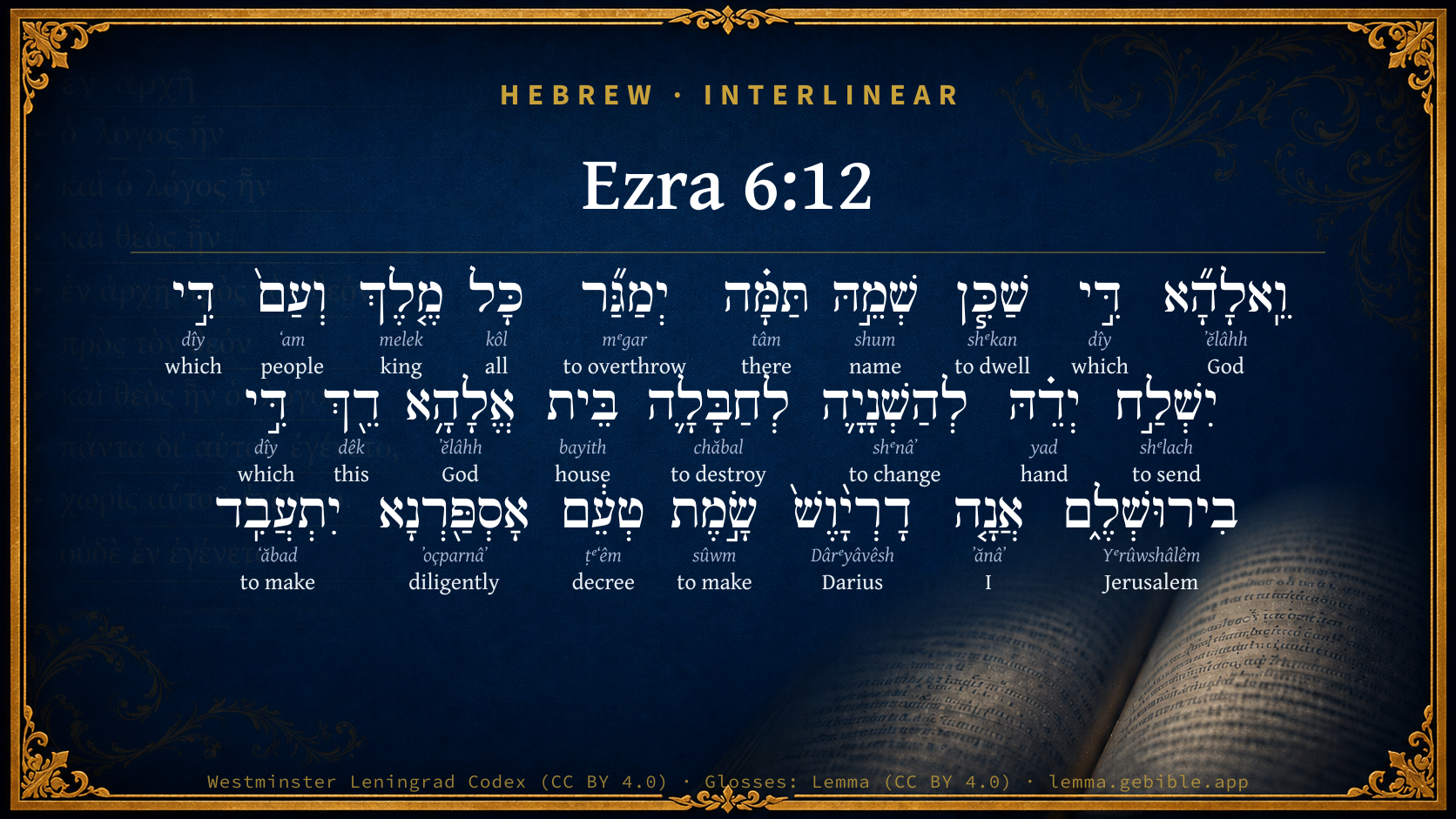
Hebrew (Westminster Leningrad Codex) Ezra 6:12 appears in the Hebrew Old Testament. The text above is from the Westminster Leningrad Codex. Each word links to its Strong’s number, a concise gloss, and parsing drawn from the Open Scriptures Hebrew Bible morphology. Click any word for its full Brown-Driver-Briggs (BDB) entry.
Download image
Cite this verse

Ezra 6:12 (World English Bible). Public Domain. Lemma interlinear Bible study tool, https://lemma.gebible.app/v/ezra/6/12.

Show BibTeX & RIS
BibTeX
RIS
English Translation
and the God who has caused his name to dwell there overthrow all kings and peoples who shall put forth their hand to alter [the same], to destroy this house of God which is at Jerusalem. I Darius have made a decree; let it be done with all diligence.
World English Bible · Public Domain
Highlights
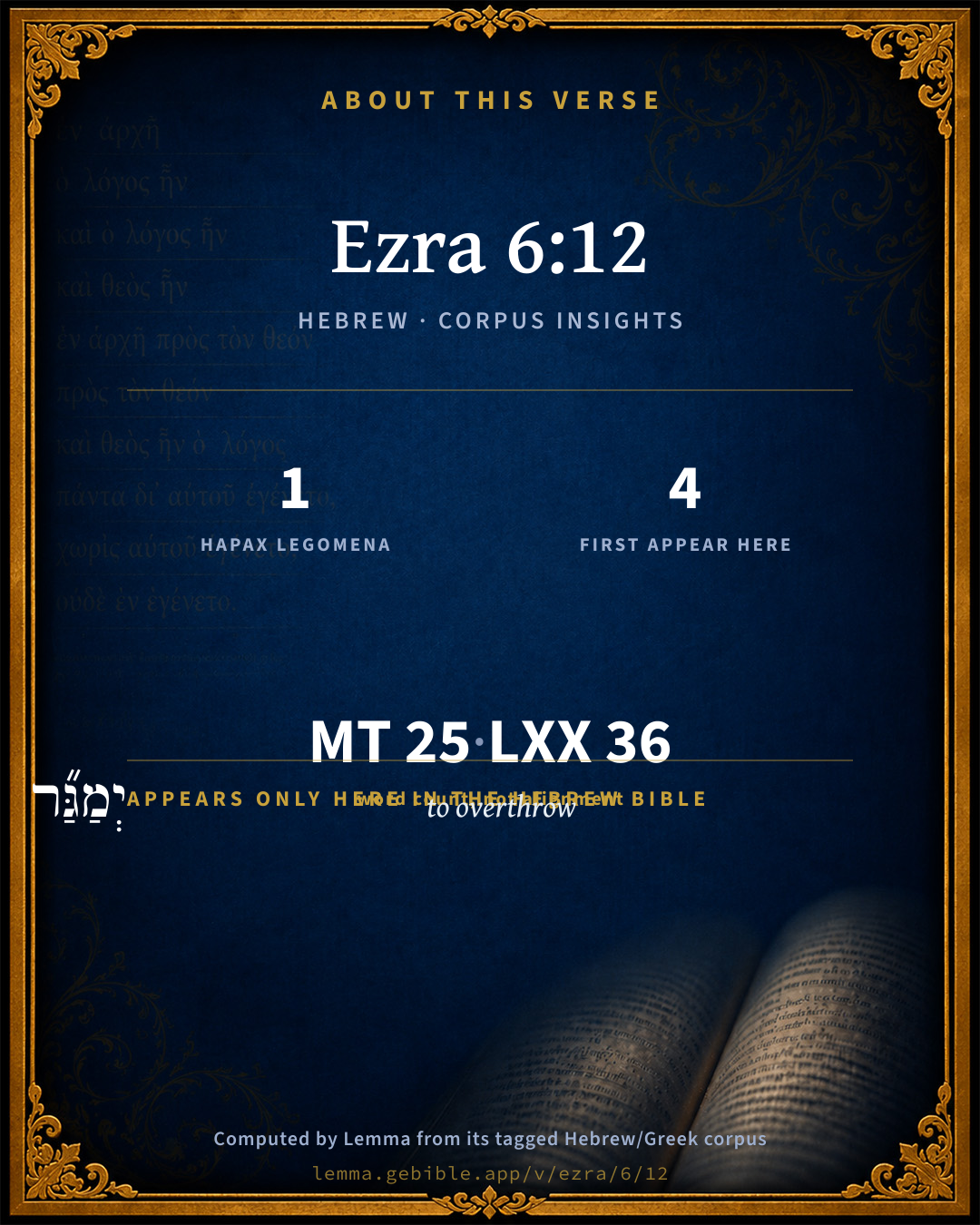
  • 1 hapax legomenon — only here in the Hebrew Bible
  • 4 first appearances in the Hebrew Bible
Full analysis ↓
Download a study sheet

One document with this verse’s original text, its word-by-word gloss line, the meaning frame, cross-references with their text, attributed commentary, and full source and license credits — printable, and it pastes into notes with its structure intact.

This verse Autodidact and up

Study sheet (.html) Plain text (.txt)

A passage Seminary Student

Up to 50 verses in one chapter. A passage sheet keeps up to 6 commentary sources and 12 cross-references per verse, in the order this page ranks them, and says so on the sheet whenever that leaves anything out. Ask for a single verse and you get the Autodidact verse sheet above.

Everything on this page stays free to read, with no account — the sheet is a download of what is already on screen, not access to it.

Want to remove ads? Support Godless Engineer
Compare translations 3

The same verse in 3 English versions, stacked beneath the original-language interlinear above. Click any original word for its lexicon entry.

Each is an independent rendering of the whole verse — the interlinear is not word-aligned to these translations.

Highlighted words mark where these versions differ — a whole-verse word diff, not a word-by-word alignment.

  • World English Bible Public Domain
    and the God who has caused his name to dwell there overthrow all kings and peoples who shall put forth their hand to alter [the same], to destroy this house of God which is at Jerusalem. I Darius have made a decree; let it be done with all diligence.
  • King James Version Public Domain
    And the God that hath caused his name to dwell there destroy all kings and people, that shall put to their hand to alter and to destroy this house of God which is at Jerusalem. I Darius have made a decree; let it be done with speed.
  • unfoldingWord Literal Text CC BY-SA 4.0
    And may the God who has caused his name to dwell there overthrow any king or people who stretches out his hand to change, to destroy that house of God which is in Jerusalem. I, Darius, have set a decree. Let it be done diligently.”

unfoldingWord Literal Text — © unfoldingWord, licensed CC BY-SA 4.0. Word-aligned USFM3 via Door43 (git.door43.org/unfoldingWord/en_ult).

Versions to compare (up to 4)

3 of 4 selected

Show all 18 translations

Every available English version of this verse, each an independent rendering of the whole verse.

  • World English Bible Public Domain
    and the God who has caused his name to dwell there overthrow all kings and peoples who shall put forth their hand to alter [the same], to destroy this house of God which is at Jerusalem. I Darius have made a decree; let it be done with all diligence.
  • Berean Standard Bible Public Domain
    May God, who has caused His Name to dwell there, overthrow any king or people who lifts a hand to alter this decree or to destroy this house of God in Jerusalem. I, Darius, have issued the decree. Let it be carried out with diligence.
  • Majority Standard Bible Public Domain
    May God, who has caused His Name to dwell there, overthrow any king or people who lifts a hand to alter this decree or to destroy this house of God in Jerusalem. I, Darius, have issued the decree. Let it be carried out with diligence.
  • King James Version Public Domain
    And the God that hath caused his name to dwell there destroy all kings and people, that shall put to their hand to alter and to destroy this house of God which is at Jerusalem. I Darius have made a decree; let it be done with speed.
  • American Standard Version (1901) Public Domain
    and the God that hath caused his name to dwell there overthrow all kings and peoples that shall put forth their hand to alter `the same', to destroy this house of God which is at Jerusalem. I Darius have made a decree; let it be done with all diligence.
  • Revised Version (1885) Public Domain
    and the God that hath caused his name to dwell there overthrow all kings and peoples, that shall put forth their hand to alter the same, to destroy this house of God which is at Jerusalem. I Darius have made a decree; let it be done with all diligence.
  • Geneva Bible (1599) Public Domain
    And the God that hath caused his Name to dwell there, destroy all Kings and people that put to their hand to alter, and to destroy this house of God, which is in Ierusalem. I Darius haue made a decree, let it be done with speede.
  • Douay-Rheims (1899) Public Domain
    And may the God, that hath caused his name to dwell there, destroy all kingdoms, and the people that shall put out their hand to resist, and to destroy the house of God, that is in Jerusalem. I Darius have made the decree, which I will have diligently complied with.
  • Young's Literal Translation Public Domain
    And God, who caused His name to dwell there, doth cast down any king and people that putteth forth his hand to change, to destroy this house of God that `is' in Jerusalem; I Darius have made a decree; speedily let it be done.'
  • Literal Standard Version CC BY-SA 4.0
    And God, who caused His Name to dwell there, casts down any king and people that puts forth his hand to change, to destroy this house of God that [is] in Jerusalem; I Darius have made a decree; let it be done speedily.”
  • Unlocked Literal Bible CC BY-SA 4.0
    May the God who has caused his name to dwell there overthrow any king or people who lifts a hand to change this decree, or to destroy this house of God in Jerusalem. I, Darius, am ordering this. Let it be done with diligence!”
  • unfoldingWord Literal Text CC BY-SA 4.0
    And may the God who has caused his name to dwell there overthrow any king or people who stretches out his hand to change, to destroy that house of God which is in Jerusalem. I, Darius, have set a decree. Let it be done diligently.”
  • Darby Bible Public Domain
    And the God that has caused his name to dwell there overthrow every king and people that shall put forth their hand to alter [or] to destroy this house of God which is at Jerusalem. I Darius have given [this] order; let it be done diligently.
  • World Messianic Bible Public Domain
    May the God who has caused his name to dwell there overthrow all kings and peoples who stretch out their hand to alter this, to destroy this house of God which is at Jerusalem. I Darius have made a decree. Let it be done with all diligence.
  • Webster's Bible Public Domain
    And the God that hath caused his name to dwell there destroy all kings and people, that shall attempt to alter and to destroy this house of God which is at Jerusalem. I Darius have made a decree; let it be done with speed.
  • Free Bible Version CC BY-SA 4.0
    May God who chose the city of Jerusalem as the place where he would be honored, destroy any king or people who try to alter what I have said or who destroy this Temple. I, Darius, issue this decree. Let it be faithfully carried out.
  • Bible in Basic English Public Domain
    And may the God who has made it a resting-place for his name send destruction on all kings and peoples whose hands are outstretched to make any change in this or to do damage to this house of God at Jerusalem. I, Darius, have given this order, let it be done with all care.
  • JPS Tanakh (1917) Public Domain
    and may the God that hath caused His name to dwell there overthrow all kings and peoples, that shall put forth their hand to alter the same, to destroy this house of God which is at Jerusalem. I Darius have made a decree; let it be done with all diligence.'

Literal Standard Version (2020), Covenant Press — licensed CC BY-SA 4.0. Text via the HelloAO Bible API (eBible.org). Unlocked Literal Bible (unfoldingWord) — licensed CC BY-SA 4.0. Text via the HelloAO Bible API (eBible.org). unfoldingWord Literal Text — © unfoldingWord, licensed CC BY-SA 4.0. Word-aligned USFM3 via Door43 (git.door43.org/unfoldingWord/en_ult). Free Bible Version, Dr. Jonathan Gallagher — licensed CC BY-SA 4.0. Text via the HelloAO Bible API (eBible.org).

Word by word

More ways to search: Search by grammar → Find every occurrence → Compare this word →

Practice this passage: Drill this verse → Learn its vocabulary →

יְמַגַּ֞ר
mᵉgar
H4049
“to overthrow”
Adjective, V
Part of Speech
Adjective
Full BDB Definition

Origin: corresponding to H4048

TWOT: 2821

(Pael) to overthrow
  1. וֵֽאלָהָ֞א ʼĕlâhh H426 “and · God · the” Adjective, C + Noun, Common, Masculine, Singular, Determined + Particle, Definite Article
  2. דִּ֣י dîy H1768 “which” Adjective, T
  3. שַׁכִּ֧ן shᵉkan H7932 “to dwell” Adjective, V, Plural
  4. שְׁמֵ֣הּ shum H8036 “name · his” Adjective, N, Common + Suffix, Personal, 3rd Person, Masculine, Singular
  5. תַּמָּ֗ה tâm H8536 “there” Adjective, D
  6. כָּל kôl H3606 “all of” Adjective, N, Common
  7. מֶ֤לֶךְ melek H4430 “king” Adjective, N, Common
  8. וְעַם֙ ʻam H5972 “and · people” Adjective, C + Noun, Common, Masculine, Singular, Absolute
  9. דִּ֣י dîy H1768 “which” Adjective, T
  10. יִשְׁלַ֣ח shᵉlach H7972 “to send” Adjective, V
  11. יְדֵ֗הּ yad H3028 “hand · his” Adjective, N, Common + Suffix, Personal, 3rd Person, Masculine, Singular
  12. לְהַשְׁנָיָ֛ה shᵉnâʼ H8133 “to change” Adjective, R + Verb, Hiphil, Infinitive Construct
  13. לְחַבָּלָ֛ה chăbal H2255 “to destroy” Adjective, R + Verb, Piel, Infinitive Construct
  14. בֵּית bayith H1005 “house of” Adjective, N, Common
  15. אֱלָהָ֥א ʼĕlâhh H426 “God · the” Adjective, N, Common + Particle, Definite Article
  16. דֵ֖ךְ dêk H1791 “this” Adjective, P
  17. דִּ֣י dîy H1768 “which” Adjective, T
  18. בִירוּשְׁלֶ֑ם Yᵉrûwshâlêm H3390 “in/at · Jerusalem” Adjective, R + Noun, Proper
  19. אֲנָ֤ה ʼănâʼ H576 “I” Adjective, P, Construct
  20. דָרְיָ֨וֶשׁ֙ Dârᵉyâvêsh H1868 “Darius” Adjective, N
  21. שָׂ֣מֶת sûwm H7761 “to make” Adjective, V, Plural
  22. טְעֵ֔ם ṭᵉʻêm H2942 “decree” Adjective, N, Common
  23. אָסְפַּ֖רְנָא ʼoçparnâʼ H629 “diligently” Adjective, D
  24. יִתְעֲבִֽד ʻăbad H5648 “to make” Adjective, V

About this verse

These counts appear in no published source. They are computed here, from the morphology-tagged text and Lemma’s own curated glosses. What Lemma adds →

25
words
22
distinct lemmas
Historical
section

Notable vocabulary

1 hapax legomenon — a word that appears only here in the entire Hebrew Bible:

  • יְמַגַּ֞ר to overthrow H4049

First appearance in Scripture

These words make their first canonical appearance in the Hebrew Bible here:

  • שַׁכִּ֧ן to dwell H7932
  • יְמַגַּ֞ר to overthrow H4049
  • לְחַבָּלָ֛ה to destroy H2255
  • אֲנָ֤ה I H576

Shared distinctive vocabulary

שַׁכִּ֧ן to dwell H7932 occurs in 2 verses of the Hebrew Bible. Also found in:

Grammatical profile

  • 2 verbs
  • 2 nouns
  • 19 adjectives
  • 2 particles

Verb forms

  • לְהַשְׁנָיָ֛ה Hiphil · Infinitive Construct
  • לְחַבָּלָ֛ה Piel · Infinitive Construct

Repetition

Words recur within this verse — often emphatic in Hebrew:

  • וֵֽאלָהָ֞א God H426 ×2
  • דִּ֣י which H1768 ×3

Hebrew & Septuagint length

In English translation the verse runs 49 words from the Hebrew and 43 from the Septuagint (LXX English) — closely comparable.

A rough comparison of the two English renderings, which tokenize alike — not a word-level alignment.

Word counts can differ between the Hebrew and the Greek without any difference in meaning — e.g. the Hebrew direct-object marker אֵת has no separate Greek word, and Greek often adds the article ὁ.

In the original languages it is 25 Hebrew tokens and 36 Greek tokens — but the two are counted differently (Hebrew bundles its prefixes and suffixes into one token; the Greek is in lemma form), so that isn’t a like-for-like length.

Cross-references

20

Topical passages linked to Ezra 6:12 in the Treasury of Scripture Knowledge — connected by theme and wording, ordered by reader-vote popularity; previews shown in the World English Bible.

  • 1 Kings 9:3 Yahweh said to him, I have heard your prayer and your supplication, that you have made before me: I have made this house holy, which you have built, to put my name there forever; and my eyes and my heart shall be there perpetually.
  • Deuteronomy 12:5 But to the place which Yahweh your God shall choose out of all your tribes, to put his name there, even to his habitation shall you seek, and there you shall come;
  • Exodus 20:24 You shall make an altar of earth for me, and shall sacrifice on it your burnt offerings and your peace-offerings, your sheep and your oxen. In every place where I record my name I will come to you and I will bless you.
  • Deuteronomy 12:11 then it shall happen that to the place which Yahweh your God shall choose, to cause his name to dwell there, there shall you bring all that I command you: your burnt offerings, and your sacrifices, your tithes, and the heave-offering of your hand, and all your choice vows which you vow to Yahweh.
  • Deuteronomy 16:2 You shall sacrifice the Passover to Yahweh your God, of the flock and the herd, in the place which Yahweh shall choose, to cause his name to dwell there.
  • 2 Chronicles 7:16 For now have I chosen and made this house holy, that my name may be there forever; and my eyes and my heart shall be there perpetually.
  • Esther 3:14–15 A copy of the writing, that the decree should be given out in every province, was published to all the peoples, that they should be ready against that day.
  • Esther 8:14 So the posts who rode on swift steeds that were used in the king's service went out, being hurried and pressed on by the king's commandment; and the decree was given out in Shushan the palace.
  • Psalms 5:10 Hold them guilty, God. Let them fall by their own counsels; Thrust them out in the multitude of their transgressions, For they have rebelled against you.
  • Psalms 21:8–10 Your hand will find out all of your enemies. Your right hand will find out those who hate you.
  • Psalms 132:13–14 For Yahweh has chosen Zion. He has desired it for his habitation.
  • Psalms 137:8–9 Daughter of Babylon, doomed to destruction, He will be happy who rewards you, As you have served us.
  • Ecclesiastes 9:10 Whatever your hand finds to do, do it with your might; for there is no work, nor device, nor knowledge, nor wisdom, in Sheol, where you are going.
  • Isaiah 60:12 For that nation and kingdom that will not serve you shall perish; yes, those nations shall be utterly wasted.
  • Obadiah 1:10 For the violence done to your brother Jacob, shame will cover you, and you will be cut off forever.
  • Zechariah 12:2–4 "Behold, I will make Jerusalem a cup of reeling to all the surrounding peoples, and on Judah also will it be in the siege against Jerusalem.
  • Acts 5:38–39 Now I tell you, withdraw from these men, and leave them alone. For if this counsel or this work is of men, it will be overthrown.
  • Acts 9:5 He said, "Who are you, Lord?" The Lord said, "I am Jesus, whom you are persecuting.
  • Ezra 6:13 Then Tattenai, the governor beyond the River, Shetharbozenai, and their companions, because that Darius the king had sent, did accordingly with all diligence.
  • Revelation 19:14–21 The armies which are in heaven followed him on white horses, clothed in white, pure, fine linen.

Cross-references courtesy of OpenBible.info (CC BY 4.0).

Hebrew and Greek witnesses Masoretic Hebrew ↔ Greek Septuagint

The same verse in the two great witnesses to the Old Testament, shown verse-for-verse.

These are two independent witnesses, not word-aligned to each other, and the Septuagint is shown in lemma (dictionary) form.

Hebrew Ezra 6:12 Masoretic · Westminster Leningrad Codex

וֵֽאלָהָ֞א דִּ֣י שַׁכִּ֧ן שְׁמֵ֣הּ תַּמָּ֗ה יְמַגַּ֞ר כָּל מֶ֤לֶךְ וְעַם֙ דִּ֣י יִשְׁלַ֣ח יְדֵ֗הּ לְהַשְׁנָיָ֛ה לְחַבָּלָ֛ה בֵּית אֱלָהָ֥א דֵ֖ךְ דִּ֣י בִירוּשְׁלֶ֑ם אֲנָ֤ה דָרְיָ֨וֶשׁ֙ שָׂ֣מֶת טְעֵ֔ם אָסְפַּ֖רְנָא יִתְעֲבִֽד

and the God who has caused his name to dwell there overthrow all kings and peoples who shall put forth their hand to alter [the same], to destroy this house of God which is at Jerusalem. I Darius have made a decree; let it be done with all diligence.

World English Bible · Public Domain

Greek LXX Ezra 6:12 Septuagint · lemma form

καί ὁ θεός ὅς κατασκηνόω ὁ ὄνομα ἐκεῖ καταστρέφω πᾶς βασιλεύς καί λαός ὅς ἐκτείνω ὁ χείρ αὐτός ἀλλάσσω ἤ ἀπο ἀναἵζω ὁ οἶκος ὁ θεός ἐκεῖνος ὁ ἐν ἰερουσαλήμ ἐγώ δαρεῖος τίθημι γνώμη ἐπιμελῶς εἰμί

And may the God whose name dwells there, overthrow every king and people who shall stretch out his hand to alter or destroy the house of God which is in Jerusalem. I Darius have made a decree; let it be diligently attended to.

LXX2012 (modern English Septuagint) · Public Domain

In the Septuagint this is one book — Esdras B (2 Esdras): Ezra is chapters 1–10, Nehemiah 11–23.

Hebrew: Westminster Leningrad Codex (CC BY 4.0). Greek: Septuagint (public domain); English from LXX2012 (modern English Septuagint) (Public Domain). How the Septuagint differs from the Hebrew →

Commentary

Notes on Ezra 6:12 from classic Christian and Jewish commentators (each source and its license shown beneath its notes). The classic Christian expositions comment on the surrounding passage and are grouped to its opening verse, so a note may address several verses; the Jewish commentaries on the Tanakh (Rashi and others) are per-verse, so they appear only where the commentator wrote on this verse.

Lemma curates 59 commentaries, every one of them public domain or Creative Commons licensed, each selected and text-cleaned for this edition rather than reprinted as found. About our sources →

Trapp's Complete Commentary

John Trapp

Ezr 6:12 And the God that hath caused his name to dwell there destroy all kings and people, that shall put to their hand to alter [and] to destroy this house of God which [is] at Jerusalem. I Darius have made a decree; let it be done with speed.

Ver. 12. And the God that hath caused his name] i. e. His word and true worship, Act 9:15 Psa 138:2 Mic 4:5 1Ki 5:3; 1Ki 5:5.

Destroy all kings and people] A dreadful curse, and such as God saith Amen to. Let all persecutors and church robbers look to themselves. God’s hand hath ever been very heavy upon such and their posterity. See Pro 20:25, with the note.

Let it be done with speed] It hath been too much retarded and delayed already; let it now be expedited. David made haste, and delayed not to keep God’s commandments, Psa 119:60. And Austin crieth out, Nimis sere te amavi, Domine. Too late I loved you, God. It was a great burden to his good soul that he began no sooner to love God. He resolveth therefore to redeem time, and to redouble his diligence; not leaving till his soul was turned into a lump of love. Morus novissime omnium germinat; et tamen parit inter primas; the mulberry tree buds last, but fruits with the first.

John Trapp, A Commentary or Exposition upon All the Books of the Old and New Testament (1647–1656) — public domain. Text from a community e-Sword module.

Joseph Benson's Commentary

Ezr 6:12. The God that hath caused his name to dwell there — Who hath willed that a temple should be built there, called the temple or house of Jehovah. Destroy all kings and people that shall put to their hand to alter, &c. — Darius was touched with such a sense of the greatness of the God of the Jews, that he prays, that He who had all power in heaven and earth, and was King of kings, would not only punish all those kings who went about to obstruct this work, but destroy both them and their people. Though this temple was at length most justly destroyed by the righteous hand of God, yet perhaps the Romans, who were the instruments of that destruction, felt the effects of this curse. For that empire sensibly declined ever after, till it was wholly destroyed.

Here let us admire, how the divine providence overruleth every thing according to its purpose, to bring about all its wise designs. The great men, we here find, stood up against the poor and shattered remnant of Judah; they took counsel together how to oppress them, and keep them down. They laid their plans, exhibited their complaints against them, and thought to overturn them: but, quite contrary to their thoughts, the steps they took for this purpose operated the contrary way, and proved the means of exalting and raising those whom they intended to ruin to a higher pitch of power and pre-eminence. The king, whose governors these men were, and to whom, undoubtedly, they represented how much it was for his interest to put a stop to the rise of Judah, instead of hearkening to their complaints, as was natural, and acting accordingly, sent back a decree, not only forbidding them to molest the Jews in any way, but also granting them the most extraordinary privileges and encouragements, as to the greatest favourites. To what can we attribute this extraordinary behaviour in the king: but to an overruling providence? which ruleth even the hearts of kings, and turneth them as it seemeth best to his sovereign wisdom.

Joseph Benson's Commentary on the Old and New Testaments (1811–1818) — public domain. Text from a community e-Sword module.

Geneva Bible (1599)

Geneva Bible translators

Who hath appointed that place to have his Name called upon there.

Geneva Bible (1599) marginal notes — public domain. Text via Bolls.life.

The Cambridge Bible for Schools and Colleges

gen. ed. J. J. S. Perowne

12. And the God that hath caused his name, &c.] A Hebrew phrase (see Deu_12:11; 1Ki_8:29; Neh_1:9; Jer_7:12) introduced by the Jewish Compiler into his paraphrase of Darius’s decree.

destroy all kings and people] R.V. overthrow all kings and peoples. The word rendered ‘destroy’ here by the A.V. differs in the Aramaic from that rendered ‘destroy’ at the close of the verse. It is used in the Targum of 2Ki_9:33 for the words ‘throw her down’, of Psa_119:139 ‘my zeal hath consumed me’.

that shall put to their hand] R.V. put forth their hand.

to alter and to destroy this house] R.V. to alter the same, to destroy this house; i.e. alter the decree and to destroy the Temple. These words illustrate the latitude that should be given to the expression ‘alter’

with speed] R.V. with all diligence, cf. Ezr_6:8, and Ezr_5:8.

The Cambridge Bible for Schools and Colleges (gen. ed. J. J. S. Perowne; Cambridge University Press, 1878–1918) — public domain. Text from a community e-Sword module.

John Gill's Exposition

Then Tatnai, governor on this side the river, Shetharboznai, and their companions,.... Having received and read the above letter:

according to that which Darius the king had sent, so they did speedily; acquainted the Jews with what the king had written; were so far from hindering the work going forward, that they encouraged it; and made disbursements to them out of the king's tribute, and furnished them with everything necessary for sacrifice: and this they did immediately, without delay.

John Gill's Exposition of the Whole Bible (1746–1763) — public domain (CC PDM 1.0). Text via the HelloAO Bible API.

Albert Barnes' Notes on the Bible

Destroy all - A similar malediction is found at the end of the great inscription of this same king Darius at Behistun: If anyone injures the tablet which he has set up, he prays that Ormazd will be their enemy, and that they may have no offspring, and that whatever they do, Ormazd may curse it for them.

To alter and to destroy this house - i. e., to alter the decree, and then proceed to destroy the house.

Albert Barnes' Notes on the Bible (1834–1885) — public domain. Text from a community e-Sword/MySword module.

Whedon's Commentary on the Bible

Daniel D. Whedon

12. God… destroy all kings — Compare the similar execrations in Darius’s Behistun inscription, especially the following: “if seeing this tablet, and these images, thou injurest them, and preservest them not as long as my seed endures, may Ormazd be thy enemy, and mayest thou have no offspring, and whatever thou doest may Ormazd curse it for thee.”

Daniel D. Whedon (gen. ed.), Commentary on the Old and New Testaments (1874–1909) — public domain. Text from a community e-Sword module.

The Pulpit Commentary

HOMILIES BY W. CLARKSON. Vers. 12-15.

Overthrow and upbuilding.

The end of this mission brings to our view

I THE OVERTHROW OF EVIL. "Then Tatnai, Shethar-boznai, and their companions, according to that which Darius had sent, so did they speedily "( ver. 13). With deepest mortification and chagrin must they have received these tidings from the Babylonian court. Their failure was complete and conspicuous. Not only had they not done what they wanted to do, but they bad been compelled to aid and prosper that to which they were implacably opposed. "According to that which Darius the king had sent, so they did speedily;" they paid the expenses (ver. 8) and presented the offerings (vers. 9, 10), and thus contributed to the cause they set out to demolish. In the end we shall see evil overthrown by the power of God, by the grace of our Lord Jesus Christ. By faith we may say what our Master said by Divine prevision, "I saw Satan as lightning fall from heaven". (Luk_10:18) And sometimes God gives us to see evil overthrown before our eyes, its designs upset, its fabric brought down to the ground. It is a pleasing and cheering sight when we see it simply defeated, as when, after long and hard struggle, a good cause succeeds in establishing itself despite the utmost efforts of iniquity to hinder it. Still more gratifying is it to see it suffer such an utter rout as on this occasion, when its forces are not only arrested, but made to serve the cause it bad assailed. Then God not only restrains man"s wrath, but makes it to praise him and to serve us. (Psa_76:10) Let us be encouraged under oppression and persecution. Our Divine Leader can not only deliver us out of the hand of our enemies, but he may even, as here, and as often since in the history of the Church, compel those who are hating us, and maligning and misrepresenting us, and seriously injuring us, to bring us their tribute and aid us in offering our sacrifice of prayer and praise unto the Lord our Saviour.

II SPIRITUAL BUILDING. "And the elders of the Jews builded" (ver. 14), "and they builded and finished" (ver. 15). Then the Jews, under their elders (in order, giving rank and direction to those who were men of experience and capacity), builded the house

1. For God: for his worship and praise; that offerings might be presented unto him which should be acceptable to him; and

2. With God: they gladly availed themselves of the help accorded them by the prophets of the Lord. These men (ver. 14) "prophesied," i.e. they spake in the name of the Lord, urging all to do their work diligently and faithfully, and therefore speedily and Soundly; also obediently, "according to commandment" (ver. 14); and thus they brought their work

3. To its completion: "they finished it;" it stood strong and fair and well furnished, from foundation to top-stone. We, too, are building for God; not, perhaps, a material fabric, but that which is more precious in his sighta Christian character or a Christian cause. We are engaged in "building up ourselves in our most holy faith", (Jud_1:20) adding to our faith virtue, and to virtue knowledge, etc.. (2Pe_1:5, 2Pe_1:6, 2Pe_1:7) And we are (or ought to be) engaged in building up the temple of some good cause. Some work of God is occupying our time, is engaging our strength and skill. We are laying the foundation in some small beginnings, or, on the foundation another has laid, we are building up the imperishable "gold, silver, precious stones," rejecting (as far as possible) the "wood, hay, and stubble," which the fires of God would consume. (1Co_3:12) Let us see to it that, in building up both our own character and the cause of God, we build

1. For God; doing all things mainly and chiefly unto him; as "unto the Lord," and not as unto ourselves. Let the glory of Christ be the mainspring of our action. Whatever toil, patience, forbearance, charity may be required, let us gladly yield all because "Jesus is worthy to receive," etc.

2. With God; accepting all the help God offers us through the varied means of grace he has supplied notably the preaching (or "prophesying") of his servants; consulting his word to know his will, that all our building may be according to commandment." We must do what we do in the way, i.e. in the spirit and after the method, in which he would have us work.

3. Unto completion. Learning, growing, ripening until death; sympathising, giving, striving, co-operating till the work is done and the fabric is finished. C.

The Pulpit Commentary (1880–1919), ed. H.D.M. Spence-Jones & Joseph S. Exell — public domain. Text from a community e-Sword module.

John Wesley's Explanatory Notes

Destroy - Tho' this temple was at length most justly destroyed by the righteous hand of God, yet perhaps the Romans, who were the instruments of that destruction, felt the effects of this curse. For that empire sensibly declined ever after, 'till it was wholly destroyed.

John Wesley, Explanatory Notes Upon the Whole Bible (1754–1765) — public domain. Text via the GEBible commentary corpus.

Rashi

Rabbi Shlomo Yitzchaki (Rashi)

And God, Who caused His name to rest there [as translated,] and God, Who caused His name to rest there.

will cast down will cast down and destroy any such king and any such people that will stretch forth a hand to lay waste and destroy His house that is in Jerusalem.

have issued an edict I have issued a command concerning this matter, that the building be constructed swiftly. Until here is Darius’s reply.

Rashi on the Tanakh — English translations: “The Judaica Press complete Tanach with Rashi, translated by A. J. Rosenberg” (CC BY 4.0); “Pentateuch with Rashi's commentary by M. Rosenbaum and A.M. Silbermann, 1929-1934” (public domain); “The Metsudah Tanach series, Lakewood, N.J” (CC BY 4.0); and “The Book of Joshua, Metsudah Publications, 1997” (CC BY 4.0). Text via Sefaria.

Lesson kit

Teaching starters — assembled from the data on this page, not authored interpretation. Every prompt links to the verse data it draws on. Edit before teaching.

Ezra, in the Historical, opens this verse with 25 words (22 distinct Hebrew lemmas). Its most distinctive word is mᵉgar (“to overthrow”). A historical commentator’s framing appears above. Read the whole chapter for the surrounding context.

Discussion questions

  1. What does “to overthrow” (mᵉgar) contribute to the verse as a whole?
  2. 1 word here appears nowhere else in the Hebrew Bible. Why might the author reach for such rare wording?
  3. 4 words make their first appearance in Scripture here. What does this debut establish?
  4. How does Daniel 4:21, which shares the word «to dwell», read alongside this verse?
  5. What does the repetition of “God” (2× in this one verse) do in this verse?
  6. The translations on this page render this verse differently — a whole-verse word diff, not a word-by-word alignment. What might account for the different wordings?
  7. «לְהַשְׁנָיָ֛ה» is a Hiphil Infinitive Construct verb. How does that grammatical form shape the action described?
  8. Compare how Trapp's Complete Commentary and Joseph Benson's Commentary read this verse. Where do they agree or differ?

Things to notice

  • 1 word in this verse appears nowhere else in the Hebrew Bible.
  • 4 words make their first canonical appearance in Scripture here.
  • This verse counts 25 Hebrew ↔ 36 Greek words.
  • These translations choose different wording for 23 words in this verse.
  • “God” occurs 2× in this single verse.

Reading settings

Reading text

Shown beneath each verse's original-language words.

Old Testament
Old Testament edition

Read the OT as the Masoretic Hebrew (MT) or the Greek Septuagint (LXX).

English shown for the Greek Septuagint (in the Hebrew ↔ Greek comparison).

Comparing translations? Open the Compare panel on any verse page to stack up to four side by side.