Daniel 2:7

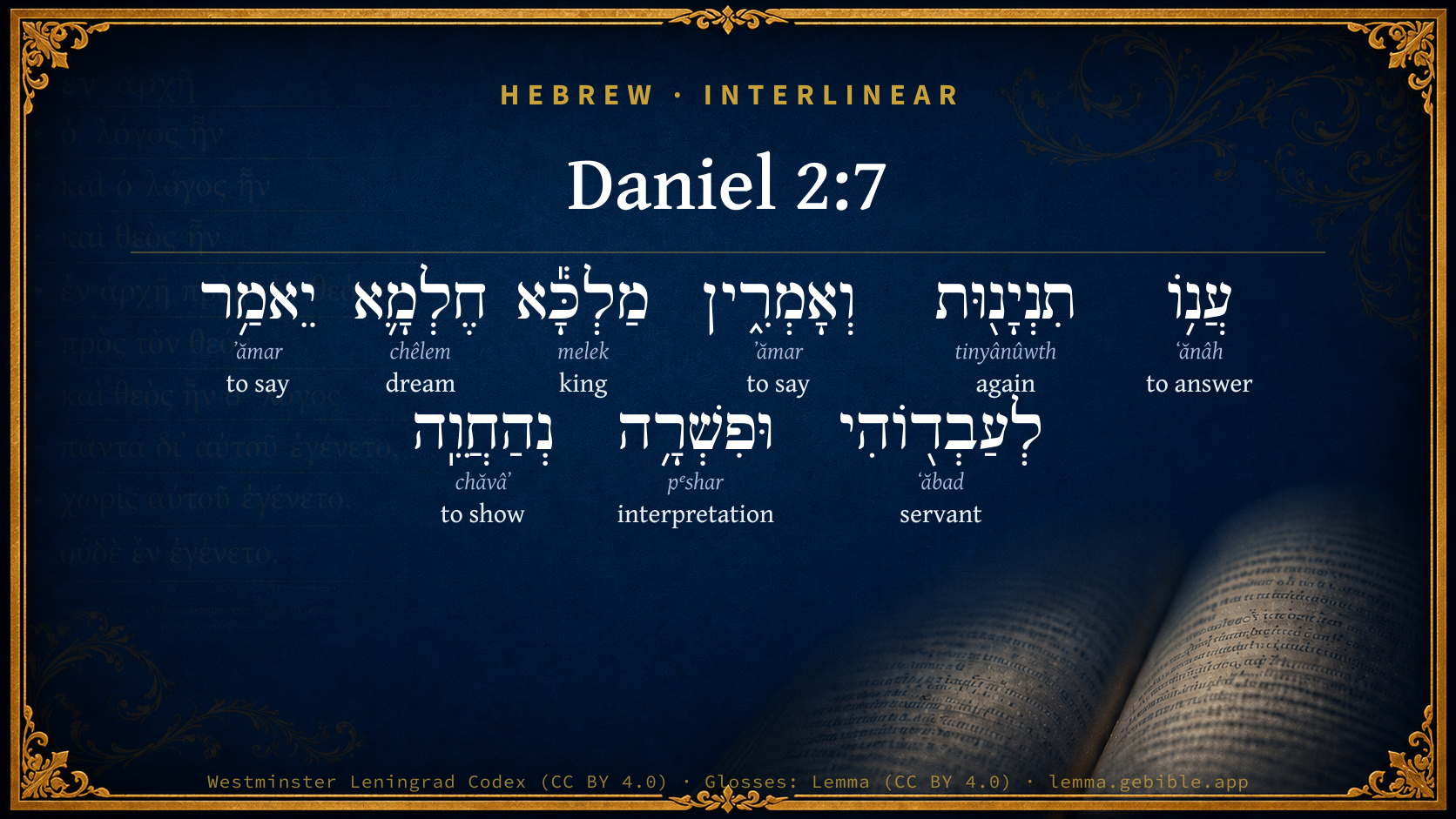
Hebrew (Westminster Leningrad Codex) Daniel 2:7 appears in the Hebrew Old Testament. The text above is from the Westminster Leningrad Codex. Each word links to its Strong’s number, a concise gloss, and parsing drawn from the Open Scriptures Hebrew Bible morphology. Click any word for its full Brown-Driver-Briggs (BDB) entry.
Download image
Cite this verse

Daniel 2:7 (World English Bible). Public Domain. Lemma interlinear Bible study tool, https://lemma.gebible.app/v/daniel/2/7.

Show BibTeX & RIS
BibTeX
RIS
English Translation
They answered the second time and said, Let the king tell his servants the dream, and we will show the interpretation.
World English Bible · Public Domain
Highlights
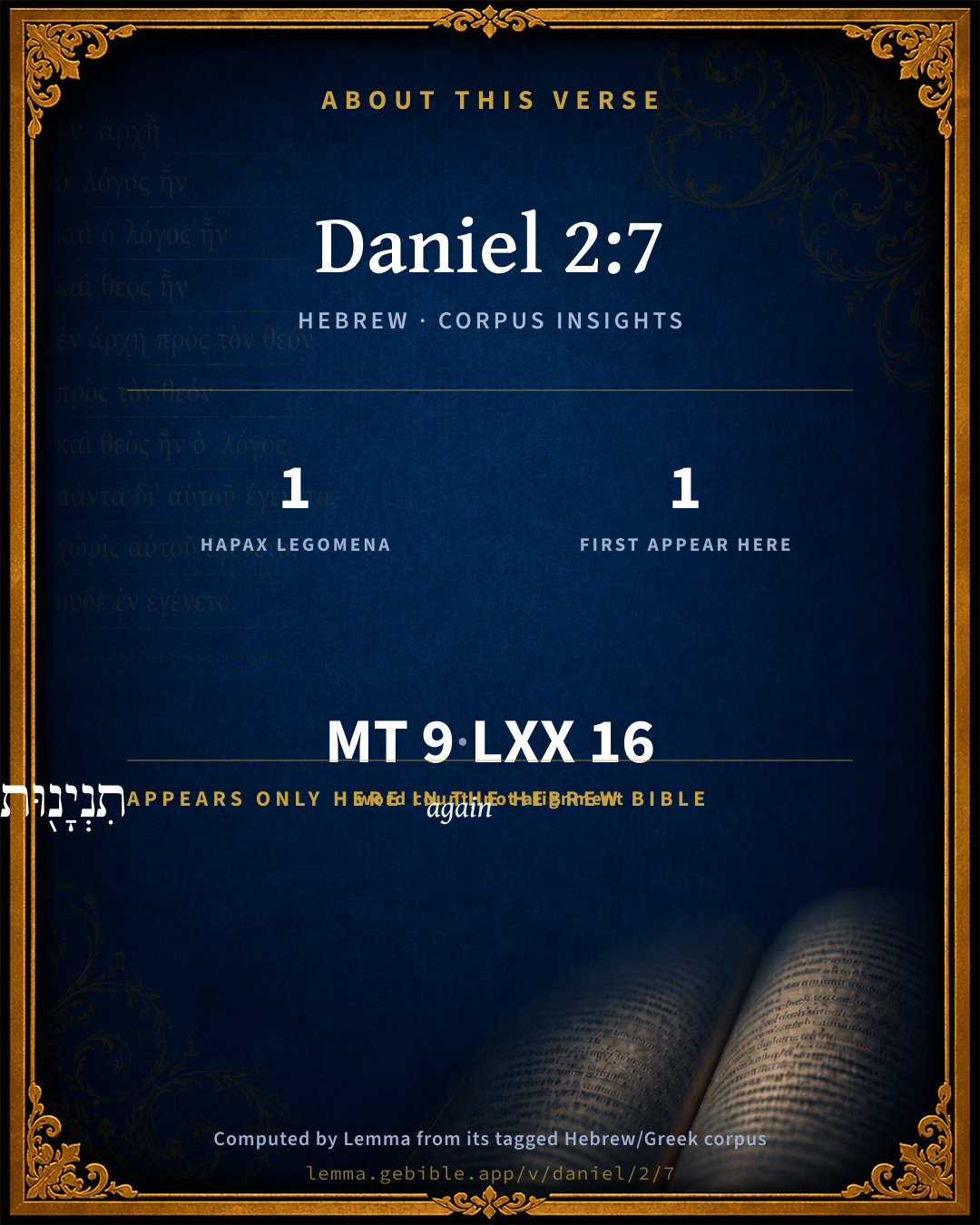
  • 1 hapax legomenon — only here in the Hebrew Bible
  • 1 first appearance in the Hebrew Bible
Full analysis ↓
Download a study sheet

One document with this verse’s original text, its word-by-word gloss line, the meaning frame, cross-references with their text, attributed commentary, and full source and license credits — printable, and it pastes into notes with its structure intact.

This verse Autodidact and up

Study sheet (.html) Plain text (.txt)

A passage Seminary Student

Up to 50 verses in one chapter. A passage sheet keeps up to 6 commentary sources and 12 cross-references per verse, in the order this page ranks them, and says so on the sheet whenever that leaves anything out. Ask for a single verse and you get the Autodidact verse sheet above.

Everything on this page stays free to read, with no account — the sheet is a download of what is already on screen, not access to it.

Want to remove ads? Support Godless Engineer
Compare translations 3

The same verse in 3 English versions, stacked beneath the original-language interlinear above. Click any original word for its lexicon entry.

Each is an independent rendering of the whole verse — the interlinear is not word-aligned to these translations.

Highlighted words mark where these versions differ — a whole-verse word diff, not a word-by-word alignment.

  • World English Bible Public Domain
    They answered the second time and said, Let the king tell his servants the dream, and we will show the interpretation.
  • King James Version Public Domain
    They answered again and said, Let the king tell his servants the dream, and we will shew the interpretation of it.
  • unfoldingWord Literal Text CC BY-SA 4.0
    They answered a second time and said, “Let the king tell his servants the dream, and we will show the interpretation.”

unfoldingWord Literal Text — © unfoldingWord, licensed CC BY-SA 4.0. Word-aligned USFM3 via Door43 (git.door43.org/unfoldingWord/en_ult).

Versions to compare (up to 4)

3 of 4 selected

Show all 18 translations

Every available English version of this verse, each an independent rendering of the whole verse.

  • World English Bible Public Domain
    They answered the second time and said, Let the king tell his servants the dream, and we will show the interpretation.
  • Berean Standard Bible Public Domain
    They answered a second time, “Let the king tell the dream to his servants, and we will give the interpretation.”
  • Majority Standard Bible Public Domain
    They answered a second time, “Let the king tell the dream to his servants, and we will give the interpretation.”
  • King James Version Public Domain
    They answered again and said, Let the king tell his servants the dream, and we will shew the interpretation of it.
  • American Standard Version (1901) Public Domain
    They answered the second time and said, Let the king tell his servants the dream, and we will show the interpretation.
  • Revised Version (1885) Public Domain
    They answered the second time and said, Let the king tell his servants the dream, and we will shew the interpretation.
  • Geneva Bible (1599) Public Domain
    They answered againe, and sayde, Let the King shewe his seruantes the dreame, and wee will declare the interpretation thereof.
  • Douay-Rheims (1899) Public Domain
    They answered again and said: Let the king tell his servants the dream, and we will declare the interpretation of it.
  • Young's Literal Translation Public Domain
    They have answered a second time, and are saying, `Let the king tell the dream to his servants, and the interpretation we do shew.
  • Literal Standard Version CC BY-SA 4.0
    They have answered a second time, and are saying, “Let the king tell the dream to his servants, and we show the interpretation.”
  • Unlocked Literal Bible CC BY-SA 4.0
    They replied again and said, “Let the king tell us, his servants, the dream and we will tell you its meaning.”
  • unfoldingWord Literal Text CC BY-SA 4.0
    They answered a second time and said, “Let the king tell his servants the dream, and we will show the interpretation.”
  • Darby Bible Public Domain
    They answered the second time and said, Let the king tell his servants the dream, and we will shew the interpretation.
  • World Messianic Bible Public Domain
    They answered the second time and said, “Let the king tell his servants the dream, and we will show the interpretation.”
  • Webster's Bible Public Domain
    They answered again and said, Let the king tell his servants the dream, and we will show the interpretation of it.
  • Free Bible Version CC BY-SA 4.0
    Again they said the same thing: “If Your Majesty the king would tell us his servants the dream, we will explain what it means.”
  • Bible in Basic English Public Domain
    A second time they said in answer, Let the king give his servants an account of his dream, and we will make clear the sense.
  • JPS Tanakh (1917) Public Domain
    They answered the second time and said: 'Let the king tell his servants the dream, and we will declare the interpretation.'

Literal Standard Version (2020), Covenant Press — licensed CC BY-SA 4.0. Text via the HelloAO Bible API (eBible.org). Unlocked Literal Bible (unfoldingWord) — licensed CC BY-SA 4.0. Text via the HelloAO Bible API (eBible.org). unfoldingWord Literal Text — © unfoldingWord, licensed CC BY-SA 4.0. Word-aligned USFM3 via Door43 (git.door43.org/unfoldingWord/en_ult). Free Bible Version, Dr. Jonathan Gallagher — licensed CC BY-SA 4.0. Text via the HelloAO Bible API (eBible.org).

Word by word

More ways to search: Search by grammar → Find every occurrence → Compare this word →

Practice this passage: Drill this verse → Learn its vocabulary →

About this verse

These counts appear in no published source. They are computed here, from the morphology-tagged text and Lemma’s own curated glosses. What Lemma adds →

9
words
8
distinct lemmas
Prophets
section

Notable vocabulary

1 hapax legomenon — a word that appears only here in the entire Hebrew Bible:

  • תִנְיָנ֖וּת again H8579

First appearance in Scripture

This word makes its first canonical appearance in the Hebrew Bible here:

  • תִנְיָנ֖וּת again H8579

Shared distinctive vocabulary

לְעַבְד֖וֹהִי servant H5649 occurs in 7 verses of the Hebrew Bible. Also found in:

Grammatical profile

  • 1 verb
  • 2 nouns
  • 4 adjectives
  • 2 particles

Verb forms

  • וְאָמְרִ֑ין Qal · Participle Active

Repetition

A word recurs within this verse — often emphatic in Hebrew:

  • וְאָמְרִ֑ין to say H560 ×2

Hebrew & Septuagint length

In English translation the verse runs 21 words from the Hebrew and 22 from the Septuagint (LXX English) — closely comparable.

A rough comparison of the two English renderings, which tokenize alike — not a word-level alignment.

Word counts can differ between the Hebrew and the Greek without any difference in meaning — e.g. the Hebrew direct-object marker אֵת has no separate Greek word, and Greek often adds the article ὁ.

In the original languages it is 9 Hebrew tokens and 16 Greek tokens — but the two are counted differently (Hebrew bundles its prefixes and suffixes into one token; the Greek is in lemma form), so that isn’t a like-for-like length.

Cross-references

3

Topical passages linked to Daniel 2:7 in the Treasury of Scripture Knowledge — connected by theme and wording, ordered by reader-vote popularity; previews shown in the World English Bible.

  • Daniel 2:4 Then spoke the Chaldeans to the king in the Syrian language, O king, live forever: tell your servants the dream, and we will show the interpretation.
  • Daniel 2:9 But if you don't make known to me the dream, there is but one law for you; for you have prepared lying and corrupt words to speak before me, until the time be changed: therefore tell me the dream, and I shall know that you can show me the interpretation of it.
  • Ecclesiastes 10:4 If the spirit of the ruler rises up against you, don't leave your place; for gentleness lays great offenses to rest.

Cross-references courtesy of OpenBible.info (CC BY 4.0).

Hebrew and Greek witnesses Masoretic Hebrew ↔ Greek Septuagint

The same verse in the two great witnesses to the Old Testament, shown verse-for-verse.

These are two independent witnesses, not word-aligned to each other, and the Septuagint is shown in lemma (dictionary) form.

Hebrew Daniel 2:7 Masoretic · Westminster Leningrad Codex

עֲנ֥וֹ תִנְיָנ֖וּת וְאָמְרִ֑ין מַלְכָּ֕א חֶלְמָ֛א יֵאמַ֥ר לְעַבְד֖וֹהִי וּפִשְׁרָ֥ה נְהַחֲוֵֽה

They answered the second time and said, Let the king tell his servants the dream, and we will show the interpretation.

World English Bible · Public Domain

Greek LXX Daniel 2:7 Septuagint · lemma form

ἀποκρίνω δέ ἐκ δεύτερος λέγω βασιλεύς ὁ ὅραμα εἶπον καί ὁ παῖς σύ κρίνω πρός οὗτος

They answered the second time, and said, Let the king tell the dream to his servants, and we will declare the interpretation.

LXX2012 (modern English Septuagint) · Public Domain

On this verse, The Pulpit Commentary discusses the Septuagint’s reading. Read the note in Commentary ↓

Hebrew: Westminster Leningrad Codex (CC BY 4.0). Greek: Septuagint (public domain); English from LXX2012 (modern English Septuagint) (Public Domain). How the Septuagint differs from the Hebrew →

Commentary

Notes on Daniel 2:7 from classic Christian and Jewish commentators (each source and its license shown beneath its notes). The classic Christian expositions comment on the surrounding passage and are grouped to its opening verse, so a note may address several verses; the Jewish commentaries on the Tanakh (Rashi and others) are per-verse, so they appear only where the commentator wrote on this verse.

Lemma curates 59 commentaries, every one of them public domain or Creative Commons licensed, each selected and text-cleaned for this edition rather than reprinted as found. About our sources →

Trapp's Complete Commentary

John Trapp

Dan 2:7 They answered again and said, Let the king tell his servants the dream, and we will shew the interpretation of it.

Ver. 7. They answered again and said, Let the king, &c.] Thus these proud boasters vaunt of a false gift, and become like "clouds without rain," as Solomon hath it. {Pro 25:14} See Dan 2:4.

John Trapp, A Commentary or Exposition upon All the Books of the Old and New Testament (1647–1656) — public domain. Text from a community e-Sword module.

Joseph Benson's Commentary

Dan 2:7-8. They answered, Let the king tell his servants the dream — But this the king could not do; and yet, unless he could do it, they could not proceed one step toward the gratifying of his desires. The king said, I know of a certainty that ye would gain time — “You only want to protract the time, either that the dream may return, or that my uneasiness may be dissipated, and that, occupied in other affairs, I may think no more of the dream. But I will have from you immediately a positive answer, and a precise explication.” However tyrannical this may appear in the king, his reasoning must be allowed to be very just and right: for if the astrologers could obtain from their gods the knowledge of future events by the explication of a dream, certainly the same gods could have made known to them what the dream was. The original expression means, to buy, or redeem, time, and may be properly applied to men’s using their utmost endeavours to free themselves out of some imminent danger, or difficulty, gaining time being of considerable advantage to that purpose.

Joseph Benson's Commentary on the Old and New Testaments (1811–1818) — public domain. Text from a community e-Sword module.

Ibn Ezra

Rabbi Abraham ibn Ezra

[Daniel 2:7] ʿAnu tinyanut (עֲנוּ תִנְיָנוּת - They answered a second time): The Gaon [Saadia Gaon] said: that they did not add anything now beyond their first answer, except that in the first instance [Daniel 2:4] they were speaking directly to the king (l'nochach ha-melekh - לְנֹכַח הַמֶּלֶךְ), in the manner of [Jacob saying to Isaac] “Arise, now, sit” (kum na sh'vah - קוּם נָא שְׁבָה) [Genesis 27:19]. But now [they use] the third-person singular jussive form ["Let the king tell..."] which is not [so directly] addressed [to the person present], like [Esau saying of Isaac] “Let my father arise” (yakum avi - יָקֻם אָבִי) [Genesis 27:31]. And the reason [according to the Gaon] is that they were afraid to speak directly to him [now], and [so] they said [in effect]: "We have no [other] response to give back except what we [already] responded to the king." [The shift to a more indirect grammatical form reflects their fear and inability to offer a different answer.]

Ibn Ezra on the Tanakh — English translations: “Sefaria Community Translation” (CC0 1.0 (public-domain dedication)); “Yalkut, Sifsei Chachomim Chumash, Metsudah Publications, 2009” (CC BY 4.0); and “Commentary of Ibn Ezra on Isaiah - trans. by M. Friedlander, 1873” (public domain). Text via Sefaria.

Geneva Bible (1599)

Geneva Bible translators

Herein appeared their ignorance, that notwithstanding their brags, yet were they not able to tell the dream, except he entered them into the matter, and therefore they would pretend knowledge where was but mere ignorance, and so as deluders of the people, they were worthy to die.

Geneva Bible (1599) marginal notes — public domain. Text via Bolls.life.

John Calvin's Commentaries

Here the excuse of the Magi is narrated. They state the truth that their art only enabled them to discover the interpretation of a dream; but the king wished to know the dream itself. Whence he appears again to have been seized with prodigious fury and became quite implacable. Kings sometimes grow warm, but are appeased by a single admonition, and hence this sentiment is very true, — anger is assuaged by mild language. But since the fair reply of the Magi did not mitigate the king’s wrath, he was quite hurried away by diabolical vehemence. And all this, as I have said, was governed by God’s secret counsel, that Daniel’s explanation might be more noticed. They next ask the king — to relate his dream, and then they promise as before to interpret it directly. And even this was too great a boast, as we have said, and they ought to have corrected their own conceit and foolish boasting when in such a difficulty. But since they persist in that foolish and fallacious self-conceit, it shews us how they were blinded by the devil, just as those who have become entangled by superstitious deceptions confidently defend their own madness. Such an example we have in the Magi, who always claimed the power of interpreting dreams.

John Calvin's Commentaries (1540-1563) — public domain. Text from the Calvin Translation Society English edition (1840s-50s) via the Christian Classics Ethereal Library (ccel.org). Calvin's coverage is partial (roughly two-thirds of the Bible); uncommented books and verses are honest gaps, never fabricated. The 19th-century editor's footnotes and remarks are omitted so the notes are faithfully Calvin's own voice.

Ellicott's Commentary for English Readers

(7) Let the king tell.—The request was reasonable enough, according to the principles of Babylonian sorcery. Nebuchadnezzar’s doubts, however, were awakened, and he was not sure of the veracity of his magicians. He speaks with great common sense (Dan_2:9), “If you can tell me the dream, I shall be sure that your interpretation is correct.”

A Bible Commentary for English Readers, edited by Charles John Ellicott (1878–1897) — public domain. Text from a community e-Sword module.

The Cambridge Bible for Schools and Colleges

gen. ed. J. J. S. Perowne

7. again] the second time (R.V.).

7–12. The wise men profess their willingness to interpret the king’s dream: but protest that his demand that they should tell him what his dream was is an extravagant one. Nebuchadnezzar, however, adheres to his original demand: and as they are unable to comply with it, commands them to be put to death.

The Cambridge Bible for Schools and Colleges (gen. ed. J. J. S. Perowne; Cambridge University Press, 1878–1918) — public domain. Text from a community e-Sword module.

John Gill's Exposition

They answered again, and said,.... Or, a "second" (e) time; repeating the same words, having nothing more to say:

let the king tell his servants the dream, and we will show the interpretation thereof; the first part was but right and reasonable, though the latter was mere boasting and arrogancy.

(e) Sept.; "secundo", Pagninus, Montanus, Junius & Tremellius, Piscator; so Ar.

John Gill's Exposition of the Whole Bible (1746–1763) — public domain (CC PDM 1.0). Text via the HelloAO Bible API.

Albert Barnes' Notes on the Bible

They answered again, and said, Let the king tell his servants the dream, and we will show the interpretation of it - Certainly not an unreasonable request, in any circumstances, and especially in theirs. They did not profess, evidently, to be able to recal a dream that was forgotten, but the extent of their profession on this subject appears to have been, that they were able to “explain” what was commonly regarded as a prognostic of a future event.

Albert Barnes' Notes on the Bible (1834–1885) — public domain. Text from a community e-Sword/MySword module.

Matthew Poole's English Annotations

But this the king could not do; they could not tell the dream, and the king could not, yet both require impossibilities.

Matthew Poole's English Annotations on the Holy Bible (1683–1685) — public domain. Text from a community e-Sword/MySword module.

The Pulpit Commentary

They answered again and said, Let the king tell his servants the dream, and we will show the interpretation of it. The Septuagint Version here is, "And they answered the second time, saying, O king, tell the dream, and thy servants will judge of these things." Theodotion, the Peshitta, and the Vulgate agree with the Massoretic. The wise men are unable to satisfy the king"s demands. Ewald comments on the fact that none of them had the inventiveness to make up a dream, and tell the king that had been his dream. He admits himself that there might have been risk of the king discovering the deception, if no flash of reviving memory in his mind answered to their invention. On our hypothesis that the king had not forgotten his dream, but was testing their powers, it was not only in the highest degree hazardous, but it was certain of failure. They must have known the case to be as we imagine it, or, when they were sentenced to death, they would have run the hazard, on the plea, "If we perish, we perish." There was a chance, though a faint one, of success in the attempt to palm off upon the king their own imaginings for his dream; there was a certainty of death if they did nothing. All they can do, however, is simply to repeat what they before said, "Tell us the dream, and we will find the interpretation of it." Nebuchadnezzar has often been denounced as specially foolish and tyrannical on account of this demand which he made of the wise men; but tyrannical though he was, and foolish though he seems at times, looked at from our elevation, this demand of his is not an example either of his folly or his tyranny. These soothsayers enjoyed great honour and great revenues, on the assumption that they possessed certain powers of foreseeing the future. He demands of them, instead of an enigmatical statement of what was coming on the earth, that they tell him what he had dreamed. They professed to be able to discover thefts, and where stolen property was; they professed to point out men who were devising evil against another. If their claims were true, they could surely tell the king his dream. They were thus employed and honoured in order that they should foretell to the king any fortune, good or bad, impending himself or the natron. His dream presumably foretold the future; they affirmed that they knew the future; they surely might tell the king what prophecy was made to him in his dream. Believing in the reality of their powers with all the faith of a fanatic, their refusal could only mean to him treason. They did not tell him his dream, not because they could not, but because they would not, in order that the disaster for such he would be sure the dream portended might not be averted by timely sacrifices. If the elaborate treatises onmagic and divination which have come to us, so far as has been discovered, only in fragments, were complete, it is not impossible that we might be able to tell what interpretation these wise men would have put on the dream, had they been told it. It would be a curious exercise, for certainly Daniel"s interpretation would not be the result. We must return to the versions for a little, in one respect the Septuagint is closer to the Massoretic than Theodotion, by having legontev, the participle, instead of ei+pan. We direct attention to this, with a view to the phenomenon we find in the succeeding clause. The Septuagint rendering is given above. The most noticeable thing which the reader will find about this rendering is the change of person in the last clause. As it stands in the Massoretic text, it is certainly the first person plural Imperfect pael of hwj; but in Syriac the preformative n was the sign of the third person in the imperfect, as well as of the first person plural; hence, if there were a little uncertainty as to the end of the word, it was an easy mistake to one who was reading from a manuscript in Eastern Aramaic, but an impossible one for a scribe translating from a manuscript written in Chaldee, or Western Aramaic. It cannot be urged plausibly that the change might simply result from a free translation, for the slavish accuracy of the rest of the verse precludes that escape. As the reading of the Greek is confirmed by the version of Paulus Tel-lensis, the probability is slight of a various reading. This is another evidence that Daniel was originally written in Eastern, not Western Aramaic. It may be observed that while in the Massoretic text the verb "tell" (y"emar) is put in the imperfect, in the Septuagint it is translated as it" it were. imperative. The difference between the third person imperfect and the second person imperative is the presence, in the case of the former, of the preformative y (y), which is absent in the other. That is a thing that might easily happen, that, (yodh) might be dropped or inserted mistakenly; consequently, this affords no evidence that the Septuagint translator took liberties with his text. The question may be put, how tar these soothsayers knew they were impostors. Most likely they were unconscious of anything approaching imposition. We know the elaborate rules by which they determined the exact meaning of every sign and portent. We know how prone men are to supplement such rules by a native faculty for foreseeing what is likely to happen, and how, further, explanations may be devised to save the credit of these canons of interpretation, even when most hopelessly proved to be false by events. Archdeacon Rose appeals to modern spiritualists as examples in point, regarding both the Chaldean soothsayers and modern spiritualists as equally impostors. We feel inclined to regard them as so far alike in this that most of both classes imposed most on themselves. The presence of these false prophets is an evidence of the existence of the true prophets at some time, at all events; there would be no counterfeit coin were there no genuine money.

The Pulpit Commentary (1880–1919), ed. H.D.M. Spence-Jones & Joseph S. Exell — public domain. Text from a community e-Sword module.

unfoldingWord translationNotes

Door43 World Missions Community

Let the king tell us

The wise men addressed the king in the third person as a sign of respect. (See: First, Second, or Third Person)

you see how firm my decision is about this

A decision that will not be changed is spoken of as something firm. AT: "you see that I will not change my decision about this" (See: Metaphor)

there is only one sentence for you

"there is only one punishment for you"

false and deceptive words

These two words mean approximately the same thing and emphasize that these are "lies intended to deceive." (See: Doublet)

translationWords

king

servant

dream

deceive

mind

unfoldingWord translationNotes — © Distant Shores Media and the Door43 World Missions Community, licensed CC BY-SA 4.0. Source: git.door43.org/Door43/en_tn.

Rashi

Rabbi Shlomo Yitzchaki (Rashi)

a second time [as translated,] a second time.

we shall tell [as translated,] we shall tell.

Rashi on the Tanakh — English translations: “The Judaica Press complete Tanach with Rashi, translated by A. J. Rosenberg” (CC BY 4.0); “Pentateuch with Rashi's commentary by M. Rosenbaum and A.M. Silbermann, 1929-1934” (public domain); “The Metsudah Tanach series, Lakewood, N.J” (CC BY 4.0); and “The Book of Joshua, Metsudah Publications, 1997” (CC BY 4.0). Text via Sefaria.

Lesson kit

Teaching starters — assembled from the data on this page, not authored interpretation. Every prompt links to the verse data it draws on. Edit before teaching.

Daniel, in the Prophets, opens this verse with 9 words (8 distinct Hebrew lemmas). Its most distinctive word is tinyânûwth (“again”). A historical commentator’s framing appears above. Read the whole chapter for the surrounding context.

Discussion questions

  1. How does “again” (tinyânûwth) shape what this verse is saying?
  2. This verse holds 1 word here found nowhere else in the Hebrew Bible. What might the rare word draw attention to?
  3. The word “again” first appears here in Scripture. What is being introduced at this debut?
  4. Ezra 4:11 shares the word «servant» with this verse. How do the two illuminate each other?
  5. “to say” occurs 2× in this one verse. What is the effect of the repetition?
  6. These translations render this verse differently. What is at stake in choosing one wording over another?
  7. The verb «וְאָמְרִ֑ין» is Qal Participle Active. How does its form color the action?
  8. Reading how Trapp's Complete Commentary and Joseph Benson's Commentary read this verse, where do the two commentators agree and where do they part?

Things to notice

  • 1 word in this verse appears nowhere else in the Hebrew Bible.
  • 1 word makes its first canonical appearance in Scripture here.
  • This verse counts 9 Hebrew ↔ 16 Greek words.
  • These translations choose different wording for 5 words in this verse.
  • “to say” occurs 2× in this single verse.

Reading settings

Reading text

Shown beneath each verse's original-language words.

Old Testament
Old Testament edition

Read the OT as the Masoretic Hebrew (MT) or the Greek Septuagint (LXX).

English shown for the Greek Septuagint (in the Hebrew ↔ Greek comparison).

Comparing translations? Open the Compare panel on any verse page to stack up to four side by side.