
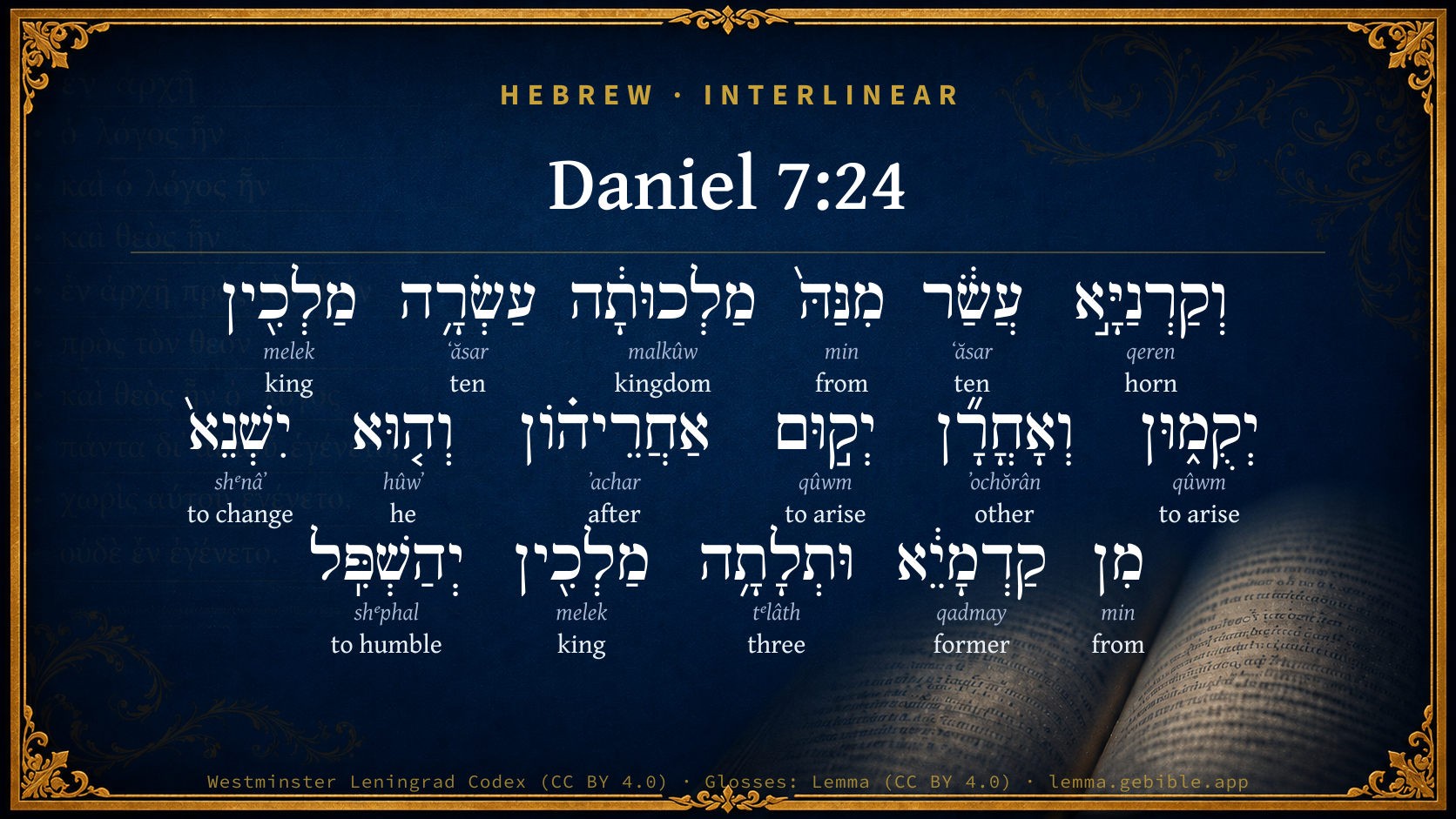
Daniel 7:24

Hebrew (Westminster Leningrad Codex) Daniel 7:24 appears in the Hebrew Old Testament. The text above is from the Westminster Leningrad Codex. Each word links to its Strong’s number, a concise gloss, and parsing drawn from the Open Scriptures Hebrew Bible morphology. Click any word for its full Brown-Driver-Briggs (BDB) entry.
Download image
Cite this verse

Daniel 7:24 (World English Bible). Public Domain. Lemma interlinear Bible study tool, https://lemma.gebible.app/v/daniel/7/24.

Show BibTeX & RIS
BibTeX
RIS
English Translation
As for the ten horns, out of this kingdom shall ten kings arise: and another shall arise after them; and he shall be diverse from the former, and he shall put down three kings.
World English Bible · Public Domain
Download a study sheet

One document with this verse’s original text, its word-by-word gloss line, the meaning frame, cross-references with their text, attributed commentary, and full source and license credits — printable, and it pastes into notes with its structure intact.

This verse Autodidact and up

Study sheet (.html) Plain text (.txt)

A passage Seminary Student

Up to 50 verses in one chapter. A passage sheet keeps up to 6 commentary sources and 12 cross-references per verse, in the order this page ranks them, and says so on the sheet whenever that leaves anything out. Ask for a single verse and you get the Autodidact verse sheet above.

Everything on this page stays free to read, with no account — the sheet is a download of what is already on screen, not access to it.

Want to remove ads? Support Godless Engineer
Compare translations 3

The same verse in 3 English versions, stacked beneath the original-language interlinear above. Click any original word for its lexicon entry.

Each is an independent rendering of the whole verse — the interlinear is not word-aligned to these translations.

Highlighted words mark where these versions differ — a whole-verse word diff, not a word-by-word alignment.

  • World English Bible Public Domain
    As for the ten horns, out of this kingdom shall ten kings arise: and another shall arise after them; and he shall be diverse from the former, and he shall put down three kings.
  • King James Version Public Domain
    And the ten horns out of this kingdom are ten kings that shall arise: and another shall rise after them; and he shall be diverse from the first, and he shall subdue three kings.
  • unfoldingWord Literal Text CC BY-SA 4.0
    As for the ten horns, out of this kingdom ten kings will arise, and another will arise after them. He will be different from the previous ones, and he will put down three kings.

unfoldingWord Literal Text — © unfoldingWord, licensed CC BY-SA 4.0. Word-aligned USFM3 via Door43 (git.door43.org/unfoldingWord/en_ult).

Versions to compare (up to 4)

3 of 4 selected

Show all 18 translations

Every available English version of this verse, each an independent rendering of the whole verse.

  • World English Bible Public Domain
    As for the ten horns, out of this kingdom shall ten kings arise: and another shall arise after them; and he shall be diverse from the former, and he shall put down three kings.
  • Berean Standard Bible Public Domain
    And the ten horns are ten kings who will rise from this kingdom. After them another king, different from the earlier ones, will rise and subdue three kings.
  • Majority Standard Bible Public Domain
    And the ten horns are ten kings who will rise from this kingdom. After them another king, different from the earlier ones, will rise and subdue three kings.
  • King James Version Public Domain
    And the ten horns out of this kingdom are ten kings that shall arise: and another shall rise after them; and he shall be diverse from the first, and he shall subdue three kings.
  • American Standard Version (1901) Public Domain
    And as for the ten horns, out of this kingdom shall ten kings arise: and another shall arise after them; and he shall be diverse from the former, and he shall put down three kings.
  • Revised Version (1885) Public Domain
    And as for the ten horns, out of this kingdom shall ten kings arise: and another shall arise after them; and he shall be diverse from the former, and he shall put down three kings.
  • Geneva Bible (1599) Public Domain
    And the ten hornes out of this kingdome are tenne Kings that shall rise: and an other shall rise after them, and he shall be vnlike to the first, and he shall subdue three Kings,
  • Douay-Rheims (1899) Public Domain
    And the ten horns of the same kingdom, shall be ten kings: and another shall rise up after them, and he shall be mightier than the former, and he shall bring down three kings.
  • Young's Literal Translation Public Domain
    And the ten horns out of the kingdom `are' ten kings, they rise, and another doth rise after them, and it is diverse from the former, and three kings it humbleth;
  • Literal Standard Version CC BY-SA 4.0
    And the ten horns out of the kingdom [are] ten kings, they rise, and another rises after them, and it is diverse from the former, and it humbles three kings;
  • Unlocked Literal Bible CC BY-SA 4.0
    As for the ten horns, out of this kingdom ten kings will arise, and another will arise after them. He will be different from the previous ones, and he will conquer the three kings.
  • unfoldingWord Literal Text CC BY-SA 4.0
    As for the ten horns, out of this kingdom ten kings will arise, and another will arise after them. He will be different from the previous ones, and he will put down three kings.
  • Darby Bible Public Domain
    And as to the ten horns, out of this kingdom shall arise ten kings; and another shall arise after them; and he shall be different from the former, and he shall subdue three kings.
  • World Messianic Bible Public Domain
    As for the ten horns, ten kings will arise out of this kingdom. Another will arise after them; and he will be different from the former, and he will put down three kings.
  • Webster's Bible Public Domain
    And the ten horns out of this kingdom are ten kings that shall arise: and another shall rise after them; and he shall be diverse from the first, and he shall subdue three kings.
  • Free Bible Version CC BY-SA 4.0
    The ten horns are ten kings that will come to power from this kingdom. The one who comes later is different from them, and will defeat three of them.
  • Bible in Basic English Public Domain
    And as for the ten horns, out of this kingdom ten kings will come to power; and after them another will come up: he will be different from the first ones and will put down three kings.
  • JPS Tanakh (1917) Public Domain
    And as for the ten horns, out of this kingdom shall ten kings arise; and another shall arise after them; and he shall be diverse from the former, and he shall put down three kings.

Literal Standard Version (2020), Covenant Press — licensed CC BY-SA 4.0. Text via the HelloAO Bible API (eBible.org). Unlocked Literal Bible (unfoldingWord) — licensed CC BY-SA 4.0. Text via the HelloAO Bible API (eBible.org). unfoldingWord Literal Text — © unfoldingWord, licensed CC BY-SA 4.0. Word-aligned USFM3 via Door43 (git.door43.org/unfoldingWord/en_ult). Free Bible Version, Dr. Jonathan Gallagher — licensed CC BY-SA 4.0. Text via the HelloAO Bible API (eBible.org).

Word by word

More ways to search: Search by grammar → Find every occurrence → Compare this word →

Practice this passage: Drill this verse → Learn its vocabulary →

אַחֲרֵיה֗וֹן
ʼachar
H311
“after · them”
Adjective, R + Suffix, Personal, 3rd Person, Masculine, Plural
Part of Speech
Adjective
Full BDB Definition

Origin: corresponding to H310

TWOT: 2568

after
  1. וְקַרְנַיָּ֣א qeren H7162 “and · horns · the” Adjective, C + Noun, Common, Feminine, Plural, Determined + Particle, Definite Article
  2. עֲשַׂ֔ר ʻăsar H6236 “ten” Adjective, A, Common
  3. מִנַּהּ֙ min H4481 “from · her” Adjective, R + Suffix, Personal, 3rd Person, Feminine, Singular
  4. מַלְכוּתָ֔ה malkûw H4437 “kingdom · the” Adjective, N, Common + Particle, Definite Article
  5. עַשְׂרָ֥ה ʻăsar H6236 “ten” Adjective, A, Common
  6. מַלְכִ֖ין melek H4430 “kings” Adjective, N, Common
  7. יְקֻמ֑וּן qûwm H6966 “to arise” Adjective, V
  8. וְאָחֳרָ֞ן ʼochŏrân H321 “and · other” Adjective, C + Adjective, Adjective, Masculine, Singular, Absolute
  9. יְק֣וּם qûwm H6966 “to arise” Adjective, V
  10. וְה֤וּא hûwʼ H1932 “and · he” Adjective, C + Pronoun, Personal, 3rd Person, Masculine, Singular
  11. יִשְׁנֵא֙ shᵉnâʼ H8133 “to change” Adjective, V
  12. מִן min H4481 “from” Adjective, R
  13. קַדְמָיֵ֔א qadmay H6933 “former · the” Adjective, A + Particle, Definite Article
  14. וּתְלָתָ֥ה tᵉlâth H8532 “and · three” Adjective, C + Adjective, Cardinal number, Both, Singular, Absolute
  15. מַלְכִ֖ין melek H4430 “kings” Adjective, N, Common
  16. יְהַשְׁפִּֽל shᵉphal H8214 “to humble” Adjective, V

About this verse

These counts appear in no published source. They are computed here, from the morphology-tagged text and Lemma’s own curated glosses. What Lemma adds →

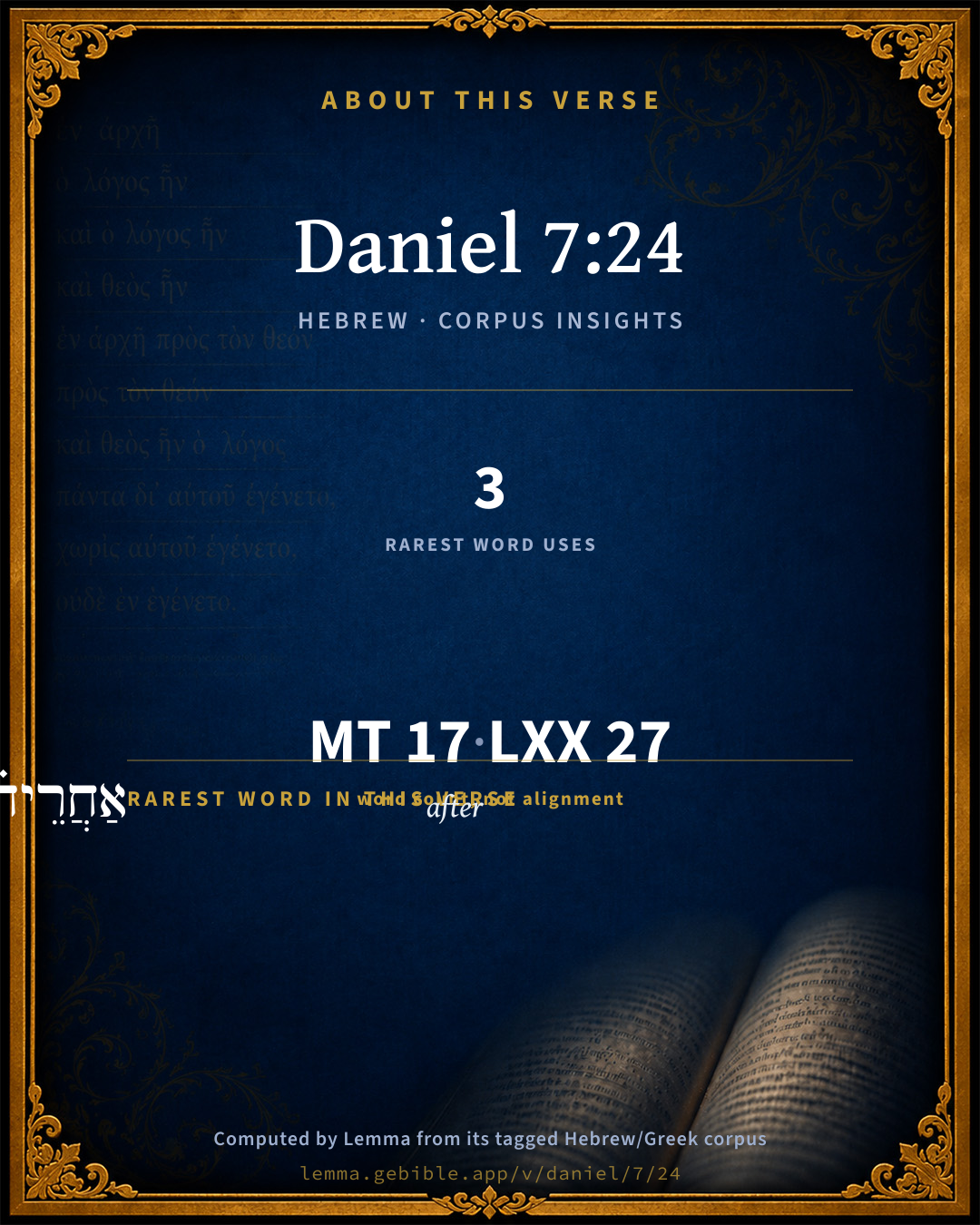
17
words
13
distinct lemmas
Prophets
section

Notable vocabulary

The rarest word here is אַחֲרֵיה֗וֹן after H311 — appearing just 3 times in the whole Hebrew Bible.

Shared distinctive vocabulary

אַחֲרֵיה֗וֹן after H311 occurs in 3 verses of the Hebrew Bible. Also found in:

Grammatical profile

  • 13 adjectives
  • 1 pronoun
  • 3 particles

Repetition

Words recur within this verse — often emphatic in Hebrew:

  • עֲשַׂ֔ר ten H6236 ×2
  • מַלְכִ֖ין king H4430 ×2
  • יְקֻמ֑וּן to arise H6966 ×2
  • מִנַּהּ֙ from H4481 ×2

Hebrew & Septuagint length

In English translation the verse runs 34 words from the Hebrew and 31 from the Septuagint (LXX English) — closely comparable.

A rough comparison of the two English renderings, which tokenize alike — not a word-level alignment.

Word counts can differ between the Hebrew and the Greek without any difference in meaning — e.g. the Hebrew direct-object marker אֵת has no separate Greek word, and Greek often adds the article ὁ.

In the original languages it is 17 Hebrew tokens and 27 Greek tokens — but the two are counted differently (Hebrew bundles its prefixes and suffixes into one token; the Greek is in lemma form), so that isn’t a like-for-like length.

Cross-references

11

Topical passages linked to Daniel 7:24 in the Treasury of Scripture Knowledge — connected by theme and wording, ordered by reader-vote popularity; previews shown in the World English Bible.

  • Daniel 7:20 and concerning the ten horns that were on its head, and the other [horn] which came up, and before which three fell, even that horn that had eyes, and a mouth that spoke great things, whose look was more stout than its fellows.
  • Daniel 11:36 The king shall do according to his will; and he shall exalt himself, and magnify himself above every god, and shall speak marvelous things against the God of gods; and he shall prosper until the indignation be accomplished; for that which is determined shall be done.
  • Revelation 13:1 Then I stood on the sand of the sea. I saw a beast coming up out of the sea, having ten horns and seven heads. On his horns were ten crowns, and on his heads, blasphemous names.
  • Daniel 8:9–12 Out of one of them came forth a little horn, which grew exceeding great, toward the south, and toward the east, and toward the glorious [land].
  • 2 Thessalonians 2:3–10 Let no one deceive you in any way. For it will not be, unless the departure comes first, and the man of sin is revealed, the son of destruction,
  • 1 Timothy 4:1–3 But the Spirit says expressly that in later times some will fall away from the faith, paying attention to seducing spirits and doctrines of demons,
  • Revelation 12:3 Another sign was seen in heaven. Behold, a great red dragon, having seven heads and ten horns, and on his heads seven crowns.
  • Revelation 17:3 He carried me away in the Spirit into a wilderness. I saw a woman sitting on a scarlet-colored animal, full of blasphemous names, having seven heads and ten horns.
  • Revelation 17:12–13 The ten horns that you saw are ten kings who have received no kingdom as yet, but they receive authority as kings, with the beast, for one hour.
  • Revelation 17:16–18 The ten horns which you saw, and the beast, these will hate the prostitute, and will make her desolate, and will make her naked, and will eat her flesh, and will burn her utterly with fire.
  • Daniel 7:7–8 After this I saw in the night-visions, and, behold, a fourth animal, awesome and powerful, and strong exceedingly; and it had great iron teeth; it devoured and broke in pieces, and stamped the residue with its feet: and it was diverse from all the animals that were before it; and it had ten horns.

Cross-references courtesy of OpenBible.info (CC BY 4.0).

Hebrew and Greek witnesses Masoretic Hebrew ↔ Greek Septuagint

The same verse in the two great witnesses to the Old Testament, shown verse-for-verse.

These are two independent witnesses, not word-aligned to each other, and the Septuagint is shown in lemma (dictionary) form.

Hebrew Daniel 7:24 Masoretic · Westminster Leningrad Codex

וְקַרְנַיָּ֣א עֲשַׂ֔ר מִנַּהּ֙ מַלְכוּתָ֔ה עַשְׂרָ֥ה מַלְכִ֖ין יְקֻמ֑וּן וְאָחֳרָ֞ן יְק֣וּם אַחֲרֵיה֗וֹן וְה֤וּא יִשְׁנֵא֙ מִן קַדְמָיֵ֔א וּתְלָתָ֥ה מַלְכִ֖ין יְהַשְׁפִּֽל

As for the ten horns, out of this kingdom shall ten kings arise: and another shall arise after them; and he shall be diverse from the former, and he shall put down three kings.

World English Bible · Public Domain

Greek LXX Daniel 7:24 Septuagint · lemma form

καί ὁ δέκα κέρας ὁ βασιλεία δέκα βασιλεύς ἵστημι καί ὁ ἄλλος βασιλεύς μετά οὗτος ἵστημι καί αὐτός διαφέρω κακός ὑπέρ ὁ πρῶτος καί τρεῖς βασιλεύς ταπεινόω

And his ten horns are ten kings that shall arise: and after them shall arise another, who shall exceed all the former ones in wickedness and he shall subdue three kings.

LXX2012 (modern English Septuagint) · Public Domain

On this verse, John Gill's Exposition discusses the Septuagint’s reading. Read the note in Commentary ↓

Hebrew: Westminster Leningrad Codex (CC BY 4.0). Greek: Septuagint (public domain); English from LXX2012 (modern English Septuagint) (Public Domain). How the Septuagint differs from the Hebrew →

Commentary

Notes on Daniel 7:24 from classic Christian and Jewish commentators (each source and its license shown beneath its notes). The classic Christian expositions comment on the surrounding passage and are grouped to its opening verse, so a note may address several verses; the Jewish commentaries on the Tanakh (Rashi and others) are per-verse, so they appear only where the commentator wrote on this verse.

Lemma curates 59 commentaries, every one of them public domain or Creative Commons licensed, each selected and text-cleaned for this edition rather than reprinted as found. About our sources →

Trapp's Complete Commentary

John Trapp

Dan 7:24 And the ten horns out of this kingdom [are] ten kings [that] shall arise: and another shall rise after them; and he shall be diverse from the first, and he shall subdue three kings.

Ver. 24. And the ten horns out of this kingdom.] He saith not kingdoms: this maketh against those that make the Seleucidae and Legidae, the fourth monarchy.

And he shall be diverse from the first.] For the first were secular kings, but he styleth himself chief bishop and head of the Church, having both Peter’s keys and Paul’s sword, &c.

And he shall subdue three kings.] See on Dan 7:8.

John Trapp, A Commentary or Exposition upon All the Books of the Old and New Testament (1647–1656) — public domain. Text from a community e-Sword module.

Tyndale Open Study Notes

Tyndale Open Resources

7:24-25 Its ten horns are ten kings: This number might refer to ten specific individuals, or it might be a symbolic number meaning that this kingdom lasted through the reigns of many kings (cp. Rev 13:1). • Then another king, who corresponds to the “little horn” (Dan 7:21), will defy the Most High and oppress the holy people by blaspheming the Lord, trying to interfere with worship of the Lord, trying to make the holy people follow his religion, and subjecting them to constant threats. • a time, times, and half a time: The text is not explicit as to the length of time. Nonetheless, the period of oppression for the holy people would be limited and would end suddenly and unexpectedly.

Tyndale Open Study Notes — © Tyndale Open Resources, licensed CC BY-SA 4.0. Text via the HelloAO Bible API.

Geneva Bible (1599)

Geneva Bible translators

Read the exposition hereof, verse 8.

Geneva Bible (1599) marginal notes — public domain. Text via Bolls.life.

Jamieson, Fausset & Brown

Robert Jamieson, A. R. Fausset & David Brown

ten horns--answering to the ten "toes" (Dan 2:41).

out of this kingdom--It is out of the fourth kingdom that ten others arise, whatever exterior territory any of them possess (Rev 13:1; Rev 17:12).

rise after them--yet contemporaneous with them; the ten are contemporaries. Antichrist rises after their rise, at first "little" (Dan 7:8); but after destroying three of the ten, he becomes greater than them all (Dan 7:20-21). The three being gone, he is the eighth (compare Rev 17:11); a distinct head, and yet "of the seven." As the previous world kingdoms had their representative heads (Babylon, Nebuchadnezzar; Persia, Cyrus; Greece, Alexander), so the fourth kingdom and its Antichrists shall have their evil concentrated in the one final Antichrist. As Antiochus Epiphanes, the Antichrist of the third kingdom in Dan 8:23-25, was the personal enemy of God, so the final Antichrist of the fourth kingdom, his antitype. The Church has endured a pagan and a papal persecution; there remains for her an infidel persecution, general, purifying, and cementing [CECIL]. He will not merely, as Popery, substitute himself for Christ in Christ's name, but "deny the Father and the Son" (Jo1 2:22). The persecution is to continue up to Christ's second coming (Dan 7:21-22); the horn of blasphemy cannot therefore be past; for now there is almost a general cessation of persecution.

Jamieson, Fausset & Brown — Commentary Critical and Explanatory on the Whole Bible (1871) — public domain (CC PDM 1.0). Text via the HelloAO Bible API.

John Calvin's Commentaries

He afterwards adds, The ten horns are the ten kings which should arise These Ten Kings are clearly comprehended under one empire, and there is no question here of separate persons. In the Persian kingdom, we observed many kings, and yet the image of the second beast was single, while it embraced all those kings until the change occurred. So also no when treating of the Romans, the Prophet does not assert that ten kings should succeed each other in regular order, but rather the multiform nature of the kingdom, under more heads than one. For the royal office belonged to the senators or leading citizens, whose authority prevailed very extensively both with the senate and the people. And with reference to the number, we said the plural number only was denoted, without any limitation to the number ten. The conclusion is as follows, — this kingdom should be like a single terrible animal bearing many horns, since no single king held the chief sway there, as was customary by constant usage in other lands, but there should be a mixture, like many kings in place of one holding the pre-eminence. The fulfillment of this is sufficiently known from the history of Rome; as if it had been said, there should not be any single kingdom, as of Persia and other nations, but many kings at the same time, alluding to the mixture and confusion in which the supreme authority was involved.

The Little Horn follows: A king shall arise, says he, different from those, other ones, and shall afflict three kings We showed how unintelligible this becomes, unless we refer it to the Caesars to whom the monarchy passed; for after long and continued and intensive strife, the whole power passed over to the Triumvirate. A conspiracy was entered into by Lepidus, Mark Antony, and Octavius. Octavius was then all but a boy, having scarcely arrived at manhood, but all the veteran soldiers were in his favor, in consequence of the name of Julius Caesar and his adoption by him. Hence he was received by the other two into that alliance, of which Lepidus was the first, and Antony the second. At length discords arose among them, and Lepidus was deprived of his place in the triumvirate, and lived, as if half-dead, while his life was only spared to him because he was raised to the office of chief priest

Reverence for the priesthood restrained Antony from putting him to death, so long as he was content to live in privacy and retirement. Octavius at, length became supreme, but by what artifice? We said Julius Caesar took no more upon himself than the office of dictator, while consuls were annually elected as usual. He did not strain the power of the dictatorship beyond moderation, but he so restrained himself, that some popular rights might seem still to flourish. Octavius also followed the cunning of his uncle and adopted father. The same conduct will be found in the other Caesars, though there were many differences between them. As the shadow of a republic yet remained, while the senate was held in some degree of reverence, it is not surprising, if the angel predicts that the beast should survive, when another small horn should arise different from the others

He adds, And shall afflict the three kings I have explained this point by the slight change which the Caesars effected in the provinces, for if any of the provinces were warlike, strong armies and veteran soldiers were usually sent there. The Caesars took these to themselves, while some executive management was left to the senate with regard to the other provinces. Lastly, by this form of speech, the angel portrays the coming dominion of the little horn, and its diminishing the strength of the former ones’ and yet the beast should remain apparently entire; thus, the effigy of the republic was preserved, as the people were always designated — in the forum, by the high-sounding name, Romans, and in battle, as fellow-soldiers. Meanwhile, although the name of the Roman empire was so celebrated, and its majesty was in every one’s mouth, the supreme authority was in the possession of one little horn which lay concealed, and dared not openly raise its head. This, then, is the pith of the interpretation of what the angel here sets before us. It; follows, —

John Calvin's Commentaries (1540-1563) — public domain. Text from the Calvin Translation Society English edition (1840s-50s) via the Christian Classics Ethereal Library (ccel.org). Calvin's coverage is partial (roughly two-thirds of the Bible); uncommented books and verses are honest gaps, never fabricated. The 19th-century editor's footnotes and remarks are omitted so the notes are faithfully Calvin's own voice.

The Cambridge Bible for Schools and Colleges

gen. ed. J. J. S. Perowne

24. The ten horns are ten kings.

and he (emph.) shall be diverse from the former ones] The king represented by the ‘little horn’ will differ from the others, viz. by being aggressive and presumptuous.

and he shall subdue three kings] put down (R.V.), as the same word is rendered in the A.V. of Dan_5:19 and Psa_75:7. Abase, bring down, lay low, is the idea of the word (Isa_2:12; Isa_25:11-12; Isa_26:5). Cf. Dan_7:8. On the interpretation, see the Additional Note at the end of the Chapter.

The Cambridge Bible for Schools and Colleges (gen. ed. J. J. S. Perowne; Cambridge University Press, 1878–1918) — public domain. Text from a community e-Sword module.

John Gill's Exposition

And the ten horns out of this kingdom are ten kings that shall arise,..... Or ten kingdoms which sprung out of the Roman empire, or into which it was broken and divided upon the dissolution of it, about A.D. 476; which, according to Mr. Mede (k), were thus divided, A.D. 456,

1. Britons; 2. Saxons; 3. Franks; 4. Burgundians; 5 Visigoths; 6. Suevians and Alanes; 7. Vandals; 8. Almanes; 9. Ostrogoths; 10. Greeks.

The list Bishop Lloyd (l) has given of them is,

1. Hunns, who erected their kingdom in that part of Pannonia and Dacia, which was from them called Hungary, about A.D. 356. 2. Ostrogoths, who settled themselves in the countries that reach from Rhetia to Maesia, even to Thrace, about 377; and afterwards came into Italy under Alaricus, in 410. 3. Visigoths, who settled in the south parts of France, and in Catalonia, about 378. 4. Franks, who seized upon part of Germany and Gaul, A.D. 410. 5. Vandals, who settled in Spain; afterwards set up their kingdom in Africa, A.D. 407; their king Gensericus sacked Rome, 455. 6. Suevians and Alans, who seized the western parts of Spain, A.D. 407; and invaded Italy, 457. 7. Burgundians, who came out of Germany, into that part of Gaul called from them Burgundy, 407. 8. Herules, Rugians, and Thoringians, who settled in Italy under Odoacer, about A.D. 476. 9. Saxons, who made themselves masters of Great Britain about the same time, 476. 10. Longobards, called likewise Gopidae, who settled in Germany, about Magdeburg, A.D. 383; and afterwards succeeded the Heruli and Thuringi in Hungary, about the year 826.

Sir Isaac Newton (m) reckons the ten kingdoms in the following order:

1. the kingdom of the Vandals and Alans in Spain and Africa; 2. of the Suevians in Spain; 3. of the Visigoths; 4. of the Alans in Gallia; 5. of the Burgundians; 6. of the Franks; 7. of the Britons; 8. of the Hunns; 9. of the Lombards; 10. of Ravenna;

who gives an account of the various kings of these kingdoms; and these, as the same learned writer says (n), whatever was their number afterwards, they are still called the ten kings from their first number; and though they have not always been in the same form and order, yet they have been generally about, if not exactly, the same number; as they are now near the same; and may be thus reckoned, as the kingdoms of France, Spain, Portugal, Germany, Great Britain, Sardinia, Denmark, the two Sicilies, Swedeland, Prussia, and Poland; of which see more See Gill on Rev 17:12.

And another shall rise after thee: not Titus Vespeasian, as Jarchi and Saadiah; nor the nation of Gog and Magog, as Jacchiades: but the pope of Rome, or antichrist; who came to his power as universal bishop, and as a horn or temporal prince, after the above kingdoms arose; not after they were at an end, but after they were constituted and established, as it was proper they should first be; since they were to give their strength, power, and kingdom, to the antichristian beast, by which it became a horn or temporal prince, Rev 17:13. The Septuagint render it, "behind them"; which Mr. Mede (o) interprets of his springing up unawares, imperceptibly, unnoticed, and unobserved by them, till he overtopped them.

And he shall be diverse from the first; from the first ten horns, kings or kingdoms; having, besides a secular power and temporal authority, an ecclesiastical and spiritual one; a power not only over the bodies and estates of men, but over their souls and consciences; and even over the other horns and kingdoms, which they had not over one another; and so was different from them all:

and he shall subdue three kings; designed by the three horns plucked up by the roots, and which fell before him; of which See Gill on Dan 7:8.

(k) Works, B. 3. c. 14. p. 661. (l) Apud Lowth in loc. (m) Observations on Daniel, c. 6. p. 47. (n) Ibid. p. 73. (o) Works, B. 4. ep. 24. p. 778.

John Gill's Exposition of the Whole Bible (1746–1763) — public domain (CC PDM 1.0). Text via the HelloAO Bible API.

Haydock's Catholic Bible Commentary

CHAPTER VII.

Mightier. Chaldee again, "unlike." Antiochus the great had lost many provinces: but his son was the most implacable enemy of God’s people. He subdued them, Egypt and Armenia; or his three competitors. (verse 8.)

George Leo Haydock (1774–1849), Haydock's Catholic Family Bible and Commentary, 1859 edition — public domain. Excludes Psalms (Douay-Rheims chapter numbering differs from Protestant) and Deuterocanonical books (Catholic canon only).

Matthew Poole's English Annotations

Ten kings; which Junius, Piscator, Polanus make to be the kings of Syria, and reckon ten of them, and that is not all neither; the tenth is Antiochus, but this cannot be, for he died one hundred and sixty years before Christ.

Others interpret the other

that riseth after the ten, and that shall subdue three, to be Mahomet; but Maldonate himself saith it agrees better to antichrist, and the 25th verse too, where he speaks of

changing times and laws, which

God hath set; none of which things he could do, but that God gives him commission for it, till God’s set time be fulfilled, which is three years and a half, i.e. one thousand two hundred and sixty years; or forty-two months, which is all the time of the witnesses prophesying in sackcloth, of the church’s being in the wilderness, and of antichrist’s reign, Rev 11:3; 12:6; 13:5,6, &c.: mind these places and compare this of Daniel with them, and Dan 7:26,27, how he shall be judged and executed. The sixth and seventh vials will decide, and illustrate all this.

Matthew Poole's English Annotations on the Holy Bible (1683–1685) — public domain. Text from a community e-Sword/MySword module.

Whedon's Commentary on the Bible

Daniel D. Whedon

24. The fourth kingdom is here represented as a beast whose “ten horns” are ten kings. There has been great diversity of opinion as to the particular kings meant. As the number is a round symbolical number it does not matter if the kings preceding Antiochus Epiphanes (the “little horn”) actually numbered a few less or a few more than ten. Professor Cowles, however, has pointed out that Daniel himself in chap. 11 (which is explanatory of the visions of chaps. 7 and 8) has referred particularly to just ten prominent kings ruling between the death of Alexander and the rise of the little horn — five of these being Ptolemies, namely, Lagus, Philadelphus, Euergetes, Philopator, Philometer (Dan_11:5-27); five of them being Syrian kings: Seleucus Nicator, Antiochus Theos, Seleucus Callinicus, Antiochus the Great, and Seleucus Philopator (Dan_11:5-20). Meinhold, on the other hand, believes Demetrius, Heliodorus, and Ptolemy Philometer to represent the three horns overthrown by Antiochus Epiphanes, the other seven horns symbolizing Seleucus I, II, III, IV, and Antiochus I, II, III. The question is unimportant, as there is practical unanimity of opinion among modern scholars that the little horn here (like that of Dan_8:9-12) is Antiochus Epiphanes. The argument that Antiochus Epiphanes could not be the eleventh horn because he was not the eleventh, but the eighth successive king on the Syrian throne (Godet, Studies, 1882; Kohler, Lehrbuch, pp. 539, 540), is not strong when we consider the symbolism of number (see Introduction to Ezekiel, VIII), and the fact that it is not stated whether these horns were successive or in part contemporaneous.* Certainly the “antichrist” of a later era had Antiochan characteristics, just as Gog and Magog had Scythian characteristics (Ezekiel 38, 39; Rev_20:8), but this does not exclude the reference to an earlier or later historic character. The older scholars, who thought Daniel’s fourth kingdom was Roman, interpreted these ten kings as ten kingdoms, but differed very materially in their guesses as to which kingdoms were meant. It seems to us conclusive that the fourth empire was not Roman. (See notes Dan_2:39-40.) All agree that Antiochus was the “vile person” who is spoken of as rising up after the ten successors of Alexander mentioned Dan_11:3-21. The analogy of prophecy is in favor of the same reference to him here.

[*Three of the kings (horns) are not said to have been destroyed before Antiochus took the throne, but to have been afterward “subdued” by him. “Now the facts are that Antiochus usurped the throne upon the assassination of his elder brother, Seleucus Philopator; he superseded the rightful heir, Demetrius — who was at that time a hostage in Rome — and he humbled by sore defeat his nephew, Ptolemy Philometer, who had as good a right to the throne of Asia as himself (compare 1Ma_11:13).… Some reckon Heliodorus among the three who fell before Antiochus, for Appian testifies that he had seized the government by force. This view is open to no valid objection, for we should no more insist on a rigid interpretation of the number three than of the number ten.” — Terry.]

Daniel D. Whedon (gen. ed.), Commentary on the Old and New Testaments (1874–1909) — public domain. Text from a community e-Sword module.

Rashi

Rabbi Shlomo Yitzchaki (Rashi)

And the ten horns And its ten horns that you saw—this is its interpretation.

from that kingdom [as translated,] from that kingdom.

and the last one will rise after them and the last one will rise after them—that is Titus.

Rashi on the Tanakh — English translations: “The Judaica Press complete Tanach with Rashi, translated by A. J. Rosenberg” (CC BY 4.0); “Pentateuch with Rashi's commentary by M. Rosenbaum and A.M. Silbermann, 1929-1934” (public domain); “The Metsudah Tanach series, Lakewood, N.J” (CC BY 4.0); and “The Book of Joshua, Metsudah Publications, 1997” (CC BY 4.0). Text via Sefaria.

Lesson kit

Teaching starters — assembled from the data on this page, not authored interpretation. Every prompt links to the verse data it draws on. Edit before teaching.

Daniel, in the Prophets, opens this verse with 17 words (13 distinct Hebrew lemmas). Its most distinctive word is ʼachar (“after”). A historical commentator’s framing appears above. Read the whole chapter for the surrounding context.

Discussion questions

  1. The word ʼachar carries the sense “after.” How does it shape the verse?
  2. Daniel 2:29 shares the word «after» with this verse. How do the two illuminate each other?
  3. “ten” occurs 2× in this one verse. What is the effect of the repetition?
  4. The translations on this page render this verse differently — a whole-verse word diff, not a word-by-word alignment. What might account for the different wordings?
  5. Reading how Trapp's Complete Commentary and Tyndale Open Study Notes read this verse, where do the two commentators agree and where do they part?

Things to notice

Reading settings

Reading text

Shown beneath each verse's original-language words.

Old Testament
Old Testament edition

Read the OT as the Masoretic Hebrew (MT) or the Greek Septuagint (LXX).

English shown for the Greek Septuagint (in the Hebrew ↔ Greek comparison).

Comparing translations? Open the Compare panel on any verse page to stack up to four side by side.