
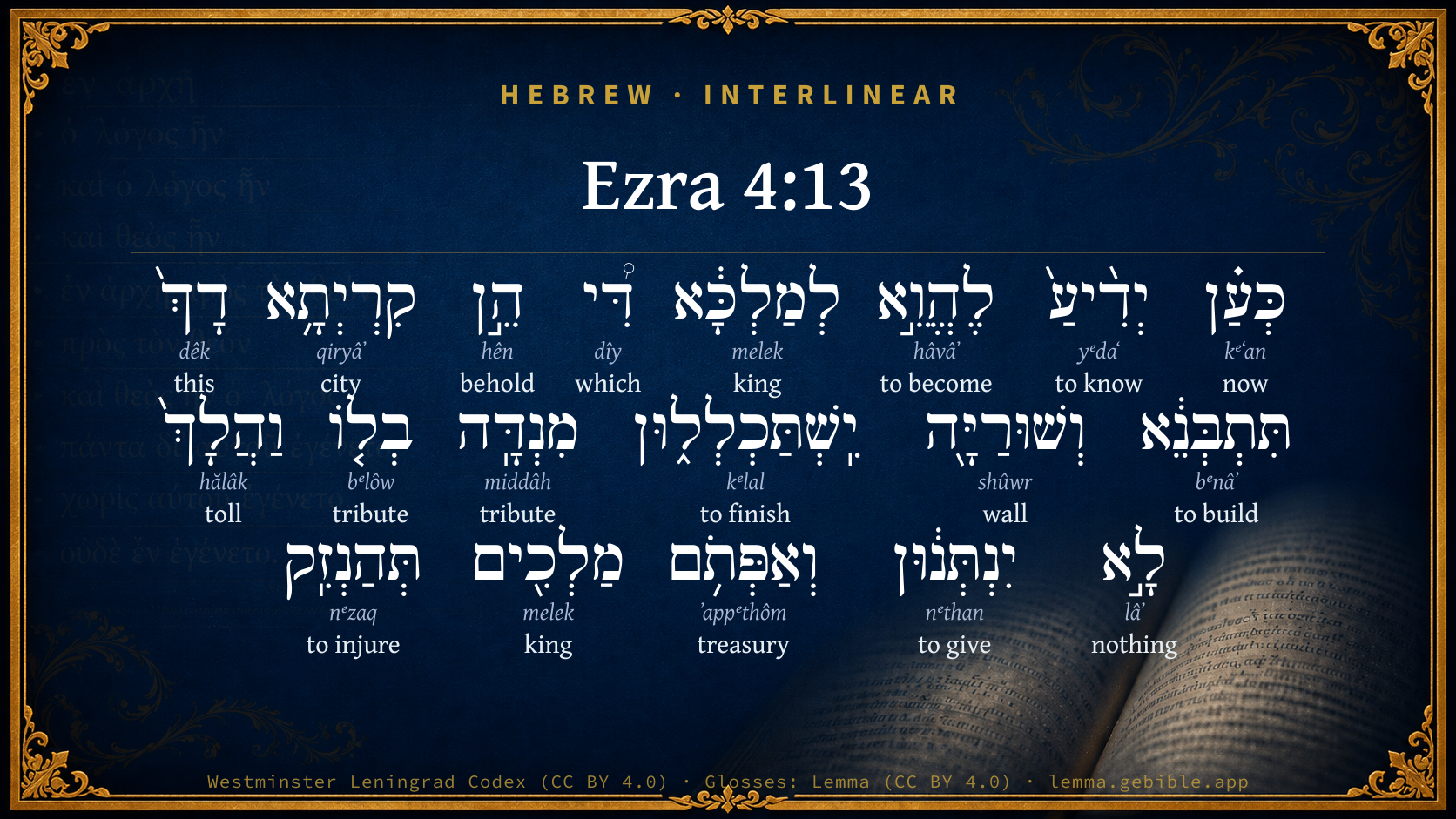
Ezra 4:13

Hebrew (Westminster Leningrad Codex) Ezra 4:13 appears in the Hebrew Old Testament. The text above is from the Westminster Leningrad Codex. Each word links to its Strong’s number, a concise gloss, and parsing drawn from the Open Scriptures Hebrew Bible morphology. Click any word for its full Brown-Driver-Briggs (BDB) entry.
Download image
Cite this verse

Ezra 4:13 (World English Bible). Public Domain. Lemma interlinear Bible study tool, https://lemma.gebible.app/v/ezra/4/13.

Show BibTeX & RIS
BibTeX
RIS
English Translation
Be it known now to the king that if this city is built, and the walls finished, they will not pay tribute, custom, or toll, and in the end it will be hurtful to the kings.
World English Bible · Public Domain
Highlights
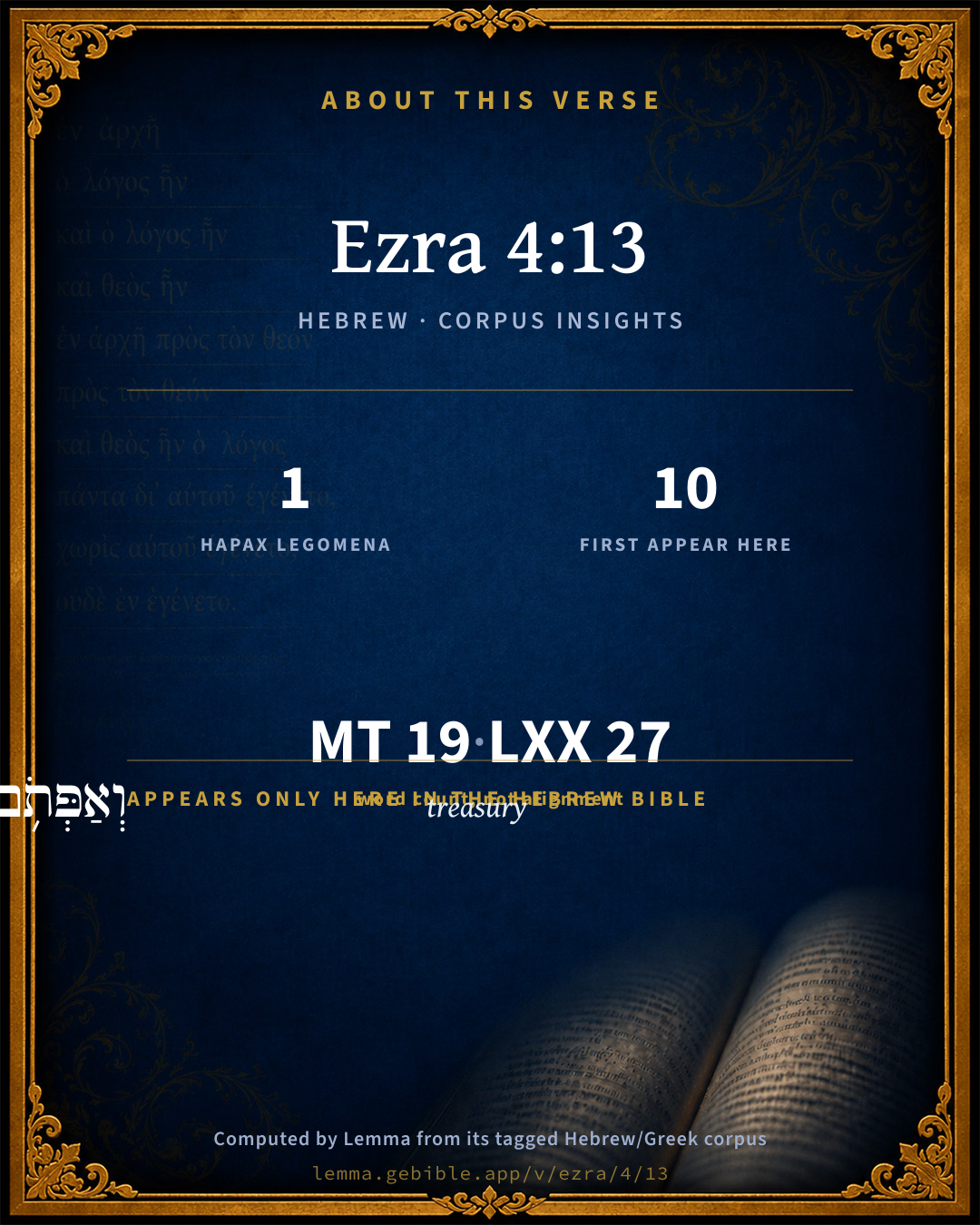
  • 1 hapax legomenon — only here in the Hebrew Bible
  • 10 first appearances in the Hebrew Bible
Full analysis ↓
Download a study sheet

One document with this verse’s original text, its word-by-word gloss line, the meaning frame, cross-references with their text, attributed commentary, and full source and license credits — printable, and it pastes into notes with its structure intact.

This verse Autodidact and up

Study sheet (.html) Plain text (.txt)

A passage Seminary Student

Up to 50 verses in one chapter. A passage sheet keeps up to 6 commentary sources and 12 cross-references per verse, in the order this page ranks them, and says so on the sheet whenever that leaves anything out. Ask for a single verse and you get the Autodidact verse sheet above.

Everything on this page stays free to read, with no account — the sheet is a download of what is already on screen, not access to it.

Want to remove ads? Support Godless Engineer
Compare translations 3

The same verse in 3 English versions, stacked beneath the original-language interlinear above. Click any original word for its lexicon entry.

Each is an independent rendering of the whole verse — the interlinear is not word-aligned to these translations.

Highlighted words mark where these versions differ — a whole-verse word diff, not a word-by-word alignment.

  • World English Bible Public Domain
    Be it known now to the king that if this city is built, and the walls finished, they will not pay tribute, custom, or toll, and in the end it will be hurtful to the kings.
  • King James Version Public Domain
    Be it known now unto the king, that, if this city be builded, and the walls set up again, then will they not pay toll, tribute, and custom, and so thou shalt endamage the revenue of the kings.
  • unfoldingWord Literal Text CC BY-SA 4.0
    Now let it be known to the king that if that city is built and the walls are completed, they will not give tax, tribute, or custom, and the revenue of the kings will suffer harm.

unfoldingWord Literal Text — © unfoldingWord, licensed CC BY-SA 4.0. Word-aligned USFM3 via Door43 (git.door43.org/unfoldingWord/en_ult).

Versions to compare (up to 4)

3 of 4 selected

Show all 18 translations

Every available English version of this verse, each an independent rendering of the whole verse.

  • World English Bible Public Domain
    Be it known now to the king that if this city is built, and the walls finished, they will not pay tribute, custom, or toll, and in the end it will be hurtful to the kings.
  • Berean Standard Bible Public Domain
    Let it now be known to the king that if that city is rebuilt and its walls are restored, they will not pay tribute, duty, or toll, and the royal treasury will suffer.
  • Majority Standard Bible Public Domain
    Let it now be known to the king that if that city is rebuilt and its walls are restored, they will not pay tribute, duty, or toll, and the royal treasury will suffer.
  • King James Version Public Domain
    Be it known now unto the king, that, if this city be builded, and the walls set up again, then will they not pay toll, tribute, and custom, and so thou shalt endamage the revenue of the kings.
  • American Standard Version (1901) Public Domain
    Be it known now unto the king, that, if this city be builded, and the walls finished, they will not pay tribute, custom, or toll, and in the end it will be hurtful unto the kings.
  • Revised Version (1885) Public Domain
    Be it known now unto the king, that, if this city be builded, and the walls finished, they will not pay tribute, custom, or toll, and in the end it will endamage the kings.
  • Geneva Bible (1599) Public Domain
    Be it knowen nowe vnto the King, that if this citie be built, and the foundations of the walles layed, they will not giue tolle, tribute, nor custome: so shalt thou hinder the Kings tribute.
  • Douay-Rheims (1899) Public Domain
    And now be it known to the king, that if this city be built up, and the walls thereof repaired, they will not pay tribute nor toll, nor yearly revenues, and this loss will fail upon the kings.
  • Young's Literal Translation Public Domain
    `Now, be it known to the king, that if this city be builded, and the walls finished, toll, tribute, and custom they do not give; and at length `to' the kings it doth cause loss.
  • Literal Standard Version CC BY-SA 4.0
    Now let it be known to the king, that if this city is built and the walls finished, that they do not give toll, tribute, and custom; and at length it causes loss [to] the kings.
  • Unlocked Literal Bible CC BY-SA 4.0
    Now let the king know that if this city is built and the wall is completed, they will not give any tribute and taxes, but they will harm the kings.
  • unfoldingWord Literal Text CC BY-SA 4.0
    Now let it be known to the king that if that city is built and the walls are completed, they will not give tax, tribute, or custom, and the revenue of the kings will suffer harm.
  • Darby Bible Public Domain
    Be it known therefore unto the king, that, if this city be built and the walls be completed, they will not pay tribute, tax, and toll, and in the end it will bring damage to the kings.
  • World Messianic Bible Public Domain
    Be it known now to the king that if this city is built and the walls finished, they will not pay tribute, custom, or toll, and in the end it will be hurtful to the kings.
  • Webster's Bible Public Domain
    Be it known now to the king, that, if this city shall be built, and the walls set up again, then they will not pay toll, tribute, and custom, and so thou wilt endamage the revenue of the kings.
  • Free Bible Version CC BY-SA 4.0
    Your Majesty should realize that if this city is rebuilt and its walls repaired, they will not pay tax, tribute, or fees, and the king's revenue will suffer.
  • Bible in Basic English Public Domain
    The king may be certain that when the building of this town and its walls is complete, they will give no tax or payment in goods or forced payments, and in the end it will be a cause of loss to the kings.
  • JPS Tanakh (1917) Public Domain
    Be it known now unto the king, that, if this city be builded, and the walls finished, they will not pay tribute, impost, or toll, and so thou wilt endamage the revenue of the kings.

Literal Standard Version (2020), Covenant Press — licensed CC BY-SA 4.0. Text via the HelloAO Bible API (eBible.org). Unlocked Literal Bible (unfoldingWord) — licensed CC BY-SA 4.0. Text via the HelloAO Bible API (eBible.org). unfoldingWord Literal Text — © unfoldingWord, licensed CC BY-SA 4.0. Word-aligned USFM3 via Door43 (git.door43.org/unfoldingWord/en_ult). Free Bible Version, Dr. Jonathan Gallagher — licensed CC BY-SA 4.0. Text via the HelloAO Bible API (eBible.org).

Word by word

More ways to search: Search by grammar → Find every occurrence → Compare this word →

Practice this passage: Drill this verse → Learn its vocabulary →

וְאַפְּתֹ֥ם
ʼappᵉthôm
H674
“and · treasury”
Adjective, C + Noun, Common, Masculine, Singular, Absolute
Part of Speech
Adjective + Noun
Type
Common
Gender
Masculine
Number
Singular
State
Absolute
Full BDB Definition

Origin: of Persian origin

TWOT: 2601

treasury, treasuries - (CLBL) revenue
  1. כְּעַ֗ן kᵉʻan H3705 “now” Adjective, D
  2. יְדִ֨יעַ֙ yᵉdaʻ H3046 “known” Adjective, V, Singular
  3. לֶהֱוֵ֣א hâvâʼ H1934 “to become” Adjective, V
  4. לְמַלְכָּ֔א melek H4430 “to/for · king · the” Adjective, R + Noun, Common, Masculine, Singular, Determined + Particle, Definite Article
  5. דִּ֠י dîy H1768 “which” Adjective, T
  6. הֵ֣ן hên H2006 “behold” Adjective, C
  7. קִרְיְתָ֥א qiryâʼ H7149 “city · the” Adjective, N, Common + Particle, Definite Article
  8. דָךְ֙ dêk H1791 “this” Adjective, P
  9. תִּתְבְּנֵ֔א bᵉnâʼ H1124 “to build” Adjective, V
  10. וְשׁוּרַיָּ֖ה shûwr H7792 “and · walls · the” Adjective, C + Noun, Common, Masculine, Plural, Determined + Particle, Definite Article
  11. יִֽשְׁתַּכְלְל֑וּן kᵉlal H3635 “to finish” Adjective, V
  12. מִנְדָּֽה middâh H4061 “tribute” Adjective, N, Common
  13. בְל֤וֹ bᵉlôw H1093 “tribute” Adjective, N, Common
  14. וַהֲלָךְ֙ hălâk H1983 “and · toll” Adjective, C + Noun, Common, Masculine, Singular, Absolute
  15. לָ֣א lâʼ H3809 “nothing” Adjective, T
  16. יִנְתְּנ֔וּן nᵉthan H5415 “to give” Adjective, V
  17. מַלְכִ֖ים melek H4430 “kings” Adjective, N, Common
  18. תְּהַנְזִֽק nᵉzaq H5142 “to injure” Adjective, V

About this verse

These counts appear in no published source. They are computed here, from the morphology-tagged text and Lemma’s own curated glosses. What Lemma adds →

19
words
18
distinct lemmas
Historical
section

Notable vocabulary

1 hapax legomenon — a word that appears only here in the entire Hebrew Bible:

  • וְאַפְּתֹ֥ם treasury H674

First appearance in Scripture

These words make their first canonical appearance in the Hebrew Bible here (10 in total — showing 8):

  • כְּעַ֗ן now H3705
  • הֵ֣ן behold H2006
  • דָךְ֙ this H1791
  • מִנְדָּֽה tribute H4061
  • בְל֤וֹ tribute H1093
  • וַהֲלָךְ֙ toll H1983
  • לָ֣א nothing H3809
  • יִנְתְּנ֔וּן to give H5415

Shared distinctive vocabulary

בְל֤וֹ tribute H1093 occurs in 3 verses of the Hebrew Bible. Also found in:

Grammatical profile

  • 2 nouns
  • 14 adjectives
  • 3 particles

Repetition

A word recurs within this verse — often emphatic in Hebrew:

  • לְמַלְכָּ֔א king H4430 ×2

Hebrew & Septuagint length

In English translation the verse runs 36 words from the Hebrew and 33 from the Septuagint (LXX English) — closely comparable.

A rough comparison of the two English renderings, which tokenize alike — not a word-level alignment.

Word counts can differ between the Hebrew and the Greek without any difference in meaning — e.g. the Hebrew direct-object marker אֵת has no separate Greek word, and Greek often adds the article ὁ.

In the original languages it is 19 Hebrew tokens and 27 Greek tokens — but the two are counted differently (Hebrew bundles its prefixes and suffixes into one token; the Greek is in lemma form), so that isn’t a like-for-like length.

Cross-references

8

Topical passages linked to Ezra 4:13 in the Treasury of Scripture Knowledge — connected by theme and wording, ordered by reader-vote popularity; previews shown in the World English Bible.

  • Ezra 7:24 Also we inform you, that touching any of the priests and Levites, the singers, porters, Nethinim, or servants of this house of God, it shall not be lawful to impose tribute, custom, or toll, on them.
  • Nehemiah 5:4 There were also that said, We have borrowed money for the king's tribute [on] our fields and our vineyards.
  • Romans 13:6–7 For this reason you also pay taxes, for they are ministers of God's service, attending continually on this very thing.
  • Ezra 4:20 There have been mighty kings also over Jerusalem, who have ruled over all [the country] beyond the River; and tribute, custom, and toll, was paid to them.
  • Psalms 52:2 Your tongue plots destruction, Like a sharp razor, working deceitfully.
  • Psalms 119:69 The proud have smeared a lie upon me. With my whole heart, I will keep your precepts.
  • Matthew 9:9 As Jesus passed by from there, he saw a man called Matthew sitting at the tax collection office. He said to him, "Follow me." He got up and followed him.
  • Matthew 17:25 He said, "Yes." When he came into the house, Jesus anticipated him, saying, "What do you think, Simon? From whom do the kings of the earth receive toll or tribute? From their children, or from strangers?"

Cross-references courtesy of OpenBible.info (CC BY 4.0).

Hebrew and Greek witnesses Masoretic Hebrew ↔ Greek Septuagint

The same verse in the two great witnesses to the Old Testament, shown verse-for-verse.

These are two independent witnesses, not word-aligned to each other, and the Septuagint is shown in lemma (dictionary) form.

Hebrew Ezra 4:13 Masoretic · Westminster Leningrad Codex

כְּעַ֗ן יְדִ֨יעַ֙ לֶהֱוֵ֣א לְמַלְכָּ֔א דִּ֠י הֵ֣ן קִרְיְתָ֥א דָךְ֙ תִּתְבְּנֵ֔א וְשׁוּרַיָּ֖ה יִֽשְׁתַּכְלְל֑וּן מִנְדָּֽה בְל֤וֹ וַהֲלָךְ֙ לָ֣א יִנְתְּנ֔וּן וְאַפְּתֹ֥ם מַלְכִ֖ים תְּהַנְזִֽק

Be it known now to the king that if this city is built, and the walls finished, they will not pay tribute, custom, or toll, and in the end it will be hurtful to the kings.

World English Bible · Public Domain

Greek LXX Ezra 4:13 Septuagint · lemma form

νῦν οὖν γνωστός εἰμί ὁ βασιλεύς ὅτι ἐάν ὁ πόλις ἐκεῖνος ἀναοἰκοδομέω καί ὁ τεῖχος αὐτός καταἀρτίζω φόρος οὐ εἰμί σύ οὐδέ δίδωμι καί οὗτος βασιλεύς κακοποιέω

Now then be it known to the king, that if that city be built up, and its walls completed, you shall have no tribute, neither will they pay anything, and this injures kings.

LXX2012 (modern English Septuagint) · Public Domain

In the Septuagint this is one book — Esdras B (2 Esdras): Ezra is chapters 1–10, Nehemiah 11–23.

On this verse, The Cambridge Bible for Schools and Colleges discusses the Septuagint’s reading. Read the note in Commentary ↓

Hebrew: Westminster Leningrad Codex (CC BY 4.0). Greek: Septuagint (public domain); English from LXX2012 (modern English Septuagint) (Public Domain). How the Septuagint differs from the Hebrew →

Commentary

Notes on Ezra 4:13 from classic Christian and Jewish commentators (each source and its license shown beneath its notes). The classic Christian expositions comment on the surrounding passage and are grouped to its opening verse, so a note may address several verses; the Jewish commentaries on the Tanakh (Rashi and others) are per-verse, so they appear only where the commentator wrote on this verse.

Lemma curates 59 commentaries, every one of them public domain or Creative Commons licensed, each selected and text-cleaned for this edition rather than reprinted as found. About our sources →

Trapp's Complete Commentary

John Trapp

Ezr 4:13 Be it known now unto the king, that, if this city be builded, and the walls set up [again, then] will they not pay toll, tribute, and custom, and [so] thou shalt endamage the revenue of the kings.

Ver. 13. Be it known now unto the king] q.d. This is no light business, but of greatest importance; and, therefore, fit to be noted and noticed.

Then will they not pay toll, tribute, &c.] This is an old device of the devil and his imps, to represent God’s people to the world as anti-magistratical, and disturbers of the public peace. Thus they dealt by the primitive Christians, who were the emperors’ best subjects, and yielded them greatest respect and profit. Thus Francis, king of France, pretended and professed to the princes of Germany, whose friendship he desired, that he pursued the Lutherans with fire and sword, for no other cause but for that they were levellers, and enemies to civil government. This drew from Calvin, who was then but twenty-five years of age, that golden book of his, Institutions of Christian Religion, to free the Reformed Churches of that slur and slander. The like was suggested by the Arminians in the Low Countries, and by the Episcopal party here. It was in Tacitus’s time, unum crimen eorum qui crimine vacabant, the only fault of such as were indeed without fault.

And so thou shalt endamage the revenue] Diminish the annual revenues of the crown, which are well called the king’s strength here, because if these fail little good can be done, either at home or abroad, Henry, king of Navarre (afterwards king of France), was wont to say, that he was a husband without a wife, a soldier without money, and a king without a kingdom. What would the king of Spain’s greatness soon come to were it not for his yearly incomes, his mines of America?

John Trapp, A Commentary or Exposition upon All the Books of the Old and New Testament (1647–1656) — public domain. Text from a community e-Sword module.

Joseph Benson's Commentary

Ezr 4:13. Then will they not pay toll, tribute, and custom — “By the first of these, Grotius understands that which every head paid to the king, and which we call poll-money; by the second, the excise, as we now speak, which was upon commodities and merchandise; and by the last, the land- tax.” — Dodd.

Joseph Benson's Commentary on the Old and New Testaments (1811–1818) — public domain. Text from a community e-Sword module.

Tyndale Open Study Notes

Tyndale Open Resources

4:13 A tribute was an annual fixed tax, customs were probably sales taxes, and tolls were probably charges for using roads. Previous rulers had collected considerable revenue from the region (4:20; cp. 1 Kgs 10:14-15).

Tyndale Open Study Notes — © Tyndale Open Resources, licensed CC BY-SA 4.0. Text via the HelloAO Bible API.

Geneva Bible (1599)

Geneva Bible translators

Meaning, the gifts that are wont to be given to kings when they pass by any country.

Geneva Bible (1599) marginal notes — public domain. Text via Bolls.life.

Jamieson, Fausset & Brown

Robert Jamieson, A. R. Fausset & David Brown

toll, tribute, and custom--The first was a poll tax; the second was a property tax; the third the excise dues on articles of trade and merchandise. Their letter, and the edict that followed, commanding an immediate cessation of the work at the city walls, form the exclusive subject of narrative at Ezra 4:7-23. And now from this digression [the historian] returns at Ezr 4:24 to resume the thread of his narrative concerning the building of the temple.

Jamieson, Fausset & Brown — Commentary Critical and Explanatory on the Whole Bible (1871) — public domain (CC PDM 1.0). Text via the HelloAO Bible API.

Adam Clarke's Commentary

Verse 13. Toll, tribute, and custom] The first term is supposed to imply the capitation tax; the second, an excise on commodities and merchandise; the third, a sort of land tax. Others suppose the first means a property tax; the second, a poll tax; and the third, what was paid on imports and exports. In a word, if you permit these people to rebuild and fortify their city, they will soon set you at naught, and pay you no kind of tribute.

Adam Clarke's Commentary on the Bible (1810–1826) — public domain. Text from a community e-Sword/MySword module.

Ellicott's Commentary for English Readers

(13) Toll, tribute, and custom.—Toll for the highways; custom, a provision in kind; tribute, the money tax.

The revenue.—Rather, at length; literally and at length damage will be done to the kings.

A Bible Commentary for English Readers, edited by Charles John Ellicott (1878–1897) — public domain. Text from a community e-Sword module.

The Cambridge Bible for Schools and Colleges

gen. ed. J. J. S. Perowne

13. set up again] R.V. finished.

then will they not pay toll, tribute, and custom] R.V. they will not pay tribute, custom, or toll. Cf. Ezr_4:20, Ezr_7:24. The R.V. gives the right order according to the Aramaic. The first word denotes the contribution of provinces, and the imperial taxation levied on districts; the second word probably the duties on merchandise or on the produce of the land for maintenance of provincial rule; the third, tolls levied upon travellers, for maintenance of roads and communication.

and so thou shalt endamage the revenue of the kings] R.V. and in the end it will endamage the kings. The A.V. is certainly wrong in translating by the second person singular. The verb refers to the city of ‘Jerusalem’, which would become the author of mischief.

The word rendered by the A.V. ‘the revenue of’ and by the R.V. ‘in the end’, has caused much perplexity. Neither 1Es_2:18 nor the versions LXX., Vulg. and Syr. have attempted to translate it.

In most Hebrew Bibles it is read ‘Aphtôm’. It has been conjectured to be a word of Persian origin (cf. old Persian ‘Apatama’, ‘most remote’: the Pehlevi ‘af-dom’ = ‘end’), and to be used here as an adverb ‘in the end’, ‘eventually’.

Some of the best Hebrew texts however now read ‘Aphtôs’ (? = ‘revenue’).

The rendering ‘revenue was a mere conjecture of the mediæval Hebrew commentators based upon the context, and by some scholars is still preferred.

This expression of loyal interest in the welfare of the king’s treasure was a somewhat transparent method of conciliating the royal favour to their side.

The Cambridge Bible for Schools and Colleges (gen. ed. J. J. S. Perowne; Cambridge University Press, 1878–1918) — public domain. Text from a community e-Sword module.

John Gill's Exposition

Now because we have maintenance from the king's palace,.... Have posts under the king, to which salaries were annexed, by which they were supported, and which they had from the king's exchequer; or "salt" (o), as in the original, some places of honour and trust formerly being paid in salt; hence, as Pliny (p) observes, such honours and rewards were called "salaries":

and it was not meet for us to see the king's dishonour; to see any thing done injurious to his crown and dignity, to his honour and revenues, when we are supported by him; this would be ungrateful as well as unjust:

therefore have we sent and certified the king; of the truth of what is before related; and, for the further confirmation of it, refer him to the ancient records of the kingdom, as follows.

(o) "salem vel sale", Montanus, Vatablus, Michaelis. (p) Nat. Hist. l. 31. c. 7.

John Gill's Exposition of the Whole Bible (1746–1763) — public domain (CC PDM 1.0). Text via the HelloAO Bible API.

Albert Barnes' Notes on the Bible

Toll, tribute, and custom - Rather, “tribute, provision, and toll” (so Ezr 4:20). The “tribute” is the money-tax imposed on each province, and apportioned to the inhabitants by the local authorities; the “provision” is the payment in kind, which was an integral part of the Persian system; the “tolI” is probably a payment required from those who used the Persian highways.

The revenue - The word thus translated is not found elsewhere, and can only be conjecturally interpreted. Modern commentators regard it as an adverb, meaning “at last,” or “in the end,” and translate, “And so at last shall damage be done to the kings.”

Albert Barnes' Notes on the Bible (1834–1885) — public domain. Text from a community e-Sword/MySword module.

Haydock's Catholic Bible Commentary

Revenues. Septuagint, &c., include all under the term of "tribute."

George Leo Haydock (1774–1849), Haydock's Catholic Family Bible and Commentary, 1859 edition — public domain. Excludes Psalms (Douay-Rheims chapter numbering differs from Protestant) and Deuterocanonical books (Catholic canon only).

Whedon's Commentary on the Bible

Daniel D. Whedon

13. Toll, tribute, and custom — Comprising all kinds of revenue. It is difficult to decide the precise import of each term. Following the etymology of the original words used, we may say that toll (מנדה) denotes some tax or portion measured out, an assessment; probably a poll tax. Tribute (בלו) comes from a root which signifies to consume, to use up. Hence Furst defines it as a tax on articles consumed; excise. Custom (הלךְ) from the root which means to walk, or travel, may denote a sort of road tax or toll levied on travellers or caravans who passed over the public roads.

Daniel D. Whedon (gen. ed.), Commentary on the Old and New Testaments (1874–1909) — public domain. Text from a community e-Sword module.

The Pulpit Commentary

Then will they not pay toll, tribute, and custom. This was plausible reasoning. In Greece, if a subject city set to work to fortify itself, rebellion was immediately anticipated, not unfairly. But the circumstances of the Persian empire were different. In the remoter parts of that empire the central government was weak, and disorders frequently occurred. A city might need fortifications to protect it against its immediate neighbours, when it had not the slightest intention of asserting independence. Judging from the later history, which shows no revolt of the Jews against Persia, we may say that the accusation now alleged was unfounded, though perhaps it was not made in bad faith. Toll, tribute, and custom represent the chief heads of Persian taxation, which, however, did not include "custom" in our sense of the word. The three terms used by the Samaritans really represent, respectively, "tribute," or the money payment required from each province, "provision," or the payment in kind equally required (Herod., 1:192; 3:91), and "toll," or contributions from those who made use of the Persian highways. According to the Samaritans, none of these would be paid by the Jews if Jerusalem was once fortified. And so thou shalt endamage the revenue. The general meaning is given correctly enough by this rendering, but "revenue" is not expressly mentioned. Aphthom, the word so translated, means really "at length," "at last." Translate, "And so at last thou shalt endamage the kings."

The Pulpit Commentary (1880–1919), ed. H.D.M. Spence-Jones & Joseph S. Exell — public domain. Text from a community e-Sword module.

unfoldingWord translationNotes

Door43 World Missions Community

if this city is built and the wall is completed

This can be translated in active form. AT: "if they build the city and complete the wall" (See: Active or Passive)

but they will harm the kings

The word "harm" refers to the Judeans no longer giving money to the kings.

translationWords

king

tax

unfoldingWord translationNotes — © Distant Shores Media and the Door43 World Missions Community, licensed CC BY-SA 4.0. Source: git.door43.org/Door43/en_tn.

Rashi

Rabbi Shlomo Yitzchaki (Rashi)

Now let it be known Now let it be known to the king.

that if this city is built [as translated,] that if this city is built.

this [as translated,] this.

and the walls are founded [as translated,] and the walls are founded.

the king’s due, the head tax, or the meal tax They are types of taxes and the money for the head taxes.

they will not give They will no longer pay taxes.

and the tax of the kings will suffer [as translated,] and the tax of the kings will suffer, for they will no longer give tax to the kings.

Rashi on the Tanakh — English translations: “The Judaica Press complete Tanach with Rashi, translated by A. J. Rosenberg” (CC BY 4.0); “Pentateuch with Rashi's commentary by M. Rosenbaum and A.M. Silbermann, 1929-1934” (public domain); “The Metsudah Tanach series, Lakewood, N.J” (CC BY 4.0); and “The Book of Joshua, Metsudah Publications, 1997” (CC BY 4.0). Text via Sefaria.

Lesson kit

Teaching starters — assembled from the data on this page, not authored interpretation. Every prompt links to the verse data it draws on. Edit before teaching.

Ezra, in the Historical, opens this verse with 19 words (18 distinct Hebrew lemmas). Its most distinctive word is ʼappᵉthôm (“treasury”). A historical commentator’s framing appears above. Read the whole chapter for the surrounding context.

Discussion questions

  1. How does “treasury” (ʼappᵉthôm) shape what this verse is saying?
  2. This verse holds 1 word here found nowhere else in the Hebrew Bible. What might the rare word draw attention to?
  3. 10 words here appear for the first time in Scripture. What is being introduced at this debut?
  4. Ezra 4:20 shares the word «tribute» with this verse. How do the two illuminate each other?
  5. “king” occurs 2× in this one verse. What is the effect of the repetition?
  6. These translations render this verse differently; the difference is in the English rendering, not the original. What questions does that raise?
  7. Reading how Trapp's Complete Commentary and Joseph Benson's Commentary read this verse, where do the two commentators agree and where do they part?

Things to notice

  • 1 word in this verse appears nowhere else in the Hebrew Bible.
  • 10 words make their first canonical appearance in Scripture here.
  • This verse counts 19 Hebrew ↔ 27 Greek words.
  • These translations choose different wording for 18 words in this verse.
  • “king” occurs 2× in this single verse.

Reading settings

Reading text

Shown beneath each verse's original-language words.

Old Testament
Old Testament edition

Read the OT as the Masoretic Hebrew (MT) or the Greek Septuagint (LXX).

English shown for the Greek Septuagint (in the Hebrew ↔ Greek comparison).

Comparing translations? Open the Compare panel on any verse page to stack up to four side by side.