
Ezra 6:14

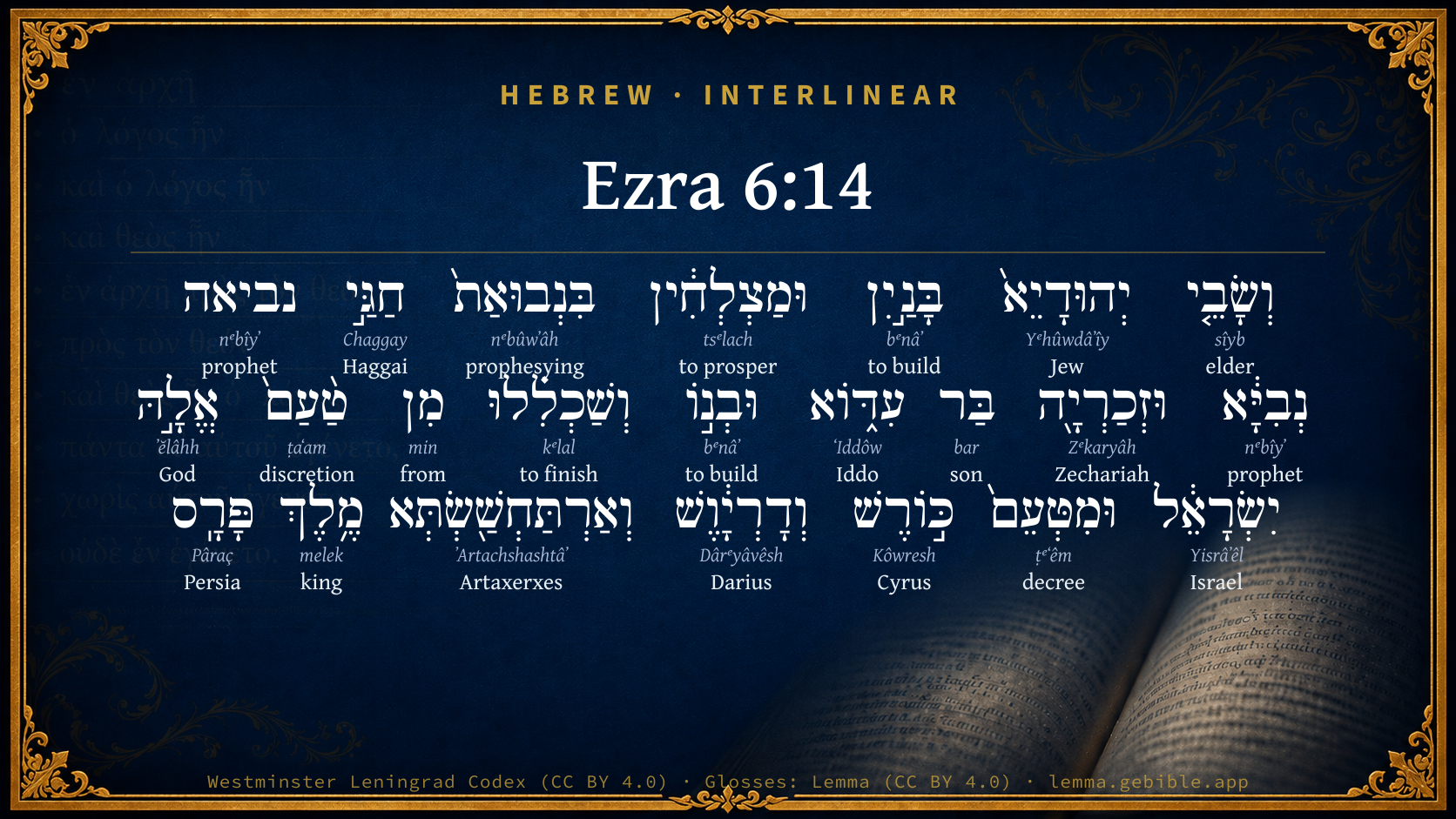
Hebrew (Westminster Leningrad Codex) Ezra 6:14 appears in the Hebrew Old Testament. The text above is from the Westminster Leningrad Codex. Each word links to its Strong’s number, a concise gloss, and parsing drawn from the Open Scriptures Hebrew Bible morphology. Click any word for its full Brown-Driver-Briggs (BDB) entry.
Download image
Cite this verse

Ezra 6:14 (World English Bible). Public Domain. Lemma interlinear Bible study tool, https://lemma.gebible.app/v/ezra/6/14.

Show BibTeX & RIS
BibTeX
RIS
English Translation
The elders of the Jews built and prospered, through the prophesying of Haggai the prophet and Zechariah the son of Iddo. They built and finished it, according to the commandment of the God of Israel, and according to the decree of Cyrus, and Darius, and Artaxerxes king of Persia.
World English Bible · Public Domain
Highlights
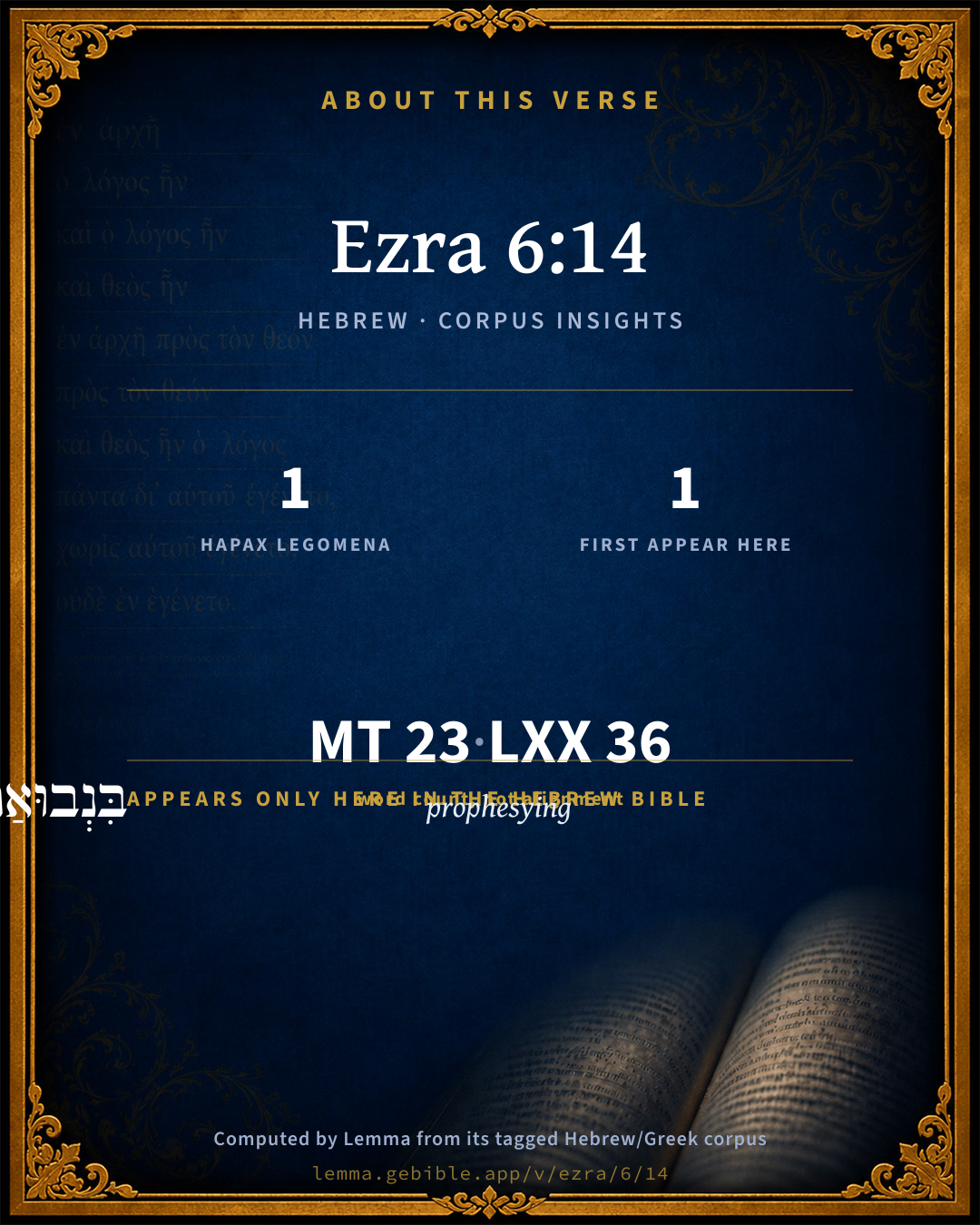
  • 1 hapax legomenon — only here in the Hebrew Bible
  • 1 first appearance in the Hebrew Bible
Full analysis ↓
Download a study sheet

One document with this verse’s original text, its word-by-word gloss line, the meaning frame, cross-references with their text, attributed commentary, and full source and license credits — printable, and it pastes into notes with its structure intact.

This verse Autodidact and up

Study sheet (.html) Plain text (.txt)

A passage Seminary Student

Up to 50 verses in one chapter. A passage sheet keeps up to 6 commentary sources and 12 cross-references per verse, in the order this page ranks them, and says so on the sheet whenever that leaves anything out. Ask for a single verse and you get the Autodidact verse sheet above.

Everything on this page stays free to read, with no account — the sheet is a download of what is already on screen, not access to it.

Want to remove ads? Support Godless Engineer
Compare translations 3

The same verse in 3 English versions, stacked beneath the original-language interlinear above. Click any original word for its lexicon entry.

Each is an independent rendering of the whole verse — the interlinear is not word-aligned to these translations.

Highlighted words mark where these versions differ — a whole-verse word diff, not a word-by-word alignment.

  • World English Bible Public Domain
    The elders of the Jews built and prospered, through the prophesying of Haggai the prophet and Zechariah the son of Iddo. They built and finished it, according to the commandment of the God of Israel, and according to the decree of Cyrus, and Darius, and Artaxerxes king of Persia.
  • King James Version Public Domain
    And the elders of the Jews builded, and they prospered through the prophesying of Haggai the prophet and Zechariah the son of Iddo. And they builded, and finished it, according to the commandment of the God of Israel, and according to the commandment of Cyrus, and Darius, and Artaxerxes king of Persia.
  • unfoldingWord Literal Text CC BY-SA 4.0
    And the elders of the Jews were building and prospering by the prophesying of Haggai the prophet and Zechariah the son of Iddo. And they built and completed by the decree of the God of Israel and by the decree of Cyrus, and Darius, and Artaxerxes, the king of Persia.

unfoldingWord Literal Text — © unfoldingWord, licensed CC BY-SA 4.0. Word-aligned USFM3 via Door43 (git.door43.org/unfoldingWord/en_ult).

Versions to compare (up to 4)

3 of 4 selected

Show all 18 translations

Every available English version of this verse, each an independent rendering of the whole verse.

  • World English Bible Public Domain
    The elders of the Jews built and prospered, through the prophesying of Haggai the prophet and Zechariah the son of Iddo. They built and finished it, according to the commandment of the God of Israel, and according to the decree of Cyrus, and Darius, and Artaxerxes king of Persia.
  • Berean Standard Bible Public Domain
    So the Jewish elders built and prospered through the prophesying of Haggai the prophet and Zechariah son of Iddo. They finished building according to the command of the God of Israel and the decrees of Cyrus, Darius, and Artaxerxes, kings of Persia.
  • Majority Standard Bible Public Domain
    So the Jewish elders built and prospered through the prophesying of Haggai the prophet and Zechariah son of Iddo. They finished building according to the command of the God of Israel and the decrees of Cyrus, Darius, and Artaxerxes, kings of Persia.
  • King James Version Public Domain
    And the elders of the Jews builded, and they prospered through the prophesying of Haggai the prophet and Zechariah the son of Iddo. And they builded, and finished it, according to the commandment of the God of Israel, and according to the commandment of Cyrus, and Darius, and Artaxerxes king of Persia.
  • American Standard Version (1901) Public Domain
    And the elders of the Jews builded and prospered, through the prophesying of Haggai the prophet and Zechariah the son of Iddo. And they builded and finished it, according to the commandment of the God of Israel, and according to the decree of Cyrus, and Darius, and Artaxerxes king of Persia.
  • Revised Version (1885) Public Domain
    And the elders of the Jews builded and prospered, through the prophesying of Haggai the prophet and Zechariah the son of Iddo. And they builded and finished it, according to the commandment of the God of Israel, and according to the decree of Cyrus, and Darius, and Artaxerxes king of Persia.
  • Geneva Bible (1599) Public Domain
    So the Elders of the Iewes builded, and they prospered by the prophecying of Haggai the Prophet, and Zechariah the sonne of Iddo, and they buylded and finished it, by the appoyntment of the God of Israel, and by the commandement of Cyrus and Darius, and Artahshashte king of Persia.
  • Douay-Rheims (1899) Public Domain
    And the ancients of the Jews built and prospered according to the prophecy of Aggeus the prophet, and of Zacharias the son of Addo: and they built and finished, by the commandment of the God of Israel, and by the commandment of Cyrus, and Darius, and Artaxerxes kings of the Persians.
  • Young's Literal Translation Public Domain
    and the elders of the Jews are building and prospering through the prophecy of Haggai the prophet, and Zechariah son of Iddo, and they have built and finished by the decree of the God of Israel, and by the decree of Cyrus, and Darius, and Artaxerxes king of Persia.
  • Literal Standard Version CC BY-SA 4.0
    and [the] elders of [the] Jews are building and prospering through [the] prophecy of Haggai [the] prophet, and Zechariah son of Iddo, and they have built and finished by [the] decree of [the] God of Israel, and by [the] decree of Cyrus, and Darius, and Artaxerxes king of Persia.
  • Unlocked Literal Bible CC BY-SA 4.0
    So the Jewish elders built and prospered under the teaching of Haggaithe prophet and Zechariah son of Iddo. They completed their buildings according to the decree of the God of Israel and by the decree of Cyrus, Darius, and Artaxerxes the king of Persia.
  • unfoldingWord Literal Text CC BY-SA 4.0
    And the elders of the Jews were building and prospering by the prophesying of Haggai the prophet and Zechariah the son of Iddo. And they built and completed by the decree of the God of Israel and by the decree of Cyrus, and Darius, and Artaxerxes, the king of Persia.
  • Darby Bible Public Domain
    And the elders of the Jews built; and they prospered through the prophesying of Haggai the prophet and Zechariah the son of Iddo. And they built and completed [it] according to the commandment of the God of Israel, and according to the commandment of Cyrus, and Darius, and Artaxerxes king of Persia.
  • World Messianic Bible Public Domain
    The Jewish elders built and prospered, through the prophesying of Haggai the prophet and Zechariah the son of Iddo. They built and finished it, according to the commandment of the God of Israel, and according to the decree of Cyrus, Darius, and Artaxerxes king of Persia.
  • Webster's Bible Public Domain
    And the elders of the Jews built, and they prospered through the prophesying of Haggai the prophet and Zechariah the son of Iddo. And they built, and finished it, according to the commandment of the God of Israel, and according to the commandment of Cyrus, and Darius, and Artaxerxes king of Persia.
  • Free Bible Version CC BY-SA 4.0
    As a result the Jewish leaders continued building, and they were encouraged by the messages from Haggai the prophet and Zechariah, son of Iddo. They completed building the Temple following the command of the God of Israel, and the decrees of Cyrus, Darius, and Artaxerxes, kings of Persia.
  • Bible in Basic English Public Domain
    And the responsible men of the Jews went on with their building, and did well, helped by the teaching of Haggai the prophet and Zechariah, the son of Iddo. They went on building till it was complete, in keeping with the word of the God of Israel, and the orders given by Cyrus, and Darius, and Artaxerxes, king of Persia.
  • JPS Tanakh (1917) Public Domain
    And the elders of the Jews builded and prospered, through the prophesying of Haggai the prophet and Zechariah the son of Iddo. And they builded and finished it, according to the commandment of the God of Israel, and according to the decree of Cyrus, and Darius, and Artaxerxes king of Persia.

Literal Standard Version (2020), Covenant Press — licensed CC BY-SA 4.0. Text via the HelloAO Bible API (eBible.org). Unlocked Literal Bible (unfoldingWord) — licensed CC BY-SA 4.0. Text via the HelloAO Bible API (eBible.org). unfoldingWord Literal Text — © unfoldingWord, licensed CC BY-SA 4.0. Word-aligned USFM3 via Door43 (git.door43.org/unfoldingWord/en_ult). Free Bible Version, Dr. Jonathan Gallagher — licensed CC BY-SA 4.0. Text via the HelloAO Bible API (eBible.org).

Word by word

More ways to search: Search by grammar → Find every occurrence → Compare this word →

Practice this passage: Drill this verse → Learn its vocabulary →

בִּנְבוּאַת֙
nᵉbûwʼâh
H5017
“in/at · prophesying of”
Adjective, R + Noun, Common, Feminine, Singular, Construct
Part of Speech
Adjective + Noun
Type
Common
Gender
Feminine
Number
Singular
State
Construct
Full BDB Definition

Origin: corresponding to H5016

TWOT: 2843b

prophesying
  1. וְשָׂבֵ֤י sîyb H7868 “and · elders of” Adjective, C + Noun, Common, Masculine, Plural, Construct
  2. יְהוּדָיֵא֙ Yᵉhûwdâʼîy H3062 “Jews · the” Adjective, N + Particle, Definite Article
  3. בָּנַ֣יִן bᵉnâʼ H1124 “building” Adjective, V
  4. וּמַצְלְחִ֔ין tsᵉlach H6744 “and · prospering” Adjective, C + Verb, a, Participle Active, Masculine, Plural, Absolute
  5. חַגַּ֣י Chaggay H2292 “Haggai” Adjective, N
  6. נביאה nᵉbîyʼ H5029 “prophet · the” Adjective, N, Common + Particle, Definite Article
  7. נְבִיָּ֔א nᵉbîyʼ H5029 “prophets · the” Adjective, N, Common + Particle, Definite Article
  8. וּזְכַרְיָ֖ה Zᵉkaryâh H2148 “and · Zechariah” Adjective, C + Noun, Proper
  9. בַּר bar H1247 “son of” Adjective, N, Common
  10. עִדּ֑וֹא ʻIddôw H5714 “Iddo” Adjective, N
  11. וּבְנ֣וֹ bᵉnâʼ H1124 “and · to build” Adjective, C + Verb, Qal, Perfect, 3rd Person, Masculine, Plural
  12. וְשַׁכְלִ֗לוּ kᵉlal H3635 “and · to finish” Adjective, C + Verb, e, Perfect, 3rd Person, Masculine, Plural
  13. מִן min H4481 “from” Adjective, R
  14. טַ֨עַם֙ ṭaʻam H2941 “discretion of” Adjective, N, Common
  15. אֱלָ֣הּ ʼĕlâhh H426 “God of” Adjective, N, Common
  16. יִשְׂרָאֵ֔ל Yisrâʼêl H3479 “Israel” Adjective, N
  17. וּמִטְּעֵם֙ ṭᵉʻêm H2942 “and · from · decree of” Adjective, C + Preposition + Noun, Common, Masculine, Singular, Construct
  18. כּ֣וֹרֶשׁ Kôwresh H3567 “Cyrus” Adjective, N
  19. וְדָרְיָ֔וֶשׁ Dârᵉyâvêsh H1868 “and · Darius” Adjective, C + Noun, Proper
  20. וְאַרְתַּחְשַׁ֖שְׂתְּא ʼArtachshashtâʼ H783 “and · Artaxerxes” Adjective, C + Noun, Proper
  21. מֶ֥לֶךְ melek H4430 “king of” Adjective, N, Common
  22. פָּרָֽס Pâraç H6540 “Persia” Adjective, N

About this verse

These counts appear in no published source. They are computed here, from the morphology-tagged text and Lemma’s own curated glosses. What Lemma adds →

23
words
21
distinct lemmas
Historical
section

Notable vocabulary

1 hapax legomenon — a word that appears only here in the entire Hebrew Bible:

  • בִּנְבוּאַת֙ prophesying H5017

First appearance in Scripture

This word makes its first canonical appearance in the Hebrew Bible here:

  • בִּנְבוּאַת֙ prophesying H5017

Shared distinctive vocabulary

וּמַצְלְחִ֔ין to prosper H6744 occurs in 4 verses of the Hebrew Bible. Also found in:

Grammatical profile

  • 3 verbs
  • 6 nouns
  • 11 adjectives
  • 3 particles

Verb forms

  • וּמַצְלְחִ֔ין Participle Active
  • וּבְנ֣וֹ Qal · Perfect
  • וְשַׁכְלִ֗לוּ Perfect

Repetition

Words recur within this verse — often emphatic in Hebrew:

  • בָּנַ֣יִן to build H1124 ×2
  • נביאה prophet H5029 ×2

Hebrew & Septuagint length

In English translation the verse runs 49 words from the Hebrew and 52 from the Septuagint (LXX English) — closely comparable.

A rough comparison of the two English renderings, which tokenize alike — not a word-level alignment.

Word counts can differ between the Hebrew and the Greek without any difference in meaning — e.g. the Hebrew direct-object marker אֵת has no separate Greek word, and Greek often adds the article ὁ.

In the original languages it is 23 Hebrew tokens and 36 Greek tokens — but the two are counted differently (Hebrew bundles its prefixes and suffixes into one token; the Greek is in lemma form), so that isn’t a like-for-like length.

Cross-references

14

Topical passages linked to Ezra 6:14 in the Treasury of Scripture Knowledge — connected by theme and wording, ordered by reader-vote popularity; previews shown in the World English Bible.

  • Ezra 7:1 Now after these things, in the reign of Artaxerxes king of Persia, Ezra the son of Seraiah, the son of Azariah, the son of Hilkiah,
  • Ezra 4:24–5:2 Then ceased the work of the house of God which is at Jerusalem; and it ceased until the second year of the reign of Darius king of Persia.
  • Ezra 5:13 But in the first year of Cyrus king of Babylon, Cyrus the king made a decree to build this house of God.
  • Ezra 1:1–4 Now in the first year of Cyrus king of Persia, that the word of Yahweh by the mouth of Jeremiah might be accomplished, Yahweh stirred up the spirit of Cyrus king of Persia, so that he made a proclamation throughout all his kingdom, and [put it] also in writing, saying,
  • Ezra 6:12–13 and the God who has caused his name to dwell there overthrow all kings and peoples who shall put forth their hand to alter [the same], to destroy this house of God which is at Jerusalem. I Darius have made a decree; let it be done with all diligence.
  • Ezra 3:8 Now in the second year of their coming to the house of God at Jerusalem, in the second month, began Zerubbabel the son of Shealtiel, and Jeshua the son of Jozadak, and the rest of their brothers the priests and the Levites, and all those who were come out of the captivity to Jerusalem, and appointed the Levites, from twenty years old and upward, to have the oversight of the work of the house of Yahweh.
  • Ezra 4:3 But Zerubbabel, and Jeshua, and the rest of the heads of fathers' [houses] of Israel, said to them, You have nothing to do with us in building a house to our God; but we ourselves together will build to Yahweh, the God of Israel, as king Cyrus the king of Persia has commanded us.
  • Isaiah 44:28 Who says of Cyrus, [He is] my shepherd, and shall perform all my pleasure, even saying of Jerusalem, She shall be built; and of the temple, Your foundation shall be laid.
  • Haggai 1:8 Go up to the mountain, bring wood, and build the house. I will take pleasure in it, and I will be glorified," says Yahweh.
  • Haggai 1:12–14 Then Zerubbabel, the son of Shealtiel, and Joshua, the son of Jehozadak, the high priest, with all the remnant of the people, obeyed the voice of Yahweh, their God, and the words of Haggai, the prophet, as Yahweh, their God, had sent him; and the people feared Yahweh.
  • Haggai 2:2–15 "Speak now to Zerubbabel, the son of Shealtiel, governor of Judah, and to Joshua, the son of Jehozadak, the high priest, and to the remnant of the people, saying,
  • Zechariah 2:1–4 I lifted up my eyes, and saw, and, behold, a man with a measuring line in his hand.
  • Zechariah 4:9 "The hands of Zerubbabel have laid the foundation of this house. His hands shall also finish it; and you will know that Yahweh of Hosts has sent me to you.
  • Zechariah 6:1–15 Again I lifted up my eyes, and saw, and, behold, four chariots came out from between two mountains; and the mountains were mountains of brass.

Cross-references courtesy of OpenBible.info (CC BY 4.0).

Hebrew and Greek witnesses Masoretic Hebrew ↔ Greek Septuagint

The same verse in the two great witnesses to the Old Testament, shown verse-for-verse.

These are two independent witnesses, not word-aligned to each other, and the Septuagint is shown in lemma (dictionary) form.

Hebrew Ezra 6:14 Masoretic · Westminster Leningrad Codex

וְשָׂבֵ֤י יְהוּדָיֵא֙ בָּנַ֣יִן וּמַצְלְחִ֔ין בִּנְבוּאַת֙ חַגַּ֣י נביאה נְבִיָּ֔א וּזְכַרְיָ֖ה בַּר עִדּ֑וֹא וּבְנ֣וֹ וְשַׁכְלִ֗לוּ מִן טַ֨עַם֙ אֱלָ֣הּ יִשְׂרָאֵ֔ל וּמִטְּעֵם֙ כּ֣וֹרֶשׁ וְדָרְיָ֔וֶשׁ וְאַרְתַּחְשַׁ֖שְׂתְּא מֶ֥לֶךְ פָּרָֽס

The elders of the Jews built and prospered, through the prophesying of Haggai the prophet and Zechariah the son of Iddo. They built and finished it, according to the commandment of the God of Israel, and according to the decree of Cyrus, and Darius, and Artaxerxes king of Persia.

World English Bible · Public Domain

Greek LXX Ezra 6:14 Septuagint · lemma form

καί ὁ πρεσβύτερος ὁ ἰουδαῖος οἰκοδομέω καί ὁ λευείτης ἐν προφητεία αγγαιου ὁ προφήτης καί ζαχαριου υἱός αδδω καί ἀναοἰκοδομέω καί καταἀρτίζω ἀπό γνώμη θεός ἰσραήλ καί ἀπό γνώμη κῦρος καί δαρεῖος καί αρθασασθα βασιλεύς πέρσης

And the elders of the Jews and the Levites built, at the prophecy of Aggaeus the prophet, and Zacharias the son of Addo: and they built up, and finished it, by the decree of the God of Israel, and by the decree of Cyrus, and Darius, and Arthasastha, kings of the Persians.

LXX2012 (modern English Septuagint) · Public Domain

In the Septuagint this is one book — Esdras B (2 Esdras): Ezra is chapters 1–10, Nehemiah 11–23.

On this verse, The Cambridge Bible for Schools and Colleges discusses the Septuagint’s reading. Read the note in Commentary ↓

Hebrew: Westminster Leningrad Codex (CC BY 4.0). Greek: Septuagint (public domain); English from LXX2012 (modern English Septuagint) (Public Domain). How the Septuagint differs from the Hebrew →

Commentary

Notes on Ezra 6:14 from classic Christian and Jewish commentators (each source and its license shown beneath its notes). The classic Christian expositions comment on the surrounding passage and are grouped to its opening verse, so a note may address several verses; the Jewish commentaries on the Tanakh (Rashi and others) are per-verse, so they appear only where the commentator wrote on this verse.

Lemma curates 59 commentaries, every one of them public domain or Creative Commons licensed, each selected and text-cleaned for this edition rather than reprinted as found. About our sources →

Trapp's Complete Commentary

John Trapp

Ezr 6:14 And the elders of the Jews builded, and they prospered through the prophesying of Haggai the prophet and Zechariah the son of Iddo. And they builded, and finished [it], according to the commandment of the God of Israel, and according to the commandment of Cyrus, and Darius, and Artaxerxes king of Persia.

Ver. 14. And Artaxerxes] This is Xerxes (called also Ahasuerus, husband of Esther), or, as some think, Artaxerxes Longimanus, the son of Xerxes by Esther; by whom the temple, finished before, might be much beautified, and, haply, enlarged also.

John Trapp, A Commentary or Exposition upon All the Books of the Old and New Testament (1647–1656) — public domain. Text from a community e-Sword module.

The Biblical Illustrator

Joseph S. Exell

Ezr_6:14-22

And they prospered through the prophesying of Haggai.

The true pulpit the best promoter of honest industry

It--

I. quickens the power of thought. He quickens public thought most who presents the most startling subjects with the highest enthusiasm. The true pulpit does this. The subjects it presents are the most vital to mans interests, the most stimulating to his inquiry. They involve the sublimest facts of nature and the grandest truths of inspiration, the highest interests of man now and for ever. Hence there is no power equal to the power of the true pulpit to break the monotony of mind and set the wheels of intellect ageing. This being so, the attendant on a true ministry will be--

1. The more qualified to form a good plan of action.

2. The more practical sagacity he will have to adapt means to ends.

3. The more solicitous he will be to execute his plan.

II. Supplies the timid with motive for action. The man who has been made thoughtful by the power of the pulpit is made to feel that the more successful he is in his business--

1. The more useful he is as a citizen.

2. The more useful as a religionist. (Homilist.)

Prophets and builders

The prophet and the builder must always go hand in hand. It is noticeable that the builder seldom or never goes first, but invariably succeeds the intelligent and ardent speaker. This is only another way of saying that thought precedes action. When men think deeply they are preparing the way for laying massive foundations by persons who could not themselves have entered into such intellectual strife. The one must not despise the other. Haggai built nothing, nor did Zechariah probably lay stone upon stone; on the other hand, Zerubbabel may not have been a man of active thought, and Jeshua may not have been gifted with eloquence; but they all worked together--the first man, seeing the truth of God and feeling the burden of the zeal of heaven, excited the sentiment of the two, that they might proceed to give practical and visible effect to the noble prophecies dictated by the Spirit. It is in vain for hearers to complain of preachers when they themselves are not prepared to carry out the word of the Lord. (J. Parker, D. D)

God requires men to work

God puts the oak in the forest, and the pine on its sand and rock, and says to men, There are your houses, go hew, saw, frame, build, make. God builds the trees; men must build the house. God supplies the timber; men must construct the ship. God buries the iron in the heart of the earth; men must dig it, and smelt it, and fashion it. Clay and rock are given us, not brick and square stones. What is useful for the body, and, still more, what is useful for the mind, is to be had only by exertion--exertion that will work men more than iron is wrought, and will shape men more than timber is shaped. Again, in the spiritual world God requires men to work. He gives them certain things, and then says, Go, work. He requires them to work in building up His spiritual temple as much as He required the Jews, in days of old, to work in building up His earthly temple.

The building of Gods temple

Men are like workmen set each by the architect upon some single bit of carving. One has given him to fashion a fragment where incompleteness breaks a promise of beauty. Another has set him only level lines and surfaces of blank monotony. To one it falls to carve a head without a body; to another, a lovely face; to many, patterns seemingly of little grace or meaning. But the task of each demands long labour and utmost care. At last the various blocks are put together, and, lo! there rises a glorious cathedral, filling eye and heart with its majesty and loveliness, destined to draw to it and shelter within itself one generation after another of devout worshippers. So, the temple of the living God, the heavenly Jerusalem, is building through the ages. Whoever, in high place or in low, is living the life of fidelity and love, is carving a stone for the fabric. (George S. Merrian.)

The erection of church

There is no book that throws more light upon the obligation of building temples for God, and the spirit that should ever inspire it, than that of Ezra.

I. In building a Christian temple we express our felt connection with the spiritual world. All building may be regarded as the expression of some sentiment, instinct, or wish of human nature. Markets, senate-houses, theatres, hotels, have all risen as the effects, embodiments, and realisations of some principle in our common nature. But these are all for our material wants and interests. In building a house for God we declare that we have other relations than those that connect us with this material system, other wants than those of the body, other interests than the secular and the physical. We thus attest our connection with the spiritual universe, our relation to eternity, our moral obligation to the Infinite, our desire for communion with God.

II. In building a Christian temple we express the idea that we require special manifestations of God. In the temple of nature God is portrayed in every object and proclaimed in every sound. But we feel that some other manifestation is required. In nature we can only see Him as the Almighty Creator and Absolute Sovereign; we want Him to appear in another relationship, one more suited to our fallen condition; we want Him to appear to us a redeeming God--one mighty to save. Had we not sinned we should need no such manifestations of God as we seek in the erection of temples. The temple of nature would suffice. There is no temple in heaven; God is seen in all, loved in all, worshipped in all.

III. In building a Christian temple we attest our faith in the gospel of Jesus Christ.

1. As a revelation from God intended and adapted to meet the condition of sinners.

2. As necessary to all men, through all times. We feel that while coming generations may not require our systems of philosophy, our ecclesiastical polities, our schemes of government, our codes of laws, they will require the gospel; and hence we rear a temple for its proclamation.

IV. In building a Christian temple we express our philanthropy. We are not building merely for ourselves, but for others; not even for our contemporaries, but for posterity. A Christian temple true to its mission is the greatest blessing to society. There the most soul-elevating ideas are proclaimed. Of all ideas to which men are subject none are so important as the religious. Other ideas will arouse certain faculties--some the intellect, some the imagination, some the emotions--but this the entire man. Other ideas act upon human nature as the rays of winter upon the soil; under its influence only a few germs will be evolved and a few plants will grow; but this, like the glowing beams of the vernal sun, will penetrate the deepest depths with its quickening energy, cause every seed-bud to burst into life and expand into fruitfulness. The mystic rod of Moses was not so mighty as the instrument the religious teacher wields. He lives nearest the heart of the world; he is up at the head springs, out of which proceed the issues of life. True religious ideas wherever proclaimed are the chief blessings of the world. In Christian temples such ideas are brought to bear with all their force upon the human mind; by them men are made to feel their obligations to be truthful, virtuous, benevolent, and Godlike; evil is subdued, hearts are changed, and souls are saved by these ideas. Christian temples are to society what tides are to the ocean, what the winds are to the atmosphere; they stir the mass and keep it pure.

V. In building a christian temple we express the idea that public worship is to be perpetuated by human instrumentality. We have reason to thank God that He has left such work as the building of temples to us. Had the necessaries of life sprung from the earth, so as to require no labour, the physical energies of man would never have been developed. Had knowledge come into our mind without the exercise of our faculties, we should never have known anything of intellectual force. In like manner, had everything in religion been done for us, so that no demand would have been made upon our benevolent sympathies, we should have been beings of morbid religious sentiment, and without any force or greatness of character. (Homilist.)

The second temple

From this subject we learn--

1. That man in this world needs a sanctuary, in which he may call on the name of the Lord his God. We are closely bound to the material globe, and the holiest affections. The most spiritual exercises naturally cling round some sacred spot where we have been accustomed to meet with God and with His people. Speaking of an old village church, Washington Irving says, For my part, there are feelings that visit me in a country church, amid the beautiful serenity of nature, which I experience nowhere else; and, if not a more religious, I think I am a better man on Sunday than on any other day of the seven. This principle lies deep in human nature. Among the most sacred memories of life are the childhood recollections which carry us back to the old familiar church, which then seemed so grand and impressive, where with father and mother we reverently worshipped God.

2. We learn that toil and sacrifice enter into the building of these sanctuaries. God does not ask for that which costs us nothing. Sacrifice may not be needed by Him, but it is necessary for us, and without it human nature cannot attain its highest and best.

3. We learn not to neglect the sanctuary. (E. B. Mason.)

Kept the dedication of this house of God with Joy.

Dedicating the temple

I. The building of Gods house was carried on in face of obstacles. Every important work has its hindrances. No great results have been achieved without meeting obstacles. But men have always been found qualified for the hard tasks. A clear brain, boundless energy, and unflinching will are hidden away in the right man, ready to be revealed at the right time. The tremendous barriers that stand before the waiting and needed reform chill the courage of the many, while they also arouse the energy and provoke the will of the true leader. Haggai had counted the cost, and knew exactly what he had to contend against. There was the cry of procrastination. The time is not come--the time that the Lords house should be built. The time is not ripe is a phrase that might often be interpreted to mean, the people are not ready. When any reform is pressing, you hear a clamour for delay. There are some who take counsel of their fears rather than of their faith. When Lincoln read his Proclamation of Emancipation to Seward, the Secretary of State counselled delay, until at last the President took the matter into his own hands and sent the message of liberty ringing through the land. Haggai understood the reason for delay, the people were filled with self-love and desire for display.

II. The building of the temple had a moral and spiritual influence on the people. At the dedication they offered a sin offering of twelve he goats, according to the number of the tribes of Israel. When once the temple was furnished, and the people saw all the appointments complete and an altar standing before them and in use, their sense of sin was aroused. The first sacrifice on that new altar was for their sins. With their new house they began a new life. The house of God in a community stands for a spiritual idea. The school-house and college stand for the intellectual needs of man. The moral and spiritual side finds its exponent in the church. These silent memorials of Gods grace compel us for a moment to think of duty and the hereafter, and they are suggestive of the rest that remaineth. A reverential soul can worship God anywhere, but a house dedicated to Him is an aid to such worship. While there we are released for the time from the distracting sights and sounds of outside life, and under the singing of hymns and the uplifting influence of prayer the mind becomes calmed for the consideration of truth.

III. The house of God is the home of joy. The Oriental expressed his feelings in most demonstrative ways. He shouted, clapped his hands, and danced when happy, and these extravagances were carried into his religious worship. Worship with the Jew was a natural channel for the display of feeling, while the Occidental suppresses his emotion in worship. We need more naturalness in the house of God. We come before God to express ourselves, not to suppress ourselves. The very truth proclaimed in Gods house is fitted to produce the liveliest emotions. Mankind ought to be induced to come to the house of God because of the abundance of peace to be found there. The view of God should be the one fitted to draw all hearts to Him. A young man, homeless and lonely, wandered through the streets of one of our cities. He could get no work, and had had no food for some time. Despair had seized his soul, and in that frame of mind he entered a church and dropped into a back seat. The sermon was being delivered, and it presented such a view of God and emphasised certain elements of truth that it deepened his despair, and he rushed from the church and threw himself into the river. This ought not to have been. There are stem truths in the gospel, yet to give them undue prominence, and make them overshadow the obvious intent of the gospel is to deprive it of its essential quality of hopefulness. The house of God stands for the best and brightest and cheeriest in human life. (Monday Club Sermons.)

Dedicating the temple

We are here advised as to the accessories by which the builders of the temple were enabled to succeed.

I. God was with them. All along He had been predisposed in their behalf. We also are exhorted to work out our own salvation because it is God that worketh in us both to will and to do.

II. God was pleased to communicate with them through his ordained servants. Haggai was an old man whose strength lay largely in admonition. Zechariah was younger, more inclined to the dreaming of hopeful dreams and the seeing of bright visions.

III. They were encouraged by the favourable attitude of temporal princes. The dedication took place in the month Adar, the month of splendour, so called because of the brightness of its suns and the beauty of its flowers.

1. A hundred bullocks, two hundred rams, and four hundred lambs were offered in sacrifice; and for a sin offering, twelve he goats for all Israel. There is something pathetic in the mention of these he goats. Ten of the twelve tribes, having out themselves loose from their brethren, had little or no part in the building of this temple, but they were remembered, and a place in the sin offering was Sacredly reserved for them. It was as when mothers set vacant chairs for their absent, wayward sons on thanksgiving day. Whatever might happen, the religious unity of Israel must be preserved. In like manner the Church of Christ, however parted asunder by the controversies of the past, should be at one in the work of the kingdom and in the rejoicings of the triumph of Christ.

2. At this dedication the ancient order of service was restored. The assignments of the priests and Levites date back to the time of Moses (Num_3:6-10). It does not follow that because a custom is old it is obsolete. Prayer is as old as human want, like the air we breathe, and time can make no improvement upon it. It should be observed that the Feast of Passover was among the venerable customs which were revived at this dedication. It was a foreshadowing of the atonement of Christ, without which all other pomp and circumstance of service are a dumb show. (D. J. Burrell, D. D.)

The joy of dedicating a house for the Lord

I. We observe in general that the joy with which the children of Israel, etc. Kept the dedication of the house of god arose--

1. Because of the consideration of its being now completely finished.

2. Of their regarding it as a token of God for good, a demonstration at once of His faithfulness and favour towards them and of the delightful prospect which it held out to them of their enjoying with comfort and with advantage the public ordinances of religion.

II. But more particularly this joy arose--

1. From the consideration of their having been honoured and enabled to build a house to the Lord their God.

2. From the consideration of its being a means of promoting the glory of God.

3. From its being a means of securing the observance and extending the benefits of religious ordinances to future and succeeding generations. (G. B. Brand.)

The dedication of the second temple

I. The occasion was one of joy. Hebrew and Christian worship are joyful, because believers worship a revealed God of salvation. Heathen worship is a straining or groping of man after God (1Ki_18:26-29).

II. The service was one for which all who had to take part in it had previously purified themselves.

III. There were burnt offerings as a token of the consecration of the people heart and soul afresh to God.

IV. There were sin offerings. In Divine worship there should always be a recognition of sin, and of Christs having put away sin by the sacrifice of Himself.

V. There was the observance of the passover. They loved God because God loved them; this is the order now, and we cannot reverse it (1Jn_4:19).

VI. The feast of unleavened bread was kept joyfully for seven days.

1. In token of national unity and fellowship.

2. In token of their desire to cultivate purity.

VII. The new national life thus inaugurated had far less of pomp and show about it than were seen in the days of Solomon. But there was more of spiritual power (Hag_2:9). (C. Clemance, D. D.)

The dedication of the temple was characterised by

I. Religious rejoicing. The reasons for this were--

1. Protracted labours brought to a close.

2. The honour offered to Jehovah their God.

3. The benefits which were likely to accrue to men through their sacred edifice and its worship.

II. Devout gratitude.

III. Deep humility.

IV. Appropriate arrangements for its future use. (William Jones.)

The Biblical Illustrator, edited by Joseph S. Exell (c. 1880s–1900s) — public domain. Text from a community e-Sword module.

Joseph Benson's Commentary

Ezr 6:14. They prospered through the prophesying of Haggai, &c. — This is a seasonable intimation that this great and unexpected success was not to be ascribed to chance, or to the kindness or good-humour of Darius, but unto God only, who, by his prophets, had required and encouraged them to proceed in the work, and by his mighty power disposed Darius’s heart to such kind and noble purposes. And Artaxerxes — That is, Artaxerxes Longimanus, who is here joined with Cyrus and Darius; because, though the temple was built before he came to the throne, in Darius’s reign, (Ezr 6:15,) yet it was afterward beautified and adorned in consequence of the commission he gave Ezra and Nehemiah for that purpose, the latter of whom was invested with full power to take measures for the building of the city, and also the ordering of all other things that concerned the Jewish nation and religion.

Joseph Benson's Commentary on the Old and New Testaments (1811–1818) — public domain. Text from a community e-Sword module.

MacLaren's Expositions of Holy Scripture

Alexander MacLaren

Ezra

THE NEW TEMPLE AND ITS WORSHIP

Ezr 6:14 - Ezr 6:22.

There are three events recorded in this passage,-the completion of the Temple, its dedication, and the keeping of the passover some weeks thereafter. Four years intervene between the resumption of building and its successful finish, much of which time had been occupied by the interference of the Persian governor, which compelled a reference to Darius, and resulted in his confirmation of Cyrus’ charter. The king’s stringent orders silenced opposition, and seem to have been loyally, however unwillingly, obeyed. About twenty-three years passed between the return of the exiles and the completion of the Temple.

I. The prosperous close of the long task {Ezr 6:14 - Ezr 6:15}. The narrative enumerates three points in reference to the completion of the Temple which are very significant, and, taken together, set forth the stimulus and law and helps of work for God.

It is expressive of deep truth that first in order is named, as the cause of success, ‘the prophesying of Haggai and Zechariah.’ ‘Practical men,’ no doubt, then as always, set little store by the two prophets’ fiery words, and thought that a couple of masons would have done more for the building than they did. The contempt for ‘ideas’ is the mark of shallow and vulgar minds. Nothing is more practical than principles and motives which underlie and inform work, and these two prophets did more for building the Temple by their words than an army of labourers with their hands. ‘There are diversities of operations,’ and it is not given to every man to handle a trowel; but no good work will be prosperously accomplished unless there be engaged in it prophets who rouse and rebuke and hearten, and toilers who by their words are encouraged and saved from forgetting the sacred motives and great ends of their work in the monotony and multiplicity of details.

Still more important is the next point mentioned. The work was done ‘according to the commandment of the God of Israel.’ There is peculiar beauty and pathos in that name, which is common in Ezra. It speaks of the sense of unity in the nation, though but a fragment of it had come back. There was still an Israel, after all the dreary years, and in spite of present separation. God was still its God, though He had hidden His face for so long. An inextinguishable faith, wistful but assured, in His unalterable promise, throbs in that name, so little warranted by a superficial view of circumstances, but so amply vindicated by a deeper insight. His ‘commandment’ is at once the warrant and the standard for the work of building. In His service we are to be sure that He bids, and then to carry out His will whoever opposes.

We are to make certain that our building is ‘according to the pattern showed in the mount,’ and, if so, to stick to it in every point. There is no room for more than one architect in rearing the temple. The working drawings must come from Him. We are only His workmen. And though we may know no more of the general plan of the structure than the day-labourer who carries a hod does, we must be sure that we have His orders for our little bit of work, and then we may be at rest even while we toil. They who build according to His commandment build for eternity, and their work shall stand the trial by fire. That motive turns what without it were but ‘wood, hay, stubble,’ into ‘gold and silver and precious stones.’

The last point is that the work was done according to the commandment of the heathen kings. We need not discuss the chronological difficulty arising from the mention of Artaxerxes here. The only king of that name who can be meant reigned fifty years after the events here narrated. The mention of him here has been explained by ‘the consideration that he contributed to the maintenance, though not to the building, of the Temple.’ Whatever is the solution, the intention of the mention of the names of the friendly monarchs is plain. ‘The king’s heart is in the hand of the Lord as the watercourses; He turneth it whithersoever He will.’ The wonderful providence, surpassing all hopes, which gave the people ‘favour in the eyes of them that carried them captive,’ animates the writer’s thankfulness, while he recounts that miracle that the commandment of God was re-echoed by such lips. The repetition of the word in both clauses underscores, as it were, the remarkable concurrence.

II. The dedication of the Temple {Ezr 6:16 - Ezr 6:18}. How long the dedication was after the completion is not specified. The month Adar was the last of the Jewish year, and corresponded nearly with our March. Probably the ceremonial of dedication followed immediately on the completion of the building. Probably few, if any, of the aged men, who had wept at the founding, survived to see the completion of the Temple. A new generation had no such sad contrasts of present lowliness and former glory to shade their gladness. So many dangers surmounted, so many long years of toil interrupted and hope deferred, gave keener edge to joy in the fair result of them all.

We may cherish the expectation that our long tasks, and often disappointments, will have like ending if they have been met and done in like spirit, having been stimulated by prophets and commanded by God. It is not wholesome nor grateful to depreciate present blessings by contrasting them with vanished good. Let us take what God gives to-day, and not embitter it by remembering yesterday with vain regret. There is a remembrance of the former more splendid Temple in the name of the new one, which is thrice repeated in the passage,-’this house.’ But that phrase expresses gratitude quite as much as, or more than, regret. The former house is gone, but there is still ‘this house,’ and it is as truly God’s as the other was. Let us grasp the blessings we have, and be sure that in them is continued the substance of those we have lost.

The offerings were poor, if compared with Solomon’s ‘two and twenty thousand oxen, and an hundred and twenty thousand sheep’ {1Ki 8:63}, and no doubt the despisers of the ‘day of small things,’ whom Zechariah had rebuked, would be at their depreciating work again. But ‘if there be first a willing mind, it is accepted according to that a man hath, and not according to that he hath not.’ The thankfulness of the offerers, not the number of their bullocks and rams, made the sacrifice well pleasing. But it would not have been so if the exiles’ resources had been equal to the great King’ s. How many cattle had they in their stalls at home, not how many they brought to the Temple, was the important question. The man who says, ‘Oh! God accepts small offerings,’ and gives a mite while he keeps talents, might as well keep his mite too; for certainly God will not have it.

A significant part of the offerings was the ‘twelve he-goats, according to the number of the tribes of Israel.’ These spoke of the same confidence as we have already noticed as being expressed by the designation of ‘the God of Israel.’ Possibly scattered members of all the tribes had come back, and so there was a kind of skeleton framework of the nation present at the dedication; but, whether that be so or not, that handful of people was not Israel. Thousands of their brethren still lingered in exile, and the hope of their return must have been faint. Yet God’s promise remained, and Israel was immortal. The tribes were still twelve, and the sacrifices were still theirs. A thrill of emotion must have touched many hearts as the twelve goats were led up to the altar. So an Englishman feels as he looks at the crosses on the Union Jack.

But there was more than patriotism in that sacrifice. It witnessed to unshaken faith. And there was still more expressed in it than the offerers dreamed; for it prophesied of that transformation of the national into the spiritual Israel, in virtue of which the promises remain true, and are inherited by the Church of Christ in all lands.

The re-establishment of the Temple worship with the appointment of priests and Levites, according to the ancient ordinance, naturally followed on the dedication.

III. The celebration of the Passover {Ezr 6:19 - Ezr 6:22}. It took place on the fourteenth day of the first month, and probably, therefore, very soon after the dedication. They ‘kept the feast, . . . for the priests and Levites were purified together.’ The zeal of the sacerdotal class in attending to the prescriptions for ceremonial purity made it possible that the feast should be observed. How much of real devotion, and how much of mere eagerness to secure their official position, mingled with this zeal, cannot be determined. Probably there was a touch of both. Scrupulous observance of ritual is easy religion, especially if one’s position is improved by it. But the connection pointed out by the writer is capable of wide applications. The true purity and earnestness of preachers and teachers of all degrees has much to do with their hearers’ and scholars’ participation in the blessings of the Gospel. If priests are not pure, they cannot kill the passover. Earnest teachers make earnest scholars. Foul hands cannot dispense the bread of life.

There is a slight deviation from the law in the ritual as here stated, since it was prescribed that each householder should kill the passover lamb for his house. But from the time of Hezekiah the Levites seem to have done it for the congregation {2Ch 30:17}, and afterwards for the priests also {2Ch 35:11, 2Ch 35:14}.

Ezr 6:21 tells that not only the returned exiles, but also ‘all such as had separated themselves unto them from the filthiness of the heathen of the land, to seek the Lord God of Israel,’ ate the passover. It may be questioned whether these latter were Israelites, the descendants of the residue who had not been deported, but who had fallen into idolatry during the exile, or heathens of the mixed populations who had been settled in the vacant country. The emphasis put on their turning to Israel and Israel’s God seems to favour the latter supposition. But in any case, the fact presents us with an illustration of the proper effect of the presence anywhere of a company of God’s true worshippers. If we purify ourselves, and keep the feast of the true passover with joy as well as purity, we shall not want for outsiders who will separate themselves from the more subtle and not less dangerous idolatries of modern life, to seek the Lord God of Israel. If His Israel is what it ought to be, it will attract. A bit of scrap-iron in contact with a magnet is a magnet. They who live in touch with Him who said, ‘I will draw all men unto Me’ will share His attractive power in the measure of their union with Him.

The week after the passover feast was, according to the ritual, observed as the feast of unleavened bread. The narrative touches lightly on the ceremonial, and dwells in conclusion on the joy of the worshippers and its cause. They do well to be glad whom God makes glad. All other joy bears in it the seeds of death. It is, in one aspect, the end of God’s dealings, that we should be glad in Him. Wise men will not regard that as a less noble end than making us pure; in fact, the two are united. The ‘blessed God’ is glad in our gladness when it is His gladness.

Notice the exulting wonder with which God’s miracle of mercy is reported in its source and its glorious result. The heart of the king was turned to them, and no power but God’s could have done that. The issue of that divine intervention was the completed Temple, in which once more the God of that Israel which He had so marvellously restored dwelt in the midst of His people.

Alexander MacLaren, Expositions of Holy Scripture (1904–1910) — public domain. Text from a community e-Sword module.

Geneva Bible (1599)

Geneva Bible translators

Whom God stirs up to assure them that he would give their work good success.

Geneva Bible (1599) marginal notes — public domain. Text via Bolls.life.

Adam Clarke's Commentary

Verse 14. According to the commandment of the God of Israel] He first gave the order, and stirred up the hearts of the following Persian kings to second that order.

Of Cyrus] This sovereign gave his orders for the rebuilding of the temple about A.M. 3468.

And Darius] Darius Hystaspes confirmed the above orders, A. M. 3485.

And Artaxerxes] Artaxerxes Longimanus sent Ezra to Judea with new privileges, A.M. 3547. With the permission of the same king, Nehemiah came to Judea in 3550. The writer recapitulates the different sovereigns who favoured the Jews after the Babylonish captivity. See Calmet.

Adam Clarke's Commentary on the Bible (1810–1826) — public domain. Text from a community e-Sword/MySword module.

Ellicott's Commentary for English Readers

(14) Cyrus, and Darius, and Artaxerxes king of Persia.—This verse includes all the agents in the great work with which the book deals: from Cyrus to Artaxerxes; the elders, that is, the heads of the Jews; the prophets (see Ezr_5:1); but all is from the God of Israel, whose commandment Cyrus and all others fulfilled.

Artaxerxes king of Persia.—Evidently the Artaxerxes Longimanus of the sequel, whose contributions and help did so much toward the perfecting of the general design, though the “finishing” here mentioned took place fifty years before his reign. Observe that he alone is called “king of Persia,” which shows that Ezra is writing in his time, and adds his name to the original record. Just as the later Artaxerxes is introduced, so the earlier Cyrus is, in this comprehensive review.

A Bible Commentary for English Readers, edited by Charles John Ellicott (1878–1897) — public domain. Text from a community e-Sword module.

The Cambridge Bible for Schools and Colleges

gen. ed. J. J. S. Perowne

14. the elders of the Jews] cf. Ezr_5:5.

and they prospered] R.V. and prospered. Cf. Ezr_5:8.

through the prophesying] i.e. the success of the work was due in great measure to the encouragement and support rendered by the two prophets. The LXX. and 1 Esd. render as if the meaning were ‘in the time of the prophesying of Haggai and Zechariah.’ The Vulgate gives ‘in accordance with the prophesying’ (juxta prophetiam).

Haggai … Zechariah] see on Ezr_5:1.

and according to the commandment of Cyrus, &c.] R.V. the decree of Cyrus, &c. The word in the original differs slightly from that in the previous clause. The R.V. preserves the distinction drawn between the Divine ‘commandment’ and the human ‘decree’.

Cyrus … Darius … Artaxerxes] The decrees of Cyrus and Darius have been given by the author (chap. Ezr_1:2-4, Ezr_6:3-12). The mention of a decree of Artaxerxes occasions a difficulty. (1) The decree of Artaxerxes quoted in Ezr_4:18-22 is hostile to the Jews and could not be intended in this verse. (2) How does Artaxerxes’ name occur in this passage, which is concerned with the reign of Darius? Certainly the context would lead us to expect the mention of only Cyrus and Darius. Some in consequence have supposed that the name of Artaxerxes has been inserted as a gloss, either in ignorance of the true chronology or for the sake of bringing together the names of the three great Persians, who were benefactors of the Jewish race. But the reading is attested by the LXX. version, and by 1Es_7:4. We must therefore suppose hat the Compiler has in this passage as well as in Ezr_4:6-23 disregarded the chronology of the context and anticipated later history.

The Cambridge Bible for Schools and Colleges (gen. ed. J. J. S. Perowne; Cambridge University Press, 1878–1918) — public domain. Text from a community e-Sword module.

John Gill's Exposition

And this house was finished on the third day of the month Adar,.... The twelfth month of the year with the Jews, and answers to part of our February and part of March:

which was in the sixth year of the reign of Darius the king; four years after the decree came forth.

John Gill's Exposition of the Whole Bible (1746–1763) — public domain (CC PDM 1.0). Text via the HelloAO Bible API.

Albert Barnes' Notes on the Bible

Artaxerxes - The Artaxerxes of marginal reference seems to be meant (i. e., Longimanus); he was one of those who together with Cyrus and Darius helped forward the completion of the work.

Albert Barnes' Notes on the Bible (1834–1885) — public domain. Text from a community e-Sword/MySword module.

Haydock's Catholic Bible Commentary

Artaxerxes, one of the seven who overturned the power of the magi; (Usher, the year of the world 3483) or rather the king of Persia, who lived some time after this, and was very favourable to the Jews. He sent Esdras (the year of the world 3537) and Nehemias (the year of the world 3550) with great powers into the country. (Calmet)

George Leo Haydock (1774–1849), Haydock's Catholic Family Bible and Commentary, 1859 edition — public domain. Excludes Psalms (Douay-Rheims chapter numbering differs from Protestant) and Deuterocanonical books (Catholic canon only).

Matthew Poole's English Annotations

They prospered through the prophesying of Haggai: this is a seasonable intimation that this great and unexpected success was not to be ascribed to chance, nor to the kindness or good humour of Darius; but unto God only, who by his prophets had required and encouraged them to proceed in the work, and by his mighty power disposed Darius’s heart to such kind and noble purposes and actions.

Artaxerxes; who is thought to be either,

1. Xerxes, Darius’s son and successor, who is called also Artaxerxes, and Ahasuerus, who is here joined with his father Darius, possibly because he favoured the Jews, and promoted their cause with his father, and saw to the execution of his father’s decree, and was his father’s viceroy, if not made co-emperor with his father in his lifetime, which was not unusual. Or,

2. Artaxerxes Longimanus, the son of Xerxes, who was best known by the name of Artaxerxes; who is here joined with Cyrus and Darius, because though the temple was finished, as to the substance of the work, in Darius’s reign, Ezr 6:15, yet it was afterwards more fully completed and adorned by Artaxerxes, as is evident from Ezr 7:20,27, by whom Nehemiah was sent to Jerusalem with a large commission and full power to take care about the building of the city, and all other things concerning the Jewish nation and religion.

Matthew Poole's English Annotations on the Holy Bible (1683–1685) — public domain. Text from a community e-Sword/MySword module.

The Pulpit Commentary

And the elders of the Jews builded. See above, Ezr_5:5, Ezr_5:9. Probably the same as "the chief of the fathers" of Ezr_2:68, and Ezr_3:12. While the younger men were those who actually laboured, the elders superintended the work. Zerubbabel and Jeshua are no doubt included among them. And they prospered through the prophesying of Haggai and Zechariah. It can well be understood that Haggai"s earnest exhortations, his warnings, his threats, his sarcastic reproaches, (Hag_1:4, Hag_1:9) his prophecies of a coming glory to the house greater than any known previously, (Hag_2:9) would rouse the spirit of the people, and make them labour diligently and perseveringly; but the visions of Zechariah seem less calculated to stir popular feeling. Still the knowledge that the angels of God were interesting themselves in the restoration of the temple, (Zec_1:9-21 Zec_2:3, etc.) and the many promises that God would "comfort Zion," and "choose Jerusalem", (Zec_1:17 Zec_2:12 Zec_3:2) and that the temple should assuredly be brought to completion, (Zec_1:16 Zec_4:9) helped no doubt to strengthen the hands of Zerubbabel, and to keep up the zeal of the people. According to the commandment of Cyrus, and Darius, and Artaxerxes king of Persia. The commandments of Cyrus and of Darius have been set forth by the writer; (see Ezr_1:3 Ezr_6:3-5, Ezr_6:7) but nothing has been said as yet of any commandment given by any Artaxerxes to "build" or "finish" the house. On the contrary, the only Arta-xerxes mentioned has been declared to have expressly forbidden the work to proceed. (Ezr_4:7-22) The Artaxerxes of that place, moreover, reigned between Cyrus and Darius, whereas this Artaxerxes should, by the position of his name, be one of the successors of Darius. It has been suggested that Xerxes is intended, and that he may have been associated with his father during the building of the temple. But as Xerxes was the son of Atossa, whom Darius did not marry until he had ascended the throne (Herod., 3:88), he cannot have been more than five years old when the temple was finished. Nor was he ever associated on the throne by his father. Xerxes, therefore, cannot be meant. The next king to Xerxes, however, who really bore the name of Artaxerxes was a favourer of the Jews, and did give commandment to "beautify," and in that sense "finish," the house of the Lord. (see Ezr_7:20, Ezr_7:27) We must suppose, therefore, that he is the person intended. The objection that the name is not spelt the same, but has a samech in one place instead of a schin, is too minute to require consideration. The Persians themselves spelt the name of Artaxerxes in more ways than one (Rawlinson, "Cuneiform Inscriptions of Persia," vol. 1. p. 348).

HOMILIES BY A. MACKENNAL Vers. 14-16.

The temple finished.

The building of the temple was finished in about four years after the work was resumed. This was a short time for a work so vast, when compared with the resources of the Jews. It was carried through without intermission; the zeal of the people was not suffered to become languid through delay. The fact illustrates both the propitious character of external circumstances and the wisdom of the Jewish leaders. When the building was completed it was dedicated, and the worship of the LORD was reestablished with solemnity and with joy. Here arc two themes, distinct and yet united first, the rebuilding of the temple; and secondly, its dedication.

I THE REBUILDING. The accession of Darius appeared to Haggai and Zechariah the sign that the Lord had again visited his people. The last monarch had been a Magian, "opposed to belief in a personal God," and "not approving of temples." Darius was in sympathy with the work of Cyrus, having faith in the God of heaven, and regarding the Jewish nation with special favour (vers. 10, 12). Darius was the great organiser of the Persian kingdom. He made each province feel itself under the protection of the central authority, and by his system of "posts" brought each province into immediate communication with himself. A strong central authority is the best protection against the tyranny of provincial governments, with their petty jealousies and miserable intrigues. Modern as well as ancient Oriental history illustrates how heavily anarchy may press on a people like the Jews, too steadfast in religious convictions to join in prevailing heathenism and immorality, too feeble to enforce their claims. The change in the method of administration of which general history informs us is indicated in the sacred history. (cf. the title "governor" given to Tatnai, Ezr_5:3, with the titles "chancellor" and "scribe" given to Rehum and Shimshai, Ezr_4:9) Tatnai"s personal character, moreover, appears in favourable contrast with the characters of the "adversaries of Judah and Benjamin" whose letter is recorded Ezr_4:7-16. He writes no "accusation against the inhabitants of Judah and Jerusalem;" he simply reports the case for the decision of Darius. (Ezr_5:6-17) Nor is his a one-sided report; fairly enough he states the pleading of the elders, referring definitely to the decree of Cyrus under which they acted, and asks that search may be made for it. And when the answer of Darius comes to him, he loyally endeavours to fulfil it. Tatnai"s doing, and doing speedily, "according to that which Darius the king had sent," is mentioned in connection with the "prospering" of the elders of the Jews. The wisdom of the leaders of the Jews is seen in their hurrying forward the work. The zeal of the people might flag; changes might occur in the monarchy; they must take advantage of the favouring circumstances. The work was a great one; not all was accomplished when the temple walls were built; the mention of Artaxerxes in conjunction with Cyrus and Darius shows that they were in the middle, not at the end, of their labours. But this at least they could do make sure their steps as they proceeded; the temple once erected wasnot destroyed; it stood a point of vantage for the carrying out of further projects. Their wisdom appears again in their refusal to relax their efforts while the appeal to Darius was being made. (Ezr_5:5) They knew the character of Tatnai; they acted in confidence either that he would not desire or would not venture on his own authority to disallow their appeal to the decree of Cyrus. Their boldness was the truest prudence; it would keep up the hearts of their own people; it would overawe the "adversaries." The basis of their wisdom was piety; they knew that "the eye of their God was upon them." They not only confided in the general providence of God; the prophets Haggai and Zechariah urged the Jews to remember his special commission to them: he had brought them back. from captivity to do this work; his blessing would crown their fidelity with success; his curse would fall on their negligence. Haggai spoke to the people, pledging the fidelity of the Lord to them. (Hag_2:10-19) Zechariah appealed to the sense of Divine inspiration in Zerubbabel, (Zec_4:6-10) and strengthened Jeshua the high priest by lofty assertions that he and his purpose and his trials were near the heart of God. (Zec 3) Special tokens of the Divine favour encouraged the people in their labour. The closing Psalms of the Psalter are assigned to this period of Jewish history; Psalm 146-148, are entitled in the Septuagint version "of Haggai and Zechariah;" and they speak of deliverance out of trouble, and prosperity after distress. Haggai"s pledge on behalf of God was fulfilled: for drought they had flowing waters; instead of fruitless labour they had "food for the hungry," and "the finest of the wheat" (cf. Psa_146:5-10 Psa_147:3, Psa_147:8, Psa_147:13-20, with Haggai, passim) In almost all great histories of deliverance and progress these two elements are found united favouring circumstance and human character. One-sidedness must be avoided in our interpretation of history. It is not wise to overlook the force of propitious events; we break human hearts if we teach that everything depends on our own fidelity, our own skill; not only so, we thus obscure men"s faith in the providence of God. On the other hand, no times are propitious to those who are not ready to serve God. God"s providence does not supersede our service, nor render needless his choicest gift of men. Inability to read "the signs of the times" is declared by Christ to be a mark of insincerity; (Luk_12:54-57) the highest service man can render man is to be an "interpreter" of God"s purpose, a prophet calling for the fulfilment of God"s will.

II THE DEDICATION. The festival of the dedication contrasts strikingly with Solomon"s festival. "The holy of holies was empty. The ark, the cherubim, the tables of stone, the pot of manna, the rod of Aaron were gone. The golden shields had vanished. Even the high priest, though he had recovered his official dress, had not been able to resume the breastplate with the oracular stones." (Cf. 1Ki 8 and 2Ch 6 with Ezr_6:17, and Ps 136, with Ps 146-150) It is the contrast of youth, flushed with prosperity and of an exultant tone of piety, with experienced and saddened manhood. The barbaric munificence of Solomon"s offering, 22, 000 bullocks and 120, 000 sheep, contrasts also with the 100 bullocks, 200 rams, and 400 lambs of the second sacrifice. But one touch of pathos appears here wanting in the first the offering of twelve he-goats, a sin offering for each of the tribes. The sin offering, for sins of ignorance and negligence, was a confession that all had been heedless; they knew not, with all they had learnt, the full extent of their remissness, they felt "the sin that mingled with their holy things." We are touched by the record; the appeal went to the heart of God. "Thou desirest not sacrifice." "The sacrifices of God are a broken spirit." With the dedication was associated the first passover, about a month after. The true consecration of a house of prayer is not the august ceremonial which attends its opening, but the habitual service offered in it. Note the carefulness to follow the law which is characteristic of this period (vers. 18-20). Negligence had been their undoing; the sin offering confessed that; but the true repentance is amendment of the evil habit. There was a forward look in this arrangement of the priests and Levites; it was provision for a long future of Divine service. And with this was combined hope for the ingathering of all the nation. All the tribes, the children of the captivity, the children of the dispersion, and the undistinguished remnant left behind by the king of Assyria were regarded as one. Their hearts like that of Paul (Ro 9 Ro 11) could not endure the thought of losing any. The family is not complete until all are gathered; humbler members, its very prodigals, as well as the virtuous and the prosperous. A nation, a Church, includes the weakly and the "less comely" members as well as those which are honourable. Among those who "had separated themselves unto them from the filthiness of the heathen of the land to seek the Lord God of Israel" may have been heathen proselytes. The "court of the Gentiles" appears for the first time in the temple of Zerubbabel. The true separation, it was recognised with increasing clearness, was separation from the sins of heathenism, not national exclusiveness. The joyousness of the festival is twice noticed (vers. 16, 22). It is remarkable how much is said of joy in the Divine service in these books of Ezra and Nehemiah. Perhaps we are never fully conscious of joy till we have been sobered by sorrow. And it is a religious duty to encourage hope and gladness in the depressed. We must learn how to treat the various experiences with which we have to deal; not only weeping with them that weep, but doing all we can to win them to smiles. Elevating influences are most needed by the depressed. It was to slaves Paul told Titus to speak of "adorning, making beautiful, the doctrine of God our Saviour." To the prosperous we may speak of sobriety; we may remind him who lives many years, and rejoices in them all, of the "days of darkness," which shall be many. But those who have seen affliction, and who have arduous labour and adverse times before them, require that their religious services should be made as joyous and as bright as possible. M.

The Pulpit Commentary (1880–1919), ed. H.D.M. Spence-Jones & Joseph S. Exell — public domain. Text from a community e-Sword module.

John Wesley's Explanatory Notes

Through the prophesying - This is a seasonable intimation that this great and unexpected success was not to be ascribed to chance, or to the kindness or good humour of Darius, but unto God only, who by his prophets had required and encouraged them to proceed in the work, and by his mighty power disposed Darius's heart to such kind and noble purposes.

John Wesley, Explanatory Notes Upon the Whole Bible (1754–1765) — public domain. Text via the GEBible commentary corpus.

Scofield Reference Notes

C. I. Scofield

finished it

The worship of Jehovah was thus re-established in Jerusalem, but the theocracy was not restored. The remnant which returned from the Babylonian captivity lived in the land by Gentile sufferance, though doubtless by the providential care of Jehovah, till Messiah came, and was crucified by soldiers of the fourth Gentile world-empire Rome, Dan 2:40; Dan 7:7. Soon after (A.D. 70) Rome destroyed the city and temple. See "Times of the Gentiles"; Luk 21:24; Rev 16:19.

The Scofield Reference Bible (1917 edition), notes by C. I. Scofield — public domain. Text from a community e-Sword module.

Rashi

Rabbi Shlomo Yitzchaki (Rashi)

And the elders of the Jews And the elders of the Jews were building and succeeding in their work, according to the prophecy of Haggai and Zechariah, and they built and founded the building by the command of the God of Israel and by the authorization of Cyrus, the first king of Persia, in whose days the laying of the foundation was commenced, and by the authorization of this Darius, the king of Persia.

and Artaxerxes He is Darius, but he was called Artaxerxes because of the province and the kingdom, for all kings of Persia were thus named just as all the kings of Egypt were called Pharaoh.

Rashi on the Tanakh — English translations: “The Judaica Press complete Tanach with Rashi, translated by A. J. Rosenberg” (CC BY 4.0); “Pentateuch with Rashi's commentary by M. Rosenbaum and A.M. Silbermann, 1929-1934” (public domain); “The Metsudah Tanach series, Lakewood, N.J” (CC BY 4.0); and “The Book of Joshua, Metsudah Publications, 1997” (CC BY 4.0). Text via Sefaria.

Lesson kit

Teaching starters — assembled from the data on this page, not authored interpretation. Every prompt links to the verse data it draws on. Edit before teaching.

Ezra, in the Historical, opens this verse with 23 words (21 distinct Hebrew lemmas). Its most distinctive word is nᵉbûwʼâh (“prophesying”). A historical commentator’s framing appears above. Read the whole chapter for the surrounding context.

Discussion questions

  1. The word nᵉbûwʼâh carries the sense “prophesying.” How does it shape the verse?
  2. 1 word here appears nowhere else in the Hebrew Bible. Why might the author reach for such rare wording?
  3. This is the first place “prophesying” appears in Scripture (first appears here). What does its debut here establish?
  4. How does Ezra 5:8, which shares the word «to prosper», read alongside this verse?
  5. What does the repetition of “to build” (2× in this one verse) do in this verse?
  6. The translations on this page render this verse differently — a whole-verse word diff, not a word-by-word alignment. What might account for the different wordings?
  7. «וּמַצְלְחִ֔ין» is a Participle Active verb. How does that grammatical form shape the action described?
  8. Compare how Trapp's Complete Commentary and The Biblical Illustrator read this verse. Where do they agree or differ?

Things to notice

  • 1 word in this verse appears nowhere else in the Hebrew Bible.
  • 1 word makes its first canonical appearance in Scripture here.
  • This verse counts 23 Hebrew ↔ 36 Greek words.
  • These translations choose different wording for 11 words in this verse.
  • “to build” occurs 2× in this single verse.

Reading settings

Reading text

Shown beneath each verse's original-language words.

Old Testament
Old Testament edition

Read the OT as the Masoretic Hebrew (MT) or the Greek Septuagint (LXX).

English shown for the Greek Septuagint (in the Hebrew ↔ Greek comparison).

Comparing translations? Open the Compare panel on any verse page to stack up to four side by side.